Captialism and Christianity: Pulling on Both Oars

A battle has been joined that is reminiscent of an earlier episode in church history. Fundamentalists and modernists in the oldline Protestant churches once disputed the proper relationship between religion and science, or between scriptural revelation and a rationalist outlook inherited from the Enlightenment. That fight was resolved in favor of the modernists who maintained that God’s revelation is ongoing, that religion and science are not inherently irreconcilable, and that the tension between the two ought to elicit discussion and reflection rather than the abandonment of one subject or the other.

Fundamentalists and modernists of a different kind are at it again. This time the issue is the relationship between religion and economics, and now the "fundamentalists" are in control of the oldline denominations both in the local church and at the judicatory level. The work of these churches in economic policy is usually criticized because it is politically too far to the left of center or socialist. The more salient criticism, however, is theological: the churches have determined wrongly that modern political economy is incompatible with biblical religion and thus to be dismissed from Christian consciousness.

This account may sound implausible because on other topics, such as human sexuality, these churches are accused of exalting social-scientific descriptions of human experience at the expense of scriptural norms. But while it is hard to imagine theologians writing scientific papers that use the Bible’s cosmology or creation account in a literal way, as though Copernicus or Darwin never lived, theologians and clergy abound who accept the Bible’s communitarian social framework as normative for political-economic analysis today. They either write as though Adam Smith never existed, or else they caricature his views in the way that William Jennings Bryan lampooned Darwin in the infamous Scopes trial. They do not concern themselves with the Enlightenment’s penetrating question about economics: How do societies generate wealth? Nor do they accept the discovery, confirmed by recent developments in Eastern Europe and even more poignantly by recent difficulties in Sweden, that societies must provide the freedom and incentives for individuals and groups to invent and innovate.

The new biblicism shows itself at both a theoretical and a practical level. The United Church of Christ’s study paper, Christian Faith and Economic Life (1987), for example, declares that the purpose of the church’s political advocacy must be "to achieve the biblical concept of economic justice." Drawing on the biblical motifs of community and solidarity, the document formulates several principles of economic justice and then advocates community interests above private interests, and calls for public ownership and worker management in corporations. Although the paper employs some materials from contemporary economics, they are used to buttress its theological contentions in the way that creationists use bits of science to support their claim that the Bible is a scientific textbook. The paper does acknowledge that the productivity of the modern corporation must be preserved, but this bald statement is never developed nor are its implications explored.

It would be one thing if such biblicism were limited to denominational studies and pronouncements, but it also informs the public action of many clergy. Last spring the budget for human services and public education in Massachusetts was threatened with devastating cuts because of a shortfall in revenues. Advocates of these interests urged the legislature to adopt a new tax package, and clergy across the state decided to weigh in loudly with the protax advocates. In an example of the straight-line thinking that is characteristic of economic biblicism, clergy in one city purchased a newspaper advertisement that began by citing biblical references about the obligation to love one’s neighbor (Lev. 19:16 and Matt. 19: 19), stressed the importance of community, and then recommended a tax increase to fund human services.

I was as eager as anyone to see these services continue, and I supported a tax increase. My agency was launching the first housing program in the state for women and children infected with the HIV virus, and projected cuts in state housing subsidies would have reduced its potential size. Nevertheless, the clergy’s approach disturbed me because it did not try to understand or respond to the position of the antitax forces who thought that new levies would impede economic growth at just the time it was most needed. Instead of arguing that the antitax case was weak, the clergy tended to dismiss their opponents as greedy and uncaring. By pressing the ancient moral criterion of equity while refusing to discuss the economic criterion of growth, the clergy in effect revived a medieval understanding of faith as intellectual sacrifice. It is not surprising that Protestant laity listen to their churches’ pronouncements on economic issues with the disdain evinced by American Roman Catholics for their church’s teaching about human sexuality.

0pposed to biblicism is the approach taken by revisionist theologians such as James Gustafson and David Tracy. They argue that theology must be correlated with general human experience and understanding. A revisionist perspective on economics might not see Christianity and capitalism as inherently irreconcilable. As A. James Reichley observes in Religion in American Public Life:

Capitalism and theist-humanist religion will always be to some degree in tension ... [but] this tension need not be hostile and may be both socially and morally productive. To the extent that it promotes theist-humanist values, religion supplies moral qualities that capitalism needs for survival and that counter its dehumanizing tendencies. Capitalism, in turn, creates the economic base on which may be built, with guidance from religion and democracy, a more humane society of the kind called for by both Christian and Jewish traditions.

This approach, with its qualified openness to economic modernity, has a long and distinguished history in the American church. Perceiving constructive possibilities as well as moral peril in the free markets that were replacing the Calvinist economic edifice and its regulated "just price" toward the end of the 17th century in Massachusetts, the Puritan clergy sought to synthesize their communitarian social ethic with the emerging individualist business ethic that accented competitiveness and aggressiveness. Cotton Mather used the analogy of a person in a boat having to pull on both oars in order to reach a destination. Since then clergy in many pulpits have articulated what Washington Gladden was to call the doctrine of the "socialized individual," exhorting society to balance capitalism and its emphasis on self-interest with religion and its traditional emphasis on the public welfare. Without exaggerating its influence, we can say that this ministry is one reason the U.S. has a mixed economic system that acknowledges the value of equity as well as efficiency, and a business establishment that acknowledges its responsibility to society as well as to its shareholders.

Of course, this account of the oldline Protestant ministry of economics is too sanguine. Harry Emerson Fosdick, the great modernist at New York’s Riverside Church, preached a sermon titled. "The Church Must Go Beyond Modernism" because he observed a tendency for religion to accommodate itself too thoroughly to the scientific outlook, sacrificing its distinctive insights. Similarly, the churches have at times accommodated themselves all too well to the capitalist spirit, as in Bishop William Lawrence’s claims early in this century in World’s Work: "We believe in the harmony of God’s universe ... Godliness is in league with riches." Pulling solely on the oar of capitalist individualism results in nihilism, as it did in the Gilded Age and in the 1920s and ‘80s, and is no more satisfactory than trying to steer society by the oar of Christian communitarianism. A revisionist perspective tries to keep both oars moving.

When the church addresses public economic issues from a revisionist perspective, it presses the biblical imperative for justice while simultaneously accepting modern economic insights into the nature of productivity and growth. It understands with economist Alan Blinder that two questions must be asked about any proposed economic policy: Does it redistribute wealth from the rich to the poor, and does it improve the market’s efficiency?

As Blinder points out, some policies flunk on both counts. Protectionism, for example, not only tends to damage efficiency but redistributes wealth from consumers to rich owners and workers whose wages are well above average. Other policies pass on both counts: the comprehensive tax reform passed during the Reagan years improved economic incentives by closing tax loopholes and lowering marginal rates, while it also protected the poor by raising the personal exemption. But then there are controversial policies which further efficiency at the expense of equality (as was true for the personal tax cuts of 1981-4) or vice versa. In these cases the practical difference between biblicists and revisionists emerges. Faced with a conflict between two legitimate goals, the revisionist’s position is unpredictable since he or she faces the dilemma squarely, reserves judgment, allows the problem to stimulate fresh thinking and conversation and finds ways to minimize the negative effect of any tradeoff. Biblicists are spared such mental aerobics since they have rejected efficiency as an important value in the first place. For the the issue is not what to think but how best to mobilize social-action networks behind the policy choice instantly assumed to be fair and just, and how best to collaborate with other like-minded advocacy groups.

If revisionists manage someday to recapture denominational offices and pulpits in large number, the churches will be less concerned to prescribe and implement theologically correct views and more interested in equipping people to do their own thinking about questions of economic policy. As the English economist and churchman D. L. Munby noted when Anglican bishops were debating responses to inflation in the late 1950s: "What is needed is not a dose of moral authority, but a careful discrimination to discern the real moral issues involved." The most important contribution the churches could make, Munby maintained, would be to convene theologians and economists to prepare and circulate a report outlining the various technical approaches to dealing with inflation and showing for each the political and moral choices that lay behind it. Comparable reports on issues of current concern would be received gratefully by many conscientious laypeople who, quite understandably, ignore current denominational literature and imperatives.

Biblicists will no doubt reject this approach as being wishy-washy and insufficiently prophetic, just as some activists have criticized Riverside Church’s proposed "center for health of the city," a think tank on urban problems. However, as James Sanders wrote in Torah and Canon: "The true prophet does not engage in political diatribe to provide a rallying point for a particular course of action ... he questions all the powers that be in the name of the one power beyond them." Such an approach requires more courage than fiery denunciations of greed and injustice; subjecting all positions in a policy debate to critical theological and moral scrutiny risks offending everyone.

Still, a revisionist perspective occasionally will take the church beyond strict neutrality. As ethicist John Bennett once noted in the context of a discussion of national-security concerns, the church sometimes needs to emphasize those moral elements which governments are most tempted to neglect. Such emphasis is needed now on equity. But that does not mean ignoring the efficiency question. As former Nixon economics adviser Herbert Stein observed, President Bush has made economic growth the acid test by which every other policy is to be judged, believing that such growth will permit progress on other fronts, including raising the standard of living for the poor. The relevant question here, Stein said, is whether devoting resources to increasing economic growth is a better way of uplifting the poor than devoting those resources directly to such a purpose. He noted that real GNP increased by two-thirds. between 1970 and 1988, but the proportion of the population in poverty did not decrease. He concluded that while government should be trying to spur economic growth, it also ought to give more direct attention to "the provision of opportunity for the very poor to lift themselves out of poverty."

Clergy and church officials should press this formulation on business and political leaders who, despite all the claims that the mainline has become sideline, are still found in disproportionate numbers in the oldline churches. This formula satisfies the criterion set out by the late Paul Ramsey for the churches’ social teaching: it steers between the extremes of irrelevant generalities and relevant particularities that are beyond the churches’ competence. Carrying the churches’ traditional concern for justice without disavowing the modern economic language of growth and efficiency, the formula also has the potential to spark genuine conversation between religious leaders and those who make or influence policy.

That conversation is what is at issue in today’s dispute between biblicists and revisionists. Are the oldline Protestant churches going to resume their constructive, culture-shaping public ministry of economics? Or will those churches now complete their sectarian withdrawal from the arena of public debate as their theologians and activists go on speaking to themselves as though they were living 350 years ago and economics were just a branch of biblical ethics? The revisionist project in economics directly addresses this challenge. For now, its proponents are a small minority, and they find themselves asking Fosdick’s famous question: shall the fundamentalists win?


Solving the Housing Crisis Pragmatically

America’s Roman Catholic bishops write that the "challenge of today is to move beyond abstract disputes about whether more or less government intervention is needed, to consideration of creative ways of enabling government and private groups to work together effectively’’ (Economic Justice for All) The truth of this declaration is evident in the U.S. housing crisis. Neither the traditional liberal approach that relies on the federal government’s initiative nor the conservative approach, that looks to the marketplace, can adequately create and preserve housing for low-income people.

In Massachusetts, for example, the rental housing market is the primary source of shelter for low-income households, but it costs about $85,000 to build a modest apartment unit. Assuming reasonable operating costs, the rental price for such a unit is $1,000 per month. Assuming that about 25 percent of household income goes to rent, a family must earn about $48,000 to afford such an apartment. Families with lower incomes, who constitute a numerical majority, would require some form of subsidy.

The federal government was the main source of subsidy in the ‘60s and ‘70s, offering for-profit developers below-market interest rates and tax incentives to build and maintain affordable housing. The most successful program, Section Eight New Construction, which made investment capital and financing easy to obtain by guaranteeing rental payments, produced 150,000 units annually.

Since 1981, however, the federal government has reduced its dollar commitment to housing by 75 percent -- from $33 billion to $7 billion per year -- and has eliminated the Section Eight program altogether. The Reagan administration presumed that in a low-interest, low-inflation economy, the market itself would produce an adequate supply of housing. The administration ignored the experience of the ‘50s and ‘60s that proved the market cannot produce an adequate supply of low-income housing -- and which led to the creation of the Department of Housing and Urban Development in the first place.

The administration also ignored important current experience. As urban policy analysts John Gilderbloom and Richard Appelbaum observe, for example, Houston would seem from a conservative’s viewpoint to have been a near-perfect environment for creating affordable housing in the ‘80s. There was a high vacancy rate, little planning regulation and no rent control or zoning ordinances. Nevertheless, Houston experienced a severe housing problem with half a million people paying more for housing than they could afford, a large homeless population and long waiting lists for public housing.

There was another irony in the administration’s approach. Contributing to the housing crisis is a federal tax policy that allows for the unlimited deductibility of mortgage interest. While the administration was drastically reducing subsidies for the poor, it supported the continuation of this economically and socially dysfunctional subsidy for the upper and upper-middle classes. The provision encourages the wealthy to purchase more housing than they need or would otherwise buy if housing were treated like other assets, and thereby forces up the cost of housing in general. Furthermore, it costs the U.S. Treasury $12 billion per year on the first. and second homes of households earning more than $75,000. Moreover, as economist William Fischel argues, it encourages excessive suburban construction that in turn hastens the deterioration of city neighborhoods by accelerating the desire to abandon housing and commercial structures in the city and removing many of the people in those neighborhoods who make for economic and social stability.

The Reagan administration’s approach precipitated a crisis in both the availability and affordability of rental housing, especially in the Northeast. At the same time that the federal government was getting out of the housing business, the economy in Massachusetts and other New England states was rebounding and the high interest rates that had dampened the real estate market in the late ‘70s and early ‘80s were easing. The result was an explosion in single-family house prices that forced middle-income families, who ordinarily would have purchased houses, to crowd the rental market in direct competition with low-income families. In Worcester, Massachusetts, New England’s second-largest city, only one household in seven in 1987 had enough income to purchase a median-priced house; in 1980 the figure was one in two.

David Angel of Clark University in Worcester illustrates the severity of the situation in his recent study of the rental market in Worcester. Interviews with a representative sampling of the city’s renting population indicate that 57 percent of households have had trouble finding rental housing and that affordability is the main problem for nearly half of these. Many poor households pay in excess of 65 percent of their gross income for rent and utilities, leaving about $75 per week for food, clothing and health care. In addition, the waiting period is over two years for public housing and four years for privately subsidized housing.

To criticize the Reagan housing policy is not to recommend returning to the time when the federal government built or subsidized for-profit developers to build the socially destabilizing, high-rise apartment complexes symbolized by the infamous Robert Taylor Homes on Chicago’s South Side. These were grossly expensive programs: in the case of Section Eight New Construction, the government virtually handed for-profit developers a blank check by promising to cover costs running over the earmarked 30 percent of tenants’ income. On top of rent supplements, each privately owned apartment costs the government from $4,000 to 6,000 per year in tax benefits and interest subsidies. Operating costs nevertheless exceeded revenues so often that HUD has had to foreclose on 140,000 units. An additional 280,000 units have been handed back voluntarily to HUD by their owners. Furthermore, as government contracts expire, owners are free to convert their properties to higher-priced market rentals; unless the government can find $17 billion to purchase them, 500,000 units will be lost in the next 12 years.

Though both conservative and liberal approaches have failed, we are not necessarily at an impasse. A creative and effective way to address the housing shortage based on cooperation between governments and private groups of the kind commended by the bishops emerged from the wreckage of the Reagan years in the form of community-based development organizations and private financial intermediaries.

Some 1,700 CBDOs operate nationwide on the principle enunciated by the privately sponsored National Housing Task Force: solutions to the housing crisis are best designed and implemented at the local level. These not-for-profit organizations work in partnership with state and local governments to undertake small-scale construction and rehabilitation. In Worcester, for example, 25 long-term residents of a neighborhood were threatened with displacement when the three buildings in which they lived were sold to a notorious slumlord. When he doubled and tripled the rents, a CBDO stepped in, assembled a complex financing package from public and private sources, purchased the buildings, employed a private contractor to rehabilitate them, and established a housing cooperative in which the residents are now shareholders.

Such work has an important cumulative effect. A recent survey of 63 of these organizations found that they had constructed 125,000 units, 90 percent of which went to low-income renters. Just as important, CBDOs can ensure permanent affordability of units by using such innovative devices as land trusts and limited equity cooperatives. And since they are close to the scene, CBDOs can ensure adequate maintenance for the apartments they own and manage.

Financing for the CBDOs’ work comes not only from state and local governments, but from private financial intermediaries whose work has been characterized as a "curious blend of social investment and business discipline" and that have grown steadily in the ‘80s in numbers and sophistication. In New York, the Local Initiatives Support Corporation secures corporate and foundation investment capital for "locally created, locally executed" community development projects. Investors have included the Ford Foundation, Aetna, ARCO and Prudential. In northern California, the Low Income Housing Fund has secured investments from Apple Computer, Equitable Life and the Wells Fargo Bank. Corporations are attracted to the tax credits allocated to investors after the units are occupied by low-income residents: over 70 companies have invested over $100 million on this basis.

As the Catholic bishops say, local church groups can help by working "creatively and in partnership with other private and public groups in responding to local and regional problems." Clergy and laity frequently provide key leadership on CBDO boards. By using financial intermediaries such as revolving community loan funds, many religious orders, judicatories and local congregations can provide below-market loan capital that helps to make marginal projects viable. In Worcester, for example, a local congregation provided some of the critical gap-financing for the rehabilitation of two buildings containing 11 apartments with an interest-free, five-year loan for $15,000. The need for such strategic investment in low-income communities ought to occupy a higher place on the agenda of church financial discussions. True, mainline Protestant organizations are running for their financial lives. But if the churches are unwilling to exercise their own moral imagination, they hardly can urge such labor on other institutions. CBDOs and financial intermediaries demonstrate the vitality of an old-line Protestant tradition that emphasizes private, voluntary responses to social needs -- what President Bush refers to with the phrase "a thousand points of light."

While CBDOs are eminently serviceable lights and may, as a recent Ford Foundation newsletter says, hold the answer to the country’s housing crisis, they are not going to burn, brightly enough until the central power Station begins to generate a stronger current. The best combined effort of state and local governments, businesses, foundations, religious and other charitable institutions to support community development is no substitute for a renewed federal commitment to housing. Although Massachusetts had the most sophisticated housing programs in the country before its fiscal crisis and spent $1 billion from 1983 to 1988, it built only half the number of units that HUD constructed here in a comparable period in the ‘70s. Only the federal government has the fiscal power required to spur the development of the units needed to house all Americans decently.

What is needed in American public life at this point, then, is wider acceptance of the principle of subsidiary. As the bishops note in their pastoral letter: "Government should not replace or destroy smaller communities and individual initiative. Rather, it should help them to contribute more effectively to social well-being and supplement their activity when the demands of justice exceed their capacities."

In this regard, the National Housing Task Force recommends that increased federal spending for housing be allocated through a program of entitlements to states and localities based on need as well as through a program of matching funds based on the willingness of local governments, businesses and nonprofits to provide land and financing. One form the federal contribution should take is that of capital grants to carry forward the programs of CBDOs. Such dollar outlays would substitute for bond and mortgage revenue that drives up housing costs, and they also would serve to free nonprofit developers from the time-consuming task of assembling complicated finance packages from myriad sources. Two current legislative proposals, one from the administration and one cosponsored by Senators Alan Cranston of California and Alfonse D’Amato of New York, are conceptually and financially inadequate; but the administration’s initiative is a breakthrough nonetheless, in that it signifies a growing awareness of the need for federal attention.

The Urban Institute estimates it will cost $97 billion to construct or renovate the 36 million units necessary to house all Americans decently over the next 15 years. Although the federal government is far from assuming its portion of the broader social responsibility for affordable housing, the very depth of the housing crisis is itself a source of hope. While people with a low income are afflicted most acutely, those with a middle income also suffer, and many corporations find it hard to attract workers because of the high cost of housing. The time is ripe for an exceptionally broad political coalition to work for a new federal housing policy reflecting what the bishops call "the American pragmatic tradition of reform."

Is the End Near?

In 1963 a respected biblical scholar wrote in a popular commentary on Daniel and Revelation, "Should anyone today make minute predictions about events in world history between now and the year AD. 2400, he would not be likely to have an audience. He would merely be labeled a fanatic" (Thomas S. Kepler, Dream of the Future: Daniel and Revelation [Abingdon]).

Perhaps that observation demonstrates how radically and unpredictably the world has changed in two short decades; or perhaps it says something about the inability of that biblical scholar -- himself obviously no reliable reader of signs -- to anticipate the movement of the times. In either case, today preachers and Bible teachers all across the land are indeed making "minute predictions about events in world history." Furthermore, they are discovering among politicians and powers on the present scene the long-hidden identities of figures in the biblical apocalypse -- thus purporting to disclose the plan God has had for history from its beginning. They welcome emergent events, whether predicted or not, as confirmation that God’s climactic and decisive intervention in human affairs is about to occur.

Rather than being dismissed as a lunatic fringe, these preachers have an audience which numbers in the millions. The New York Times named Hal Lindsey the best-selling author of the decade for his runaway best-seller The Late Great Planet Earth (Zondervan, 1974), which has sold more than 15 million copies, to say nothing of four other highly successful Lindsey books on biblical prophecy. Television evangelists all across the dial -- Jerry Falwell, Jim Bakker, Charles R. Taylor, Jack Van Impe and Jimmy Swaggert -- along with sect leader Herbert W. Armstrong and many others -- are urgently warning their viewers that the end of history is near. And in large cities and small, independent Bible teachers and fundamentalist preachers are growing bolder in their claim to discern -- accurately and with divine authorization -- the cataclysmic signs of the times.

What is significant about this current apocalyptic mood, apart from the apparent size of the crowd that has been drawn into it, is that fundamentalists do not appear to be the only ones giving ear to the purveyors of biblical prophecy. Here and there, other Christians are beginning to wonder whether there may be something in it. I suspect that this wide attraction is partly the result of incessant repetition, and partly because events such as the doomsday nuclear policies of the United States and the Soviet Union and the dangerously deepening crisis in the Middle East lend apocalypticism a certain surface plausibility.

Here are some reasons for rejecting the claims being made in the name of biblical prophecy:

1. We’ve heard them all before. And we’ve heard them pronounced with the same confident assurance that, however mistaken and disappointed earlier millennial expectations may have been, this time we’ve got the scenario right.

Millennialism began in the very first generation of the church, and there has scarcely been a period of history since which has not witnessed predictions of its own imminent end. We have heard the beasts of Daniel and Revelation identified in virtually every century with whatever powers and persons were in the ascendancy at the moment. We have heard Revelation’s 666 identified successively as Muhammad, Pope Benedict IX, the whole of the Roman Catholic Church, Martin Luther, Napoleon, the Kaiser, Hitler, Mussolini, Franklin Roosevelt, the National Council of Churches, Henry Kissinger and Anwar Sadat, to name only a few.

We have heard William Blackstone earlier in this century announcing that new modes of transportation, growing world literacy, pestilence, famine, socialism, accumulating armaments, industrial conflict, spiritualism, Christian Science and biblical criticism were all signs of that spiritual deterioration which heralded the immediate return of Christ. Today teachers of prophecy talk about satellite communication, space travel, television, world communism, the breakdown of the family and of church authority, abortion and the re-establishment of Israel’s nationhood as all pointing to that return.

We have heard William Miller’s call to the faithful to prepare for Christ’s coming on October 22, 1844; Jehovah’s Witnesses’ declaration that Christ returned invisibly and spiritually in 1914; and Herbert Armstrong’s prediction that the end would come in January 1972 -- an announcement that led many members of his World Wide Church of God to sell their possessions in preparation for going to Petra (Wadi Musa) in Jordan, believed to be a place of safety for the elect.

One thing more is familiar -- and, one would think, embarrassing for the literalists -- out of the history of millenarianism: those who assert the literal and plenary facticity of the Bible cannot agree on what its facts are. Despite the assertion that God has favored Christians living in this present moment of history with the key to decode the prophetic ciphers, millennialists are unable to agree on how to read the message. Hal Lindsey says that the United States is not mentioned in biblical prophecy; but Herbert W. Armstrong, whose church is built on the belief that Great Britain and the United States are the ten lost tribes of Israel, holds that a great deal of biblical prophecy has to do with their special destiny in God’s plan for the world.

2. Prophecy of the kind represented in the current popular movement is an arrogant, self-centered, at the same time self-pitying and self-congratulatory, misuse of Scripture. What it says is that no one else who has ever read the Bible has read it accurately until now. Augustine thought he understood the biblical message, as did Luther and Calvin and Wesley; but God has finally given it to us to know that all of them are wrong and we are right.

In fact, it seems to me that these folk are telling us that if Daniel and Ezekiel and John of Revelation thought they understood the import of their own visions, they were wrong too. For they assumed they were saying something of significance to their own contemporaries, but we know that their message was really intended for late 20th century believers.

That attitude strikes me as arrogant. It makes a mockery of the view, also professed by this same crowd of witnesses, that the Bible is the eternally truthful Word of God. But if they are right, then the Bible cannot, in any meaningful sense, have been God’s Word to Augustine, or Luther, or Calvin or Wesley, since God deliberately hid the real Word (in contrast to the merely apparent words) from their eyes. This becomes nothing less than a claim that ours is the only generation to have been given the Word of God in its full truthfulness.

The claim is also at once self-pitying and self-congratulatory: self-pitying be-cause it says, "Our time is worse than any other time; nobody else in history has suffered as we are suffering, and that is one of the ways we know the end is near." The self-congratulation arises when we think that because of our extremity, God has chosen to let us in on the essential truth of things.

Of course we live, in tough times. But is our 20th century darker than, say, the 14th, that hapless time which has been impressively chronicled by Barbara Tuchman in A Distant Mirror (Knopf, 1978)? That was the century when, during two terrible years, the Black Death killed more than a third of the population from Iceland to India, returning four more times before the era was up; when gangs of terrorists roamed and plundered Europe without hindrance; when the Hundred Years War took on a life of its own, frustrating efforts to end it, "an epic of brutality and bravery checkered by disgrace"; when new weapons and errant knighthood brought an end to chivalry; when widespread peasant revolt was answered by terrible aristocratic repression; and when internal scandal robbed the church of its ability to comfort and save. Is our time worse? I doubt it.

3. Current claims for the impending end of history depend for their authorization on a highly selective use of Scripture. It must be admitted at once that there is a strong element of apocalypticism in the Gospels, with anticipation of the Parousia in Acts, in Paul’s letters and in Revelation. If the earlier liberals were guilty of distortion in their attempt to make Jesus over in the image of a historical evolutionist, Albert Schweitzer’s work made it impossible for liberal scholarship ever again to ignore the authentically apocalyptic theme which is present in Jesus’ teaching.

Two things must be said about that teaching, however -- both of which are ignored or interpreted away by the teachers of prophecy. One is that the end was clearly expected to occur within the lifetime of the generation to which Jesus spoke. For example, Matthew 16:28: "Truly, I say to you, there are some standing here who will not taste death before they see the Son of man coming in his kingdom." And Matthew 24:34: "Truly, I say to you, this generation will not pass away till all these things take place." And when Jesus advised his hearers, in Luke 17:31, on their proper behavior when the end should break in ("On that day, let him who is on the housetop, with his goods in the house, not come down to take them away; and likewise let him who is in the field not turn back"), both he and they appeared to understand that the advice was for them.

Paul carried that understanding with him, especially during his early ministry. He told the Thessalonian Christians that "we who are alive, who are left, shall be caught up together with them [who have already died in the faith] to meet the Lord in the air" (I Thess. 4:17). And to the Corinthians, he said reassuringly that "we shall not all sleep [that is, die] before Christ comes again" (I Cor. 15:51)

So for much, perhaps most, of the New Testament, the expectation of God’s in-breaking is a present historical expectation; if in later writings New Testament authors appeared to alter that expectation from an outward, historical event to an inward, spiritual experience -- in light of its lengthening delay -- the church did not excise that earlier, more immediate expectation from the canon. It is still there to trouble and confound us.

Paul offers a similar warning to the Thessalonians. "But as to times and seasons, brethren," he writes, "you have no need to have anything written to you. For you yourselves know well that the day of the Lord will come like a thief in the night" (I Thess. 5:1-2).

Indeed, whenever in the Gospels the question of the in-breaking of God’s Kingdom comes up, Jesus’ emphasis is not on prediction, not on prophesying, but on readiness. He says, in effect, "Don’t wait until you think you see the signs of its coming, for those signs will probably be false anyway. God will choose his own time. Rather, be ready at every moment by living, in that moment, a life which is commendable to God. Then whenever God calls, in the sudden unexpectedness of his own will and way, you will be ready."

When teachers of biblical prophecy ignore the New Testament’s sense of apocalyptic immediacy and imperative to readiness, they distort the scriptural witness to serve their own historical and theological predilections.

4.Rather than creating a greater faithfulness and readiness, as Jesus apparently intended, apocalyptic teaching in our time provides some men and women an excuse for engaging in forms of personal and social behavior which are, by Christian standards, unacceptable and inexcusable. Listen to what some teachers of prophecy are saying, and see how often their message is either subtly or flagrantly anti-Jewish, anti-Muslim, sometimes anti-Catholic, usually anti-Soviet, almost always antihumanist. It is, at least in some of its forms, a movement of againstness, offering a pious license for hatred. The language it uses in describing the "tribulation" to come is a language of terrible violence, and it appears to delight in the prospect that God’s "enemies" will suffer unspeakably -- feeling free, of course, to make assumptions about who God’s enemies are.

At the level of national policy, it is now possible to despoil the American wilderness; since the end is near, we are no longer required to worry about consequences for future generations. Said Interior Secretary James Watt at his Senate confirmation hearing, "I do not know how many future generations we can count on before the Lord returns." When he subsequently denied any implication from those words that, under his direction, the Interior Department would not be concerned with the long-term management of our natural treasures, he failed to explain satisfactorily why he raised the issue in the first place.

At the level of international policy, it is desirable to fire up the arms race and to create nuclear confrontation with the Soviet Union, because that activity may make things worse and thereby hasten the end. William Martin quotes television evangelist Pat Robertson as saying, "We are not to weep when there are certain tragedies or breakups of the government or the systems of the world. We are not to wring our hands and say, ‘Isn’t that awful?’ That isn’t awful at all. It’s good. That is a token, an evident token of our salvation, of where God is going to take us." So if we do not choose to help make things worse, we can at least have a good conscience about resigning from responsible participation in the world. Ro much for seeking to alleviate world hunger or to ease the plight of refugees; so much for trying to mitigate violence or disorder or crime or family breakup. For only as these things worsen will God finally intervene decisively.

Strange behavior from those who profess to believe a Bible which tells us that anyone who says, "I love God" but hates the neighbor is a liar; which tells us that "God was in Christ, reconciling the world to himself, not counting their trespasses against them, and committing to us the ministry of reconciliation"; and which offers us a Lord to follow whose mission was to the blind, the bruised and the captive.

5. When the followers of prophecy teach that God will visit the earth with a time of tribulation beyond any previous suffering humankind has experienced, they traduce the character of the God whom we come to know in Jesus Christ. This is the way Ezekiel describes the tribulation, and the way followers of prophecy expect it to occur:

Because of all your abominations I will ao with you what I have never yet done, and the like of which I will never do again. Therefore fathers shall eat their sons in the midst of you, and sons shall eat their fathers; and I will execute judgments on you, and any of you who survive I will scatter to all the winds. . . . I will cut you down; my eye will not spare, and I will have no pity. A third part of you shall die of pestilence and be consumed with famine in the midst of you; a third part shall fall by the sword round about you; and a third part I will scatter to all the winds and will unsheathe the sword after them. [5:9-12].

Is that the God of whom Jesus taught that he makes his rain to fall upon the just and the unjust, that he causes his sun to shine on the evil and on the good? The shepherd who leaves the ninety and nine and goes in search of one who has strayed? The father who neglects the son who has stayed at home in order to watch for the return of a prodigal one who deliberately walked away? The God who loves not only the sinners but this imperfect world, sending his own son, as the fourth Gospel tells us, not to condemn the world, but that the world through him might be saved?

Would you deliberately infect your neighbors with deadly pestilence? Would you starve or kill them? Surely not. Then are your goodness and compassion greater than God’s? Jesus taught that we should love our enemies and forgive those who persecute us unjustly. Would God do less? We are to be "perfect" in direct imitation of God’s perfection. Jesus said, "If you, being evil, know how to give good things to your children, how much more shall God give good things to those that ask him?" The difference between ourselves and God, Jesus tells us, is that God is not less loving, but more loving; not less forgiving, but more forgiving; not less persistent in seeking the good of all, including his enemies, but more persistent; not less willing to give good things to the undeserving, but more willing.

I, for one, cannot believe in the God whom Jesus reveals and at the same time believe that he would deliberately visit upon the world a tribulation worse than all of the death camps of Germany and Russia, and all of the unremitting torture of Latin American regimes, and all of the diseases and natural disasters which have ever occurred, and all of the nuclear arsenals set off at once -- all at one time. Surely that makes a mockery of saying that God is love!

In biblical times, the Jews expected a messiah who would come with flaming sword, conquering and to conquer, calling down the hosts of heaven to destroy all who did not bear the mark of God’s elect, thereby purifying and clearing the earth for God’s Kingdom. Jesus faced the temptation to be that kind of messiah, but he believed that the temptation came from the devil, and he turned his back decisively on it. Because of his refusal of power, he was misunderstood by his Jewish-Christian disciples and rejected by the public at large, once events beyond Palm Sunday began to unfold. He said that he had come not to destroy sinners but to seek and to save that which was lost; not to cause suffering but to heal the sufferers; not to establish an earthly kingdom but to confirm a spiritual one; not to perpetrate a violent triumph by taking the lives of others but to win through his own suffering and death -- and by that unearthly means to set loose the power of salvation in the world.

When asked some years ago by a college student, "Is there a hell?" Baptist teacher Gordon Poteat said -- after a thoughtful silence -- "If there is a hell, Jesus is in it." The New Testament leads us to expect Jesus to be actively at work in the place of greatest human need.

Satan would host a holocaust. Jesus would not.

Well, that attitude simply won’t do. It is, in fact, evidence of unbelief. To be a Christian surely means to live in the confidence that God has already intervened decisively in history, setting loose in the life and death and resurrection of Jesus Christ all of the transforming power the world needs. To be a Christian means to conform my life actively and responsibly to that power, and to let it do its transforming work through me.

Perhaps the end of the world is near. I don’t know what foolish things people and nations will permit themselves to do in the near future, what compacts we will make with hell through the use of nuclear and biological weapons, what ecological disasters we will actively perpetrate or merely permit to happen or what unprecedented human tragedy we will willingly or witlessly sponsor. I only know that if there is a danger of the imminent destruction of the world, God’s hand is not in it. And if I am to be God’s man for this moment, it will be my obligation to work with him to see that it doesn’t happen.

The Gospel of Equality and the Gospel of Efficiency

In their views on public economic policy, mainline Protestant clergy tend to be more liberal than business executives. While it is commonplace to say that there is a gulf between pulpit and pew, most attempts to account for this gap fail to edify. In conversations with their colleagues, clergy often point to the faithlessness and moral obtuseness of the laity. As did the Pharisees of old, ministers suppose themselves to be running toward the “Age to Come,” while their parishioners rush toward the “pit of destruction.” Business people, on the other hand, point to the invincible ignorance of the clergy on economic matters, which prevents them from comprehending the success of the free-enterprise system. Reasoning that it is this very success that indirectly pays clerical salaries and heats ecclesiastical facilities, they sometimes conclude that clergy are ungrateful as well as dim. I want now to cut through the self-righteous bombast on both sides and find a way to a more constructive engagement.

Reginald Jones, who is chairman emeritus of General Electric and a United Church of Christ layman whose son is a minister, suggests what is at issue between clergy and business people. In an essay titled “The Transnational Enterprise: Business and Religious Perspectives.” he writes:

I’ve noted that church leaders have tended to emphasize the redistribution of wealth, but that is not really the key to the problem. . . . It is the creation of wealth -- the creation of a civilizing surplus -- that is the key to a better life for all people. As John Kennedy said. “A rising tide lifts all boats.”

Jones is giving us here a version of Ronald Reagan’s “trickle-down economics,” ennobled a little by John Kennedy’s more felicitous expression. Nonetheless, he makes a valuable point. Clergy use the standard of distribution or equality to evaluate an economic policy, while executives use the standard of production or efficiency.

Jones’s assertion is borne out by my own conversations with clergy and executives about the Reagan administrations economic performance. Clergy point to the gospel imperative of justice and complain that the president is insensitive to the poor. Business people, on the other hand, underline the importance of personal and corporate incentives and credit the president with reviving an economy that had been straitjacketed by redistributive schemes undermining private initiative. Clergy seem unconcerned about economic growth, while executives seem indifferent to the poor.

Put in this way, however, the debate between clergy and executives is misplaced. Joseph Pichler, who is dean of the business school at the University of Kansas, notes that the economic problem is complex and has two parts. In Ethics, Free Enterprise, and Public Policy: Original Essays on Moral Issues in Business (Oxford University Press, 1978). he observes:

First, human and material resources must be allocated toward the production of goods and services in quantities sufficient to satisfy at least the minimum expectations of society’s members. Second, the resulting output must be distributed among the population.

If an economy fails to meet its material goals, a society will be poverty-stricken. If it fails to satisfy the moral criteria, significant segments of the population will consider the system to be unfair. In either case, the result is misery and social instability.

Both efficiency in production and fairness in distribution are necessary values for an economy, but neither is sufficient in itself. Theologian Reinhold Niebuhr accented equality in his writings because he could take for granted the abundance of the American economy. That assumption cannot be made today, when we have experienced a long relative fall in productivity. Great Britain’s industrial strife and social unrest demonstrate that justice is not served by a shrinking economy and that, contrary to Schumacher’s thesis, small is not always beautiful. It is not a question of efficiency or equality, but a question of how to advance both values.

My approach here is similar to ethicist Paul Ramsey’s approach to international relations. Some ethical theories stress the need for order in relations among states, while others stress the requirements of justice. Ramsey thinks both such approaches are too simple. Justice and order are of equal importance, he says, and are conditional upon each other. A wise and just politics attempts to increase the area of their convergence.

Unfortunately, however, not all good things go together all the time. Author Robert Packenham has argued that it is in America’s interest to promote its own security concerns and also to promote democracy in developing countries. He says, though, that sometimes policy-makers must pursue one goal at the expense of the other.

Economic decision-making often encounters similar dilemmas. This was the thesis of Arthur Okun’s 1974 Godkin Lectures at Harvard, which were published by the Brookings Institution under the title Equality and Efficiency -- The Big Tradeoff. Okun believes that the “market needs a place and the market needs to be kept in its place.” Paradoxically, the market pushes simultaneously toward social justice by means of the creation of jobs and toward the maldistribution of goods and services. Sometimes measures which favor income redistribution and equality must be enacted, and sometimes measures which favor profit maximization and efficiency are required. Okun refuses consistently to give priority to either efficiency or equality.

In international relations, there is a nonperfectionist ethic which is associated with the name of Arnold Wolfers. It is similar to Ramsey’s position. In effect, Okun has given us a nonperfectionist ethic for economic decision-making. It is impossible to convert a nonperfectionist ethic into simple rules which give explicit guidance to the policy-maker, since so much depends on the circumstances of the case at hand. Its virtue, to borrow a precept from Aristotle’s Nichomachean Ethics, is that it refuses to treat its subject with a greater precision than is appropriate.

A nonperfectionist ethic in economics functions broadly as a guard against ignoring considerations either of equality or of efficiency. Consider, for example, the two tax exemptions for capital gains which benefit wealthy people and large corporations. As author Michael Harrington observes, they cost about twice as much as what we give welfare mothers. Should they be retained? These tax exemptions diminish equality, but they are intended to bolster productivity by encouraging investment. A nonperfectionist ethic, by upholding the value of efficiency, will keep us from automatically calling for the elimination of these exemptions on the grounds of fairness. On the other hand, our concern for equality will prompt us to check very carefully whether the tax breaks are producing their desired effect, or whether they are being used by the rich to purchase yachts and by giant corporations to gobble up smaller companies. A nonperfectionist ethic, while offering no specific resolution of the issue, keeps us from choosing options too easily, according to ideological reflex. Philosopher William James said once that most people are not empiricists unless they are forced to be. Left to ourselves, most of us will dogmatize infallibly; but a nonperfectionist ethic forces us to be good empiricists.

A nonperfectionist ethic is often unpopular, since, as philosopher Alfred North Whitehead said, people “have a pathetic desire to find themselves starting from an intellectual basis which is clear, distinct, and certain.” We find economist Milton Friedman always opting for efficiency, or ethicist John Rawls always choosing equality. Similarly, we find governments which achieve great efficiency by repressing the mass of their people, or we find socialist countries which manage to achieve a greater degree of equality than our own by paying a heavy price in efficiency.

Our own political process blends considerations of efficiency and equality into an imperfect compromise, asking the question: On what terms is America willing to trade efficiency for equality, or equality for efficiency? Politicians often appreciate the twofold character of the economic problem not because they have superior training in economics, but because their constituencies include both “haves” and “have-nots,” and their colleagues comprise liberals and conservatives. The practical demands of policymaking require that competing concerns be integrated to the greatest extent possible. Unlike politicians, clergy and executives who have no direct responsibility for policymaking can sit back and blithely preach either the gospel of equality or the gospel of efficiency with a pure and irrelevant doctrinal simplicity.


In my experience, business people are more likely than clergy to embrace a nonperfectionist ethic in economics. Clergy often charge that such an ethic is inherently conservative, a compromise with an unjust status quo. Author Irving Howe recently criticized literary critic Lionel Trilling’s “liberal mind,” a mind alive to the complexity of human affairs, for being an essentially conservative mind. One cannot he both complicated and passionate about justice at the same time, Howe seemed to say. Many clergy would agree with his assessment.

A nonperfectionist ethic will always incur this kind of criticism. Indeed, such criticism is useful as a safeguard against the tendency of nonperfectionists to practice moral self-deception. But the question is: What do local congregations need most today, agitators or negotiators? As matters stand, clergy and executives talk past each other to no avail, and Ronald Reagan seems well on the way to a second term. If clergy could see that both equality and efficiency are legitimate values, however, they then would have a point of contact with executives. From personal experience I can say that if clergy show some sensitivity to executives’ concerns, that concern will be reciprocated. That is the power of empathy.

We should evaluate Reaganomics, then, with a broad perspective which upholds the values of both efficiency and equality. Liberal clergy, borrowing Robert Lekachman’s title, cry that “Greed is not enough.” To see Reaganomics simply as a matter of greed, however, is to miss an important point. Clergy are relentlessly critical of the president, but even if their only concern is equality, they should be able to see that there is justification for his efforts to improve the economy’s efficiency. Consider his efforts to curb budget expenditure, for example. A case can be made (in as compelling a way as cases can ever be made in the dismally imprecise science of economics) that budget deficits lead to increased interest rates, which slow economic growth. In the case of a turndown, unemployment affects some of society’s weakest members. The church’s concern for the poor should therefore lead it to sympathize with the president’s general intention to reduce the rate of growth of the budget.

The problem is that while the president is correct in his concern to limit the growth of the budget, he is cruelly deficient in his concern for justice. Restraining the budget provides a happy opportunity to improve efficiency without diminishing equality. Theoretically, at least, a tradeoff is unnecessary. This is because the growth of the welfare state, as author Robert Reich notes, has little to do with the poor. The biggest spending increases have typically been in Social Security, Medicare and other programs which are unrelated to recipients’ income. Reich notes that by 1980, expenditures for entitlements for the middle class were four times larger than those for programs based on need. What has happened in the budget process, though, as Frances Piven and Richard Cloward point out in their book The New Class War, is that cuts have come at the expense of the truly needy in programs such as food stamps, public housing, Aid to Families with Dependent Children, Medicaid, and Comprehensive Employment and Training Act (CETA) jobs. Programs for the middle class, on the other hand, have been well defended.

In fairness to the president, it must be said that he tried to restrain Social Security expenditures, but the political outcry from the Democrats was too great. Those cuts would have struck a blow for efficiency and they would not have diminished equality. As authors Lester Thurow and Robert Heilbroner observe, from 1970 to 1980 the average elderly family slightly improved its position relative to that of the average family in the nation as a whole because Congress steadily raised Social Security benefits ahead of living costs.

Clergy can agree with executives that the present size of the welfare state is excessive, given our current level of production. But clergy need to help business people see that it is they themselves, with their tax-deductible mortgage interest payments and low-interest student loans, who constitute America’s great welfare class. The church needs to help people to say with Pogo: We have met the enemy and he is us.

President A. Bartlett Giamatti of Yale has said that the Moral Majority, with its simple prescriptions for complex problems, is a “cry of exhaustion, a longing for surcease from the strain of managing complexity.” But this exhaustion infects all parties and sects, including mainline churches which pride themselves on their open-mindedness. It is time now for both clergy and executives to break away from the ranks of the “terrible simplifiers.” Some years ago, University of Chicago ethicist James Gustafson pointed to the possibility that our congregations might become “communities of moral discourse” where proponents of laissez-faire economics would encounter advocates of the welfare state in earnest conversation and study, thereby checking the idolatry of both extremes. We should begin now to claim that promise.

Have Ethics Disappeared from Wall Street.?

Soon after the financial scandal broke last year involving Ivan Boesky, the Wall Street arbitrager, I spoke with a dean of Harvard University’s Business School at a suburban Boston church. Not wanting to sound moralistic, .I wondered aloud if insider trading in 'securities might be ethically ambiguous since some argue that it promotes market efficiency. To my surprise, this dean of one of, America's educational bastions of capitalism replied sharply with a moralist's simplicity: "There's . nothing ambiguous about it. It's. illegal and immoral -- sheer. greed."

However, something troubled the dean ,even more than financial corruption: At Harvard we had lots of good and thoughtful young people. They would not commit illegal acts in their business. But business education doesn't do a very good job of teaching them how to incorporate values in business.

To help instill values; at an early age, he has been teaching Sunday 'school for a dozen years.

The effect in the past of. the Protestant ethic, observed historian Richard Hofstadter, was to heighten generally the sense of personal responsibility and create a strong sense of civic consciousness. And Henry James, the literary expositor of this sensibility, said that ."responsibility is glory." Not surprisingly, this outlook helped significantly to shape the ethos of American finance.

As economics writer Leonard Silk points out, the 20th-century American establishment is rooted in the19th century Unitarian Church in Massachusetts.. The Unitarian clergy reminded the Boston merchants with some success that wealth carries responsibilities as well as privileges. In this they drew, upon their Puritan antecedents. As Cotton Mather told his Boston congregation in 1701:

"God hath made man a sociable creature. We expect benefits from human society, it is but equal that human- society should receive benefits from us. We are beneficial to human. society, by. the works of that special occupation, in which we are to be according to the order of God. ["A Christian at His Calling.".The Annals of America: 1493-1973, Vol. I (Encyclopaedia Britannica, 1976), p. 39]

Uncontrolled land speculation was an issue for the Unitarians. They disliked even legal land speculation since it contributed nothing to the commonwealth, and since success resulted more from luck than from diligent labor. Historian Daniel Howe observes that the Unitarian clergy fomented considerable dissent in Massachusetts against the U. S. annexation of Texas by portraying the Texans as irresponsible speculators who had entered Mexico at their own risk.

Through the 19th century, the Protestant establishment became less ecclesiastical and more secular, but it remained concerned with shaping business by the values of service and disinterestedness. Quite a few of the establishment were sons of New England ministers, and many more mere educated. in. New England church schools and colleges. As Silk suggests, the- Unitarian heritage helped form the basis for the modern social responsibility creed that David Rockefeller articulated in the 1970s as business being a "public mission" with public responsibilities. Of course,- the Protestant establishment's practice always fell short of its professed moral standards: the decline of the Puritan ethic into an, ethic of individualist capitalism has been well chronicled. After a visit to New York, the English novelist Anthony Trollope wrote in 1857 in Barchester Towers that everyone "worships," the dollar. Twelve years, later, Jay Gould and James Fisk perpetrated, the great gold conspiracy. And -the crash of , 1929 was abetted by Wall Street's financially irresponsible practices.

Whatever the moral failures or outright hypocrisy of the old establishment, however, Wall Street's current ethos is even more lamentable. Today, moral aspirations themselves are rejected as being worthy subjects for business enterprise. In the Reagan era, extreme free-enterprise ideology, which has always been popular with entrepreneurs and small business people, is staging a takeover of the more exalted bastions of American finance. This stringent creed, eschewing mention of responsibility and social obligation, maintains that the only way to run a business (or even a country) is to concentrate on maximizing profits in the near term. It has found some of its more fervent apostles among the younger investment bankers.

The more profound implications of this development, however, have been overlooked for the most part. The elder investment bankers are appalled that younger members of the fraternity who are already making $1 million a year, such as the convicted insider trader Dennis Levine of Drexel Burnham Lambert, are trying to make even more through illegal insider trading. How can they be so greedy? the elders ask. Currently, the financial periodicals are printing jeremiads about the destructiveness of greed. But greed is not the feature of financial life that should worry us most. We can survive greediness. The quintessential financier J. P. Morgan was probably as greedy as is anyone on Wall Street today. He took a lot from society, but he left even more. Within a few years he created U.S. Steel Corporation, General Electric and International Harvester, all of which produced many jobs and contributed to the commonwealth. In contrast, today's rash of takeovers has little such value.

Wall Street’s recent scandals have diverted attention from an even more serious financial phenomenon: ordinary, perfectly legal corporate takeovers that pass for investment banking. To paraphrase Max Weber, the connection between the pursuit of wealth and ethical meaning has come undone. Or as novelist Gore Vidal comments, Puritan virtue is dead and there is nothing to replace it.

What is really disturbing is that so much of investment banking's acquisition and merger activity has ceased to be economically productive. Economic activity has an inherently moral purpose: to provide the material undergirding for our common life by allocating scarce capital in ways that will promote economic growth. To a late 20th-century church that speaks about "economic democracy" and "solidarity with the poor," these may seem like modest goals, morally speaking. But now even these goals are becoming remote from financial activity.

In 1986, some 3,500 companies or corporate divisions totaling $159 billion changed hands. In the past four years, over 12,000 mergers and acquisitions valued at almost $500 billion have taken place. This activity has been spurred by the prevailing market ideology, by the concomitant deregulation of the financial markets and the growth of the financial services industry and by the combination of a, fairly sluggish economy with a hot stock market that encourages paper profiteering rather than investment in plant and product. Some of these takeovers are proper: Chrysler's 1987 acquisition of American Motors Corporation gives it much-needed production and distribution capacity at an economical price. Robert Lessin of Morgan Stanley thinks that takeovers will increasingly feature such legitimate goals and be prudently financed. That is encouraging.

However, many takeover targets are companies having no relation to the business of the firms that are raiding their stocks. Takeovers generate large fees for investment bankers, increased share prices for stockholders of the acquired companies, and great gains for the raiders, who, after running up the stocks of their acquired companies, often liquidate their assets; but these maneuvers add little if anything to the economy's productive output, and they often mean a loss of jobs through devastating restructurings. Indeed, according to Irwin Friend, emeritus professor of finance at the University of Pennsylvania's Wharton School, stockholders in the raiding companies do not even benefit appreciably from takeovers, which raises the question of whether the raiders are fulfilling their fiduciary responsibilities to their own shareholders. More important, however, is the deterioration in the combined balance sheets that may occur after a firm has been acquired in a hostile takeover or through the threat of a takeover. Felix Rohatyn of Lazard Freres, a New York City investment banking firm, observes that the mergers of Occidental and Cities Service, of Chevron and Gulf, and of Mobil and Superior have all had this effect.

Carl Icahn, chairman of Trans World Airlines, and other raiders say that takeover threats force inept, bloated management, or the "corpocracy",to shape up and become more competitive, but this is not true for the most. part. Rather, as Anthony Solomon, partner president of the Federal Reserve Bank. of New York, observes, the targets of takeovers tend to be well-run companies that have a commitment to the long-term potential of an industry despite,.temporarily unfavorable circumstances that lead the market to undervalue their stocks. Even if they are not acquired, such companies often are hurt ,by being forced to pay "greenmail" -to buy-back their own stock at inflated prices from the raider in return for dropping the threat.

Further, much of the' takeover-activity is financed with low-quality, high yield bonds known as junk bonds - And takeover target companies often assume significant additional debt themselves in order to appear less attractive. This erosion of credit quality, and the high level of debt built up on corporate management, pose dangers for the future. Economist John Kenneth Galbraith fears that when corporate earnings drop, as they must at some point in the business cycle, the debt burden will become unsupportable; and then we will wonder, as we did with, Penn Square Bank and with the loans to Latin America, how we could have been so foolish.

When the distinguished firm of Salomon Brothers decided to go into the junk bond takeover business,! Henry Kaufman - the most respected economist on Wall Street, resigned from the firm's executive committee. He sounded the traditional. theme of the Wall Street establishment at its best: "I am not sure that this whole trend makes a net contribution to society as a whole.. We cannot escape the fact that we have some financial responsibility. We are not just in the business of pushing companies around" (quoted in the New York Times, November 16, 1986).

If much of the takeover business on Wall Street has ceased to be an economic activity, then what is it? It could be called an athletic contest. Young investment bankers speak about "putting companies into play, " about getting corporate managers interested in deals that would not occur to them on their own. Max Weber noted that as the pursuit of wealth becomes devoid of religious and ethical meaning, "it tends to become associated with purely mundane passions, which often actually give it the character of sport" (The Protestant Ethic and the Spirit of Capitalism). This is the picture that lawyer-writer Louis Auchincloss presents in the novel Diary of a Yuppie (Houghton Mifflin, 1986). The lawyer and takeover specialist Robert Service describes without compunction the current moral climate:

It's all a game, but a game with very strict rules. You have to stay meticulously within the law; the least misstep, if caught, involves an instant penalty. But there is no particular moral opprobrium in incurring a penalty, any more than there is [in] being offside in football. A man who is found to have bought or sold stock on inside information, or misrepresented his assets in a loan application, or put his girl friend on the company payroll, is not "looked down on," except by sentimentalists. He's simply been caught, that's all. Even the public understands that. Watergate showed it. You break the rules, pay the penalty and go back to the game [pp. 26-271.

This is why insider trading is not the most disturbing financial phenomenon on Wall Street today. It is only the consequence of legitimate economic activity transformed into sport. And this transformation reflects in turn an even more serious development: the collapse of the Protestant ethic of responsibility that traditionally connected finance to socially desirable ends that transcend personal ambition.

A poignantly appropriate symbol for the separation of financial activity from the moral values that once informed it is the configuration of the old Protestant establishment's shrine, Harvard University. On one side of the Charles River, in Cambridge, Massachusetts, stands the college, the nursery of Puritan preachers, Unitarian moralists and their secular descendants. On the other side of the river, in Boston, stands the business school, founded only in this century, with its students eager to be catechized in the extreme free-enterprise creed. In John Marquand's novel The Late George Apley),(1936), the Boston Brahmin banker described the business school as a "damnable example of materialism," and he looked the other way when he motored by. But today we are getting used to the fact that traditional values and financial practice occupy separate spheres of existence.

If we are to enjoy a viable economic future, however, we need some other approach than either revulsion or complacency. The importance of responsibility and community needs to be heard in the financial district. The insider-trading scandals expose a deeper crisis in values in our financial leadership that must be confronted now by government and society before the economy suffers further damage. Legislative and regulatory reforms are needed to curb current abuses and preserve the soundness of our financial system. Investment banker Rohatyn has made several proposals in this regard that would promote responsible behavior. These include limiting the number of junk bonds that can be acquired by federal- and state-insured institutions, and specifying to company directors and officers that achieving the best short-term investment returns is not their main fiduciary responsibility. As Rohatyn acknowledges, these reforms will be opposed by powerful lobbies. It would be good to see the churches advancing such reforms through their public policy offices, along with their more traditional support for anti-poverty measures.

There is in addition to this political work, as the Harvard Business School dean suggested, the task of shaping the culture's moral ethos, of reconnecting religious and ethical values to the pursuit of wealth so that it has a genuinely economic purpose. One hopes the churches will have a constructive role here. The Roman Catholic bishops' and several Protestant denominations' recent papers dealing with the relationship between Christian faith and economic life have begun this work. These. proposals can help us to develop suitable understandings of economic responsibility through the end of the 20th century. Unfortunately, however, this admirable work is being undermined by the churches them selves. There is a dichotomy between the churches' teaching on public issues where the concept of obligation is emphasized, and the churches' approach to pastoral ministry that in effect encourages personal irresponsibility.

I have in mind here the criticism offered by Don Browning of the University of Chicago Divinity School. In Religious Ethics and Pastoral Care (Fortress, 1983), he argues that in an effort to avoid moralism, the churches have capitulated to models of humanistic psychology in their approach to pastoral care. These models, such as that of Carl Rogers, embody ethical egoism and reduce morality to the satisfaction of one's own personal needs. While Christianity emphasizes the importance of responsible individual action, the Protestant churches in practice have "taken simplistic and unsophisticated stances with regard to openness and expressiveness." Browning continues:

They have in general maintained a low profile on a wide range of practical moral issues, taking no position and offering no real guidance. In a pluralistic and rapidly changing society, there are strong pressures on all institutions-especially churches-to maintain a broad common denominator on practical issues. It is easy for the ethics of "do your own thing" to pervade even the province of organized religion [The Moral Context of Pastoral Care (Westminster, 1976), p. 1291.]

The churches like to take what they call a "prophetic stance" toward economic and political issues. denouncing injustice and calling for change. But perhaps their first order of business should be repentance for having helped to foster a national moral environment that features a laissez-faire approach to moral decision making, that serves in turn to perpetuate economic irresponsibility.

Michael Thomas, a former Lehman Brothers partner, characterizes Wall Street's current mentality with a reference to Charles Dickens's Martin Chuzzlewit. Young Martin inquires of a man he meets on the streets of New York City, "Pray, Sir ' what is the source of all virtue?" The man replies: "The source of virtue? Dollars, Sir! Dollars!" The Protestant ethic had the power for much of U.S. history to keep America's financial establishment from taking such foolishness with perfect seriousness. It infused the financial system with a working moral capital, with the understanding, in Cotton Mather's words, that business must be "beneficial to human society" as well as profitable. Now that this capital is almost exhausted, one wonders, to borrow a favorite biblical phrase from the Puritan preachers, if the "day of trouble" may be close at hand. Will our financial temples have to fall on our heads, as Galbraith predicts, before we are brought back to our senses?


The Oldest Extant Editions of the Letters of Paul

The Oldest Extant Editions of the Letters of Paul

(David Trobisch, 1999)

David Trobisch was born in Cameroon (West Africa) as the son of missionaries. The family then moved to Austria. He studied theology at the Universitiesof Tuebingen and Heidelberg in Germany. He taught at the University of Heidelberg for ten years before accepting teaching positions at South West Missouri State University, Yale Divinity School and Bangor Theological Seminary. For a more detailed curriculum vitae and a list of publications see http://www.bts.edu/faculty/trobisch.htm

Table of Contents

Introduction*

Different Editions*
Huge Number of Manuscripts*
Grouping Manuscripts*
The Authorized Byzantine Version*
Fragmentary Manuscripts*

The Manuscripts*

Introduction*
Notation of Manuscripts*

The Oldest Manuscripts of the Christian Bible*

Codex Alexandrinus (A 02)*
Codex Ephraemi Rescriptus (C 04)*
Codex Sinaiticus (À 01)*
Codex Vaticanus (B 03)*

Number and Sequence of the Letters of Paul*
The Four Literary Units of the New Testament*
The Letter to the Hebrews*
Manuscripts Containing Only the Letters of Paul*

Codex Boernerianus (G 012)*

Codex Augiensis (F 010)*

Codex Claromontanus (D 06)*

Papyrus 46*

The Archetype*

Introduction*
Principle of Arrangement*

Chronological Order?*
Independent arrangements?*
Uniform Sequences*
Other Manuscripts*

Interpretation*
Uniform Number of Letters*
Uniform Titles*
Summary*

The Canonical Edition*

Overall Title of the Edition*
Principle of Arrangement*

Letter to Philemon*
Letter to the Hebrews*

Summary*

Table of Illustrations:

Typical page of the Greek New Testament*

Codex Ephraemi Rescriptus (C 04)*


The Four Literary Units of the New Testament*


Number and Contents of Greek Manuscripts of the Letters of Paul.*


Codex Boernerianus (G 012).*


P46: Letters of Paul arranged according to their length*


The Sequence of The Letters of Paul In The Manuscripts (1)*


The Sequence of The Letters of Paul In The Manuscripts (2)*


Eph 1:1 in Codex Sinaiticus:*

Before book printing was invented in the 15th century, all books had to be copied by hand. Approximately 800 early copies of the letters of Paul have survived to the current day. No two copies are completely identical.

When copies are made by hand, mistakes will inevitably appear in the text. But there are other reasons for the differences in the text of the extant manuscripts.

Different Editions

At all times books were made to be sold. The text has been revised over the centuries to meet the needs of the people who actually used the books. Different needs prompted different editions. Bilingual editions were produced for Latin-speaking students who were learning Greek; these provided the Latin translation between the lines or on the page facing the Greek text, paragraph by paragraph. Lectionaries were produced to be read aloud by the priest during worship services. Other editions added introductory passages to explain where and why Paul wrote the specified letter. As with modern revisions of the English Bible, old-fashioned expressions were changed to modern ones and style was updated.

Some of the manuscripts are mere copies of an older copy. But often the scribes would compare more than one older manuscript and note all the differences in the copy they were producing. We do the same today with our critical text editions: if there are differing readings in extant manuscripts, modern editors decide which one they believe is the authentic one and print it as the critical text, putting the variants in the apparatus at the bottom of the page.


Typical page of the Greek New Testament
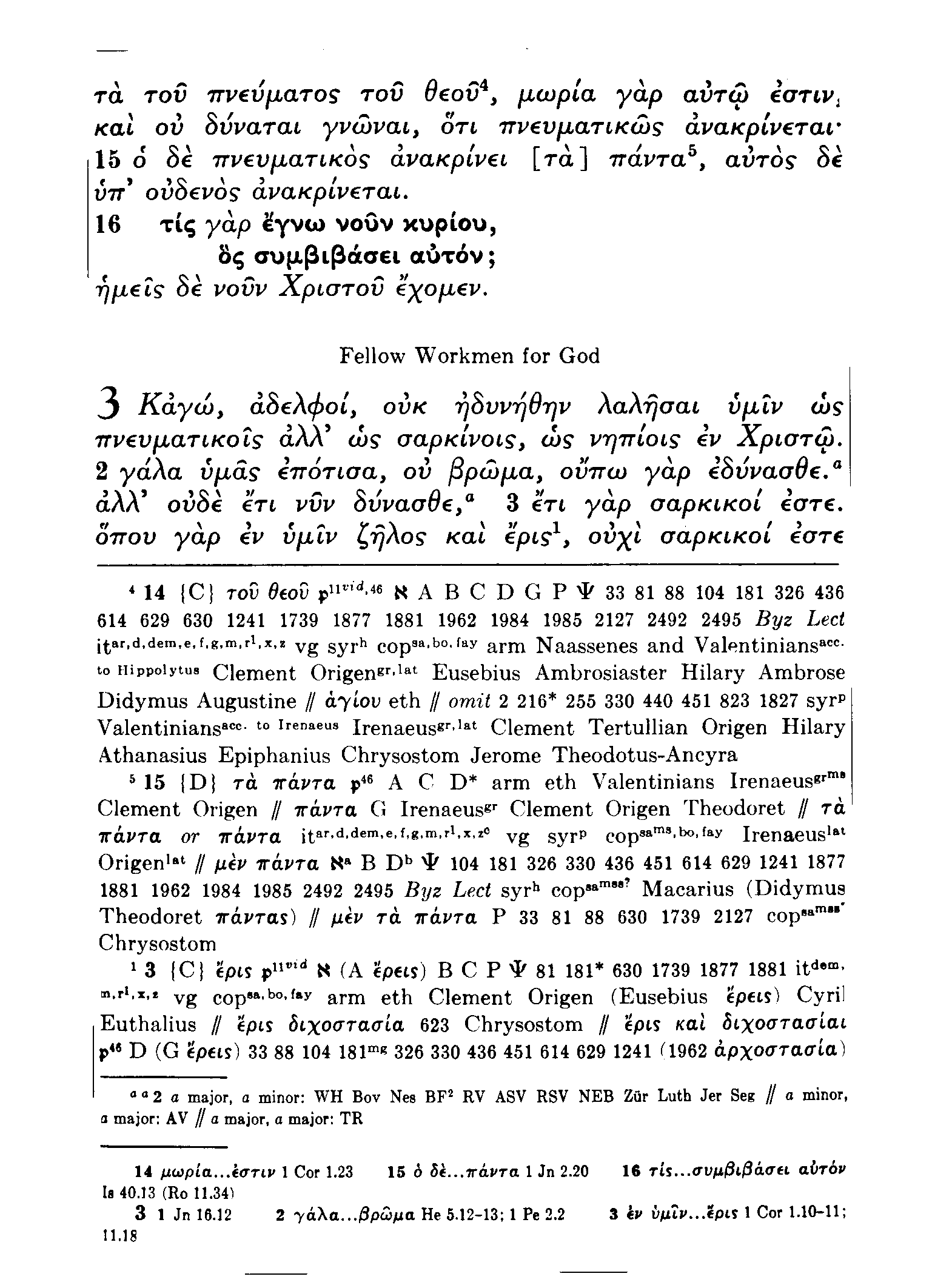

Greek New Testament

The text of the page covers 1 Cor 2:14-3:3. The editors marked three words with superscript numbers 4, 5 and 6; these refer to footnotes. The footnotes describe different readings supported by text witnesses. For example, footnote 4 relates to the passage translated by the NRSV as (1 Cor 2:14): "Those who are unspiritual do not receive the gifts of God's Spirit...". Instead of "God's Spirit" the old Ethiopian translation reads "Holy Spirit", two Greek manuscripts (330, 451) omit "of God" completely. The omission is supported by several Christian and non-Christian writers when they refer to this passage, such as the influential heretic Marcion (2nd century); members of the Gnostic sect of Valentinians (2nd century), according to Irenaeus; one of the first known Christian interpreters of the New Testament, Clement of Alexandria (ca. 200 C.E.); his brilliant student Origen (died ca. 254); Jerome, who translated the Bible into Latin; and others.

The editors of the The Greek New Testament noted three variants they considered to be important. You will find a picture of the same passage from a bilingual manuscript referred to as manuscript "G" in the edition. I counted no less than fourteen minor differences not noted in the edition, nine alternative spellings, three synonyms used, one change of word order and one additional word.

{The page is reproduced from: The Greek New Testament. Edited by K.Aland, M.Black, C.M.Martini, B.M.Metzger, A.Wikgren (Stuttgart: Württemberg. Bibelanstalt, 1966).}

Usually an English translation will not give the reader all the information on the variants of the text. The same was true in ancient times. Only if the scribes were producing a copy for scholarly use would they carefully note variants and give explanatory notes on the margin. But if they were producing a copy for a broad audience, they would try to produce an authentic but understandable text, as free from scribal blunders as possible.

This was the situation of all ancient literature. The letters of Paul were passed on from one generation to another in essentially the same way as, for example, the writings of Aristotle.


Huge Number of Manuscripts

Compared to any other ancient Greek letter collection, however, the letters of Paul survive in an enormous number of manuscripts. The large number of manuscripts provide a large number of variant readings and the result is that there probably is not a single verse of the letters of Paul that has the same wording in all surviving manuscripts. How should we deal with this discouraging situation?


Grouping Manuscripts


Fortunately, the complex manuscript evidence is not as enigmatic as it seems at first sight. The trick is to find a way to reduce the enormous number to a small set of manuscripts to be considered. One way is to group manuscripts into families. This may reduce the number dramatically.

Let me give you an example. A paperback economy edition of the King James Version of the Bible looks a lot different than a deluxe study edition of that same King James Version. Yet, as far as the Bible text is concerned, both can be treated as printed copies of the same manuscript.

The majority of the extant manuscripts of the letters of Paul reproduce the Bible text as it was officially edited, revised, and published by the authorities of the Byzantine Church. I will call these editions the Authorized Byzantine Version.


The Authorized Byzantine Version


More than 85 percent of Greek manuscripts of the New Testament were produced in the eleventh century or later. At this time Christianity was no longer connected to the Greek language as closely as it had been in the second century, when the New Testament came into being. From the third century on, the influence of the Roman church was steadily growing and with it the influence of the Latin translation. During and after the eleventh century, the political situation of the Byzantine Empire became more and more precarious. Wars were fought and often lost, against Islamic tribes in the South and against Bulgarians, Slavs and Russians in the North. In 1054 the Byzantine and the Roman Catholic Church separated. May 29, 1453 the city of Byzantium was finally taken by the Turks and the Byzantine Empire came to an abrupt end. For the Greek manuscript tradition of the Bible during these centuries this means that exemplars were produced, sold, bought, and used within a very limited geographical region controlled by the Byzantine Church. Almost all manuscripts, therefore, reproduce the same Authorized Byzantine Version.

All manuscripts of the Authorized Byzantine Version can be dealt with as one single manuscript. The differences of text are the result of scribal blunders or the varying purposes for which the editions were produced and usually do not convey any knowledge of manuscripts independent of the Authorized Byzantine Version.


Fragmentary Manuscripts


Many manuscripts are not complete. Whole pages or parts of pages are missing. The vast majority of copies older than the sixth century actually provide only small portions of text, some of them being tiny scraps of papyrus containing but a few words. This results in the favorable situation that a large number of text witnesses are useful only for very small portions of the text. And because we look at the letters of Paul as a whole in the following, the number of manuscripts to be considered shrinks further.

To be precise, by now we are talking about no more than eight manuscripts. Besides the Authorized Byzantine Version these eight manuscripts form the essential background for the reconstruction of the original text of the letters of Paul. In the next chapter I will introduce these eight manuscripts to you.


Introduction


There is a good reason to deal with manuscripts of the letters of Paul before you deal with what Paul has to say. Because these manuscripts are all that is left of the letters of Paul. We do not have any letter with Paul's handwriting on it. If, in studying Paul, you want to go as far back in history as possible, the manuscripts of his letters are the oldest objects you can take in your hands and physically touch with your fingers. Any knowledge older than that may be the result of learned reconstruction, but, like all reconstruction, it could be wrong. So it is important to start out at a safe point. The oldest editions of the letters of Paul are a safe starting point for our journey towards Paul.


Notation of Manuscripts


Old manuscripts usually are referred to by the name of the library where they are kept today or the library where they were reported to be found for the first time. This applies to all old manuscripts, not only to manuscripts of the Bible. For example, a manuscript from the Vatican Library in Rome is referred to as a Codex Vaticanus.

The Vatican Library, however, treasures hundreds of New Testament manuscripts, and a reference solely by the name of this library is not precise at all. Therefore scholars began to assign each manuscript a capital letter in addition to the library's name if the manuscript is written in majuscules, very similar to our capital letters, or a number, if the manuscript is written in minuscules, very similar to our cursive handwriting today. For example, the oldest known manuscript of the Christian Bible is called Codex Vaticanus (B). This system was introduced in the middle of the 18th century by the German scholar Johann Jakob Wettstein (1693-1754).

You can easily imagine that this traditional system had trouble to cope with the steadily growing number of majuscule manuscripts that were discovered in libraries and described for the first time during the following centuries. After the Latin alphabet was used up, scholars used Greek and Hebrew letters. But even the most sophisticated alphabet will run out of letters trying to classify the more than 270 majuscule manuscripts known today. Finally a third system was adopted: all the manuscripts were numbered. If the manuscript is written in majuscules, the numbers start out with a zero, for example 03. If it is written in minuscules the manuscript is referred to with a simple number, for example 1739. If the manuscript is written on papyrus, a "p" is put before the number, for example p46.

Although this system of classification is very precise, most New Testament scholars find it easier to remember library names than numbers. And the traditional capital letters are still widely used.

Each time I refer to a manuscript I will give you all three designations, the name of the library, the traditional capital letter, and the numbers designed for scholarly use.

The Oldest Manuscripts of the Christian Bible

Let me now give you a short description of the four oldest extant editions of the Christian Bible, comprising books of the Old Testament and the New Testament as well. After all, the letters of Paul are only one part of the New Testament, and all the New Testament purports to be is the second part of the Christian Bible.

Codex Alexandrinus (A 02)

The first manuscript I want to introduce to you is Codex Alexandrinus (A 02). It was written in the fifth century. Kyrillos Lukaris, Patriarch of Alexandria, gave it as a present to King Charles I of England in 1627-28. Today it is kept in the British Museum in London. This manuscript contains all the letters of Paul. Only a few pages are missing.

Codex Ephraemi Rescriptus (C 04)

The Codex Ephraemi Rescriptus (C 04) also was produced during the fifth century. Originally it covered the whole Old Testament and the New Testament. In the twelfth century the ink was carefully washed off the parchment and someone copied the works of the Syrian church father Ephraem on many of the pages. The other pages are lost. If you look at the manuscript now, all you see are the writings of Ephraem. Ink, however, contains acid, and acid leaves marks on the parchment. With the help of modern technology, such as ultra-violet lighting, it is possible to make these marks visible and to read the original script. This palimpsest, the technical term for a rewritten manuscript, still provides 145 of the original 238 pages of the New Testament. Portions of texts from every book of the New Testament, with the exception of 2 John and 2 Thessalonians, are preserved. No book, however, is complete. The manuscript was brought to France by Catherine de Medici and is now kept at the Bibliothèque Nationale in Paris.

Codex Ephraemi Rescriptus (C 04)

Ephraemp8.tif (289180 bytes)

If you look at the original page all you see are passages from the writings of the Syrian theologian Ephraem, written in cursive handwriting (minuscules) and arranged in two columns. To read this text you would have to turn the page upside down. For this reproduction the Biblical text (end of the Gospel according to Luke) that was written first and washed off was made visible again with the help of modern technologies. It fills only one column and is written in capital letters (majuscules).

{The reproduction is taken from Kurt and Barbara Aland. The Text of the New Testament, 2d ed. (Grand Rapids: Eerdmans, 1989).}

Codex Sinaiticus (À 01)

Codex Sinaiticus (À 01) is the only one of the four manuscripts still containing all the books of the New Testament. It was discovered 1844 in the library of the monastery of St. Catherine at Mount Sinai and brought to Russia in 1869. In 1933 the Russian government sold it to the British Museum, where it is kept today as one of the great treasures of this museum. The manuscript was probably written in the fourth century.

Codex Vaticanus (B 03)

Codex Vaticanus (B 03) was written in the fourth century. Nobody knows where it was produced, but it is recorded as belonging to the Vatican Library in Rome as far back as 1481. 1 Timothy, 2 Timothy, Titus and Philemon are missing from the end of the manuscript.

Each of these four manuscripts was written independently. That is to say, none of these manuscripts is a copy of any of the others.

Number and Sequence of the Letters of Paul

While teaching seminars for theological students at the University of Heidelberg in Germany, I had an interesting experience. Very few of my students were able to tell me outright how many letters of Paul are contained in the New Testament. And out of a group of forty not a single student could give me the right order of the letters. This was all the more surprising in light of the fact that a high percentage of these students read the Bible daily and could recite by heart long passages from the letters of Paul, such as 1 Corinthians 13.

The four oldest manuscripts described above present the letters of Paul following the four Gospels, Acts and the general letters. In all of them the number of the letters of Paul is fourteen. Their sequence is uniform: Romans 1 Corinthians 2 Corinthians Galatians Ephesians Philippians Colossians 1 Thessalonians 2 Thessalonians Hebrews 1 Timothy 2 Timothy Titus and Philemon.

The Four Literary Units of the New Testament

These simple observations may teach us two important lessons. First, there is an apparent difference between the four oldest editions of the New Testament and our modern English editions, in which the letters of Paul do not precede the general letters (James 1 Peter 2 Peter 1 John 2 John 3 John Jude) but follow them.

Let me go into more detail. Many modern readers of the Bible have lost the feeling for the four literary units of the New Testament, and it is one of the goals of this book to get us back into touch with these units. Only very few Greek manuscripts of the letters of Paul - to be precise only 59 out of a number of 779 - contain the whole New Testament. It was difficult to produce large books and very large books became cumbersome and expensive. Most manuscripts, therefore, contain only part of the New Testament. The producers of manuscripts broke the New Testament down into four units. One of these literary units is the collection of the letters of Paul. This means that you will not find an edition of a single letter of Paul in a manuscript.

If you read Paul's letter to the Romans, you will read it among a collection.

What are those four units clearly demonstrated by the manuscript tradition? To put the Four Gospels in one unit and the letters of Paul in another unit is easy, but what about Acts?

Now be ready for a surprise. Acts is always combined with the general letters. There are manuscripts starting out with the letters of Paul followed by Acts and general letters, and there are manuscripts starting out with the Gospels, followed by the letters of Paul, followed by Acts and general letters, and of course there are manuscripts containing Acts and general letters only. But with very rare exceptions to the rule there are no manuscripts combining Gospels and Acts only, or manuscripts of the general letters without Acts. Acts more or less functions as the introduction to the general letters. On second thought, this combination really makes sense, for the main authors of the general letters, James, Peter and John, are the important leaders of the Early Church so vividly described in the first chapters of Acts. In later centuries the editors and revisers of the Authorized Byzantine Version started to move the letters of Paul between Acts and general letters in editions containing the whole New Testament. The reason is not clear, but it has been suggested that this arrangement was more convenient for use in church services. Whatever the reason might have been, it is clear from the older manuscript tradition that Acts and the general letters originally formed a unit.

The Revelation of John forms the fourth literary unit.

 GospelsActs and General Letters Letters of PaulRevelation
Textlength:45,66%19,57%28,21%6,56%

The Letter to the Hebrews

The second lesson the four oldest existing manuscripts of the New Testament teach us is that the letter to the Hebrews is treated as a letter of Paul. It has its place right in the middle of the collection, following 2 Thessalonians and preceding 1 Timothy. Even though the exact place of Hebrews varies in later Greek manuscripts, this letter is always copied as one of the letters of Paul; it is not situated as one of the general letters.

The reason why my German students have such a hard time with identifying the right number and sequence of the letters of Paul is that most of them grew up with the translation made by Martin Luther. Martin Luther, like many learned Christians from the second century onward, did not think that Paul was the author of Hebrews. Translating the text, he rearranged the order of the New Testament letters, moving Hebrews, James and Jude to the end, preceding Rev. This does not represent the order of any extant Greek manuscript.

Most English translations and the bulk of Greek manuscripts from the eighth century on present Hebrews at the end of the letters of Paul, following Philemon. This was the normal sequence of the Authorized Byzantine Version. The first printed edition of the Greek New Testament was prepared by Erasmus of Rotterdam and published in 1516. He used only late Byzantine manuscripts of the twelfth and thirteenth century to produce the text. From this edition the sequence of the letters was passed on to most of the following printed editions and still is the order of today's leading editions of the Greek New Testament, consequently influencing practically all translations of the New Testament. This order, however, does not represent the arrangement of the letters of Paul in the four oldest manuscripts of the Bible.


Manuscripts Containing Only the Letters of Paul

Not all of the manuscripts containing the letters of Paul present the whole New Testament. Actually fewer than eight percent of all known manuscripts do. In most cases the letters of Paul were bound together with Acts and the general letters. And very often they were written in a separate copy containing no other New Testament writings. The following table gives you the exact data.

Number and Contents of Greek Manuscripts of the Letters of Paul.

{ Kurt and Barbara Aland. The Text of the New Testament, 2d ed. (Grand Rapids: Eerdmans, 1989) 91}

ap27134.79%
p21327.34%
eap14919.13%
apr769.76%
eapr597.57%
pr60.77%
ep50.64%
TOTAL779 

e = Gospels a = Acts + general letters p = letters of Paul r = Revelation

Besides the four manuscripts mentioned, there are four others of equal importance for the reconstruction of the original form of the letters of Paul. All four manuscripts contain no other New Testament writings than the letters of Paul. Three of them are related to each other; the fourth one is a papyrus book, the oldest known edition of the letters of Paul.

Codex Boernerianus (G 012)

Codex Boernerianus (G 012) is a bilingual edition and very probably was produced in the monastery of St. Gallen, Switzerland, during the second half of the ninth century. The Latin translation of the Greek text was written between the lines by an Irish monk. It is kept today at the Sächsische Landesbibliothek in Dresden, Germany.

Codex Boernerianus (G 012).


Boernerianusp14.tif (323190 bytes)

The text (1 Cor 2:14-3:3) matches exactly the passage given from the printed edition of The Greek New Testament a few pages ago. Capital letters structure the text and divide it into passages of comparable length, so-called stichoi. Many manuscripts still note the number of stichoi at the end of each book, because the length was important to scribes, booksellers and bookbuyers alike to calculate the price. The marks placed in the left margin indicate a quotation from the Old Testament and a Latin note identifies it as taken from the book of Isaiah. The Latin text follows the Greek word by word and is usually taken from the Vulgate, the most popular translation, but occasionally two alternative Latin renderings for the same Greek word are given. Because the scribe evidently had no other Greek manuscript available beside the one he copied, it could very well be that this bilingual manuscript was to be used for teaching Greek to Latin-speaking monks. At the bottom of the page the scribe, evidently an Irishman, added several lines of Irish, starting with the words "To come to Rome, to come to Rome, much of trouble, little of profit..." documenting the medieval rivalry between the Irish monks who were to be the first missionaries to central Europe and the authorities of the Catholic Church in Rome.

{The reproduction is taken from Bruce M. Metzger, Manuscripts of the Greek Bible: An Introduction to Greek Palaeography. (New York, Oxford: Oxford University Press: 1981), 105 (plate 28).}


Codex Augiensis (F 010)

Codex Augiensis (F 010) very probably was written in the monastery of Reichenau, situated on the island of Reichenau in Lake Constance, Germany. Like Codex Boernerianus, it is a bilingual manuscript, but gives the Latin translation on the opposite page, corresponding line by line. It is now kept in Trinity College in Cambridge, England.

In both manuscripts, five passages are missing in the Greek text. The scribes left some room there to fill in the text later, but never closed the blank space. Apparently some pages were missing in the manuscript they copied and no other Greek edition was available to them. Numerous differences between these two manuscripts can easily be explained by assuming that the exemplar they copied had notes added to the text, and that these notes were sometimes interpreted in a different way by the two scribes. Therefore, neither one is a copy of the other manuscript. They were produced independently, but from the same exemplar.

What makes Codex Boernerianus and Codex Augiensis so important? In both, the letter to the Hebrews is missing completely. The remaining thirteen letters are given in the usual order: Romans 1 Corinthians 2 Corinthians Galatians Ephesians Philippians Colossians 1 Thessalonians 2 Thessalonians 1 Timothy 2 Timothy Titus Philemon.

Codex Claromontanus (D 06)

Codex Claromontanus (D 06), from the fifth or sixth century is somehow related to these two manuscripts. This too is a bilingual manuscript giving the Latin translation on the opposite page. Because of numerous distinct text-variants, which this manuscript shares uniquely with Codex Augiensis and Codex Boernerianus, their close relationship is evident.

The sequence of the letters is: Romans 1 Corinthians 2 Corinthians Galatians Ephesians Colossians Philippians 1 Thessalonians 2 Thessalonians 1 Timothy 2 Timothy Titus Philemon. No satisfactory explanation has yet been given for the unusual order of Colossians and Philippians. Originally three pages were left blank after Philemon, but later a Latin list of Canonical books was copied there, the so-called Catalogus Claromontanus. Following this list the manuscript contains Hebrews. The evidence therefore suggests that Hebrews was not part of the manuscript that was copied to produce the Codex Claromontanus, but that Hebrews was added later.

Papyrus 46

The oldest manuscript of the letters of Paul usually is referred to as papyrus 46, abbreviated p46. Judging from the handwriting used in this manuscript, it is dated around the year 200 and was produced in Egypt. The University of Michigan in Ann Arbor acquired parts of this manuscript, but most pages belong to the Chester Beatty collection in Dublin, Ireland.

This manuscript is not only the oldest extant edition of the letters of Paul but it is at the same time one of the oldest manuscripts in book form known to exist. Up until the fourth century CE literature was copied almost exclusively on scrolls. There is some mystery about the origin of the codex, the Latin term for book in contrast to the scroll. Somehow the public use of the codex is closely connected to the formation of the New Testament. The Christians were apparently the first ones to depart from the scroll and to use the bookform as a medium.

This codex of the letters of Paul was made out of one single quire. That is to say, 52 papyrus leaves were put on top of each other and then folded in the middle; thus forming 104 leaves holding 208 pages of text.

If a codex is made out of one quire, the scribe must carefully calculate how much text the book will have to hold before he starts to write. Once he is past the middle page there is no way to correct a mistake, for any sheet of papyrus added at the end of the codex will give an empty first page.

You can imagine how difficult the calculation was. Consider, for example, the problem of the inner leaves. When you fold a heap of paper in the middle, the inner leaves will stick out and you will want to cut them so the book looks nicer. This is what was done to p46 before the scribe started writing. Now if you do that you should be aware that the inner pages are smaller than the outer ones and hold less text.

For some reason, the scribe of p46 made a mistake when he calculated the amount of paper he needed. After he had filled more than half of the book, he realized there would not be enough room for all the text he planned to copy. He started to write more characters in each line and gradually increased the 26 lines per page in the first half of the codex to 28, then to 30 and in the end to 32 lines per page.

Although the manuscript is in fairly good condition, the outer pages did not survive. The text starts with Rom 5:17, then runs through Hebrews 1 Corinthians 2 Corinthians Ephesians Galatians Philippians Colossians and ends in 1 Thess 5:28. Because many pages still provide their original page numbers it is easy to see that the seven missing outer leaves holding 14 pages of text at the beginning left room for 14 corresponding pages at the end. There is no way to get the rest of 1 Thessalonians, 2 Thessalonians, 1 Timothy, 2 Timothy, Titus and Philemon on 14 pages of the size used by p46. A fair estimate lies somewhere close to 23 more pages necessary to hold all of the expected text. What the scribe decided to do, we do not know.

It is not necessary to assume that some of the missing letters were unknown to the scribe, although it could of course be possible. But the scribe evidently had difficulties with the length of the text. Two fragments of papyri codices contemporary to p46 have been found in the sands of Egypt, one of them, p32, preserving text from Titus, the other, p87, with text from Philemon, thus proving that these letters were known at the time and in the region, where p46 was produced.

What caused the unusual sequence of letters? Why is Hebrews put between Romans and 1 Corinthians and why does Ephesians precede Galatians?

I think the solution is very simple. It was crucial to a scribe properly to calculate the length of the text before he started to write a codex consisting of a single quire. Facing this situation it probably is a good idea to arrange the different parts according to the length of the text before you start to copy the text. For if you start out with the longest letters and end with the shorter ones, the chances are good you can finish the codex with the end of a letter even if your calculation was wrong. In this case all the scribe would need to do is produce an extra volume out of some additional leaves holding the missing letters. But if you start out with the short letters and end with the long ones the chances are much higher that you are right in the middle of a letter when you hit the last page. And who would want to use a book that ends in the middle of the text?

So let us have a look at the length of the letters. Which is the longest, which the shortest?
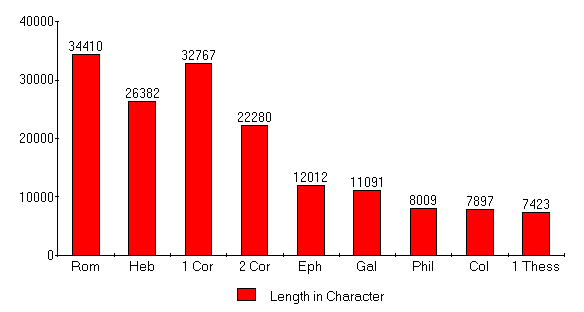
Ephesians is longer than Galatians. Hebrews is shorter than 1 Corinthians but longer than 2 Corinthians. Nobody would want to separate the two letters to the Corinthians. An easy solution is to let Hebrews stand before 1 Corinthians. And that is exactly the sequence of letters in p46. So the producers of p46 arranged the letters of Paul strictly according to their length: Romans Hebrews 1 Corinthians 2 Corinthians Ephesians Galatians Philippians Colossians 1 Thessalonians.


Introduction


I was born in Africa. My parents were missionaries. My grandparents were missionaries. So it seemed very natural to me to view Paul as a kind of David Livingstone of antiquity.

I grew up with a picture of Paul traveling through Asia and Europe, founding congregations, counseling and teaching the men and women who had given their life to Jesus. If he could not visit them, he sent letters. When Paul died, his letters were kept as treasures. Each church that had received one of his letters saved it, had it read during worship services, and exchanged copies of the letter with other congregations close by. Later the congregations tried to complete their collection.

But this view does not match the uniformity of manuscript evidence.

I will have to explain this more closely. Today, before a book is published, the author presents a manuscript to the publisher. The publisher very often will suggest changes and will have the manuscript edited by professional editors. After author and publisher agreed on the final version, one single manuscript only is forwarded to the printer. This manuscript becomes the ancestor of the whole edition or, in other words, this manuscript is the archetype of the text tradition.

The view I grew up with does not suggest that there was any archetype of the letters of Paul. There were several collections and different editors combined these collections at different places until all known letters were included.

Now there is a way to find out whether a text tradition goes back to a single archetype or not. All you have to look for are editorial changes made while editing the final version of the manuscript, changes not made by the author. For example if Paul did not collect and publish his letters himself, someone else must have added the titles of the letters and someone else must have arranged them. It is this final editorial touch that defines the archetype. The next step is to concentrate on elements of this final editing that are unusual and very probably would not be made by two independent editors. If all copies of the text show these peculiar editorial changes, they all derive from the same archetype.

Principle of Arrangement

What would an editor do, if he or she had to order the correspondence of another person? Chances are, an editor would try to arrange letters in a chronological order. That is what most editors nowadays do when they prepare letters for publication. And that is what editors tried in the days of Paul as well. But what do you do if the letters have no date?

Chronological Order?

The letters of Paul are not dated. New Testament scholars have tried down through the years, but a generally accepted chronological order of the fourteen letters has not yet been established.

For example: You can find arguments that First Thessalonians was written during Paul's first missionary journey to Macedonia, thus making it the oldest recorded letter of Paul. Others place it during his last trip, making 1 Thessalonians one of his last letters, and their arguments are plausible. In his letter to the Philippians (Phil 1:13) Paul clearly states that he is in prison when he writes. But scholars could not agree up to this day whether he was in prison in Ephesus, Cesarea, Rome, or even some other place, and they consequently dated this letter very differently. The letters of Paul do not give enough information.

Nevertheless, two letters, 1 Corinthians and Romans give us almost certainly clues to establish their relative chronological order.

1 Cor 16:1-4 (NIV)

Now about the collection for God's people: Do what I told the Galatian churches to do. On the first day of every week, each one of you should set aside a sum of money in keeping with his income, saving it up, so that when I come no collections will have to be made. Then, when I arrive, I will give letters of introduction to the men you approve and send them with your gift to Jerusalem. If it seems advisable for me to go also, they will accompany me.

Rom 15:25-26 (NIV)

Now, however, I am on my way to Jerusalem in the service of the saints there. For Macedonia and Achaia were pleased to make a contribution for the poor among the saints in Jerusalem.

In 1 Corinthians Paul has not yet decided whether he will travel to Jerusalem or

not. When Paul writes to the Romans his mind is made up. He plans to make the trip. By

speaking of Achaia in Rom 15:26 Paul makes a clear reference to the addressees

of 1 Corinthians and 2 Corinthians, because Corinth (1 Cor 1:2) is the

capital city of the province called Achaia, and 2Cor is explicitly addressed to "all

the saints throughout Achaia" (2 Cor 1:1) as well.

Putting the information of these two passages together gives us the impression that

Paul has just visited or is still visiting Corinth when he writes to the Romans. His

fundraising campaign in Achaia seems completed, and he is determined to bring the gift to

Jerusalem himself. This suggests that Romans was written after 1 Corinthians.

Let us have a look at the manuscripts. Romans precedes 1 Corinthians in all

manuscripts. Obviously the letters are not presented in the chronological order.

Independent arrangements?

If the view I grew up with was right, that Christian congregations started out with

some letters and gradually tried to complete their collection of Paul's letters

independently from each other, then each editor of the collection would face the problem

of arranging the letters. And how likely is it that each one came up with exactly the same

arrangement as is given in the New Testament?

Uniform Sequences

The reason I think this would be very improbable is that the principle behind the

arrangement of the letters of Paul in the canonical edition is highly unusual. Let us have

a look at the manuscripts again. The sequence of the letters is very much alike in the

manuscripts I described above. The following table gives an overview.


1. Rom 1 Cor 2 Cor Gal Eph Phil Col 1 Thess 2 Thess Heb 1 Tim 2 Tim Titus Phlm
2. Rom 1 Cor 2 Cor Gal Eph Phil Col 1 Thess 2 Thess 1 Tim 2 Tim Titus Phlm
3. Rom 1 Cor 2 Cor Gal Eph Phil Col 1 Thess 2 Thess 1 Tim 2 Tim Titus Phlm Heb
4. Rom 1 Cor 2 Cor Gal Eph Col Phil 1 Thess 2 Thess 1 Tim 2 Tim Titus Phlm Heb
5. Rom Heb 1 Cor 2 Cor Eph Gal Col Phil 1Thess

1 = Sinaiticus (À 01), Alexandrinus (A 02), Vaticanus (B 03), Ephraemi Rescriptus (C 04)
2 = Boernerianus (G 012), Augiensis (F 010)
3 = Authorized Byzantine Version
4 = Claromontanus 5 = p46

In the first three sequences only the place of Hebrews differs. This can easily be explained by assuming that a collection without Hebrews existed and Hebrews was added to this collection independently at two different places.

This process of adding Hebrews to a collection of thirteen letters is documented, as we have seen, by the Codex Claromontanus, where Hebrews is added later, following three pages originally left blank. This codex has the sequence Philippians Colossians reversed. I consider this a minor variant.

In p46 the letters are arranged strictly according to the length of text as I demonstrated above.

Other Manuscripts

But what about the other manuscripts? Do they all have the same sequence for the letters of Paul?

I dedicated two years of my doctoral studies to finding an answer to this question. I checked all reports of unusual sequences that I could find, including existing manuscripts, reconstructed ancestors of extant manuscripts, old commentaries, citations by ancient Christian writers, the oldest translations, the lists of canonical writings issued by the Old Church and the very first references to the letters of Paul in Christian literature. As far as I know, this is the most comprehensive survey of this question ever made. {David Trobisch, Die Entstehung der Paulusbriefsammlung: Studien zu den Anfängen christlicher Publizistik (NTOA 10; Freiburg/Schweiz: Universitätsverlag; Göttingen: Vandenhoeck, 1989).}

I could only find three more sequences.

One of them has the same order as Codex Claromontanus, reversing the order of Colossians and Philippians. The manuscript, usually referred to as minuscule 5, is now kept at the Bibliothèque Nationale in Paris. It was written in the fourteenth century and contains the letters in the following order: Romans 1 Corinthians 2 Corinthians Galatians Ephesians Colossians Philippians 1 Thessalonians 2 Thessalonians Hebrews 1 Timothy 2 Timothy Titus Philemon. On the top margin of the page where Ephesians ends and the text of Colossians begins, a comment was added that seems to me to be written by the same hand as the manuscript, saying that the expected Philippians is to be found after Colossians. Thus the scribe was well aware of the unusual order and still he did not change it. So the scribe probably reproduced the order of an older exemplar he copied.

6.Rom 1 Cor 2 Cor Gal Eph Col Phil 1 Thess 2 Thess Heb 1 Tim 2 Tim Titus Phlm
7.Rom 1 Cor 2 Cor Gal Heb Eph Phil Col 1 Thess 2 Thess ...
8.Rom 1 Cor 2 Cor Gal Eph Phil Col 1 Thess 2 Thess Heb 1 Tim 2 Tim Titus Phlm Heb

6. Min. 5 7. Chapters in Vaticanus (B 03) 8. Min. 794

The other sequence is preserved in the described Codex Vaticanus (B 03), where the text of the letters of Paul is divided into numbered chapters. These numbers do not fit the sequence of the letters as it is now presented in the manuscript. The numbers start with Romans and run consecutively through 1 Corinthians 2 Corinthians and Galatians. At the end of Galatians the number of the next expected chapter is 59 but Ephesians starts out with chapter 70 and goes on correctly through 2 Thessalonians. Hebrews following 2 Thessalonians then starts out with chapter 59. This makes it obvious that in the manuscript where the division into chapters was made Hebrews was to be found between Galatians and Ephesians.

The third sequence is even less significant. The manuscript referred to as minuscule 794 provides the letters of Paul in the usual order with Hebrews between 2 Thessalonians and 1 Timothy. A second scribe added Hebrews after Philemon so this manuscript today contains Hebrews twice. This probably happened by mistake.

Interpretation

I think the reverse order of Philippians Colossians in minuscule 5 and Codex Claromontanus is to be considered as a minor variant.

In all the other arrangements (except p46) only the place of Hebrews differs. And this, too, can easily be explained by the assumption that Hebrews was added later to a collection of thirteen letters of Paul. This thirteen-letter collection is still extant in Codex Boernerianus (G 012) and Codex Augiensis (F 010).

Two further observations confirm that Hebrews was added later: The uniform number of thirteen letters in the manuscripts and the titles of the letters.

Uniform Number of Letters

There is no manuscript evidence to prove that the letters of Paul ever existed in an edition containing only some of the thirteen letters. The last pages of a codex are very often lacking. The outer pages of every book are easily exposed to mutilation once the cover gets lost. To conclude from the missing end of p46 or Codex Vaticanus (B 03) that some letters following 2 Thessalonians were not known to the scribes who produced these manuscripts seems unwise.

To hold on to the view of an independent grouping of the letters of Paul at different Christian congregations, it is necessary to assume that the collectors not only ordered the letters the same way but that each one of them had access to exactly the same number of thirteen letters, no less and no more.

Uniform Titles

The other observation regards the titles of the letters. I think you will agree that Paul did not formulate the titles we read in the New Testament when he first wrote the letters. If you write a letter you do not need a title. But if you collect several letters and present them to a broader audience you have to come up with some kind of name for the letters. The function of these titles is to show where one letter ends and the next one starts, and to make it easier to refer to them.

All the manuscripts have the same titles for the letters. They name the addressee of the letter; a literal translation from the Greek is "To Romans, To Corinthians Number One, To Corinthians Number Two, To Galatians, To Ephesians," and so forth.

This is especially noteworthy concerning the letter to the Ephesians. The three oldest manuscripts, p46, Codex Vaticanus (B 03), and Codex Sinaiticus (À 01) do not have any address in Eph 1:1, the only place where the Ephesian church is mentioned in this letter. But these manuscripts do provide the title "To the Ephesians". You do not have to be an expert to realize that scribes could easily take the address from the title and fill it in the text where they would expect it. This actually happened in Codex Vaticanus (B 03) and Codex Sinaiticus (À 01), the later correction is still evident in these two manuscripts. But you might find it hard to think of a reasonable explanation why a scribe should have deleted the address from the text and leave it in the title. So it is pretty clear that the oldest text of Ephesians did not have an address in the text. How then could anyone figure out the title? No two independent editors could come up with the same name.

Eph 1:1 in Codex Sinaiticus:
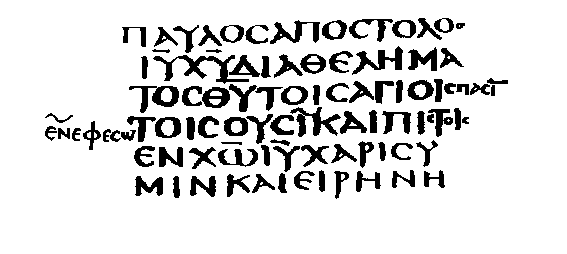
A critical mark is put between the lines (~). This mark is repeated in the margin indicating that the Greek words EN EF ECw (in Ephesus) should be added here. The Ephesian address obviously was not part of the original text of the codex but was added by a corrector.

{The page of Codex Sinaiticus (À 01) is in a condition that makes it difficult to produce a good photograph. To demonstrate the evidence the photo of the page containing Gal 5:20 - Eph 1:9 given in H.J.Vogels (Codicum Novi Testamenti Specimina. Bonn: Haustein, 1929, 4) was scanned and then retouched with the help of a computer.}

Summary


Let me sum up the two points I wanted to make so far. First, the complete manuscript evidence can be interpreted to testify to an edition of thirteen letters of Paul with the order Romans 1 Corinthians 2 Corinthians Galatians Ephesians Philippians Colossians 1 Thessalonians 2 Thessalonians 1 Timothy 2 Timothy Titus Philemon. Second, it is very unlikely that two editors would arrange the letters of Paul in this way independently of each other.

These two assumptions lead me to conclude that the canonical edition of the fourteen letters of Paul as it is presented in the New Testament today goes back to one single copy of thirteen letters of Paul, and that only the letter to the Hebrews was added at a later stage of the text-tradition.

Let us have a closer look at the canonical edition of the fourteen letters of Paul. The titles of the letters reveal two more interesting insights. They suggest an overall title of the edition, and they indicate the principle of arrangement of the edition.

Overall Title of the Edition

If a letter collection had letters written by more than one author you would probably refer to the single letter by the author's name. But if all the letters of the collection are written by the same person, as the letters of Paul purport to be, there is no need to repeat the author's name in each title. Using the address to distinguish them from each other seems a good idea.

On the other hand, if you have a letter collection in which the letters are named by their address, like the letters of Paul, you can safely conclude that they all were written by the same author. The author's name, however, becomes automatically the title of the whole collection.

Therefore the titles To Romans, To Corinthians and so on clearly suggest that the complete title is Paul's letter to Romans, or Paul's First letter to Corinthians, and that the overall title of the collection runs: Letters of Paul.

The oldest manuscripts, however, do not provide this overall title. Nevertheless, this letter collection is called The fourteen letters of Paul in many lists of the Canonical writings and in most manuscripts of the Authorized Byzantine Version.

So the name of the book is letters of Paul, and the chapters received their titles from the names of the addressees of these letters.

Principle of Arrangement

The second insight the titles reveal is that the letters were arranged according to their addressees. Obviously, the letters with the same address are put together: the two letters to the Corinthians, the two letters to the Thessalonians, and the two letters to Timothy.

Furthermore the nine letters that are addressed to congregations are grouped together, forming the first and longest part of the book ranging from Romans to 2 Thessalonians.

This part is followed by the four letters which are, at least according to their titles, addressed to individuals: the two letters to Timothy, the letter to Titus, and the letter to Philemon.

Letter to Philemon

It is worth noting that the letter to Philemon actually is addressed "to Philemon our dear friend and fellow worker, to Apphia our sister, to Archippus our fellow soldier and to the church that meets in your home" (Phlm 1-2). As far as this address is concerned, it would be possible to arrange Philemon among the letters to congregations. On the other hand, Paul writes to only one individual in the following text, so it makes perfect sense to give the letter the name of the first person mentioned and to put it together with 1 Timothy, 2 Timothy and Titus. There again a tight connection between title and sequence of letters is established.

Letter to the Hebrews

Before I close this chapter, let us have a look at the letter to the Hebrews again. The codices Sinaiticus (À 01), Alexandrinus (A 02), Vaticanus (B 03) and Ephraemi Rescriptus (C 04) place Hebrews after 2 Thessalonians. Because the letter is not addressed to an individual but to a group, `the Hebrews', it was added as the last one of Paul's letters to congregations. The Authorized Byzantine Version places it at the end of the collection, following Philemon. The codices Boernerianus and Augiensis do not have Hebrews at all. The different places in which Hebrews was inserted in the letters of Paul clearly indicate that at some time the collection consisted only of thirteen letters. Hebrews was lacking.

The title of Hebrews has the same wording in all extant manuscripts. This is especially noteworthy because the text itself does not suggest this title with a single word. It is very unlikely that any two editors independently from each other would think of this name.

On the other hand, the title gives only the address; it does not give the name of the author of the letter. This implies that the reader knows the author. But how should he know? And still, the reader of the canonical edition of the letters of Paul had good reason to assume that he was reading a letter of Paul. Why?

To answer this question it is instructive to have a look at the general letters. A letter of Paul can easily be distinguished from any other New Testament letter.

Let us pause for a moment. This is a very important observation. If you look at the New Testament as a whole, the titles of the letters are designed to group them into two collection: The letters of Paul are named according to their addressees; the titles of the general letters give the name of their authors, James, Peter, John, and Jude.

As I have shown above, to name a letter by its addressee makes sense if the letter is part of a collection of letters written by one author. Therefore the reader of the canonical edition will readily assume that he is reading a letter of Paul when he encounters the title "To the Hebrews". And actually the only place Hebrews is found in the extant manuscripts is among the letters of Paul.

The uniformity of the title clearly demonstrates that all manuscripts of Hebrews go back to a single exemplar. In this exemplar Hebrews was already part of a collection of the letters of Paul.

It is time for a rest and a good opportunity for a résumé of our journey so far. We covered 1800 years back into history looking at the oldest, handwritten editions of the letters of Paul. The oldest manuscripts we investigated dates from the end of the second century.

Let me sum up the major insights. Of the 779 manuscripts of the letters of Paul known today, not all are of the same importance. After grouping manuscripts and excluding witnesses with only small portions of text, only eight manuscripts and the Authorized Byzantine Version form the essential base for the reconstruction of the original text.

Looking at these editions we learned that the manuscripts split the New Testament into four parts: the Gospels, the letters of Paul, Acts and general letters, and Revelation. Furthermore, the uniform titles, sequence, and number of letters in the manuscripts indicate that the canonical edition of the letters of Paul derives from one single archetype. Although the letter to the Hebrews was added to the collection later it always is part of the letters of Paul.

From the simple observation that the letters are named by their addressees, we learned that the overall title of the canonical edition is "Letters of Paul". The letters were arranged according to their addressees. The letters to congregations form one group (Romans 1 Corinthians 2 Corinthians Galatians Ephesians Philippians Colossians 1 Thessalonians 2 Thessalonians Hebrews); the letters to individuals form the second group (1 Timothy 2 Timothy Titus Philemon) of the collection. Letters with identical addressees are placed adjacent to each other (1 Corinthians 2 Corinthians; 1 Thessalonians 2 Thessalonians; 1 Timothy 2 Timothy).

Now that we have a picture of the text tradition of the letters of Paul, it is time to investigate peculiarities of the text itself. There are puzzling observations to make, we will encounter riddles that have not yet been solved, and we will discuss competing theories of interpretation that try to shed some light on the mysteries of the text. But, after all, we will not be able to solve all the difficulties. It is the privilege of any ancient text to keep some of its secrets to itself, and it is a matter of honor to respect that. Nevertheless, I am confident that you will enjoy this part of our journey. So let us have a look at some of the characteristic features of the letters of Paul.

{The previous text is a slightly edited version of the first chapter of Paul's Letter Collection: Tracing the Origins (Fortress Press: Minneapolis, 1994) by David Trobisch.}

Sharing a Vague Vision: Wieman’s Early Critique of Whitehead

In 1927, Henry Nelson Wieman began nearly 20 years of teaching at the University of Chicago Divinity School, commissioned, in part, to interpret the thought of Alfred North Whitehead for his colleagues and students. Bernard Meland, a member of Wieman’s first class on the philosophy of religion there, recalls that Wieman used only two texts for the course: Part IV of William Hocking’s The Meaning of God in Human Experience, and Whitehead’s Religion in the Making. Of these texts, Meland remarked that, "We studied them the way fundamentalists study the scriptures" (BEM). Because of this historical connection and because of his continued emphasis on the process of creativity, Wieman has often been grouped with the school of process philosophy and theology, and especially with Whitehead. While Wieman was certainly a process thinker in the broad sense, his use of the key terms "process" and "creativity" was often very different from Whitehead’s. And Wieman eventually expressed sharp criticism of Whitehead’s philosophy.

The central focus of this study is to trace the development of four major strands in Wieman’s thought, which should both clarify his relationship to the philosophy of Whitehead and illuminate the growth of his own thought.

This task is complicated by what Meland calls the "maverick" character of Wieman’s thought. Indeed, Meland adds, "Wieman’s thought was just one transition after another." But this is not to derogate Wieman. He was an experimenter who listened to those about him, both colleagues and students, with interest in and openness to new ideas and modes of expression. He was not afraid to grab hold of a phrase or concept and explore it in an article or even a chapter of a book and then, finding it wanting, drop it without further comment. Those ideas which survived this constant sorting process might take radically different forms from book to book. And running through much of this are his periodic re-evaluations of Whitehead.

Four Themes

Despite his wanderings, there is also a remarkable persistence in Wieman’s thought. I see at least four major strands running through his work which can be traced and which can help to clarify his understanding of, attraction to, and eventual disenchantment with Whitehead. They are:

1. A theory of Supreme Value which, despite many changes in formulation, can always be understood (whether or not Wieman himself said so explicitly) in aesthetic terms;

2. Correlative to his value theory, a definition of God as that Something which is supremely important to the increase of quality or value in human existence (although he wavered in his use of the designation "God" for that Something);1

3. The conviction that this Something is subject to scientific examination in the broad sense of empirical observation and rational reflection, and that we must not go beyond the empirical evidence in describing its nature;

4. The determination that our concept of God be a "workable" one, which persons can "adjust to" and assist through practical, concrete activity.

While few texts clearly discuss all four of these concerns, it does seem best to trace these strands chronologically.

Preview of Conclusions

Given the complexities and occasional inconsistencies in the development of Wieman’s thought and his critique of Whitehead, the following analysis will be easier to follow if the general conclusions are outlined in advance.

The most basic and consistent theme in Wieman’s thought is the quest to understand and describe the nature and source of supreme value in a way that will enable humans to experience the greatest increase of value. A central element in this quest was the insistence that it be empirically grounded. Wieman was always sensitive to the lack of precision inherent in any exploration of the breadth and depth of religious experience. Nevertheless, he never ceased to oppose any interpretation of God or the creative process which moved beyond the range of empirical and rational investigation. If something is not subject to such investigation, Wieman argued, then it must be outside the world of events relevant to our experience, and hence cannot possibly be the source of value which we seek.

Changes in Wieman’s own constructive thought and in his critique of White-head revolve around these central affirmations. Early in his career, Wieman was interested in creativity, or the source of supreme value, as a cosmic process. Consequently, he was willing to lean toward the speculative side of empirical philosophy. During this stage he was very attracted to Whitehead, who was then groping for just such a universal vision of reality and value. As an empiricist, Wieman felt comfortable with Whitehead’s explicit effort to develop a metaphysics which was informed by, and informing of, the modern sciences. As a value theorist, Wieman was attracted to Whitehead’s discussion of the process by which all value becomes actual.

Whitehead continued to sharpen his metaphysical vision, especially in Process and Reality. That additional specificity required that Whitehead be more speculative. Especially, Wieman believed Whitehead’s vision of the concrete nature of God was interpretive in ways which moved beyond the range of empirical verification. From Wieman’s point of view, I think, this doctrine not only lacked empirical justification, it also tended to move the source of human good further away from the range of human action.

While Whitehead was becoming more speculative and cosmological, Wieman was moving in the opposite direction. He was becoming more restrictive in his empiricism and less interested in cosmic processes. He was also focusing his concern more on specifically human experiences of creativity. Although Wieman never denied the relevance of larger cosmic processes to the human predicament, he became less interested in them and more suspicious of speculation. So despite the closeness of their common interests at some points, it can readily be seen why Wieman gradually moved away from Whitehead, while retaining an appreciation for Whitehead’s contribution to his thought.

The Beginnings The Organization of Interests, 1917

Two sources are especially informative for Wieman’s early period -- his dissertation in philosophy at Harvard, The Organization of Interests, and an article in the Journal of Philosophy, Psychology and Scientific Methods of September, 1917, titled "A Criticism of Coordination as a Criterion of Moral Value." Together, these provide an important picture of the origins of much that will follow.

It seems most appropriate to begin with the thesis.

Our problem will be to discover that organization of human interests which is most conducive to their maximum fulfillment. The object of our desire is the greatest good. The principle of organization, which we propose, we shall call creativity. Our thesis is that all interests should be so organized as to function as one; and that one should be a creative interest. Interest which is directed to developing a fuller consciousness of some object, and not for any ulterior end, is what we shall call creative interest. It is creative of integrated experience. We believe that the organization which causes all the processes constitutive of human life to function in satisfying creative interest, is the organization of life which yields the most complete and continuous satisfaction. (OI 3)

Note the centrality of creativity, the analysis of human life in terms of processes, and especially the beginnings of an aesthetic theory of value.

Beauty was the central value category for Whitehead, because in his vision reality is constituted by drops of experience which must integrate complex data (feelings) into a unity with both harmony and contrasts. The published texts do not indicate that Wieman was explicitly working with an aesthetic ideal in mind at the start of his career. But I think they do suggest that he was moving in that direction. The "thesis...that all interests should be organized as to function as one," so as to be "creative of integrated experience," while "sustaining and increasing the number of different elements or aspects of the world which enter into consciousness," seems to adumbrate a vision of aesthetic organization of value experience (OI 3, 15).

What might qualify any claim as to the aesthetic character of Wieman’s model was his concern to distinguish "organization" from "coordination," coupled with his specification that "Coordination means harmony, but . . .organization does not" (JPPS14:539). Wieman challenged the theory of coordination’s claim that "all conflict is evil because it means that two or more interests are preventing each other from that full measure of satisfaction which each would enjoy if they were delivered from this condition of mutual frustration" (JPPS 14:534). Wieman offered the obvious refutation that such conflict is not only inherent in existence, but at times desirable. In his dissertation a specific example of this appeared that was central to his theory of interests: conflict intensifies consciousness, the source of interests.

Primary consciousness consists of perceptions; secondary of the phenomena of reflection, of memory, of conception, of desires, fears, hopes, affections. . . . The development of secondary consciousness is the development of self-consciousness. Its growth is what we mean by creativity. (OI 8)

What tended to blur the aesthetic consciousness in Wieman’s approach was not just the denunciation of harmony, but also the emphasis on conflict that results from this concern for the growth of self-consciousness. Wieman believed that "It is the antagonism of other minds which more than anything else, stimulates the processes of secondary consciousness" (OI 8). He went so far as to claim that "Coordination has no value for creative interest except as it enters in to magnify the conflicts of systems, and thereby make consciousness more vivid and complicated" (OI 15).

This failure to express clearly the need for balance between harmony and conflict need not be taken as an indication of serious deficiency of insight on Wieman’s part, for he acknowledged (though almost grudgingly) that "creative interest is fulfilled in reducing uncoordinated interests to a coordinated system, provided these systems can be applied to a wider range and complexity of antagonistic responses" (OI 15). There is, in fact, an embryonic suggestion of Whitehead’s concept of peace as it appears in Adventure of Ideas, combined with what could just as well be termed, with Whitehead, "harmony and intensity of feeling." Wieman writes:

So we reach the conclusion that discord of interests is a value because it is the sole condition which satisfies one of the inalienable interests of human nature, namely, the interest in creativity. Whether the mutual thwarting of impulses does, or does not, have values depends on whether there exists in the individual this state of mind, this onward-pressing consciousness, which seeks that satisfaction found in the forming of new combinations and the consequent growth in the range and vividness of consciousness. For such a mind all experience would have positive value, the conflicts as well as the harmonies, just so far as all experience is integrated in the growth of an expanding consciousness. Hence, the supreme moral achievement would be the establishment of such a state of mind. . . . (JPPSI4:539)

We should also note that even then Wieman sought to restrict his efforts to a workable arena, while acknowledging that the problem itself is not so limited.

We cannot for several reasons make a distinct study of that natural environment which would be most favorable to satisfaction of human needs. Such a study would lead us too far afield. The significance of climate, rivers, soil, seaboard, mountains, etc., it [sic] is no doubt very great, as well as the wider cosmic processes. But every field of investigation must be more or less arbitrarily limited. So we shall restrict ourselves to activities most conducive to satisfaction. . . . (OI 5)

It is not simply the explicit decision to limit the discussion which is important, but also the decision as to what the limits shall be (human activities) and the recognition of the relevant data being excluded (the wider cosmic processes) which are of interest. While Wieman was not always faithful to this resolve, it does foreshadow his eventual movement away from Whitehead, as well as the vision which originally attracted Wieman to him.

Sharing a Vague Vision

Bernard Meland, reflecting on Wieman’s period of enthusiasm for Whitehead, remarked that "It is often the very vagueness of an idea which makes it so attractive." And indeed, it was in the vague, groping efforts of Whitehead in Concept of Nature, Science and the Modern World, and Religion in the Making, that Wieman found such exciting prospects for a whole new way to get at the problem of God through the joint efforts of science and religion. "I remember his saying in class," Meland continued, "that there are possibilities in Whitehead’s early writings for a metaphysics that would be just right for us if he would just turn his attention to metaphysics." This interest in metaphysics points to another important aspect of this period. It is during this time that Wieman briefly departed from his resolve to limit his investigation. Only when struggling for a vision of the whole of reality -- of the "wider cosmic processes" -- did he share the special excitement of Whitehead’s endeavor.

Religious Experience and Scientific Method, 1926

It is precisely this excitement which flows so electrically through Religious Experience and Scientific Method, and which Wieman strove to convey to his students. Once again, Meland re-creates for us the atmosphere of that period.

I should say that to me, the exciting thing about the first book is that I think it was at this time Wieman had been almost poetically, aesthetically, religiously aroused by Whitehead. And he’s engaged in trying to say what he knows he cannot say, but which it is important to perceive if there is any way of pointing to it. It almost has the vividness of some of the things you find in scripture where someone has had a vision, and all he can say is "Come and see! Come and see!" And he is saying that about quotes from Whitehead. Come and see what this man has said. And ponder what he has said. See that this is not simply a matter of language, ideals, or something we fabricate in terms of our own wishful outreach. He’s talking about happening. He’s talking about the way the whole universe, the total datum of the universe, at this moment, at any moment, actually is.

Wieman defined the purpose of the book as an attempt to show the objective character of religious experience in the sense that the "religious experience is experience of an object, however undefined, which is as truly external to the individual as is any tree or stone he may experience. It signifies something which extends beyond that space-time occupied by the individual undergoing the experience" (RESM 5). And of course that object is God.

Whatever else the word God may mean, it is a term used to designate that Something upon which human life is most dependent for its security, welfare and increasing abundance. That there is such a Something cannot be doubted. (RESM 9)

This Something may be either the universe as "a single organic unity" or it may be only "certain of these sustaining conditions," but in either case,

The word God, taken with its very minimum meaning, is the name for this Something of supreme value. God may be much more than this, but he is certainly this by definition. In this sense, with this minimum meaning, God cannot be denied. His existence is absolutely certain. He is simply that which is supremely significant in all the universe for human living, however known or unknown he maybe. He is certainly the object of supreme value. (RESM 9-10)

While Wieman was not dealing specifically with value theory in this text, his concern that God be identified with supreme value is clearly stated. It was here, however, that he established the correlation between God and supreme value via the undefined Something. To the extent that this Something actually remained undefined (beyond the minimum offered above), Wieman was introducing a rigid empiricism to which he would not be entirely faithful here, but to which he would return in later years.

The claim that he was not fully empirical in this rigid sense requires some explanation. The basic logic presented above is this: Human beings could not survive unless some condition or conditions beneficent to them existed. Human beings do, however, exist and experience some degree of value and prosperity. Therefore some condition or conditions beneficial to persons must exist. The empirical support for this argument is so fundamental that Wieman considered this argument to be effectively beyond dispute. Almost on a par with this is the correlative conclusion that this Something must be a concrete reality experience-able by humans in some manner. This was the kind of highly restrictive empiricism with which Wieman would later attack Whitehead -- but not yet.

The attempt to define the nature of the Something more precisely led Wieman to the search for a method. Since he was convinced that the reality he sought must be a concrete one, subject to experience, he argued for a scientific method. "The knowledge of God must ultimately be subjected to scientific method," (RESM 23) "if by science we understand merely that method by which truth and error are discriminated and knowledge verified" (RESM 32-3). But in order to define God, the Something which underlies human existence and welfare, a new kind of science is needed. The advance of human knowledge has demanded, and subsequently resulted from, the development of new methods of identifying and dealing with the data within a certain scope of human experience: first the physical and chemical, and then, more recently, the social and psychological. Wieman was quite aware of the charges that these latter disciplines, and certainly the religious arena, were not and never could be proper subjects for science. But his argument was that just as the physical and chemical sciences (he distinguished the two on the grounds that chemistry developed from the pseudo-science of alchemy) were once vague and unscientific because they had not yet learned to properly discriminate the relevant data, so the social sciences were then (as now) struggling to develop adequate methods for discrimination of data. Given time, he believed they would succeed. Thus far, Wieman was still seeking a non-speculative empiricism, but he soon began to blur that distinction.

The basic difference between the social and physical sciences, he argued, is that the former are confronted by data which are so much more complex and inter-related than the latter. Thus, it has required and will require longer to develop adequate methods to deal with the data. But the most complex and far-reaching of all aspects of human concern is the religious one. As a result it requires the most sophisticated of all scientific methods. Furthermore, the central source of data for the study of religion must obviously be religious experience. But "the datum of religious experience is so exceedingly complex that no method has yet been devised which is fit to treat it scientifically" (RESM 23).

Wieman had already indicated that he did not know whether God was to be conceived as the whole of the universe or only as a part of it, a limited set of conditions within it. It was his tendency throughout the book to pursue the first alternative, very probably in response to the Whiteheadian vision, that led him to conclude in his preface to the 1971 edition that "In this book I still retained features of the idea of God beyond the reach of empirical inquiry and hence obstructive to the full cooperation of science and religion" (RESM 3). Indeed, it was precisely his effort to incorporate the cosmic vision of Whitehead (especially the idea of experiencing all of reality as a single complex datum) into his own interpretation of religious experience that created such tension in his efforts to effect a union between religious experience and scientific method; for the task of science is to "prune down the objects [of experience] to the limits of its own powers of definition and minute examination," while "religion must deal with the total concrete fact..." (RESM 53).

The several sciences can help immensely in our attempts to understand this datum of religious experience, but until we get a science which can study this datum without reducing it to the data peculiar to some other science, we cannot give a scientific explanation of it.... The science adapted to the investigation of the religious problem has not yet attained maturity. It is still in the womb of philosophy which is the mother of all sciences. (RESM 296)

It seems likely that the philosophy which Wieman hoped would give birth to this science was at least in part Whiteheadian. The specific text to which he refers is Concept of Nature, from which he extracted two major concerns: one epistemological and one metaphysical. First, Wieman noted Whitehead’s concern that the object of experience must be granted an objective reality separate from the experiencing subject. Wieman was careful to acknowledge that White-head himself avoided discussing the religious aspects of any of the problems under consideration. But the general concern to avoid any solipsism was certainly in Whitehead’s mind, and Wieman understood Whitehead’s position to be relevant to his own. He pointed to Whitehead’s rejection of the "bifurcation" of nature, interpreting this to mean that the "object or event observed must not be confused with the mind that does the observing" (RESM 178).

In this we most heartily agree. We feel that he has contributed immensely to the clarification of the whole field of experience by this insistence; and that he has opened the way to a far more satisfactory interpretation of the object of religious experience as well as to a more satisfactory scientific description of natural processes. As long as we think that the observing mind must perforce give its own qualities to everything which it observes, our thinking is constantly moving in a circle and we find our-selves headed toward solipsism with almost every turn. (RESM 179)

Given the initial statement of the purpose of Wieman’s book, the impact of Whitehead on Wieman at this point is evident.

Perhaps even more important is the concept of the "total event" of experience which Wieman also credited to Whitehead. The account of this totality to which Wieman referred was clearly an early formulation of the process of concretion which, in Process and Reality, is the process by which individual actualities acquire concreteness, or definiteness. Quoting the Concept of Nature:

. . .The past and future meet and mingle in the ill-defined present. The passage of nature which is only another name for the creative force of existence has no narrow ledge of definite instantaneous present within which to operate. Its operative present which is now urging nature forward must be sought for throughout the whole, in the remotest past as well as in the narrowest breadth of any present duration. Perhaps also in the unrealized future.(CN 73 = RESM 153)

Wieman tended to deal with this largely in terms of living organisms who are able to remember, learn, and anticipate, but he did not limit it to this, acknowledging that, "In fact, Whitehead seems to be very sure that the whole passage of nature involves in its operative present all the past" (RESM 158). It should be explained, however, that his tendency to emphasize the organic quality of such "mnemonic accumulation" is not to exclude the inorganic in nature but to toy with the idea of a cosmic consciousness, spirit or mind.

May we not conclude, then, that life, purpose and spirit all have this generic character of mnemonic accumulation.... Here, then, do we not have a tenable concept of spirit and purpose? It is the preservation of the past as operative in the present and as shaping the future. Such mind and purpose throughout nature would be an "operative present" which included "the remotest past as well as the narrowest breadth of any present duration," and furthermore included "the future that might be" as well as the future "that shall be." (RESM 158-9)

This early form of concretion was even more important as it took shape in Wieman’s concept of religious experience. Quoting Whitehead again, Wieman found just the description of mystical awareness that he wanted. "The immediate fact for awareness is the whole occurrence of nature" (RESM 176, CN 14). Wieman seemed puzzled that "Whitehead does not seem to attach any value to this state of awareness, that Whitehead in fact conjectured that this might be the kind of awareness present in lower life forms. As an early approach to perception in the mode of causal efficacy, this is hardly surprising to Whiteheadians, but it is also hardly surprising that it should have confused Wieman, who was interpreting this awareness as the apex of religious experience, the source of data for the new religious science he envisioned. Thus we come again to the recognition that it was the very vagueness of Whitehead’s formulation, at least as read by Wieman, which made it possible for Wieman to be so excited by it. This is not to say that at this early stage Wieman was unfaithful to Whitehead or grossly misinterpreting him. Quite the contrary, he did seem to have grasped several important concepts and to have harnessed them successfully to his own endeavor as is seen in the following citations.

In fact, Whitehead is most emphatic in his rejection of materialism; and we believe that his work, together with that of others akin to him, has rendered materialism altogether obsolete among the well informed. Furthermore, his insistence that the event, rather than the object, is the basic fact of nature and that nature is marked by a "creative advance" lends itself most readily to the religious interpretation. For "event" and "creative advance" mean precisely that in nature the past does not drop out of existence with each successive instant, as materialism would declare, but that the past continues operative with the present to shape the future. And this, as we saw last chapter, is precisely the best idea we can form of mind, purpose and life.

There is, above all, one all-inclusive event including all other events, and having as its ingredients all objects. (RESM 180-I)

This "total event" can no doubt be correctly described as having electrons as its ingredients, and many other things besides. It can also be described as having God as its ingredient. That is to say, it can be correctly defined as that which, when made the object of attentive awareness, yields the values of religious experience. That is what we mean by God when approached from the standpoint of experience. (RESM 178)

This last passage is especially important, for it draws together the notion of God, value, and experience. Of it, Meland wrote in the margin of his text, "This is the beginning of Wieman’s empirical search for God as a definitive event." But I believe it can be argued equally well that it was rather the point at which he crossed over into the vision which he later came to believe was too broad to be workable or empirically sound and from which he eventually retreated. In either case, the power of Whitehead’s influence is evident here in Wieman’s thoughts on value, his efforts to define the Something, and his early efforts to expand the range of experience open to a yet-to-be-developed scientific method of interpreting religious experience.

The Wrestle of Religion with Truth, 1927

It was in his second book, The Wrestle of Religion with Truth, however, that Wieman embraced most completely the thought of Whitehead, specifically as found in Religion in the Making and (to some extent) Science and the Modern World(WRT 181-2). Meland agrees, and goes further to say that,

It represented a total commitment to Whitehead for giving a definition to the meaning of God, in almost a behavioral sense of the word. What stood out as an almost mystical vision in the first book, now came down to a kind of a working broad delineation, in a behavioral fashion, to the specific behavior in the universe that was to be designated God.

It is worth pausing to remind ourselves that Wieman’s wholehearted endorsement was of Whitehead’s thought as Wieman understood it then. As Meland indicates, Wieman understood Whitehead’s God in terms of the behavior of the universe itself. Wieman saw Whitehead’s God at this point as the fully immanent principle of concretion, as (a dimension of) the universe’s "system of organization," the "make-up of the universe," or the "inherent nature of all things" (WRT 185), not as the more transcendent actual entity who emerged (more clearly?) in Process and Reality. Wieman also saw Whitehead ‘s God at this point as fully temporal. God here is an aspect of the temporal order of the universe, not a non-temporal ordering entity. God is a dimension or aspect of the order of the universe because in Wieman’s view God (the principle of concretion) is the source of good, but not of evil. Hence God cannot be identified without qualification as the structure of all reality.

Was his understanding accurate? We might object, for example, that Wieman never responded here to Whitehead’s references to God as a "non-temporal actual entity" (RM 88) -- a crucial omission. Yet, at the same time, Wieman’s reading of Whitehead can have historical importance for us since it is not shaped by a prior reading of Process and Reality. We should be careful not simply to assume that we have a clearly superior understanding of Whitehead’s 1926 mind because we see how ideas blossomed in later works. Perhaps it is Wieman (obviously one of the best-informed and most careful contemporary readers of Whitehead) who gives us a clearer picture of Whitehead at that point -- precisely by being free of our temporal bias. For my purposes here it is not crucial to decide whether Wieman accurately understood Whitehead’s view of God, and I have no great wish to defend Wieman. But those with historical interests may wish to consider the value of his contemporary reading of Whitehead.

With that introductory comment, let me return to our primary strategy. Each of the four strands outlined at the beginning of this study was clearly and explicitly developed in this text, or more accurately, in three chapters (XI, XII, XLII) which were devoted exclusively to the interpretation of Whitehead’s principle of concretion. I will consequently organize the analysis of these three chapters according to the four strands.

The principle of concretion is the principle of aesthetic organization in the universe, and hence, said Wieman, the source of supreme value. Quoting Whitehead’s assertion that "All order is therefore aesthetic order, and the moral order is merely certain aspects of aesthetic order" (RM 101), Wieman concurred.

Why is the most basic order of the universe, and the order to be identified with God, the aesthetic rather than the moral or conceptual? Because the aesthetic is the most rich and full. The aesthetic is the order of concreteness. The aesthetic order includes the moral and conceptual and much more, because it is the order of the total concrete fullness of the world. (WRT 186)

To be moral, then, men must be more than moral. They must be aesthetic. And to be profoundly aesthetic, in Whitehead’s sense, is to be religious. (WRT 190)

Some note should certainly be taken of the fact that Wieman was not satisfied with the term "aesthetic" to describe the experience of this order; i.e., of religious experience. He felt that it carries too restrictive a connotation and that it implies too passive an experience. Clearly, however, this in no way contradicts the claim that his value system is an aesthetic one. His point was only that the word is not generally understood to refer to the character of reality as a whole or the religious experience of that order.

It was not until the concept of aesthetic value in the process of concretion was interpreted as the Something which is supremely important to the increase of value and quality in human life that this picture became more clear. And perhaps to round it out, it would be best to include the fourth concept specified, that of a workable concept of God to which people can and must adjust.

In the chapter on "The Religious Test of this Concept," Wieman asked specifically,

Does the concept designate that Something in all being upon which human life must depend and to which humans must adjust, in order to attain the greatest possibilities of good and escape the greatest possibilities of evil? (WRT 198)

The answer, according to Wieman, is that the principle of concretion does satisfy this test. First, because it implies a benevolent character on the part of reality toward the general accumulation of value and richness. "For what is universal love if not the ordering of all being in such a way that it can enter most fully into the existence of every particular thing?" The same thing would be true if God were defined as beauty. "For is not beauty precisely this entrance of all parts into each part?" In either case, if God be love or beauty, it is clear that God as the principle of concretion is, according to this test, that which increases value throughout reality. Thus "God must be the principle of concretion" (WRT 198-200).

But insofar as prehension, the mechanism of concretion developed in Science and the Modern World (and later in Process and Reality), can be interpreted in specifically human terms, this aesthetic principle is especially crucial to the increase of value in human existence, providing persons adjust themselves to it. A dog prehends more richly than a grain of sand, a person more richly and fully than a dog. Further, a genuinely cultured person with a wider range of exposure and sensitivity prehends more richly and completely than a savage, Wieman suggests. And finally, if the person is a prehender of other persons, a lover of persons whose lives are also filled with rich prehensions, then we have, according to Wieman, the richest kind of human existence. "In such a person we have the divine order of concretion reaching its highest degree of actualization in this existent world, so far as we have knowledge. The best man in the best society is the most concrete thing we can have in this world. He is the most divine" (WRT 196).

Lewis Ford is probably correct in holding that Wieman departed from Whitehead by seeing concretion as something which occurred in degrees (EWM 148). For Wieman, the more concrete something is, the more value it achieves; while for Whitehead something either becomes concrete (actual) or it does not. Thus for Whitehead, the principle of concretion is the ground of good and evil alike; while for Wieman, the principle -- God -- is unambiguously good. In chapter XIII of Wrestle Wieman adopted the classic Augustinian argument (as in De Natura Boni) that evil is ultimately parasitic on the principle of concretion, which is itself good. This determination to define God as absolutely good persisted in Wieman’s thought throughout his career.

Lastly, Wieman would hardly fail to be captivated by the strong empirical emphasis in Whitehead’s discussions of the principle of concretion in general. and God in particular. Consider, for example, Whitehead’s statement in Religion in the Making:

It is not the case that there is an actual world which accidentally happens to exhibit an order of nature. There is an actual world because there is an order of nature. If there were no order, there would be no world. (RM 101)

The argument that "since there is a world, we know there is an order," is obviously like Wieman’s argument that since persons exist and prosper there must be Something beneficial to us. This order, of course, for Whitehead, is the principle of concretion, which is God. But the empirical demands and opportunities go further, for while concretion may be necessary as a general metaphysical principle, Whitehead adds that "there can be no metaphysical reason for what is determined.... What further can be known about God must be sought in the region of particular experiences, and therefore rests on an empirical basis" (SMW 178). That is, the general principle of concretion cannot tell us in advance what, specifically, will become concrete. Only experience can tell us this. Wieman was also impressed that Whitehead was working out of a context of mathematics and thorough familiarity with modern physics, and devoted a chapter to "The Scientific Test of this Concept," in which he also affirmed a resounding "yes" to Whitehead.

"A Workable Idea of God," 1929

The next expression of Wieman’s thinking of significance for this study appears in The Christian Century for February 14, 1929, under the title "A Workable Idea of God." Here he began by warning his readers against ideas which are merely pleasant or enjoyable at the expense of workability. "A workable idea of God is one which enables us to join ourselves with his working in such a way as to promote it and to be sustained and strengthened and enriched by it.... Ideas of God which give pleasant inner experiences but have no other practical value are dangerous because they either soothe us to negligent passivity or else divert our energies into unprofitable channels" (CC46:226).

In order to be workable, a concept of God must identify God with "Whatever actual operating process in the universe is capable of producing the greatest good" (CC46:226). Obviously such a concept must be founded on facts gained through empirical analysis and rational thought. Even if such study leads us to something comparatively unromantic or unexciting, like "electrons, or the organic chemistry of the living cell, or the autonomic nervous system or the sun or anything else, then the workable idea of God would say: Lo, this is God. This is what we must work with and connect with in order to attain the greatest goods" (CC46:226).

Repeating the reasoning encountered before, he asserted the obviousness of the presence of some value-making process in the universe. There is some value, so there must be something which works to create value, whatever it is. He then went on to define value in terms similar to those used before, but with more of an emphasis on activity. "Wherever we find anything which can be called a value or a good, we find two or more activities or factors working together to sustain and enhance one another" (CC46:226). Given this, it is clear, he said, that "The value making process of the universe is that process by which activities are brought together in such a way as to sustain one another." "Value is increased by increasing the degree to which factors support one another and also by increasing the number of different factors which enter into mutual support" (CC46:227). Then, in a very Whiteheadian way, he concluded that God "is the constitutional tendency of the universe toward progressive integration.... Without this tendency the universe would fall to pieces and become a multiverse or chaos" (CC46:228).

He then foreshadowed two themes later to be developed in The Source of Human Good.

That does not mean that the universe will inevitably develop richer integrations and higher values, because there are other tendencies which work against it. But it does mean that the tendency which is God, no matter how obstructed, will always operate as long as there is any universe at all. (CC46:228)

Nature might take other routes, but in the absence of empirical data to that effect,

we must hold that the way of progressive integration lies through the increase of human good. It thrills through all the universe but comes to fullest flower in human friendliness and mutual understanding, in aesthetic and logical organization of shared experience, in all the arts and sciences and in a planet transfigured with creations of beauty. (CC46:228)

While this article may in some ways have already marked the beginnings of a transition to more independent thinking on Wieman’s part, it seems more appropriate to conclude this section with his review of Process and Reality, in January of 1930, He began with an observation destined to evoke knowing smiles of agreement from every student who struggles through this Herculean text. "Not many will read Whitehead’s recent book in this generation; not many will read it in any generation" (JR 10:137). While emphasizing the inability of any man to conceive adequately or express fully the character of reality, Wieman gave Whitehead the sober but high praise, "There is reason to believe the best possible answer up to date is here presented. Some day there will be a better answer, but not now" (JR 10:137-8).

As we would expect, Wieman expressed certain aspects of Whitehead’s thought here in terms appropriate to his own concerns. Never using any of Whitehead’s own language, which he, like many others, felt was excessively original, he nevertheless stressed that "Events constitute the ultimate fact beyond which there can be nothing else" (JR 10:139). This theme would be foundational for The Source of Human Good, even though in a very different sense than Whitehead meant it. In line with concerns already seen, Wieman noted Whitehead’s acknowledgement of the mutually exclusive character of many great values and concluded that "Therefore the chief problem of progress is to organize the world in such a way as to make less mutually exclusive and more mutually inclusive the best that men can experience and the best that can ever occur" (JR1O:138). He identified God with the organization in the universe which works to achieve this in regard to both actualities and possibilities (i.e., the primordial nature of God), and concluded his review with the assertion that "Through him is all increase of value" (JRIO: 139). This return to Wieman’s own dominant concern may not be an accurate representation of Whitehead’s own central intent, but it is certainly a major tribute to Whitehead’s doctrine of God from Wieman’s perspective.

At the beginning of this section, Bernard Meland recalled for us Wieman’s wish that Whitehead would turn his attention to metaphysics. It should now be added that he further remarked that Wieman "got more than he asked for in Process and Reality. That ‘more’ was the consequent nature of God." Although Wieman singled out Chapter I of Part V for special tribute, he totally ignored Chapter II and made no reference whatsoever to the dipolar God. We can hardly imagine that he failed to notice this crucial addition to Whitehead’s metaphysics. Something new had been added and Wieman apparently needed time to reconsider.


References

BEM -- Bernard Eugene Meland. All quotations from Meland are taken from tapes in my personal files of three conversations we shared on 11/4/75, 12/2/75 and 12/16/75. Meland was a student, and later a colleague of Wieman’s, as well as being himself a major figure in empirical process theology at the University of Chicago.

WORKS BY HENRY NELSON WIEMAN

APR -- With Bernard E. Meland. American Philosophies of Religion. Chicago: Willett, Clarke & Co., 1936.

JPPS14 -- "A Criticism of Coordination as a Criterion of Moral Value." The Journal of Philosophy, Psychology and Scientific Methods (now the J. of Philosophy) 14/20 (Sept. 27) 1917.

RR -- "God and Value." Religious Realism. Ed. D. C. MacIntosh. NY: Macmillan, 1931.

ETW -- "Intellectual Autobiography." The Empirical Theology of Henry Nelson Wieman. Ed. Robert Bretall. NY: Macmillan, 1963.

ITG -- With D. C. MacIntosh and Max Carl Otto. Is There a God? A collection of articles from The Christian Century. Ed. Charles Clayton Morrison. Chicago, NY: Willett, Clarke & Co., 1932.

MUC -- Man ‘s Ultimate Commitment. Edwardsville and Carbondale: S.I.U. Press, 1974 (first published in 1958).

NPR -- With Regina Westcott-Wieman. Normative Psychology of Religion. NY: Thomas Y. Crowell Co., 1935. (Wieman wrote the chapter on "Supreme Value.")

OI -- The Organization of Interests. Ed. Cedric L. Hepler. NY: University Press of America, 1985. (Wieman’s 1917 Ph.D. thesis at Harvard.)

JR10 -- "A Philosophy of Religion." Journal of Religion 10/1 (January, 1930). (A review of Whitehead’s PR.)

RESM -- Religious Experience and Scientific Method. Edwardsville and Carbondale: S.I.U. Press, 1971. (First published in 1926).

RI -- Religious Inquiry. Boston: Beacon Press, 1968.

JR19 -- Review of Whitehead’s MT. The Journal of Religion 19/2 (April, 1939): 237-9.

SHG -- The Source of Human Good. Edwardsville and Carbondale: S.I.U. Press, 1967. (First published in 1946).

JR14 – "Values: Primary Data for Religious Inquiry." The Journal of Religion, 16/14 (October, 1936).

CC46 – "A Workable Idea of God." The Christian Century 46 (Feb. 14, 1929): 226-8.

WRT -- The Wrestle of Religion with Truth. NY: Macmillan, 1927.


Notes

1Wieman’s interest in the term "God" seems to have fluctuated considerably. In his "Intellectual Autobiography," he asserted that, "Never once in my life have I doubted the reality of God..." (ETW 6). But this is not to say that he always affirmed that this reality must be called God. Certainly that name lacks prominence in The Source of Human Good (SHG) in comparison with terms like "creative event" or "qualitative meaning." Meland expressed his view that while Wieman may have been a valuable member of the University of Chicago faculty, he was somewhat out of place there as a philosopher among theologians. In an interview Wieman granted me on May 24, 1975. shortly before his death, he indicated that he felt that there must be an alternative to the terms "theist" and "humanist" which would more accurately describe him. In Is There a God?, he wrote, "Perhaps I am an atheist, as Mr. Otto says I am. But give me a word, if you take from me the word ‘God.’ I must have a word that I may speak of that which is so plainly pointed out by the glory and passion, tragedy and despair of human living." See also his article, "On Using the Word ‘God’: A Reply," in the Journal of Philosophy 30 (July 20, 1933), pp. 399-404.

Added on Like Dome and Spire — Wieman’s Later Critique of Whitehead

In "Sharing A Vague Vision: Wieman’s Early Response to Whitehead," I examined four central strands in Wieman’s thought which I believe can also illuminate his changing reaction to Whitehead’s thought. They form the focus of this study as well.

1. A theory of Supreme Value which, despite many changes in formulation, can always be understood (whether or not Wieman himself said so explicitly) in aesthetic terms;

2. Correlative to his value theory, a definition of God as that Something which is supremely important to the increase of quality or value in human existence (although he wavered in his use of the designation "God" for that Something);

3. The conviction that this Something is subject to scientific examination in the broad sense of empirical observation and rational reflection, and that we must not go beyond the empirical evidence in describing its nature;

4. The determination that our concept of God be a "workable" one, which persons can "adjust to" and assist through practical, concrete activity.

At first Wieman was tremendously excited about Whitehead’s metaphysical vision, especially in Religion in the Making. But when Process and Reality appeared, clearly presenting a more speculative view of God as a divine, dipolar, actual entity, Wieman began to reconsider.

Transition: Creativity as Cosmic or Human?

In The Wrestle of Religion with Truth, Wieman had enthusiastically embraced Whitehead’s principle of concretion as God -- the source of all good in the universe. In The Source of Human Good he acknowledged the existence of a creative event apart from human beings, but declined to spend much time on it, making it clear that his real concern lay with the creation of human good. Between the two works came a period of transition. One difficulty in this period lies in determining at which level he was operating -- the cosmic or the human -- in any given text.

Wieman may have had two motives for his transition from a cosmic vision of divine creativity toward one focused on creativity in human experience. One motive was clearly Wieman’s concern for a "workable" idea of God, one concrete and specific enough to engage human effort. Another may have been Wieman’s concern to keep the category of God free of ambiguity. Whitehead’s category of creativity is foundational for all becoming, without regard for questions of good or evil. Eventually (there is disagreement over when), Whitehead developed the idea of God as an actual entity who, though probably not free of tragedy and ambiguity, actively promotes goodness. Wieman consistently defined his vision of God as the source of good only, never evil. But since he never conceived of God as an actual entity, he confronted the challenge of conceiving creativity as wholly, unambiguously good.

Value Theory: Increasingly Aesthetic, 1931

After Wieman’s review of Process and Reality, his first published text relevant to our concerns was "God and Value," a chapter in Religious Realism, ed. by D. C. MacIntosh in 1931. The major thrust of the chapter seems to be a response to various forms of idealism. Wieman was concerned to argue that ideals, especially impossible ideals, however worthy of contemplation as guidelines, must not be identified with supreme value, i.e., God. The process which allows us to actualize ideal possibilities is what demands our active devotion. Our real concern for this study, however, is the extent to which it captures an aesthetic vision of value.

However we may define value in its elementary form, it would seem that supreme value must be some system or structure which brings lesser values into relations of maximum mutual support and mutual enhancement.... A system which brought lesser values into such relation that each derived maximum value from all the others, would be one in which each served and promoted all the others. Then the value of each would be its meaning for the system as a whole, i.e., its functional activity in sustaining and improving the total system. Thus the system as a whole would endow each activity with the maximum meaning and value, and each activity would give value to the whole. (RR 155-6)

While Wieman did not specifically identify it as such, it is clear that his insight into the aesthetic character of supreme value, or at least his expression of it, was significantly improved at this point. It was not simply integration, but real mutual support between parts and the whole which began to come into focus. This is far superior to the conflict-oriented vision of his dissertation.

At what level was Wieman envisioning this process? Wieman himself probably was not yet sure. He said immediately after the above quotation that "Such a system of maximum value is achieved insofar as all intelligent, self-conscious, goal-seeking activities of men, and as much of the rest of nature as possible" are brought into it (RR 156). The idea behind the phrase "the rest of nature" is not clear at all. Did he mean to suggest that persons are responsible for bringing as much of the rest of nature as possible into conformity with this standard or was he thinking of a natural process apart from human effort?

Later in the chapter, another, expanded, statement of the nature of supreme value appears.

What, then, might conceivably be called the greatest possible value? Would it not be some system which includes the greatest number and diversity of enjoyments but adjusts them to one another in such a way that they (1) support one another and so make each more secure, (2) magnify one another 4 by reason of the increasing sensitivity which the system produces in the individuals who participate in it, (3) enables each individual to find in his experiences not only immediate satisfaction but also the satisfaction, which is often much greater, of fulfilling a function in sustaining and promoting the system as a whole which may be carried down through history indefinitely, (4) a system which is not static but creative inasmuch as it enables one individual to integrate his enjoyment, idea, insight, technique with that of others and out of this integration to bring forth new and different enjoyments, ideas, insights, techniques to further enrich the system. (RR 161-2)

The paragraph immediately following this makes it clear that he was speaking of a process in human history, indeed, in the history of a race. "Now the sort of system we have described does actually occur more or less in human history" (RR 162). But later he returned to the stance taken in The Wrestle of Religion With Truth by affirming that the structure in question "is not the universe as a whole, but it is a certain structure in the universe" (RR 176), and that "God is not merely an abstract order that does nothing. Neither is he the process of nature that does everything regardless of value.... But he is...that kind of process in nature which most nearly approximates this order of supreme value and promotes further approximation to it" (RR 175).

What did Wieman have in mind as that process which "does everything regardless of value?" Did he mean the principle of concretion or was he referring to such natural forces as gravity? We are given no explanation of this or of that process which "approximates this order of supreme value and promotes further approximation to it." It certainly makes sense to speak of striving for greater approximation to such forms of organization in human societies, but in what sense did he suddenly interject those qualifications regarding natural process? Is supreme value now an ideal to which nature seeks closer approximation? Given his attack on such forms of idealism in the rest of the chapter, this hardly seems likely.

There remains one more paragraph of great interest. It deserves examination in detail, for it may very well suggest some reflections by Wieman on the consequent nature of God.

This structure as bare possibility is not causally efficacious. But to the degree that it is the structure of actual existence, it does promote its own fuller embodiment in nature. To claim that all of nature is dominated by such a structure and process, is to fly in the face of all observable evidence. But to deny that there is any manifestation of this process anywhere in nature, is equally to run counter to what can be observed. To say that there is a process in the world which operates to increase the structure of value, and to that degree is the embodiment of this structure, does not necessarily imply that the process is teleological in the ordinary human sense of the word. (RR 156-7)

This paragraph is so suggestive that it compels me to undertake some speculation, however slim the available support for it may be. Is it possible that his rejection of "This structure as bare possibility" reflects some anxiety on his part about a possible but undeveloped connection between idealism and the role of abstract possibility in the primordial nature of God? As mere possibilities apart from actuality, Wieman might have felt that they lack causal efficacy. He may also have confused the idea of God’s envisioning them as goals for the world with impossible ideals. Certainly the term "causal efficacy" alone catches a Whiteheadian’s attention. It might next be asked what sense it would make to speak of the principle of concretion as promoting "its own fuller embodiment in nature.

Whitehead moved beyond the bare principle of concretion when he realized that it was not sufficient by itself to provide value and direction to reality. Wieman, who (except perhaps in Wrestle) was never willing to affirm the total dominance of the value-making process in nature, was reasserting that position, while moving beyond the principle of concretion toward something which could "promote" itself. Aside from the very beginning, he pressed his usual argument for the existence of a value-making process, while pointing out that the argument’s flip side (the existence of evil and hence of its causes) limited the extent of its claim. More directly, however, he displayed uneasiness over the claim that the process was teleological. Certainly we are justified in wondering if this was a response to Process and Reality and perhaps to the dipolar nature of God directly. Still, these are only vague hints.

In the following year, C. C. Morrison, then editor of The Christian Century, combined a series of articles from that periodical by D. C. MacIntosh, Max Carl Otto and Wieman into a book entitled, Is There A God? Here there appeared another excellent case of Wieman’s inability to settle on the human or the metaphysical level in his definition of God. At the beginning of the discussion he clearly chose the former, saying that "God is that interaction between individuals, groups, and ages which generates and promotes the greatest possible mutuality of good" (ITG 13). But then he broadened his scope.

Thus far we have been speaking of God as most intimately involved in human life. But this is only one level of the total system of patterns which is God. God reaches down to the foundations of the universe, into atomic structure, and reaches up into the highest possibilities of blessedness, far beyond the reach of our knowledge and imagination. These possibilities are patterns in the totality of God which have not yet come into this world of existence. (ITG 14)

But then he totally surprises us by affirming that God is a system of patterns which is "eternal and changeless. He would be identically the same if all existence were destroyed.... But existence is dependent on him for all the great good it contains or may ever hope to attain. For when these patterns of God enter existence in the form of a patterned process, they operate with power to increase the good of existence" (ITG 15). Such a claim was entirely new for Wieman. Even Whitehead would not have gone so far. He would in fact have opposed such a view. If this is true of God, how can God ever be associated with the human processes? And how are we to reconcile the suggestion that "these patterns of God" might ever not have entered into existence as a process with the adamant statement in the preceding text, "God and Value," that "God must be a process, not merely a principle"? The whole idea seems a slip of the pen.

Later in the discussion, however, Wieman turned to a every Whiteheadian mode of expression.

In saying God is a power I do not mean he is a power back of existence. The notion of a power back of existence is inherited from a time when it was thought existence was made up of inert atoms that had to be pushed and pulled around to get anything done. Existence is dynamic. Dynamic means that it is its nature to go, to stream, to change, to move on, to operate. Hence to say existence is a process of dynamic becoming means precisely that there is not something back of it to make it go. (ITG 201)

And yet this process was not simply identified with God, for he specified that "God is only one process among others" (ITO 88).

The various different forms of dynamic existence are doing many different things.... There is no necessary unity among all these forms of dynamic existence, so far as we can see. They are not all cooperating to one common end by any means. At least we have no evidence for it. They overlap, intertwine, some mutually sustaining, some destructive of one another, some indifferent. (ITG 202)

It is true that the dynamic process of becoming includes many sub-processes, and that in this sense Wieman felt free to identify God as one process among many. But in this context I only find myself becoming more and more lost in the effort to identify that process, or processes, which Wieman had in mind when he spoke of God. At this point it certainly was not the abstract principle of creativity or the universal process of concretion. Nor was he limiting it to the human realm. The one clear continuity is that "God is what is most worthy of the supreme devotion of all human living" (ITG 83). "I am simply trying to find out the nature of a certain fact. This fact is that ‘something’ which is most worthy of the supreme devotion of all human living" (ITG 86).

Exploration: Values as Activity and Growth, 1935-1936

Searching for new ways to define this Something, Wieman briefly experimented with the idea of "activities" or alternately, "appreciable activities." This exploration was conducted chiefly in a chapter on "The Concept of Supreme Value" in Normative Psychology of Religion (1935) and in an article for the Journal of Religion (1936) entitled, "Values: Primary data for Religious Inquiry." The primary units of value, he suggested in the former, "are activities, enjoyable or the opposite of enjoyable." In the latter, he refined this somewhat with the term "appreciable activities," to provide a better basis for discussing suffering. In both texts, he went on to point out the obvious fact that "What is enjoyable for one person is not for another" (NPR 46; JR14:392). Consequently, we cannot identify particular activities with value, but we can say, "that some certain relations between enjoyable activities are always of value while other relations are not." Whereupon he returned to his basic pattern with the conclusion that "Value is that connection between enjoyable activities by which they support one another, enhance one another, and, at a higher level, mean one another" (NPR 46; cf. JF14:394). Not only did he maintain his aesthetic approach to value, but he even identified it specifically as beauty (NPR 58).

Beyond this experiment with the vocabulary of activity rather than event, there are other explorations of interest. Instead of speaking of God or Supreme Value as a process, in these texts he used the term "growth" of value. "God is the growth which goes on through the succession of these limited systems of value.... This unlimited growth of connections of value is God" (JF14:404). Supreme value "is the growth of meaning in the world" (NPR 51).

These formulations of the nature of value were not developed in later texts. The term growth had the obvious difficulty of leading one to think of "created goods" rather than of "creative good" (the distinction made in The Source of Human Good) as the supreme value -- Wieman’s idea of idolatry. Nevertheless, these formulations do say something about what was going on in Wieman’s mind during this period. "Event" may have seemed impersonal, or at least something which might happen to a person rather than something which a person does. Wieman did make it clear, however, that while the growth of value is not controlled by persons (superhuman but not supernatural), there is a great deal that we can do to promote the growth of value. Thus, while the idea behind the terms "event" and "activity" may be basically the same, the shift may have indicated a growing concern that the stress be laid on the human role in the growth of value.

Increased emphasis on human effort was a strong theme. Especially in the chapter on supreme value, for example, an early form of the process of creative interchange was beginning to emerge (NPR 60). Indeed, that chapter concluded with one of the most powerful paragraphs in all of Wieman’s writings on the human role in the growth of value.

Here is the most urgent work for men to do. We today have reached one of those crises in history when old institutions, ideals and habits are being cracked and shattered by the up-thrusting of the superhuman growth of meaning and value. But those meanings and values cannot be consummated in the experience of human living until this old obstructive debris is taken out of the way. Such is the present state of society. In face of such a situation anyone who thinks that God will do it all and man has nothing to do, is wrapped in a blanket of delusion. It may be that men will refuse to do this work, If so, it will never be done and the great opportunity of this age to experience a superhuman flowering of meaning and value, will pass. In that case future historians will say: A springtime of history hovered near and then departed. After that winter came. (NPR 62)

There were two further changes of special interest in these two texts. First, there was an indication of a significant change in his definition of supreme value. In 1935 he wrote that "The greatest conceivable value would be the organization of this cosmos into that sort of a system where every activity in it would be sustained by every other...," but then he went on to make it clear that there is a "distinction between supreme value and greatest conceivable value" (NPR 50-1). He apparently considered the greatest conceivable value to be an ideal impassible of attainment, as distinguished from what is a combination of actuality and real possibility.

But far more specific than this was his abandonment of the principle of concretion and the correlative principle of relativity, or universal relatedness. In The Wrestle of Religion with Truth, Wieman had illustrated the principle of concretion by referring to Tennyson’s "flower in the crannied wall."

This flower is what it is because all the rest of being is what it is.… Everything that is or ever has been or ever will be is organized about this flower in concentric circles of relevance. Some things enter much more fully into it than others. The climate and soil in which it grew, and the gardener that. raised it, have more to do with it than the molecules at the center of the earth, or Spenser’s Faerie Queene or the reign of Julius Caesar, or the principle that two things equal to the same thing are equal to each other. But all of these things, and the totality of all being, has something to do with the flower.... The flower ‘prehends’ all being.... (WRT 182-3).

In sharp contrast to this is his reflection in the 1936 article.

Take the situation in which one enjoys the beauty of a rose.... Certainly the whole universe is not brought into the experience. Many things may happen in the world without affecting in the least the enjoyment of the rose. Whales may spout in the open sea, people may die around the corner, famine may stalk the land of China, and another revolution may break out in Russia without affecting in any way the connections which make up the value experienced in that situation. (JR14:402)

This is a clear indication that Wieman was making significant movements away from Whitehead and the metaphysical vision of the total event of reality.

The Key Text: Wieman’s Major Critique of Whitehead, 1936

This brings me finally to what is without question the key text for understanding the relationship between Wieman and Whitehead. What had gone before and what would come after only serve to give depth to the understanding of this one text. It is the section on Whitehead in the chapter on "Cosmic Theists" in American Philosophies of Religion (APR 229-41). For the first time Wieman acknowledged the dipolar character of Whitehead’s concept of God. Beginning his analysis with the primordial nature, he offered a very accurate, if highly simplified, account of the role of the primordial nature in the becoming of the universe. Interestingly, he used the terms "epochal occasion," "event" and "droplets of existence," but never "actual entity" or "eternal object," suggesting that he still may have been working largely from Religion in the Making.

He explained how it is that each droplet comes into existence and perishes simply because it is the nature of reality to flow. There may be some clue here to previously puzzling observations about processes of nature which are unrelated to value in the comment that this process of flowing "is not the work of God. It simply goes on because it is the ultimate nature of the universe to go on without end. But God has very important work to do in this process" (APR 232). Wieman then went on to explain that work. Each droplet, he wrote, strives to organize itself toward the fulfillment of its own interests without regard for the rest of the universe. "That is to say, it would do so were it not for God." If left to themselves the droplets would fall into chaos, frustrating each other and thus the whole universe through indifference. Then he repeated his standard empirical argument.

Observation makes plain that while these droplets or epochal occasions do work in this self-centered way, yet the world does not fall into complete chaos. There is mutual frustration and destructiveness aplenty, to be sure, yet at the same time there is an amazing amount of mutual support and mutual helpfulness in reaching fulfillment.... It is an observable fact. Now this observable fact is, for Whitehead, the reality of God. God is the mutual adjustment, mutual helpfulness, the mutual support that all epochal occasions find in attaining their several fulfillments respectively. (APR 233)

Wieman actually went too far in crediting Whitehead with this kind of highly restrictive empiricism, claiming that "When he finds this fact he stops there and does not claim that God in his primordial nature is anything more than just this fact." Again, this may be a possible reading of parts of Religion in the Making, but it is certainly not all that was going on in Process and Reality. Within this restricted interpretation, however, Wieman offered Whitehead high praise, identifying this mutual support as the supreme value. Why, he asked, should this be called God? Because "it is the supreme value.... This fact of mutual support, when taken simply as a fact and not used as a springboard from which to leap out into speculative realms, is an order.... It is the primordial order that gives to the world whatever mutual support can be found there.... Hence it is the sustainer and maker of all value" (APR 234-5). Note that the text gives the strong impression that Wieman was sharing and applauding this much of Whitehead’s vision. Having done this, Wieman then expanded his explanation of the primordial nature of God to make it somewhat closer to Whitehead’s actual position. He explained that the primordial order accomplishes this value-creating feat by holding over the world "forever all the different forms of order which might enter into it.... The primordial nature of God is that order by virtue of which all these forms are forever relevant to existence" (APR 235-6).

Finally, Wieman spoke of the work of the primordial nature of God as bringing more harmony into the world. When humans experience this harmony "they call it aesthetic experience Aesthetic experience is experience in which many influences vivify instead of neutralize one another and at the same time do not impair or destroy the clarity of consciousness.... That is the reason Whitehead calls God the aesthetic order of the universe" (APR 237). So far Wieman had related the first three strands I identified directly to the primordial nature of God: supreme value as an aesthetic concept, the identification of God with this Something which creates supreme value, and the empirical character. What he had not done was to present this concept as a workable one which avoids mere pleasant dreaming and affords people an opportunity to get in and help.

Finally, he took up this problem in regard to the consequent nature of God. "Whitehead’s system," he maintained, "could not stand without the primordial nature. It enters into the essential structure. The consequent nature, on the other hand, is added on like dome and spire" (APR 237). In doing so, Wieman asserted, Whitehead was failing the scientific, empirical idea. He was entering into the realm of speculation. Yet, almost surprisingly, he still felt that Whitehead "comes closer to [this empirical ideal] than almost any other thinker in the field of religion."

Nevertheless, it was for the consequent nature that Wieman reserved his final and, for Wieman, decisive attack (APR 237-40). "The consequent nature of God is added to meet the awful fact of evil which Whitehead sees and feels so keenly" Quoting from Process and Reality V, I, Wieman spoke of Whitehead’s great sensitivity to the tragedy of the loss of beauty, richness, and value. Obviously, he acknowledged, not all value and richness are lost. "All living things retain some of the past. There could be no development, no increase of value, if some of the value of the past could not be retained and built on in the present and handed on to enrich the future" (APR 238). But Whitehead, Wieman complained, was not satisfied with this empirical fact. The wastage is too great and the preservation too small.

Now the consequent nature of God is the way of deliverance from this wastage. The consequent nature of God is the gathering up of all the values as they arise and their conservation in an everlasting consciousness that grows from more to more as each epoch rises and perishes and delivers up the value which it has achieved to this cosmic consciousness. (APR 239)

But is there such a reality, such a value preserving consciousness? Wieman believed that Whitehead had "indulged in a speculation, driven to it by the awful tragedy of life" (APR 239). What he should have done was simply to have said: there is much loss, and that is tragic, but there is a little value preserved, and this preservation of value is the consequent nature of God. This is the only answer Wieman believed responsible empiricism could accept, however unsatisfying it may be to the mourning heart. "But the human heart cries for more, as it views the continuous perishing of so much that is superbly precious. It cries for more and Whitehead yields to the appeal" (APR 240).

That which Wieman had so strongly condemned in February of 1929, the merely pleasant idea of God which refused to face the cruel facts of reality, he almost immediately had found in the closing pages of his mentor’s greatest work. That, at least, seems to have been Wieman’s conclusion. Only after years of thought had he come to publish his disappointment. The idea of the consequent nature of God, he seems to be saying, is unworkable. It goes beyond any empirical justification and provides no direct way for persons to assist in its work. Three years later, in his review of Modes of Thought, he brought the period of transition to a gracious close.

We believe there is no teacher in the world today who so profoundly points the way to a great deliverance from the ills that beset us as does Whitehead. This we believe even when we cannot accept some of the things which he himself may hold to be basic to his philosophy. (RMT 239)

Final Independence

Although the influence of a major thinker, once absorbed, endures, it does seem necessary and appropriate to draw a line of demarcation between the period we have just studied and the period marked so decisively by the appearance of Wieman’s major text, The Source of Human Good, in 1946. There, and in the later volume, Man’s Ultimate Commitment (1958), are found the fullest blooming and greatest depth of Wieman’s insights into the problem he had set for himself. Only, it seems, in the above-cited chapter on "Supreme Value" is there any real foreshadowing of the direction and quality which emerged in these works. I can only skim them briefly here, along with a pair of minor texts, to discover the extent to which Wieman moved away from his earlier metaphysical commitment to Whitehead.

The Source of Human Good, 1946

The first of the four themes I have been tracing, an aesthetic theory of value, was made quite clear here. Wieman demonstrated that he had learned much from Whitehead, while finally casting his concerns decisively on the human level. The basic measure of value, he asserted, is qualitative meaning in human life. There are, he explained, two kinds of value which people experience: instrumental and intrinsic. Instrumental value identifies the many moments of our lives when we are involved in activities which offer little satisfaction or quality in themselves but which are necessary to the maintenance of life and to the possibility of moments of intrinsic value. Many people may dislike their jobs, but will put in the required time in order to support dependents, hopefully at a level which will allow some degree of satisfaction beyond mere existence. Perhaps it will be in the community of the family that workers will find moments of living which are valuable and meaningful for their own sakes, just because the experience of those moments is what makes it all worthwhile. These are moments of intrinsic value, and in too many lives they are largely isolated occasions, few and far between, connected only by long chains of life lived instrumentally.

The goal of life, Wieman argued, is to so arrange our lives that every moment participates in the richness and value of every other moment so that our lives are constantly filled with richness. This is the creation of qualitative meaning.

Qualitative meaning is that connection between events whereby present happenings enable me to feel not only the quality intrinsic to the events now occurring but also the qualities of many other events that are related to them. (SHG 18)

This continued a theme pervading all his previous work, and paralleled very closely a statement by Whitehead in Process and Reality, where he says that triviality (in effect, the opposite of qualitative meaning) "arises from lack of coordination in the factors of the datum, so that no feeling arising from one factor is reinforced by any feeling from another factor" (PR 132). But Wieman was no longer slipping back and forth between Whitehead’s metaphysical vision and his own concern for the human level. Qualitative meaning definitely relates to the latter. The aesthetic awareness of Wieman, which he had learned in part from Whitehead, was specifically stated in the chapter on Beauty. Normally, he said, people use the term "beauty" to refer to a narrowly restricted context, but "if one wishes to extend the meaning of beauty to include all aesthetic richness attained by this reference of events to one another, then all qualitative meaning is beauty" (SHG 134).

While Wieman was somewhat less concerned with the term "God" at this point in his career, the second theme, that of the elusive "Something," may be seen in a brief look at Man’s Ultimate Commitment. There he repeated his basic argument in a new form. Persons can be transformed to great good or great evil. Therefore there must be something which lies back of that transformation, but which requires human cooperation.

The problem having these two aspects can now be stated: What operates in human life with such character and power that it will transform man as he cannot transform himself to save him from the depths of evil and endow him with the greatest good, provided that he give himself over to it with whatsoever completeness of self-giving is possible for him. (MUC 11)

Then, very helpfully, I believe, he goes on to argue that the religious problem is misconceived whenever we turn aside from this problem to inquire into the existence or non-existence of some previously defined entity, i.e., God.

The word "God" is irrelevant to the religious problem unless the word is used to refer to whatever in truth operates to save man from evil and to the greater good no matter how much this operating reality may differ from all traditional ideas about it (MUC 12).

The conviction that this something must be both subject to empirical scientific examination, and workable in the sense of allowing and demanding human effort, was stronger in the last period than in the earlier years, very certainly because of the awesome advances in science, and especially in the arts of war. In 1946 he went so far as to say that,

The bomb that fell on Hiroshima cut history in two like a knife. Before and after are two different worlds. This cut is more abrupt, decisive, and revolutionary than the cut made by the star over Bethlehem. It may not be more creative of human good than the star, but it is more swiftly transformative of human existence than anything else that has ever happened. (SHG 37)

Because of this, today more than ever before, our science and technology must be directed away from the paths of destruction and into the search for the conditions demanded for the creation of human good. This is possible only if we understand those conditions in terms of concrete actual events, If religion persists in identifying the source of human good and the proper object of our ultimate commitment with a transcendental essence or ideal beyond the world of events which compose and shape the world in which we live, and if religion, by exempting itself from such investigation, diverts science and technology away from their rightful and crucial tasks of discovering and supporting the conditions which make for human good, then "they will destroy us because they will then be put into the service of those diverse and conflicting values which the restricted, self-centered and group-centered consciousness of man can apprehend." Thus, Wieman was convinced that in the matter of the empirical nature of this creative process, "We are discussing, not logical inconsistency, but life and death" (SHG 31),

It was undoubtedly this conviction which led to Wieman’s declaration early in The Source of Human Good that

The only creative God we recognize is the creative event itself, So also we ignore the transcendental affirmation in the Greek tradition of the reality of Forms of value, uncreated and eternal, having causal efficacy to constrain the shape of things without themselves being events at all. The only forms of value we recognize are produced by the creative event. Even possibilities, so far as relevant to actual events, are created. (SHG 7-8)

Probably, Wieman intended to reject Whitehead’s God in this statement, at least in the last two sentences. This is suggested by the explicit criticisms of Whitehead offered later in the book. In the chapter on "Truth" Wieman reveals a serious misunderstanding of Whitehead’s concept of God, albeit an error which may arise in part from problems within Process and Reality. Wieman clearly treats Whitehead’s God as a bifurcated rather than a dipolar being. The primordial nature of God is treated entirely in isolation from the consequent nature so that both aspects of God are left in a state of total passivity, the primordial nature as a mere receptacle for possibilities and the consequent nature as a mere preserver of values.

According to Whitehead, the primordial order waits helplessly for creative events to embody in themselves the eternal objects which are presented to them as possibilities by this order. The primordial order serves merely to provide a habitation, so to speak, for structures that otherwise would have no relevance to the existing world and thus to keep them in storage.... (SHG 192)

As the primordial order provides a receptacle for storing all structures that may ever become relevant to the existing world, so the consequent nature provides a receptacle for storing all that has ever existed, so far as it can have any value whatsoever (SHG 193).

These descriptions are not inaccurate, they are simply inadequate. By treating these two facets of God’s nature in isolation Wieman loses the Whiteheadian vision of a dynamic God who is intimately related to the world, who is capable of sharing in the experience of the world and responding to that experience by adjusting the divine role in each new entity’s self-creation appropriately to the new situation. The very actuality and concreteness of God for Whitehead depend on the final unity of this dipolar character of the divine life. Naturally, if Wieman destroyed that unity through such a misunderstanding he would be forced to say of this God that "it cannot respond to man or meet the needs of human life as the creative event we have been describing" (SHG 193). In short, because the Whiteheadian God as Wieman understood it had no active role in the creative process, it was neither subject to empirical investigation nor workable as a concrete process to which persons can adjust their activities.

This is not to say that Wieman’s critique was based wholly on this misunderstanding. He did also offer a straightforward philosophical disagreement. He (recognized that "the primordial order as defended by Whitehead is necessary if every structure that might ever become relevant is to have some kind of reality prior to that creation of a world to which it would be relevant" (SHO 189). But Wieman qualified (or possibly even rejected) the applicability of the ontological principle to irrelevant possibilities. He insisted that structures arise which make new possibilities come into existence. The evolution of sufficiently complex molecules, for example, is required before the vast possibilities of life become relevant. It is unclear, however, whether he was sensitive to Whitehead’s distinction between pure and real potentials.

Despite this public separation from Whitehead, there are two aspects of Wieman’s position which are very interesting. First, he did not deny the validity of the metaphysical enterprise altogether. He stated clearly that "the form of the creative event itself at our higher levels of existence is determined by the creative process at more elementary levels. In our view the higher levels of existence spring from, rest upon, and are undergirded by the lower" (SHG 8). And in the section discussed above from the chapter on Truth, Wieman explicitly refers to the "metaphysics here defended," i.e., his own. Secondly, the metaphysical position with which Wieman concludes that chapter is amazingly Whiteheadian, although perhaps still somewhat closer to the principle of concretion he had endorsed earlier than to the bipolar God of Process and Reality.

But diverse and complex as these possibilities may be, there is an order which is coercive, determinate, and antecedent to all that man may do or seek or know, setting limits to knowledge, to truth, and to all that may happen. It is the order of the existing world as created to date, plus the order of creative energy as it operates in the world, plus the range of relevant possibilities as determined by this structure of creative energy and the world with which it must work. (SHG 195-6)

A final note needs to be added before moving on to the next text The discussion just above tends to be misleading in that it suggests that these concerns were far more important to Wieman than they were. Yes, he was very concerned with the religious tendency to place God beyond the world of actual events which persons can study and to which they can adjust. And yes, he did acknowledge that the creative process would be at work even if all life were destroyed. But these were largely asides, and were clearly distinguished from the discussions about what really grasped Wieman’s own soul -- the urgent demand that men and women commit themselves without reservation to the process of creative interchange which creates human good through the increase of qualitative meaning. We must now turn our eyes away from mere created goods to the study of the creative process itself, and devote ourselves, our science, and our technology to that process in order to avoid the destruction which surely awaits our failure to do so. This was the thrust which really set him apart from Whitehead’s concentration on metaphysics. We must focus our attention on what we can do to make possible our own creative transformation.

The "intellectual autobiography "

This conclusion is reinforced by the brief section on Whitehead in Wieman’s "Intellectual Autobiography," published in The Empirical Theology of Henry Nelson Wieman. He stressed that Whitehead did not use the name "God" for what operates in the human sphere but reserved it for a cosmic process. Curiously, he again spoke mainly of the primordial order. It is a little difficult to distinguish what Wieman did and did not agree with regarding the primordial order. He did seem to acknowledge some such reality, while observing that a Whiteheadian would no doubt give more emphasis to the realm of eternal objects But his objections to this realm and to such speculation was nevertheless made clear.

This is a cosmic speculation about which it is difficult to get evidence. In any case religious seeking must not be led astray from its primary problem and responsibility. Religious inquiry seeks to know what operates in human life here and now to save from stagnation, perversion, and destruction, and to transform toward the best to be attained. If this problem is solved, the eternal possibilities, if any, will take care of themselves. Man in existence is the religious problem, not the cosmos and not eternal being except as those enter into man’s existence (ETW 9-10)

Religious Inquiry

The last published expression of Wieman’s evaluation of Whitehead I found is his discussion of "Cosmic Consciousness" in Religious Inquiry (1968), pp. 40-45. While the rest of the book includes some excellent thinking on a wide range of problems, this short section is disappointing. Without saying why, Wieman chose to take Hartshorne as the representative interpreter of Whitehead’s thought rather than Whitehead himself for analysis. And while I think some of his arguments are very important, others seem quite unfair to process theology.

At the outset he made it clear that he rejected the whole idea of a cosmic consciousness, "since all the galactic systems, with their exploding stars and vast lifeless spaces in between, give no evidence of being organized like a biological organism fit to embody a conscious mind..." (40). With this I am inclined to agree.2

But even if such a mind did exist, he continued, it would not deserve the designation "God" because its own values would necessarily conflict with ours. Wieman argued that such a mind could never experience love or justice because these are not "experienced in one’s own body... [but] are experienced in the relations between persons" (41-2). Since there is nothing outside the universe’s body, the universe must be a total sensualist with no knowledge of these values and no concerns beyond itself. Clearly these attacks are wholly inappropriate for the process vision of God as the supremely related social being.

More empirically, Wieman argued that the occurrence of life capable of sustaining human values is apparently so small in the vastness of the universe as to be at best negligible, and at worst to "seem, from the standpoint of this cosmic consciousness’ like aberrations and evils" (42). In short, while the material universe without consciousness may be accepted as merely indifferent to our welfare, given a consciousness it must appear hostile. At the very least, the failure to generate more beings able to sustain values at the human level does not speak well for its beneficence or significance. Some might argue that this critique is just as applicable to Wieman’s own "Something" or "Creative Process" beyond the limits of strictly human interchange.

There is one very specific and interesting shift from the discussion of Whitehead given in American Philosophies of Religion. There, Wieman spoke with high praise of the role of the primordial nature of God in bringing into mutual support the becoming of epochal occasions whose efforts would otherwise be directed solely to the fulfillment of individual interests without concern for the rest of the universe. It was this aesthetic work of the primordial nature of God which he felt made it of supreme value and worthy of the name of "God." But here Wieman ignored such praise and spoke with scorn of this concept, arguing that any contribution such atomic events make to other atoms (he still had never used the term "actual entity") comes only after perishing. While becoming, each is purely concerned with selfish interests, seeking "only the satisfaction of its own subjective aim..." (43).

As if this were not a harsh enough judgment, he went on to add that since the contribution which is made by each event upon perishing is determined by the cosmic consciousness, "it is perpetrated by the ‘cosmic mind’ to satisfy the needs of its own body; there is no concern for anything outside its own body because there is nothing outside its own body" (43). Clearly such arguments grossly distort Whitehead’s (and Hartshorne’s) philosophy, and I see no reason why Wieman should have launched such an incredible attack. While there are other examples of erratic quality in Wieman’s work, it is especially regrettable that his last discussion of Whitehead’s philosophy should fail to demonstrate the insight and sophistication evident in so many of the other chapters of the final book.

Summary

I have traced four major strands in Wieman’s thought with the purpose of showing through them the development of his critique of the philosophy of Whitehead.

(1) Wieman was already dealing with an implicitly aesthetic approach to value in his dissertation. But it seems that his encounter with Whitehead, especially in Religion in the Making, brought this aspect of his value theory to much greater clarity and prominence.

(2) Wieman did not derive his definition of God as "that Something supremely important for human well being" from Whitehead. But for a while he did identify this Something with Whitehead’s concept of God -- first with the principle of concretion and then with the primordial order. Whitehead certainly contributed to Wieman’s willingness during this period to think of this Something as a cosmic, rather than exclusively human, process.

(3) Part of the attraction of Whitehead’s philosophy was its strongly empirical character, especially, I think, in Concept of Nature and parts of Process and Reality. Whitehead made it clear that God was not to be exempted from the basic principles governing the rest of reality. His God was not conceived as transcendent to the universe in a way which made it inaccessible to any form of rational, empirical study.

(4) But with the coming of the consequent nature into Whitehead’s concept of God, Wieman became disenchanted. First, it seemed to Wieman that Whitehead had violated the requirements of sound empirical philosophy by indulging in speculation. He felt that Whitehead had yielded to the natural human tendency to conceive of God in terms which offered a merely pleasant feeling about religion without demanding the kind of ultimate commitment to the creative process itself which Wieman felt was urgently needed.

We can see that the universe hangs together and exhibits some creative advance, but how can we possibly know anything about this consequent nature of God? How can we know if it loves or hates, is caring or cold, prehends without loss, or offers us a lure other than those we get from the culture which gives us our conscience?

Wieman was essentially arguing that the natural world itself performs the functions of the primordial and consequent natures of God alike -- so far as they are performed at all. Possibilities are not eternal, he finally concluded. They are themselves simply structures of the material world (SHG 8-9). The events and processes creative of human good are entirely natural. Wieman became increasingly hostile toward religious visions which set the source of human good in a transcendent reality. Such visions make us helpless, he believed, since we cannot possibly study or work with something "wholly other." Appeals to transcendental realities are both debilitating and useless.

These claims rest upon an analysis of our experience, revealing that no transcendental reality could ever do anything. It could not make the slightest difference in our lives except in the form of some happening, some event. In other words, nothing can happen if it does not happen. But when the transcendental becomes an event, it is no longer transcendental. (SHG 8)

Furthermore, the world is not so nice as Whitehead’s vision of God would lead us to expect, Wieman argued. So far as we can see, the universe is mostly empty space, cold dust, and exploding balls of gas. So far as we can tell, life is an incredibly rare aberration, consuming itself in natural systems "red in tooth and claw," doomed to die as suns die out. In the larger view, there just doesn’t seem to be any kindly God drawing the universe toward the kind of richness Whitehead’s God would seek. What value is created in this world is preserved here or nowhere, and it is obvious that value is gradually lost.

But finally, it seems that Wieman’s most fundamental reason for moving away from Whitehead and his metaphysical vision is captured in this reminiscence of Bernard Meland from Wieman’s transition period:

Wieman said explicitly to me once, "You have to make up your mind whether you are going to be completely intrigued by this unmanageable scope of inquiry or whether you are going to adhere to a manageable course. And he said, "I’ve decided to follow the latter. And that means that though I am not unaware of this undefined awareness and this surplusage of experience, in order to proceed with my inquiry, with my problem, I have to keep it within manageable scope." And I think he adhered to that tenaciously.

Wieman believed that the consequent nature of God had been "added on like dome and spire" -- lacking both empirical support and practical value in the search for the sources of human good.


References

BEM -- Bernard Eugene Meland. All quotations from Meland are taken from tapes in my personal files of three conversations we shared on 11/4/75,12/2/75 and 12/16/75. Meland was a student, and later a colleague of Wieman’s, as well as being himself a major figure in empirical process theology at the University of Chicago.

Works by Henry Nelson Wieman

APR -- With Bernard E. Meland. American Philosophies of Religion. Chicago: Willett, Clarke & Co., 1936.

JPPS 14 -- "A Criticism of Coordination as a Criterion of Moral Value." The Journal of Philosophy, Psychology and Scientific Methods (now the J. of Philosophy) 14/20 (Sept. 27) 1917.

RR – "God and Value." Religious Realism. Ed. D. C. MacIntosh. NY: Macmillan, 1931.

ETW -- "Intellectual Autobiography." The Empirical Theology of Henry Nelson Wieman. Ed. Robert Bretall. NY: Macmillan, 1963.

ITG -- With D. C. MacIntosh and Max Carl Otto. Is There a God? A collection of articles from The Christian Century. Ed. Charles Clayton Morrison. Chicago, NY: Willett, Clarke & Co., 1932.

MUC -- Man‘s Ultimate Commitment. Edwardsville and Carbondale: S.I.U. Press, 1974. (First published in 1958).

NPR -- With Regina Westcott-Wieman. Normative Psychology of Religion. NY: Thomas Y. Crowell Co., 1935. (Wieman wrote the chapter on "Supreme Value.")

OI -- The Organization of Interests. Ed. Cedric L. Hepler. NY: University Press of America, 1985. (Wieman’s 1917 Ph.D. thesis at Harvard.)

JR10 -- "A Philosophy of Religion." Journal of Religion 10/1 (January, 1930). (A review of Whitehead’s PR.)

RESM -- Religious Experience and Scientific Method. Edwardsville and Carbondale: S.I.U. Press, 1971. (First published in 1926).

RI -- Religious Inquiry. Boston: Beacon Press, 1968.

JR19 -- Review of Whitehead’s MT. The Journal of Religion 19/2 (April, 1939): 237-9.

SHG -- The Source of Human Good. Edwardsville and Carbondale: S.I.U. Press, 1967. (First published in 1946).

JR14 – "Values: Primary Data for Religious Inquiry." The Journal of Religion, 16/4 (October, 1936).

CC46 – "A Workable Idea of God." The Christian Century 46 (Feb. 14, 1929): 226-8.

WRT -- The Wrestle of Religion with Truth. NY: Macmillan, 1927.


notes

11n a footnote to this (n84), Wieman appended the explanation that "This criticism is made specifically of Whitehead because we are so profoundly indebted to him that we fear our thought will be confused with his in every particular. This would be a misunderstanding."

21t is interesting to contrast Wieman’s dismissal of the cosmic mind here with his own speculations along that line in his earlier works. In addition to quotations appearing elsewhere in this essay, consider also the following. In "Experience, Mind and the Concept," The Journal of Philosophy 21/21 (Oct., 1924) (reprinted in Hepler, ed., Seeking A Faith for a New Age: Essays on the Interdependence of Religion, Science and Philosophy, Metuchen, NJ: The Scarecrow Press. 1975), Wieman makes this comment (p. 41): "Mind is physical nature plus.... Does all physical nature have in it that something more by virtue of which it is not only physical nature, but also mind? That is a metaphysical question into which we cannot now enter, but we only mention it to say that the view of mind and nature here presented does not necessarily preclude the possibility of all nature being mind."

And from RESM 181:

Not all events involve a mind, but some do, and it may be that what gives the character and creative advance [sic] to the whole of nature and every part of nature is that there is operative throughout the whole of nature a Mind. And what is most important, the whole material world, while not ceasing to be material may in its totality, by reason of the form of this totality constitute a mind. (317)

Aesthetic Value and Relational Power: An Essay on Personhood

It seems reasonable to suppose that all people have some vague image of ideal personhood, or at least of what they want their lives to be like and what would be needed to bring that about. Put in very general terms, every person has a theory of value and of power and of the relationship between the two. While most people do not recognize it, they also have a view of the nature of reality which undergirds and shapes these other notions. Whitehead reminded us that "The importance of philosophy lies in its sustained effort to make such schemes explicit, and thereby capable of criticism and improvement" (PR xiv, x). The purpose of this essay is to make explicit two theories of value and power and their impacts on our images of personhood. More specifically, this essay will suggest some ways in which process metaphysics, with its concepts of value and power as inherently relational, founded on the claim that aesthetic order is universally basic, ought to influence our images of personhood.

I. Traditional Substance Theories of Value and Power

It seems obvious upon a little reflection that there is a strong relationship between classical metaphysics of substance and being and traditional images of personhood. Just as a substance is that which requires nothing but itself (and perhaps God) to exist; which has the power to exist independently of any relationships; and which demonstrates its relative degree of reality, power, and value by its imperviousness to external influence -- so the Caesar, the hither ruling his family, the rugged individualist, and the successful financier establishes his or her relative power and value through conspicuous independence from the assistance or influence of others. Relationships and change are seen as accidental. Substance notions of reality produce substance images of personhood.

It is no mystery why value has been so tightly associated with substance and being. People want security. And they especially want to survive. Thus they value, and wish to imitate, that which they see as most able to endure through the turmoil of time. This approach to reality as being or substance intrinsically involves a notion of power.

A. The Philosophical Tradition

Plato provided a concise metaphysical formulation of the association of being and power in his declaration in The Sophist that "the definition of being is simply power." And he provided an accompanying definition of power. "My notion would be that anything which possesses any sort of power to affect another, or to be affected by another, if only for a single moment, however trifling the cause and however slight the effect, has real existence."1 But despite Plato’s insight that power is involved in both the ability to affect and the ability to be affected (with its implication that reality and value might involve both), there has been a persistent tendency to favor what Bernard Loomer has called unilateral power -- the ability to affect while remaining unaffected.2 Although this tendency is evident in every field of human thought, it will be appropriate to examine it first in the philosophical tradition, where it goes hand in hand with the valuation of being over becoming.

Plato himself clearly preferred the power to affect over the power to be affected, and explicitly connected this power with value. In the second book of The Republic he asserted confidently that "things which are at their best are also least liable to he altered or discomposed." "Then everything which is good, whether made by art or nature or both, is least liable to suffer change from without."3 And of course, anything which is perfect cannot change at all, for this would imply that it must have been imperfect before the change or become imperfect because of the change. Consequently, Plato affirmed the forms to be eternal, unchangeable, and in no way dependent upon any relationships for their existence or value. Being itself the ultimate perfection, Plato’s form of the Good neither could nor needed to receive any value from the world of becoming. It could in no way be enriched by relationships with other centers of value. Thus, Plato explicitly united the concepts of reality, value, and unilateral power.

The figure of Socrates provides a persuasive illustration of how this association of power and value influences images of personhood. Only rarely, as in The Parmenides when Socrates is portrayed as a very young man, did Plato present Socrates as really learning from (being influenced by) other persons. Despite Socrates’ affirmation of his love of learning through dialogue with other persons, Plato apparently found it difficult to image his mentor and symbol of human perfection as really being influenced by others, even in philosophical dialogue.

Perhaps the best example in the history of philosophy of metaphysical preference for the power to affect over the power to be affected is Aristotle’s God, the Unmoved Mover. This name clearly declares the valuation. The Unmoved Mover is also the supreme exemplification of the notion of substance as that which exists independently. For Aristotle, there was a tension between the unchangeability of God and God’s character as being filly actual, since actuality for Aristotle definitely involved activity. The activity of God, therefore, is thought thinking itself in one eternal round, so perfectly complete and final that it knows nothing but itself.4

Aristotle was boldly self-consistent in recognizing that for God to have knowledge of the process of flux in the world would necessarily involve some change in God. To have knowledge of change is to be changed or affected in some degree. Hence, Aristotle’s God knew nothing of the world. But since the divine perfection involved having all possible value already actualized in the divine experience, God had no need of the world for the perfection of the divine life. Hence, Aristotle’s God neither was nor needed to be enriched by the world.

Although less explicit, it seems clear to me that this same preference for the power to affect is apparent in Descartes’ definition of substance as "a thing which so exists that it needs no other thing in order to exist."5 In Descartes’ system, of course, God is the only substance to which this strictly applies. Other substances "need only the concurrence of God in order to exist."6 The crux of this doctrine is that while substances may acquire accidental properties, they may not in themselves be affected in any essential way. Again, that which is most real, simply is, and the more real it is (God’s self-caused existence as opposed to finite substances) the more totally it excludes the power to be affected.

Leibniz saw clearly that this definition of substance means that finite entities must also then be devoid of any power to affect other entities. Obviously, if all finite substances were immune to being affected by other finite substances, there would be no substances available upon which they could exercise any power at all. Hence Leibniz clearly reflected the traditional assumption that entities with the power to affect are superior to, or more perfect than, entities with the power to be affected. In discussing those pre-established relations, which we normally take to be causal, he wrote:

A created thing is said to act outwardly insofar as it is perfect, and to suffer from another insofar as it is imperfect. Thus action is attributed to the Monad insofar as it has distinct perception, and passion or passivity insofar as it has confused perception.7

Given a system in which there are no genuine causal relationships at all (except God’s actions) it becomes especially curious to favor one kind of appearance of power over another. But translated into a discussion of experience (perception), it is clear that experience free of outside influence must be seen as of greater value than experience which is influenced.

A further witness to this tradition is offered by Locke. He wrote:

Power thus considered is two-fold, viz., as able to make, or able to receive any change. The one may be called active, and the other passive power. Whether matter be not wholly destitute of active power, as its author, God, is truly above all passive power; and whether the intermediate state of created spirits be not that alone which is capable of both active and passive power, may be worth consideration.8

In the hierarchy of being, this assumes, there is a direct relation between the kind of power present in any kind of being, and the value or degree of perfection present at that level. The ability to be affected is a sign of human finitude and imperfection. The logical conclusion would seem to be that the more nearly we are able to imitate the divine perfection, the less power we will have to be affected by other entities.

B. Motives for the Traditional View

There are, of course, obvious reasons why the two facets of power receive different valuations. In the philosophical field there has been the strong assumption that any perfect thing must already have all possible values (at least for its specific ontological status), so that any change must be for the worse. Thus, perfection involves immunity to change. Furthermore, the active power, as Locke calls it, is how we get things done, how we improve the present situation and work for the increase of value.

We have assumed, with good reason, that our superiority over -- indeed, our survival in -- the material world lies largely in our ability to shape it to our needs. As our power over the physical realm is perfected, it would seem, we will be less and less subject to its power to affect us and increasingly efficient in our power to affect it. Certainly that is the thrust and hallmark of the kind of power exercised in our modern technological society.

Both in philosophical and practical thought, there seems to be an underlying assumption that to really BE is to have the power to affect without being affected. The power to be affected, may, it is conceded, constitute a kind of being also, but such being is less real, less significant, less perfect, and certainly less valuable. The power to be affected is seen as weakness, as imperfection -- actually as lack of power and lack of value.

C. Traditional Images of Persons and Communities

These traditional views of power and value have an obvious impact on our images of ideal personhood. For a young man in a tough neighborhood, his status (value) may be determined primarily by the number of other young men he can beat up, minus the number who can beat him up. In this, as in any pecking order, social value depends directly on the exercise of unilateral power. Thus the young man aspires for the ideal of perfect immunity to external control, to a sort of immutability with regard to the wishes of others. This is no less the ideal for many in the business world. A little financial power means freedom from the influence of others. Great financial power means the ability to influence others.

Thus we have traditionally chosen as our models of personhood the kings, athletes, politicians, mountain men, soldiers, and even Eastern mystics who typify the ability to affect those about them and/or to exist independently of their assistance and influence. And it is rather conspicuous that even where we have acknowledged as role models persons who seem to express relational power (the ability both to affect and to be affected) -- like Jesus -- we have generally insisted that they really could have called on twelve legions of angels or some equivalent if they needed to.

That this connection between power and value is operative in the arena of international politics is equally conspicuous. In his classic text, Peace and Wars A Theory of International Relations, Raymond Aron confirms that

An individual’s power is his capacity to act, but above all to influence the actions or feelings of others. On the international scene I should define power as the capacity of a political unit to impose its will upon other units.9

[Power is] the ability to keep others from imposing their will on the unit in question or to impose that unit’s will upon others.10

That this is how the majority of citizens of the United States -- and the current administration -- determine the value of nations is obvious to all the world. And it is certainly our fear that we may be losing our imagined power to influence other nations while remaining immune to their influence which contributes to driving us ever more frantically into militarism. As the big lie grows that nuclear war can be won, the illusion grows that the ability to destroy other nations with nuclear weapons is the supreme exemplification of unilateral power in human affairs. Our image of ideal nationhood seems to focus on the power to destroy any or all other nations without being destroyed by them.

II. An Alternative

The whole of Whitehead’s philosophy rebels against the traditional understanding of the nature and relationship of power and value. His rejection of independently existing substance in favor of a universe in which all entities are related, the idea of actual entities as valuing subjects prehending and creating themselves Out of the feelings of other subjects, the declaration that the most basic form of order is aesthetic, and the insistence that the lure toward beauty and adventure is a primary drive in the process of reality, are all examples of Whitehead’s fundamental insight that to be is to be related, to exhibit some degree of beauty in those relationships, and to have the power both to affect and to be affected.

Since persons are exemplifications of, not exceptions to, fundamental metaphysical categories, it is obvious that we, too, are essentially related and changing. Bernard Loomer has expressed this fact well.

In the relational viewpoint, the individual begins life as an effect produced by the many others in the world of his immediate past. But he is not simply a function of these relations. He is emergent from his relations; and in the process of his emergence he also creates himself. His life as a living individual consists of synthesizing into some degree of subjective unity the various relational causes or influences which have initiated his process of becoming something definite.11

The question then is not whether we shall be related hut how we shall image our ideal participation in and self-creation out of those relationships.

A. Human Beauty

How shall we be related? This question refers both to our relationships with the world and other persons, and to the internal structure of our own experience. Because I take seriously Whitehead’s claim that the most fundamental order of reality is aesthetic, and the attendant doctrine that "The real world is good when it is beautiful" (AI, Chapter XVIII, Section III), I want to propose that we use the category of beauty as the norm in constructing our images of person-hood and of personal and communal relations.

Whitehead distinguished between minor and major forms of beauty. The minor form of beauty asserts that logic and finitude place limitations on what any particular entity can successfully synthesize into a unified experience. The major form of beauty presupposes this but aims beyond the mere achievement of actuality toward greater richness and intensity of feelings. Whitehead attempts to define this major form of beauty in a variety of ways. The definition which I propose for use here, and which I think captures Whitehead’s intention, is as follows:12 Beauty is a structure of relationships in which the contrasting parts of a whole mutually support and enrich each other so that each part contributes to the value and richness of the whole while the whole enhances the individual strength and value of each of the parts. Ultimately, of course, beauty is a function of experience, but we commonly use the term to refer to objects so structured as to stimulate such experience.

While this definition is not primarily intended to address artistic issues, it can easily be illustrated in the arts. Music, literature, and the visual arts all depend upon the ability of the artist to select and arrange individual components (notes, words, colors) and to create relationships among them in which each element contributes to the beauty of the whole work while the unity of the work enhances the value of each individual part.

As a very simple illustration in human communities, it is obvious that athletic teams strive to develop this kind of aesthetic relation of mutual support among their members. The better each member performs, and the more willing each member is to be supportive of the other members, the better the team as a whole will perform. And generally speaking, the better those around us perform their roles, the easier it is for us to perform our best. The common exclamation, "What a beautiful play!" is more accurate than we usually realize.

But individual experience will disclose the same lessons to us. When the many aspects of our lives fit together well in relationships of mutual support, our lives are richer. As a teacher, for example, I am presently enjoying the opportunity to teach a seminar on a topic on which I am also writing a book. The two efforts tremendously enrich each other. They are mutually supportive. The more that we can bring every dimension of our life experience into such harmony, the easier things go.

But Whitehead was also insistent that beauty involves contrast as well as harmony. Without contrast to give life intensity there is the threat of monotony and trivialty. But every new contrast threatens us with destructive discord and chaos. Whenever we hear a new idea which threatens our present concepts, or when a new and strange person enters our community, there is a new struggle to reconstruct aesthetic relationships. Success means richer, more dynamic and intense experience. Failure means the dis-integration of self or community. Thus the simpler and more homogeneous our experience and relationships, the more easily we sustain our identity. The greater the contrasts which upset our existing harmonies, the greater the threat to our survival.

The traditional approach to power would seem to grow out of the not uncommon experience that when we must incorporate new elements into our personal and communal aesthetic structures our stability is threatened. Thus the tradition has been long-lived because it speaks to part of our experience very persuasively. But it must be rejected, or at least qualified, because it is seriously inadequate to deal with the whole of our experience of power and value. As Daniel Day Williams so profoundly declared, "The self is a will to belong."13 We want to care for others and to be cared for by them. We want to touch their lives and to be touched by them. We want to share life with others, to enrich and be enriched. We want to belong to a community to which we can contribute and which can contribute to us. We want to be open to new insights, new experiences, and new relationships. Our fear of chaos and helplessness may drive us toward a substance image of personhood in which we attempt to insulate ourselves from disruptive influence, but our deeper longings for quality of life lure us toward other images.

B. Relational Power

Process theologians have written repeatedly about the priority of persuasion over coercion, especially with regard to divine power. But I think they have not succeeded in showing that this division is genuinely metaphysical. The real distinction, I am convinced, is between relational and unilateral power, as Bernard Loomer has argued. This distinction is more fundamental because it is directly related to the primary principle of relativity in opposition to substance metaphysics. While I cannot develop the argument here, I believe it makes sense to understand unilateral power as a special case arising out of the more basic relational power, much as determinism arises statistically out of subatomic indeterminancy. Furthermore, the distinction between unilateral and relational forms of power is directly relevant to the process concept of value as aesthetic.

Bernard Loomer defined relational power as the ability both to affect and to be affected. But I believe that his intention is more adequately expressed by a threefold distinction, following Whitehead’s analysis of experience. Thus relational power is here understood as the ability (1) to be affected, in the sense, especially, of being open, sensitive, receptive, and empathic; (2) to create oneself out of what has been experienced by synthesizing that data into an aesthetic unity; and (3) to influence others by the way in which one has received and responded to their influence.

The measure which Loomer suggests we apply to such power is that of size.14 Size measures the range of data, especially contrasting experiences like love and hate, or novelty and the need for security, which a person can creatively integrate. The greater the range of variety and contrast which the individual can positively prehend and organize into personal relational beauty, the greater the relational power of the person.

It follows that the greater the relational power of people -- the greater their size -- the greater their potential for aesthetic richness through the actualization of greater harmony and contrast. The greater the size the greater the ability of persons to accept external influences disruptive to the existing structures of their experience and to integrate those new contrasts into new and richer beauty. A person with great relational power is one who can enter into a wide range of personal relationships, who can entertain a wide range of ideas, and who can appreciate a wide range of values, even when those relationships, ideas, and values involve great contrast and produce much pain.

The differences between the logic of unilateral and relational powers become strikingly significant in the context of the inequalities of power among persons and communities which are so obvious in our experience.15 Unilateral power, by definition, increases in one person only as it decreases in another. As I increase my ability to affect you while remaining unaffected by you, your ability to affect me and remain unaffected by me must necessarily decline. When there is inequality of unilateral power, the weaker person bears the greater burden.

The opposite is more nearly true in the exercise of relational power. The more I try to be sensitive to your concerns and values, the more I will try to open you up to mine. And since my life will be enriched by what I receive from you, it is to my advantage to make your life as rich as possible. The greater your relational power, and the more rich and beautiful your life, the more you have to contribute to my life and the greater our ability to share beauty with each other. Thus relational power tends to increase relational power in others. And when there is inequality of relational power, the stronger person carries the greater burden.

There is risk inherent in relational power. When I open myself up to your feelings, I must be as willing to share your sufferings as your joys. And as I open my feelings up to you, I take the risk that you will use them against me. My act of relational power cannot guarantee that you will choose to respond relationally rather than unilaterally. And there is no assurance that my relational size will be great enough to overcome the unilateral power of another. It is in the nature of relational power to generate power and freedom in others and to take the risks that entails.

III. Images

If the concepts of relational power and aesthetic value are accepted as more adequate categories for understanding human experience than those arising from substance metaphysics, then we must obviously change our images of ideal personhood and ideal communities. The task of reconstructing the images will be a long one. But in many cases it is less a matter of creating new images than it is of recognizing a more solid foundation and criterion upon which to evaluate existing images which have long been in competition. And this new foundation can help to eliminate divisions between traditionally separate images which ought to be joined.

A great many people today are insisting that we must reject traditional images of power, but they lack an alternative concept of power upon which to base new images. A conspicuous example is the struggle to break free of traditionally "male" concepts of power. Traditionally men have been seen as good when they exhibit unilateral power through domination and control. Women have been seen as good when they were weak by this standard. The qualities of sensitivity and changeability which women were supposed to develop are obviously the opposite of unilateral power. As men and women have sought to break free of those molds and to establish new identities and images for themselves, they have often complained of the lack of alternatives. Women have often felt compelled to seek unilateral power in order to gain effective influence in their communities; but they have begun to see this as a regression to the very images they sought to escape. Men have often been fearful of becoming, or seeming to become, weak and effeminate through the development of their qualities of sensitivity and nurture. What is needed is a new image of power. I propose that the concept of relational power is an important contribution because (as Loomer points out) it blends the best of these traditional roles into a unified theory of power in which agents are sensitive and nurturing as well as effective. This new model can affect our images both of ourselves and of our interpersonal relationships.

Another important area in which destructive models of interpersonal relationships are generated by traditional images of power has to do with the relationships between children and their parents and teachers. Obviously, we parent best and teach best when we are most sensitive to the hopes, fears, confusions, angers, excitements, frustrations, and insights of our children and students. But a great many parents and teachers have been raised and trained with the image of a good parent or teacher as one who -- out of concern to shape the child effectively -- appears totally uninfluenced by the child. In the name of stability of life and values, our children are presented with role models of adults who (at least on the surface) make every effort to block out the feelings and influence of the child. For the same reasons, children are taught to hold beliefs and values without openness to external challenges or alternatives. Although the inadequacies of these images have long been recognized by some, we have lacked an alternative understanding of personal power to which these parents and teachers and young people might be directed.

The consequence, of course, is that we perpetuate those models of power which impoverish our lives. Children who are taught to achieve stability through the automatic rejection of new ideas, values, and relationships are deprived of great opportunities for growth of value in their lives. As a teacher, I frequently grieve over the steadfast refusal of some students to entertain new possibilities for beauty in their lives while others around them are blossoming. And while some do retain stability at this terrible price, many find their beliefs and values collapsing because they have never been taught or exercised in the practice of relational power. They have developed little size, little capacity for integrating new and contrasting ideas and values into their existing personal structures. Thus they lose even what their parents and teachers hoped they were giving them -- the stability to survive. Although the inadequacies of these models have long been lamented in some circles, and increasingly so in recent years, my point is that the problems are perpetuated by the lack of clearly formulated models and images of power.

Our increasing understanding of our inescapable relatedness to our environment may be helping to make people receptive to this new model of power and value. We have thought that survival in nature means increasing our ability to shape the environment while becoming increasingly immune to its influence on us. To this end we have become tremendously adept at distorting the basically relational process of learning into a destructive unilateral event. Since we can never affect anything of which we have no knowledge, every general or hunter recognizes that the more you know about the activities of the enemy or prey, the more successfully you can kill them. Through the aid of modern science we have learned so much about our physical and animal environment that we can destroy and kill with tremendous efficiency. But we surely do so only as we refuse to be open to the full value of that environment and the full experience of animals. If we were more filly open to the value experience of animals, we would almost certainly turn from such slaughter. And as we learn that we are related to their lives whether we like it or not, we are being forced to recognize that unilateral power does not ultimately hold survival value for us. If we are to survive, much less increase our ability to draw value from the environment, we must develop relational power in this area. We must be sensitive to the environment, be willing to be affected by it, and be able to enter into relationships of aesthetic mutual support with it.

There is also good reason for doubting whether the unilateral model of power any longer has survival value at the national level. War has always been a primary expression of contests of unilateral power between nations. But war between nations is no longer something we can expect to survive, either as nations or as individuals. It is admittedly difficult to envision, however, an image of what a relationally powerful nation would be like. We do not seem to have any solid examples to study. Obviously the problem is a complex one, for relational power involves risk taking, and national leaders may legitimately feel that they have no right to take such risks with the life of the nation. This might be a persuasive argument if there were no risks of destruction in war. But that risk is present in a way never before.

A nation which operated by relational power would be one which actively attempted to be sensitive to the feelings of persons in other nations, to the needs, fears, hopes, angers, and goals of other nations (as well as of its own citizens), and which allowed those to influence its policies. But this is not to say, of course, that other nations would determine its policy. The nation, like a person, would create its own policies out of its sensitivity to other nations, as well as its own concerns.

The not too distant debate over the Panama Canal treaties might be an example of such an act of relational power. Without being too optimistic about our motives, it seems fair to hope that we were partly led to that action by our recognition that the people of Panama felt humiliated by our presence there, and angered by our profit from their labor and suffering in the building of the canal. Their sense of having suffered injustice at our hands, along with a growing sense of autonomy and dignity among Latin American nations in general, seems to have been a significant element in our decision.

Relational power is not unrealistic for national policy. Relational power does not mean the abdication of self-interest. Rather, it requires the recognition that our interests are inescapably intertwined with the interests of others. Economically, this is obvious. But an image of nationhood suggested by true relational power goes further than economics. It affirms that the richer the total economic, cultural, spiritual, and intellectual life of others, the richer our potential for aesthetic value relations. The greater their beauty, the greater our joint beauty can be. Thus relational power involves our openness to every dimension of the lives of other persons and nations.

IV. Summary

If we take seriously Whitehead’s claim that the fundamental form of order and hence of value is aesthetic, and the accompanying principle of relatedness, it is obvious that unilateral power (the ability to affect without being affected) inherently inhibits the growth of value in human experience. Relational power (the ability to be affected, to create oneself, and to affect others by having first been affected by them) is the essential foundation for the growth of such aesthetic value. The acceptance of beauty as the primary criterion of value, and of relational power as the means of producing such value, necessitates the development of new images of personhood and nationhood. We must reject those images arising from substance philosophies and shortsighted pragmatism which falsely elevate success in the pecking order to the supreme image of ideal personhood.


Notes

1Plato, The Sophist, in The Dialogues of Plato, B. Jowett, trans. (N.Y.: Random House, 1937), Vol. 2, p. 255.

2 Bernard Loomer’s 1975 lecture on "Two Conceptions of Power," delivered at the University of Chicago Divinity School, seems to me to be the major statement clarifying the process contribution to the concept of power. I am simply building on, and providing some background to, his ideas. The lecture was originally published in the Divinity School’s quarterly, Criterion 15:1, Winter 1976. It was subsequently published in PS 6:1, Spring 1976. I cite the Criterion.

3 Plato, ibid., Vol. 1, pp. 64Sf.

4Aristotle, Metaphysics, Bk. 12, Ch. 9, The Basic Works of Aristotle, Richard McKeon, ed. (N.Y.: Random House, 1941).

5Descartes, Philosophical Works of Descartes, Haldane and Ross, trans. (U.S.: Dover Publications, Inc., 1955), Vol. 1, p. 239.

6Ibid., p. 240.

7Leibniz, Monadology, in Leibniz: Discourse on Metaphysics/ Correspondence with Arnauld/ Monadology, George Montgomery, trans. (La Salle, IL: Open Court Publishing Co., 1973), pp. 261-62.

8 John Locke, An Essay Concerning Human Understanding, A. C. Fraser, ed. (N.Y.: Dover Publications, Inc., 1959), Vol. 1, pp. 309-10.

9 Raymond Aron, Peace and War: A Theory of International Relations, (N.Y., Washington: Frederick A. Praeger, Publisher, 1967), p. 47.

10 Ibid., p. 57.

11 Loomer, p.22.

12 See AI, Chapter 17, "Beauty.’

13 Daniel Day Williams, The Spirit and the Forms of Love, (N.Y., Evanston: Harper & Row, 1968), p. 105.

14 Loomer, "S-I-Z-E is the Measure," Religious Experience and Process Theology, Harry James Cargas, Bernard Lee, eds. (N.Y.: Paulist Press, 1976), and also, "Power," pp. 26-27.

15 Loomer, "Power," p. 25.

A Friend’s Love: Why Process Theology Matters

 "The hard fact, beyond all sentimentality, is that either we share suffering in love or outside of love, and it is not the same in one case as in the other." [Daniel Day Williams].


It matters if someone loves us. No human experience is more fundament to the Christian faith and tradition than the transforming wonder of being loved when we least deserve it. The very heart of the gospel is that the life and death of Jesus reveal the unconditional, gracious love of God. "By the love of God is made..." "While we were yet sinners..." "Beloved, if God so loved us..." "We love because he first loved us."

In my youth I experienced God as a' Friend who loved me. The persistent power of that experience puts me in the odd position of defending the importance of a theology whose truth I doubt. As a process philosopher I argue that Alfred North Whitehead's basic cosmology, and thus the world, will work very nicely without God. And yet I surprise my philosophical colleagues, by challenging those theologians who say that. process theology is irrelevant and unimportant to the Christian faith. My attraction to process theology is deeply personal, but not, I think, idiosyncratic.

It is important to emphasize again that I did not experience God as a distant or angry judge who condemns people to an eternal hell. My life-shaping religious experiences at worship services and with private prayer were .nearly all intense ones- of -feeling that love of God my heart so- that I could riot help but be loving toward those about me

My God was certainly mysterious, but not in the distorted sense which thinks that divine love is "mysteriously" manifested in plagues, famines, child abuse or concentration camps. My Friend called me. to love justice, honesty. and people.

For this very reason I began asking the -necessary. questions, acknowledging the undeniable facts, reflecting on the conspicuous contradictions, and gradually stripping away my theology. At first I thought my Friend, God, was very powerful; but as I looked at the evil in the world, I knew that the God whose love I had felt would never willingly cause or allow such senseless suffering. It was 'God's love, not God's-power, that had evoked ,my loving worship. I also thought .my Friend saw all of time in changeless eternity. But when it became obvious to me that this faculty destroyed human freedom and the dynamic responsiveness of divine love, I realized that it was my Friend's steadfastness that had won my friendship, not the power to remain unaffected by the torrent of time. Love alone was left as worthy of my worship.

At the same time, life and theology became more ambiguous for me, Copernicus, Descartes, Feuerbach and Freud taught me-that. there is more than one way to account for an experience even the experience of my Friend's love,. So today I am more comfortable talking about the experience of the sacred that! about the existence of a -divine being.

Because love. has continued to be central for me and because the crucified Christ remains a powerful symbol f transforming grace, I persist in thinking of myself as Christian -- however liberal and humanistic. But remembering my Friend, I have strongly resisted all attempts to defend God in the face of evil by ranking power above 'love, by hinting that evil is really good in disguise or by saying that. God's love is too 'mysterious for us: to grasp. However great the divine mystery I know well enough what I meant by God's love. and it, would never allow an innocent child to suffer needlessly if my Friend .could prevent it. So I have opposed much in traditional Christianity.

At the same time, I have felt a certain sympathy with more traditional Christians who have argued that many liberals have undersold one' vital element of the faith an actual, loving God. Love is concrete and personal, never abstract. As profound as I have found theologians such Paul Tillich to be, I wonder what it means to say that- Being' Itself loves me. I'm not sure that Tillich ever really said that God loves me, but he seemed to write as if "You' art Accepted" 'amounts to the same thing. Even when I agreed with his philosophical description of reality, Being Itself never evoked in me that ultimate cry, "Lord, God!" However I struggled, I could never take the name of my Friend and transfer it to Being Itself. Tillich did not speak to me of the God who loves us, loves me, in that concrete, personal way that the gospel proclaims.

When I encountered the process theism of thinkers like John B. Cobb, Jr., I immediately recognized my Friend. The ambiguity of the world and the difficulties of interpretation remain dominant for me. But process theology retains what I loved in God and offers intelligent responses to standard -concerns about science, history, freedom and evil. Process theology proposes a serious dialogue with both my traditional heritage and my liberal integrity.

Here is my Friend, freed of the insulting suggestion that divine love would willingly allow senseless suffering. Free, also, of supernatural hocus-pocus here is a genuine Friend who does everything divine power can do to defeat the world's pain and suffering. We know that in everything God works for good with those who love him (Rom. 8:28). This is a vision of God that liberal Christians should appreciate.

It amazes me that so many traditional theologians and laypeople think that the God of process theism does not matter. If God does not know the future with certainty, they say, then God is not worshipful. If God is not able to control the world, they say, then God is not important. Both of these objections focus on issues of power. If God has perfect unilateral power -- perfect ability to affect without being affected -- then God cannot be affected by time. Either God has no knowledge of time, as Aristotle thought, or it is necessary subtly to deny the ultimate reality. of time so that God's knowledge is timelessly complete. It all boils down to this: if God is not perfectly powerful in the way we want, if God cannot infallibly see and guarantee the happy outcome we want, then God is unimportant. At least, they say, such a God is not the God of the Christian faith. I wonder how this position squares with Jesus and the cross. "We preach Christ crucified, the wisdom and power of God. "

Our Father who art in heaven . . . " What are good parents like? As children we sup I pose that our parents know all, see all and control all. Gradually we learn that they do not. To the extent that they are beneficent and loving parents, of course they do all they-can to make life good for us and to teach us to be caring and giving people. And it is finally for loving us that we love them, not for the power which we thought they had.

Imagine that two physicians are caring for a sick child. One has the power to cure the child at the snap of a. finger but chooses not to for some "mysterious" reason'. The other. lacks this power but does everything she can to help the child -- nursing, cooling covering, feeding, holding, loving. We may send our pleas to the first doctor, but when my child dies, you know how I feel. The second doctor is the one I embrace as I cry, and love with the love of shared suffering. I know which one cares for my child.

Power may evoke my fear and awe, but not my worship or love. Unilateral power cannot transform me into a more sensitive or caring person, but love can. Twelve legions of angels could not save one soul, but a crucified love could. When I teach Plato, I try to help my students feel the awe, mystery and attraction of timeless, unchangeable Being. But I do not understand what that Being has to do with a person hanging on a cross, with a Friend who loves me when I am unlovable, with a grace that pours love into my heart until I become more loving.

I said earlier that my Friend's love called me to love honesty as well as people. And it is through process theology that I see how to connect God's love with human integrity. To make this clear I must return to the experience of my Friend's love and to the problem of the world's ambiguity.

As a young man I took God's existence for granted, seeing the divine hand in the grandeur of the stars and the beauty of the flowers. And most important, I felt God's love pour into my heart. But a loving friendship involves openness, honesty and trust; so part of what came from those experiences was a deep conviction that God approved of my strongest challenges. I could never imagine feeling condemned for being honest in my search, wherever that search took me. Instead, my Friend's love said, "Come find me as I really am." Oddly, then, it was the very experience of God's love that enabled me to challenge my beliefs about God, and thus to confront the ambiguity of the world.

The world's ambiguity is a central theme of modern liberal consciousness, and the openness and tolerance required to confront it are central liberal values. It is essential to modem communities of inquiry that we respect each other as honest searchers, especially regarding such emotionally powerful questions as the existence and nature of God. Many of us think the world neither requires nor leaves room for a divine being. And yet my theistic friends are far too intelligent and insightful for me to dismiss theism lightly, as a dying remnant of the past. At the same time, honest theists today must recognize that many intelligent and insightful persons look at the world and do not see a divine hand. This situation poses a serious problem for classical theism which process theology is well equipped to address. Why would a powerful and loving God create a world which hides God from the view of honest seekers?

The Apostle Paul ' stated very clearly that those who do not accept his gospel "are without excuse for what can be known about God is plain to them, because God has shown it to them" (Rom. 1: 19). I once thought the same way. My experiences of God's love were very clear to me, and I simply assumed, as did most biblical writers, that God's love had been made abundantly clear in the miracles of the Exodus, the words of the prophets, the work of Christ. But more to the point, my Friend would make that love clear, just as would any good friend or parent. True love does not hide itself from the loved one, but -reveals itself in every possible way.

Yet my Friend's call to search for the truth gradually led me to acknowledge that. science, suffering, and the plurality of world religions all indicate that the existence and love of a divine being are not clear and obvious to all honest and intelligent seekers. Honest reflection showed me that even my own experiences could be accounted for on naturalistic grounds. Indeed, I found myself increasingly compelled to think so. And so my personal position, as well as the world's position, is thoroughly ambiguous. The. traditional God could reveal the divine existence and love clearly, and the God who was my Friend would make that existence and love clearly So why is God hiding from us?

People who accept the integrity of other searchers cannot think as Paul did. Belief that the world plainly and unambiguously displays the existence and love of God necessarily entails the conclusion that those who do, not believe are dishonest, refusing to acknowledge what they know to be true. "They exchanged the truth about God for a lie" (Rom. 1:25). Such belief has obvious epistemological consequences, as reflected in I John 4:6: "We are of God. Whoever knows God listens to us, and who is not of God does not listen to us. By this we know the spirit of truth and the spirit of error." How can traditional theists avoid this conclusion?

John Hick has seen far more clearly than most that the ambiguity of the world is part of the problem of evil. Knowledge of God is surely a good thing, and the classical God would obviously be able to reveal the divine existence and majesty with overwhelming clarity, as Paul declared. But Hick recognizes that the existence and nature of God are not made clear in this ambiguous world. Hick stands above the theological crowd in seeing that this is a serious modem challenge to classical theism and in systematically attempting to justify God's lack of clearer revelation. Rejecting Paul's confidence, and the inevitable dogmatic corollary, Hick's solution is that God has intentionally made the world ambiguous -- i.e., has intentionally created it "to look as if there were no God" so that we can come to faith freely.

I believe that Hick is absolutely right in insisting that classical theists today who would reject narrow dogmatism must hold that God intentionally created an ambiguous world. Hick recognizes that a basic grasp of modem science makes naturalism an honest option. But also, as a student of world religions and a philosopher, he recognizes that only by acknowledging that ambiguity can he participate authentically in a community of inquiry that includes people with so many differing points of view.

.Nevertheless, I cannot accept Hick's solution that a loving God has intentionally made the world look as if there is. no God so that we will be free to choose faith. I do not believe that ignorance is the ground of freedom or faith. It is true that good teachers must let student arrive at some insights on their own. But imagine parents following the model of Hick's God and putting their children in an orphanage so that they will be free to decide whether to believe that their parents are alive and whether they love their parents. This is absurd! Yet it is what Hick says God did.

Hick's solution to the world's ambiguity also ignores the heart of the Christian experience. When I experienced my Friend's love poured into my heart I could not help but love the people around me. But it was not against my will because my will had been transformed. We can not be fully free to choose faithful commitments when we do not clearly see what we are choosing for or against. Nor are, we fully, free -to love until we have first been loved. Hick is right in seeing that this world's ambiguity is a serious challenge to traditional theism; but he solves the problem in the wrong way. Process theology, how ever, can solve the problem while affirming the core experience of Christian theism: that God loves us and struggles to reveal that love in all of life.

The world's ambiguity is not an embarrassment to process theologians. Instead, it is a primary datum on which process theism builds. Because God loves us, God is constantly struggling to disclose that love in the world; but because the world has-its own agency, and God's power is solely persuasive, that disclosure always occurs with- in and through the historical and natural processes. 'Of course all religious experiences, texts and institutions are historically. conditioned. (while yet opening occasional windows I to a glimpse of the divine). Of course the world of nature involves its, own causality (while ye leaving us to wonder at the beauty and love it has produced). Of course God's creative and, sustaining activity appears through a glass darkly.

In process theology, neither belief nor unbelief caries any moral stigma, because the world is ambiguous, but unlike in Hick's thesis, God has not intentionally created it that way to test our faith. So process theology can claim as a major strength its ability fully and consistently to sanction the modem ethic of mutual respect by removing any preconception that those who disagree are necessarily unfaithful. It supports the modem climate of inquiry in ways that classical theism must resist. If one adopts a process concept of God and God's relationship to the world, the ambiguity of the world loses its character as a divine deception and becomes ' an expression of the divine struggle for self-disclosure, a struggle powerfully symbolized in the paradox of a crucified God.

Process theology may not be true, but those who argue that it is irrelevant or unimportant have chosen the, wrong, ground How can Christians look at the crucified Christ and say that it does not matter if God is the great companion – the fellow-sufferer who understands"? How can Christians who both respect the integrity of honest searchers and. believe that God actively seeks to reveal the divine love fail to appreciate the way in which process theology makes sense of the world's ambiguity? How can Christians affirm with I John 4:119 that we love because God first loved us and think it religiously unimportant that the world's evolution is grounded in creative, responsive love? I once knew such a divine Friend’s love, and it mattered. It matters whether process theology is true because it matters whether Someone loves us.