Inequality, U.S.A.


Book Review:

Wealth and Democracy: A Political History of the American Rich.

By Kevin Phillips. Broadway, 473 pp.

The argument of Kevin Phillips’s provocative and disturbing new book could almost be rendered as a cliché: the rich get richer and the poor get poorer. According to Phillips, the very rich in the U.S. have gotten much richer over the past two decades while virtually everyone else has gotten a good deal poorer, despite the widely publicized financial gains of the 1980s and ‘90s.

The evidence Phillips marshals in support of his thesis is convincing and disturbing. Under the heading "The United States Leads in Inequality" he observes that "those in the top fifth in the U.S. make 11 times more than those in the bottom fifth." In 1997 the top 1 percent of the population held 40.1 percent of total household wealth. The only comparable moment in American history was in 1929, prior to the stock market crash and the Great Depression, when the top 1 percent held 44.2 percent of household wealth.

Despite the rhetoric of both the Democratic and Republican parties heralding the U.S. as a republic of stockholders, Phillips observes that "middle-class families held (just) 2.8 percent of the total growth in stock market holdings between 1989 and 1998, but accounted for 38.7 percent of the rise in household debt." And although the "pro-wealth policies of the right have enjoyed sustained low- and low-middle-income support, particularly among religious voters enlisted by cultural facets of conservatism," these households have lost ground precipitously.

Why has the net worth of median-income families stagnated or depreciated? Consider that while a family’s "minuscule stock ‘portfolio’ or pension fund interest had grown by $2,600 or even $6,100," the family’s typical "debt load for college, health insurance, day care, and credit cards had jumped by $12,000." The Wall Street Journal in 1999 noted the disparity between the very rich and everyone else with growing concern: "Nearly 90 percent of all shares were held by the wealthiest 10 percent of households." And the top 1 percent still own approximately 45 percent of all privately held stock.

Even these numbers fail to tell the whole story. Citing figures from the Bureau of Labor Statistics, Phillips notes that by the mid-’90s "only 26 percent of employees in the bottom 10 percent had health insurance provided by their companies, down from 49 percent in 1982. For mid-range employees, 84 percent had coverage in 1996, down from 90 percent in 1982."

This at a time when the pay ratio of the top corporate CEOs to the hourly wages of production workers soared from 93 times that of workers in 1988 to 419 in 1999.

The "upward redistribution of wealth" which Phillips charts has more often than not been aided by political power. "From the nursery years of the Republic, U.S. government economic decisions in matters of taxation, central bank operations, debt management, banking, trade and tariffs, and financial rescues or bailouts have been keys to expanding, shrinking, or realigning the nation’s privately held assets." Robert Reich, secretary of labor in the first Clinton administration, memorably criticized the hypocrisy of the wealthy and powerful who condemned government assistance for the poor while pocketing their own corporate welfare. The data Phillips cites bear out Reich’s observation. Though the principles of risk-taking and adventurous entrepreneurship were publicly lauded as fueling the engines of wealth in the ‘80s and ‘90s, the creation and protection of corporate wealth owed more to the influence of "friends in high places" than to the inveterate courage of entrepreneurs.

Phillips, a contributing columnist for the Los Angeles Times and a former Republican political strategist, is no stranger to issues of wealth and political power. His previous study, The Politics of Rich and Poor (1990), laid the groundwork for what the Economist called "a personal, populist radicalism." Perhaps it would be more accurate to characterize Phillips’s perspective as economic progressivism. While not a radical populist, Phillips is concerned about the consequences of that "fusion of money and government" which can be described as "plutocracy."

Placing the American experience in a larger context, Phillips considers three earlier economic powers: Britain, the Netherlands and the Spanish Hapsburg Empire. Those who have read Phillips’s The Cousins’ Wars (1999) will be familiar with his ability to draw together a web of historical correspondences to serve his thesis, though this strategy is less successful in Wealth and Democracy, tending to diffuse the core argument. He does, nonetheless, succeed in drawing a parallel between the decline of those imperial powers and the present situation, observing that in their twilight they (like the U.S.) came to value finance over industry and commerce. Owning came to take the place of creating.

Today’s global economy only makes the situation more volatile and perilous -- not least for the millions of working men and women whose economic fate lies at the mercy of vast international financial markets in which short-term gains for stockholders can win out over the long-term stability of communities.

That Phillips’s central arguments become, at times, lost in a clutter of redundant data and sometimes irrelevant digressions does not, finally, take away from the book’s significance. It especially deserves to be read by leaders of religious institutions, scholars and religious laypeople. Wealth and Democracy raises two particular concerns for these audiences, the first (explicitly) regarding the health of the democratic experience itself, the second (by extension) related to the role of the church in this democracy.

Corruption and graft -- the manipulation of political processes by moneyed special interests -- feed cynicism and undercut the popular trust necessary for democracy to thrive. If the U.S., as Arthur Schlesinger Sr. once observed, has become "a government of the corporations, by the corporations and for the corporations," how can it be saved from a cynicism that inevitably erodes people’s fundamental confidence in democratic institutions?

Phillips argues that meaningful economic reform (such as that which occurred in the 1830s under Andrew Jackson’s leadership, in the progressivism of Theodore Roosevelt and in Franklin D. Roosevelt’s New Deal) is the only effective means of combating such cynicism. Carefully scripted public relations campaigns orchestrated by the White House will not undo the damage done by wealth’s undue influence over the nation’s political processes.

The second concern remains even more intractable. The church seems to have largely abandoned its prophetic office with reference to American economic policy. The reason for this is unclear. Is it because many religious groups are too preoccupied with sexuality, sexual misconduct or other issues of individual morality, or their own institutional survival? Or have churches allowed their own financial interests to compromise them? What is clear is that this compelling and provocative book has much to say to religious leaders concerned about the integrity of democracy in America and about the integrity of the church in its public commitments

Unforgiven (Matthew 18:15-20, Romans 13:8-14)

I don’t smoke them," he said. "I eat them." I knew what he meant. Neither one of us smoked cigarettes until we were a few months into our first pastorates -- tiny, rural churches staffed by us city boys straight out of seminary. When Reinhold Niebuhr wrote glowingly in his diary about small churches in rural communities he admitted that some are "small and mean." He had in mind the church I was serving. Although it has been nearly 20 years, my memories are as vivid as if it were yesterday. For three years I went to bed every night with knots in my stomach.

Two hundred yards down the road from the church was the manse, and beyond it, soybean fields stretching as far as one could see. To the left were three homes occupied by three couples, all in their late ‘50s and early ‘60s. Four of the six were elders and all of them had been ordained in the church to which I was called. But only one couple still belonged. Four years earlier the other two households had left, angry with each other and the church over a vote at a session meeting. They had joined other Presbyterian churches in the county, and had not spoken to each other for four years.

The couple that stayed had tried to talk to the others, but the meeting only brought more resentment. The interim minister addressed the matter head-on by preaching from Matthew 18:15-20. In light of scripture and the circumstances, he said, the congregation needed to stop in the middle of the service and process together to the homes of the other two families. So they did. But nothing came of it. Both families were appreciative and courteous, but their decisions were final; they were not coming back.

By the time of my arrival, membership had dropped from 115 to 70. The disappointment over the congregation’s failed attempt at reconciliation had damaged its spirit in ways no one wanted to admit. Everyone, including this wet-behind-the-ears pastor, walked around on egg shells.

"See how these Christians love one another,"’ was the pagan observation of the new quality of life among the members of this new sect, alive and growing in second-century Rome. Without exaggerating the piety of that primitive church, I wondered how my new congregation had come to its sorry pass. What quality of life could my congregation offer that would attract outsiders?

And what about other congregations? What difference does it make when people leave a congregation over some tiff, join another congregation, and allow us all to avoid the difficult and arguably primary Christian work of forgiveness and reconciliation? Does anybody really believe that this scandalous behavior within churches is lost on society in general?

In Paul’s summary of the second table of the law, those commandments having to do with our horizontal obligations, he emphasizes that "love" fulfills the law. As he summarizes Leviticus 19, he reminds us of the final word: "Love your neighbor as yourself." This is not sentimental, hormonal and romantic "love." This love is an act of the will. As N. T. Wright says, this "love will grit its teeth and act as if the emotions were in place, trusting they will follow in good time." This love, modeled as it is on the action of God in Christ, is willing to suffer patiently in the unrelenting effort to achieve forgiveness and reconciliation. Christians believe that cruciform love is both intrinsic to Christian community and to the paradoxical power that overcomes the world. So why is it so rarely practiced in the life of the church?

Fred Craddock once said that throughout history Christianity had civilized millions, moralized thousands and converted a few. Is that what our congregations need most: conversion? My former teacher, Robert Johnson, once carried on a lengthy correspondence with Paul Tillich. For years the two men debated the role of preaching in the faith formation of the congregation. Finally, Tillich observed that underneath their differences lay the simple fact that Johnson didn’t believe the congregation was Christian while he, Tillich, did, Johnson concurred that his teacher had called it right -- Johnson didn’t believe church members were very Christian about their faith. For if they really knew what it meant to be a follower of Christ, said Johnson, quoting Karl Barth, "the number of those calling themselves Christian would melt like snow before the sun."

As that sun continues to set on mainstream Protestantism in the West, there is no want of reasons to account for its galloping demise. For Robert Wuthnow, Wade Clark Roof and William McKinney, it is ‘declining birth rates"; for Tony Campolo, "affluenza"; for Martin Marty, "weekend trips"; for John Buchanan, lack of "mission" (defined as outreach ministries); and for Will Willimon, it’s because "Rotary meets at a more convenient time."

It is, I believe, the lack of forgiveness if not faithlessness itself that belongs at the top of the list. More than anything else, the unwillingness to perform the difficult task of forgiveness and reconciliation in the love and spirit of Christ is what robs the church of that quality of life that first attracted outsiders. It was that quality of the church’s life that set it uniquely apart from all other attempts at creating community. By the grace of God, it still can.

The only petition of the Lord’s Prayer with a condition placed at the conclusion is the one about forgiveness. One cannot help believing that Jesus knew forgiveness would always need special emphasis. The need for that emphasis will remain till the kingdom comes.

A Questionable God (Exodus 3:1-15, Matthew 16:21-28, Romans 12:9-21)

When a rabbi was asked, "Why is it that you rabbis put much of your teaching in the form of question?" the rabbi replied, ‘So what’s wrong with a question?" The rabbi may be on to something.

Consider the question that Moses knew the Hebrews would ask him about the liberating God. "What is his name?" Given the polytheistic environment of the ancient world and the ancestral gods of the people, the question seems reasonable. But God’s answer likely frustrates Moses: "I am who I am" or "I will be who I will be." YHWH is the only answer Moses is going to get. Furthermore, there is nothing in that name that either he or the Israelites can use, and the use of the name is what they want.

At Mount Sinai we learn that the use of God’s name ranks third on the Top Ten list of dos and don’ts: "You shall not make wrongful use of the name of the Lord your God." Or as Walter Harrelson translates it, "You shall not lift up the Lord’s name for mischief."

Perhaps Moses had something less than a "hallowed" use in mind when he inquired as to God’s name. But the third commandment prohibits the use of "God" for entrapping, circumscribing or trying to control what the Divine One will be and do. Among the ancients, knowing the name of a god gave one divine power. As Moses begins his journey with YHWH, he is aware that he has no god on a leash, no genie in a lamp, no chip in the big game he can produce on demand. Humankind is on notice that this God is elusive; giving a name that is not a name, a moving, not a fixed, target, a God who is not here, not there, but everywhere.

Thinking he can seize the reins of the divine initiative and usurp God’s prerogative, Moses receives a boomerang -- a name that takes the form of a larger question redirected to him. He learns that only God can ask this question, and that the answer for Moses or any of us is to give our lives. It is as though God were saying, "If you want to know my name, come with me and spend the rest of your life finding out."

The move from Moses and YHWH in the Sinai to Jesus and Peter at Caesarea Philippi presents something of a role reversal. Now the "I Am," the God-with-us, speaks, and Moses the questioner becomes Peter the questioned. "Who do you say that I am?" asks Jesus. Peter’s confident reply of "Messiah" is quickly followed by Jesus’ command for silence about his identity.

While not a name, the title of "Messiah" is a close second to a name, perhaps even a "handle" that might give power to those who possess insider information. If this handle on divine power is Jesus’ concern, one would think his call for secrecy a needless command.

Does Jesus really think any of the Twelve would divulge this information and risk losing his place in the kingdom hierarchy? Or does Jesus call for secrecy because he realizes that Peter did not get the answer right, but only the words?

The title of "Messiah" had been forged centuries ago and proclaimed by the prophet Nathan (2 Sam. 7). Though Peter knew Jesus was greater than the heroes of the past, he too thought of a messiah as one of those who had controlled kingdoms of this world. When Jesus announces his impending suffering and death, his meaning of "Messiah" clashes with Peter’s. A suffering and dying Messiah does not fit with Peter’s image, and he exclaims, "God forbid this should happen to you!" Suddenly Jesus calls him "Satan."

Then Jesus warns that what will happen to him will happen to the Twelve and even to you and me. Confessing Jesus as the Messiah means living lives marked by denying and picking up, losing and saving, forfeiting and finding. It means living lives in a faith community where the ethical exhortations of the apostle Paul shape both the individual and common life. It shows in those who have willingly embraced limited certainties and unlimited sympathies while leaving the rest to God.

Answers like the one Moses sought and the one Peter offered are vastly overrated and can be dangerous for our faith. Like two-day-old manna that can poison. Like clinging to an outdated notion of the "Messiah" that puts us on the side of Satan. When it comes to our relationship with God, the answers we seek or think we already know have a limited shelf life. Better for us to live with questions -- provided they are the right questions, those grounded in the mystery of the name YHWH and heard on the lips of Jesus then and now.

Elie Wiesel tells of once getting this advice: "Every (ultimate) question possesses a power that does not lie in the answer." There is always more to the answer than we are capable of comprehending at anyone time. This is why we must return to the question again and again. Rainer Marie Rilke offers sage advice: we are to learn to "love the questions" and not "search for the answers which could not be given to you now, because you would not be able to live them. And the point is to . . . live the questions now. Perhaps then, someday far in the future, you will gradually, without noticing it, live your way into the answer."

"So what is wrong with a question" -- especially when it is the question, the question we were meant to answer with our very lives?

Remembering Rwanda

April marks the ten-year anniversary of the beginning of the genocide in Rwanda, a catastrophic mass slaughter which claimed 850,000 lives in three months. Ten years later, Christian reflection must focus on the role Rwandan Christians played in the swiftest and in some ways most brutal genocide of the 20th century.

Rwanda was the most heavily Christianized country in Africa. Some 90 percent of the people identified themselves as Christians. The Roman Catholic Church, to which 65 percent of the population belonged, played a huge role in Rwandan society. Christian churches, seminaries, schools and other institutions were sprinkled throughout the land. And yet all of this Christianity did not prevent genocide, a genocide which leading church officials did little to resist, in which a large number of Christians participated, and in which, according to African Rights, more people "died in churches and parishes than anywhere else."

How could this be? Christianity should produce justice and love; it should certainly not produce genocide. So I believe and so I have taught.

But a study of the Holocaust, and now of the Rwandan genocide, has led me to realize that the presence of churches in a country guarantees nothing. The self-identification of people with the Christian faith guarantees nothing. All of the clerical, garb and regalia, all of the structures of religious accountability, all of the Christian vocabulary and books, all of the schools and seminaries and parish houses and Bible studies, all of the religious titles and educational degrees -- they guarantee nothing.

Careful examination of the role of the churches in Rwanda as well as in Nazi Germany reveals some heartbreaking truths.

First, it cannot be assumed that the Christian faith is taught in such a way as to emphasize love of neighbor (all neighbors) and respect for human life. No agency on earth has ever been able to control what is actually taught in a local church on a given Sunday morning. A variety of bastardized versions of the Christian message, including hateful ones, have been and continue to be communicated in congregations all over the world. This is true both in churches where authoritative (and sometimes authoritarian) church hierarchies supposedly have great power to control what happens in the local church, and in decentralized communions in which the local minister has the final say. Either way, the teaching of the Christian churches lands all over the map, from richly faithful to blandly mediocre to dreadfully immoral.

Second, it cannot be assumed that the people gathered to hear the Word proclaimed and to participate in the sacraments are serious about the Christian faith. People come to church for a wide variety of reasons. They bring widely varying levels of receptivity to the truth that leaders communicate from the pulpit and the altar. They bring widely varying moral and spiritual capacities. Jesus himself said that the seed of the gospel is scattered on all different kinds of ground; only one of the four kinds of soil that he mentions has the quality needed for fruitfulness (Mark 4). In light of Auschwitz and Rwanda, that sounds about right. Narrow is the road that leads to salvation; few there are who enter it.

Third, it cannot be assumed that all of the self-identified Christian people (baptized, born-again, converted, members -- whatever criteria or name you want to use) gathered in these churches are subject to the influence of the Holy Spirit. I cannot believe that what the Bible says about the work of the Spirit of God is erroneous. But what must be admitted is that there is quite a gap between the list of "Christians" on church rolls or in church pews and the much smaller list of Christians in whom the Spirit of God is working.

This is not a novel idea. The ancient concept of the true church within the visible church seems irrefutable in the shadow of Rwanda’s killing fields and the crematories of Auschwitz.

Fourth, it cannot be assumed that Christian faith is the only or even the primary factor affecting the attitudes and behavior of those who claim Christian identity. In fact, Christians, like everyone else, are subject to being blown about by ferocious ideological, economic, social and political crosswinds.

In that light, the teachings of the Christian faith are often more like a candle flickering in a tornado than the sure anchor of the soul -- the dominating factor in a Christian’s thinking and behavior -- that we often assume them to be. Or, to switch images, Christian teaching provides one set of inputs into human consciousness, but other inputs are always cycling through that consciousness as well.

Christians often speak of the terrific struggle of the soul before a profession of initial faith in Christ; but now we see that this terrific struggle of the soul for faith (and especially faithfulness) continues long after faith commences. The spiritual journey is never over, and the Christian is never free from the possibility of careening over the cliff into moral disaster, until he breathes his last breath.

We must move beyond the general to the particular. Certainly there were specific historical factors in Rwanda that contributed to the disastrous involvement and complicity of the churches in the 1994 genocide. The most significant appear to be the following:

The historic participation of the Rwandan churches, especially the Roman Catholic Church, in reinforcing ethnocentric thought and behavior both in public life and in the church itself. This weakened the church’s ability to resist the quasi-fascist genocidal racism that emerged in a sector of Hutu society in the late 1980s and early 1990s and eventually led to genocide against their Tutsi compatriots.

The cozy relationship enjoyed by the leaders of the Rwandan Catholic Church and of several Protestant denominations with the Hutu government. This led church leaders to identify their interests with the interests of the then-current government and its leaders. In the end, the outcome was a hesitation on the part of church leaders to stand up for innocent Tutsis (and moderate or resistant Hutus) and say a clear no to genocide.

The traditional teaching of the churches that the Bible mandates unquestioning submission to both churchly and governmental authority. This teaching left Christians very poorly prepared to resist the genocidal commands of local and national leaders.

The historic social power of the missionaries and churches that brought about the nearly universal "conversion" of Rwandans to Christianity. This nearly universal assent to Christianity, we can now see, was clearly more of a veneer than a living reality in people’s hearts, as observers of Rwanda have noted.

It is striking that each of these problems was also apparent in the German churches (and throughout Europe) during the Hitler years.

German Christianity did not produce racist, pseudoscientific Nazi anti-Semitism any more than Rwandan Christianity produced racist, pseudo-scientific Hutu anti-Tutsism. But a misunderstanding of Christianity in Germany (and throughout Europe) that tied it to ethnic identity through historic anti-Semitism weakened the resistance of Christians to the allure of a much more vicious and hateful genocidal mentality when it emerged.

The cozy marriage of church and state that had existed throughout much of Europe was a prize that both Catholic and Protestant church leaders were loath to give up. In Germany, this left them susceptible to the false promises of a Hitler who at first promised a return to "positive Christianity" in Germany. Here was a conservative leader who would restore traditional German Christian values! It also left them indisposed to resist the unjust decrees and behaviors of the Nazi regime, for fear of weakening their already uncertain influence with the government as well as their institutional independence and social power.

The Authoritarian understanding of power and the requirement to submit unquestioningly to it in all of its forms was, if anything, worse in Germany than in Rwanda. It certainly inhibited resistance to Nazism and to the Holocaust. Indeed, the same misunderstanding of scripture as mandating total and unquestioning obedience to government (based on a misreading of Romans 13:1-7) contributed to submission to Nazi mandates among Christians in occupied Europe as well.

The Europe of the 1930s still bore the marks of the culture of Christendom that had dominated for over 1,500 years. Well over 90 percent of Europeans who lived through World War II identified themselves as Christians. When just about everyone is a "Christian," and all agree that they are living in a "Christian" culture, what is the meaning of Christianity? The observation of a Commonweal editorialist concerning Rwanda, that "the pervasive Catholic institutional and cultural presence . . . proved little impediment to such mind-numbing savagery," applies equally well to Germany and German Christianity, both Protestant and Catholic.

Plenty of evidence is in on this point: when a ruling elite decides to destroy a group of people in a society, most of the people who are not targeted will not resist, whatever their religious affiliation. To put it bluntly: politics usually matters more than religion does; or, politics co-opts religion and thus neutralizes it. To put it even more bluntly: people are sheep. Most will go along with what their elites tell them to think and do. Few have the intellectual, spiritual or moral capacity to resist either the genocidal thinking of elites or the genocide itself once it begins.

But still we must affirm the mission and vocation of the churches. Churches are required to be agents of resistance to genocide or any other kind of social evil, as a basic expression of faithfulness to their God, their sacred scriptures and their social responsibility.

Churches cannot, however, start preparing people for resistance only at the point when evil takes the stage. Training in resistance to evil should be a part of the daily teaching, preaching and training that occurs in every congregation. If the lessons of both Rwanda and the Holocaust are taken seriously, the implications are clear:

The churches should attempt to do everything they can to destroy racism where they find it in their congregations. Even "mild," subtle, unarticulated racist attitudes are poison. They are poison because they violate biblical norms. They are poison because they weaken or neutralize resistance to more virulent forms of political racism when these emerge.

The churches would do well to give up, once and for all, any hope of great social and political power, including a comfortable embrace by government leaders. The dream of Christian political dominance is alluring, but must be recognized as a demonic snare. And a cozy relationship with government almost always comes at far too high a price either for Christian integrity or for the victims of government injustice. Christians do nothing to protect the victims because we are too busy protecting our privileged position.

Churches need to teach that government powers, and all other structures of authority, are mandated by God to serve the well-being of people and communities. The mandate of government does not require Christians to offer unquestioning obedience. Government leaders and laws are to be respected, yes, but they are to be obeyed only insofar as they advance the common good and act in accordance with the dictates of justice. Otherwise they are to be cheerfully disobeyed, in the tradition of civil disobedience or even, in extreme cases, justified revolution.

The churches should reconsider what exactly we mean when we invite someone to "Christianity" or call someone among us a "Christian." In both Germany and Rwanda, we now see, Christianity was broad and wide but not deep, like the seed sown on rocky ground that has no root and so endures only for a while, till "trouble" comes (Mark 4:17). How can we read about this veneer-like faith and not shudder as we compare it to the broad, wide and often equally shallow thing that passes for Christianity in so much of our culture and in so many of our churches? What if we understood Christians to be only those who "hear the word, accept it, and produce a crop" (Mark 4:20)? What if we conclude that when Jesus said, "Not everyone who says to me ‘Lord, Lord,’ will enter the kingdom of heaven, but only he who does the will of the Father in heaven" (Matt. 7:21), he knew exactly what he was talking about?

Speak Up, God (Exodus 33:12-23)

In the Front Line television documentary "Faith and Doubt at Ground Zero," an angry man who has lost many friends expresses rage toward God. "I don’t have problems with the Son," he says, but I have real problems with the Father." This denouncement of the first person of the Trinity is evidence that there is still, as there was for the Israelites, an unbridgeable abyss between God and humanity. Even though God has revealed himself fully in Jesus Christ, there is the sense in which God remains hidden.

As I read the dialogue between Moses and Yahweh in the Hebrew scripture, I envy Moses’ intimacy I with the Holy One. It is an intimacy that is rare for believers today. The scripture lesson is oddly woven; there are threads of intimacy and distance, threads of the overt freedom of God and the self-limitation of God. The intimacy lies in Yahweh’s longing to be with his people, so much so that Yahweh cohabitates with them in tents and speaks to Moses face to face, as a friend speaks to a friend. Yet Yahweh also places his hand over Moses’ face so that Moses cannot behold his face. And Yahweh extends favor to Moses even as he says, "I will be gracious to whom I will be gracious" underscoring the freedom of God.

Moses’ third intercession occurs in the "post-calf" period when he requests that Yahweh once again "go up," or lead the Israelites out of the pit of idolatrous sin and dwell with them. Yahweh is reluctant to accompany Moses and the Israelites to the land flowing with milk and honey, but when Moses pleads with Yahweh to consider Israel as his people, Yahweh relents. So much for the immutability of God!

The fourth intercession is Moses’ daring, brash demand to see Yahweh’s glory. Moses knows that seeing the glory will he reassurance of Yahweh’s presence. "Show me a sign, a neon sign, anything," a young woman said to God in a counseling session, when she wanted to know God’s will in an agonizing decision. We want unambiguous signs, but today’s theophanies are more subtle. And yet I wonder, what faith would there be in a world where the Creator intruded so powerfully that we would have no choice but to believe? What freedom would we have if we were coerced into faith?

Yahweh tells Moses that his face will remain forever hidden, for anyone who sees the face of Yahweh will not live. This statement is often cited as a universal description of the holy otherness and imperceptibility of God, but anyone familiar with other texts will hear the soft whisper of a reply, "Blessed are the pure in heart, for they shall see God" (Matt. 5:8), or "Anyone who has seen me has seen the Father!" (John 14:9). Our inability to see God or, even more, to know God is related to covenant infidelity and covenant betrayal. Yet we hope to live with a beatific vision of God and life even if we cannot see his blinding glory.

Walter Brueggemann suggests that the primary condition for reentering into relationship with God and experiencing his presence following covenant betrayal is the "stripping of ornaments. We are blinded by "commodity fetishes" and by our assignment of status to ornaments and the material world. Religious vision is found in unfettered simplicity.

God tells Moses that he will be known through proclamation. "I will make all my goodness pass before you, and I will proclaim the name of the Lord before you. Knowledge of God is facilitated by hearing the word. Sight, it appears, does not tell us much about either divine or human behavior. When someone appears at my office door, I often learn more from the voice than the face, which is frequently a mask.

We cannot return to a pre-calf existence when the fullness of God could be seen more clearly. We are left instead with the task of knowing God through our obedience. Knowledge of God becomes a volitional matter.

"How shall we begin to know who You are if we do not begin ourselves to be something of what You are?" asks Thomas Merton. "We receive enlightenment only in proportion as we give ourselves more and more completely to God by humble submission and love. We do not first see, then act: we act, then see. . . And that is why the man who waits to see clearly, before he will believe, never starts on the journey."

We all go through periods in life when, like the Israelites, we feel that the presence of God has been withdrawn. The structure of faith remains, but it feels like an uninhabited structure. When this happens we try to fill the void by buying things or browsing through travel magazines. The void reminds us that God is not at our beck and call and cannot be domesticated by our wishes or demands. When we are in a dilemma or a crisis, we will not always see what God is doing. But years later, we may come to understand the quiet and hidden things God has been doing in our lives.

Whitewash (Revelation 7:9-17)

I was in Cuba this summer on a mission trip when our host pastor, Héctor Méndez, approached me, his face grave and drawn. "They have attacked a Presbyterian hospital and school in Pakistan," he said, "and people have been killed." The next day our U.S. delegation, along with the congregation in Cuba, prayed for families who had lost loved ones. We pondered the sacrifice of those who had died. It was a jarring reminder that persecution of Christians continues in our world.

The Book of Revelation was written when the Christians of Asia Minor were being persecuted by Roman officials for their refusal to worship the emperors. Some gentile Christians, confronted with persecution and possible death, became martyrs; others weakened and left the faith. Left unchecked, the large number of defections could have resulted in the disappearance of Christianity. In this crisis, the writer of Revelation tried to sharpen the alternatives of worshiping either Caesar or God. We still have to choose.

One often hears how strange it is that the most puzzling and mysterious book of the Bible is called the Book of Revelation. Yet those who are willing to probe its cryptic codes will find words used in worship and in some of the best music ever produced by and for the church. During a time of tribulation, the words from Revelation can be like salve on a wound. The word tribulation means literally "grinding" -- derived from the Latin Tribulum, which was a threshing sledge for beating the stems and husks of grains. Our lesson today contains words for those who strive to be faithful, but who are ground down by life.

"Who are these clothed in white robes and where have they come from?" one of the elders of heaven asked John. John answered, "You tell me." The elder said, "They are the ones who have come out of the great tribulation." Some versions say, "They are the ones who are coming out of the great persecution." And then a paradoxical image is presented: the blood of persecution has been washed from the robes by the blood of the lamb -- and the robes are dazzling white. The baptism of the redeemed is complete. The palm branches signify victory.

"Washed in the blood of the lamb." The language of substitutionary atonement embarrasses our post-Enlightenment sensibilities. The words conjure images of a revival tent on a hot humid summer night. "The blood of the lamb!" Sweat pours down the preacher’s face, saliva sprays from his mouth. "There is no salvation apart from the blood of the lamb!" Something recoils deep within. And yet, Revelation 7:14 asks us to reconsider. We should be cautious about relinquishing the rich language of biblical metaphor. The therapeutic language of "self-esteem" or "Happiness comes only from within you" will not help us pass through the great tribulation. There are still some things that we cannot do on our own or for ourselves.

We look at the faces of the 144,000. Although a number is given, they are a great multitude from every nation, tribe and color. The redeemed are so numerous they cannot be counted. Who is among them? There is Steven who was stoned and St. Peter who was crucified, There is Oscar Romero with the eucharistic prayer of thanksgiving still issuing from his mouth; Dietrich Bonhoeffer, triumphant over the Nazi gallows; Martin Luther King Jr. still praying that his dream will come true for humanity; Sudanese Christian boys gunned down in their villages by Muslim fanatics. And hospital workers in Pakistan -- their robes are the most freshly washed. We see a procession of the faithful lined up in historical order, or maybe not, because order does not matter in the heavenly realm. Will those of whom we know nothing, whose tribulations are private, will they not also be in the great multitude?

This biblical passage speaks powerfully to those of us who face not martyrdom but simply death. Even if we have not been persecuted, we have been beaten enough by the threshing machine of life that the words seem relevant to all of us. Ordinary faces belong to the great multitude: a young girl at Columbine high school; the man who used retirement funds to pay for a mission trip to Haiti to build a house; the corporation accountant who reported the manipulation of numbers; countless others. No wonder the poet Robert Burns could not read this particular passage without weeping.

Arthur McGill, former professor at Harvard Divinity School, observed that death is the great measure of our lives. "So long as parents hear the screeching brakes and react with panic," he said in a lecture, "they will worship death as the Lord of life." We often behave as though life on earth is all there is, and I’m not sure it will ever be otherwise. In Revelation 7: 9-17, however, death no longer has its grip, nor does hunger, thirst or drought. In this glimpse of heaven, there are no tears.

The heavenly activity of the redeemed is singing and praising God without ceasing. The word worship comes from the word "worthship," or that act of rendering to God that which God’s worthiness demands. So, worship for the saints is not asking and requesting, as we do in our earthly worship, but simply reflecting on and praising God’s perfection and being. This is our final purpose, our telos, the goal of our existence. It is the best worship ever offered, and those of us on earth who check our watches after one hour of worship might take notice.

Jesus’ Final Exam

The problem with any speech that one hears repeatedly is that a hardening of the ears sets in. That may be the case with the first portion of our lectionary reading containing the summary of the law: we have undoubtedly overheard it.

There is something appealing about what Jesus does with the theology professors and senior pastors. He is being tested. The atmosphere is not one of lively and amiable scholarly debate; it is hostile, with the intent to discredit Jesus. Much is at stake -- Jesus’ authority, his role and his identity. Tom Long has called this Jesus’ final exam, because it will be this test that ultimately dooms Jesus in the minds of the scholarly authorities. But what is appealing is that Jesus takes something so complicated and posits a simple formula.

Jewish scholars had surveyed the Torah, counted carefully and discovered 613 commandments. Applying all 613 at once was virtually impossible, even if they could he remembered. If one were to hang all of these laws on one nail, what nail would it be? Jesus uses two nails: love of God and love of neighbor. The formula is memorable and its simplicity appealing. It could almost be a motto on the company stationery. Yet I wonder if the result for those repeatedly exposed to these basic tenets of Christianity has been not simplicity, but dilution, or even a "dumbing down."

A few weeks ago I had a conversation I have had many times. I was due to call on a family in the congregation. The wife had been coming to church for years, but I had never seen her husband. On the phone, I inquired about the husband’s wishes regarding church membership. "I don’t know what to say," she said. "He believes in God and he is a good man, kind to everybody. But he just doesn’t feel it is necessary to go to church." I have heard this litany so often, I wonder about its source. Where does one get the idea that worship is unnecessary and that faith is an easy matter of being kind and believing in God? I wonder if the summary of the law, which is read so often in churches, contributes to the problem. "Loving is what it is all about, isn’t it?" said another lapsed church attender sitting next to me on an airplane.

It is true that love is the sine qua non of Christian living, and, as Karl Barth says, "whenever the Christian life in commission or omission is good before God, the good thing about it is love. And we are all familiar with religious obedience that is loveless. In the newspaper this week, we read that a Muslim woman in Nigeria has been accused of extramarital sex and sentenced by a religious tribunal to be stoned to death after her new baby is weaned. We shudder at this manifestation of loveless law.

But I also fear that the progressive Christian church is suffering from another kind of problem, a kind of lawless love. Our Jewish Sisters and brothers, frequently with some justification, have accused Christianity of being antinomian -- that is, of believing that obedience to the law is unnecessary and perhaps even damaging to one’s hope for salvation. John Wesley’s intuition was perhaps right when he said that the entire gospel is a hair’s breadth away from antinomianism. If any charge were to be made against the mainline church, it might be our laxity about the laws: sabbath practice, tithing, prayer, worship, scripture study and fighting injustice.

The summary of the law, as simple as it may seem, is actually complex. Jesus ingeniously combined love of God (Deut. 6:5) and neighbor (Lev. 19:18). Jewish scholars had devised other summaries of Torah, but Jesus’ summary is unique, and his assertion that the two laws are inseparable is also distinctive.

We might ponder whether one law has primacy. We know that loving God is not the same as loving our neighbor. Frankly, loving a neighbor may at times be easier than loving God, just by virtue of’ the concrete visibility of the neighbor. And neighbors might make fewer demands on us, But the converse is also true. Humanistically oriented Christians assert that love of neighbor is worship, thereby concluding that worship is superfluous. I contend, however, that worship is still our primary expression of our love for God. Calvin said in his Institutes, "Surely the first foundation of righteousness is the worship of God. When this is overthrown, all the remaining parts of righteousness, like pieces of a shattered and fallen building, are mangled and scattered."

On the other hand, worship -- without -- neighbor -- love deletes the logical conclusion of loving God. The foundation of neighbor love is to recognize that, as God’s own, we are called to love what God passionately loves. The inseparable unity into which Jesus brings love of God and neighbor has its meaning not in the similarity of God and neighbor, but in the nature of love itself. To love God and neighbor is to enlarge the boundaries of the self so that universalizing love is possible.

Universalizing love is authenticated and road-tested in particular relationships. It is one thing to love humankind; it is another thing to love a bed partner. Erik Erickson, when writing his book on Gandhi and nonviolence, had to stop his work for a while when he discovered the unfairness and muted violence in Gandhi’s treatment of his wife, Kasturba. Gandhi insisted that his wife remove the bodily wastes of the untouchables from the house -- something he was apparently unwilling to do himself.

We cannot avoid the dialectical relation of love and law: in fulfilling one we will possibly sacrifice the other. We can only apply the summary with the awareness that as Christians we live with the tension, that each one of us will have proclivities toward one pole or the other.

Herein, thank God, enters grace.

Slippery Slope: Medical Technology and the Human Future

Book Review:

Life, Liberty and the Defense of Dignity: The Challenge of Bioethics.

By Leon R. Kass. Encounter, 300 pp.

When people remember the l960s they usually think of Vietnam, cultural upheaval and assorted liberation movements. But the ‘60s should also be remembered as the time when postwar medical technology blossomed. The decade witnessed the advent of kidney dialysis, organ transplantation, the birth-control pill, intensive-care units, the artificial respirator, prenatal diagnosis and the first glimmering of the genetic revolution. Together, these maybe the real long-term legacy of the era.

While hardly the most important issue then, the possibility of human cloning was debated during the ‘60s. Tadpoles had been cloned, and there was every expectation that humans soon would be. While this prospect brought a shudder to most people, a few scientists -- among them the Nobel laureate geneticist Joshua Lederberg -- were not put off. They welcomed the possibility as a sign of progress.

Not so Leon R Kass, who in 1966 was a young scientist at the National Institutes of Health. In a letter to the Washington Post he challenged Lederberg, thus setting off a public debate on the subject. More than 30 years later, human cloning has yet to take place, but Kass has not let up. Now a professor serving on the Committee on Social Thought at the University of Chicago, he was appointed chair of the President’s Council on Bioethics in 2001. Kass ably led the council members in a long debate on cloning, with the result that earlier this year they came out in opposition to human cloning but divided on the use of cloned embryos for research purposes. For Kass, however, cloning of either kind is a fundamental assault on our humanity and our dignity.

In 1969, at the suggestion of theologian Paul Ramsey, I asked Kass to help my colleague Willard Gaylin and me establish the Hastings Center, which became the world’s first research group devoted to the then nonexistent field of bioethics. He agreed, worked on many of our projects and served on our board of directors for many years -- and as time went on began muttering about the dangerous direction bioethics was taking, hinting at times that the center had become part of the problem, not of the solution.

In light of this history I was surprised to be asked to review this book. Well, the editor said, it’s because I might in fact differ from Kass in interesting ways. True enough. What Kass and I share is well articulated in the book: the conviction that bioethics can play an important role in examining the meaning and direction of biomedical research and technological innovations. It can change the way we direct critical institutions, think of human nature and live our lives.

Much is at stake for many of our traditional moral and cultural foundations, particularly those "self-evident" truths proclaimed in our Declaration of Independence. The American romance with science means that, as Kass writes, "we adhere more and more to the scientific view of nature and man, which both gives us enormous power and, at the same time, denies all possibilities of standards to guide its use." What standards we still have are being assaulted by an encircling and only lightly resisted scientific ethos, assisted by a liberal individualism ill prepared to deal well with questions about our common future rather than our private interests. In the early days bioethics focused on such larger issues, but the field was in time overtaken by an interest in what can be called regulatory bioethics: the protection of research subjects, the advancement of patient rights, and the devising of procedural guidelines for end-of-life care, for instance. Those were the issues that made it into the courts and the media. Americans have found them far more congenial to debate than the kind of deep inquiry Kass has long called for.

I hope that Kass’s book will move his cause along. Its great strengths are its clear and pungent prose, its passion, its seriousness, its uncommon perspective and the many fresh insights it brings to familiar, much debated topics. Consisting in part of earlier essays, the book ranges over a broad swath of bioethical issues, from the beginning to the end of life, with a particular interest in the moral trajectory of science and technology, reproductive biology, and genetics. Of these matters, Kass writes that "human nature itself lies on the operating table, ready for alteration, for eugenic and neuropsychic ‘enhancement,’ for wholesale design. In leading laboratories, academic and industrial, new creators are confidently amassing their powers, while on the street their evangelists are zealously prophesying a posthuman future."

Kass is hard on contemporary philosophy, faulting it for its rationalistic bent, its failure, as he says, to deal with life on the ground. In any case, philosophy has not of late aspired to the kind of grand and profound wisdom that Kass is seeking. The language of rights might do the job, but it is saddled with an emphasis on negative rights (i.e., our right to be let alone), and it is both too legalistic and overused as a quasi-moral language.

But the concept of "dignity" has many drawbacks as a contender for the transcendent, universal motivating ideal. "The first trouble with ‘dignity,"’ as Kass himself concedes, "is that it is an abstraction, and a soft one at that." His attempt to clarify the concept is not very successful, mainly relying on the word’s etymological roots and on different dictionary definitions. But these are bewilderingly diverse, particularly if one is looking for a term with both ethical and political force. A major part of the problem is that though Immanuel Kant wrote about dignity in the 18th century and the word was in use even earlier, strong efforts to elucidate and work with it have not been made (as have been made for, say, the notion of human rights, the subject of innumerable books, essays and court cases).

Kass’s ambitious use of the term -- as a clear standard for determining what is right and wrong and in keeping with our nature, and for judging the course of biomedicine -- strikes me as impossible for such a soft and abstract concept. To make matters worse, Kass construes "dignity" to be an "aristocratic" idea and speaks, in a somewhat slighting way, of the possibility of "democratizing" it. If the idea of dignity needs that kind of marketing or selling, then as a politically useful concept it is dead on arrival. Since in other places, however, he makes a strong case for human equality, which is not a function of particular traits or virtues, perhaps I am reading incorrectly what he means by "democratizing."

My objection is not to Kass’s effort to find a way of characterizing the inherent value of human life and certain important human characteristics, but to his reliance on "dignity" to make his case. For all of its shortcomings, mainly vagueness and the tendency to invite contention, the language of costs and benefits, or risks and benefits, or good and bad consequences (a language whose value Kass minimizes) does a reasonably good job of helping us make prudent judgments. My basis for flatly opposing reproductive and research cloning is that it offers too little human benefit at the cost of too much likely harm, not that it is an offense against human dignity.

Our culture lacks a way of talking effectively about the ultimate value of human life, or making large judgments about what is good for human beings in the long run. We do it well enough when we debate nuclear weapons, environmental degradation, world hunger or totalitarianism. There we have a fund of experience to draw upon. But with most of the newer biomedical and genetic technologies we have little or no direct experience only speculation.

Kass would like nature to serve as some kind of moral guide, but he does not develop how that could best be done. Referring to C. S. Lewis’s much-cited claim in The Abolition of Man, Kass writes that if "man’s so-called power over nature is, in truth, always a power exercised by some over others with knowledge of nature as their instrument, can it really be liberating to exchange the rule of nature for the role of arbitrary human will?" The idea that the conquest of nature is inevitably used as a means to gain power over others is at best an unhelpful half-truth. The invention of the wheel and the plow don’t easily fit that description, and the Internet, it turns out, often subverts autocratic power. And just what is "the rule of nature" regarding medicine and biomedical technologies? Surely Kass does not mean that whatever nature brings to the human body is acceptable (indeed, he praises much of medical progress). His meaning here remains obscure.

True though this is, many of the possibilities Kass foresees may come about inadvertently, not as the result of arrogant scientists and their shills engaged in creating a posthuman future. Improved memory for all of us, for example, is most likely to come from efforts to treat the loss of memory in Alzheimer’s or other dementias. Efforts to improve the quality of life of the elderly will almost certainly continue lengthening life as an unintended by-product (the main increases in longevity for those beyond 65 have been an offshoot of higher socioeconomic standards of living and disability-oriented technologies). Demographers have shown that, based on historical trends, it is plausible to project an average life expectancy of 100 even if we don’t lift a finger specifically to bring about that result.

A major point in Kass’s arguments against research cloning is that it is a classic slippery slope, allowing the development of the biological tools necessary for reproductive cloning, which is sure to happen when those tools are in place. Yet the biomedical sciences, which he agrees we should not undermine, are full of slippery slopes, most of them accidental and unforeseen. We may on occasion be able to control the posthuman scientific devils we foresee, but those that we do not foresee have as good or better a chance of doing us in. Moreover, there is a strand of the biomedical community that celebrates risk-taking. The name of James D. Watson, our most celebrated geneticist, comes immediately to mind. Ethical hand-wringing and doomsday scenarios are said to slow progress. The environmental movement makes use of a "precautionary principle" to deal with environmental risks. The biomedical sciences have made no move in that direction, but Kass’s book might help us to do so.

Unfortunately, there are many features of the book that will alienate scientists and bioethicists, as well as many liberals, who will be put off by Kass’s at times cavalier treatment of their commitments. "If I have written too polemically, it is only because of a passionate concern that we consider before it is too late whether we truly know what we are doing," Kass says. But a little polemic goes a long way, and there is more than a little of it in his book. Worse, this polemic is marred again and again by a harsh moral rhetoric directed against unnamed bioethicists and scientists accused of driving us to a posthuman future. For example, the chapter on the "right to die" is not helped by Kass’s assertions that "many" of its proponents "are either too ashamed or too shrewd to state their true intentions," which are to decrease the cost of caring for the "irreversibly ill and dying . . . and to change our hard-won ethic in favor of life."

It is a toss-up whether scientists or bioethicists will be most offended by the way they are characterized in the book. Of genetic therapists and technologists, Kass writes that, despite their appearance of eschewing "grandiose goals" and simply aiming to relieve suffering, "let us not be deceived. Hidden in all this avoidance of evil is nothing less than a painless, suffering-free and, finally, immortal existence," a goal he finds wrongheaded and dangerous. His harsh treatment of the therapists and their camp followers (including the earlier National Bioethics Advisory Committee) might usefully be compared with the irenic way he handles criticisms of his own Jewish tradition and recent Jewish commentators on the same matters.

"Jewish commentators on these and related topics in medical ethics," he writes, "nearly always come down strongly in favor of medical progress and on the side of life -- more life, longer life, new life. They treat the cure of disease, the prevention of death and the extension of life as near-absolute values." In short, it turns out that just those values Kass excoriates in our current medical culture have existed for a long time, and in a venerable religious community. I should add that he tries to show that both cultures are wrong, and it is fitting that he do so. But the more irenic tone he uses for speaking to his own Jewish community might win some of them over, while the more harshly attacked "genetic therapists and technologists" are likely to go away mad.

Yet Kass presents a distorted, out-of-date picture of the present field of bioethics, which has changed much over the past three decades. He says that a particular moral theory called "principlism," which emerged in the mid-1970s -- embracing the principles of autonomy, nonmaleficence, beneficence and justice -- came to characterize the field "according to the profession’s own self-declaration." There was no such declaration and no professional body even existed that could claim to speak for all of us. Even now, there is not, as Kass says, a "national professional society that accredits members of the guild." More important, by the end of the 1980s principlism was a theory widely joked about and rejected as the "Georgetown mantra" (it was emphasized at the Kennedy Center for Bioethics at Georgetown University). In addition, its leading principle, autonomy, has been under constant criticism for well over a decade.

Bioethics is also said by Kass to be abstract and removed from ordinary life. But for at least a decade most bioethicists have agreed with that criticism, and this has spawned a lively interest in the social context of moral problems and decisions, and in the kind of daily life in which they manifest themselves. As for the claim that bioethicists are indifferent to the possibility of a new eugenics, a reader might consult Troy Duster’s Back to Eugenics.

Far overshadowing those reservations, however, is the fact that Kass is one of the most stimulating people I have ever known. His many skills are on display in this provocative book. If those who cannot imagine reading a book by such a hard-shell conservative will put aside their prejudices, they are likely to be sometimes annoyed and exasperated, but they will learn a great deal. They may come to take seriously Kass’s central argument that these issues are crucially important and may come to agree that they are critical for the human future, as he so tellingly contends.

The Method of Abstraction: A Musical Analysis

One cannot undertake the performance of a great work without first sorting out its principal trends, its architectural sense and the relation between the different elements which make up its structure. It is not that reason should be in command. It is at the basis of inspiration, which becomes, as one might say, a sort of exaltation of what has first been ordained and fixed by the intelligence.

-- Pablo Casals

If this word "music" is sacred and reserved for eighteenth-nineteenth-century instruments, we can substitute a more meaningful term: organization of sound.

-- John Cage

The only true comment on a piece of music is another piece of music.

-- Igor Stravinsky

"Philosophy," writes Whitehead, "is the welding of imagination and common sense into a restraint upon specialists, and also into an enlargement of their imaginations. By providing the generic notions philosophy should make it easier to conceive the infinite variety of specific instances which rest unrealized in the womb of nature" (PR 17/ 26).

Music theory, as traditionally approached, centers largely upon a description of Western music covering roughly the period from Bach’s chorales through the late Romantics. Such theory not only superficially treats the Greeks, the Medieval, and the Renaissance -- but has few constructs with which to examine our own century’s art (as well as the Eastern world as a whole).

A "new approach" to music, on the other hand, may approach "sonic design" or the "organization of sound" from four perspectives: musical space, time and rhythm, musical language, tone color.’ Examples may include Gregorian chant, Bach, Mozart, Beethoven, Schoenberg, Carter, as well as traditional Japanese music for the koto, the Indian Raga system, and a Sioux dance.

The latter approach, with its variety of analysis, impresses one with the truth that no conceptual description is adequate to the reality. The former approach, with its highly formalized and specialized theory -- for example, common tonal practice while treating of Bach, or Schenkerian analysis while investigating Beethoven -- yields a world of truth from a microcosm, but is proportionately abstract, artificial and limited in application. Yet again, the "organized sound" approach, while more concrete and "phenomenological," yields a highly varied but proportionately less "in-depth" understanding of the genus. Both approaches, finally, impress one with the truth that -- although nothing substitutes for the reality -- formal analysis only intensifies the reality’s depth of satisfaction.

These are the topics which Whitehead investigates in his discussion of the relevance between forms and the occasions they participate in. This essay is largely a simple, concrete, particularized application of the universal principles discussed in the chapter entitled "Abstraction" found in Science and the Modern World. I have attempted to illustrate the metaphysical traits with simple musical examples. Finally, I have drawn some conclusions respecting the relationships discussed.

Whitehead writes:

The first definition of Euclid’s Elements runs:

‘A point is that of which there is no part.’

As [this statement occurs] in Greek science, a muddle arises between ‘forms’ and concrete physical things. Geometry starts with the purpose of investigating certain forms of physical things. But in its initial definition of the ‘point’ and the ‘line,’ it seems immediately to postulate certain ultimate physical things of a very peculiar character. Plato himself appears to have had some suspicion of this confusion when he ‘objected to recognizing points as a separate class of things at all’. . . . He wanted ‘forms’, and he obtained new physical entities. (PR 302/ 460f.)

The problem with Euclid’s definition is that it begins with abstracted entities -- formulae of interrelation -- instead of the concrete actualities being related. Formulae, or "forms," as general, possible patterns of relationship, are abstracted from analogous concrete situations and explained by them. The "geometrical" relations are merely the most general cosmological instances of morphological (i.e., "formal") possibilities for internal relations binding the actual occasion into a nexus, and which bind the prehensions of any one actual occasion into a unity, coordinately divisible (PR 288/ 441).

Euclid’s mistake, then, was postulating the form as the fundamental fact. Actually, the only facts are prehensions, that is, the actual occasions. The fact is that duration of self-enjoyed becoming -- that moment of passage in which the past actual world is prehended and objectified in a new way for the use of the future. The facts are prehensions interrelated by means of energy transmission. Thus, "To be an actual occasion in the physical world means that the entity in question is a relatum in this scheme of extensive connection" (PR 288/442).

"Every actual occasion is set within a ‘realm’ of alternative interconnected entities. This realm is disclosed by all the untrue propositions which can be predicated significantly of that occasion. It is the realm of alternative suggestions (SMW 158/ 228).2 The very possibility of comprehending this matrix requires a reference to ideality, i.e., to a realm of undertermined, purely possible formulae for interrelationships of actual entities. These possible formulae -- the eternal objects -- are characterized by their ability to be comprehended without reference to some one particular occasion of experience (SMW 159/ 228). Together, they form the comprehensible matrix from which the indefinite number of propositions may be derived.

An eternal object may be considered in two ways. With respect to its uniqueness (its "individual essence") the eternal object is considered as adding its own unique contribution to each actual occasion (SMW 159/ 229). But the eternal object must also be considered in reference to other eternal objects -- that is, in its "relational essence." This referential character adds what is commonly overlooked in discussion of ideality and reality -- namely, no eternal object (or ideal) is ingressed (or realized) simpliciter, but only as a relatum whose relata are simultaneously ingressed relatively (insofar as they are graded in value up or down). Put another way, ideality is never grossly imitated or mirrored, but creatively synthesized with a view toward intensity or aesthetic satisfaction.

Let us take an analogy from music, and examine the musical procedure termed "fugue." The fugue as a procedure ("formula") has its individual essence -- it is a fugue, and in a unified series (e.g., Toccata, Adagio, and Fugue) it adds its unique contribution to the whole. However, what it involves in itself cannot be divorced from its status in the universe of discourse -- there is a determinateness as to its relationships with other eternal objects. For example, the forms "Tonic, Dominant," "Subdominant," may all be included in the relational definition of the "Fugue." A "Fugue" is characterized with respect to the intervals at which the subject and its answer enter. Mathematically, the procedure’s relational essence (in a much simplified example) can be expressed:

Subject stated at 0

Answer stated at 7

Subject stated at 0

Answer stated at 5

Answer stated at 3 or 9

Subject stated at 0

(where 1 = one half-step of the diatonic scale)

Having "defined" a fugal formula, we see that it is entirely indeterminate with respect to any actual occasion. Indeed, if it were determined, there would be no possibility of more than one actual "fugue." The procedure "Fugue" would simply be grossly mirrored whenever we chose to hear it. There would be no novelty -- only a simple One. The creator must order the material -- that is, the available field of sound permitted by the available instruments -- according to the determined intervallic relationships of the formulae. Thus, as one of many possibilities, a Fugue in C major could read:

Subject stated at C

Answer stated at G

Subject stated at C

Answer stated at F

Answer stated at E or A

Subject stated at C

We can note here that the above-cited tones are also eternal objects, "C" being comparable to "red." In itself, "C" is just "C." If we attempt to define the "individual essence" of "C," we may specify 33, 65, 131, 262, 523, 1047, 2093, or 4186 cycles per second -- depending on the range of a particular "C." But even here we see that this notion of "C" is relational (i.e., to space and time) and a universal with respect to several possible instances. Relationally, "C" is fully determined with respect to the other tones. The interval C-G is an example of an interval of 7 half-tones. This relationship is built on the determined relationships of the overtone series, apart from any specifications respecting an individual instance or region of "C" or

A comparison between Gregorian notation and modern notation reiterates the point. The Gregorian notation (Figure 1) indicates mere intervallic relationships with respect to an established "Fah." No reference is made to specific tones (frequencies). Modern notation (FIGURE 2), however, goes beyond mere intervallic relations and sets up a correspondence between the notation and the well-tempered tuning system. The modern system is less abstract than the medieval in that it specifies modes (frequencies) of ingression.

In sum, we can say that the eternal object "Fugue" is determined with respect to other eternal objects, and is indetermined, or has a "patience" for relationships to actual occasions. The indeterminateness of the eternal object "Fugue" may be solved into the determinateness of the actual performance of "Fugue in C." The actual occasion has the eternal object as an internal factor, while the eternal object maintains an external relationship. It retains, for example, its patience for ingression as "Little Fugue in G Minor."

An actual occasion synthesizes within itself the complete relatedness of "Fugue" to every other eternal object, including the eternal object "C major." This synthesis is a limitation of realization but not of content (SMW 162/ 233). For example, in the aesthetic synthesis "Fugue in C" (i.e., the actual occasion), a high grade of inclusion is assigned to the eternal objects "Fugue" and "C major," while the lowest grade of value is assigned to the eternal objects

"Sonata" and "D major." In so far as "C major" is highly valued in this particular aesthetic synthesis, it is included and with it every other eternal object with which it is internally related -- including "D major." However, in this particular synthesis, D major remains an unfulfilled alternative -- the composer has chosen not to employ it for aesthetic satisfaction.

With respect to actual occasion "a," eternal object A as not-being means that "A in all its determinate relations is excluded from ‘a’." Then "A as being in respect to ‘a’" means that A in some of its determinate relationships is included in "a." However, no actual occasion can include A in all its determinate relationships. For example, no piece can include "C" with its internal relatedness to "F" as "Dominant," and "C" with its internal relatedness to "F" as "Tonic" (or "Sub-Dominant"). Thus, with respect to excluded relationships, A will be not-being in "a," even when in regard to other relationships A will be being in "a" (SMW 163/ 234).

We are brought again to the question of how a "form" is "realized." Every occasion is a synthesis of the eternal object as being and as not-being. Forms cannot be grossly mirrored. They contain with their very internal relations incompatibilities, contraries, or -- in the mathematical language of Plato -- incommensurabilities. We can see at this point the similarities between Plato’s and Whitehead’s definitions of "Being": "the dynamis to render incommensurables commensurable" and "individual effectiveness in the aesthetic synthesis." Forms considered in abstraction contain within their relational essences contraries which cannot simultaneously "be." Considered abstractly, these forms are isolated from each other, engaging in no real togetherness. However, as realized, the ideals are graded in value with respect to what will enhance the present self-creation of the actual occasion. In this act of ingression, every relation is prehended -- some relations are prehended positively (qua being), while others are prehended negatively (qua not-being). This is not merely a matter of semantics -- to choose negatively is to choose. To understand what a creator did not choose enlarges one’s imagination and enhances the appreciation of that chosen. More generally, the mark of an advanced organism is its ability to select some things while neglecting others -- in composition or analysis.

The recognition of this complete scheme of interrelatedness provokes a new question: How is any partial truth possible?

Insofar as there are internal relations, everything must depend upon everything else. But if this be the case, we cannot know about anything till we equally know everything else. Apparently, therefore, we are under the necessity of saying everything at once. This supposed necessity is palpably untrue. Accordingly, it is incumbent on us to explain how there can be internal relations, seeing that we admit finite truths.

Since actual occasions are selections from the realm of possibilities, the ultimate explanation of how actual occasions have the general character which they do have, must lie in an analysis of the general character of the realm of possibility. (SMW 163/ 23Sf.)

The primary metaphysical truth concerning the realm of eternal objects is "that the status of any eternal object A in this realm is capable of analysis into an indefinite number of subordinate relationships of limited scope" (SMW 164f./ 236). The question remains as to how a limited relationship between objects is possible.

Let us again turn to a musical analogy. In the realm of eternal objects -- a realm in which the relationships between objects are simultaneously unselective and systematically complete -- we discover the musical tone "B." Considered purely with respect to its relational essence, "B" entertains the possibility of many relations: it may be a tonic, a dominant, a subdominant, a neopolitan, a relative minor; it may form the base of a fully diminished vii chord, or the seventh tone of a V/V chord, the third tone in a twelve-tone row, the fourth interval in a five-tone cell, and so on. In other words, we have just examined only a small number of the functions which the eternal object might play. These functions are not particular to "B" -- they are possibilities for any other tone as well, but only insofar as we do not consider the individual essence of each object. With respect to its individual essence, in the realm of eternal objects "B" simply is what it is in isolation. In FIGURES 3 and 4 below, the notation specifies the same tones: in both figures, the tones C - E - G are indicated.3 In their individualities, both clusters from a "C major triad." But in the contexts, the two clusters are functionally unrelated -- hence the difference in notation. Simply put, the two clusters are functionally unrelated, but are actually the same. Functions as pure possibilities are unlimited because they leave unaccounted the internal essences.

The inclusion of the eternal object "b" in an actual occasion "a" and the selection of its functional possibility as a "Tonic" determines its real-togetherness with the eternal object "F-sharp." Here they

escape the confined isolation of indeterminateness and exist in a determined functional relationship of individual essences. In this realization of forms, a value is achieved complete with purpose and emotion. (For example, Bach intuited the cosmic feeling of divine pathos in the key of B-minor, as exhibited in the "Mass in B Minor" and "St. Matthew’s Passion.") The value is shaped by the definite eternal relatedness -- the eidos -- or, that to which the creator "looks" for guidance. The emergent actual occasion is the superject of informed value.

The difficulty with respect to finite relations is evaded by two metaphysical principles:

i) the relationships of any eternal object A, considered as constitutive of A, merely involve other eternal objects as bare relata without reference to their individual essences, and

ii) the divisibility of the general relationship of A into a multiplicity of finite relationships of A stands therefore in the essence of that object. (SMW 165/ 238)

With respect to (i), the pure possibilities mentioned above for "B" do not specify the related eternal objects -- indeed, the more highly abstract possibilities could not be applied generally if specifications were demanded. The scheme, then, is general and not nearly exhausted by our examples, so that with respect to (ii), the scheme is analyzable into a multiplicity of limited relationships which may be known without referring to the whole. I can understand "B as Tonic" and "B as Dominant" as two finite relationships comprehensible without reference to each other. Indeed, considered with respect to individual essences, they are incommensurable and could not both be ingressed (qua being) in one and the same actual occasion.

It will be seen by now that "B as Tonic" -- as a limited set of two eternal objects -- is itself a complex eternal object made up of the related components "B" and "tonic." Likewise, "B major as Tonic" is a complex eternal object analyzable into components and derivative components. Thus, we can analyze as in FIGURE 5.

The complex abstract eternal object "B major as Tonic is an "abstract" situation in two senses. There is first an abstraction from actuality -- we are considering "B major" without reference to any concrete actual occasion. Second, we are considering "B major as Tonic" as abstracted from possibility. For example, both "B" and "B major as Tonic" are abstractions from the realm of possibility. "B" refers to "B" in all its possible relationships in the realm of eternal objects, among them "B major as Tonic." Also, "B major as Tonic" must mean B major as Tonic" in all its relationships. But this meaning of "B major as Tonic" excludes other relationships into which "B" can enter. Thus, as we increase the complexity of the eternal object, we are also abstracting in progressively higher levels from the realm of possibility.

Whitehead terms this progression in thought through successive grades of increasing complexity "an abstractive hierarchy" (SMW 167/ 241). The base of an abstractive hierarchy is a set of objects of zero complexity. Let us consider formally the abstractive hierarchy based upon the following group (g) of simple eternal objects:

g = B, D-sharp, F-sharp, Dominant, Tonic, 0 : 4 : 7, Major

The abstractive hierarchy based on g is a set of eternal objects such that:

1) {B, D-sharp, F-sharp, Dominant, Tonic, 0 : 4: 7, Major} are the only simple eternal objects in the hierarchy.

2) the components (e.g. B,D-sharp,F-sharp) of any complex eternal object (e.g. B major) in the hierarchy are also members of the hierarchy.

3) Any set of eternal objects belonging to the hierarchy are jointly among the components or derivative components of at least one eternal object which also belongs to the hierarchy. (SMW 167f./ 242f.)

This third condition is the condition of connexity. The abstractive hierarchy "includes" (i.e., "has as a subset or is equal to") every progressively higher grade of abstraction. The hierarchy is also internally "connected" by the reappearance in higher grades (e.g., "B major") of any set of its members belonging to lower grades (e.g., [B,D-sharp, F-sharp]) in the function of components or derivative components. FIGURE 6 illustrates an abstractive hierarchy.

This figure illustrates the commonplace that there is an inverse proportion between intension and extension. That is, as the content of the concept increases in specification (and hence, complexity), and a progressively large number of relationships is excluded, the number of members decreases to a unitary set at the level of maximum complexity. This member satisfies the condition of connexity in its function of synthesizing the interrelationship of every member of the hierarchy within itself. FIGURE 7 offers an alternative perspective.

The maximum level of complexity is the "point" -- which is the same as saying that it is the maximal limit of abstraction. In its function as the sharpest focus of definite connectedness, it is likewise at the maximal remove from pure possibility. Paradoxically, this point defines the starting point of our analyses. Beginning with the "point" of maximal abstraction (i.e., the "vertex"), we descend through grades of less complexity whose members are the components of the higher grade objects. Descending from the vertex, we re-collect the component members of the "first proximate’ (i.e., proximate to the vertex) grade, then the members of the "second proximate" grade, and so on, until we arrive at the grade of simple objects. Using our previous example, instead of beginning with the setg and arriving at "B major as Tonic" (i.e., the method of composition), we begin with the complex "B major as Tonic" and arrive at the set g (i.e., the method of analysis). Throughout analysis, Whitehead cautions, we should remember that we are entirely in the realm of possibility -- that is, the "cuts" we make (as in later Platonic dialectic4) are only selections among many possible analytic "cuts." In abstraction, the eternal objects are devoid of any real togetherness -- they remain "isolated" (SMW 169/ 244).

Only ingression qua-being enables eternal objects to escape their isolation and enter into real relationship. In any actual occasion "a," there is a group of eternal objects ingredient in that actual occasion. Since any given group of eternal objects may form the base of an abstractive hierarchy, there is an abstractive hierarchy associated with any actual occasion "a." "This associated hierarchy is the shape, or pattern, or form, of the occasion, insofar as the occasion is constituted of what enters into full realization" (SMW 170/ 245).

The abstractive hierarchy is both the bane and wellspring of our ability to explain any concrete reality (e.g., a musical event) using concepts, images, or language. The infinity of the hierarchy assures that we can never exhaust an actual occasion’s potentiality for description. There are always more interrelationships, more components and derivatives possible. However, by virtue of the condition of connexity, partial grasping of interrelations is possible by virtue of the inclusion of the more abstract subset by the less abstract, and by the "reappearance" of the components and derivatives in the complexes.

By way of comparison, the corresponding geometrical abstraction is the convergence of the geometric "point." Every "base" (i.e., "abstractive set") has an associated geometrical element. The geometrical element called the "point" is that which does not include another element. It is the "point" (see FIGURE 8) of maximal complexity, of sharpest convergence in abstraction (PR 299/ 456).

We see, then, how finite truths are possible. The description of an actual occasion "a" grows in accuracy in proportion to the complexity of the predicated member of the associated hierarchy. Predicating the vertex may be predicating the most abstract element with respect to pure possibility -- but it is the most concrete element with respect to the actual occasion. If students in my ear-training class correctly identify a chord as "Dominant F-sharp Seventh chord with third in the base," they have described it more accurately (albeit more abstractedly) than if they had said simply "a V7 chord."

Our temptation is to believe that by the addition of concepts we can describe an actual occasion fully, as if we could know any "thing in itself." The reason for the impossibility of such knowledge (as hinted in Plato’s Seventh Epistle5) lies in the infinite relations in an associated hierarchy. Perhaps this is what Plato meant in his alleged remark, "The point is a fiction." The "point" -- that is, the point of maximal convergence in any given hierarchy -- is a limit notion which defines the association between occasion and form, but not the occasion or the form. The "rubbing" (tribe in) in dialectic of the occasion against its associated form continues to yield partial relations describing the occasion more fully in its relational essence.

In any event, we can see the source of Plato’s suspicion concerning the point, and Whitehead’s need to derive the point from the more general. In postulating the vertex of an abstractive set, Euclid had begun with the form instead of the fact.

The fact remains the actual occasion -- the ingression of the associated (infinite) hierarchy together with various finite hierarchies in the modes of memory, imagination, and anticipation (SMW 170f./ 246). In the realm of music, the fact is always the present organized sonic-event. However, a review of the metaphysical foundations of the relationship between form and fact reminds us of the need for the formal. Ifthe aesthetic synthesis is to be one which is comprehensible and deeply satisfactory, the variety sought must be "the variety of structures, never of individuals" (PR 319/ 485). "Form" provides the very intelligibility of the experienced. Without a reference to the realm of eternal relatedness, not only music but all reality is incomprehensible.

As we have seen, increased complexity yields less extension (e.g., the number of pieces analyzable with the aid of common tonal practice is limited) but increased information in a microcosmic setting. An investigation into the generic traits of existence reveals to the musician (both as composer and as analyst) the nature of creativity as varying form and not individuals -- and creativity’s need for prior synthesis of the tradition.

On the other hand, the generic traits reveal the truth that the "womb of nature" is infinitely richer than we can imagine. Metaphysical considerations free one from preoccupation with the "point" -- whether it be the "Baroque," the "Romantic," the "Avant-Garde" -- and open one’s imagination (and ears!) to the continuum of space, time, and cultures. Approaching Western tonality as one of numerous available divisions of the sonic continuum brings a renewed realization of how rich and simultaneously arbitrary our peculiar organization of sound is.

In any event, the fact remains the aesthetic synthesis in prehension, and the guiding principle "depth of satisfaction in harmonized contrast."


Notes:

1Elliot Carter: "The authors of Sonic Design have made a pioneering effort to view the large field of music we live in today as a whole and to derive general concepts and principles that describe and explain methods of each style, age, and people. The development of such a comprehensive view has long been a need, for it has become clearer and clearer as we have become familiar and involved with a constantly widening horizon of different musical aims and practices, that the old ‘common practice’ theories of harmony and counterpoint could no longer be overhauled or extended, but had by necessity to be replaced by a way of description and analysis that treated the ‘common practice’ of Western music from the late seventeenth to the end of the nineteenth centuries as only one instance of a much wider musical method and practice that could be applied to all of Western music, from its origins to the present, as well as to music of other cultures." From the foreword to Robert Cogan and Pozzi Escot, Sonic Design: The Nature of Sound and Music (Englewood Cliffs: Prentice-Hall, 1976), p. ix.

2 Where two references are given for Science and the Modern World, the first refers to the Free Press edition of 1967, the second to the 1926 edition.

3Assuming that the tones are produced on a well-tempered keyboard.

4 Plato, Statesman; cf. the first four "cuts" dividing "art," 218b6-226a8.

5 Plato, Epistle VII, 342a-344b.

6 Cf. "Variety is valid only as a means of attaining similarity." Igor Stravinsky, Poetics of Music, trans. A. Knodel and I. Dahl (Cambridge: Harvard University Press, 1947), p. 37.

The Value of the Dialogue Between Process Thought and Psychotherapy

The true method of discovery is like the flight of an aeroplane. It starts from the ground of particular observation; it makes a flight in the thin air of imaginative generalization; and it again lands for renewed observation rendered acute by rational interpretation (PR 5/ 7).


In Process and Reality Whitehead produced a cosmology derived from several areas of knowledge and "years of meditation" (PR xiv/ x). These derived general ideas have been woven into a system which aims at universal applicability and adequacy (PR 3/ 4). For Whitehead, "the test of some success is application beyond the immediate origin" (PR 5/8), which is also a measure of adequacy (PR 3f./ 5).

The challenge is to bring these general ideas to ground in a new field, to see if they are indeed illustrated in this latter area, while remaining fair to the self-understanding of both fields. The challenge would appear worth taking for the potential value to Whitehead’s system and for the field chosen for examination.

This could transcend the limitations of static exercise and result in an active exchange between two fields, yielding new ideas and directions for both as concepts twist and flow together, exciting each field in turn. We wish to examine the value this undertaking might have for process thought and psychotherapy. This piece will not present the complete agenda, but simply initial indications of areas of mutual benefit and some of the implications for such an exchange.

A. Value to Process Thought

This dialogue between process thought and psychotherapy can benefit the former in at least four ways:

1. It can increase the recognition and appreciation of the relevance of process thought for the major issues of our times while exposing the theory to a vast and diverse audience.

Work that emerges from this encounter will further current efforts to make Whitehead’s thought more accessible to a larger and more general audience by correlating it with the purpose and concepts of a conceptual system more readily understood as applicable to the world in which we live. The relevance of therapy for dealing with some of the major problems of society is widely recognized. These problems include psychotic and neurotic disorders, certain crimes against property and persons, alcohol and other substance dependencies, troubled marital and family relationships, certain educational difficulties, and psychogenic somatic disorders.

Correlation of process concepts with those of therapy will make them more widely understood. To realize, for example, that the dominant occasion, as one example of an actual occasion, is what is called the self at a given instant (the organizing center of the person) can clarify the relevance of the cosmology.

To make this point clearer and more convincing, let us consider some major concepts from one representative school of therapy. Gestalt Therapy is fairly well-known, ranking as the sixth most common affiliation for therapists by one recent assessment (GE 3). Its founder, Fritz Perls, and others have created a unique system by combining several sources: psychoanalysis, Gestalt Psychology, Zen, existential philosophy, Reichian Therapy, and psychodrama. At its best, it is playful and experimental. As an outgrowth of psychoanalysis, it can represent this source for the purposes of this argument.2

The notion of a gestalt, borrowed from Gestalt Psychology, has much affinity with Whitehead’s notion of an actual occasion. "A gestalt is a pattern, a configuration, the particular form of organization of the individual parts that go into its makeup" (GA 3). A gestalt is made by contact with the field. A gestalt therefore is a complete and organized unit of experience which includes individual aspects and which is formed out of its contact (prehension) with the field or environment. This contact, which results in the gestalt, yields meaning and provides the perspective. (These and other correlations between Whitehead’s ideas and Gestalt Therapy are summarized in Figure 1.)

In Gestalt Therapy, the self is called "the system of contacts at any moment" (GT 235) and is a gestalt (as the dominant occasion is an actual occasion), though the theory does not emphasize this.The "self is spontaneous, middle in mode . . ." (GT 376). The two poles of the middle mode are the "alternate structures of the self" (GT 243), the id and the ego. The id is the passive, relaxed pole, and the ego, the opposite. These modes of the self and Whitehead’s modes of perception are quite similar. The id mode, which correlates with the mode of causal efficacy, is characterized by acceptance of the unchanging given which is perceived vaguely. The ego mode, which correlates with the mode of presentational immediacy, is engaged with the given, actively seeking to create a solution to the problem, defining the self through identifications and alienations (self vs. not-self). The middle mode correlates with the mode of symbolic reference and is characterized by spontaneity, the outgrowth of the two preceding modes.

Concrescence correlates will with the stages of gestalt formation. Fore-contact (phase of physical feelings) includes confluence, openness to all (initial aim) and introjection, the taking in of an aspect of the whole (objective datum). Destructuring contact3 (phase of conceptual feelings) involves the complete abstraction of the pure possibilities from the accepted given. Projective contact (phase of propositional feelings) projects a set of possibilities for meeting the need. Retroflective contact (phase of intellectual feelings), turns back toward the self an outwardly-directed impulse in order actively to experiment with the set of possibilities for the discovery/creation of the best solution. Final contact (satisfaction) is the full, intense response to the best solution to the need. The goal is clear and dominates awareness. (This is also described as involving the middle mode and its characteristic spontaneity.) The self moves from extreme deliberation (the fourth stage of gestalt formation) to surrender (relaxation) as the process reaches a satisfactory conclusion.

Finally, the id mode of the self, where reality is experienced as causally efficacious, correlates with the stage of fore-contact and the phase of physical feelings. The ego mode of the self, where reality is experienced or perceived as immediately presented (with the detailed discrimination of the data supplied by the first mode), correlates with the stage of projective contact and the phase of propositional feelings (those at least which involve the world as the locus in the presented duration). The middle mode of the self, where there is reference between the symbol (usually via presentational immediacy) and the meaning (usually via causal efficacy), correlates with the stage of retroflective contact and the phase of intellectual feelings. Final contact and satisfaction are the culmination of the process.

Most schools of psychotherapy agree upon the reality and importance of the unconscious. Gestalt Therapy sees the continuum of awareness shading off into total unawareness. Traditional psychoanalysis has held the unconscious in a central place for both theory and practice. All of its offspring, from C. G. Jung to the ego psychologists, tend to recognize the reality of unconscious experience, even if it does not always play the key in treatment that it does for more classical analysts.

Whitehead’s discussions on consciousness are complicated, but generally they correlate well with the understanding of psychotherapy. There is consciousness and unconsciousness, the former arising in the phase of intellectual feelings (and also associated with symbolic reference). An actual entity, in this case the dominant occasion, can "be conscious of some part of its experience" (PR 53/ 83). Most of experience remains unconscious.

2.The dialogue with psychotherapy can serve as a test of Whitehead’s theory by evaluating its success in areas beyond its immediate origin, indicating to some extent the adequacy of its cosmology.

One such area which illustrates this point is family systems therapy. This approach is one of the most recent and most vigorous developments in psychotherapy. It arose from several sources, including simultaneous attempts on the part of several clinicians in the early Fifties to understand and to treat their schizophrenic patients more successfully than had been the case with orthodox one-to-one approaches (see HFT). These psychiatrists, psychologists, and others looked anew at the sheer experience of what actually was occurring. The result was a shift beyond the reigning one-to-one patient-therapist relationship for both explanation and treatment. The theories of Bateson and Bowen are the two examples to be explored here of the many theories and approaches which resulted from this shift in perception.

The more basic and noninterpreted data of direct experience can be understood in Whitehead’s categories as physical feelings. Whitehead understands these as fundamentally relational. This was recognized also in the family therapy movement. In discovering that the "sick" member of the family could be more clearly understood and sometimes better helped in the context of the purposive role played in the family, a system with much mutual inheritance, these pioneers went far afield from their origins, yet in just the direction that a Whiteheadian perspective would anticipate. For Whitehead’s theory is thoroughly relational.

The pioneering work of Murray Bowen contains categories with strong affinities for Whitehead’s concepts. A good deal of Bowen’s scheme turns on his notion of an "undifferentiated ego mass" of a family. To quote:

Differentiation of self. This concept is a cornerstone of the theory The concept defines people according to the degree of fusion, or differentiation, between emotional and intellectual functioning. This characteristic is so universal it can be used as a way of categorizing all people on a single continuum. At the low extreme are those whose emotion and intellect are so fused that their lives are dominated by the emotional system. These are the people who are less flexible, less adaptable, and more emotionally dependent on those about them. They are easily stressed into dysfunction, and it is difficult for them to recover from dysfunction. They inherit a high percentage of all human problems. At the other extreme are those who are more differentiated. It is impossible for there to be more than relative separation between emotional and intellectual functioning, but those whose intellectual functioning can retain relative autonomy in periods of stress are more flexible, more adaptable, and more independent of the emotionality about them. (FTCP 362)

At higher levels of differentiation, the function of the emotional and intellectual systems are more clearly distinguishable. (FTCP 363)

The over-all goal [of therapy based on differentiation] is to help individual family members to rise up out of the emotional togetherness that binds us all. The instinctual force toward differentiation is built into the organism, just as are the emotional forces that oppose it. (FTCP 371)

This, when coupled with Whitehead’s theory, is highly suggestive of a developmentally-grounded diagnostic scheme, whereby the mental pole becomes increasingly important in the constitution of the dominant occasion as a person develops and matures. The growth of the role of the mental pole does not happen at the expense of the physical pole. This development further enriches the occasion s experience.

This principle can be extended to the persons who constitute a particular family. Though a family is not an ontological reality, the intensity of the mutual inheritance influences the development of the individuals such that one potentially can speak of a family’s maturational level as being roughly identical to any given member, and in the same terms used to describe an individual’s developmental position. The connection between the intrapsychic and the interpersonal, via the singular ontological reality of the actual occasion, has value for therapy, as we shall see (Section B. 7.).

The work of the late Gregory Bateson provided a major portion of the creative impetus for the Mental Research Institute, noted for its contributions to the field of family therapy, and more recently for a large number of theoreticians-clinicians. His work bears exciting similarities to Whitehead’s.4 Lawrence Allman, a student of Bateson, has written of the "Aesthetics of Family Therapy." In this he touches on themes familiar to students of Whitehead: aesthetics, transformation, evolution, the one and the many, fundamental relatedness, among others:

The fundamental aesthetic nature of systems epistemology is one of the central ideological legacies of Gregory Bateson. Through the careful study of numerous living contexts, Bateson again and again showed how the patterns of systems reflect the symmetry and unity of nature. Family systems, being part of the whole ecology of living systems, are organized, according to Bateson, by the aesthetic principles of nature. Through an understanding of these fundamental aesthetic principles of organization, we can best help to keep ourselves and our families alive and open to the evolutionary process. (1:43)

The goal of therapy within Bateson’s view of mind would be to increase our aesthetic resonance with the unity of contexts, transforming our consciousness from a linear, mechanistic view of reality to one governed by the aesthetics of patterns. In order to maintain the forever changing sense of connectedness, we must continually participate in the infinite contextual meanings of our lives that unite us as a species to the evolutionary process of fitting together. (1:49)

It has been a fundamental principle of family therapy that the self is part of a holistic universe and that within the differentiated self the whole is immanent. (1:49)

Viewing life energy from an open systems view frees us from the Freudian pessimism of closed system models and allows us to participate as parts of evolving open systems creating meaningful contextual transformations. In turn, we will help families and ourselves adjust to and adapt to the continual evolution of mental life. (1:55)

Or to take a very different illustration, we may consider C. G. Jung’s polar categories of the intuitive vs. sensate modes of perception and the thinking vs. feeling modes of decision making. These psychological functions, popularized through the Myers-Briggs test, are defined in terms easily recognizable as Whiteheadian. For example, a person generally prefers to perceive either by means of sensation (concrete facts) or intuition (forms, possibilities). This may be the difference between perceptive propositions (particularly those which are direct and authentic) and imaginative propositions, or the contrast between conscious perception and intuitive judgments. Decisions for Jung are made on the basis of either feelings or rational analysis, thereby involving varying degree’s of Whitehead’s physical and mental poles.

3. The interaction with psychotherapy can enhance Whitehead’s original theory by stimulating further work. In the first instance, it can function as a stimulus for internal integration of the theory as presented in Process and Reality.

The analysis required to produce the four-way connections of FIGURE 1 suggested a relationship between Whitehead’s theories of perception and concrescence. This grew out of the effort to relate Whitehead’s ideas to therapy, particularly with respect to Gestalt Therapy. The form of the argument is roughly: If the modes of the therapy’s theory of self can correlate with Whitehead’s modes of perception, and these same modes can correlate with the stages of gestalt formation, which in turn correlate with the phases of concrescence, then it is quite possible that Whitehead’s mode of perception can correlate with the phases of concrescence.

These two theories may well be offering differing descriptions of the same basic unit of reality (cf. the ontological principle). In summary, for human beings, causal efficacy can be considered as the physical feeling by the subject of the world as grouped into nexus (involving a transmuted physical feeling). This world is experienced as causally efficacious for the percipient subject by reason of the physical purposes in the given. Presentational immediacy, on the other hand, can be considered as a propositional feeling with its speculation centered on the presented duration, derived from bodily efficacy; and it involves the kind of propositional feeling called "perceptive," for the most part, but not exclusively. Symbolic reference is the concluding integration of these two primary or direct modes of perception, involving error (if not always consciousness) as does the phase of intellectual feelings.
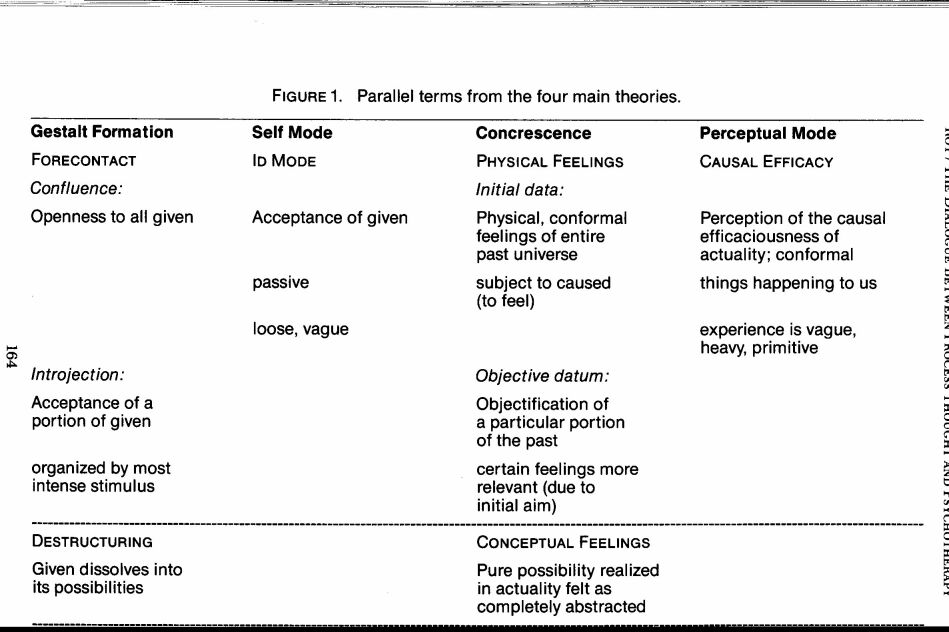
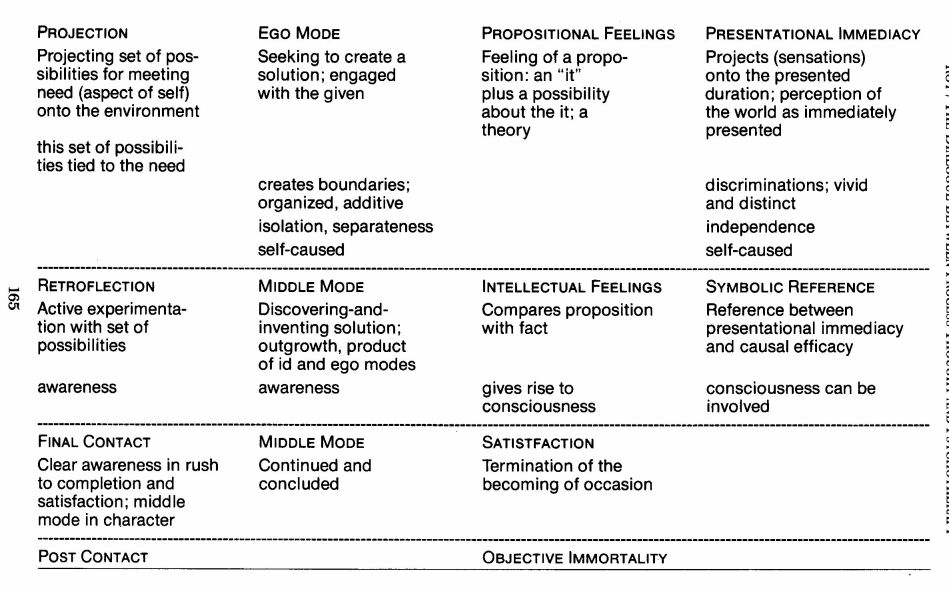
 

4. The comparison can serve as a catalyst for further development of themes only initiated in Process and Reality.

For example, there is a certain richness added to Whitehead’s ideas about perception when one begins to see that presentational immediacy and propositional feelings may be differing discussions of the same topic. It seems quite possible that presentational immediacy involves both kinds of propositional feelings (perceptive and imaginative).5 Yet there are differences. The most important one is that propositional feelings are not limited to the presented duration, in contrast to presentational immediacy. Thus it would seem that presentational immediacy defines one aspect of a propositional feeling, but does not define all kinds of propositions in terms of the locus of their logical subjects.

Among Whitehead’s denser discussions are his remarks about propositional and intellectual feelings. Any serious work developing an understanding of perception and consciousness, let alone a theory of psychopathology or disturbed functioning, will spend time elaborating on these brief remarks. The understanding of "reality" vs. "fantasy" and the complex interweaving of perceptions of possibilities (far-fetched to immediate) with reality, which produces consciousness, will be teased apart and discussed at length.

These are four ways in which process thought may benefit by an exchange with psychotherapy. They may only scratch the surface.

B. Value to Psychotherapy

Psychotherapy can benefit from the dialogue with process thought in at least eleven ways:

1. The field of psychotherapy is a pluralistic and creative adventure today with numerous schools of therapy, major and minor. Each has its particular emphasis of how and what to treat (and for how long). Whitehead’s unified cosmology has the power to serve as bridge and unifer of this variety. It can promote creative yet systematic connections among these various schools by viewing several approaches from a common perspective, thus furthering the quest for the metatheory.

It is interesting to note in this context that family therapy broke out of purely intrapsychic relations into wider systems of relationships that characterize and condition us all; and now we see the more recent birth of "ecological" therapy, where the concern broadens to include human relationships to the fullest extent possible (see FFT 256ff.). This is exactly the direction of development that would be anticipated and supported by Whitehead’s cosmology. Yet in the wake of this advance there is a tendency by some to ignore or disparage the myriad of ideas and approaches of other schools. Thus Perls, to the end of his life, criticized Freud and his theories, sometimes quite caustically (see GA). The family therapy movement long has criticized its precursors in individual therapy (see BFT 38ff.). Whitehead’s system has the potential to hold this diversity together, while at the same time suggesting priorities and judgments as to what is more and less important.

Within the field of family therapy there are the same kinds of issues:

A question that will not (and perhaps should not) be resolved is the relationship of the major schools of systems change to one another. Are the systemic and strategic approaches basically the same, or do they come from different conceptual universes, despite their seeming likeness and common roots? (FFT 337)

How does this explosion of theories and approaches fit together? Is there a developmental continuum such that one theory and approach may fit a particular case at one stage of therapy, but need to be replaced by another at a point further along? The field is beginning to have clarity about its degree of development and needs a vision with the power to further the progress.

Hoffman sees the shift occurring from a homeostatic to an evolutionary paradigm and lists nine ideas she believes "will be the benchmarks of the new generation" of thinkers and therapists in the field (FFT 346-48). Several of them involve the attempt to move beyond the Newtonian paradigm of causality, an issue which certainly concerned Whitehead. To the degree that his solution that both the physical and mental poles are aspects of each occasion is recognized, those wrestling with the issue of causality in the context of individual choices will produce clearer results. The nine benchmarks also accept the contemporary understanding of time, the role of unpredictability (novelty), persuasion as a higher form of power than coercion, and the priority of evolution and change (instability) over equilibrium or stasis.

This whole issue has important practical implications as more and more families become involved in therapy. These families certainly need to have the closest fit between their situations and the theory and approaches used by their therapists. Being able to hold together, and to sort through, the multitude of theories in relation to the variety represented by clients and therapists should help produce better matches and therefore better treatment.

2. Individual schools of therapy would also benefit by encountering Whitehead’s cosmology, even if no thought or attention is given to connections with other schools.

Each may find improvement (increased clarity and consistency, for example). Gestalt Therapy is a process-oriented therapy (without any known direct influence from Whitehead), for it transformed into processes Freud’s extensive reifications of psychic events (such as the transformation of the Freudian constructs of id and ego into modes of the self). Yet in Gestalt Therapy there are occasional lapses into substantialist categories. For example, contact is defined in a processive fashion as experience, as defining the subject and simultaneously representing a point of view, which brings the concept of contact and prehension quite close. But the authors lapse immediately into a discussion of the "contact-boundary," as though there were this "thing" which separated subject from object (cf. GT 229). This "thingness" pervades much of psychotherapy, contributing to a sense of mutual exclusiveness and difficulty in seeing commonality. After all these personality structures are not like physical structures, such as a heart or lung, upon which you can get observers to agree. These structures are less visible, and yet equally real. They certainly endure, yet they are dynamics of the occasion at each moment, not immutable or impenetrable barriers. Descriptions of these structures should not turn them into objects in which characteristics adhere.

3. Whitehead’s theory also can begin to orient psychotherapy to a deeper understanding of its means and goals.

If process philosophy has more adequately described the nature of reality, we can reasonably expect that persons treated according to its values will be better served. The emphasis would be on the creative, developmental, relational, and feelingful themes of experience. Intensity and harmony of experience generally would be valued over dullness and discord, complexity over simplicity, beauty and enjoyment over ugliness and drudgery. Some of Allman’s discussion illustrates this point (section A. 2), as does later material (in B. 10).

4. There is the implicit affirmation in this cosmology that the resources necessary for healing, for being able to function as an integrated whole, are perpetually available.

Each instance of a dominant occasion is a renewed opportunity where any given dynamic can achieve its proper place among others. Individuals who are excessively dominated by powerful emotions which flood the self can objectify those emotions by reflecting upon them in conceptual experience. Individuals with a paucity of emotional content in their experience can be assured that those more causal, bodily experiences lie behind their intellectualizations, always supplied by physical experience.

5. The primacy of creativity, as the ultimate principle of reality, raises wonderful issues.

Where there is reiteration instead of reversion, there may be need of therapy, a need for new possibilities to be introduced from someone outside and therefore relatively unaffected by the reiteration (at least initially) in order to free the system to find new solutions utilizing other approaches. These other approaches are not just laterally equivalent, but may well represent progress along a continuum of development. This continuuum appears to begin with physical feelings dominating the occasion’s experience and may well exhibit a continuous increase in the role of conceptual feelings in the self’s experience. The richest, most intense, and most highly developed stage would be that experience which includes the maximum of both.

Creativity affords a vantage point to evaluate therapies. The number of family therapies which place high value on the role of creativity and related characteristics for diagnosis, assessment, and therapy, as well as for its goals, is striking (DA). The words creativity and creative are positively valued and regularly occur in the literature, as do related concepts: flexibility (vs. rigidity), growth, tolerance of deviance, paradoxical prescriptions, creation of greater complexity, and so forth (DA 25-28; generally, 22-33).

6. Process cosmology produces a clear focus on the fundamental relatedness of all of reality.

This has implications for the full range of therapy. Just as an individual can be dominated by physical, conformal feelings, so can a family. The influence of those members frequently in intense contact with each other is often explicable and predictable. Process thought also suggests therapists cannot be neutral or uninfluential. Values play a central role in therapy and will come through the personhood of the therapist, like it or not. A current debate in family therapy concerns whether or not it is valid to use the therapist’s self extensively (DA). From Whitehead’s perspective this particular debate is an empty gesture, for the selves in the room are mutually involved.

7. The ontological principle, the concepts of the essential relatedness and separateness of reality, and numerous other Whiteheadian concepts help pave the way for a truly holistic view of health and healing while moving beyond mind-body and subject-object splits. The rigor, complexity, and cohesiveness of the theory enables it to provide the comprehensive conceptual framework for holistic approaches to health and healing so that the field can move beyond the support of compelling intuitions about the shape of this orientation.

There is but one kind of actual occasion, though occasions differ in many ways. The occasions that make up the body, whether viewed at the subcellular or the major systemic levels, are not different in kind from the one that is the self at a given instant. The self, the dominant occasion, is supported by and arises out of the body. When it is organized into a serially ordered grouping, it becomes what we call the psyche.

8. The Whiteheadian orientation, when applied to sexual and cultural differences, can give rise to more sensitive and inclusive, systematic, and appropriate theories and therapies.

The diminution, if not complete exclusion, of the feminine from our global culture is at the root of the precarious imbalance caused by independence, self-sufficiency, exploitation, domination, and so forth. As the feminine emerges, so does a much richer and more healing global society, one characterized by interrelatedness, interdependency, synergistic mutual enhancement, persuasion, and so forth. The masculine probably will become more deeply rooted and more mature as a result. Whitehead’s cosmology includes the characteristics that cluster at each of these poles and can aid this personal and cultural evolution by holding both together. This understanding will be able to enhance work done in therapy where these issues play themselves out in a direct, immediate, and specific fashion in the lives of clients -- and therapists.

Just as there are clear cultural differences that in turn influence the course of therapy (by whatever name), the theory should be able to illustrate the fundamental similarities. Certain basic developmental and relational issues, for example, must pervade all cultures. Interest in this is more than mere curiosity, for the lack of this understanding can be seen at the heart of the enormous number of global conflicts which have increasingly catastrophic implications.

9. The theory also should be able to hold together the intrapsychic and the interpersonal (see also section A. 2.).

There is understandable wariness about approaching the understanding of families with a developmental scheme (Hoffman refers to it as "stairs to Heaven" in FTT 102). Nevertheless, there may be a developmentally-grounded diagnostic scheme in which the mental pole becomes increasingly important in the constitution of self as a person matures, adding its contribution to that of the physical pole. This same principle of development can be extended to the persons who constitute a particular family because of the intensity of the mutual inheritance among family members. This means we can speak of a family’s maturational level in the same terms used to describe an individual’s developmental position. Individual members of the family system become more capable of interdependency (being independent yet connected) as both the individual and the family system mature along the same continuum. While the mental pole becomes increasingly important, with its operations involving presentational immediacy and symbolic reference, propositional and intellectual feelings, the person nonetheless needs the full availability of the physical pole for prehending the world with physical feelings.

A disorder might be defined as a major diminution of any of these dimensions of experience over many instances of the dominant occasion, when a full and creative response to the situation could be enriched by the inclusion of the missing dynamic(s). These disorders may often be supported by individuals who stay in close relationship within the family. Though individual members of the family may differ, their degree of maturity along the continuum will be strongly related (often either identical or quite the opposite). This is due in part to the intense and repeated inheritance from one another. This gives one a bridge between the intrapsychic and the interpersonal which extends the relevance of the theory beyond the older view, though still including it, and into the more contemporary interpersonal focus of many of today’s therapies.

10. The dialogue with process thought can lead to an emerging understanding of the role of the spiritual dimension of reality for psychotherapy.

This is a complicated topic which raises many emotions on all sides. Projections and assumptions abound in the secular and religious communities, few of which are submitted to much rational scrutiny. The religious community has been its own worst enemy in this needless struggle. The secular community with some justification has resisted insights which appear to come from religion and theology, since so much of this has been clearly antithetical to the facts of human beings and their development and to mental and social health in general. For religion and theology have behaved defensively in the face of new ideas, reacting with suspicion and hostility to what emerges in the world. Instead of working to include these new ideas, and thereby growing and becoming more sensitive, the reaction has been to become more and more protective, insolated, and exclusive. Western religion has tended to lose sight of its role in the scheme of things. Theology has not been able to show how to overcome that blindness. This lack is a major factor in actual and potential twentieth-century tragedies. Religion and theology have come to represent merely one perspective among others, no longer the most fundamental and most inclusive. Yet there is a place for the dynamics which are studied by the field of theology, no matter what those dynamics are called.

One root of cause of this splitting, which results in the exclusion of the spiritual, is a world view that emphasizes one pure mode of perception (presentational immediacy) over against the other pure mode (causal efficacy). Our experience of reality is predominantly characterized by the analytical, the visual, the independent and detached, the clear and vivid. The qualities belonging to the other mode are diminished, even actively devalued. These include an experience of being connected to all of reality, a full sense of acceptance of what is and is coming to one, a strong feeling of being influenced by all that is. When this mode is dominant, there are moments when one’s awareness is dominated by the less organized, more chaotic, vague, and primitive feelings (akin to Whitaker’s "crazy" side). Eventually what is diminished and thereby trivialized by the downplaying of this mode is the experience of meaning, for that is usually contributed by the mode of causal efficacy to the mixed mode of symbolic reference. Yet this pure mode’s very existence is denied often and, at the same time, its characteristics become "bad" from the culture’s point of view. This is very confusing and results in a denial of actual experience, a paradigm for splitting the self and also for creating a double-bind (which family therapy literature asserts is a root cause of schizophrenia).

Our theology and our practice of religion have been influenced by this cultural tendency. Their reflective and active wisdom has been reduced to being equal to other points of view, no longer providing the perspective by which to evaluate and to transcend these other views. As a result, we have lost the capacity to directly experience, and reflect upon, our connection to all, and to the source of meaning. This has greatly diminished the positive, creative influence of theology and religion in our culture. The irony is that often religion and theology have attempted to "prove" their importance and to "justify" their existence by attempting to use arguments designed to satisfy the requirements of the mode of presentational immediacy, when that of course will not work. It is impossible to attempt to "prove" the spiritual dimension and its influence in the world, in the context of a simple empiricism, for fundamental and inclusive meaning is exactly what tends to be excluded from this context. At best this context ends up allowing the spiritual dimension to be viewed as one among others, and not as the dimension which underlies and gives meaning and direction and purpose to all the others.6

Now perhaps is the time for a change towards a fully integrated understanding of psychotherapy as fundamentally spiritual. Much will have to be changed to allow this to happen, but there are already places within the traditionally secular psychotherapies where there is explicit or implicit recognition of the role of the transcendent values. Certainly this role is explicitly realized in Jung’s works, as well as in Assagioli’s Psychosynthesis. There are shades of this in Gestalt Therapy, with its emphasis on the "wisdom of the organism" and its faith placed in the hierarchy of needs. Whitaker approaches it in his emphasis on the whimsical, the freedom to play and to allow the "crazy" side of the therapist to emerge with all its intuition and novelty. Even in more traditional analysis, the notion of the observing ego as a prognosis of health and a means of health has a close kinship with Cobb’s understanding of the spiritual structure of existence and the self-transcendent self (see SCE). This structure of the self, the spiritual, develops within the psyche (soul) and serves the purpose of being potentially fully open to the initial aim.

Generally, when viewed from the perspective of Whitehead’s vision, any therapy which assigns creativity, in all its various forms and with all its various names, a central place in its self-understanding and in the conduct of its work is approaching an understanding of the centrality of the spiritual dimension.

Body, self, psyche, and spirit are in close relationship with each other. In Whitehead’s vision, they are not truly separable. The self emerges from the body, the psyche unfolds from the succession of selves, and the spirit develops within the psyche. What a vision for therapy!

11. Finally, the metatheory. In the long run, the creative comprehensiveness of Whitehead’s cosmology may contribute to a unified theory of psychotherapy, such as psychiatrist and pioneer family therapist Carl Whitaker has dreamed of for more than 30 years (see RP xiii-xiv). One of the basic notions that undergirds the new and emerging vision is the resounding importance of the ontological principle, whereby there is but one kind of res vera. The dynamics of a temporal entity or actual occasion, which can be separated only through analysis but not in actuality, are the features which characterize each moment in some kind of unique configuration. This means that any scheme for diagnosis or assessment, any kind of developmental scheme, any kind of scheme at all for psychotherapy, will take this into account. Our experience is constituted out of these themes, whether in health or disease. This makes the job deceptively simply, yet quite complex. The personal, the interpersonal, the entire self-other, all flows out of this. The rich wisdom of Freudian thought, of Jungian depth analysis, of Gestalt experience, of Family systems and structures, each has a place. All have pursued the fundamentals far enough to have touched those basic themes. What Whitehead’s cosmology will do is to help them see that more clearly and go further.

The dialogue therefore will further the evolution of psychotherapy, which is one major force for improving the human condition. This transformation, to be set in motion by bringing together process philosophy and psychotherapy on both a theoretical and an applied basis, will involve how we understand and how we respond to each other and the world. The impact will not be limited to the consulting room, obviously, for psychotherapy from its start has been a catalyst for change in many areas, a key source of inspiration in the struggle to create a more coherent, nurturing, and whole world.


References

BFT -- Ferber, Andrew, Marilyn Mendelsohn, and Augustus Napier. The Book of Family Therapy. Boston: Houghton Mifflin Co., 1973.

DA -- Keeney, Bradford P., Editor. Diagnosis and Assessment in Family Therapy. Volume 4 in The Family Therapy Collections, James C. Hansen, Editor. Rockville, Maryland: Aspen Systems Corporation, 1983.

FFT -- Hoffman, Lynn. Foundations of Family Therapy. New York: Basic Books, Inc., 1981.

FTCP -- Bowen, Murray. Family Therapy in Clinical Practice. New York: Jason Aronson, 1978.

GA -- Perls, Frederick S. The Gestalt Approach and Eye Witness to Therapy. Ben Lomond, California: Science and Behavior Books, 1973.

GE -- Smith, Edward L., Editor. The Growing Edge of Gestalt Therapy. New York: Brunner/Mazel, 1976.

GT -- Perls, Frederick S., Paul Goodman, and Ralph Hefferline. Gestalt Therapy. New York: Dell, 1951.

HFT -- Gurman, Alan S. and David P. Kniskern, Editors. Handbook of Family Therapy. New York: Brunner/Mazel, 1981.

RP -- Whitaker, Carl A., and Thomas P. Malone. The Roots of Psychotherapy. New York: The Blakiston Company, 1953.

SCE -- Cobb, John B., Jr. The Structure of Christian Existence. Philadelphia: The Westminster Press, 1967.

1.Allmnan, Lawrence B., "The Aesthetic Preference: Overcoming the Pragmatic Error," Family Process 21/1 (March, 1982), 43-56.


Notes

1 I am indebted to John B. Cobb, Jr., for much help with this article. The flaws are entirely mine.

2 The id was connected to causal efficacy by William C. Lewis, M.D., a psychiatrist, in his article on "Structural Aspects of Psychoanalytic Theory of Instinctual Drives, Affects and Time," in Norman S. Greenfield and William C. Lewis (eds.) Psychoanalysis and Current Biological Thought (Madison: University of Wisconsin Press, 1965). However, Whitehead’s system was not well-integrated with the psychoanalytic theory in this article. For example, there was no reference to other features of the theory of perception, let alone concrescence.

3 The theory of Gestalt Therapy does not recognize the stage of "destructuring" contact along with the other stages usually assigned. However, there is important attention given to this process in the theory, and it is not totally unreasonable to give it the formal title of a stage. A stage, after all, is merely a verbal shorthand for distinctions arrived at analytically, not a reality in the ontological sense. A summary of the evidence for destructuring:

There is reference made to "the given dissolving into its possibilities" (CT 403) as a part of the discussion on gestalt formation. "Destroying (destructuring) is the demolition of a whole into fragments in order to assimilate them as parts in a new whole" (CT 340). This is seen as necessary prior to any "creative reconstruction" (CT 67) and is applied to any "given object" (CT 67). These objects include substance (food) as well as ideals, interpersonal influence, and habits (CT 341); as well as activities or situations (CT 67). The process of the given dissolving into its possibilities is assigned by Gestalt Therapy to the first contact stage (fore-contact) along with the experience of the given (FT 403). Likewise, experience of actual fact ("unchanging given," CT 375) and pure potentiality (CT 375) are assigned to the same self mode, the id (CT 378).

4 Bateson did have some awareness of at least the early Whitehead. In Steps to an Ecology of Mind (Chandler Publishing Company, 1972) Bateson refers to Principia Mathematica several times. He acknowledges Whitehead’s "fallacy of misplaced concreteness (p. 64). He differs from Whitehead on a major point: "I do not agree with Samuel Butler, Whitehead, or Teilhard de Chardin that it follows from the mental character of the macroscopic world that the single atomies must have mental character or potentiality. I see the mental as a function only of a complex relationship" (footnote to p. 465).

5An earlier attempt at developing the relationship between Whitehead’s theories of perception and concrescence was made by William S. Cobb in his article "Whitehead’s Twofold Analysis of Experience," Modern Schoolman 47 (1970), 321-30. The purpose of his article was "to show, by means of a detailed comparison, that the two analyses are coherent" (p. 321). In his conclusion, however, he acknowledges that his analysis "has been sketchy, but hopefully . . . sufficient to give some indication of the fact that the two analyses are complementary" (p. 330). He does not explain the shift from "coherent" to "complementary" in describing the two theories.

There is one major area of difference between Cobb’s account and this one, having to do with the relationship between presentational immediacy and propositional feelings. In Cobb’s version, there is an understanding that despite an indication that presentational immediacy may be equivalent only to one type of perceptive propositional feeling (the direct authentic perceptive feeling), other material suggests that "delusive" perceptions (a variation of direct authentic) are involved as well (PR 122/186). However, there are also indications that presentational immediacy may involve the other major kind of propositional feeling, the imaginative: "Again in the transmuted feeling only part of the original nexus maybe objectified, and the eternal object may have been derived from members of the other part of the original nexus. This is the case for perception in the mode of ‘presentational immediacy’ " (PR 253/386; also, 122/ 186). The basic elements of an imaginative proposition are named: the origin of the logical subjects from one portion of the original (objectified) nexus and the eternal object (for the predicate) from another part of the nexus.

6 If there is no way to talk about this, or to lift the experience of causal efficacy into our awareness, then eventually it drops away, flows into the background where it is held prisoner, active sometimes in a chaotic and destructive fashion, a producer of illness and not of health. Yet the need for some way of addressing this dimension is clear, for there is a return to this over and over in other terms. The priestly quality of scientists and their pure white robes is a familiar image. Yet the meaning of their discoveries and of their creations is lost, and the results are extraordinarily cruel and destructive. We have the Holocaust to remind us of that. We have the threat of nuclear annihilation against a backdrop of chemicals unleashed in our air, in our water, and in our bodies as a result. We have enormous corporations, some of which conduct business with the principle that they bear no responsibility to the world beyond making profits for shareholders. Once the product leaves their door and the wastes leave their premises, they are not responsible. If our craziness is excluded from our direct and conscious experience, it comes back as the demonic in rational clothing.

Another result of the overemphasis on the mode of presentational immediacy is the devaluation of the role of the generalist and the overvaluation of the role of the specialist. We leave ourselves with no way to tie all of our various studies of and activities in reality together. This leads over and over to separateness and not to connection. This should not be taken for an argument against specialization, for knowledge is furthered this way. But there is a limit to the value and importance of this tendency, and ultimately it becomes quite destructive if there is no way to hold all the specialties together. We become exclusive and not inclusive.