Chapter 2:<I> </I>What About Salvation?

Every man and every woman wants to be whole. That is the secular way of saying that every man and every woman wants Salvation.

Salvation, as an English word, is derived from a Latin root that means "health" or "wholeness," and health or wholeness, this desire to be all of oneself in the fullest and richest possible sense, is native to man. It seems to me that often we who are Christians, and perhaps especially those of us who are concerned to preach and teach the Gospel, have let words become a positive barrier to meaning. Frequently, words change their significance as the years go by. Often they become tarnished; very frequently they are misunderstood -- and then they act as barriers to meaning rather than conveyors of meaning. This, I think, has happened with the word Salvation. Certainly there can be no doubt at all that for a great many of our fellow Americans, when the word Salvation is said, they think of hitting the sawdust trail, responding to the invitation to sit on the mourners’ bench, or responding to the goings-on of Billy Graham or one of his predecessors. Sometimes they think that Salvation is a sort of fire-insurance policy which guarantees that we shall not have a rather warm future beyond death. Very infrequently do our fellow citizens, even Church people I think, grasp the rich and full meaning of Salvation as the Christian tradition has understood this term. "What must I do to be saved?" means, "What must I do to be well, to be healthy in my total personality, to be a whole man as God intended me to be." When we put it in this way, we see its vital significance, even to those who have, as they think, no interest in, or concern for, the Church and its teaching. Every man and every woman wants to be whole.

As it stands, unfortunately, you and I and all our fellow men are not whole. We are sick. We are unwell. We are disordered and disintegrating personalities. It does not take much introspection to understand this, to see it for oneself, to recognize the horrible fact that man is not well. He is not well physically much of the time, but this is not so important a fact about him as that he is not well spiritually; and by this I do not mean that he is unwell psychologically, that he is neurotic or that he has gone beyond neurosis into psychosis. When I say spiritually I mean that in his relationship with the sources of his being, with the things that ultimately and finally give his tiny existence meaning, he is unwell. He is maladjusted to Reality with a capital "R." Sometimes people have not liked to admit this. They have thought that they were in pretty fine condition. They have disguised from themselves their spiritual disease. But I very much doubt that in this day, save among the very few people who manage to live in splendid isolation from the world in some kind of private ivory tower, people are really as self-satisfied as that.

The world is at sixes and sevens, and we shall all confess that things are not as they ought to be, even under the best human administration, so far as the "world-affairs" side of life is concerned. It is not indeed a political matter at all. We have seen perfectly well that all the increase in technical devices, all of the improvements in circumstance which are made by governments and other human agencies, simply do not accomplish our Salvation as a society; and the reason they do not accomplish our social Salvation is that the fundamental trouble with us is not that social matters are all askew but that our personal lives are in a state of bad health. You and I are why the world is all mixed up. Surely we realize this, or we ought to. Improvement begins at home, like charity. The attempt to blame society, under whatever form of government, party rule, or social pattern, for the ills that afflict us is one of the most absurd attempts at alibi-ing oneself out of difficulties that the ingenious and sinful mind of man has ever devised. The trouble is with us, with you and me. We shall never have social health until we have personal health. We shall never save men in society until men personally are on the way to Salvation as the children of God. That is the way things are.

We were created in what theologians call the "image" of God. Alas, the fact is that in us, without exception, that image has been so blurred, dimmed, and damaged that it is often hardly recognizable. The image of God in man is man’s capacity to relate himself meaningfully, freely, and with complete devotion to God Himself, but you and I have managed so to harm this capacity that it is almost impossible for us to make any strides whatsoever towards that relationship with God our Creator.

Some think this is a very pessimistic point of view. Some feel that man is able under his own steam to make meaning for himself. But it is my suspicion that the people who say this, and usually say it rather glibly, are people who have not bothered to look very deeply into their own lives. They are often quite charitable toward themselves, although they tend to be a little cynical about their neighbors. It is easier to see sin in the person next door to you than it is in your own heart. We men are very well gifted with this kind of dishonesty.

But those of us -- and today they are legion -- who have dared to face the facts are crying like the man in Acts: "What must I do to be whole?" It is to people like that, who are facing the facts, that the Christian Gospel speaks with high meaning. The old-fashioned evangelist had a saying that it was only to a person convicted of sin that the word of reconciliation could come. I think this is profoundly true. The only people who can be saved are the people who know they need Salvation. That is why the very first step to any adequate understanding of what Christians have meant by Salvation is an honest look at ourselves. Granted that we have done this, we can then begin to see why the affirmation that "while we were yet sinners Christ died for us," speaks right to our condition.

It is hardly my purpose here to enter into a discussion of ways of honestly facing oneself. But there is one thing which has always seemed to me the most devastating judgment ever made by any man upon himself. That is to look at the Cross, to see there what most people of good will are prepared to admit -- human life at its best and finest. Of course, this is not all that Christians believe, or even the major part of what Christians believe, about Jesus Christ; but for our purpose, it is enough now just to admit at least that much, to see here life given in love to the point of complete surrender of self, to agree that the ages witness that this is healthy life, this is wholeness, and then to turn to oneself and ask the very simple but very searching question, "How do I measure up to that standard?" I think that the answer of any honest person will be, "I do not measure up to that standard at all. My selfishness, my concern for place, my pride, my unwillingness to give myself -- all of these so powerfully affect my very being that I am forced to say, ‘Depart from me for I am a sinful man.’" There are many other ways in which this kind of judgment of self, with the resulting conviction of sin, unhealth, may come home to us. This one seems to me, for people who profess and call themselves Christians and who are to some degree influenced by Christian ideas and symbols, the most striking and terrible.

What we need, then, is wholeness that will replace our brokenness, health that will drive out the infection of self-centeredness in us, power that will make us function like men rather than as sophisticated but not really very smart animals. We need Salvation; every man needs Salvation.

Now there is only one way in which personalities can be made whole, and that way is by falling in love. I do not mean by this the sort of thing the motion pictures portray; I do not mean the sentimentality of "soap-operas" on radio or television. What I do mean is that our greatest Salvation is found when we extrovert ourselves, when we turn our attention and give our whole concern to some other person, in caring for whom we find our health and our joy.

Just ordinary experience makes that perfectly plain. Have you ever watched a member of your family who has fallen very deeply in love? There you see the way in which a life which may have been disorganized, self-centered, thoughtless, and indifferent to others finds a center in which it can discover the meaning of existence, presented in the object of affection. But what is much more important, we see how one can commit oneself with a splendid throwing-away of the narrowness, pettiness, self-seeking that dogs our lives. This is what a Scottish divine once called "the expulsive power of a new affection," by which we are redeemed from the sort of self-centeredness that gives us our sin.

So through the history of the human race, men have sought that with which they could fall in love. They have tried to commit themselves to all sorts of things, gods and half-gods, which they think will serve the purpose of saving them. The trouble with most of these gods and half-gods is that they are not adequate to the job. A human object of love may serve for a while, but unfortunately the mortality rate is one hundred per cent. Even our best friends may let us down. There is no guarantee that any human will be ‘‘without variableness nor shadow of turning." It is only Reality, the ultimate and final Reality of God, which is a safe object of love.

Or look at it another way. We are maladjusted; we do not get on well enough with our friends, colleagues, business associates. We know this and we seek right adjustment. The psychologists have understood this for a long time. Unfortunately, many of them have said that all we really must do is to become adjusted to the society in which we live and then we shall be well, since health is a relationship between us and our environment. One is inclined to say that anybody who is well adjusted to contemporary society is by definition very maladjusted indeed, because contemporary society is as mad as a coot and is something to which nobody ought to be adjusted, even in this land, not to speak of others which may be less fortunate than ours. There is only one Reality to which adjustment may be made with security and safety. That is our final environment, the One in whom "we live and move and have our being," the One whom we call God. To be adjusted to Him is to be adjusted to that which is; and all other adjustments are only to that which seems to be.

The Christian Gospel proclaims -- because you and I are not able of ourselves to help ourselves, because our mundane loves will not really make us whole, because our adjustments to temporal realities will not save us -- that God has acted for our health, to give us a way to be well. For myself, I do not think that this is the only reason for what we call the Incarnation. It seems to me that even if men were not sinners (an almost incredible thought!), still God would have brought the world of human affairs into such a relationship with Him as in Christ He did do, so that He might crown His many comings and revealings and workings among us by this supreme and definitive act. The fact is, however, that we are sinners, and that therefore it is medicine that we need; and in Christ, so Christians believe, God has provided the medicine of mankind.

There have been many theories as to the way in which, through Christ, we may be made well. Some of them are a little difficult for modern ears, as, for example, the ancient theory that man, having been sold to the Devil, must be brought back by God; and so God paid a price to Satan. Many of our hymns reflect that theory; if we take them seriously and symbolically but not literally, we probably do no harm to ourselves, although sometimes we do not edify our non-Christian friends. Sometimes the theory of the way in which we are made well through Christ has been put in terms of the honor of God having been offended by the enormity of man’s sin and the consequent necessity for some compensation to be made to God’s honor. This is a feudal conception which did very well in the Middle Ages but is hardly intelligible to us today.

I myself do not have any theory of what we call the Atonement. I prefer to take all the theories and look at each as a way of stating something of importance in terms appropriate to the day in which various people have lived. I presume that if we were to find some metaphor that would do the job for our own day, we should probably want to turn to the hospital and speak of the "Great Physician," or we should want to go to the psychiatrist’s clinic and speak of the "Healer of our Spiritual Ills." But it seems to me that all of these are of slight importance in comparison with a simple fact of experience: the observable truth is that men and women who have really let themselves go -- committed themselves, turned from self-centeredness outwards, looked to, and centered life in, Christ -- have, in fact, become different from the run-of-the-mill type of men and women.

They have indeed started to be "saints." That is what all of us are meant to be. One is a little afraid of saying this, because most people think of saints as anemic human beings who inhabit bad stained glass windows. But a saint is simply a healthy person. And since I began this answer by some exercises in word derivation, I will go on by saying that in German, for example, as in French, the word for saint means "whole," or "hale," or "healthy." It means a well person. A saint is a man or a woman who is open to the inrush of the healthy life of God. A Saint is a person who -- in the trite and often repeated remark of the little girl, thinking, I suppose, of the stained glass window -- "lets the light shine through." By letting the light shine through, by being the instrument or vehicle for some Power or Force not of oneself, one is delivered from the appalling self-centeredness which is the fact of our sin. "There is only one sadness," said the French writer Leon Bloy, " -- not to be a saint."

The only really tragic thing in life is to be a self-centered, narrow, proud, possessive, "holding-on" kind of person. The only joyful and great thing in life is to be a person who is so open to Reality, so adjusted to that which is, that the whole of one’s life becomes a vehicle for the charity of God. I said the charity of God; for Christians that means Jesus Christ. God sent Him forth as that One who takes away our sin. We could not find the way, but as Saint Augustine said, the way has come to us and all we have to do is to walk in it. Christ is the way.

Salvation means that you and I and every son of man may be given healthy lives, rightly adjusted to the things that are, and delivered from allegiance to the things that seem to be. Salvation means that we who are unwell in our inner spirits may have the healthy life of God’s charity, which is Christ, poured into us through our discipleship, our prayer, above all, our Communions; and may live whole, healthy lives in Him. Salvation means that we are delivered by this fact from faithless fears and worldly anxieties, because our final treasure is placed where moth and rust cannot corrupt.

There is one question which may come to the minds of some of you. If this be true of us who are Christians, or if this may be true of us, what about those who have not heard the Christian Gospel? What about their Salvation? There are two things only that I should wish to say: One -- that you and I are not competent judges of anybody’s life, save our own. We do not know to what degree those who have not heard of the Christian Gospel may in their own way have responded to whatever of God they did know under whatever disguise God chose to use in coming to them. The second thing is that this statement in no way modifies our responsibility to share with all men everywhere what, if once we have been grasped by it, is for us saving truth, truth so important that it is unthinkable that we should let anyone through our failure go without the privilege of hearing and accepting it.

Sometimes people have asked the question this way -- "Who is in Hell?" My own answer to this has always been, "When you wake up there you will be surprised to find who is absent." It is not for us to make any such judgments. There is a lovely medieval legend that Judas Iscariot once gave a cup of cold water to a thirsty person, and that simple act of out-goingness was enough for God to use to bring him eternal health. And yet Salvation is not an easy matter, so we cannot say with confidence that everybody has it or will have it. Look around you, look inside you, notice the ill health, the dis-ease which is the token of the disease. We are not permitted to judge lest we be judged; but of ourselves surely we can say, "I am sick, I need health. By God’s grace this health has been made available to me. I have been accepted just as I am. All that remains for me to do is to accept with my whole heart and life the fact that I have been accepted. Then I shall be well and my life will be on the way to increasing wholeness here and now, and beyond death by God’s re-creating act to all eternity in His presence. Yet I must decide, I must say Yes, I must use all of the means, all of the ways that are at hand. I cannot put this off. God’s grace is my responsibility; and even then, at the end of my days -- because I know how prone I am to love my disease, to like being sick, to enjoy being a spiritual hypochondriac -- I must always remember that by my own decision I may refuse health." That is why, from his first day until his last, a Christian must say, "God be merciful to me a sinner," and must admit that he has done the things which he ought not to have done, left undone the things which he ought to have done, and has found health only in God; to whom, by His mercy, may we all cleave, and so ever find His health in us.

Chapter 1: Why Do We Have Creeds?

The plan for the series of six meetings which we are having together includes the discussions of some questions that are often asked by Church people and by inquirers -- questions concerning the meaning of important beliefs of the Christian Church, questions concerning certain practices which we find among those who are members of the Church. This evening the question which is before us is one which is very frequently put to all of us who are Christian people and most frequently to anyone who is a clergyman: "Why Do We Have Creeds?"

It seems to many people that Christianity is a very simple thing. It consists, they believe, in the Fatherhood of God, the brotherhood of man, the promotion of good will and understanding among all people, and the development of a spirit of charity, a spirit of sympathy, a concern for justice; and that is about all there is to it. Jesus Christ in that idea of Christianity plays the part of the great teacher and prophet who enunciated the truths with which Christians are concerned, but who is not Himself the center of their worship and their service. I am afraid that I have got to say flatly that any such view of the meaning of Christianity is simply wrong.

Of course, it is theoretically a possibility that the Christian Religion for two thousand years has been moving along the wrong line, and that another, and what might be called by some a better, understanding of the meaning of Christianity will take the place of that which has been conventional among us through these centuries. I say theoretically that is a possibility, but if we are concerned not with theoretical possibilities but with actual facts, we shall have to admit that Christianity is not the simple religion of God’s Fatherhood and man’s brotherhood, but rather the religion which finds God come to men for their wholeness of life in the person of Jesus Christ; and therefore finds in Him, in who He was, in what He did, in who He is, and in what He does, and in the consequences of those things, the whole substance of our Christian way of life.

If Christianity is centered in Jesus Christ, in who He was and what He did, in who He is and what He does, and in the consequences of these things, there will have to be a creed, there will have to be a statement of belief in Him and in His significance. And I think that one could say that those who object to creeds on principle are usually those who object to Christianity on principle, or more likely, do not know what Christianity is. They object, that is, to the idea of any religion which is concerned with affirmations about the nature of things, with affirmations about historical personalities and their significance; and they prefer a religion which is concerned more with how we feel and think, or how we think we ought to feel.

Our creeds, such as we have in the Book of Common Prayer, are of course, two: the Apostles’ Creed and the Nicene Creed. For purposes of American audiences, we do not have to think about a third creed which is found in the Prayer Books of all the other branches of the Anglican Communion, the Athanasian Creed, which has the misfortune of being neither a creed nor by Athanasius. It does not really concern us. It is a detailed, theological canticle set for singing, and is of extreme importance to theological experts but for most of us does not even get within our range of vision. We are concerned here with the Apostles’ Creed, which we use in Morning and Evening Prayer and at some other times, and with the Nicene Creed which is the creed used in the Holy Communion. We ought to see how these creeds came to be.

Let us look first of all at the Apostles’ Creed. That is a very simple thing. If you should look at it, you would find that it is divided into three sets of statements. One is a set of statements about Jesus Christ Himself; the other is a set of statements about God, the Father of our Lord; and the third is a series of statements which are, as it were, the consequence of the other two. Now that is not the way the Creed actually runs. It begins by our saying that we believe in God the Father Almighty; it goes on to say that we believe in Jesus Christ his only Son our Lord; and it concludes by statements about the Holy Spirit, the Catholic Church, the Communion of Saints, the forgiveness of sins, the resurrection of the body, and the life everlasting. But the central paragraph, which is concerned with Christ, is literally the crucial paragraph, and it is that second and central section which helps us to understand how the Apostles’ Creed came into existence.

When, in the earliest days of the Church, men and women who had been converted to Christianity were to be welcomed into membership in the Christian fellowship, incorporated into the Church, it was required that they should profess their belief in Christ as the Messiah -- which is to say, God’s special representative for the establishment of His kingdom among men -- and as the Son of God -- that is, as uniquely related to the Father of all mankind. From the simple formula used at Baptism the development of the Apostles’ Creed takes its rise. It is quite wrong to think, as some people apparently do, that the Apostles sat down and contributed each one a clause to the Creed. That was an ancient and mistaken idea. It is equally wrong to assume that a group of theologians, intent on making Christianity very difficult, determined that they would devise a sort of formula that would have to be accepted by anybody who claimed to be a Christian. The Apostles’ Creed arose out of -- and, in fact, still has its primary meaning as -- a baptismal creed.

"Do you believe in Jesus the Messiah, the Son of God?" If you do, you can be baptized and welcomed in the Church. That is the beginning of the Creed. But the early days of Christianity -- the first two or three centuries -- were not all easy going. There were theories, speculations, philosophies, and ideas which imperiled the Christian point of view. For example, there were those who believed that our Lord did not really have a human body and a human nature, and such people by their teaching imperiled the Christian assertion that God had acted for us in one of our own kind, and therefore in a way which we, men and women with bodies and human nature, could grasp and be grasped by. It is for this reason that the simple affirmation about our Lord as Messiah and Son of God was expanded to include the assertions of His birth, His death, His resurrection -- sheer historical data to show that man’s Salvation had been won m terms of our common humanity and on the open field of history.

There were some also who believed that the God who had sent Christ was not really the final God of all things, that behind the God of religious experience and faith there was a dark, unknown, all-controlling being, or even a fate, and that in meeting Christ we met not this final God who in the long run is in control, but only, as it were, a secondary, but good, God. You can see at once that any such view would destroy the whole meaning of Salvation, because if the God who meets us in Christ is not the God finally in control of all reality, then life is not made safe. It may be that there are some obscure corners somewhere in which God’s writ does not run. The Christian position does not hold by such views; and so assertions about God the Creator of Heaven and earth, the Almighty One, were placed in the Creed to safeguard the Fatherhood of God by making clear that He who is our Father is also the Ruler of all things.

And the implications of the coming of Christ in the forgiveness of our sins, the assurance of life beyond and through death, the persistence of personality conceived in terms (natural to the time) of the resurrection of the body: these too were added to the Creed, as being necessary to the right understanding of the purpose and mission of Christ as come from God.

So also to the Creed were added the Holy Spirit, the Church, and the Communion of Saints, all of them closely related because all of them are ways of saying that he who commits himself to Christ commits himself also to that community established through Christ’s coming, where the fact of Salvation is known and experienced and men are empowered from God by a Spirit which is given to them, a Spirit that is indeed so personal in operation that no longer can we call the Spirit ‘that’ or ‘which,’ but must call the Spirit ‘Who’ or ‘He.’ That is a very brief and inadequate sketch of the way in which from the simple, early baptismal formula we have received the developed Apostles’ Creed.

Now let me try to say something more of the "Why" of the Creed, the "Why" of the Church’s having a Creed. I think I can get at this best of all by pointing out that Christianity is not merely, as so many have thought, a way in which men live one with another, nor is it merely a way in which we worship God. It is also a set of affirmations which give meaning to our way of life and illuminate our worship of God, a set of affirmations in terms of which we live and the meaning of which is declared to us and by us every time we participate in an act of Christian worship. The Church, that is to say, stands for something or, as I like to put it, the Church belongs to the order of vertebrates -- it has a backbone; it is not a jelly fish. To be a Christian means that you take a stand. It means that you take a stand with millions of men and women over hundreds of years who have also taken that stand, the Christian stand, the Christian position: that God is, that God cares for men, that His care for men has included His coming among them in a Man to give them wholeness of life, that His care for men has included the bringing of them to Himself in fellowship with their brethren and with the assurance that life does not end with this short term of mortal years. If you are a Christian, this is what you believe and this is why you have a creed. If you did not have a creed, there would be no way of securing that the essential Christian statements would continue from generation to generation and across the whole world, uniting us as a fellowship in belief as well as a fellowship in worship and in Christian service.

But, of course, there is the problem of the way in which you and I as individual men and women are to say the Creeds. And I think that we should look very honestly at this particular difficulty in an effort to see precisely what the Creeds are all about.

Let me suggest that there are in the Creeds three different kinds of language. The first kind is historical. I have spoken about that. It is a statement that a certain Person lived in history, that He was in fact born, that He died, that He rose from the dead.

The second kind of language in the Creeds is what I should want to call by a word that I hope is not too outlandish: "ontological." Now this is a word which comes from Greek. By it I mean that there are statements in the Creeds which concern the nature of things, the way things really are. There is, for example, an affirmation about God. Now that is not "historical"; God is not just somebody who happens to turn up in history. God is, in the very nature of things, there. And so also I should say that phrases such as those concerned with our eternal destiny are what I call by this long philosophical term -- they have ontological significance.

There is a third kind of language in the Creeds, and that is symbolical language, the language which talks, for instance, about God’s "right hand." Obviously, God does not have a right hand on which or at which Christ sits. This is the language of poetry, the language of metaphor. It used to be said -- although I am told it is incorrect to say it -- that when the Creed was translated into Chinese, it was necessary to alter the words so as to have Christ sitting on the left hand of God, this being the Chinese place of honor. This illustrates the point: if there were some culture where the place of honor was sitting on somebody’s head, then we should have to put it that way, for "the highest place which heaven affords is His by right."

And while I am speaking of this, I might just as well say something about the Nicene Creed, with its language about coming down from Heaven, and the like. After all, Heaven is not "up" and earth "down." But to say that Christ "came down from heaven" means that he entered with humility and love into the world of men, and so this symbolic phrase is appropriate, although obviously it is not to be taken literally, unless you want to subscribe to a view of the world in which Heaven is literally up and Hell is literally down.

I have mentioned the Nicene Creed, and I want to go on with it, because it is for some of us rather more complicated and difficult than the Apostles’ Creed. The Nicene Creed is an amplifying and developing of the point of view stated in the Apostles,’ or Baptismal, Creed. The history of the Nicene Creed can be put briefly: apparently it is a rewriting of a statement of faith used in one of the churches of Asia Minor, adopted by a gathering of Christian bishops assembled in council in the town of Nicaea AD. 325, expanded very considerably at two later councils of the Church’s bishops, and finally adopted in the approximate form in which we have it in the year 451, at a meeting of the bishops in the town of Chalcedon, held to rid the Church of some pestilent heresies concerning the meaning of Christ.

The Nicene Creed is constructed like the Apostles’ Creed. The opening paragraph is concerned with God the Father. The middle paragraph deals with the historical facts of Christ, but with something else too -- namely, the relation of Christ to God, so there can be no mistake among Christians as to the major insistence of all Christian experience, that when we meet Christ we meet nothing less than God Himself. Christ as we know Him is so related to God that we use of Him the words, "of one substance with the Father"; which is to say that the very same stuff, the very same reality, is in Christ as characterizes the nature of God our Creator. The third part, like that the Apostles’ Creed, is once again an amplification of the consequences of belief in Christ, with references to the Holy Spirit, to the Church, to the forgiveness of sins at Baptism, to our destiny beyond death. Here, once more, the same three kinds of language may be noted. "God the Father Almighty, Maker of heaven and earth, and of all things visible and invisible" -- this is the language which I call ontological, as is also the phrase "of one substance with the Father." There are also the historical phrases: "born," "crucified," "died," "risen." And there are the symbolical phrases: "came down from heaven," "sitteth on the right hand of the Father," etc., like those we have seen in the Apostles’ Creed.

With that much behind us, we may go on to say something about the way in which you and I repeat the Creeds. Surely we cannot expect that the Creeds are to be treated as if they were hurdles over which every Christian must jump in order to be "qualified" to be a member of the Church. It would be a little absurd to expect a three- or four-month-old baby to repeat ex animo, with complete assent, every phrase that occurs in the Creed. For the rest of us, too, it is not as if the Creeds were proposed as tests -- that the Church puts up tests that we must past with at least the grade of "D," or we cannot be admitted to membership. The fact that we baptize little babies who cannot understand anything about the Creed, and bring them up in a society where the Creed is said and believed, is the clue to the way in which the Creed is to be used. The Creed is the Christian Church’s affirmation of belief; and when you and I say, "I believe," as we repeat the Creed, what we are really saying is this: "I take my stand where the Christian Church takes its stand, and, please God, I shall grow daily into a deeper understanding of that position which the Creed states, so that the faith which is the faith of the Church will more and more become my own personal faith too, until at the end of the day I, with all the saints, may join in the great Te Deum before the throne of God."

Anybody who has his wits about him does not ask a young person presenting himself for Confirmation to pass a test in dogmatic theology such as I might give my students in General Seminary. What is asked is that the young person shall be willing and desirous to live the Christian life, to worship in the Christian way, and to share so far as may be possible for him in the Christian faith, trusting, indeed knowing, that as he lives the life and worships in the way, he will grow more and more in the understanding and the believing.

It is significant in this connection that in the early days of Christianity, the Creed -- not the Apostles’, but the Nicene -- began with the Greek word p s t e n w m e n "we believe." This was the community’s act of assent, and when Christians stood and said or sang the Creed, they were saying that they wished to be, they were intensely anxious to be, of the company of Christian faith. I think that if we understood this, one of the real difficulties that many people have about both Creeds would disappear, because as perhaps some of you may yourselves feel, there are certain phrases to be found in the Creeds that can cause trouble. Perhaps you do not know whether you can really say that you believe them with all your heart, and yet you would not want to contradict the Church’s tradition, feeling that there is a wisdom here that may be deeper than your own. I should say that the right thing to do is to "come on in because the water is really very fine"; that there is no place where the wisdom of the Christian Church can be known save within the Christian Church; that if one can assent in general lines to that which the Creeds say, one can rightly belong in the Church.

For my part, I believe that Christianity is true. It is not just helpful, nice, agreeable, valuable to develop your personality and help you make friends. It is true, and truth need never be afraid. Any man or woman who is willing to expose himself to the truth of the Christian faith in the life of the Christian community, nourished by the worship of Christian people, will discover that the truth becomes true for him.

Preface

The first section of this book is the result of a series of Tuesday evening meetings at Trinity Church, New York, during November and December of 1953. On those Tuesdays I gave a number of addresses, answering questions often asked by Christian laymen and inquirers; the answers were taken down by tape-recorder and are here printed with very slight changes. It seemed best to leave them in the somewhat informal and conversational style which was inevitable in an attempt to answer, simply and directly, questions that were proposed to me.

In the second section, the Penick Lectures, given at the Women’s College of the University of North Carolina, are reprinted exactly as they were delivered in November, 1952. I am grateful to the Penick Lectureship Committee for the invitation to deliver these lectures on "The Meaning of Christian Worship"; to Bishop Baker for his kind hospitality; and to others who entertained me during a pleasant week in Greensboro.

The last section, whose purpose is to bring the material into a unity of faith, worship, and Christian life, was originally an address given to the clergy of the Diocese of Connecticut at the annual conference held at Kent School. I have re-worked this material for the present book, in the hope that it will relate the several themes in the earlier sections and summarize the Christian affirmations which are peculiarly relevant to our own time.

W. N. P.

Chapter 5: Sense Awareness in the Flow of Language and the Flow of Nature

Participating: R. B. Braithwaite, Margaret Masterman, Dorothy Emmet, Chris Clarke, Rupert Sheldrake, and Jonathan Westphal participating.

DE: In these discussions we have been seeing how the earlier Whitehead was struggling to get behind abstractions, and indeed behind ontologies, which are metaphysical abstractions, and speak as concretely as possible about our primitive experience, as given in bare sense-awareness. Of course with our propensity to interpret what is given us, we never get back just to bare sense-awareness, which could be something a unicellular organism might have. He thinks, in the nearest we can get to it, we experience nature as a flow, a "passage," and ourselves as part of this, not as thinking about it from outside. The passage of nature also contains properties which we notice in sense-awareness, and we then go on to form abstractions about these, which are perfectly legitimate for their purposes. But we need to come back from them to the underlying experience.

I tried in our second discussion to say that the passage of nature is more primitive than the ontology of events and objects into which Whitehead analyzed it. In particular, the notion of events extending over other events was an abstraction, especially when the properties of events were called "objects" thought of as quasi-Platonic ideas "ingressing" into events. When we come back to the primitive experience of the passage, we find repetitions and contrasts within it, and we fasten on these and interpret them I believe we should think of these properties as within the passage, not "ingressing" into it, so making it a rich process, and not simply a transition.

RB: This was part of the trouble about events. You can’t have transitions without having permanent objects. Transition is change in a permanent object from having one property to having another.

DE: Not necessarily permanent: continuant.

RB: Right, continuant.

MM: This continuance comes from reiteration.

DE: This is a particular kind of continuance, which is certainly there in Whitehead.

CC: What is worrying me is how one gets from bare sense-awareness to the idea of a process. How does one bring together these two? In Whitehead you have events, extended over others, and linked by reiterations.

MM: The reiteration doesn’t link events, it links patterns.

DE: I have been saying that events are abstractions, and what is concrete is the passage of nature. The grounds for thinking that this has rich properties are in what we get from direct sense-awareness. We ask, what does this give us before we start making abstractions?

MM: And then you are not obliged to make any one kind of abstraction or construction. Unless I am mistaken, all four of us want to make different abstractions, but we all come back to sense-awareness. Rupert goes back to bare sense-awareness because he needs it, if everything in nature presupposes his formative causation. Chris can say how his mathematical view of space and time comes back to bare sense-awareness. Jonty clearly comes back to it in his view of color. Language brings you up against bare sense-awareness in hearing. I am prepared to say more about this, because I think it does illustrate a Whiteheadian view, but it cuts out the Whitehead jargon. If you use this jargon everyone becomes totally confused, unless you give an enormously long lecture.

DE: I think this is where we should hear more about the language case. We didn’t do so before.

MM: Language is a flow of speech and it goes from the past to the future, and in written speech in Western languages it goes from the left hand top of the page: in Chinese, downwards from the top right hand corner. But there is a flow, just as there is in the passage of nature. In the passage of nature, as I understand it, you have rhythms, so to speak, pulsations. It doesn’t just flow on without distinction. And in language the limitations of the brain mean there is a segmentation of language, a necessary one, in spoken speech. The psychologist George Miller thought this was of the order of plus or minus seven words. Phoneticians call it a "breath group," though it is actually a hearing group, and this segments the flow. The Cambridge Language Research Unit has now got the same paragraph segmented in 25 different languages. The passage of nature, you could say, goes on in pulsations, and so does language. These segments build up into patterns. In the first instance they reiterate patterns where you don’t say exactly the same thing twice, but recapitulate it. In evolved speech these reiterations, so to speak, go underground, are superimposed on one another and get eliminated. But because of the limitations of our brain we have to keep re-capping. So the reiterative pattern of a language is matched in the reiterative character of the passage of nature. If I have understood Whitehead right, the passage of nature keeps on recapitulating, saying almost the same thing to you but never quite. So does spoken speech.

The next thing language has, on my view, is focus, structures where you have peaks of emphasis on what you think important. In Chinese the emphasis pattern determines the actual syntax. Again, Whitehead has focal points in his passage of nature. The passage of nature does not just roll on. In language these focal points are emphases which lead up to the mega-peaks which form a paragraph. After that, you can put in syntactic markers to heighten the effect.

DE: Could you say what a syntactic marker is?

MM: The best known example would be classifiers. We talk in English of a heap of sand or a sand heap, a pool or drop of water or grains of something. The classifier limits the meaning of the word it governs and makes it a kind of something. In Chinese there is an interesting classifier for a kind of activity which shows that it is a disastrous activity that happens suddenly.

The kinds of prefixes and inflections that the Aristotelian view of language presupposes aren’t necessarily required for languages at all. That view has the advantage that there are certain things you can easily say, for instance about present action, past action, continuous past action, but by doing this speech throws away its combinatorial potential for any segment or sub-segment to combine with any other. I’m not now going to argue with people who dispute this view of language. That is another ball game. What I am flying to say is that when I read Whitehead on the passage of nature, I saw that he had reiterating patterns, focuses, emphases, and I said, "This is my view of language." What I think he was saying may not be what he was saying in fact. But I had a moment of absolute illumination. "Good heavens! This is the philosophical background I have been looking for. It gets right behind the syntax-based, logic-based ways of looking at language." And of course there are languages which don’t have the subject-predicate form. The Chinese language is one in which shades of meaning can be expressed without these Western forms. I learnt Chinese, and I thought Whitehead had invited philosophers to learn Chinese as a non subject-predicate form of language. A woman philosopher, Hilda Oakeley, told me so.

DE: I don’t know any written passage where Whitehead talks about this, but Miss Oakeley was a philosophy colleague in the University of London in his time, and he may quite well have said it to her. There is a passage in the Aims of Education (1932, 104) where he says that the languages of heaven will be Chinese, Greek, French, German, Italian and English -- note, not Hebrew and Latin.

CC: Jonty, do Margaret’s thoughts about language extend beyond language to the sort of thing you want to talk about in color perception?

JW: Flow is important. I believe that perceptual constancy is at the heart of perception, and this is essentially what one might call a pattern in a flowing series, say of shapes.

CC: So there is reiteration?

JW: Well, you’re perceiving the same thing through changes in percepts.

DE: I take it that "reiteration" means there isn’t a "thing" just like that. A "thing" is thought of as a constant pattern through repetition rather than a substance or a material object in the old sense.

JW: Yes, that’s better. I think that’s right. Indeed, the pre-philosophical notion of a thing or substance, at any rate in perception, requires a basis in this sort of reiteration because it depends on constancy phenomena.

MM: We have got to separate repetition, in which something repeats exactly, from reiteration, in which the general shape repeats, and in language recapitulation, where there are synonyms. There are probably other variants of recurrent pattern in language. Where a bit is left out, second time round, you have ellipsis.

CC: You have ellipsis in perception, don’t you? Reconstructing objects for partially obscured objects. There is a signal that something is there, but the signal is different from that which is omitted.

JW: Seeing one thing emerge from behind another is an example of perceptual information where the narrow physical stimulus isn’t sufficient for perception, for example seeing someone come round a corner.

When I wrote my thesis on color some years ago I saw that purely logical requirements ruled out the identification of colors with the standard physical magnitudes; I also saw that the stimuli in the textbooks couldn’t be the right ones. Then reading Whitehead helped me to see what I wanted to say. The properties I needed were relational, and they consisted of a relation between the light, the visible scene and the observer. They were part of his environment, though not part of the world as it is described by physicalist philosophers. First we must find out what the sense organ is actually related to -- not wavelength, but changes in the light, not shape as such but constant ratio proportions, not mean molecular kinetic energy but heat loss and heat gain from the organism itself. We should study the environmental constants to which organisms are coordinated.

In this I see three points of contact with Whitehead. First, there is the role of Whitehead’ s "conformation" of present to past and anticipation of the future. Perception takes place over time. Second, his basic unit is, like mine, the organism in its environment adapting and adjusting and so fastening on constancies within ordered changes, not just in random flux. Finally the physicalist-type stimuli are rejected. They are, for perception, relatively unimportant physical happenings, which are abstracted from whole situations as given in perception, and then they are supposed to cause the perception. It seems to me that Whitehead was getting to the bottom of the wrong way of thinking which started in the perceptual sciences at the time of Newton. He’s a great catalyst. He makes one believe that there are real options besides the Newton model. I feel a certain amount of confidence that the scientific description of the functioning of the eye won’t remain as it is for long.

Another important thing that Whitehead was onto is that we do not in non-laboratory conditions start from a single factor, like an intensity meter, and react by signaling the presence of the factor by a sensation. From an evolutionary point of view it’s a good question why organisms have sensations at all. Why don’t they just react? For Whitehead seems to be saying something very modern indeed, that without exploration in the environment and movement through it there isn’t any perception. So the environment takes the place of the stimulus-plus-response. Actually it would be better to say that it’s the information which can be extracted from the environment which takes the place of the stimulus, for example, that one thing is moving behind another.

RS: Animals respond according to their overall pattern of activity to certain aspects of the environment and not to others. In another season they will respond to others. Leeches in a tropical forest sit on leaves and their front part waves about in the air like an antenna, extremely interested in infra-red radiation of heat. As soon as anything warm comes along, such as a botanist, they immediately drop off the leaves and start sucking blood. You can only distract them by applying some extremely noxious stimulus such as holding a flame to them. Then they let go. This is nothing like building up from sense-data. There is a whole pattern of response.

DE: Does your view of perception, Jonty, make it a particular case of this sort of response?

JW: Yes, absolutely. Perception is organic and environmental. Its function is to pick up what is needed in the environment. You get colors in the environment, but not in the world of physics. They exist in a complex harmony of organism, surroundings, illumination, and, above all, the activity of exploring the environment.

DE: Let’s sum up what each of you gets from Whitehead for your own concern In the case of Margaret and Jonty, reading something in Whitehead has clicked. They felt it chimed in with something they were saying. They indeed said it showed them how to develop what they wanted to say. Rupert doesn’t seem to have been sparked off by reading Whitehead, but other people have been trying to find links on his behalf.

RS: What I can say is that a holistic tradition has been a great influence on me and the kind of biology I have been doing. For instance in embryology this has in fact been an influence from Whitehead through Waddington. The main influence (e.g., on my notion of morphogenetic fields) was the idea that nature should be founded on the model of the organism and not on the model of the machine. It is this aspect of Whitehead that has influenced the sort of work I have done, not ideas about the passage of nature and space and time.

DE: I think this is important. Waddington said in various places how much he owed to Whitehead. So could you say that this has fed into what you are doing indirectly?

RS: Very much so.

DE: What does Chris get?

RB: I thought that Chris had an interesting way of producing a uniform one-dimensional time out of a statistical average. This is physics, not Whitehead, though Chris connected it with Whitehead’s wanting to construct the Special Theory of Relativity.

CC: I think I was motivated by two things. First, Whitehead’s construction of the Special Theory of Relativity from a rather distinctive use of the word "event," and secondly by his more general idea of events which related to each other without having a substratum which passed from one to the other. With regard to the first, what I want to understand in the context of what I have been talking about is the way in which one starts dividing up the contents of bare sense-awareness. To talk about it you have got to divide it up, and each of us does it in different ways. Whitehead says a consequence of dividing it up is that you have got a lot of chunks with an overlapping relation, whereas we have been looking more at the relation of similarity of pattern. Do you get "overlaps" in language and in perception? What holds the process together? Whitehead can only use "overlapping" when he has got an abstract notion of an event. So where is the flow?

MM: The passage of nature is a flow, and notoriously there is a flow in speech.

CC: I think the characteristics of flow in language are those Margaret has been drawing attention to -- this linking of parts and anticipation of the future with reiteration of the past. It is there, rather than changing properties in a substratum, which one wants to look at in saying a thing is flowing. The "parts" are more properly just points of focus in the flow.

MM: Part of what you mean by a ‘focus" is that you work up to climaxes. But the word "overlap" misleads, the word "property" misleads. These are part of metamodels of language, such as the Thesaurus model which has a mathematical structure, but this is different from bare language awareness, which is an adaptation to hearing in time.

RB: As to "the passage of time," I quoted Ronsard in a review of Eddington I wrote in 1933, "Las! le temps non, mais nous, nous en allons."

DE: That would be all right by Whitehead. The passage of nature isn’t the passage of time.

MM: Rupert, Jonty, Chris -- you are all wanting to start investigations from something more bare, more primitive, because of an intuition that what is given is not the abstractions philosophers have made of it? I have the highest opinion of the abstractions they have made of it. I was very impressed by the sense-datum theory; I still think it was very beautiful. When you abstract in different ways, new scientific possibilities emerge. But we need help from philosophers to get back to the bare givenness and then to be far more self-conscious about when we are abstracting and how we are abstracting. I thought, rightly or wrongly, that Whitehead had the intuition to go right back, even if he didn’t in the end use the bare sense-awareness he carried on about in the beginning.

DE: In these dialogues we have been extracting from the Whitehead of the early 1920’s a conception of the passage of nature as it comes to us in bare sense-awareness. We have looked at these middle period books in their own right to see whether some at any rate of the things he is saying are philosophically suggestive for people who are exploring certain ranges of facts, or looking at them in a new way. I myself started out from the later Whitehead, and I have become less and less happy about its obscurities. But I am coming increasingly to see the importance of some of what he was saying in these earlier books. I have been encouraged as a result of what has come out of these Dialogues. I think Whitehead himself would have approved of our approach; he would have said, "If you think anything I have said is fertile and could have applications, go ahead and use it." He might well have got tired of endless exegesis. He thought of philosophy as something going on, as nature and life go on, not as backward-looking commentaries on what was in books. And he started out and remained a philosopher of science.


NOTES

1See his paper, "Whitehead and Modern Science" in Mind In Nature: Essays on the Interface of Science and Philosophy, edited by John B. Cobb, Jr. and David R. Griffin (University Press of America. t977, pp. 143-46).

2 "Cellular Oscillations and Development" in Towards a Theoretical Biology 2: Sketches of a Symposium of the International Union of Biological Sciences, edited by C. H. Waddington (Edinburgh University Press, 1969).

3 Passages from The Concept of Nature (1920) are quoted by permission of the Cambridge University Press,

Chapter 4: Causal Efficacy

Participants: Dorothy Emmet leading. Margaret Masterman, Richard Braithwaite, Chris Clarke, Rupert Sheldrake, and Jonathan Westphal participating.

DE: I have been trying to think what in Whitehead’s views on Causation might be relevant to Rupert’s concern with Formative Causation and its relation to energetic causation, and to Margaret’s concern with language, as a flow with reiterations and boundings giving emphasis points, each stage going on into the next. It is vital, as always with Whitehead, to start with remembering the fundamental thing is the passage of nature -- something going on. But then, he says, how can we take it for granted that the present is going to resemble the past, and also the future resemble the present (not necessarily of course entirely)? Using a phrase of Locke’s, he speaks in Process and Reality of time as a "perpetual perishing." In fact he went so far as to say at the end of his life:

Almost all of Process and Reality can be read as an attempt to analyze perishing on the same level as Aristotle’s analysis of becoming. The notion of the prehension of the past means that the past is an element which perishes and thereby remains an element in the state beyond, and thus is objectified. That is the whole notion. If you get a general notion of what is meant by perishing, you will have accomplished an apprehension of what you mean by memory and causality, what you mean when you feel that what we are is of infinite importance, because as we perish we are immortal. That is the one key thought around which the whole development of Process and Reality is woven. (ESP 117)

That is, how does an earlier stage in this process get carried over into a later stage, thereby producing continuity and the possibility of recognition? He sees this as constituting a problem, whereas most people take it for granted. It won’t do just to say there is a succession in time, because time has got to be derived from this on-going process. You have to secure the continuity to have the time. You might "bracket" the metaphysical question by saying we just do have continuities in which there are repeated characteristics -- repetitions of characters over what he calls routes of events. But he sees this as a problem, and so he must be metaphysical as well as phenomenalistic about it -- he wants a view of why a later stage in a process should carry forward a character inherited from an earlier stage. Here when we get this 1927 book Symbolism, there are two key terms: "Conformation" and "Causal Efficacy," "Conformation" being a later stage taking on its character from an earlier stage, "Causal Efficacy" being the earlier stage passed on into a later stage. So they are two sides of the same thing. Whitehead is prepared to have a view of the passage of nature as an actively patterning process, not simple as succession in time, which is why the analysis of it as sliced into events by itself is insufficient as leaving out this active patterning aspect. A lot of his language about objects, or "eternal objects" ingressing into the process, sounds Platonic, as though they came from "outside," but I think there is more possibility of a tenable interpretation if we take it that one patterned event passes on into another either by repetition or modification. The form gets carried in what he calls an "energetic" process. I know there are difficulties here about "energy" because it has a technical sense in physics for work done. Whitehead says this is one manifestation of energy, but he wants to use it in a more general sense -- really as a more metaphysical notion -- and the problem is what to call it: this "drive of the universe," "X," or whatever, that manifests itself as a patterning activity.

The form gets carried in what he calls an "energetic" process. I know there are difficulties here about "energy" because it has a technical sense in physics for work done. Whitehead says this is one manifestation of energy, but he wants to use it in a more general sense -- really as a more metaphysical notion -- and the problem is what to call it: this "drive of the universe," "X," or whatever, that manifests itself as a patterning activity.

CC: You are talking about a process whose chains are linked by a single object.

DE: Or a group that forms a chain that in Whitehead’s terminology would be called an "enduring object" -- for instance the tabular route of events that constitute what we call this table. "Object" in Whitehead’s terminology is a property or characterization of events, but, as I said yesterday, I think there is enormous difficulty in splitting the events, as propertyless slices of the passage of nature, off from "objects" as thought these were like Platonic forms entering into it. Very often he is more Aristotelian than Platonic -- the "forms are in the facts." He also uses the term "Aristotelian adjective" for his "objects." So on this view you have a patterned activity carrying characters transferred from one stage to the next.

CC: This makes a subsequent event more likely to have property O.

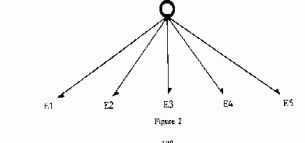
DE: I try to indicate this by the arrow in the figure:

O (E1) Õ O (E2) Õ O (E3) Õ - - -

MM: You needn’t only have one arrow.

DE: No. I am just illustrating one property being carried on.

RS: We are talking about persistence of an object, not the coming into being.

DE: Yes, about the persistence, the maintenance of a character over a route of events. Whitehead is prepared to use the term "causal efficacy" for perpetuating the pattern into a next stage. Some philosophers would say that in talking about causation we merely are talking about sequences of events between which we notice resemblances of A-like events followed by B-like events -- we distinguish the A-factor and B-factor and make a generalization that A-like events cause B-like events. Then of course all the questions about necessary and sufficient conditions and counterfactuals come up. But Whitehead isn’t talking about that kind of causation. He is talking about an earlier and later stage of something that can be looked on as one process. An analogy in the literature is W. E. Johnson’s distinction in his Logic (Vol. III) between "immanent" and "transeunt" causation. Another analogy is with what Russell, called "causal lines," where you distinguish routes within the whole continuum of nature, and saying something about one of them at one stage enables you to infer something about it at another stage. One stage gives information about what is likely to happen in the next.

CC: So we don’t have a transitive verb "A causes B," only a process.

DE: What he is saying is that one stage of the process has causal efficacy in the next.

CC: So if you divide it into segments you could say "A causes B."

DE: In fact he does divide it into segments, but they are phases in an on-going process; so his question is how one phase can pass over into another phase that sustains the same character. It isn’t enough to say you attach the same description to it. He wants to say that in some way the property is carried on. This, taking "passage" seriously, goes with saying that a stage comes to you as inheriting from the stage before, and as pointing forward to a stage just about to happen. You see this most forcibly if you make the stage very small -- a fraction of a second. You are not aware of it instantaneously, but always as coming from and going to, and the character you are aware of is a character in a process, which has inheritance and forward thrust. He maintains we do actually experience this kind of transition.

Then you can ask what kind of segments you are going to make in this on-going process. Is there a phase that, in Margaret’s term, "comes to a maturation"? Whitehead thinks there is, but how he conceives it comes out in the later books, and is extremely difficult. In those books he looks on the process as divisible into "actual occasions" or "actual entities" in mutes. Each is a unit of becoming (B) which attains what he calls its "satisfaction" and perishes. But in what he calls "prehensions," it picks up and inherits from others in the immediate past of its environment, (A), and more importantly, from the occasion which was its own immediate past, its predecessor in its route.

Figure 4 (p. 128)


I find this very difficult because he says one thing can only prehend something else when that is completed. And then it has perished, completed its pattern.

MM: And then it has to resonate, and jumps. So it can’t just perish.

DE: He says one thing can only prehend another when the latter has reached its "satisfaction." This, of course, belongs to the later books. But if it was then just dead and gone, you would lose what he earlier insisted on, that there is always a thrust forward of patterning activity from the past into the future. He gets this by saying every "subject" is also a "superject." Something perishes as that particular subject but its patterning activity is picked up, and perhaps modified, by its successor. The best I can make of this is that it is the flow of on-going "energy," in which there are phases which come to completion, but the "energy" passes on from them, and at each stage is carrying patterns inherited from the previous stages, each "actual occasion" that perishes contributing its pattern. So this on-going passage becomes a kind of cumulative memory-store of the patterning activities that make it up. Whitehead calls this the "objectification" in the present of what has gone in the past.

CC: You are talking of "past" and "present" before you have got time.

DE: There is no "before you have got time" except intellectually; true, time is a derived concept, but in actuality you have "before" and "after" in an on-going passage.

CC: You (or Whitehead) are wanting to have events tuning in to a cumulative store of effects, and say this store of effects is localized in the present of that which is tuning into it. I don’t see why you want to formulate this as a temporal process in some derived "time."

DE: If you like, whenever I use the words "past" and "future," translate them into "subvening" and "supervening" stages of the process.

CC: If you talk about a kind of "memory store," do events tune into something present in this? Or do they tune into the events themselves?

DE: That is a difficulty. Those events have perished.

CC: Then you are presupposing a derived time, and this makes life unnecessarily difficult for us.

JW: If you didn’t have time there would be no problem. Nothing would vanish or change.

DE: If you are going to have process at all, you have got to have a before and after relationship, but this can be different from metrical time, and the same event could be "before" in one metrical time system and "after" in another.

CC: You started off from saying Whitehead was bothered about the problem of continuity. It arises if you attach ontological properties to "before" and "after."

How can something that has passed be a present influence? This is a separate question from how there can be continuity in process.

JW: The first can’t arise, or even be stated, unless you have the concept of time.

CC: The concept of a time with certain ontological prejudices stuck on to it.

DE: What are the prejudices?

CC: That nothing that is past can be an influence for something present because there is no direct interaction between them.

DE: For Whitehead, a present entity takes up from one that is past, and he says the past has perished, so there can be no action on its part. What he calls the "superject" is the past entity as picked up by a "prehension." But the view of prehensions belongs to the later books. In the earlier books I think he did hold that the passage of nature was a process in which there was an energy flow in which patterns were reiterated as it passed on from one stage to another. The link seems to be the "conformation" of the present to the past.

RS: It isn’t just done by overlaps, as it might be in waves?

DE: I don’t think the perishing of one entity and the arising of another, as he talks about it in the later books, is just overlapping. The link is "conformation."

CC: What good does it do an event to be conformed to another?

DE: It gives it an inheritance from the past out of which it arises. But the "it" needs here to be seen as an actual entity rather than as an event, and it also has what he calls its "subjective aim," to complete its own particular pattern out of this inheritance, and to get going it has to have this subjective aim.

RS: I don’t think this is very satisfactory.

DE: Nor do I. The language is very difficult.

MM: Patterns can build up. But Rupert is right in saying you can t start from something completely unpatterned.

DE: There has to be a combination of "creativity" and pattern. There couldn’t be a passage of nature with just creativity. He says there has to be an initial ordering, and he calls this "the Primordial Nature of God." You may say this is just putting an ultimate problem into theistic language. But I think we must allow that to have his sort of world there needs to be a patterning activity going on all the time, producing complexity because it is carrying with it an inheritance of previous patterns and producing fresh ones as it goes on. The initial requirements are creativity and pattern.

MM: What about contrast?

DE: That is also part of his picture. The pattern is made out of multiple relations. I didn’t say much about the relation of an actual entity to its environment because I was talking about conformation as its relation to its immediate past in its own route and this is the opposite side of causal efficacy. But there are other routes, in a pluralistic world, parallel to it as simultaneous, and so not interacting. He defines simultaneity through causal independence. Things are acting on other things in their immediate past, as there can’t be mutual interaction between contemporaries -- I find this difficult. Fig. 4 showed two routes of entities, in which each entity in a route prehends its own past and a past entity in the other route. In Fig. 5, 1 show this between two groups ("societies"). The groups SI and S2 have two routes each, A and B, and C and D. I haven’t put in the prehensions shown on Fig. 4 between each entity on a route and its own past entity, or the other entities in the same society, because the diagram would have become too complicated.


Figure 5

Page 130


CC: It sounds as though each event had its forward thrust in it, and it prehends, picks up, previous events. The connections lie in the backward prehensions, and the forward thrust is in the activity of the event itself. Can prehending jump further back than the immediate past: A3 prehend B1, for instance?

DE: I don’t see why not. It is prehending some aspect of the passage which runs with cumulative inheritance through the whole routes of A’s and B’s.

CC: Is there some link, besides going forward rather than backwards, shown by arrows between A1 and A2 and A3 that makes A2 and A3 into A’s rather than B’s, (other than that A2 is prehending A1 and A3 is prehending A2)?

DE: That is a good question. I would like to think, put in easier language, that this route was what was called a "causal line" through nature. The difficulty is he divides it into these atomic actual entities which come to maturation and perish. You might say is there is a greater intimacy of inheritance between A2 and A1 than between A2 and B1.

RB: What starts the two series off as different?

DE: You mean why does Whitehead have a pluralism of routes rather than one big route?

RB: Quite so. I am waiting for one word which you haven’t mentioned -- space. They are separated spatially.

DE: Or you could put it the other way round. You have a process and you derive time from its direction.

RB: Then what is it from which you abstract space?

DE: From there being a plurality of routes.

RB: Exactly so. But why shouldn’t you just have Heraclitus -- a moving on? The universe changes. You and Whitehead have got to separate out the different routes in the universe at an instant, unless you just want to be Heraclitean, with everything in the past affecting everything in the future. How does Whitehead not be monistic? What is the origin of the pluralism of routes?

DE: I agree, Whitehead uses very monistic language in his earlier books but later he definitely has a pluralistic universe.

RB: How do you distinguish one event from another if they can occur at the same time?

MM: In the same duration.

RB: Yes. Yes. In the same duration. There is no doubt how the earlier Whitehead distinguished them -- spatially.

DE: The later Whitehead distinguishes them by giving each its own "subjective aim," to produce its "satisfaction." No two can share a subjective aim.

RB: So a plurality of events at the same moment is due to some internal characteristic of the events, not some external relation between them.

DE: I think the later Whitehead would have to say this.

RB: Quite so. That is to say, each of these has a causal efficacy to itself. There is a separate "dynamis," or whatever you like to call it.

DE. You have to say each one of these has its own subjective aim.

RB: The separation of these chains is then not spatial. Each chain has a separate internal "dynamis" -- a private conatus.

DE: Yes. Or rather each link in the chain has.

RB: So each route -- the A stream and the B stream -- shares a conatus.

DE: I think it would be much easier if they did. The conatus of A perishes with A and A1 picks up from A and has its own conatus.

RB: To use an unsuitable metaphor -- a conatus gene.

DE: Yes. You can inherit a "conatus gene," but not share the original conatus of the predecessor.

RB: So the mutes are distinguished by different conatus genes.

DE: Whitehead’s word for this would be "subjective form," which one can derive from another.

RB: Why does he say "subjective?"

CC: As opposed to superjective: it determines the way they prehend rather than their character for other prehensions.

RB: Of course, this is pan-psychism.

DE: I think if you press that everything has internal subjectivity this would he a natural way to take it. He protests against "pan-psychism," though, because he says that by "subjective aim" he doesn’t presuppose consciousness, or even rudimentary consciousness. He wants an internal activity in each thing.

RB: But he says "subjective."

DE: I agree -- I don’t like the language. I think shading down "subjective" to apply everywhere is very difficult. But the pluralism would follow from saying every entity has its own inner side.

RB: Would you want to say having the same subjective form is what individuates the chain, and differentiates one chain from another chain?

DE: I think he would say that a thing’s subjective aim perishes with it, but that its character as subjective form can be conformed to by the next in the chain.

RB: There aren’t examples. It is too general.

BE: I think it has become the wrong sort of generality. When there were objects and events, this was general, but one could see what he was after. When you give everything a subjective aim, and make this apply right down the scale, you are using language which is very difficult to make intelligible, except in the case of what Whitehead calls "high grade organisms."

RB: Does Whitehead make no attempt in his later work to construct space out of these separate causal chains, if he doesn’t have space before he has the causal chains? Is space ignored in the later works? Does "space" occur in the Index to Process and Reality? If space can be produced the book is serious. If not, not, because, as Chris said yesterday, physics is impossible without space. You have got to allow for the possibility of physics in the system.

MM: Also Rupert made a good point when he said organisms can do things, strike things, act by using their sense of touch, and this gives another kind of sense-awareness that is much more spacy, more "thingy" than sight.

RB: You are saying unless you have space brought in and the notion of prehensions sophisticated, it won’t deal with this set of phenomena -- entities, rather, as a neutral term.

MM: Rupert was trying to get organisms with a power of action that weren’t human -- they are aware of action fields in their environment. Everything is food or non-food, friend or enemy, something you can ignore or must be careful about-very sharp contrasts. They are active organisms operating with a kinesthetic sense. If not space, they have ambience around them.

DE: I haven’t yet answered Richard’s question, about whether "space" is entered in the Index to Process and Reality. The answer is yes, but there aren’t many entries. What Whitehead really discusses is the "Extensive Continuum," and the fundamental relation is "extensive connection" which was defined by notions of whole, part, and overlapping. This could go with the earlier view of events, but in the later books he connects it with the relation of prehension between actual entities in what he calls an "organic extensive community." He seems to be assuming what he had said about extensive connection in the earlier books, but the notion of the organism has really taken over from the notion of the event. In Process and Reality the language has become psycho-physiological. The organisms are individuated by their subjective aims, not by occupying separate regions of space, and the "extensive community" is formed by their relations. The "Extensive Continuum" is not space, but a field of possible relations.

RB: It is not a matter of dealing with another realm of things not in space. Biological organisms are thoroughly in space.

DE: Of course they are. According to his original way of defining organisms, they are units functioning with spatio-temporal spread. But, as far as I can see, in Process and Reality he hasn’t got a technical method of abstracting space, as he had before.

RB: There must be a logical method of showing the spatial distinction between two events. If in Process and Reality this corresponds to a distinction of what we called "conative genes," what is the relation between that and the spatial distinction of the earlier books? Not the actual construction of a space; but something more primitive. Why does this entail a distinction in conative genes? Or vice versa. If this is something extra to what there is in the earlier books, how is it to be fitted on?

CC: There are relations to the environment.

RB: "Environment" is a spatial term. Then what is the connection between relations to the environment and conative genes?

CC: Either you stick the two systems together and have some link between prehensions and extending over, or we scrap "extending over" and find some way of defining space in terms of links between prehensions.

MM: Rupert says you get space out of actions. Actions must be in some something. Whitehead’s prehensions are too floaty, too sight-like.

DE: I think the other senses come in -- take the word "prehension," and connect it with "prehensile." It is more a tactual than a visual word.

MM: When you are just looking at a pattern which you are able to prehend, the pattern isn’t anywhere out there -- as when he talks about the artist seeing a pattern at the beginning of the essay on Symbolism. But when you have prehensile organisms sticking out their tongues, there may not be a Newtonian space, but there has got to be something.

RB: When you are looking at a pattern you can be Heraclitus, seeing it changing.

DE: But unless you are taking music, and even then I am not so sure, doesn’t a pattern have to have a certain spread-outness?

CC: In Rupert’s scheme you have resonance which could correspond to Whitehead’s prehensions, but also the possibility of things hitting each other which is a relation distinct from morphic resonance. There is an interaction in morphic resonance that is different from the interaction between things hitting each other.

DE: The honest to goodness interaction.

RS: Yes, the cat catching the mouse -- pouncing on the mouse.

JW: Whitehead’s question was why the cat goes on being a cat.

DE: Yes, I think he is so concerned with this that he doesn’t give a very intelligible account of the cat pouncing on the mouse, in that interactions have to be via the past.

JW: What is his explanation why the cat goes on being a cat?

RS: It prehends the past state of being a cat.

RB: Presumably it not only prehends its own past states, but the past states of other cats.

RS: It does for me, but not necessarily for Whitehead.

RB: He can’t create more than Heraclitus did. Things that flow.

MM: He hasn’t got enough primitiveness, enough action.

DE: He uses action words, and talks about the flow as a patterning activity.

MM: I am interested in eating, which is not patterning. All changes comes from that kind of thing.

DE: I think, though he uses action words, he thinks of activity in terms of repetition, patterning. What bothers me is how he gives an intelligible account of interaction.

JW: His substances . . .

RB: Whitehead doesn’t have substances. There are properties of events.

JW: Then at two different times two slices have the same property.

RB: And so, in your language, are the same cat. They are slices of the same cat.

JW: All the talk about causation seems to be between stages of the cat, and this isn’t an example of causation.

DE: That is what I said at the beginning. I think he is under great difficulty in giving an account of causation in our normal sense of interaction between different things, because he is obsessed with causation as the relation between an earlier and later stage in the same process. This gives you time. But for interactions you need a common space, and I don’t think he gives you this.

MM: I don’t think that is right; I think in the earlier books he made a very solid attempt to get space and time. What we lack is imagination of what space is when it is not yet Newtonian space. It must have room to eat the mouse in.

CC: It depends on whether you are trying to get space by implementing this scheme at a microscopic physical level, which was what I was trying to do, or implement this on Whitehead’s earlier scheme at the level of perceptions. I think you are trying to do the latter.

MM: If you start from what is given in sense-awareness, you mustn’t later go back on it, and indeed you don’t get space as extensionless points.

JW: You might have space as a permanent possibility for biting something else in.

CC: There is no reason why you shouldn’t get space out of entities that eat each other. You would set up a distance relationship between A and 13 according to the probability that A can eat B and ask whether this distance relation is or is not compatible with what we understand by Eucidean space. This is what I am doing with my model of interacting entities.

MM: I want a stage before that, because I want binary contrasts. A thing is eatable or it isn’t.

RB A negation contrast.

CC: I only see a way of getting a distance relation by a probability. Two things either succeed in catching each other or they don’t.

MM: Then you only have two probabilities.

CC: That is a well-known problem about probability. If you only have one event it either happens or it doesn’t. In my system, as a result of the interaction of all the things going on, you can assign a number to any given pair of things and hence assign a probability that those two will or will not succeed in eating each other, if you do it in terms of eating.

RB: Chris is doing his best to incorporate a deterministic system into a probabilistic system.

MM: This makes it just an either/or system.

CC: In fact it isn’t just that, there is the amount of effort.

RS: Something comes into contact with an amoeba, and it puts a pseudo-pod round and "prehends it."

MM: Surely the pseudo-pod has a gradient; it can strike out further or less far, or more this way than that way. Response to a gradient is response to differences.

JW: I am concerned about the cat which continues to be a cat because it participates in previous cats. When this cat is eaten, there is no more cat.

RB: People who believed in metempsychosis had difficulty about animals that eat others. In reincarnation what happened to the other animals?

RS: The cat can be destroyed by being eaten, or by being run over by a car. In such cases, one could say that the destruction of the cat is due to energetic causation. But its resemblance to other cats is due to formative causation.

DE: But, Rupert, you can’t just say some things happen by formative and some by energetic causation. Say some more about "formative causation."

RS: According to the hypothesis of formative causation, outlined in my book A New Science of Life, systems such as molecules, crystals, cells, organs and organisms are organized by specific morphogenetic fields, which give them their characteristic form and organization. The structure of the morphogenetic fields themselves depends on the actual forms of previous similar systems, which act through a process called morphic resonance. Thus, for example, the form of cats is influenced by the form of previous cats, even though they may have lived thousands of miles away. Formative causation is distinct from energetic causation, but works with it: no form can come into being without energy, but energy alone is not responsible for the form the system takes. This depends on formative causation. Both happen all the time. Essentially energetic causation corresponds to the onward thrust.

RB: What is your "onward thrust?"

RS: Energy.

RB: Margaret thought there was a relation between your thinking and Whitehead’s. You can’t adopt things from him without trying to get out of the difficulties. In Whitehead there is a plurality of onward thrusts. How many have you? Are they separate, or is there one thing called "onward thrust" manifested in all the different onward thrusts, and if so, what have the different onward thrusts in common? This was the question about "conative genes."

RS: I see it as organisms striving towards their goals.

RB: Have the goals something in common or has each organism its own goal?

RS: The latter.

RB: Is a kind of organism defined as a set of organisms that have goals of the same kind?

RS: Yes. You have a plurality of kinds of organisms.

RB: Given by the kinds of goals. The classification of the goals into kinds will ipso facto classify the organisms. Does this help unless you can classify the organisms? But does that help unless you can classify the goals? What is an individual goal?

RS: The most basic one for an organism is to develop and maintain its form.

RB: The goal of an individual organism is to maintain the form of the individual organism. Isn’t this circular?

RS: I get out of the circularity by having morphogenetic fields, and an organism has a morphogenetic germ to start with which becomes associated with a morphogenetic field. This then causes it to take up the form of the complete organism. I think that the reason that there are many cats is that the morphogenetic germs are separated spatially.

RB: The individuation of cats is spatial?

RS: Yes, in some sense of spatial.

RB: Two cats are not separate by having different morphogenetic germs, but spatially. Two cats can’t occupy the same space, other than by one eating the other.

RS: Yes.

RB: Rupert starts from talking about organisms, and he also mentioned crystals. But they aren’t the paradigm case. Organisms are the paradigm case.

RS: The paradigm case actually is the developing embryo.

RB: Exactly. Something biological.

MM: He wants a set of principles that go right up from electrons via molecules to organisms, just as Whitehead did.

RB: As I read Rupert, it wouldn’t have hurt his system seriously if crystals hadn’t come in.

MM: You are totally wrong: it would hurt it centrally.

RB: How much are crystals important to your system?

RS: They are important in distinguishing what I am saying from vitalism. It is based on Driesch and in turn on Aristotle, and the apparent duality between formative and energetic causation has its ancestry in Aristotle’s distinction between form and matter. The reason why crystals are important is that if it just applied to organisms it would be vitalism.

RB: What’s wrong with vitalism? You have now got something with the disadvantages of vitalism without the advantages.

RS: I started as a vitalist and then I saw that the most persuasive argument for mechanism was that if crystals could form themselves, why shouldn’t plants and animals. I then read the literature, and found that far from the principles of crystal formation being known, they were not. Then I saw the point of the organismic philosophers treating all grades of nature as different kinds of organism. I then couched it in that way.

JW: It is a general theory of form.

RS: Yes. I have generalized something which started with Driesch’s entelechy Into what seemed a justifiable generalization.

CC: What I was asking yesterday was, what causes an atom to do what it is going to do next? Is it being pushed around by electro-magnetic forces arising from nearby atoms, or is it going to respond to morphic resonance or is it going to take some course which is neither of the two? If you are going to ask these questions, there must be a guiding thing, morphic resonance which one can analyze at various levels, and one level of analysis will be into electro-magnetic forces.

RS: That hasn’t been done, but I think it could be done.

CC: I would want to maintain that it is possible to do it, and this for me involves the possibility of deriving space from a system of morphic resonance.

RS: We presuppose a multiplicity of kinds of things with multiple copies of each kind of thing which are not occupying the same point but standing in what can only be spatial relations to each other.

CC: I’m not demanding that you here and now derive the whole of physics, but that it could be done.

RS That is a reasonable demand.

CC Either you accept multiplicity of things as a fact, and hope to get spatial differentiation out of it, or you accept space, and use it to differentiate things.

RS: It seems to me obvious you have multiplicity of spatial separation.

CC: If you have space, I don’t see how you have a primary role being played by these global forms; you have reactions in space, and if the form is defined in terms of space, that is the primary thing and not the form. The form becomes reducible to properties distributed over a region in space.

RB: Are you Newtonian about space?

CC: In a very general sense.

RS: When you try to deduce space from distance, to me the very word ‘distance" presupposes space.

RB: You are ignorant about the construction business, all of which is enormously controversial. Of course these elements are in a sense spatial because you can construct space out of them.

RS: What Chris is talking about is a specialized physical concept and what I am talking about is just distance between things.

RB: That is a specialized physical concept.

DE: Metrical space seems to me something one constructs out of descriptive space-like describing the experience of walking across the room then measuring it.

CC: I want a relation where you have a lot of entities and the relation between them can be expressed by numbers. Out of these numbers I can construct a geometrical structure: then I can construct space, and go back and re-interpret the numbers.

RS: I am using space not in a technical but in an ordinary sense.

MM: You are talking as though if you used it in a commonsense way you could understand physics.

RS: I don’t, but I don’t see what the fuss is about, and that is because I am not a physicist.

RB: No it isn’t. The point at issue is that you have one distinction which is not in spatial terms and another which is in spatial terms. If they are both fundamental, what is the relation between them?

DE: You mean the distinction of energetic and formative causation?

RB: Yes. I have toyed with the notion of why there shouldn’t be these two things, but then, as Chris says, there is the objection: what happens when you pass from one to the other?

RS: I think it should be possible to deduce things, like electro-magnetic forces from morphogenetic fields. I see what I am saying as a transitional hypothesis, not an end point. But this question of how you arrive at space was my misunderstanding, as I didn’t understand you were using ‘space" in a highly technical sense.

RB: No we’re not.

CC: If you presuppose a number of accessibility relations, how accessible a number of entities are to each other, you have two systems -- on the one hand, morphic resonance, and on the other these accessibility relations. These latter would I think have to be explained as constructs out of morphic resonance. There is at present no way of saying how the two are related.

RS: Can you presuppose form?

CC: You have got to have some basic, primitive entities, but they have to be related to each other.

RB: Yes.

DE. Rupert’s word "form" seems to me ambiguous. Sometimes he seems to mean pattern in space, sometimes something Aristotelian -- that which makes a thing what it is as being of a certain kind. Is your pattern in space an ordering?

RB: It must have been an ordering between things.

RS: You can only define form in terms of spatial distribution.

DE: Plato and Aristotle didn’t define form in terms of spatial distribution, but more in terms of what we would call definitions -- what it was to be, say, a cat.

RB: Yes, the essence of a cat.

DE: So it becomes a matter of logical definition, and you get the problems about "essential natures" and so on. Aristotle indeed thought these essential forms were active ingredients in things coming to be, and sometimes you seem to use "form" in this sense. Aristotle thought somehow a thing was trying to reach its form.

RS: I daresay most of the implications of Aristotle are present in what I am saying.

CC: If we are looking at primitive things and what can be derived from them, I don’t see why Rupert’s forms should not come out as spatial distributions in some circumstances and also as principles defining what it is to be those sorts of things in other circumstances. That doesn’t worry me.

RS: Um!

Chapter 3: Space and Time

Participants: Chris Clarke leading; Margaret Masterman, R B Braithwaite, Dorothy Emmet, Jonathan Westphal, and Rupert Sheldrake participating

CC: I will first describe the source of my current interest in Whitehead’s ideas on space and time. Then I want to pick up from the remarks I was listening to from Margaret yesterday morning, and then go on to the particular ways I am thing to think about space and time at the moment.

A Whiteheadian position seems to be required by quantum mechanics. Quantum mechanics is usually presented in terms which are extremely heterogeneous. There is the "state" out there which is observed -- to some it is observed by mind, so this is explicitly heterogeneous. Most people for obvious reasons don’t like the state being observed by mind, and they say "the observer," but this is a cop out: It is more honest to call it mind. Now my previous attempts to get round this may have been another sort of cop out. I wanted there to be macroscopic forms as an essential ingredient in the theory, and these exerting an influence on what happened by providing a sort of filter into which the causation of quantum mechanics had to direct itself. But when one introduces macroscopic forms as well as the conventional forces of quantum mechanics one still has a sort of heterogeneity, though it isn’t between mind and matter. So once again there is a requirement for homogeneous thinking not based on this bifurcation of nature. The example of homogeneous thinking Whitehead develops concerns space and time; presumably he thought one could pursue the same sort of analysis in other fields. There could be generalizations of Extensive Abstraction applicable to colors and so on, but the particular example he develops concerns space and time, where proceeding from perceived events one achieves points as ideal limits of a series of approximations. I think the derivation of space and time is a primary necessity in any Whiteheadian scheme. On the one hand if you presuppose space and time, I suppose most people would find themselves led into bifurcated thinking, which is essentially the conventional position. On the other hand you have got to have space and time to make contact with any conventional science at all. One cannot make statements comparable to conventional science if you don’t have space and time. So you cannot embark on any sort of Whiteheadian scheme if you have not some idea of how you are going to get space and time out of it. The particular way he gets them is, I think, basically inconsistent with his own principles; he gets space and time by staring off with the duration and then passing to what yesterday we called the "duro." The duration is something perceived, with structure in it because of one’s focus of attention. A "duro" has a much more generalized connotation, It is shorn of its attention focus and is globalized. The duro is supposed to be a slice of the entire universe, whereas we certainly don’t perceive a slice of the whole universe: we perceive a chunk of it. The second way in which his approach is inconsistent is that duros are supposed to obey axioms which are contrived to give Special Relativity. Nothing in our experience corresponds to these axioms, and their introduction is a glaring peculiarity in his development. What is more, his derivation of space depends on them. If one had the axioms of Galilean or Newtonian physics one would not get space as Whitehead gets it. But space is so basic in our experience that there is something rather fishy about a development that has to introduce Special Relativity to get it.

RB: When you say "Special Relativity" you mean essentially Lorentz transformations?

CC: Yes. So just on a logical level I find his approach unacceptable. I also find it unacceptable scientifically because if one is approaching it from our current understanding of Relativity, the thing that corresponds to our awareness of the universe over an interval of time is not a simultaneity slab, because in General Relativity there is no such thing. It is a thickening of our past light cone. It is a perception of what we can see, and what is fairly immediately causally related to us. At the time when Whitehead was writing The Concept of Nature, and also when he was thinking about the theory of Relativity, it was still possible to adhere to a Special Relativist view of the Universe. Now with the very strong tests of the Equivalence Principle which have been done it is impossible to have this, so one has to presuppose a General Relativist view of the way space-time is, where there is no natural definition of simultaneity relative to an observer. This means I am dissatisfied with his derivation of space and time and in particular I want to reject duros. On the other hand the concept of the duration alone, while it is adequate for time and for understanding the flow of nature, cannot, as I see it, give you space. One requires more structure than is inherent just in durations. So in order to get space as well as time, I want to go back to his concept of events, as a more general category than durations, and regard events as constituents of durations, with the connotations of maximality which inhere in the idea of a duration. Durations can be decomposed into events which are contemporaneous in a particular perception of them.

MM: Durations have what he calls factors, and I call aspects, which enable you to discriminate.

CC: When I talk about events, I am not talking about factors. In speaking of events, he introduces "factors" which give rise to objects and so on.

DE: I don’t think you can say the factors give rise to objects: the objects are factors. Events are perceived as having qualities, patterns, and when you single these out you call them factors. You can’t have a bare perception of events and start putting objects into them.

CC: No. That’s right.

MM: I query that there is nothing spatial in durations. Dorothy wanted to say they had spread. The problem about a duration isn’t so much its relation to a particular percipient as whether it is a visual or a tactual, an auditory, an olfactory duration, or several of these. They all have different imagined universes they live in.

CC: So you think durations have enough structure to give rise to space?

DE: What they have are what Whitehead calls "events in unison of becoming" -- this is where the families of durations with parallel events come in. You are aware of these, and these produce already a spatialized notion. Whitehead would talk about "regions in an extensive continuum" -- not space in the sense of a measurable grid.

CC:The relations durations can have with each other is that of "extending over." If one restricts this simply to durations, then unless you bring in Special Relativity axioms, all you can get is some sort of time.

DE: Whitehead doesn’t think his relation of "extending over" is only extending over in time.

MM: When I look at that window, however much I focus I see two bars, not one. This is why in Richard’s example yesterday of the two clocks striking at the same time, if you heard the one you heard the other. Durations are given in sense-awareness, and what I am looking at is spreading in its nature.

DE: It has seemed to me that what Whitehead calls a duration is much more a spatial than a temporal concept. What he calls the Extensive Continuum is four-dimensional, with regions in it. You are wanting a more conventional space, Chris.

RB: He is only wanting to separate space and time.

CC: Certainly it is the case with duros that if one does not impose Special Relativity axioms, all one can get out of them is time. The relation of "extending over" as applied to duros is not sufficiently rich to give one more than some sort of time. My own feeling is that when Whitehead introduces the term "durations" he has at the back of his mind duros and is wanting to de-focus as far as possible. What we need is a duration that still preserves the focussing.

DE: Isn’t this where that note to the Principle of Natural Knowledge comes in. He says when he wrote the book he was thinking of durations too much just in terms of "extending over," and he brings in the notion of "cogredience."

CC: Cogredience is a relation between events.

DE: It is a relation where one is a percipient event.

CC: I want to make a logical leap, which I shall claim is a smaller leap than that taken by Whitehead. I was saying earlier that if one wants to do physics one has got to get space, and I didn’t want to do it the way Whitehead did. So the question is how do you do it. The scheme I have been looking at is very far from full implementation of the ideas we have been discussing. I have been looking at a set of entities with some sort of relations between them which I hope is capable of being developed more in the direction Whitehead wants to have it developed. But it is still very materialistic in Whitehead’s sense. I have a temporal succession, though not a succession of instants. It is possible to say one thing happens later than another thing, so temporal succession is presupposed, whereas Whitehead, I think, would want temporal succession to be deduced. I was thinking of my entities as analogous to events, though in view of what we have been saying I would like to push them in the direction of durations. But right now, they are very thin things with very abstract properties indeed. To go through Whitehead’s materialist trinity: my events are chained together in succession, and so far as they are, I have material entities. To some extent space arises out of relations of these material entities. But I don’t think these are essential to the scheme. It would be possible to remove material entities and temporal succession. Also it is not a relativistic scheme. The relation between my events is different from Whitehead’s. Whitehead’s is the relation of extending over. I would like a scheme in which events are related by something other than extending over -- one, for instance, of being a recapitulation or reflection of another.

RB: If you want the logic, you ought to look at Russell’s Analysis of Matter where Russell disliked Whitehead’s Extensive Abstraction for purely technical reasons. It requires an existence theorem for an infinite number of events. If you have a limiting process, you have to have an infinite number to specify a point. Russell did it by overlaps of events.

A point for Russell is the class of things which overlap, and he thinks this doesn’t need an infinite number. This is a technical matter.

CC: I think in a full-bodied system one would want both a relation of overlap or extending over and probably also a relation of resonance or recapitulation between durations which did not extend over each other. I was looking at systems with some external relation other than extending over. I then looked at whether it was possible to get space out of entities with some sort of relation like this. One of my motivations in this was the quantum mechanical. I took the simplest system, where my events were two-state systems with only two possibilities. I was representing them quantum mechanically in the usual quantum formalism for possibilities. The relation between any two events was the natural quantum relation between their possibilities. Between any two events it is possible to say whether two aspects are similar or dissimilar. I was also allowing this relation to be stronger or weaker on a continuous scale. I was then looking at the possibility of chaining these recapitulatory relationships together -- if you had a relation of A to B to C to D, I could automatically set up a relation of A to D.

DE: It is transitive.

CC: The relation itself is not transitive, but given a set of relations, one could define further relations by chaining them together. The dynamics of the situation was that there was an evolution whose effect was to make the relation transitive, so that it became the average of the relations you got by chaining them together. I was looking at two systems in this way. One was a large number of elements I was simulating on a computer. The other was the continuum analogue of this, where you have a very large number of entities and treat them statistically. In both cases the entities do evolve to a three-dimensional structure, in the sense that you get a three-dimensional distance geometry out of them. As far as it has gone, I am satisfied that it is possible to get space out of this network of relationships, and you don’t need duros or Special Relativity axioms. It is sufficient to have any sort of relationship which at a minimum has the sort of quantum mechanical relation I was indicating in it, to give space as I have tried to get it. So what I have got out of this is that I want to take this relation and thicken it up. There is a structure there whereby one can get space, and I see no reason why one shouldn’t get space-time if one drops the assumption there is a fixed temporal succession.

MM: So you don’t get a conventional Newtonian space and time?

CC: In the way I have been doing it, with temporal succession in, you get space rather than space-time. What I have been doing on the computer is represent these things in a large number of dimensions and then I have a scheme by which you can look on them on a screen from any angle. If you look on them as they develop, they squash down to a three-dimensional slice.

MM: Automatically?

CC: It is not completely reliable -- they do a lot of the time, but they sometimes seem to screw themselves up. It depends rather critically on the number of dimensions you work in. If you work in a high enough number they form a nicely balanced two and three-dimensional slice. If you work in too few they screw themselves up and fold over.

DE: To ask an ignorant question, what makes this happen? Is there a sort of averaging out?

CC: Yes. I am putting points in the dimension I am working in at distances that reflect their similarity. So two whose relation is very dissimilar are a long way away, and it is an averaging out of the chaining together of the relations which causes these relations to evolve.

RS: "Evolve" means become more similar, does it?

CC: There is a temporal succession. You set the thing up and average Out at one time, and that is what it looks like at a later time.

MM: So you have got time in as well as similarity.

CC: It needn’t be there. I can do something with it. That’s all I want to say.

RS: Good heavens. That is a real cliff hanger.

CC: I think the development of getting space and time is now separate from the development of seeing how this relates to morphic resonance. The main thing we want to work at here is thickening up these concepts. At present all I am trying to do is to get space and time from concepts that seem roughly along the right lines. But I am miles away from seeing how you could get both morphic resonance and Schroedinger’s equation.

MM: If we get rich durations, aren’t we going to get morphic conformation and moiphic resonance and morphic jumping long before we get space and time?

CC: Precisely. They are going to be different developments, and space-time an extremely lengthy abstract development and morphic resonance an immediate thing, whereas on the conventional way of looking at it, it is the opposite way round.

MM: We are turning the whole thing on its head, so what needs accounting for is how G. E. Moore’s common sense ever got going at all.

DE: Do you mean by G. F. Moore’s common sense Newtonian space and time?

CC: The hypothesis we are thinking about is about what is going on among elementary particles, which we don’t know anything much about. What we see is the end result, which is of the same nature as the process itself. The way we get our ideas of space could be through Extensive Abstraction and so on -- I don’t actually think it is.

DE: I have heard you say Special Relativity was now only thought to be a local theory.

CC: Yes, if you are thinking of the universe as a whole in the way Whitehead does in his duros, it is now not consistent to use Special Relativity. It is a local theory which can be applied anywhere.

DE: You also said it didn’t answer to anything in our experience.

CC: Our experience is Newtonian.

MM: It is touch that gives you space.

CC: It is action -- movement. This is why I was expressing doubts as to whether Extensive Abstraction actually corresponds to the way we get our intuitive idea of space.

MM: If you go about with your eyes shut, you get a very atomic view of space, not at all like anything you see. I don’t think Whitehead faces how different senses give you totally different durational worlds.

RS: On my view all senses give possible actions. Visual sense gives possible actions involving movement towards things distributed around us. Auditory sensations to some extent give that; olfactory a different kind of potential response, and you have a whole set of sensory potential action fields which have different properties depending on which sense. An amoebae which doesn’t have eyes has a rather limited set of fields, in response to contact. When you have organisms with eyes, they have more extended fields of potential action. Bats have a field that comes from the specialization of the auditory sense. Electric fish which swim about in muddy rivers have electric fields, and through these get a sense of where things are around them. These fields give senses of objects near by to which they can act or react. I think this is how it is built up. The only things in these fields which influence us are things on which we could potentially act. Organisms on the whole don’t respond to things they can’t act on. Birds respond to things that mean something to them -- they hear the song of other birds, or alarm cries, and there are a lot of other things to which they are indifferent. They soon habituate to the general background.

JW: To what potential actions is color sense a response?

RS: A robin responds to the color red, and so does a stickleback, because this is a sign of another male in the mating season. Outside the mating season it doesn’t respond much to that color. You have what the ethologists call fixed action patterns that are inherited, in this case those which give in-built responses to certain colors. I think the color responses are inherited in these cases. In our own case I think we have such sophisticated potential actions we no longer have these simple instinctive reactions. We then start abstracting and talking about colors just by themselves. I think butterflies when they respond to other butterflies of the same pattern, or animals when they run away from something striped respond in a fairly simple way to particular patterns of color. These fixed action patterns are what I call motor fields. They can be in response to different sensory things -- smells or colors. Gypsy moths respond to the smell of the female and fly towards it.

MM They respond to a whole pattern, and it can be a multi-sensory pattern.

RS It needn’t be.

MM: No, but it can be.

JW: The message from Whitehead seems to be that in thinking about perception you have to start from more basic things -- what you call fixed action patterns -- and then go on to the more sophisticated and abstract.

MM: The more bare (in the sense of raw) it is, the more comes into you at once, and you then can abstract one aspect. Then it is not so bare, but is simpler.

JW: With children I believe that all the color terms came in a bunch very suddenly, none being used properly; and secondly, they are associated with liking. The child can call the color "red" because he is interested in it.

MM: "I like a banana and it is yellow."

JW: It is not a mastery of color terminology by itself.

RS: In other words, there are potential actions. Like and dislike involve potential actions towards things. So the point of the ethological account is that there is always an association with potential action. Only things involving potential action are noticed. Animals notice novelties in their environment because anything new could be a threat. You usually get avoidance responses to anything new. Then if it doesn’t do anything, they rapidly habituate and cease to respond. So, so long as the background doesn’t change it doesn’t provoke response. Changes trigger off action patterns.

CC: Of the things given us, dominant are patterns which arise from our vision, which are linked with space -- concepts like nearness. But there are other things given to us as well which we can interpret by non-standard space.

MM: If your olfactory sense is your main one, or if you live in a marsh, half in water, half out, you will get "half in, half out of water," but not much else.

CC: If there is anything in the idea of trying to start with what you are mainly given and working from there, you would hope that whatever you started from, whether you were an electric fish or what, you would finish up with the same things, but in different orders.

MM: I don’t think you end up with the same things, you end up with lots of local universes. We can’t yet ask the electric fish, but maybe one day we shall be able to.

CC: You have a lot of local universes based on potential actions of organisms, and they overlap. After all, we can see and catch an electric fish and it gets involved in our set of actions. Animals respond to other animals though they have different perceptual universes, so they overlap.

MM: But you can’t presuppose the Newtonian overlap is the ultimate overlap.

CC: I never said so. What I said was when there was an overlap, and you can make comparisons. For instance, between our perceptions and those of some hypothetically intelligent dog, we would describe the smell relation as secondary to the space relation, but the intelligent dog may well have the smell relation as primary and the space one as derivative. But, being who we are, I think we ought to start from there.

DE: We mustn’t, though, be imperialistic about it.

CC: One plays with different descriptions when one is doing a scientific description. We postulate entities like electrons whose relationships make a totally different universe, and if one does that there is a peculiar concept of space that bears no relation to our intuitive one.

MM: Rupert has been needing a crude three-dimensional space for actions, not a relativistic one.

RS: For me, what is primary are organisms and their fields of potential actions. I think we experience these ourselves, and, as well, this is primary in nature. So if we want to build up a world with space and time, I don’t see why you have to start to get them early on -- why we can’t start from organisms and their in-built action patterns which are inherited from actions or memories in the past. These are fundamental facts from which we start.

CC: I agree, but if one is talking about how things go on, you seem to have a conflict between two ways of looking at it: one is starting from organisms and working down and the other is starting from space-time and working up. This I am worried about. If you get space-time out of the organism, then there shouldn’t be a conflict. Can one see on the horizon any way of starting off from wholes? But without taking the Special Relativistic course Whitehead does, how can one finish up getting space-time?

DE: Could we just be reminded of your objections to how Whitehead does it?

CC: In order to get space, he puts in axioms which are essentially Special Relativity axioms for incidence relations about intersections of limits of durations. These are axioms of a geometrical nature.

RS: My view is that fields associated with organisms give things tendencies to develop in particular directions, and the universe is made up of vast numbers of overlapping organisms, and that these are in conflict with each other through their overlapping. Out of these conflicts you get energetic processes of change. One kind of change is this moving change; the other is inner change as organisms develop. The mechanistic view tries to explain all kinds of change in terms of the relative movement of things; but there is also, especially in living organisms, an inner kind of change which is goal-directed. Some kinds of change due to movement can be studied in isolation, and then you get a physics model trying to explain everything in terms of that, but I am suggesting that inner change is primary.

CC: But if you work on those lines, how do you get mass x acceleration force? You can only do this if you look on these fields as they arise from fairly large scale organisms. You have got to apply these same criteria across the whole board.

DE: You, Rupert, are taking a rather extreme "philosophy of organism" view.

RS: Yes -- I think changes arise ultimately from inner teleological change -- even gravitational change.

RB: You think gravitation is to be explained in a goal directed manner?

RS: Yes, I do.

DE: Teleological in terms of the goals of what?

RB: You know, Dorothy -- "Every body finds its own place" (Aristotle).

RS: I can’t answer about gravitation. I can answer about electro-magnetism. In my view this arises from the striving of partly completed atoms and molecules to complete their forms by capturing electrons. The atom takes on an electric charge only when it is incomplete. When it has the right number of electrons it becomes electrically neutral, and one can consider electro-magnetic fields arising from the morphogenetic fields of atoms and molecules.

CC: This will only give the thinnest fragment of electro-magnetism. Electro-magnetism has quantitative laws. On your principles the nature of things is to describe things like atoms interacting. But how do you get quantitative laws Out of your morphic resonance? If at the sub-microscopic level you have simple entities, you need to have not only vague appetitions but some hope of getting to the Lorentz force law, which is the particular mathematical law known to determine the motions of electrically charged particles.

RB: How are you going to get the relation of perpendicularity? What is Rupert’s spatial pattern, and what is the notion of dimensions in it?

RS: I don’t see why you shouldn’t start with organisms as three-dimensional.

RB: What is meant by three-dimensional? If you just say you have a three-dimensional space, I think Chris is right.

RS: Why can’t you start with forms of things?

RB: What is a form? If it has geometrical characteristics you have got to give it a geometry, and then you instantly start on transformation theory and the mathematics of it.

DE: Is a form meant to be a spatial distribution?

CC: If not, and the forms are first given you, you have not got spatial structure.

RB: Yes.

CC: If you are given forms and not space, how are you going to get space out of them?

RS: You have to presuppose you have a multiplicity of forms interacting with each other. One of the ways they interact is through space.

JW: Why not say they interact by eating each other?

RS: By eating each other is one way.

RB: If you have got these forms, you have got to specify what their relations are. If you say the primary one is eating, I take that to he a spatial relation. Eating is something inside something else.

RS: I don’t see why one has got to build up everything a priori -- space for instance.

RB: My trouble with you is as with Steiner -- you have a fine metaphysics and then put in all the things which are inconsistent with it. You don’t reject physics, you use it when you want to. You should produce another physics.

CC: As a pragmatic device you have to refer to existing physics. But it shouldn’t be essential. Obviously in explaining your form and how it works in biology you presuppose physics. But it shouldn’t be a necessary part of the system that you are given both space and forms.

RB: Then please do it. You should define the relations, and get the notion of dimensions -- Whitehead and Russell tried to do it with regard to events. If you want to know, I would take your word "eating." Eating is a relation -- is it transitive? Yes. What sort of series does it illustrate? Is it completely ordered or partially ordered? You have got to have a topology to get dimensions. I think you might get a topology out of eating, but do it.

JW: You might get "nearer than" out of eating. You could see how with some organism its experience of space arose out of this.

MM: Sticking its tongue out and chewing.

JW: The primary thing is trying to kill the thing with your paw.

MM: Lots more have tongues than paws.

DE: I see a difference between what Whitehead is trying to do and what Rupert is trying to do. I don’t know if I am misrepresenting Rupert by saying he is taking a lot of normal science, and space and time, and pushing in what he calls formative causation. Whitehead is seeing that if you are having a radical view, starting from events and flying to get space-time, with his insistence on sense-awareness and durations for the strong notion of an event, this is going to affect everything all along the line.

RS: I agree, he is trying to do something more fundamental. But if one is going to start by doing something more fundamental, I think his notion of organism is likely to be more helpful than what are to me these extremely confused notions about events.

RB: For me this isn’t helpful till you say something definite about the organisms. Eating is quite an idea.

JW: "Distant" is derived from "it got away.

RB: You could get partial orderings, and then dimensions out of partial orderings.

RS: Organisms act more on things nearer to them.

RB: You could impose a metric on these simple orderings and get numbers. But you haven’t yet got dimensions, only one set of numbers.

CC: Rupert, you are thinking of eating not just as a relationship, but a quantitative ability of A to eat B as having real structure.

RS: The thing about eating is that an organism feels hungry; you have a motor field for hunger, and the organism searches for food. The actions will depend on the distance. If it is very near it pounces. Then it starts putting the food in its mouth, and it is assimilated into its body. I think the capture of molecules from solution by a growing crystal is rather like this and so is the capture of an electron by an ion. It involves a similar kind of appetite and its potential action on the electron depends on its distance from it, and it can engulf it in its orbital.

CC: I think this is fine; if you have a probability that A will succeed in eating B, you have a sort of metric, and then you have to explain how, in the space thus defined, if protons and electrons want to eat each other they obey the Lorentz force law.

RB: Yes, yes, yes.

CC: I am demanding it should be possible to see how this would be done.

RS: You might have to bring in other electrons in competition. But I’m not bothered about the Lorentz force law. It is not something I think about

RB: Then you are not producing a physical system. Or you could say this is an explanatory notion not in terms of physics at all. But then you would have to say something about the relation between the two explanations. This is a trouble I have over explanation by motivation as reasons for doing one thing rather than another. You consider crystals as organisms. It is very difficult to remove them from the realm of physics. Structures come in because the number of crystalline forms is limited.

JW: I like to say electrons want something.

RB: Then we aren’t responsible for Hiroshima. It was these wicked little electrons. No, No. We can’t get out of it like that. Perhaps you could keep a pack of electrons.

JW: Well-trained electrons.

RB: You starve them and they tear your opponents to pieces.

JW: You whip them up.

RB: That’s right.

Chapter 2: Events And Durations

Participants: Dorothy Emmet leading; Margaret Masterman, Richard Braithwaite, Rupert Sheldrake. Jonathan Westphal, and Chris Clarke participating

DE: I can’t produce as good passages to read as Margaret did this morning. What Whitehead says about events and durations is scattered through a number of passages, so I shall have to try exposition. It is vital to start from the fundamental idea of "the passage of nature" -- that something is going on. In his early books Whitehead divided this into events -- Here is a rough sketch.


Figure I p. 103

The fundamental relation is "extensive connection." One event AB extends over another, CD, and that over a smaller, EF, and that over another, GH. So the event we call the happening of this week extends over that we call today, and that over this discussion and that over this sentence I am saying. You go down into smaller and smaller events extending over other events. But you never get down to an event at an instant except as an abstraction. I will say more later about how he shows approximation to this in his "Method of Extensive Abstraction" when we get on to how he tries to bound events. Events, then, have a spread, and extend over others. They are divisions in the passage of nature, and where you draw the boundaries between events seems to me to depend on how you want to describe them, e.g., "What is going on in this discussion." But to be able to talk about events, you have got to qualify them by what older philosophers would have called "universals" and Whitehead calls "objects." I think this use of the term "object" for general terms, "green," "round," "man," is very confusing because one normally wants to use "object" for "something out there." But when Whitehead uses "objects" as contrasted with events, he means properties or qualities. Again, there is obscurity, because he uses the term "ingression" as though the object was something existing (or "subsisting," as was said in the controversies about abstract entities round about 1910) which "ingresses," comes into events from outside. This suggests a Platonic interpretation of Whitehead, which I indicate in this diagram:

You have the object in some external wherever, entering into a series of different events. If the object "ingresses" ab extra, where is the extra, and what kind of status do you give it? I would be happier to push him in the other direction, which is suggested when he talks of objects as "Aristotelian adjectives" of events. In this next diagram, you have a route of events over time, all characterized by the same object, and "ingression" would here not mean "coming in," but being an "ingredient" in the complex fact which describes the situation over the route of events.

0 (E1) -> 0 (E2) > 0 (E3) > 0 (E4) -> 0 (E5) -.

What we have in experience is one qualified slice of the passage of nature passing over into another. How it passes, and how this character gets transmitted from one slice to another, are among the questions we are interested in, but at this stage we want to go on and look at "durations."

CC: Are events purely temporal, or both temporal and spatial?

DE: They are both. The slices made in what is going on are made both temporally and spatially.

MM: Isn’t this a duration?

DE: The event is a more abstract notion than the duration. The duration consists of events with qualities as contemporarily related to a central event he calls "percipient" (this doesn’t have to be conscious).

JW: Can you explain what the arrows mean in the diagram.

DE: They indicate what Whitehead would call a "route of events" -- for instance, the event we call this table yesterday, and then this table a few seconds ago going on into the table now, all qualified by the object word "table," so that we say "Here is this table again."

RB: It is a history. I would call an event a bit of space-time.

MM: Is an event a pattern?

DE: The pattern is the objects qualifying the event.

JW: Would "this is an orange elephant" be an example?

DE: There would be an orange slice of elephantine history, or rather, of history with an elephantine quality. What we have got are qualified slices of the passage of nature with further slices in which you recognize the same quality. The difference between "event" and "duration" is that the earlier Whitehead was talking about the passage of nature, which you slice into events, with the fundamental property that one event can be taken as extending over a lesser one, and so on (Fig. I). In an important note he added later (in 1927) to the Enquiry Concerning the Principles of Natural Knowledge he says that book (of 1919) was dominated by the relation of Extensive Connection, but this isn’t sufficient.

Note II. The book is dominated by the idea [cf. l4.I,p. 61] that the relation of extension has a unique pre-eminence and that everything can be got out of it. During the development of the theme, it gradually became evident that this is not the case, and cogredience [cf.§ 16.4] had to be introduced. But the true doctrine, that ‘process’ is the fundamental idea, was not in my mind with sufficient emphasis. Extension is derivative from process, and is required by it. (PNK, 1927, 202)

Now he has two fundamental relations -- that of Extensive Connection (extending over), and that of "Cogredience." Cogredience is taking a particular locus in the passage of nature as a point of origin; he calls it a "percipient event," but it isn’t necessary that percipience should mean anything like conscious perception. It may be like the observer in some relativity theories, that can be an instrument. It is a locus which gives a point of reference. But by calling this a "percipient event" he then goes on to a duration as discernible from a percipient event. This can be bounded, but bounded in wider and narrower ways according to the ways it is related to the percipient event and the emphasis this gives. So the relation to a percipient event gives a point of origin, a "here -- now" and the duration is- related to this. It is a slab in the passage of nature from this point of origin. I think, though, there is a difficulty about using "percipient" in a very general way as point of origin, and as "discerning" a particular slab of the spatio-temporal passage called the duration. I think he may put it like this because of what he says in The Concept of Nature -- that nature is what is disclosed in sense-awareness -- and he uses a sense-awareness word. So here a duration is a qualified slab of spatio-temporal extension of which you are aware.

MM: If you are thinking homogeneously, why do you want a percipient, and not just what is perceived?

DE: You want the percipient because you want a "here -- now" and if you haven’t got absolute space and absolute time, you have to have a focal point.

RB: Cogredience gives you a here -- now. This can be one way of taking the body-mind problem. One event differs from others as the focal event. The problem about naturalistic views of perception is how you get the mind into nature, and I don’t think anyone has solved it.

CC: You said a duration was nature in a temporal spread from a focal event. Is there a difference between events which are durations and events that aren’t?

DE: An event is distinguished from the objects which qualify it. So in that sense it is an abstraction, and can be thought of out of the context of a duration.

MM: So the duration is the real thing.

DE: The duration is the real thing.

MM: Do durations, because they pass from past to future, maturate, come to climaxes? Because if they do, that cuts across having percipient events.

RB: The motivation was to produce the frame of reference for Special Relativity. As Russell said, the observer could be a camera.

DE: This is where I think he is ambiguous about "percipient."

RB: He is thinking physics at the same time as the psychology of perception.

DE: "Percipient event" gives nature as discerned in sense-awareness, and can also be used in this Special Relativity sense.

RB: The percipient event is clearly a spatio-temporal reference point.

DE: Yes.

RB: Is the "duration" the time element in the percipient event?

DE: The duration is a spatio-temporal spread; going now to the other sense of percipience, it is the spread taken in awareness from what he calls "our observational present"

RB: This is the time, not the space part.

DE: It is spatial as well.

RB: Calling it "duration" refers it to the time axis -- making a division, relativity-wise, out of the theory of space-time.

DE: He sometimes used William James’ phrase -- "specious present," and this can be enlarged to "the whole of nature apprehended in our immediate observation."

RB: "Immediate" is temporal.

DE: The duration has a kind of completeness that marks it out as a special kind of event -- all there is of nature with certain temporal limitations.

MM: Then it has no edges -- you can’t have a minimum or a maximum.

RB: There is no limit to its spatial extension.

MM: You haven’t got time, you have only got passage, and you haven’t got space.

DE: If you are meaning space and time as absolute, no. What you must have are space and time derived from how passage is divided up. But instead of dividing them up in a very abstract way, as with events extending over other events, you are making your division by taking a slab with reference to a focal event.

RB: He is wanting to produce a series with arrows, the terms in which are "occasions." The occasions can be infinitely extended spatially.

MM: I want to keep out "infinite" and "space." You have passage with a continual re-imprinting of pattern (space and time are abstracted a lot later).

CC: In the Enquiry Concerning the Principles of Natural Knowledge he tried by axioms to single out by their formal properties spatially maximal events, and then in the note he says he found this was impossible, and therefore he had to single them out by a different means, namely durations defined by their relation to some percipient event.

DE: I think he was trying to make a bridge between sense-awareness and these more formal properties by saying that in sense-awareness you are always aware of -- can I say, a spread? Something is temporally going on, but it also has a spread, and he says the spread is the whole of nature -- or rather, of contemporary nature: roughly, it is the present state of the world. Then he says parts of this are discerned and the parts that are discerned have reference by relatedness to further parts that aren’t discerned. What you call the present has reference to what is past and what is coming; what you call this room has reference to what is beyond it. So in principle you can speak of the whole of the contemporary world as this phase of the passage of nature.

MM: But you can’t talk about what you are not perceiving.

RB: Oh yes you can.

DE: It is fundamental to Whitehead that what you perceive is always related to what you aren’t perceiving. For instance I am aware of what I perceive at the present moment as arising out of what I was perceiving a moment ago.

RB: It would be simpler if he had said that a duration was everything simultaneous with a specious present.

DE: He says you are aware of events as simultaneous in the same duration.

CC: The trouble here is he wants things linked by some physical kind of relatedness which is caused, but also another kind of togetherness which is the simultaneousness. The things that make up a simultaneous slab cannot be causally related.

DE: Whitehead defines simultaneity by causal independence.

MM. I think he not only has two things at once, but three things. As well, he has this primitive model of sense-awareness, where you never, so to speak, find what is happening in the present awareness, only in the next one, because nature is always rolling on; but there is a printing and re-printing of pattern where the next one may or may not be the same as the first, and patterns may maturate -- build up.

DE: If we stick to the idea that a duration is a qualified event, not just an abstract event, and also complex, it has a pattern.

RB: It is not specified by its pattern, but by its simultaneity with the "here -- now."

DE: Here is a passage:

The unity of this general present fact is expressed by the concept of simultaneity. The general fact is the whole simultaneous occurrence of nature which is now for sense-awareness. This general fact is what I have called the discernible. But in future I will call it a ‘duration’, meaning thereby a certain whole of nature which is limited only by the property of being a simultaneity. (CN 53)

He talks of events in durations that are parallel to a given duration, and which don’t interact causally. Then you are getting towards space and time.

MM: But in the opposite direction to the one I want to go. I think Dorothy is trying to disentangle the two, if not three, ways in which Whitehead is talking without realizing it, so she has a horribly difficult task.

DE: In a duration from a position called "percipient" -- can I say it is a spatio-temporal spread?

MM: You lose the passage of nature if you do.

RB: No, no, the time dimension is there.

MM: You lose the arrow.

DE: No, the passage of nature is always going on, and in the going on, you are aware of this spread.

MM: The passage of nature needn’t be uniform. It can have bumps.

RB: You must get something uniform first, and then discuss the bumps after.

MM: Can you define for me a "family of durations"?

DE: Whitehead speaks of a family of durations where one contains another, or where they overlap and so produce a duration common to both, or where they are entirely separate, that is, presumably, contemporary. Durations are excluded from forming a family if they contain events with no overlap, as would be AC with CE, and FD with DE, in my Fig. 1. AE and FR would not be a family though they are both within AR.

RB: "Family" is used by logicians for groups or classes.

CC: Do you think Whitehead is trying to do this for any reason other than that he is trying to get Special Relativity?

DE: I think he wants to emphasize the passage of nature and sense-awareness, and a duration is a slab of the passage of nature disclosed to sense-awareness. But I think his definition of a "family" is topological rather than given in sense-awareness.

MM: A duration has no boundaries, no minima and maxima, and has the impact of the past and the anticipation of the future, unless you de-fuzz it. You de-fuzz it by having what I would call aspects and he calls "factors."

DE: If we come back to the difference between events and durations, the events have to be bounded under some description, whereas the durations are bounded by reference to some discernibility from a focus. You may be talking in a wider or narrower spread from this. Your breath groups, Margaret, in your model of language, might be relevant here, as, if I understand rightly, they are natural units for taking in hearing, and in that way they could be bounded durations.

RB: They could be specious presents in the good old Jamesian sense.

MM: What is wrong with specious presents is they don’t have any maturation, any structure, any emphasis points? When you have sense-awareness it will have these, and be repeating itself.

DE: I’d say that the bounding of a particular sense-awareness, when you are making it narrower and wider, will be in terms of some emphasis point -- what attention fastens on and what becomes background. I think a duration will get bounded by the emphasis you are giving in this discernment, whereas an event can be bounded by any description you put on it.

MM: So we needn’t really have events at all.

DE: There are events in durations and events beyond durations.

MM: You can have them if you like, but they are optional. But you must have durations on a Whiteheadian view of the world.

DE: If you are talking about sense-awareness, as he does far more in The Concept of Nature than in The Principles of Natural Knowledge, which is more abstract, then you are talking in terms of durations, where you have points from which you are aware.

MM: If you have an emphasis, you are still talking homogeneously, because the emphasis is in the awareness. If you have structures of which some parts are noticed more than others, from this you can build up pattern ih passage. And if you add the possibility of the pattern jumping in space and in time, and if some of the patterns you build up resonate, you are beginning to get something which Rupert Sheldrake wants. I am an easily satisfied customer (with my language model) because I only need one observational dimension to do it in, but Rupert needs three.

RS: Everything you say I might get from Whitehead I have already got from Bergson

DE: Where I think there is a crucial difference between Whitehead and Bergson is that Bergson says space distorts; the real thing is time, and his on-going duration would be time. Whitehead’s duration is a spread of the passage of nature from which spatial as well as temporal properties are abstracted, and the spatial ones aren’t distortions due to our intellect or something, but are integral.

MM: Whitehead is much better than Bergson who is horribly vague. Whitehead can make families of durations, boundaries of durations, structures of durations, imprinting in durations, recognitions of devotions.

RB: When he is doing this, he is creating a Theory of Relativity. It isn’t relevant to your concerns at all.

MM: You can go towards it that way, but also the other way.

CC: When he brings in events, before you get to durations, events are neutral as between space and time; their overlapping can be used to define space or time, but at that stage there is no distinction between them. He then tries to get a distinction from the notion of duration, which is a singling out of time. Having done that, he has got to regain space and does it simply by putting on the axioms of Special Relativity.

DE: I think there are two senses of "duration" here.

MM: Yes, first they are what is given in sense awareness, where they weren’t specially space or time, but what sense awareness gives, and the second sense in which they are a sort of event. After introducing durations he gets space by intersecting durations. At that point he brings in a high level mathematical abstraction that has nothing to do with sense awareness.

DE: Here I have a great difficulty. On the one hand he is claiming to be very empirical, going for what is disclosed in sense awareness, and we must talk homogeneously about nature. Then a duration is something given us in this way.

MM: But then you must have repetition of patterns in real durations, and we should start from that and not from these abstract things for which we can coin the word "duros." Here is the passage of nature rolling on, and if you are to recognize anything, it has got to re-imprint itself.

RB: I think, Margaret, you had much better project the metaphysic you want onto Bergson than on to Whitehead.

MM: No, Bergson is too vague.

RS: But we are arguing about confusions in Whitehead.

RB: Bergson’s vagueness is more suitable for Margaret than Whitehead is.

MM: I would rather have confusions in a man who is genuinely trying to say something.

DE: I was saying that my dilemma is that, on the one hand, he is trying to be thoroughly empirical, but then when he comes to how we try to get down to sense data, and still more how we try to get down to points and instants in the Method of Extensive Abstraction, he moves away from sense-awareness to a technique of presenting areas extending over other areas, making the enclosures smaller and smaller.

RH: Chinese boxes.

DE: You go down, but never in fact get to an unextended point or instant -- or to what he calls an "event particle" -- at the center, though you can make them as large or as small as you like.

RH: This is merely a method of talking about points.

DE: I know, but it is a method of abstraction very different from what you are given in crude perception, and yet if you look at his paper called "The Organization of Thought" he says all this is presented to us.

RB: I should rather defend him on that. What is presented is one event extending over another. Great St. Mary’s striking twelve is extended over the Caius’ clock striking twelve, and this is given in experience.

DE: Could one say what is given are rough examples of one thing extending over another but not an exact route of areas coming down like this always to a smaller area?

MM: "Extending over" may be very suitable for clocks but not for much else.

DE: I suspect this is formalizing in an abstract way something which is also given in a concrete way in sense perception. He is trying to derive these abstractions from something given, but they are abstractions.

MM: Look at how many exact muddles he gets into. This is why he wins my respect. The enterprise is difficult, and even if he is doing one or two things at once, he is flying. My growl about Bergson, whom I used to admire enormously at the age of 18, is that he plain doesn’t try. He goes into a waffly mysticism.

DE: I think the passage I quoted from Russell is relevant, on Russell starting from thinking how Whitehead said he saw the world was horrid, and then he being so pleased because Whitehead mathematicized it. In his Method of Extensive Abstraction he is trying to formalize the vague experience of perceiving something included in something else. There are always the two sides to him.

MM: I don’t think "vague" is the right word. "Raw" is better -- what the camera gets is not vague but raw.

CC: Whitehead is saying the relations of overlapping which happen to percipient events can be translated into corresponding relations between durations which percipient events are aware of, so he makes his slab-like simultaneity into a basic metaphysical category for the universe, which is why he gets the wrong theory of gravitation. This worries me. I am happy to take as a basic primitive this overlapping as it applies to events. I am not happy about extending it to durations.

RB: Chris, you should separate off his Special Relativity part about durations from his Kantian thesis of a transcendental argument that space-time must be homogeneous. Because of that he couldn’t accept the Einstein theory of gravita (ion. But that is a separate thing.

DE: This separation was made by Grunbaum, who said you could have the other things Whitehead wanted without having to have the homogeneity of space-time.

CC: What I don’t understand is what a duration as a metaphysical postulate is if it is not linked to the sort of uniformity which forces you to Whitehead’s view of simultaneity.

MM: Chris wants to know the difference between a duration. and a duro as applied at the physical level. When it comes to be a component of a physical universe it is no longer the raw slice given in sense awareness. Itis not a duration, it is a duro. The duration starts from being what is given in sense-awareness, and Chris is right: Whitehead then slithers into making it a particular kind of event, which is much more abstract. In order to get the two senses of durations-the raw one given in sense-awareness, which has reiterative patterns and so on, and the events which are introduced as factors -- he gives them the same name and then in his "duro" he loses the reiterating structures given in sense-awareness.

DE: What continually bothers me is that he brings in far more abstraction than he allows for, when he talks about what is given in awareness. It may be partly his wanting to keep mind out of the picture. He is not allowing for the extent to which what he describes is something thought up, and abstracted.

MM: It is very difficult to allow for this with the relativistic space and time lowering all the time over your shoulder. He wants to be in a hurry to get scientific space and time and there was no need to be in such a hurry. Later in life he had prehensions and God knows what, but he never got the philosophy of organism we want of him. But the muddles he gets into are the muddles of an exact thinker who has confused different things.

DE: The muddles of a thinker aware of the problems of Relativity on the one hand, and of being realistic about what we perceive in nature, and on the other hand the enormous gap between them.

MM: He keeps trying to relate them, and he may do it wrong, but I think it is a noble failure in a way.

CC: As a physical hypothesis I like the idea of the event -- something which is not yet either space or time and has extension in both. But I don’t see what it has to do with this fundamental raw kind of perception.

MM: And yet what is interesting, what captured me, was that things could be said about this raw sense perception, especially about reiterating and imprinting and things conformating, but never quite repeating exactly the same -- no two perceptions of a cat exactly repeat.

JW: How does he distinguish a cat from half a cat and half a table?

MM: You mean a not-so-solid, reiterated cat?

JW: We can be aware of a cat sitting by afire, but drawing the boundary is arbitrary.

DE: It isn’t arbitrary -- it is a matter of what you are interested in when you look.

MM: You could have a more or a less real cat.

DE: You could be seeing it as a rather catty picture, or you could be thinking "Good heavens, that cat is just going to pee" -- an occasion.

RB: I am now clear that Whitehead’s use of "occasion" is different from "event."

DE: When he gets to Science and the Modern World he starts talking about "occasions" which become "actual entities."

RB: In my review of Science and the Modern World I said that by "occasion" he frequently means a fact.

MM: Isn’t he really meaning the original durations which got lost? Or is "occasion" an abstraction then?

DE: No, because he attaches the word "actual" to it.

RB: I was worried about "occasions," and Susan Stebbing saw that some sense could be made if he was using it as a synonym for actual fact.

DE: A fact isn’t just an event. It has properties in it.

RB: It is the event having that property.

MM: It is miles away from the raw stuff.

RB: That is the events. I think Susan Stebbing and I thought it was unnecessary to introduce the word "occasion" at all.

MM: If he had had proper durations with proper patternings and proper reiterations he wouldn’t have needed to start again with "occasions." Rut the durations had slithered into being duros, so to establish something raw he re-started with occasions and produced a new muddle.

DE: It became worse when they became actual entities.

MM: We haven’t got to the units that reiterate themselves. So we haven’t yet got his epistemological units.

DE: In the earlier books the ontological units were events characterized by objects (though we have seen these events can be abstractions from durations). In the later books, from Science and the Modern World on, he was working towards a notion of the units which could answer to a generalized notion of organisms. He defines an organism as a unit functioning with spatio-temporal spread. Now you have got "functioning" -- before you had "the passage of nature," something going on in process, and the notion of a spatio-temporal spread, but now you also have them notion that it is functioning. The "passage" is to be divided into units of organic functioning.

RB: That should be the next subject to discuss.

DE: This seems to me to be what his philosophy of organism should have gone for, and when he said he was trying to make this a bridge notion between the biological and physical sciences, I think the link is in his notion of the "non-uniform object" of which the simplest example is the wave. He is always going on about these vibratory phenomena in physics; here is something which has to have spatio-temporal spread. You can’t have a wave at an instant. You have its periodicity from trough to crest, and going on. This is a single example -- there will be more elaborate rhythmical processes. But this is a functioning which has spatio-temporal spread. It can’t happen at an instant. So there is the question of how its divisions are bounded -- you can bound the wave by its periodicity.

Whitehead harps on this because he saw the fundamental physical units at the time he was writing as having a vibratory wave-like character. He is trying to get to natural units which are not instantaneous, because, as we said, he was gunning for what he saw as the materialist notion of particles of matter at an instant and at a point in space. Instead, you have something spread out, passing, "functioning."

MM: And resonating.

DE: The resonating comes in as a repeating pattern. He wants reiterations, and also variations on the reiterations. If you simply had a wave with periodicity you wouldn’t get novelty.

RB: You can change the periodicity as with frequency modulation in radio.

DE: You don’t want waves, you want variations on a theme. A tune could be an instance.

MM: That would be too easy. I want to imagine what happens when you haven’t got dimensions yet, and get towards Rupert’s notion of morphic resonance.

CC: I think the only way you can do this is to go away from the one-dimensional analysis of perception in terms of overlappings and extended presents to his idea of events as a physical hypothesis.

MM: I don’t think you want to go round by hypotheses, or you will lose this fundamental passage of nature.

DE: I would very much like to think that this passage of nature isn’t just a general going-on, but can be thought of as in some way active. Whitehead also uses the word "creativity," but "creativity" for him can also be something abstract. But when he speaks of "the creative advance into novelty," you have to give it some character by which it is an active transfer of properties.

MM: This is already in the passage of nature.

DE: When you say that, the "passage of nature" is not just "transition."

MM: The passage of nature has got to be thick. All the properties are in it, and you abstract bits later.

RB: Is this "creativity" another word for novelty? Novelty means something that in that form hasn’t happened before.

DE: I think he means two things; one, the novelty is the future, which by definition has not been before, but also that things of fresh sorts can happen.

RB: My gloss on the words "creativity" and "active" is that they are the remains of Whitehead’s theism. What is creative and active is God in the universe. He doesn’t always say this, but this would be the justification for his language.

DE: You have "the creative advance into novelty" in the earlier books before he had God.

RB: Why "creative"? You have novelty, but why say "creative" and "active"? The materialists explain novelty by chance mutations.

DE: It isn’t only used of biological organisms. It is in the passage of nature all the time.

MM: I don’t see why the passage of nature shouldn’t be allowed to be creative.

DE: Why must creativity only be a hang-over of God?

RB: For me, "creativity" and "active" are personal characteristics. This is part of my liberal humanism. It is persons who are creative and active. To use it for other things is to use a transferred epithet.

MM: Suppose it wasn’t.

RB: Then I don’t think it means anything more than novelty.

MM: Amoebas as unicellular organisms can be creative.

RB: For me, I know more or less what creative means when used of persons. If it is to be used for more than that, you have to ask, "Is there a person in the background?"

DE: An application which was made with acknowledgement to Whitehead was Waddington’ s notion of the "chreod," a new way of behaving in biological organisms which wasn’t traced to a genetic mutation. The organism was groping around all sorts of difficulties and sometimes found a way round them which then gave its descendants a selective advantage.

RB: This is a novelty that is not a genetic mutation. lam not wishing to deny this.

DE: If you don’t like the word "creative," try "constructive." This organism has solved a problem.

RB: "Solving a problem" is always with reference to a person.

MM: You can’t damp down language like that. These expressions can have sense without a personal background. They needn’t be personal or impersonal.

RB: Hartshorne puts this view from Whitehead very definitely theistically. This is very reasonable, given Whitehead’s language.

RS: Can I come back to Bergson? In the notion of creative evolution, which sounds very like the creative advance into novelty, Bergson probably uses the word "creative" as a metaphor, but he doesn’t want to introduce the idea of a person. What is the difference from Whitehead on that point?

RB: I am prepared to admit that if you have a novelty of an extreme character it is reasonable to have a word for it.

DE: To take up Rupert’s question: I think Whitehead is trying to be more detailed than Bergson. Bergson has a general concept of what he calls creative evolution. Whitehead was saying there is a grasping at a new possibility, a feeling out, groping, establishing something not just as a result of pure chance.

MM: Whitehead is neither being teleological nor non-teleological. These notions would be the result of abstraction. Rut there are fundamental unclarities we haven’t cleared up which will come back and hit us.

DE: We seem to be in a situation where three different types of abstraction are going on at once in three directions. There is the abstraction Chris wants via events and extensions of events in space and time. There is this way, and there is the way of reiterative patterns in the passage of nature, which Margaret wants, and there is the way of the generalized notion of organism, which I may say I want. If you start from events extending over other events . . . .

MM: They have to be sliced. Events are surely by their nature sliced.

DE: Yes, but by the time they become "actual occasions" they become units, and by that time he has got a kind of atomicity in the passage of nature which he didn’t have with events, as events could always be taken as larger or smaller. There is no absolute bounding of events in nature. We do the slicing by applying a description to an event.

MM: But you can do nothing with events until you have sliced them.

DE: No. What you are saying is that the passage of nature is sliceable.

MM: You can slice anything. You must have a tendency to have boundaries.

DE: Yes, and the interesting thing is when the boundaries become non-arbitrary. In the durations they are made by sense-awareness, and when he gets to his notion of organisms they are non-arbitrary because there is the unit in time needed for functioning to take place.

MM: That is another story.

Chapter 1: An Attempt To Get Back To Whitehead’s Earlier Stance

Participants: Margaret Masterman leading; R. B. Braithwaite, Dorothy Emmet, Rupert Sheldrake, and Jonathan Westphal participating.

MM: The object of these sessions is to see whether the ontological view of the early Whitehead can be used to open up new areas of science. These sessions are not about commentating on Whitehead; they are not about process theology; they are not about the part of Whitehead’s work that post-dates the essay on symbolism. They are about what Whitehead thought when he was still a scientist. The young Richard Braithwaite published papers and listened to Whitehead about this in the period to which we want to go back, so he can set what Whitehead said in the context of controversies which surrounded it. The young Dorothy Emmet got herself a studentship to go and learn from Whitehead; we have three people as well who are trying to open up new research areas in science and who want to see if this vision of the early Whitehead couldn’t help in doing this. Rupert can be asked whether The Concept of Nature can be used to provide a philosophic background for his notion of "morphic resonance," and I want to see whether the concept of a bare sensory awareness in a passage of nature couched in terms of durations can sufficiently produce boundaries so as to yield breath groups in spoken speech and semantic reiterations in paragraphs and language; and Chris wants to know whether Whitehead’s starting point can be used, though not in Whitehead’s manner, to develop a realistic conception of space and time. So we are going to need sessions on each of these. I suspect that there is also a relevance to some of what Jonathan Westphal is currently saying about colour.

So here are four innovators in scientific areas who feel that Whitehead’s early vision just might provide them with a philosophical base, and two experts to guide them.

I myself began to investigate this matter wrong way on. That is, I was impatient. The experimentalist in me said, "What bits of all this can I take that will support my view of language so that I will be able to write a philosophic book on language?". I will now read you the first paragraph of my proposed book to show why you can’t just do this; that is, take bits and pieces out of a man who has a fundamental vision:

Whitehead’ s view of language -- which he himself never develops, not even in the essay on Symbolism -- is an almost incidental result of his view of sense-awareness, and of the primacy (once you start from sense-awareness) of the absolutely fundamental process which he calls "the passage of nature."

That was what I wrote. Then I discovered, of course, that I couldn’t go on without knowing a great deal more about the passage of nature.

So next I copied out a piece of The Concept of Nature:

Nature is a process. As in the case of everything directly exhibited in sense-awareness, there can be no explanation of this characteristic of nature.... It is an exhibition of the process of nature that each duration happens and passes. The process of nature can also be termed the passage of nature. (CN 53)3

This passage shows how difficult it is just to dip into the philosophy of the early Whitehead. However, I still did not see this. I merely commented:

Whitehead fails here to say, though, that the passage of nature can also resonate: one part can act on another across space and time. This capacity to resonate would account not only for Newton’s action at a distance and Sheldrake’s morphic resonance; even more it accounts in the observed "one-dimensional" system of language for the well-known phenomena of flash forwards and recapitulations.

So then I thought, "I must really find out more about the early Whitehead’s passage of nature," and I struggled to do that; but this was again a mistake.

It was a mistake because again I was impatient. I wanted to find out what this thing was without finding out what was the philosophic stance behind it.

DE: You mean what is "the passage of nature"?

MM: Yes, and the unit of it, which is a duration. I saw that Whitehead was defining families of durations (using the logic of classes) in order to get the constructions of scientific space and time, and defining boundaries of durations, moments, instantaneousness, and abstractive sets. But I still didn’t understand ‘why": only something about "how."

RB: You mean why Whitehead went in for this?

MM: Why he went in for this. Later I had a talk with Richard which brought me a lot of light, because he said Whitehead was gunning for the Russell view of sense data on which I was philosophically brought up. But at that time, the controversy which I did manage to get hold of, which is in Whitehead, is that between Whitehead’s vision of the passage of nature and what he calls, and with much justification (writing, of course, in 1920), "materialism":

It can be summarized as the belief that nature is an aggregate of material and that this material exists in some sense at each successive member of a one-dimensional series of extensionless instants of time. Furthermore the mutual relations of the material entities at each instant formed these entities into a spatial configuration in an unbounded space. It would seem that space -- on this theory -- would be as instantaneous as the instants, and that some explanation is required of the relations between the successive instantaneous spaces. The materialistic theory is however silent on this point; and the succession of instantaneous spaces is tacitly combined into one persistent space. This theory is a purely intellectual rendering of experience which has had the luck to get itself formulated at the dawn of scientific thought. It has dominated the language and the imagination of science since science flourished in Alexandria, with the result that it is now hardly possible to speak without appearing to assume its immediate obviousness.

But when it is distinctly formulated in the abstract terms in which I have just stated it, the theory is very far from obvious. The passing complex of factors, which compose the fact which is the terminus of sense-awareness, places before us nothing corresponding to the trinity of this natural materialism. This trinity is composed (i) of the temporal series of extensionless instants, (ii) of the aggregate of material entities, and (iii) of space which is the outcome of relations of matter. (CN 71)

. . . . . . . . . . . . . .

The theory which I am urging admits a greater ultimate mystery and a deeper ignorance. The past and the future meet and mingle in the ill-defined present. The passage of nature, which is only another name for the creative force of existence, has no narrow ledge of definite instantaneous present within which to operate. Its operative presence which is now urging nature forward must be sought for throughout the whole, in the remotest past as well as in the narrowest breadth of any present duration. (CN 73)

I now saw this was a vision more different from the materialist one than any philosophic vision I had seen before. So the only thing to do was to go right to the heart of the matter and see why Whitehead was led to take that stance. So I went back to the beginning again (you see, I had kept flying to go backwards from my field, as I think any scientist would, instead of from the beginning to the end of Whitehead’s book). So then I felt I had to find out more about durations and their characteristics and how they build up, and that wasn’t good enough -- because the question immediately arises, why have durations at all? That was when I had the conversation with Richard, who said Whitehead was gunning for Russell’s theory of sense data. So then I went back to the beginning of the book yet once more, hoping this time round I would really see what made Whitehead take the stance he did.

This is Whitehead’s preparatory remark, and it connects with what I have just read:

The modern natural philosophy is shot through with the fallacy of bifurcation. . . . Accordingly all its technical terms in some subtle way presuppose a misunderstanding of my thesis. It is perhaps as well to state explicitly that if the reader indulges in the facile vice of bifurcation not a word of what I have here written will be intelligible. (CN vi)

This baffled me, because I did not know what Whitehead meant by "bifurcation," but I deferred this point, because Whitehead then goes on to say what he is aiming for:

What do we mean by nature? We have to discuss the philosophy of natural science. Natural science is the science of nature. But – "What is nature?" (CN 3)

And here, I felt, at last I have got to the heart of the matter. This is Whitehead’s starting point, "What is nature?"

Here follows Whitehead’s first, not very satisfactory, but highly original, attempt to define nature: he is working up to establishing the possibility of two different ways of thinking about nature:

The first of these is thinking homogeneously about nature:

Nature is that which we observe in perception through the senses. In this sense-perception, we are aware of something which is not thought and which is self-contained for thought. This property of being self-contained for thought lies at the base of natural science. It means that nature can be thought of as a closed system whose mutual relations do not require the expression of the fact that they are thought about.

Thus in a sense nature is independent of thought. . . . we can think about nature without thinking about thought. I shall say that then we are thinking "homogeneously" about nature. (CN 3; italics added)

Note that this is a scientist’s remark, not a philosopher’s one. The second way is thinking heterogeneously about nature:

Of course it is possible to think of nature in conjunction with thought about the fact that nature is thought about. In such a case 1 shall say that we are thinking ‘heterogeneously" about nature Natural science is exclusively concerned with homogeneous thoughts about nature. (CN 3; italics added)

According to me, everything that follows stems from this initial distinction between homogeneous and heterogeneous thinking about nature.

Now I think that in making this distinction Whitehead makes a good and original initial point; because it is the fact that philosophers, by instinct, always think heterogeneously about nature, whereas scientists, equally by instinct, don’t, which, more than any one thing, makes the philosophy of science so unreal a subject for actual research scientists.

So Whitehead is going to think about what nature is going to mm out to be when you think about it homogeneously, as scientists so. And since nature (see above) is that which we perceive in sense-perception, Whitehead has obviously now got to go on to see what sense perception itself, seen homogeneously, look/like.

He proceeds to do this by making a distinction between "sense-perception" and "sense-awareness."

Sense perception has in it an element which is not thought. It is a difficult psychological question whether sense-perception involves thought; and, if it does involve thought, what is the kind of thought which it necessarily involves. Note that it has been stated above that sense-perception is an awareness of something which is not thought. Namely, nature is not thought. (CN 3)

However, in fact, when we think about nature, scientifically, we are no more thinking about the nature of sense-awareness than we are thinking about ourselves thinking about nature So Whitehead is going to increase and widen the notion of thinking homogeneously:

We are thinking "homogeneously" about nature when we are thinking about it without thinking about thought or about sense-awareness, and we are thinking "heterogeneously" about nature when we are thinking about it in conjunction with thinking either about thought or about sense-awareness or about both. (CN 5)

Thus Whitehead, by making the two distinctions which he has made, has got himself into an extremely strong position from which to embark on a new philosophic enterprise of generalizing from the direct deliverance of sense-awareness. Any philosopher who is going to try and prevent him doing this has got to say either that nature is not that which is given to us in sense-awareness (which no philosopher would say), or that it is not possible to talk about nature homogeneously (which no scientist would say), or that there is no such thing as sense-awareness, which nobody, especially not in 1920, would say.

So Whitehead is now launched; simply because he has been that bit more perceptive and realistic about how natural scientists really talk and think about nature than either Russell or C. D. Broad, his contemporaries, were. And this is just the sort of way in which cardinal philosophic advances are in fact made; by being more perceptive and more realistic than others are about something which is always taken for granted.

Having got himself so well launched, Whitehead now goes on to try and distinguish (actually not very well, since he is bound by his own work with Russell in writing Principia Mathematica) between what thought asserts that the world is like, and what sense-awareness shows it to be like, and I think he has far too narrow a notion of thought. He then begins to point out the loss of content when you go from sense-awareness to thought. By thought he means theoretic, scientific thought, not imaginative thought, nor yet analogical scientific speculation.

No characteristic of nature which is immediately posited for knowledge by sense-awareness can be explained. It is impenetrable by thought, in the sense that its peculiar essential character which enters into experience by sense-awareness is for thought merely the guardian of its individuality as a bare entity. Thus for thought "red" is merely a definite entity, though for awareness "red" has the content of its individuality. The transition from the "red" of awareness to the "red" of thought is accompanied by a definite loss of content, namely, by the transition from the factor "red" to the entity "red." This loss in the transition to thought is compensated by the fact that thought is communicable whereas sense-awareness is incommunicable. (CN 13)

If people think the initial vision of Whitehead, which reveals such a different vision of nature as given to us in bare sense-awareness, ought to be explored -- and if it is explored you get a very new, very wide set of possibilities for science -- then one ought to start by flying to find out what his units of the passage of nature are -- namely these "factors" which he also calls durations.

DE: No, a "factor" isn’t the same as a duration. A factor is anything which plays a determinate part in the whole complex fact which is nature as disclosed in sense-awareness. But there is a passage (CN 107) where he says there are always two factors in this whole complex fact: one is the "duration," which is all nature as present to a particular standpoint (roughly, the state of the contemporary world), and the other is the standpoint, the "here," which he calls a percipient event. No doubt we shall have to come back to what he means by this when we come to talk about what he means by "events" and "durations." What is relevant at this stage is that nature as perceived gives a "now," and the percipient gives a "here," but this is not a distinction between what is really there in nature and what is produced by a mind -- what he calls "the bifurcation of nature."

MM: The other thing I did go into in my study, is this great fallacy of the bifurcation of nature. Perhaps Dorothy or Richard could give an exposition of this, and after that we could get down to the question of the nature of durations.

RB: I haven’t anything to say about the bifurcation of nature; I think it is irrelevant to the question about "passage."

MM: I think that too, which is why I didn’t go into it. But nevertheless Whitehead himself says what is dividing people philosophically is the question of the bifurcation of nature.

DE: I think he brought it in because he wanted to get everything into a single passage of nature. I think he was attacking the conception that you had mind here and you had nature there, and you had sense-perception as being aware of things in nature, but with mind doing a great deal of interpreting and doctoring, and producing theoretic entities which are not in nature. Moreover, you had the distinction of primary and secondary qualities, with the secondary qualities not out there in nature at all. This philosophy goes back a very long way; and it means that ultimately you have an agnosticism as to what nature itself is like; you can then go all the way with Berkeley’s refusal to distinguish primary and secondary qualities, so that in the end the primary qualities get into the mind as well. And if you are then left with a substance as a "something I know not what" out there, Berkeley says what is the use of even having that. So Whitehead is wanting to put everything back into the passage of nature which is given, and say that there are various ways in which events in nature can be conditions of, for instance, perceptions of colour; but he doesn’t want to have mind right outside nature.

MM: I have a not too long passage which we might look at on this:

In my previous lecture I criticized the concept of matter as the substance whose attributes we perceive. This way of thinking of matter is, I think, the historical reason for its vague introduction into science, and is still the vague view of it at the background of our thoughts which makes the current scientific doctrine appear so obvious. Namely, we conceive ourselves as perceiving attributes of things, and bits of matter are the things whose attributes we perceive. (CN 26)

This is where he says something which I would like to bring to Rupert’s attention; it is science itself which has upset materialism.

In the seventeenth century the sweet simplicity of this aspect of matter received a rude shock. The transmission doctrines of science were then in process of elaboration and by the end of the century were unquestioned, though their particular forms have since been modified... The result completely destroyed the simplicity of the "substance and attribute" theory of perception. What we see depends on the light entering the eye. Furthermore we do not even perceive what enters the eye. The things transmitted are waves or -- as Newton thought -- minute particles, and the things seen are colors. Locke met this difficulty by a theory of primary and secondary qualities. Namely, there are some attributes of the matter which we do perceive. These are the primary qualities, and there are other things which we perceive, such as colors, which are not attributes of matter, but are perceived by us as if they Were such attributes. These are the secondary qualities of matter. (CN 26-27)

So what Whitehead is essentially protesting against is the bifurcation of nature into two systems of reality, which, insofar as they are real are real in different senses -- one reality would be entities such as electrons which are the entities of speculative physics; the other reality would be what is given us in actual sense-awareness. There would then be two natures; one is the abstract nature of scientific speculation, the other the nature of what is actually given in sense-awareness.

RB: Is this Whitehead or Masterman?

MM: Whitehead. He is protesting against bifurcation between the nature which is the apprehending awareness and the nature which is the cause of awareness. Another way of putting the theory which Whitehead is protesting against is to bifurcate nature into two divisions.

He writes:

What I am essentially protesting against is the bifurcation of nature into two systems of reality, which, in so far as they are real, are real in different senses. One reality would be the entities such as electrons which are the study of speculative physics. This would be the reality which is there for knowledge; although on this theory it is never known. For what is known is the other sort of reality, which is the byplay of the mind. Thus there would be two natures, one is the conjecture and the other is the dream. . . . (CN 30)

. . . . . . . . . . . . . . . . . . . . . . . . . . . . . . . . . . . . . . . . . . . . . . . . . .

The reason why the bifurcation of nature is always creeping back into scientific philosophy is the extreme difficulty of exhibiting the perceived redness and warmth of the fire in one system of relations with the agitated molecules of carbon and oxygen, with the radiant energy from them, and with the various functionings of the material body. Unless we can produce the all-embracing relations, we are faced with a bifurcated nature; namely, warmth and redness on one side, and molecules, electrons and ether on the other side. The two factors are explained as being respectively the cause and the mind’s reaction to the cause. . . . (CN 32)

There is a diatribe against saying that the basic entities of science are merely conventional entities that aren’t really there, but help explain what is really there.

Then again there are formulae which assert that there are entities in nature with such and such special properties, say, for example, with the properties of the atoms of hydrogen. Now if there are no such entities, I fail to see how any statements about them can apply to nature. For example, the assertion that there is green cheese in the moon cannot be a premise in any deduction of scientific importance, unless indeed the presence of green cheese in the moon has been verified by experiment. The current answer to these objections is that, though atoms are mervly conceptual, yet they are an interesting and picturesque way of saying something else which is true of nature. But surely if it is something else that you mean, for heaven’s sake say it. Do away with this elaborate machinery of a conceptual nature which consists of assertions about things which don’t exist in order to convey truths about things which do exist. (CN 45)

But all this about die bifurcation of nature leaves me in a complete muddle.

DE: Whitehead is protesting against having two distinct realities, mind and nature, and in doing so he is attacking two kinds of bifurcation. One is that which puts secondary qualities -- colors, sounds, smells -- in the mind, so that, although they give us clues as to what is going on in nature, they are not themselves in nature. The other kind of bifurcation, and I think the more interesting, is the difference between nature as perceived, and the scientific entities, such as electrons, which are held to explain what goes on in nature. One way of dealing with the status of these entities is to say that they are theoretical constructions, but Whitehead doesn’t take this way, because he wants them to be causal controls of what is perceived and he holds causes are efficacious, which theoretical entities can’t be. So these entities must be real elements in nature. Their properties are the most general ones in natural processes, that is to say, of actual processes in nature. Of course there are problems about how you relate these properties to the properties of what we perceive: the agitation of the molecules to the redness of the fire. We shall no doubt be coming back to what it is we actually perceive. In the controversies of the time when Whitehead was writing, this was generally said to be a sense-datum, and, as Margaret said earlier, he was gunning for Russell’s view of sense-data.

RS: Before leaving bifurcation, can we ask Richard why Whitehead was quarrelling with Russell over sense-data?

RB: What I consider Whitehead was resisting in the Lake Representative Theory was that there were two sets of properties, sensible properties and material properties, one in the mind somehow representing the other. Whitehead’s method of dealing with this, as I saw it then, was that the Representative Theory of Perception gave rise to the notion of sets of things which, after Russell’s Problems of Philosophy of 1912, were called sense-data, which were the immediate objects of perception. The problem of physics was to relate other things to these immediate objects of perception, these sense-data. The bifurcation, I take it, that Whitehead was referring to was that, in the ultimate system of things that was produced, in some way the sense-data had vanished. Of course the other standard way of dealing with this, which Mill put forward unsatisfactorily about 1850, was taking the sense-data as ultimate and constructing other things in terms of them -- this, the doctrine usually known as phenomenalism, Whitehead didn’t accept.

There is no bifurcation in phenomenalism. The ultimate things are the sense-data and other things are logical constructions out of them. Russell worked on this, and Ramsey sophisticated the notion of logical construction in terms of theoretical entities. I expounded it in terms of concepts in a deductive system in which the bottom level consists of sense-data, and this was a phenomenalist exposition. The philosophers of science then discussed the relations of the theoretical entities to the bottom layer without assuming they were necessarily sensible. You had then a system with basic elements -- Carnap called them protocol propositions -- without making any assumptions as to what they were. Subsequently it was discussed what the basic elements were. But there is no doubt that the basic elements were propositions about matters of sense. In my book (Scientific Explanation) I treated them as essentially that, but I rather carefully qualified myself as not wanting to discuss this aspect of phenomenalism.

Now, Whitehead didn’t like this sort of approach, and what Whitehead said (I am now going to use his word "events") was that this produced one set of things in terms of material events and another which he called percipient events in the mind. What he wished to say was that it wasn’t a question of one set of events being constructed out of the other. Both existed, and there was a three-termed relation between them and something else he called "objects." It wasn’t a question of one set of events representing another, or (on the phenomenalist view) one set being constructed out of the other. The process of perception was one in which both sets of events came in, and neither of them separately had properties. The properties were "objects" ("eternal objects").

I myself think this is a view to be considered, though I think it is subject to all the criticisms that can be made to phenomenalism and some extra ones as well -- I think Susan Stebbing agreed with me on this. Susan Stebbing and I commented on Whitehead in 1924 and 1925 in the Aristotelian Society papers. If I were writing a book on Whitehead I should put forward and discuss how much this interpretation was a distortion of Whitehead; I don’t believe there is any other view as definite as this that can be got out of him.

For me, the interesting thing about Whitehead is that he maintained and defended an event and not a substance ontology. This is related to durations because Whitehead’s durations are events. What I’ve been describing is what I take to be his view of perception, the relation of the mental and the physical, his solution of the problem of primary and secondary qualities left us by Locke, and it is opposed to phenomenalism, which said secondary qualities were the basic data and primary qualities are to be constructed out of so-called secondary qualities. Carnap and Ramsey felt this and sophisticated the notion of construction. Whitehead does not do this. He has constructions of space and time out of events; that is a different matter. Whitehead produced this other theory which is more complicated -- it is essentially a dyadic relation, between two sorts of events, percipient and material. and he complicates it by expressing this dyadic relation in terms of what he calls eternal objects.

MM: He starts from a different place.

RB: This is the Braithwaite view of Whitehead. I tortured myself spending a summer writing a review (for Mind) of Science and the Modern World and I think Ramsey agreed with it, and Stebbing. But, as we all know, Whitehead is a very difficult writer. As I have said, if I were writing a book on Whitehead I should put this forward and discuss how much it could be accepted as a view of Whitehead.

MM: Once you have two sets of events, though, you are within the ordinary climate of thought. The whole point of the philosophy of durations, which starts from the sort of perception an organism which wasn’t human might have, is that you are not within the ordinary climate of thought.

RB: I have given the original philosophy of perception I have found in Whitehead. I have not found anything else. Masterman may find something different.

MM: My thesis is that in language human beings and possibly also other organisms (mutatis mutandis) are reacting to bare sense-awareness, and mimicking this with reiterating durations without explicitly going through thought; and therefore language, at its roots, is very different from what Subject-Predicate Aristotelian thought assumes that it is.

RB: When I wrote my review of Science and the Modern World I found no reference in Whitehead to language.

MM: No. Nevertheless, in order to get a real model of the roots of language, I should have thought it was very necessary not to start with this Aristotelian Subject-Predicate thought, which is for me as for Whitehead a local accident. And all this about dyadic and triadic relations between events isn’t so different from what you get in ordinary thought. This is for me the shock of saying that Whitehead was just disagreeing with Russell.

DE: I’d like to come back to this view of perception. What Richard has put is a phenomenalist alternative to Whitehead, and I think Whitehead’s view differs from phenomenalism in two crucial ways. As Richard said, phenomenalism has fastened on the secondary qualities as basic in how you verify, and has theoretical entities as constructions by which you link perceptions of secondary qualities. Whitehead is claiming we have a direct perception not only of secondary qualities but also of durational qualities. He wants to say that transitions are directly experienced, which means that instead of starting off from comparatively clear and distinct sense-data we start from these experiences.

Russell has a revealing remark in his Portraits from Memory. He is groaning over how they were brought up on Hegel, where "the universe is more like a pot of treacle than a heap of shot," and he says "the universe is exactly like a heap of shot: -- i.e. made up of different items."

It was Whitehead who was the serpent in this paradise of Mediterranean clarity. He said to me once, ‘You think the world is what it looks like in fine weather at noonday, I think it is like what it seems like in the early morning when one first wakes from deep sleep.’ I thought his remark horrid, but could not see how to prove that my bias was any better than his. At last he showed me how to apply the technique of mathematical logic to his vague and higgledy- piggledy world and dress it up in Sunday clothes that a mathematician could view without being shocked. This technique which I learnt from him delighted me, and I no longer demanded that the naked truth should be as good as the truth in its mathematical Sunday best. (41)

So this is how Russell, in his mind, tamed Whitehead. But the point is that Whitehead was saying you start from vaguer kinds of sensation.

MM: Why "vaguer"?

DE. I hesitated over the word "vaguer." These kinds of sensation are certainly more dynamic. In considering them, you always have to come back to the notion of "passage." Anything that is fixed as clear and distinct is the result of an abstraction. This means that Whitehead thinks we have a very deep experience of transition, of something changing into something else, something imprinting its form on something else; and so I think his particular kind of radical empiricism (a term of William James’ which Whitehead liked) is a very different kind of empiricism from that which starts from secondary qualities as sense-data and constructs the world out of these.

MM: Broad used to give a whole lecture on a sense-datum as an undifferentiated round green patch. This is what you might see through a microscope; not what you really see.

DE: What you experience in the early morning when you wake from a deep sleep is something coming into clarity. Also he has to defend the view that we actually experience transitions.

MM: Well, Whitehead’s view now has the science of unicellular organisms behind it. People who make cybernetic models of unicellular organisms now consider the unicellular organism as being imprinted and re-imprinted on by external changing stimuli. So the unicellular organism reacts directly to transition. There is no persistent thing that it sees.

RB: Russell and Whitehead really lived before Monet was appreciated in England. The contrast is between pictures with definite colour boundaries and Monet’s pictures where no such boundaries can be found. Whitehead was seeing the world as Monet saw it.

DE: The Whiteheads’ apartment in Cambridge, Mass, had a number of abstract pictures. Mrs. Whitehead was an artistic character and had been brought up in France.

RB: Yes, but Monet’s pictures weren’t abstract; they were pictures of, for example, St. Mark’s at Venice, without any definite boundaries.

MM: You picked up what they were of.

RB: So did Whitehead when he woke up.

DE: But the picking up isn’t the primitive primary awareness.

MM: How do you do the picking up? Not by clicking back into a Russell sense-data awareness.

DE: You pick up through our primitive sensory awareness of processes going on with reiterated characters which we can notice. He is gunning for the idea that there is any such thing as awareness of an instantaneous present. He gets at points and instants through his Method of Extensive Abstraction, but they are not objects of awareness as instantaneous. The objects of awareness themselves always have an extension.

MM: Why do you put back "objects"? If you do, you are clicking back. There are primarily re-imprints, reiterations, recognitions, but surely no "objects."

DE: Incidentally I think Whitehead’s own use of the word "object" is extremely confusing, since he uses it (as I was not just now) for the character of an event, but don’t let’s go into that now.

MM: Look, if we want to go into how Whitehead may help in opening up new areas in science, it is vital not to go into all the confusions as well as all the insights.

RB: As far as I understood Whitehead, what you were aware of was a relational situation. It is moving, "kinetic" is the word, not "dynamic."

RS: "Dynamic" implies "forces.’

MM. There is a perfectly good sense of "dynamic" in which you can say the situation is dynamic not static.

RB: "Dynamic" is here a vogue word. "Transition" -- or rather "change" is the word, we should use.

DE: I would like to know what Jonathan would say about putting the "secondary qualities" back into nature, as termini in sense-awareness of a process that physicists describe in terms of vibrations and so on. Do you think there can be a continuity between the physicist’s account and the perceiver’s account, or do you think there is a bifurcation no one can get over?

JW: I don’t think there is, but you have to remember what Newton was doing. He was concerned with the chromatic aberration telescope lenses. When he looked at a pin point star he got a coloured image on his lens, and he had to get rid of that, so he was very interested in the angles of refraction. His problem was how to get rid of the color.

MM: And yours is how to get it back.

JW: Yes.

MM: We are concerned with getting back into nature what is really there and not being told that in one way or another it is an illusion.

RB: Whitehead was starting at a level above that -- not of illusion. He says there is a problem presented by the Locke view of secondary qualities. Very few, except Eastern people, would say "illusion." They would say "secondary qualities aren’t as real as," or something like that.

JW: Physicalists are committed to saying these sensations of heat are illusions.

RB: Physicalists wouldn’t deny we have these sensations.

JW: I want to say that what is perceived in them is this change.

RB: I would agree, because I am phenomenalistically inclined. I get into trouble for saying that electrons don’t really exist.

MM: Jonathan, could you say something about how you see this applying to colour?

JW: There has been an assumption that the perception of colour depends on the quantity of light entering the eye. But that assumption is actually false because as the light changes during the day, the colours are seen the same. What actually happens is that the eye reads the light as standard and sees how the object affects that light: it reads the relation between the light coming in and coming off, and reads the other colours in relation to a chosen colour and in relation to its own adaptive state. So the direct perception would be of a change, and you can’t just take the spectral composition of the light.

RB: This is the ‘constancy’ phenomenon, which applies also to size.

JW: As Whitehead says, you can’t take the past for granted. Your perception goes from it into the present.

DE: That is fundamental to his view. The present is always experienced as coming from the past.

JW: If it wasn’t, you would get the colour wrong.

MM: This deeper conception of nature is what we have got to go for, because it opens up new areas for investigation.

DE: Whitehead called his view a radical empiricism because it claimed to be more radical than sense-data empiricism, as going back to a more primitive kind of experience. He claims this is actual experience, not a theoretical addition. We actually experience these transitions and modifications and adaptations, and what then becomes clear and distinct is the doctored thing, not the basic one. But then we come to the passage you read about there not being additions of thought, and in this passage he seems to be going counter to what he had said about sense-perception including an element of thought. But the point is that it includes an element which is not thought, and it is this which meets us in primitive sense-awareness. It is difficult to report on, because as conscious beings we tend to turn sense-awareness into sense-perception and there is a strong case for saying that all sense-perception involves elements of interpretation. Whitehead would meet this contention through having a hierarchy from sense objects to perceptual objects, to physical objects, to scientific objects, with more and more abstraction and interpretation, at each stage and he can only get away with what he says about pure sense objects if he makes them far more primitive than one normally thinks sense objects are. What we normally call sense objects have to become his "perceptual objects."

MM: There is no objection to having this more primitive awareness.

DE: There is no objection if we can substantiate that we have it.

MM. In all science you presuppose something that isn’t thought that you are Investigating.

DE: And this isn’t, as for Hegel, a very rudimentary kind of judgement. It is something perceived. Russell puts the problem very well in his Enquiry into Meaning and Truth where he talks about the "pure datum." Russell there says it is difficult to say "here we have a pure datum," because we have judgement coming in all the time, but nevertheless, the notion is something you must hold on to, if there is to be a difference between perception and thought. The opposition is between the view that the further back you go, you go to more and more rudimentary judgements and the view that there is a real difference between perception and thought; and also that you don’t in perception come down to a (Kantian) inchoate manifold which you work up with conceptual schemes, but that you come down to something given in sense-awareness about which you can say a great deal more than that.

MM: You can not only say more about it. You can say it is something that different areas of reality, like developing organisms and speakers of languages, react to, and in these areas you can see the reactions it causes.

So Whitehead really has an alternative vision of sense-awareness and it is to that awareness which Rupert is trying to show nature reacting, and I to show language reacting, and Jonathan (I think) trying to show colour perception reacting; and Chris, possibly, will be saying a theory of space and time must be related to this. The awareness is there because it has effects but, because conceptually we ignore it, these tend to be effects we haven’t looked at. If the phenomenalists are helping us break the mould that prevents us looking at these, we will have them as allies -- if not, forget phenomenalism this time round, as we need this more primitive, but also more proliferating and glorious vision of perception, in order to get a basis for these new areas, where we are trying to investigate something which Isn’t the contribution of the mind, and which you can refer to so as to verify or falsify your experiment. So the next advance should be to get back to what we really experience.

DE: We have been concerned in this discussion with how Whitehead was trying to get close to the concrete in what we actually see and hear.

RS: What I have got out of it, put very simply, is that Whitehead’s criticism of the existing scientific view is not that it is pragmatic, or empirical, or based on sense-data, but that it is based on a kind of theory about the nature of the world, and that this has imparted a view of time and space and how the mind works. This is a theory we have brought in; scientists when they are thinking about the world, though they may believe they are thinking homogeneously, are imparting a whole lot of assumptions. We have got to get behind all that to what we really see.

Introduction, by Dorothy Emmet

The discussions in this special issue took place in the Summer of 1981 under semi-camping conditions in the hostel of an old Quaker Meeting House at Pardshaw in West Cumbria, and were continued in Cambridge in 1984. They were taped, and are reproduced here with only minor amendments, so as to preserve the cut and thrust of the actual conversations. The participants were members of the Epiphany Philosophers group which had produced the journal Theoria to Theory, and they had a concern in seeing how philosophy might contribute to new developments in science. Margaret Masterman had found that reading Whitehead’s Symbolism and The Concept of Nature suggested the kind of philosophical background she was needing for her theory of language. She therefore opened the Dialogues by quoting from The Concept of Nature, and the other participants were invited to say whether they could see a bearing on their own work. There was general agreement that Whitehead’s earlier books, up to and including Science and the Modern World of 1926, would be likely to be more fruitful for this purpose than the later Whitehead of Process and Reality. The earlier Whitehead was closer to the philosophy of science; the difficulties in his views are ones that philosophers of science can recognize. On the other hand, obscurities in the terminology of the later Whitehead, if not in his thought, make it difficult for philosophers of science to see ways in which what he is saying would bear on their own problems. This may be why the work of the later Whitehead has become a world of a special exegetical industry, and one largely closed to other philosophers. Those inside it have been more often concerned to connect his views with theology than with the philosophy of science. (The two Whitehead seminars held in Germany in 1981 and 1983, however, along with some numbers of Process Studies, show a welcome widening of interest).

We have four philosopher-scientists in the Dialogues: Margaret Masterman, developing a new theory of language; Christopher Clarke, a mathematical physicist working out a theory of space; Rupert Sheldrake, who has a hypothesis of "formative causation" as supplementing energetic causation; and Jonathan Westphal, who is working on the philosophical psychology of colour perception. There are two other participants who had been concerned with Whitehead’s thought at certain periods: R. B. Braithwaite had interested himself in Whitehead’s ontology and philosophy of science of the 1920’s, and had, along with Susan Stebbing, discussed aspects of these at meetings of the Aristotelian Society. He had also written a long critical notice of Science and the Modern World for Mind (N.S. xxxv pp. 489-500, 1926). Dorothy Emmet was turned seriously to philosophy by reading Science and the Modern World in 1927, and won a graduate fellowship which enabled her to attend Whitehead’s seminars at Harvard in 1929-1930. This was the time when Process and Reality was coming out, and her early book, Whitehead’s Philosophy of Organism, was largely a discussion of this. Looking back after more than 50 years, she found she had become increasingly aware of the obscurities in Process and Reality, and of her own failure at that time to see far enough into them. She also had come to think that the work of Whitehead’s middle period merited a fresh look. She has since written two papers which owe much to the discussions in these Dialogues: "Whitehead’s View of Causal Efficacy" in the volume of the proceedings of the Bonn symposium Whitehead und der Prozess-begriff (1984), "Creativity and the Passage of Nature" in the proceedings of the Bad Homberg symposium, Whitehead’s Metaphysik der Kreativität (1987)

There are at least three ways of approaching the Whitehead of the middle period (here meaning in particular the Whitehead of An Enquiry concerning the Principles of Natural Knowledge and The Concept of Nature). The first way fastens on the event ontology and connects it with his relativistic view of the derivation of space and time. In this approach sense-perception (a major preoccupation in these Dialogues) will be presented as a three-term relation between a focal ("cogredient") event, another event perceived as a space-time region, and a characterizing property called an "object." This, broadly, is the approach taken by R. B. Braithwaite. A second approach is to look on the earlier Whitehead as the precursor of Process and Reality, and to see the early views as finding their true expression in the late ones. None of the participants adopts this approach. A third approach is when someone gets excited by some feature in the thought of the earlier period, and wants to see if it could be developed, not necessarily in Whitehead’s own way. This is the approach of Margaret Masterman, in connection with her theory of language, and of Jonathan Westphal, in his interest in the relation between the percipient and the perceived, particularly in the case of colour. Chris Clarke latches onto the event ontology, but he is critical of Whitehead’s way of deriving space and time. Rupert Sheldrake had been putting forward a view of the transmission of patterned structures in nature through what he calls "morphic resonance" in "formative causation" (see his book, A New Science of Life: the Hypothesis of Formative Causation). He was invited to see whether Whitehead’s view of a patterned passage of nature could help him about this.

The last Dialogue took place at a later date. In this Margaret Masterman was asked to say more about her theory of language with its Whiteheadian overtones. There had been a number of allusions to this, but, in the earlier Dialogues, Margaret had been mainly concerned to bring out how our participation in the "passage of nature" gives us a bare sense-awareness which is much richer than that presupposed in other empiricist accounts, notably the sense data account. The Dialogue ends with an attempt to look back on what the participants had been trying to do. It would be redundant to recapitulate this here. However, I should like to emphasize the concluding reflection: the time has surely come when those interested in Whitehead should break out of what is largely a closed world of exegesis. If anything in his writings excites them, they should go on from there and develop their own thinking, probably in a very different language. I am sure that this is what he himself would have wished.

Some of Whitehead’s views to which attention is drawn contain difficulties not explicitly brought out in the Dialogues. I shall indicate them for the possible interest of Whitehead scholars.

First, there is the claim that what is given in bare sense-awareness yields a richer empiricism than the sense data views of, for instance, Russell, Moore and Broad. Sense data such as the proverbial yellow patch are here seen as abstractions, segregated from a context where a perceived colour is affected by its background, and by contrasts with its surrounding colours. The reference to background was, of course, a feature of Gestalt psychology; the importance of contrast is brought out by Jonathan Westphal, drawing on recent work on colour perception. Moreover, what is given in primitive sense-awareness is not only the contemporary scene as such; it is affected by what was seen in the immediate past, and anticipates what is about to be seen in the immediate future. It comes in a duration with temporal as well as spatial spread, not in an instantaneous but in a specious present. The phrase "specious present" was William James’; its importance in the Whiteheadian view is that it marks the general character of primitive sense-awareness, and can be the character of the sense-awareness of what Whitehead calls "low grade organisms," affected by their immediate past and directed to how they are going to act in the immediate future. It is not a matter of mental interpretation.

This temporal spread in sense-awareness is connected with what Whitehead sees as our primitive experience of the "passage of nature" -- that something is going on. Awareness of the passage of nature shows its taking a rhythmic and reiterative form. This is something which particularly impressed Margaret Masterman.

Another of Whitehead’s views which the participants find congenial is that one should think "homogeneously" and not "heterogeneously" about nature. Epistemologically, this spells realism; a realism in which so-called secondary qualities are not subjective experiences, and one in which so-called "scientific objects" (in Whitehead’s time the standard example was the electron) are not merely theoretical entities. The "bifurcation of nature," which is here repudiated, could consist in either or both of these forms of dualism. To think homogeneously is to think in a realist way about what is given in sense perception.

But this need not be a naive realism; a mental response may be a response to what is given in the external world, but it can also produce its own abstract images of what is given, and this applies to "scientific objects." They are not conventional constructions, but are controlled through the reception of causal influences from the environment which provide clues as to what is going on. "Scientific objects" are theoretical entities, in that the abstract mathematical picture they present is very different from anything which could be given in sense perception; hence the plausibility of views which only give them meaning within the context of a scientific theory. Nevertheless, their use within the theory enables predictions of future perceptions to be made. Whitehead holds that this is possible because the scientific objects are mathematical representations of relationships in natural processes connected causally with experienced relationships. These representations are models of what is going on in the external world, suggested originally by what is given in sense perception, and coming back to this for verification. The realist grounding of perceptions comes from their being derived causally from experiences of processes going on in external nature.

Whitehead (as also Russell) avoids the bifurcation of nature through a causal view, where perceptions arise out of physiological responses. So sense experience is described in psycho-physiological language. In Whitehead’s later works, the psycho-physiological language becomes all-embracing, being stretched both up into conscious mental experiences and down into the ostensibly inorganic world. This distinguishes Whitehead’s avoidance of mental-physical dualism from contemporary forms of physicalism, where the basic type of explanation is in principle that of physics. Here the basic type is psycho-physiological, and this language becomes definitive for his generalized view of "organism," leading to a view of fundamental natural entities which are said to have "feelings." This suggests "pan-psychism," a description which Whitehead rejected but which, given the trend of his later writings, it is hard to avoid. The participants in these Dialogues do not, however, follow him into the language of the later books.

Those who consider this language to have been unfortunate may be encouraged by the Dialogues to go behind it and look again at the generalized notion of "organism" which seemed to be emerging in the earlier books. In Science and the Modern World Whitehead was suggesting a view of organisms which might bridge the gap between the physical and biological sciences, without physics appearing to be swallowed up in biology or biology, and still more psychology, being reduced to physics. This generalized notion of organism does not preclude real differences of functioning at different levels. But it is characterized in a way which, I believe, might have marked out a different route for the "philosophy of organism" from that taken in Process and Reality. I shall briefly indicate how I see this.

We start from a passage of nature divisible into natural units. In the early ontology of events the divisions could be made by arbitrary cuts (see D.E. in Dialogue I). The substitution (not consistently maintained) of "organisms" for "events" indicated a recognition that the basic units should be natural units, not merely slices of the passage of nature. The most primitive natural unit given in perception is characterized by what Whitehead calls a "non-uniform object." A uniform object would be a macro-object such as a chair, where any temporal slice could still be seen as a chair. A non-uniform object is one which needs a certain time spread to be seen as that object at all. A wave would be an instance; it can only be a wave from peak to trough and back to peak. There is no wave at an instant, or in a shorter time span than that needed for its wave length.

Organisms are non-uniform objects which are essentially units functioning with spatio-temporal spread. Here the notion of "functioning" is added to the temporal factor. "Functioning" is a mode of activity contributing to the continuing maintenance of some ongoing complex process. There are two aspects of this to which attention is drawn in the Dialogues. One is that the process is maintained in a reiterating pattern. A pattern reiterated over time can be segmented into phases. In Science and the Modern World Whitehead had said that the fundamental physical entities appear to have a "vibratory" character. As such, they would be non-uniform objects. Turning from the micro to the macro world, biological organisms also exist through reiterating phased processes, notably in the circadian rhythms such as alternating waking and sleeping. The suggestion is that to exhibit reiterative pattern may be a feature of nature at different levels, and an ingredient in the generalized notion of an organism.

But an organism is not only a route of rhythmic reiterative activity. It is a natural unit functioning in an environment, and it maintains its patterned activities through responding to signals from outside. It is also an open system, dependent on an intake of energy from the environment, and in turn dissipating energy into it. The energy maintains the system by being channeled in a structure which limits its dissipation. The structure at one stage acts like a template providing the form to be taken at the next stage. This is generally put in terms of "information" or "instructions." These terms are, of course, latent metaphors; what happens is more like the imprinting of a pattern than the conveying of a "message."

The notion of organisms as carriers of form -- or rather, as only existing in patterned processes -- was a preoccupation of the participants in the Dialogues, largely because of Rupert Sheldrake’s book. He himself, however, wants to maintain that formative causation is a separate force from energetic causation, and this would not be a Whiteheadian view. But he had been indirectly indebted to Whitehead through the influence of Waddington’s approach to the study of organisms. My own opinion is that it was Waddington above all who saw ways in which Whitehead’s views could be of service to biologists: that is to say, the views of the 1920’s, before they were transmuted into the language of "feelings" about which Waddington himself had reservations. Waddington genuinely carried forward applications of Whiteheadian ideas in his own work, and in his own language, and his death was a grievous loss to these studies. We must recover what we can from some of last reflections, notably his contributions to Towards a Theoretical Biology.

Waddington’s paper in Towards a Theoretical Biology follows on from one by Brian Goodwin ("A Statistical Mechanics of Temporal Organization in Cells") in which Goodwin looks at the question of how ordered systems like cells, and still more macro-organisms, supervene on the movements of their constituent molecules, and how one is to close the gap between molecular biology and cell physiology. He sees a possible link in the oscillations in the biochemical control circuits. "Cells have not selected against dynamic oscillations in their control circuits, but have made use of them to organize the staggering complexity of cellular dynamics into a well-ordered rhythmic sequence of biochemical processes. The oscillations are thus regarded as the dynamic basis of temporal organization in cells" (148). Waddington picks this up in his comment (179ff). Limit cycle frequencies in oscillatory systems in biology may form templates in which forms can be fixed in structures which provide instructions for the next stage. That these mark processes in which a system follows a reiterative sequence of states is a feature of Whitehead’ s earlier generalized view of organisms, through what in Science and the Modern World he called "organic mechanism.

This oscillatory character may be necessary, but it is of course not a sufficient condition for living organisms, as distinct from the fundamental particles studied in physics. A living organism is a developing system sustained through multiple interactions over periods of time with other systems in the environment, giving interchanges of energy. Waddington says that it was his early studies of Whitehead which got him out of a view of single strands of linear causation (e.g., one gene-one trait), to a view of multiple interactions sustaining a "concrescence." This is a "growing together" over time of a balance of interlocking processes. These interlocking processes can not only restore an equilibrium after disturbance, but can sometimes establish a new pathway of reactions, which Waddington calls a "chreod." The pattern is then one of "homeorhesis" -- the sustaining of a stabilized pathway -- as distinct from "homeostasis," the restoration of equilibrium after disturbance.

Whitehead’s own view of the interaction of organisms in their environment has, however, difficulties in which Waddington did not involve himself. Some of these come out in the Dialogues. First, there is the view of "prehensions," of causation as not so much a transmission from the past as a picking up of a character, and in the later works, a "feeling" of an immediate predecessor by an actual entity in the present, when the predecessor has perished. I do not think that commentators on Whitehead’s later work have dealt satisfactorily with what this does to the notion of the onward thrust of the passage of nature. I express a worry about it in Dialogue 4, but on the whole the participants were not concerned with this particular problem, which belongs to the later Whitehead.

They were concerned, however, with a second difficulty over the multiple interactions between organisms. Whitehead does not allow causal interaction between contemporaries (he defines "contemporary as causal independence; this is not derived from a relativity view of transmission of light signals from distant bodies). This causal independence of contemporaries makes it difficult to see how there can be simultaneous action and reaction, for example, in collisions. Whitehead would say that a reaction is a later action; an actual entity can inherit a feeling from its predecessor, but it cannot itself collide with a contemporary. The disputants, particularly R. B. Braithwaite and Chris Clarke, trace the impasse over interactions to the lack of a satisfactory view of space in the later books. Here space is in effect a perceptual space allowing for measurement; the "extensive continuum" is a domain of possible relationships. It is not a space in which moving bodies can collide and interact. Whitehead might retort that to ask for this is to ask for the reinstatement of the Newtonian absolute space. In the middle books he was concemed to reject this for a space projected from a point of origin, and so relativistic. But the question of the space of interactions between moving bodies, as distinct from the space of measurement, was not, I think, resolved. In the later books this becomes a crucial question when the key notion of the ontology is not that of event, but of organism.

Thirdly, there is the question of the status of the moving bodies themselves, especially where these are macro-organisms. For the later Whitehead the ultimate entities were micro-entities, and the macro-organisms with which we are familiar were "societies," ordered complexes of these micro entities. In one sense this is surely right; it is, as he says, a "cellular" view, where cells themselves are societies of the ultimate actual entities. But if all activity resides in these latter, how should we describe the activities of macro-organisms, including what appears to be their goal directed activity? For Whitehead the goal directed activities are those of innumerable momentary actual entities. This raises the question of coordination. Whitehead suggests that in "high grade organisms" where there is strong coordination, this is secured by the influence of some "presiding actual entity," possibly lurking somewhere in the interstices of the brain.

I shall not comment on this latter day version of the "soul ," except to say that it is hard to see how anything which exists only for a very short interval and then perishes would be able to carry out such complicated presidential functions. In any case, we want to be able to describe the self-directedness of a whole macro-organism, which seems to be more unified than an association in a society of individually self-directed micro-organisms, even with a "president." The notion of a "society" is being made to carry too much weight. Whitehead takes the notion of "organism" as the most profitable one for designating the natural units, but, by making macro-organisms societies of micro-organisms and giving directed activity only to these, he loses the distinctive unity of macro-organisms. A macro-organism is indeed a nested structure of small components with coordinated rhythmic activities, but the notion of "society" does not do justice to its goal directedness.

These are, however, problems for Whitehead scholars concerned with the later works. The participants in the Dialogues were wanting to look at what appeared fruitful lines of thought in the earlier works. They were impressed by the basic notion of the passage of nature, individuated into routes showing reiterative patterns whose phases marked contrasts and emphasis points. These emphases and contrasts in a patterned flow are said to be features of which we are aware in sense experience, giving epistemologically a richer kind of empiricism than that given by the sense data view. The nature indicated by such an empiricism can only be experienced temporarily and dynamically, and its rhythmic character is shown in the natural units of physics as well as those of biology.

In this Introduction I have tried to give my personal impression of the ways in which these Dialogues fasten on some features of Whitehead’s thought in his middle period. All the participants might not agree with my presentation. In particular, R. B. Braithwaite might have reservations about some of the suggested developments and applications, since his interest was in the event ontology and the derivation of space and time in the earlier works. These were also Chris Clarke’s interests; he was taking Whitehead’s views as giving points of comparison for the different view of space which he was developing. Rupert Sheldrake’s concern with the transmission of form was a Whiteheadian question, though he did not find help in Whiteheadian answers. Jonathan Westphal, with his view of the importance of contrasts and changing contexts in the visual perception of colour, and Margaret Masterman with her view of a reiterative flow in the auditory perception of spoken speech, were the two who were able to connect most closely with Whitehead’s conception of sense-awareness of the patterned flow in the passage of nature.

For myself, and speaking personally, I find a moral significance in a view of on-going processes, perhaps a total life span, in which temporal divisions can indeed be drawn, but as stages in which what happens at one stage can have a "feedback" correcting the process for the next stage. Thus happenings in the past, especially those in which one has gone badly wrong or suffered, need not only be painful memories or causes of damage. Nor need one just be stuck with programmed patterns which repeat themselves over and over again -- a kind of Nietzschean "eternal recurrence of the same" -- with performance becoming decreasingly effective as the organism runs down. There is indeed reiteration, and we largely depend on it; but living organisms can vary the pattern. And, importantly, painful experiences in a past stage can be utilized in a later stage by what has been discovered through them; experiences can be evaluated for what they give to an ongoing process, and not only by what they were at the time. So "souffrir passe, avow souffri ne passe jamais" need not be a depressing thought; it is a way of saying that the process can be enriched.

The Participants

This is a list of those participating in the dialogue which follows:

R. B. Braithwaite is a Fellow of King’s College, Cambridge, and former Knightbridge Professor of Moral Philosophy in the University of Cambridge. His publications include Scientific Explanation (1953), An Empiricist Looks at Religious Belief (1955).

Christopher Clarke read mathematics at Cambridge where he completed a Ph.D. on general relativity. Since then he has worked on various aspects of relativity and quantum theory at Cambridge, Hamburg, and the University of York and is the author of Elementary General Relativity. He is now Professor of Applied Mathematics in the University of Southampton.

Dorothy Emmet attended Whitehead’s seminars at Harvard in 1929. She was Professor of Philosophy in the University of Manchester from 1947-1966, when she retired to Cambridge, where she edited Theoria to Theory. Her books include Whitehead’s Philosophy of Organism (1932; second edition 1966), The Nature of Metaphysical Thinking (1946), and The Effectiveness of Causes (1984).

Margaret Masterman, the chief instigator of these dialogues, died in April, 1986. She was Director of Research at the Cambridge Language Research Unit from 1956 and a Founder Fellow of Lucy Cavendish College, Cambridge. Though her projected book on language was never written, her publications include "Metaphysical and Ideographic Language" in British Philosophy in the Mid-Twentieth Century; ‘The Nature of a Paradigm" in Criticism and the Growth of Knowledge (1970); "Braithwaite and Kuhn: Analogy clusters within and without hypothetico-deductive systems in Science" in Science, Belief and Behaviour; Essays in Honour of R. B. Braithwaite (1980); and "First Impressions of a Whiteheadian Model of Language" in Whitehead und der Prozessbegriff (1984).

Rupert Sheldrake read natural sciences at Cambridge and studied philosophy at Harvard. He took a Ph.D. in plant biochemistry at Cambridge and then, as Research Fellow of Clare College and of the Royal Society, carried out research on the hormonal control of plant development. From 1974-1978 he was Plant Physiologist at the International Crops Research Institute of the semi-arid tropics in Hyderabad, India, where he is now a consultant. His books include A New Science of Life: The Hypothesis of Formative Causation (1981) and The Presence of the Past (to be published in 1988).

Jonathan Westphal studied Philosophy at Harvard, Sussex, and London where he completed a Ph.D. on colour perception. He was an Alexander von Humboldt Fellow at the University of Munich. Since these dialogues took place, his book Colour has been published in the Aristotelian Society Book Series. He was at one time the assistant editor of Theoria to Theory.