Chapter 2: Two Democracies

Every human being needs goals and principles by which to direct his life and shape his conduct. To be a person in any satisfactory sense is to have a characteristic way of life -- a system of ideals and values that one has adopted as his own or to which he has declared his allegiance. Not only the quality of life, but also its intensity, creativeness, and persistence are dependent upon the possession of definite aims. When such principles are lacking, personal existence loses its zest and meaning, life seems stale and unprofitable, and personality decays for want of an integrating objective.

The need for a clear set of values holds for societies as well as for individuals. Social groups have ideals and regulations that comprise their reason for existence and their basis for effective activity. Productivity and progress by the group require commonly accepted aims. Societies, like individuals, deteriorate when the characteristic patterns of group life are no longer understood or accepted. When the binding power of shared goals is dissolved, harmony and cooperation give way to discord and antagonism. Corporate life loses its vigor and appeal, traditional symbols are emptied of their meaning, and confusion and anxiety arrest social advance and condemn the culture to stagnation and decay.

The need for goals in individual and social life sets a clear and exacting task for education. It is through education, not only in schools but also in homes and in other institutions and by a variety of agencies, that individual character is formed and social patterns are’ propagated. The most important product of education is a constructive, consistent, and compelling system of values around which personal and social life may be organized. Unless teaching and learning provide such a focus, all the particular knowledge and skills acquired are worse than useless. An "educated" person whose information and ability are directed to no personally appropriated worthy ends is a menace to himself and to society. A highly sophisticated society educated to no coherent way of life is likewise by its very learning made the more prone to disease and degeneration.

Parents, teachers, writers, ministers, and others responsible for education are, of course, not solely accountable for individual and social values. These people inevitably reflect the influence of large cultural and social forces beyond their power to control. Compelling purposes cannot be created at will by concerned individuals. Guiding ideals for life for the most part grow out of complex cultural conditions which are not deliberately produced. Nevertheless, those who teach do exert an influence on those who learn, and often the effect is profound enough to counteract other, more impressive forces. Furthermore, in times of prevailing doubt and confusion, even a few voices speaking with clarity and authority can contribute measurably to the restoration of purpose.

Regardless of what other forces may limit the success of their efforts, it remains true that the teaching of values is a fundamental obligation of educators. All special knowledge and skill derive meaning and justification from the purposes that persons and societies should seek to promote. Education is not a neutral enterprise. It is permeated with convictions about what is important to know and to become. Educators have unparalleled opportunities for the promotion of desirable personal and corporate objectives which will heighten the significance of life and fortify the will to progress.

The essence of the curriculum -- whether considered formally in schools or informally in other agencies of education -- consists not of the objective lessons to be learned and courses to be passed, but of the scheme of values, ideals, or life goals which are mediated through the materials of instruction. The really significant outcome of education is the set of governing commitments, the aims for living, that the learner develops. The various subjects of study are simply means for the communication and the appropriation of these values.

Never before in human history have the requirements of education been so exacting as today. This is clearly evident in view of the staggering volume of new knowledge and technique which is being continually produced and which must be put to use in the management of the indescribably complex mechanism of modern civilization. Less generally recognized is the still deeper crisis in values. The rapid pace of change in what we know and can do has caused pervasive unsettlement of traditional values. The introduction of wholly new modes of living as a result of invention has greatly widened the range of available choices and thrown into question the superiority of long-established ways.

Our greatest danger is not the avalanche of novelties with which the industrial age presents us, but the loss of direction that exclusive preoccupation with the problems and pleasures of innovation entails. The fresh opportunities presented by a world made over through science do not bear with them instructions for their proper employment. Enlarged potentialities magnify rather than diminish the responsibility for making wise decisions among possibilities and intensify the difficulties of such choices.

It is particularly important that the work of education shall not be consumed with the effort to deal with the complexities and superabundance of modern cultural products. Some kind of radical simplification is essential if mankind is not to be smothered by the endlessly multiplying mass of things to be known and done. Expansion of educational opportunities cannot begin to solve the problem. Nor can specialization, which involves a relinquishment of general human responsibility for the sake of mastery in a limited field.

The answer lies in focusing education upon values. Worthy purposes, goals, meanings -- these are what need to be acquired by every person. These are the foundation of every good society. If education is designed with regard to these objectives, the particular tasks to be accomplished will fall into perspective. Criteria will be available for distinguishing essential from nonessential subjects of study and for wisely apportioning available resources of time and talent.

Today we are lacking in sustaining purpose; many individuals are beset by a gnawing sense of meaninglessness. This prevailing lostness is reflected in the confusions and contradictions of organized society. With all our knowledge, our troubles multiply, and we see no way through the tangle of domestic and international problems. Despite having attained the highest "standard of living" in the history of the world (measured by production and consumption of goods), Americans have not found the secret of happiness. Having conquered the wilderness and built a nation unparalleled in power and wealth, we seem to have lost our clear vision of a future worthy of sacrifice and struggle. We only fear the loss of what we have, as ambitious peoples everywhere importunately clamor for a larger share in the riches of the earth.

The malady of meaninglessness is not peculiar to America. It is the predicament of modern man everywhere. It is the sign of a profound spiritual sickness brought on by the wholesale dislocation of traditional values, the development of mass society, and the spectacular increase in available material power. The special position of Americans in this situation is that we have succeeded so well in the game of acquisition that we are now forced to face our spiritual sickness openly and directly. Many other peoples "on the way up" are temporarily finding ample direction and purpose for life in their effort to win prestige, power, and possessions. The world-wide rise of nationalism is the dramatic evidence of this fact. The people of the nations that have newly won independence from imperial control are exhilarated by the prospect of a brighter future in the political firmament, and peoples whose resources have long been exploited for the enrichment of others now see their own prospects for material improvement happier than ever before. For such people there is no present problem of motivation or direction. Their goals are simple, concrete, and compelling.

Most impressive of all on the contemporary world scene is the growth of the communist movement as a system of meaning and value. Communism is not unrelated to nationalism, as the development of great communist nations such as the U.S.S.R. and China well demonstrates. Nevertheless, the system of ideals and principles upon which communism is founded far transcends the rather simple motives of national ambition. Communism is presented to mankind as a total way of life, complete with ideological justification. As such, it promises to all who accept it a solution to the problem of meaning and provides definite goals by which to live.

Communism, like nationalism, actually affords only a temporary escape from the basic spiritual predicament. Its proponents claim more for it, advancing it as a complete and final answer to human problems. In fact, communism is based on an untrue conception of human nature and of values. Its present success is due to the fact that the collective effort and strong centralized authority associated with it are producing dramatic improvements in the economic, political, and military position of nations hitherto impeded by traditional systems unsuited to industrial civilization. As long as this tangible progress in modernization continues, sufficient goals for living are provided. When these immediate objectives -- of affluence and power -- are reached (and at the present rate of progress, barring total war, this time is not far off), the communist peoples will feel, even if they may not express, the emptiness of their system as a framework of meaning for life, and they, too, will experience the need for direction and motives for conduct.

The appeal of the communist movement today is at root the same as that of the ill-fated fascist movements of the 1930’s and 1940’s in Germany, Italy, and Japan. When individuals are united in a totally controlled drive for national power, they are proud to belong to a successful organization. They gain satisfaction from being on a winning team. The collective effort supplies the larger system of reference by which individual purpose and progress are measured. The price exacted for these benefits is the loss of personal freedom.

That millions of people have deliberately or by default preferred the ordered life of the police state to the hazardous blessings of liberty is striking evidence of the vacuum of meaninglessness into which modernity has plunged mankind. Freedom without direction and purpose is an insupportable burden, from which even the tyranny of a successful state is a welcome escape.

Nationalism, communism, and fascism are not the only ways in which men attempt to escape from freedom and to regain security and purpose in living. They do it in every appeal to arbitrary authority. The giant corporations or professional organizations to which individuals give allegiance and with which they identify their lives supply a temporary pattern of meaning. The resurgence of religious orthodoxy and the revival of traditional religious supernaturalism and institutionalism are further evidences of the struggle for reassurance in an age of disintegrated values. Many people try to solve this basic, problem by simply condemning the typical products of the scientific age and by reasserting the values of the past -- that is, by a resolute renunciation of modernity in favor of the "classical" tradition.

In all of these approaches to the recovery of purpose, education has played a pivotal role. The nationalism of many of the newly independent states can be traced directly to the leadership of a few men who have had the benefits of extensive education. The possibility of technical development by such nations depends upon the rapid expansion of educational opportunities to produce the necessary skilled workers. Political stability and military security also presuppose well-developed provisions for education directed to the national interest. Education was a key factor in the growth in power of the fascist states, with their assiduous cultivation of state-controlled youth movements, ideological reshaping of the school curriculums, and their hostility to the traditional teaching of home and church. The communists are even more thoroughgoing in their employment of education for the purposes of revolutionary socialization. Not only is the program of the school wholly designed to fulfill the aims of communism, but newspapers, radio and television, advertising, book publishing, and even the arts are marshaled by the central government as tools in a comprehensive and continuous program of indoctrination.

Similarly, though perhaps less impressively, education is the key to every other form of social movement with a determinate set of guiding principles. In the advancing of business and professional interests, continuing institution-oriented education programs make an important contribution to the creation and maintenance of "organization men." The renewed emphasis on religious orthodoxy has been associated with a vigorous upsurge in theological education, in the growth of church-controlled schools, and in concern for religion in public education. Finally, the New Conservatives make their most vigorous attack on modern education and seek above all, through the restoration of traditional learning to the schools, to secure the values they believe essential to civilized existence.

Thus, individuals and societies need a system of values by which to live; the nature and pace of modern cultural transformations have cut men adrift from the security of established ideals. Men have sought in a variety of ways -- through surrender to central authority or retreat to the past -- to recover meanings and motives, and in all of these conditions and developments education is centrally implicated. We now move to the issue toward which this analysis points. Are there discernible principles and ideals which can supply modern man’s needs for personal and corporate energy and guidance, without surrender to arbitrary authority or retreat into the past?

This book affirms that the principles of democracy, rightly understood, provide an answer to modern man’s predicament. Democratic ideals, the finest flowering of two and a half millenniums of Western civilization, have provided the vision and the wisdom necessary to build enduring commonwealths established in liberty, justice, and love. The American Experiment has been a great adventure in democracy. The dominant note of our aspiration as a people, the central direction of our efforts, the authentic measure of our success, has been the democratic faith. The United States is, of course, not the only nation with this heritage. Other nations have in certain respects achieved a higher perfection of democratic aims and practices than have Americans. However, our country has the special distinction of having been founded on democratic principles and having maintained unbroken allegiance to them for nearly two centuries.

In the growth of democracy both in the United States and elsewhere education has been of great importance. The development of universal free public education, beginning at the elementary levels and rising within recent years to the college and university levels, has been a direct consequence of the democratic impulse. Methods of teaching, courses of study, and administrative procedures in the schools have been fashioned in the light of the democratic vision. In democracy American parents and teachers have found significant goals for the guidance of individual conduct and social development.

Yet today there seems to be evidence that democracy has lost some of its power to inspire and direct. Even when democratic ideals are still affirmed, they often appear to be dull platitudes rather than energizing aspirations. Democracy does not always generate the enthusiasm that nationalism, communism, and the other collectivist and authoritarian gospels produce. Americans and other democratic peoples are beset by doubts and uncertainties. Instead of the progressive spread of democracy throughout the earth, they see antagonistic systems on the march while they seek anxiously to save themselves from outer conquest and inner disintegration. Amid unprecedented prosperity and power, many Americans and other free people are haunted by feelings of emptiness and forebodings of unavoidable defeat.

Is democracy a failure? Is it now evident that democracy is not truly adequate to the predicament of modern man? Does democratic education have a future, or must we find other patterns by which to direct the course of learning? Are there actually resources of abiding worth in the democratic way, or must we now discover post-democratic standards for our personal and corporate life?

The answer to these questions depends upon what is meant by "democracy." Two contrasting types of democracy need to be distinguished. In this contrast may lie a clue to the fate of democracy in the modern world.

The first kind of democracy is founded on the principle of organizing life to insure maximum satisfaction of human interests or claims. According to this conception, the highest good is independence, or autonomy. Human beings are regarded as continually in pursuit of happiness, and the goal of this democracy is to help people as far as possible get what they want. Thus, the determining authority in human affairs is the desire of the people; they are not to be governed by anything or anyone beyond themselves. Man and man alone is the proper measure of all things. Each individual is expected to seek his own welfare and to cooperate with others in forms of social organization that will enable everyone to gain what he desires without interfering with the corresponding pursuits of others, and also to increase his own and others’ satisfactions by such joint efforts. This type of democracy is here referred to as the democracy of desire, since the image of human nature upon which it is based is that of an intelligent organism striving single-mindedly to fulfill its desires.

Under the democracy of desire, education is governed by the twin principles of self-realization and social accommodation. Teaching should be directed toward helping the learner to gain maximum satisfaction of his interests, with due regard for the demands of others. Skills of every kind, particularly those of trained intelligence, are to be acquired as tools for the more efficient acquisition of what is desired. Education also serves to transform and refine desires, so that one does not simply seek immediate gratification of animal hungers, but gains the ability to postpone present satisfactions for the sake of more lasting benefits and to enjoy the "higher" pleasures as well as ordinary bodily delights.

According to this first view, values are neither more nor less than what people want. The value system of a person is the set of desires that govern his conduct, and the values of society are the will and preferences of the people as expressed in customs and through the activities of government. The "good" and the "right" are simply values arrived at through the refinement of desire by critical intelligence. In other words, the desirable is what is desired by one who takes account of circumstances and consequences. The purpose of such critical appraisal is to avoid frustrations and disappointments due to unreasonable expectations and to open up new and richer fields for want-satisfaction. Thus, the general aims of education are to intensify and extend human desires through the charting of possibilities for enjoyment, and to supply the tools necessary for the effective exploitation of these possibilities.

The democracy of desire is the dominant conception of democracy today. As we shall see in later chapters, this is the prevalent view in every sphere of life -- in scholarship, in the arts, in work and play, in politics, economics, and international affairs, and even in religion. It is assumed that the gift of democracy is the emancipation of man from all higher powers, so that he may at last build according to his heart’s desire the world of which he is now the master, thanks to science and invention. This form of democracy is man-centered. Its emphasis is on acquisition, on efficient production for large-scale consumption. The good society is regarded as one of material affluence, where a wide range of desires are powerfully stimulated and abundantly satisfied.

The other type of democracy centers around devotion or loyalty to the good, the right, the true, the excellent. It is referred to as the democracy of worth. Devotion is different from desire. It is primarily other-regarding rather than self-interested. It invites sacrifice and loyalty instead of conferring gratification. It is concerned with giving instead of getting. One honors and respects things of value instead of using and consuming them.

The watchword of the democracy of worth is responsibility, not autonomy. Its objective is not to maximize satisfactions but to establish and increase what is excellent. Universality and equality in the democracy of worth refer not to privileges but to obligations and, opportunities to serve the right. In this view, the democratic way is a means, not for securing to every person as much as possible of what he wants, but for minimizing the injustices caused by self-centeredness.

If the American way of life is to be worthy of survival, and if democratic societies are to offer any lasting solution to the problems of men, the solution lies with the democracy of worth. We should not chart our course and determine our destiny primarily by reference to what people want, whether intelligently or not. The history of mankind and the facts of personal experience suggest that the health and fulfillment of life spring from release from self-centeredness in loyalty to the good. Authentic democracy is the means of making such commitment most likely.

Under the democracy of worth, education is directed toward the learning of what is excellent. In such democratic education the learner’s desires are relevant only insofar as they reveal the nature and extent of the transmutation that must be effected through teaching and learning. The cardinal principle of teaching is, then, to subordinate considerations of learner interest and satisfaction to those of transcendent qualitative worth. This does not mean that the wants and inclinations of the learner should be ignored, but only that they should never become the criterion of value.

Education in a democracy of worth is opposed to much so-called democratic education of the progressive, child-centered variety. In the latter, desires have been nourished and fed, and when they have conflicted with the interests of others, they have been redirected by intelligence -- that is, socialized -- so that the sum total of want-satisfaction might be increased. When desires are frustrated, measures are taken to remove the obstacles, or, if this is impossible, the unsatisfied wants are replaced by ones that can more surely be fulfilled. Teachers and parents have been cautioned against repression and warned of its dire consequences for the emotional health of the young. In short, such education has been directed to the intensification, elaboration, and harmonization of desire. Instead of this, education should be dedicated to the civilizing function of exchanging natural wants for human loyalties.

Although the self-regarding character of desire is opposite in direction to the other-regarding character of devotion, the two are subtly interlinked. Devotion to what is good does not necessarily negate pleasures and satisfactions; in fact, it often heightens them. Thus, eating for health and for the loving celebration of life usually does not diminish enjoyment, but generally intensifies it. The point is that these subjective rewards are by-products of the activity of eating, and not its main objective. While in some cases the dedicated life, instead of yielding dividends in pleasure, requires pain and sacrifice, which the truly devoted person willingly suffers, love and loyalty generally impart to life an incomparable sweetness and zest, far transcending the pleasures of self-centered satisfaction.

In the democracy of worth, education follows a value principle and not a principle of want-satisfaction. Furthermore, a value is defined not as what yields pleasure, either immediately or in the long run, but as what evokes continuing self-transcending dedication. Only such a way of life can supply the directives and energies for regenerating and advancing civilization, the meanings required for healthy life individually and in association, and adequate foundations for teaching and learning.

The basic assumption of the democracy of worth is that the values that emerge in human experience are not in the last analysis determinations of human will, but discoveries of antecedent possibilities. This assumption does not require any belief in "absolutes" in the ordinary sense of known values that are independent of time and circumstance. The excellences toward which mankind gropes are manifest in a great variety of forms. What is true, right, or desirable is not determinable in the abstract, but only within each particular situation. Generalizations are, of course, possible, but can never capture the full truth or right in any one case. This complexity of the evaluation situation does not negate the basic assumption that values are discovered and not man-made. They may be made in the sense that by human activity conditions are created in which the values become manifest. But the experienced quality, the "being of worth," is not itself a matter of human decision, for the essence of value, as distinguished from desire, is precisely the power of evoking devotion and of transforming persons in conformity with its own pattern.

In the democracy of worth it is further presupposed that these discovered excellences are universal, not in the sense of being abstract generalizations, but in that of being of relevance and appealing concern to all human beings. Universal values are those that are potentially capable of eliciting every person’s loyalty. Obviously desire, which (as we are using the term) is self-interested, cannot claim universality, for private wants do not take account of others, except as others limit the acquisition of what is desired. Only values that can reconcile the forces of egocentrism (individual or collective) by their power to attract allegiance are suitable ideals for a commonwealth for all mankind.

The use of scientific methods and of "democratic group process" does not guarantee freedom, when human autonomy is the governing principle, for these techniques only cover the impulse of some men to manage others and thus make the resulting subjugation of mankind more rapid and more irremediable. The true basis for democratic freedom is devotion to excellence. Through loyalty to what is true and right, without regard to individual and group wants or calculated advantages, release is gained from both external compulsion and the more insidious tyranny of desire. Devotion in its essence is a free, uncoerced self-giving, the fruit of which is the enrichment of personality, the flowering of individuality, and the advancement of the enlarged community.

The present work is not intended as a definitive statement of the values toward which the democracy of worth should be directed. Truth and rightness are forever beyond full and final formulation or realization. Every claim to universal perfection turns out to be tainted with self-interest. Yet we cannot escape the necessity for specific decisions about what is worthy of devotion. The values suggested in what follows are offered in illustration of the kind of objective that might follow from commitment to excellence. The really crucial task is not recommending any given set of values, but establishing the fundamental principle that there are values worthy of our devotion and suggesting ways of developing personal and social disciplines based on that principle.

Four pivotal values to be developed in a democracy of worth are here proposed. These are: intelligence, creativity, conscience, and reverence. Intelligence will be analyzed first with respect to intellectual competence in general and then with particular concern for the problem of truth in the mass media of communication. The ideals of creativity will be discussed in relation to esthetic standards, manners, work, and recreation. Conscience will be treated in relation to problems of conservation, health, sex and family life, social class, race, economics, politics, and international affairs. Finally, reverence will be set forth as the value that encompasses and undergirds all the rest, as the key to the principle of devotion upon which the democracy of worth rests.

Chapter 1: Text and Context

This introductory chapter will state the theme around which the whole book revolves and on which the widely diverse topics considered are so many variations. This will constitute the text upon which the succeeding chapters are commentary, illustration, and elaboration. In order that the central theme may stand out clearly, its statement will be followed by a discussion of the context in which the text is set, indicating some of its sources and relationships.

A glance at the chapter headings reveals at once the need for such an introduction. The subjects treated cover a wide range, from table manners to international organization, from scientific methods to the tax structure. How can the treatment of matters so different within the compass of one short book be justified?


There are several common concerns by which the topics are united. These concerns move successively to deeper levels, finally culminating in certain principles which are the organizing center of the entire analysis.


The first unity lies in the fact that this is a book about education. The study grows out of the practical problem of deciding what should be taught in our homes and schools. If we ask what should be the content of instruction, it is evident that anything like an adequate answer must include many different topics, because a person living in the complex modern age must know and be able to do a multitude of things. So it seems reasonable that a book about the content of education should treat subjects covering a wide spectrum -- not exhaustively of course, but only so as to show why each one is important and to indicate something of the knowledge, skills, and attitudes that need to be developed in each area and how this may be done.


The next unifying concern is that of finding a common perspective from which to consider the content of instruction. Shall it be the traditional subject fields? Shall it be current issues in education, like federal aid to schools, education of the gifted, and so on? Instead of such perspectives, the major problems in contemporary culture and civilization have been elected as the basis for the choice of topics. What should we teach our children? We must above all teach them to meet the problems of our time with courage and competence. And what are the problems of our time? Are they not such matters as the role of intelligence, the mass media, standards of taste, sex, race, politics, and religion? The fifteen subjects considered in chapters 3 through 17 cover most of the major problem areas in modern life. Thus, the question, "What shall the young be taught?" is answered by saying, "Teach them to meet the challenge of these problems."


The traditional formal schools taught subjects -- the three R’s and their higher elaborations. The progressive schools were concerned more with the individual child’s interests and needs. The premise of this study is that neither the organized subject fields nor the psychology of personality furnishes the criteria for deciding the content of instruction. The clue to choice in the curriculum lies in the demands that are imposed by the development of modern civilization. Hence the chapters to follow range over what appear to be the principal problematic fields in present-day culture.


This leads us to the third level of unity, deeper than the concern for the curriculum and for the problems of civilization. Problems appear and their solution is believed important only because people have values, that is, purposes that they wish to realize. Race, social class, the use of leisure time, and the like are problems only because values are at stake, because people care about the outcomes, because these are questions on which decisions of moment must be made. They are real problems because most people are not neutral toward them but, on the contrary, hold firm convictions about them. Thus, the use of genuine issues as the criterion of what shall be taught affirms that education is a moral enterprise, where the term "moral" refers to purposeful conduct based on consideration of values. Intellectual and esthetic responsibility, right choice of work and recreation, conservation of natural and human resources, and so on are all moral issues. With respect to each of them every person is faced with the demand to make choices between better and worse. Hence the present array of topics is bound together by the common thread of moral concern. Each matter considered, from the choice of food to the worship of God, is examined from the standpoint of the values at stake and with regard to the betterment of conduct through education.


Questions then arise about which values shall be chosen. Whose purposes shall the curriculum reflect? What moral standard shall govern teaching and learning? It is in attempting to answer these questions that it is necessary to move to the fourth and deepest level of concepts that unify the many subjects comprising this volume.


This fourth level is concerned with the nature and source of values. The essential idea is that a distinction must be drawn between values based on interest or desire and values based on objective worth. There is a decisive difference between wanting something and affirming its worth, for about any want it is always possible to ask whether or not it is worthy, about any desire whether or not it is desirable, about any interest whether or not it is right. The position taken here is that the moral enterprise makes sense only if there are objective excellences that invite the loyalties of men and constitute the standard and goal of human endeavor. It is not claimed that anyone knows what the ultimate good is, nor that it is always actually possible to secure agreement about moral questions. But it does seem clear that any serious concern to discover and to do what is right rests on the premise that there are objective standards of worth upon which universal agreement is in principle possible.


Objective standards of worth do not mean abstract moral laws to which all particular instances should conform. Judgments of value are always concrete and particular. They always have reference to circumstances and context. For example, it is unlikely that there are any rules that define the ideal economic or political system for all people at all periods in history. Similarly, excellence in works of art or in games is a specific quality of the concrete object or game. But to affirm the concreteness of values is not to make them subjective and relative to the appraiser. The moral enterprise presupposes the potential universality of judgments about values that are individually objective.


Why are we so far from common understanding about what is really good, and why are we so slow to serve the right? There are three causes. The first is ignorance. The problems that present themselves for decision are often extremely complex. It is difficult to take proper account of the myriad relevant factors in making decisions on even relatively minor matters like diet, let alone such major concerns as foreign policy or population control. The antidote to ignorance is research and education. By increased knowledge, widely disseminated, judgments of value can at least be made more intelligently, for a just appraisal of any situation requires that the facts of the situation and the consequences of alternative decisions be understood.


The second cause of difficulty is the boundless depth and richness of reality. The world is constantly changing, every moment presents new problems, and old solutions seldom apply to fresh situations. Furthermore, every judgment of worth is necessarily tentative, for no insight or system of knowledge contains the whole truth about anything, and no finite act or object embodies perfection. The dynamism and infinitude of the world forbid any final state of consummatory equilibrium, in which all truth is known and absolute right is done. It follows that education should be primarily not for accumulating information but for learning to learn and for readiness to meet new demands and make new choices imaginatively. The quest for finality and absolute certainty must also be abandoned in favor of the adventure of boundless discovery.


The third and most important cause of confusion and conflict in the moral enterprise is the human tendency toward self-centeredness. People disagree on good and evil, not mainly out of ignorance nor because of the changefulness of the world, nor because perfection is beyond reach, but primarily because they are self-centered. They then reinforce and entrench this selfishness by adopting a philosophy in which values are reduced to interests, desires, or wants, and in which all notions of objective good and right are rejected. Thus, theoretical warrant and support are given to self-serving.


If this chief cause of moral failure and confusion is to be remedied, the central aim of education should be the transformation of persons so that they will serve the good instead of pleasing themselves. The focal point around which the entire argument of this book revolves is that the cardinal goal of instruction in whatever field, from physics to etiquette to race relations, should be the development of loyalty to what is excellent, instead of success in satisfying desires.


This ideal of commitment to what is right further proves to be the key to the meaning of democracy. Fundamentally democracy is a social system in which in some significant sense all citizens are accounted equal. In what respect are they equal? Surely not in abilities, wants, interests, needs, qualities, or circumstances. They are equal in being human, mortal, possessed of body and mind -- but from these elemental equalities no significant direction for conduct follows. The significant equality upon which democracy rests is moral. Democracy presupposes the equality of all persons with respect to truth and right. There is not one standard of worth for certain persons and another standard for others, but a single standard under which all are comprehended. Goodness is no respecter of persons; rather, all persons are obliged to respect goodness.


Thus, democracy is the social expression of belief in objective qualities of goodness and of common loyalty to them. It is not to be assumed, of course, that the content of the good is fully known or agreed upon. On the contrary, the continuing task of democratic man is to seek ever fuller disclosure of the truth, through study, reflection, experiment, and dialogue, moved by shared devotion to a goodness that forever escapes complete finite embodiment and universal consensus. Education for democracy, therefore, should encourage the habit of sustained inquiry and the arts of sincere persuasion, and above all should confirm and celebrate faith in the priority and ultimate givenness of truth and goodness, in which the moral enterprise is grounded.


In contrast with this ideal of democracy established in common dedication to a given order of worth and excellence is another concept of democracy growing out of the interest, or satisfaction, theory of value. Here the common good is defined as that which maximizes satisfaction and minimizes destructive conflict; that is to say, democracy is regarded as a means of organizing for the greatest possible harmonization of desires. The position taken in this book is that such a democracy is inherently self-defeating, in part because the unrestrained pursuit of satisfaction tends to breed conflict rather than harmony, but more importantly because human nature is such that persons and cultures do not grow in beauty, strength, and virtue when people strive only to get what they want. The fulfillment of existence comes not from grasping for it, but by indirection, as a by-product of self-forgetful and loving devotion to the good.


These, then, are the several levels of unity that bind together the diverse topics of the chapters to follow: first, the curriculum of education; second, the major problems of contemporary civilization; third, the values by which education is seen as a moral enterprise; and fourth, a concept of value as devotion to worth rather than to satisfaction of desire, together with an ideal of democracy as the social expression of basic moral commitment. This is the text upon which everything to follow is commentary. Each chapter discusses an aspect of the one theme that the central purpose of all education -- whether in homes, schools, churches, business organizations, community agencies, or the mass media, and whatever the area of learning, whether science, art, health, or international relations -- should be the transformation of persons from the life of self-centered desire to that of devoted service of the excellent, and at the same time the creation of a democratic commonwealth established in justice and fraternal regard rather than in expediency.


To make the basic perspective as clear as possible, a few comments about the relation between desire and devotion are needed. First, it would be a misunderstanding to assume that desire is in itself wrong. The truth is quite the contrary. Most of the ordinary objects of human interest -- such as food, companionship, vitality, and security -- are good. The point is that the desire for anything is not a criterion or a measure of its goodness. That which is really excellent may or may not be wanted. Through good education, however, it is possible to a large extent to help people habitually to want what they should want, thus effecting a happy reinforcement of devotion by desire. But that something is desired, whether intelligently or not, is no indication by itself that it is really valuable.


Thus, desire as such is not here ignored or condemned. No grim, joyless, ascetic obedience to duty is advocated. Rather, the way is indicated to the abiding enrichment, fulfillment, and joy of life that follow from abandoning self-will, the quest for success and power, and the demand for autonomy, in favor of dedication to the right and good. With such devotion, satisfaction will usually abound far more than if it is directly sought. But this is not its justification, for true love demands no compensation and is sometimes not so rewarded. What is desired and what is of worth may often, in fact, coincide. In the long run, loyalty to the good should bring with it rich fulfillment of many of the heart’s desires. Pleasure and happiness are commonly associated with the good life; but they are not its inevitable goal or standard.


Augustine once offered this ethical prescription, "Love God and do as you please," by which he meant that a person who is really devoted to the good experiences no conflict between desire and duty, for his wants have been transformed to accord with the supreme object of devotion. Such a person, however, is not necessarily successful or secure in the ordinary society of self-centered people.


Development of the central theme of this book through a variety of separate areas of learning has been guided by four concepts which are usually given somewhat restricted meanings but which prove to be widely applicable to the analysis of the moral enterprise. These concepts are: democracy, economics, science, and religion.


First, democracy is here taken to refer not simply to political organization, but to all aspects of civilized life. For example, the canons of valid scientific knowledge are as much a matter of democratic concern as are the principles of representation in government. Similarly, democratic ideals are as pertinent to the use of the mass media, to appropriate manners, and to health education as they are to the conduct of elections. Democracy has this comprehensive relevance because it has to do with the establishment of universal principles of conduct. Democracy is a way of life in which everybody counts, and not only a privileged few. The significance of this way is contained in the detailed setting forth of what it means for everybody to count, in intellectual life, in creative pursuits, in the realm of conscience, and in religion.


Second, economic considerations are important throughout this analysis because they are the source of the idea that values are interests. Economic life is concerned with the production, distribution, acquisition, and use of goods and services that are in limited supply. The economic man is conceived of as one who has wants that he seeks to satisfy as fully as possible, with due consideration for the competing demands of others. This economic outlook has come to dominate all phases of life. Knowledge is considered a commodity to be accumulated and consumed, and intelligence is viewed as a tool for prosecuting vital interests. Taste is a function of sales appeal, work is done for profit, and even play is a means of gaining success. Nature and people are regarded as resources for efficient exploitation, and religion is seen as the ultimate form of life insurance.


Third, the fundamental presupposition of science is taken as a model for the moral enterprise in all its phases. The scientist assumes that there is truth to be progressively discovered, that acknowledgment of truth is a universal obligation, and that knowledge of it is everyone’s privilege. It is here assumed that judgments of worth in the esthetic, moral, and religious fields require a similar presupposition of the givenness of an order of value which is to be discovered and universally recognized and honored. Truth is one kind of value, different in quality from esthetic excellence, justice, or holiness, but like them in being part of an objective structure of worth. To be sure, knowledge in the natural sciences has become precise and universally warrantable to a degree not realized in the other realms of value; and this disparity has led many concerned and competent scholars to deny that esthetic, moral, and religious values are anything more than relative and culturally determined preferences, without any basis in a universal and objective order of worth. Despite the evident difficulties in securing agreement on such values, one can take the position that the moral enterprise requires loyalty to values that in their own realms have an authority comparable to the value of truth in scientific inquiry.


The fourth basic concept is religion. In the final chapter it will be shown how the whole range of topics exemplify a religious point of view, provided religion is understood as ultimate devotion and is not restricted to the conventional sectarian sense. Thus, our guiding theme is that the primary aim of education should be conversion from the self-centered striving for advantage to a life of loyal dedication to excellence. This accords with Whitehead’s belief that "the essence of education is that it be religious." Perhaps also this book not only may throw light on the fundamental purposes by which education should be directed, but may at the same time suggest the outlines of a relevant and mature faith for modern man -- a faith that grows directly out of the daily struggle to make responsible decisions.


Having thus stated the text that governs this book, it may be helpful now to say a few words about context -- to indicate some contrasts and kinships with other movements and writers past and present.


It has been said that all philosophy is but a footnote to Plato, who raised all of the major philosophic questions and indicated most of the possible answers. The present work certainly belongs in the Platonic tradition, with its emphasis on the primacy, reality, and transcendence of the good and on the unity of truth, beauty, and goodness within a supreme source of light and love.


More generally, it stands within the "realist" tradition in affirming the objective reality of the orders of truth and other kinds of excellence, as against nominalists and subjectivists who believe that knowledge is essentially a human construct and values are nothing but human preferences. In the manner of the realists, the competence of reason to understand the intelligible structures of the world both as fact and as value is affirmed. This analysis is in line with the view of those who, like the Stoics, conceive of a natural law of moral obligation as well as of physical existence, though not with the position of legalists who suppose that an actual code of law may be an absolute statement of the right.


At many points the influence of John Dewey and other pragmatists will be evident, particularly their belief in democracy as a comprehensive way of life, their confidence in the wide relevance of the scientific spirit and methods, and their commitment to education as a moral enterprise. However, in other respects the position taken in this book differs substantially from that of the pragmatists. They base their philosophy on the concept of man as an intelligent adaptive organism and regard reason as an instrument for solving problems of adjustment to the natural and human environment. They hold that to be moral is to be social, and that the ideal of social life is democracy, in which the fullest possible harmony of interaction is realized. This position is most compatible with what is hereafter designated as the "democracy of desire," in which conduct is conceived of as guided by desire disciplined by reflection on the consequences of various courses of action.


The pragmatists rightly emphasize the intelligent charting of consequences, but such concepts as satisfaction, adjustment, problem solving, growth, and harmonious interaction do not provide a sufficient basis for judgments of worth. These may or may not be good, depending on circumstances. Sometimes frustration, dissatisfaction, and conflict are preferable. The sole criterion in respect to values is what is true, right, and excellent, apart from how satisfactorily personal or group interests are served. The pragmatists hold that man is the measure of truth and goodness, that ultimately something is worthy because intelligent human beings want it. The position here taken is rather that man is himself judged and measured by an antecedently conceived goodness, and that it is the proper goal of man to discover and be fashioned after the image of that excellence.


As an account of how human beings actually do behave, pragmatism is reasonably adequate. For the most part, people are more or less intelligent adaptive organisms, and they do aim to solve their problems of interactive adjustment. The pragmatists also rightly warn against dogmatism and absolutism, making clear the dynamic nature of human existence, the particular contexts in which judgments of value must be made, and the need for intelligent appraisal of alternatives. Their concern with the processes of rational inquiry and their rejection of easy and premature certainties are entirely in accord with the position set forth in this book. But pragmatists tend to swallow up values in process: they are so determined to banish fixed traditional codes of value and so absorbed with the methods of reconstructing them that the transcendent ground and goal of the moral enterprise are obscured, if not explicitly denied. For the conduct of life and the guidance of learning we need a firm commitment to truth and goodness which men and their processes subserve but do not create.


For educational purposes and for the health of civilization we require a new accent on values that transcend human wants. The various behavioral sciences have performed a valuable service in describing the factors and conditions shaping human conduct. Why do people act as they do? And how can conduct be improved? Harold Lasswell’s celebrated Politics analyzes human life as a struggle of people to get the most of what there is to get, and the various objects of striving he designates as "values" -- that is, what people want. We cannot safely guide education on the basis of a Lasswellian picture of human beings. We need to be wise enough to know that people do largely live by acquisitive striving, and we should take account of this fact in educational planning, but we should also know the more urgent truth that there is another more authentic human way -- the way of loyalty, devotion, and love -- in which the urge to get is transmuted into a contrary dedication, to give. The knowledge of this possibility and the acceptance of this goal constitute the major premises for educational policy.


The theme developed here may be regarded as a broader application of the ideas set forth by Tawney in The Acquisitive Society. The standards of the marketplace have become dominant in all phases of culture. It is largely taken for granted that success, power, wealth, and position are the goals of living and that education should be organized to serve these purposes. Tawney argued for the subordination of gain to function and of economic life to principles of justice. This parallels the objective of the present work, which is to show the destructive consequences of a desire-dominated philosophy of life and to point the way to a restoration of culture and learning through the reaffirmation of standards of excellence.


The present book may also make a contribution to what Walter Lippmann calls "the public philosophy." Lippmann’s view is that there are universal principles, accessible to men of dedicated reason, by which the life of the commonwealth ought to be governed. Democracy is misconceived when it is regarded as the rule of the people, in the sense that the wants of the people are to be carried out as fully as possible. Democracy ought rather to be conceived as a way of approximating the practice of justice by insuring that no individuals or groups arbitrarily and irresponsibly exercise authority over others. The public philosophy is the claim that the objective law of right, written into the nature of things, makes on citizens, as contrasted with the claims that the citizens make on the natural and social reality on which they depend.


The context in which the spirit and intention of the present book are most clearly revealed is that of the religious traditions of mankind. For example, the central teaching of Buddhism is that the misery and frustration of existence are due to attachment and desire, and that release comes from understanding this basic cause of suffering and from taking the necessary measures to become free. The way to emancipation is through renunciation, detachment, and compassion. This is similar to the thesis that the proper goal of education is conversion from the life of self-serving to the life of devotion.


The same basic idea is found in the contemporary Jewish philosopher, Martin Buber, who contrasts the "I-Thou" with the "I-It" orientation. The former is a truly personal relation manifesting love and reverence. The latter is an external connection established for purposes of manipulation and control. This is the contrast suggested in the succeeding pages. The way of interest or desire is the "I-It" approach to life -- the acquisitive, managing, using, consuming attitude. The way of devotion is that of the "I-Thou"-- of reverence, appreciation, humility, and service. The central task of education in every field of study is to effect a "turning" (in Buber’s phrase) from the life-destroying struggle to get and to hold, toward the life-giving path of reverent devotion.


In a different context, there are similar insights in classical Chinese culture, particularly in Confucianism, with its concern for the right ordering of life in accord with the Will of Heaven. The message of this book is that democratic life should be conceived not as an enterprise of autonomous men, no matter how clever they may be in organizing to pursue their interests, but as a way of realizing the Will of Heaven -- that is, of doing the truth and serving the right in which man’s proper being and destiny consist, This is another manner of signifying the "public philosophy" earlier mentioned. In every field of endeavor -- in scientific inquiry, manners, family life, politics, and all the rest -- man is not his own judge and master; he is "under orders," he is answerable to principles of "propriety," he is responsible for the preservation, improvement, and perpetuation of the "traditions of civility." The fulfillment of human existence is thus not in the mastery of life, but in glad obedience to the right.


More than from any other source, the position here set forth derives from the Christian tradition. In its theoretical basis much has been drawn from Paul Tillich. One guiding principle is what Tillich calls "theonomy," which means a situation where the divine ground of being shines through the finite conditions of historical existence and where man sees the orders of truth and right as the law of his own being. This is the meaning of the life of reverent devotion, as opposed to the self-sufficient finitude of autonomous man and to servile subjection in what Tillich calls ‘’heteronomy,’’ which may be interpreted as the essence of undemocratic authoritarianism.


If a single text for the present work were to be selected, it would be: "Whoever would save his life will lose it, and whoever loses his life for my sake and the gospel’s will save it." The striving for success, security, and influence may be regarded as the losing attempt to save life -- an attempt in which contemporary civilization, with its promise of material abundance and of power to control the conditions of existence, is deeply involved. This anxious and strenuous effort is a consequence of the widespread doubt or denial of any worthy object of loyalty. It is to the establishment of faith in the reality of infinite goodness made manifest in the conditions of finite existence that the work at hand is directed. It aims to redirect education away from grasping after the life that is but the prelude to death, to self-forgetful dedication to goodness itself, through which alone true and enduring life comes.


The theme, again, relates to two ways of love. One is the love that springs from the desire to possess: "the lust of the flesh and the lust of the eyes and the pride of life." The other is the love that leads to loyalty and sacrifice: "greater love has no man than this, that a man lay down his life for his friends." The one is concupiscence in all its manifestations. The other is charity -- the responsible, concerned love which issues in caring and sharing. The objective of all learning should be the transformation of personality from one centered in acquisitive love to one grounded in self-forgetful love of righteousness.


Finally, the chapters to follow do not so much argue a case conclusively as bear witness to a fundamental outlook and orientation toward culture and education. Reasons are given for the positions taken, and it is hoped that they are good and convincing. But it is doubtful that anybody will be persuaded solely by the logic of the argument. It is a spirit and a way of viewing things that is more likely to be communicated. Every author is in search of an audience whose vision he may help to clarify and confirm.


Perhaps more can be done, however, than to bear witness to a viewpoint. A further objective is to encourage discussion of the purposes that should guide contemporary education. This is a discussion into which all should enter, whatever their philosophical or religious positions. This book may hopefully stimulate even those who differ sharply from its position to greater concern for the moral issues in teaching and learning.


In treating so wide a range of problems as appear in this study, adequate documentation and scholarly support of the statements made would require erudition that the author cannot claim. Specialists in every one of the fields considered can doubtless find many faults with what is said -- faults that could have been avoided had each field been treated by an expert. The present overview is nevertheless offered, with all its shortcomings, as an illustration of the kind of integration that every person must attempt in his own way. Everybody must come to terms in some fashion with the whole sweep of human concerns. Every citizen, every parent, every teacher and administrator must make decisions about what shall be taught in homes, schools, churches, industry, and community. Everyone must somehow put together his convictions about such matters as knowledge, the mass media, art, manners, work, play, nature, health, sex, class, race, economics, politics, international relations, and religion into a pattern for the formation of character through the curriculum.


This is, then, an essay in synthesis. It is an illustration and an invitation to integral thinking about education. It is a call to each reader to new perspectives on the curriculum, to the end that the high calling of education in democracy may be better served.

Chapter13: Epilogue: The Ministry and Mission of Congregational Story

Narrative can be a means by which the congregation apprehends its vocation. Though I have written this book in part to set forth what I think is a neglected perspective among scholars, researchers, and consultants who study congregations, at the end of the ministerial day it matters less whether private analysts understand the narrative features of the congregation than whether the congregation itself understands those features. If through greater sensitivity to its stories a local church better discerns its constitution and mission, the effort of narrative analysis will have a significant result.

That a congregation communicates by narrative is not merely a descriptive fact. It is also a normative intention of Christian ministry. A healthy congregation, like a healthy family, is one that understands and tells its stories. Neither families nor parishes can, in any event, escape some kind of narrative exchange, but their vigor in part depends upon the degree to which they know that they know these narratives. Parish self-understanding, like that of a family, depends upon its perception of itself in a particular time and form, with a memory of its past and the capacity for an open yet characteristic future. A vital congregation is one whose self-understanding is not reduced to data and programs but which instead is nurtured by its persistent attention to the stories by which it identifies itself. Thus a congregation that wants to deepen its perception of what it is and where it is going should consider what James Hillman called "restorying,"1 the conscious employment of accounts by which its corporate life is structured and interpreted. To ignore story, or to treat it lightly, is to miss a major way by which a congregation may come to terms with its identity and calling.

The central argument of this book is that narratives, like sacraments, can be signs that do things. As J. B. Metz reports, a story can have a practical and performative aspect, not just a descriptive function.2 Three potent actions of ministry are latent in the stories that a congregation tells about itself. They correspond to the major sections of the book. First is the ministry of evocation present in congregational storytelling: the development of an awareness "that we are." Second is the ministry of characterization: the deepening of the sense of "who we are." Finally there is the ministry of confession: the congregation’s acknowledgment of "what we are."

a. Evocation. If uncorrected by story, the subtle message of a congregation portrayed primarily by its statistics and programs is that members are essentially private contributors to the church who volunteer their presence, time, funds, and energy to constitute its being. Much of the current understanding of Christian commitment begins with the individual, who, supposedly, from a personal stock of time and resources provides for the church. Storytelling represents a different way of considering commitment, one that depicts members as agents in a drama, not donors to a program. By its ministry of evocation, parish story incorporates participants in a common entity. Narrative establishes "that we are." It works against the notion that the congregation is a loose aggregate of miscellaneous souls whose relationship to each other is summed up in the private contribution that each makes to an unsubstantiated whole.

A major function of parish story, therefore, is the formulation of a larger setting for the self, one that situates the individual as part of a society and a world. In establishing a setting, narrative acknowledges that what "I" am only gains sense in the matrix that "we" are. "I" do not as donor create the corporate entity and the world that holds it; rather, "I" figure as actor in the larger narrative that group and world provide. Insofar as parish story is told with attention to its setting, then, we state that we are not adrift as atoms in a chaotic soup. By narrative we are comrades in common story, first with those who play out the story in our congregation, but ultimately with all people who in communal discourse inhabit the world. Jesus cleansed the temple of symbols that suggested that worshipers by their private donations of money and animals could constitute the temple’s activity. The temple, his action suggested, did not require such gifts. It was the house of God: its corporate prayer constituted the worshipers and formulated their setting.

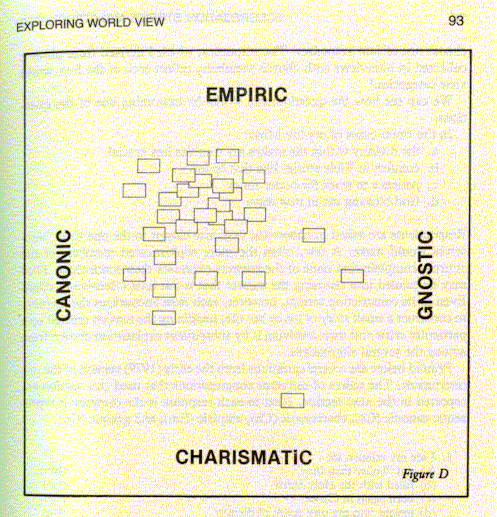
Any congregational setting or world view, particular and idiomatic as it may be, evokes the commonality even of those who do not adhere to it. For each particular view is formed in negotiation, sometimes in contention with its opposite, often in conspiracy with a different but partly allied view. Thus empiric Wiltshire links itself, in one way or the other, to a wide array of divergent views and those who hold them. Thus my hospital visitors and I, as different and even contradictory as were our various views of my plight, found that our telling of world stories evoked among us a corporate ministry.

b. Characterization. "A man’s sense of his identity," Stephen Crites says, "seems largely determined by the kind of story which he understands himself to have been enacting through the events of his career, the story of his life."3 The story told by Hero Trinity enabled the congregation to consider its peculiar identity. The second ministry of parish narrative is to articulate the character of the congregation, the persistent distinctiveness that individuates the church from its setting and from other bodies. Ministers, I noted much earlier, refer to the unique character of the church as its personality. But character is a more adequate term to describe the full ethos of the parish, its specific pattern of dispositions and values. It is in its distinctive experiences through time that these traits and norms are expressed, and story is the vehicle that accounts for them. Telling the story identifies the parish’s moral particularity, the finite role and behavioral dimensions of the church’s life.

The conscious use of myth in the ministry of characterization does more than merely sharpen the story. It also encourages a more authentic storytelling and thus a more faithful ministry. Wendy O’Flaherty explains. We can best understand our own myths, she says, "by translating them into other myths, by drawing them back into that internal hub where our own reality, our own nature, intersects with the myths preserved by tradition, by culture."4 Finding the mythic resonance of congregational story is not an eccentric action, diverting the group from real self-knowledge. The correlate myth, rather, draws perception toward O’Flaherty’s hub, the center of human characterization. "Properly understood," she continues, "myths provide a conceptual system through which one may understand and thereby construct a universal reality, a roundhouse where we can move from the back of one person’s reality to another’s, passing through the myth that expresses them all.’’5

There is always the danger of distortion in relating stories about one’s church, accentuating the achievements and minimizing the failures. A greater danger of distortion occurs, of course, in the congregation that totally neglects its story, but even in the best of tellings there persists the temptation to flatter the teller or the audience. What O’Flaherty reports about myth, however, is that using it consciously provides a means of directing the narrative to ordinary social constructions of reality. Myth seldom flatters; it reminds us of our labor to interpret ourselves in an uncertain world and of our commonality with other societies in the labor. An entirely objective assessment of congregational character can never be gained by any means. But telling the congregational story in counterpoint with mythic parallels may give it greater chance of being a "true" story.

When the corporate story and myth are not used to characterize the tellers, the group finds other ways to account for its condition. When a parish lacks a narrative sense of its corporate identity, it will probably assume that its nature is the aggregate of personal stories of individuals prominent in its life. It therefore may glorify or, by scapegoating, condemn such persons out of all proportion to their actual consequence. Frequently these projections focus on the pastor, who, without the constraint of the larger parish story, is extravagantly praised or blamed for the condition of the congregation. Parish story tempers the tendency to create goats and heroes, providing in their stead a corporate identity by which to characterize the happenings of the church.

It is now several years since Bigelow Church first told its Briar Rose story, and it still wrestles with the implications. A new team of pastor and young assistant have been appointed to the church, and members voice the hope that "the suitor has now penetrated the thorns." "We were a teenaged church," says one member, "and now we are waking up." "The myth of Briar Rose was still active until the fall of 1981," says the assistant pastor, "but members have now got restless and have dug themselves out of the thistles." Bigelow members have focused on the problem of their frail identity. They feel that they have now consolidated their programs and financial prospects and that their sense of community has measurably increased under the care of their new pastor. Anger is still expressed about the manner in which earlier ministers did not "parent" them in a way that would have permitted their childhood "innocence, beauty, and wonder" to bloom a bit longer.

Has Bigelow escaped the Briar Rose myth? A number in the congregation believe that the tale no longer characterizes the church. Some have speculated, though based on little new research, that the church may now live in consonance with another fairy story: Cinderella. Bigelow is today known by passers-by as the Pumpkin Church because of the tons of pumpkins that its young people sell in its yard before Halloween. Prince Charming may have come to the church in the form of its new pastor, who is significantly more acceptable than his immediate predecessors. In the terms of this new myth, the church considers itself treated poorly by its former pastor-parents, who, it feels, abused, ignored, and abandoned it. "Sandwiched," as it says, "between two great churches," Bigelow persistently compares its poorer lot with two sister Methodist churches. Prince Charming, moreover, promises a castle, for he is leading a movement to build a new sanctuary to replace the present casket-like structure in which Bigelow worships. Bigelow feels, like Cinderella, the possibility of transformation.

What matters here is not which myth to employ. What is significant is that Bigelow has learned to wrestle with the nature of its character by the use of narrative. It is able by metaphor to talk publicly about its serious problems, more able than most churches I have encountered. It is also more clear and candid about its hopes. Without platitudes or promotional rhetoric it can express its dreams and talk about awakening and new life. It has, through narrative, come to terms with the particularity of its character.

c. Confession. Confession, like story, involves both an exercise of memory of what has occurred and the anticipation of what might happen next. In story, especially in a confessional form that stakes parish life within the gospel story, the congregational plot develops from a remembered past through a confessed present to a promised yet open future. Narratives relate the possibility of transformation, the unpredictable outcome of present congregational actions and decisions. To tell the congregational story, therefore, is an act of confession in which the parish acknowledges that while it is the principal author of its plot, and accepts the design of its past and the nature of its present, in the light of God’s story for all humankind it also resolves to claim a transformed future.

Unless its corporate story is confessed, a congregation may drift in despair. Unless the plot is found that connects its actions and identifies their course, corporate life has no point, no conclusion. How does the recounting of the story to date set up the future? Charles Winquist likens it to homecoming, a return to dwelling:

Storytelling can be allied to homecoming because homecoming is more than the collection of actuality. It is more than a bare statement of our facticity. Homecoming is a re-collection of experience. Our remembrance is an interpretation. We tell a story about the actuality of experience to lift it into a context of meaning that speaks out of the reality of possibility as well as actuality. The prima materia of meaning encompasses the possibilities from which the particularity of historical fact is made determinant. The re-collection of experience attends the fullness of the reality. As strange as it may seem, re-collection allows us to think ahead to the original ground of experience and become conscious of the finality of meaning that coincides with the origination of the actual.6

In telling the story of the congregation, we unravel its plot. Perhaps our version is less authentic than others yet to be told, but only in relating it does the congregation begin to come to terms with its symbolization of the way things have been for it. Then, as Winquist suggests, the group struggles by story to acknowledge the ground of its corporate existence and the possibility that projects it toward the end of all being.

Those proposing to undertake the recollective, confessional, and transforming ministry of plot must be warned, however, that this aspect of congregational story is, in J. B. Metz’s word, "dangerous." "Memory and narrative," says Metz, "only have a practical character when they are considered together with solidarity and solidarity has no specifically cognitive status without memory and narrative."7 A local church examining its own plot explores at the same time its inescapable identity with the actions of all groups: their linkages, unfoldings, thickenings, and twists. Thus a fortuitous irony awaits those congregations whose white, American, middle-class representatives are most likely to buy this book and employ some of its methods. If such relatively affluent communities do in fact attempt to move beyond their technically and psychologically sophisticated understandings of themselves to tell their household stories, they will encounter there the narrative of groups deprived of technical and academic sophistication who have little but story by which to understand and modify their corporate existence. Churches curious about their own story embark on a "dangerous" activity that might show their solidarity with the world’s poor and oppressed peoples.

An example of the danger lies close at hand. In the previous chapter, I argued that plot indicates the participation of the congregation in history. Consider how a congregation’s deepening awareness of its historicity parallels the struggle of oppressed people reported by Paulo Freire. Freire states that human groups gain consciousness of their selfhood only as they recognize themselves in the pregnant sequence of time. They "develop their power to perceive critically the way they exist in the world with which and in which they find themselves [when] they come to see the world not as a static reality, but as a reality in process, in transformation."8 Liberation first requires that a people discover their own historicity:

Strictly speaking, "here," "now," "there," "tomorrow," and "yesterday" do not exist for the animal, whose life, lacking self-consciousness, is totally determined. Animals cannot surmount the limits imposed by the "here," the "now," or the "there." . . . Through their continuing praxis, men simultaneously create history and become historical-social beings. Because -- in contrast to animals -- men can tri-dimensionalize time into the past, the present, and the future, their history, in function of their own creations, develops as a constant process of transformation.9

By understanding their presence in time and their creative participation in its unfolding, people overcome their sense of life’s immutability and find courage for a transformed future.

Most popular notions of the future of the local church today are technical concepts that work by formula, not history. The notions build upon regularities that use numbers and statistical trends to predict the outcome of the congregation. Pictured in this mechanistic light, congregations suffer in a state resembling the dilemma of the unselfconscious, ahistorical peoples described by Freire: they do not know their plot. They do not understand the storied continuity that moves by the transfiguring power of links and twists. One of the tragedies of mainline churches that lost so many members in the 1970s was that their leadership was better equipped to offer them computer-produced documentation of their decline than to help find meaning in the changing story of each community. But the survival of the local, middle-class American church is less than half its story. In finding the forms of its own narrative, it meets also the labor of the human race in the larger struggle for meaning and freedom.

By its witting participation in its own stories the congregation becomes a mediating structure by which individuals ally themselves with the people of the world. Deepening its consciousness of the cultural forms and social processes that constitute its own household, the parish functions as a halfway house that initiates the once isolated member into the struggles of society at large. Local churches are seldom judged to have this capacity. More frequently, observers maintain that present-day congregations are unlikely to escape their captivity to local interests and private religiosity. But the congregation, by both tradition and demonstrable narrative composition, is more powerfully associated with the struggle of the whole church, the oikoumene, than often recognized. Parish resources are, as argued before, capacious, sensitive to the issues of power, open to history. If a congregation persistently wrestles -- in sermon, class, and conversation -- with its own memory and narrative, it can profoundly deepen its sense of identity with the suffering of the world.

I am not minimizing the power of social and psychological forces that mold a congregation’s conservative outlook and behavior. I am proposing, however, an alternative to the usual means employed to goad the local church to social responsibility: appeals based on shame, sympathy, and scriptural injunction. The approach through parish story is different, subversive, dangerous. Unlike the other methods, it instructs us first to watch ourselves: how we set and characterize our story, how our own plot moves through history. Shielded neither by statistical and programmatic facades of self-description nor by normative proclamations about what the church should be, we look at our finite, culture-bound symbolisms and find in them our idiomatic expression, but also structures wrought by the imaginative labor of all humanity.

The Church in the World

I want to end close to where I began, locating my argument among those of others who care about the local church. The fundamental differences among us, I believe, have to do with the various ways we envision the parish in mission within the larger world. Mission in its Christian sense means crossing the boundary between the domestic and what lies beyond the parish household. In an early chapter, I envisioned the congregation peering out of certain windows to interpret itself in the light of the part of the horizon it saw there. But congregations do more than orient themselves to one of a variety of world interpretations. They also live in engagement with the world that extends beyond, and through, their own identities.

Stephen Pepper, in his World Hypotheses, again assists me. Earlier I used, somewhat covertly, a version of Pepper’s categories to distinguish the various approaches that analysts make to understand individual congregations.10 Here I return to Pepper’s original intention and consider the root metaphors by which various thinkers have understood the world. I then search these metaphors for the place of the church within them.

Pepper finds four distinct arguments for what constitutes the world and its operation. He terms these hypotheses the contextualist, mechanist, organicist, and formist positions, and he demonstrates how philosophers and scientists have based their theories on one of the four. If our interest is the mission of the Christian church and the gospel to which that mission witnesses, we must pay close attention to what composes the world that the church engages. Pepper provides four different images. 11

In Pepper’s contextualist category, the world is the exciting and disturbing texture of current events. Missional engagement in such a world means embracing the consequences of today’s incidents, the events to be related in tomorrow’s newspaper and other chronicles. It requires the parish to recognize its dependence upon the circumambient forms of its place and epoch and to accept as its own nature the world’s problems and opportunities. A contextualist understanding of the world requires the passion of the church, the suffering of the world’s issues. Most present characterizations of world events include oppression, injustice, and anxiety. For the church to undertake its mission in a contextually conceived world compels its presence in such distress and ambiguity.

Pepper’s mechanist category portrays the world as a machine. By this metaphor the world is understood according to the regularities of its forces. Causal laws explain it. Scientific treatises rather than newspapers record its workings. Mission in such a world entails action rather than passion, impact instead of suffering. To be the church in a mechanistically conceived society is to be an initiating agent that changes the lives of those the church reaches out to touch. The congregation applies the laws of human and social behavior to the world to transform it.

Pepper’s organicist hypothesis views the world as developing toward a final integrated reality which is unapparent in its present state. In an organic process the world unifies its disparate parts, overcomes obstructions, and grows toward wholeness. A congregation in an organicist world has a different sort of mission: it uses its corporate life as a prototype of the world process. Accepting the heterogeneity of its members, the congregation takes upon itself a synthesizing activity for the world at large and strives to develop a paradigmatic fellowship, a foretaste of the ultimate community of all humanity. Eschatological vision rather than scientific treatises reveals the organicist world. Both the world and the kingdom to come occur in microcosm in the local church. In an organicist hypothesis the part discloses the whole. The life of a single parish stands for the ultimate fellowship, the koinonia, that all people will have among themselves and with their God.

There is a fourth world hypothesis that suggests still another way. The formist category of Pepper figures the world as a collectivity of structures. Different entities participate in this collectivity in different ways to derive their particular identities. Such a world rests upon the evidence of similarity, the correspondence of certain images and patterns with others, and the argument that such consonance implies a common form or structure in which similar objects participate. It is upon such a perception of the world that this book relies. To note, as I do, the correspondence between the exploits of Trinity Church and the journey of the Hero, or between sickbed tales and the genres of literature, is to propose a formist view.

This view also has as its base a missional purpose. I have been trying to convey a fourth and underused way in which the church exists in the world. Mission in my view involves a witting participation in the world’s meanings, an appreciative acknowledgment of forms of signification by which societies from the first have labored to shape and point their communities. The world in this formist argument is witnessed not so much in newspapers, scientific works, and eschatological vision as in literature and other symbolic structures.

Many missiologies assume that there are essentially two forms of mission: evangelism and service, a vertical obligation that brings people to God and a horizontal duty that requires Christians to support other human beings. The mission of the congregation in the world is actually more complex. It includes the witness and participation in social action that mechanist and contextualist understandings of the world imply. It also involves the paradigmatic modeling that an organicist interpretation promises. And, fourth, it requires that the local body identify certain of the world’s imaginative structures that give life its meaning. The gospel is conveyed through all four modes of mission. The gospel also represents the astonishing news that a local church can suffer in the world, change it, symbolize its outcome, and be subject to its interpretive structures.

Pepper’s formist hypothesis permits me to picture the congregation as a dwelling within a larger house. That, in fact, is close to the manner in which early Christians figured their own distinctive nature.12 They called themselves the paroikia, the "sojourning," that inhabited the oikoumene, the "big house" or "world." In early Christianity, paroikia was the temporary frame of a Christian community that represented its corporate life in the big inhabited house, the oikoumene. By emphasizing the temporality implied in the concept of paroikia the New Testament conveyed the alien nature of parish in its larger setting and the sojourning of Christian groups in the world.13 By patristic times, however, the spatial aspect of paroikia also proved useful because it designated the prolonged physical existence of Christian community in the world. Often in distinction to ekklesia, the whole catholic church, paroikia as parish came to signify the persistent dwelling of the individual congregation.14

Viewing the parish as house within the world house emphasizes its participation in the frame of all language. Human imagination as a whole provides the particular idiomatic and narrative construction of a congregation; its members communicate by a code derived from the totality of forms and stories by which societies cohere. In such a picture, local church culture is not reduced to a series of propositions that a credal checklist adequately probes. Rather, the congregation takes part in the nuance and narrative of full human discourse. It persists as a recognizable storied dwelling within the whole horizon of human interpretation.

Notes

1. James Hillman, "Archetypal Theory,’’ in Loose Ends (New York and Zurich: Spring Publications, 1975), 4.

2. Johann Baptist Metz, Faith in History and Society, 207.

3. Stephen Crites, "Myth, Story, History," in Parable, Myth and Language, ed. Tony Stoneburner (Cambridge: Church Society for College Work. 1968), 68.

4. Wendy Doniger O’Flaherty, "Inside and Outside the Mouth of God: The Boundary Between Myth and Reality," Daedalus 109 (Spring 1980): 120.

5. Ibid., 121.

6. Charles E. Winquist, Homecoming: Interpretation, Transformation and Individuation, American Academy of Religion Studies in Religion no. 18 (Missoula, Mont.: Scholars Press, 1978), 108.

7. Ibid., 183.

8. Paulo Freire, Pedagogy of the Oppressed (New York: Herder & Herder, 1968), 70-71.

9. Ibid., 88-89, 91.

10. See chap. 2, n. 5.

11. There exists an obvious relationship between the four categories of Pepper and the four genres of Northrop Frye. A contextualist understanding of events linked to the indeterminate world at large invites the romantic adventure; the mechanist hypethesis about the predictable regularity of action poses instead the ironic rejoinder; organicist images of an ultimate integration tend to the comic; and formist perceptions of adherence to structured pattern are more tragic in their orientation. Correlations of these and other fourfold typologies presented throughout this book are, however, at best imprecise and at worst diminish the richness of the varied interpretive options that constitute a congregation’s web of meanings.

12. Gerhard Friedrich, ed., Theological Dictionary of the New Testament (Grand Rapids: Wm. B. Eerdmans Pub. Co., 1967), 5:851-53.

13. 1 Peter 1: 17; 2:11, but note Eph. 2:19. Abraham is the prototypical sojourner in Acts 7:6; Heb. 11:9; Israel in Acts 13:17.

14. Adolf von Harnack, The Mission and Expansion of Christianity in the First Three Centuries (New York: G. P. Putnam’s Sons, 1908), 1 :408-14.

Chapter12: Wiltshire’s World Story

The most analyzed congregation in America today is a church in New England that agreed in 1981 to submit itself to the scrutiny of a score of investigators who sought to understand how their different methods might work together when trained on the same object. Ethnographers, sociologists, psychologists, theologians, case study writers, and organization and management consultants observed the congregation and searched through church documents and transcripts of member interviews. The analysts later compared their findings in several conferences and finally recorded them in a book.1 Because a consciously multidisciplinary approach to comprehending the life of a congregation had never before been attempted, the book, Building Effective Ministry, represented an important advance in the study of the local church. The difficult project was more successful, however, in analyzing the problems of Wiltshire Church than in suggesting how the church might address them. Chief among the findings was the consuming degree to which Wiltshire Church cultivated its private life and the self-centered values of its affluent neighborhood. But neither the social analysts nor the organization and management consultants provided much help to Wiltshire’s leaders or to similar churches that want to change such a situation.

Whatever external investigators and consultants may accomplish in a congregation, its specific future still depends overwhelmingly upon its reaction to the information it gains about itself. Finally, it matters more what a congregation tells itself than what it is told. Deft analysis or intervention can, at best, resource the attempt of the local church to understand or change itself. Transformation requires a different order of knowing than that which outsiders provide.

The self-knowledge a congregation requires to study and alter itself is predominantly narrative in its form. Stories ranging from gossip to gospel compose the substance of what members say to each other about their household identity and task. Interpersonal communication occurs by symbol and is conveyed largely in story. Though preachers, analysts, and consultants may sometimes wish it otherwise, there is no connective tissue among members that directly transmits meaning except the symbolic interaction of the members themselves. Members can individually hear the words of a sermon or analytical presentation, but their corporate response depends upon the signals they subsequently trade with each other.

Taking up where the book on Wiltshire Church left off, this chapter suggests ways by which the congregation itself might, comprehending its own story, better understand its nature, circumstances, and mission. We shall start with a synopsis of the story Wiltshire Church tells itself and then show how an awareness of the narrative might help the church achieve deeper reflective and performative significance.

This account assumes the accuracy of the case study that begins the book about Wiltshire.2 After a fictive introduction, the case study divides the plot into eight periods. The same form is employed in the synopsis that follows, and each period is identified by the title given to it in the case study.

1. Company town -- company church

Members of the Adams family, who owned the major industry in the town of Wiltshire, had built without assistance from the townspeople both the first and the present church building, the latter a replica of a beautiful Anglican church in England but made from the same sandstone used to construct the Adams factory. The family had continued to control and maintain the church in a manner resembling the factory’s oversight of the community. The patriarch would annually cover any deficit in operating the church. For decades the church had languished, a congregation of elderly people served by pastors who were themselves "tired old men, ready for retirement." In 1970 the last Adams patriarch, who had long been the church board chairman, and three other trustees died, causing great consternation among parishioners.

2. Sid Carlson appointed to Wiltshire

The Methodist bishop thereafter negotiated with Sid Carlson, a pastor known for his unusual managerial and preaching effectiveness, about the Wiltshire appointment. Before accepting the post, Sid, disguised as a corporate representative seeking a new business site, "checked out" Wiltshire. Officials welcomed Sid in disguise. He closely examined both the civic and religious institutions in town. In accepting the appointment, Sid entered a listless church that was losing members, while its surrounding community was rapidly growing. To consolidate the congregation he quickly: (a) collapsed the two ill-attended Sunday worship services into one, (b) removed 221 inactive persons from the church rolls, and (c) reduced the administrative board from 55 to 15 members. Because he found them incompetent, Sid fired both the veteran church secretary and the choir director. An angry choir met to consider petitioning the bishop to remove Sid, but Sid, uninvited, attended their meeting and challenged their authority. The choir backed down, as did the 55-member administrative board, which voted itself out of existence. Sid used executive force, not standard Methodist procedures, to make these changes. With moral indignation he disclosed that members contributed an average of only 25 cents each to the church each week and that they sent their children to church school in a building that violated seventeen fire code regulations. To address both failings Sid led the congregation into major debt that simultaneously required a more substantial contribution to retire it and permitted the renovation of the church school building and parsonage.

3. Growth in Wiltshire Church

The tactics worked. Over a hundred new members, drawn from the community’s transient, upwardly mobile, middle-class executives, joined the church each year. Sid deliberately adapted the activities of the church to meet the conscious needs of a congregation composed of relatively young parents attracted to Wiltshire by its seclusion and good schools. "They really buy a school, not a home." Church school and youth work therefore became strong program features. Sid developed an uplifting worship service that included excellent music, and he used the pulpit to address the personal and family problems that accompany executive life: skepticism about the Christian faith and disenchantment with the American Dream, broken homes, tensions at work, appliances that malfunction, traveling spouses, children who drink and use drugs. To befriend such wary, wistful people Sid rejected the ministerial stereotype. He dressed, cursed, behaved, and managed his work like a dynamic corporate executive. No longer impotent, the church under Sid’s leadership became an attractive and popular institution. "If you can’t join the country club, join Wiltshire Church," the saying went. Wiltshire Church developed the reputation of being "the best show in town."

4. Recent changes

In the latter part of the 1970s, however, the combination of a compliant congregation and a forceful leader began to unravel. A similar shift occurred in the town itself. Wiltshire residents who commuted in order to work for other businesses had recently wrested control of the town from citizens loyal to the old Adams Company. They blocked, for the first time, a plan of the Adams Company to expand its business. Similar challenges confronted Sid Carlson. Members once eager to follow his leadership lost their zest, and Sid, turning fifty, lost some of his as well. Anxious about the future he: (1) entered a D. Min. program, the exams for which he failed, (2) pressed for better retirement provisions, (3) considered quitting the ministry, and (4) went to see a psychiatrist. Members increasingly criticized three aspects of what seemed to them arrogant behavior of pastor and church: neither Sid nor the congregation adequately participated in Methodist conference functions; they gave scant evidence of traditional Christian piety; they did not, except in some personal ways, concern themselves with the poor.

5. Administrative board retreat

At a recent retreat the administrative board of Wiltshire Church spent its first hour exploring the identity of the church: its character, goals, and image. The lay leader drew up a summary, deprecatory statement: "I hear us saying we are a community of individuals who profess a belief in Christ, who have a limited or nominal belief in his teachings and the extension of his work, and who pose very limited responsibilities on becoming part of our group." Sid sat at the edge of the group and did not enter into its discussion.

Then the tenor of the meeting changed. Breaking his silence, Sid turned the discussion to a consideration of staffing needs, and the group spent the rest of the morning examining issues raised by the departures of the Sunday school superintendent, the minister of visitation, the assistant pastor, and the youth leader. After lunch, attention shifted to needs for extra Sunday school space and the inadequate insulation of the present education wing. Because there were not enough funds in the current budget to finance a new church school building, a vote on the construction advocated by Sid was postponed.

6. Pastoral housing proposal

During the last three years of the decade members had debated whether they should erect a new church school building, but another, more covert, building venture brought the church to open conflict. In early 1979, Sid had revealed that he was considering job offers elsewhere, and, to keep him at Wiltshire, several close friends in the congregation developed a plan to help Sid buy his own house. They contrived the proposal without the knowledge of the administrative board chairman, without approval of the bishop, and in opposition to conference regulations. The supporters viewed a private house as a way not only of retaining Sid but also of releasing him and his family from the constant attention of parishioners that the present parsonage adjoining the church encouraged. Sid liked the idea.

When presented to the administrative board in the fall of 1979, however, the proposal met a variety of objections. Some board members objected to the hidden negotiations, which were technically "out of order." Others doubted that the church members would submit to simultaneous campaigns for a church school building and for Sid’s house. Some were concerned that the plan tied the church to Sid indefinitely, others that Sid already made more money than any other minister in the district. Worry about the bishop’s reaction and uncertainty about precedents for relationships with future pastors further darkened the issue. The board tabled the proposal for further study. Sid became angry. "They don’t give a goddamn about me," he said, feeling unsupported by those whom he had served for ten years. In a later public meeting he vilified one of the objectors. Further conflict and complaints led the administrative board chairman to cancel all further official discussion of the housing proposal and to call a special meeting of the board, excluding Sid, to discuss objections to several aspects of Sid’s behavior.

7. Tensions increase

Feeling its own authority usurped, the Pastor-Parish Relations Committee objected to the meeting called by the administrative board chairman to discuss complaints against Sid. The meeting ended without decision, and shortly thereafter the church member abused by Sid resigned from the administrative board. Other members expressed their concerns about Sid’s belittling those who did not agree with him and his breaking of confidences. Sid began to raise questions about the church’s renowned music program. It was rumored that the organist and choir director would resign, thereby deepening the alienation of the choir from Sid.

8. Building proposal

It was widely recognized that the church school building was small and poorly constructed. Classes spilled over into Sid’s study and also across a busy street into rented quarters. The building itself could not be heated adequately and was ill-equipped for emergencies and handicapped people. Yet the members of the church were uncertain about their capacity to raise sufficient funds to build a new building. The present levels of attendance and giving seemed dependent upon the continuing presence of Sid Carlson, but the increasing discomfort with Sid and his own dissatisfaction with his lot suggested that he might leave. The administrative board continued to postpone a decision about construction, and, tired of the mounting difficulties of Wiltshire Church, the chairman of the board resigned his post.

The Setting of an Isolated Church

Because it follows a case study format, the Wiltshire story ends with the chairman’s resignation and the important issues of the story unresolved. But enough of the story has by then been told to sketch the church’s plot and to pose the major question the plot raises for Christian ministry: How might Wiltshire Church address its alienation from the life of the world that surrounds and sustains it? How might it -- entangled as it is in problems of self-preservation -- participate instead in the larger quest of humanity for redemptive community?

Others might identify another problem as the central one: ineffectiveness of leadership and administrative arrangements, for instance. If this were the key problem, the solution might be the removal of Sid Carlson. From another perspective, the problem might be identified as one of damaged relationships among members, the repair of which might be found in building up a fellowship that encourages greater love and less animosity. Such managerial and therapeutic approaches in Wiltshire’s case seem to me, however, to miss the depth of its trauma. The church was autistic. Probably to a greater degree than most other churches, Wiltshire conducted its affairs and generated its problems without reference to any larger church, society, or deity. It suffered, to be sure, from symptoms of ill will and maladministration, but these difficulties only exacerbated the more basic problem of Wiltshire’s blindness to the rest of the world.

Note the evidence of its isolation. Church members were residents of a community dedicated to separating itself from the business life of its inhabitants in the nearby city. Wiltshire was dubbed a "Shangri-La" and was characterized in a news article as having a "drawbridge mentality." Upwardly mobile executives retreated to Wiltshire each evening. The attraction of the town, said its mayor, was "the ability to live in a suburban community and yet have . . . your own island. You can not only get in between the ridges every night, you then go and get in between the birches and elms. You can really isolate yourself."

Although the executives, restored by their overnight respite in Wiltshire, would return each morning to the realities of the workday world, they left their church behind, among the trees. Wiltshire Church was part of the retreat, like the town’s country club. The church’s recent success in recruiting members was due in good measure to the pastor’s attention to private needs of those members. To further secure its seclusion, the congregation avoided links with either its denomination or its larger society. Sid Carlson provided the primary example. He was said to be "really turned off by Methodism," attending his annual conference only on its opening day and finding all Methodist structures burdensome. Nor did he cultivate the social dimension of his ministry. He said he had "minimal interest in impacting major social and economic problems in the community." Wiltshire Church sanctioned the independence of its pastor. It placed none of its members on denominational committees; it spent less than 4 percent of its budget on social outreach.

A similar isolation marked the beliefs of the congregation. At its retreat, the administrative board characterized the faith of Wiltshire Church by its distinction from the board’s understanding of Christian orthodoxy: "We are a community of individuals who profess a belief in Christ, who have a limited or nominal belief in his teachings and the extension of his work." Other references are made to the church’s agnosticism. When members of Wiltshire Church took the world view test described in chapter 6, the congregation made the highest empiric and lowest charismatic scores of any church yet tested. There was near the town of Wiltshire an eminently successful charismatic church that drew its members from roughly the same population as the United Methodist Church, suggesting that it would have been possible for Wiltshire Church itself to take a different spiritual tack, but instead the congregation, in its sermons and education programs as well as its informal conversations, emphasized its distrust of both standard orthodox and adventurous charismatic forms of Christian belief.

Ministry in a church as alienated as Wiltshire usually takes one or another form of scolding. The scolding asserts standards of benevolence, piety, and denominational conformity, and then demonstrates how far short of the mark a church like Wiltshire falls. Sermons and other pronouncements take on the prophetic task of criticizing a negative performance. Since the accomplishment of Wiltshire in its congregating fails to measure up to ethical expectations, its culture is treated as an inferior undertaking to be nagged toward improvement.

Prophetic critique conducted through the medium of scolding has several drawbacks. Because its manner is antagonistic, there is the temptation not even to attempt such an approach to a group as politically and economically powerful as Wiltshire Church. Persons or groups with strong commitments to social action or evangelical faith often shun direct engagement with Wiltshire-like churches, dismissing them as lost to the cause, and instead issue more general pronouncements that avoid the nastiness of encounter with specific congregations whose values oppose their own. Words that chastise, moreover, have difficulty making their way into the idiom of the congregation under censure. Criticisms in such a setting are usually deflected or rationalized. Although straightforward, specific talk about the shortcomings of a congregation has its place, its power to transform a church in contemporary times is not very much in evidence. Wiltshire Church patently serves a class of capitalist society that reinforces the individualistic posture and management style of the church. The congregation is further captive to the privatistic values of the American suburb. Its sophisticated membership and financial independence still further diminish the chances that it will be willing to listen to scolding. Wiltshire therefore seems a poor prospect for any usual type of prophetic critique. Might prophecy take another form?

The argument of this book is that the culture of even a church as isolated as Wiltshire contains its own prophecy. Instead of judging Wiltshire’s story by external standards of merit, I would rather labor within the story to find its own dimensions of human value and transformation, its own linkages and twists. Like any other society, Wiltshire Church congregates itself by languages of association. Within those languages are the structure and images of all human imagination and their potential for both social cleavage and coherence. Rather than berate Wiltshire, I would seek to show how the story itself implicates Wiltshire Church in the life of the wider world.

One such implication resides in the church’s world view. Members of the congregation consider their own beliefs, if not nonexistent, at most pale versions of Christian orthodoxy. Their empiric outlook, however, is integral to the circle of world view interpretations laid out earlier in this book. Human groups do not withdraw from the business of determining the setting of their own story. Wiltshire’s faith is not, as it suspects, an infidelity to a Christian canon not its own, but a participation at a different point in a full round of interpretation. Each point in the compass of world view options involves, as earlier observed, its own oppositions and ancillary alliances. Far from being a withdrawal from faith, the highly empiric position of Wiltshire Church in fact represents a familiar way by which human society everywhere has attempted to wrest meaning from the chaos of life.

Were I a leader of Wiltshire Church, I would try to plumb the richness of what the church now interprets as rejection of Christian belief. I would point out that Wiltshire is dependent upon a worldwide imaginative struggle to gain an ironic distance upon traditional assertions about life and cosmos. I would attempt to show that what members identify as their doubt about Christian claims can also be viewed as reliance upon a genre of interpretation that has a reciprocal relationship with other, quite different genres of Christian belief. Wiltshire agnostics do not in fact remove themselves from the business of believing. In their reflection of certain interpretations they engage in a practiced and patterned negotiation familiar in the settings of many other human narratives.

The opportunities for taking Wiltshire’s world view seriously might arise in sermons, classes, or informal conversations. Whatever the occasion, the common intention would be to show that the congregation’s lack of orthodoxy is itself an arc of rich human interpretation that, rounded into a circle, enfolds all expressions of belief. If members were to begin to see in their own constructions the working of an entire world, what would be gained would be a sense of participation in a common human struggle for meaning.

The Character of the Isolated Member

"I look upon myself on Sunday mornings as addressing a congregation of wistful hearts," Sid Carlson reported. "I am basically addressing a secular, agnostic congregation of people who are drawn to the church because they find themselves with children and suddenly begin to sense that they want to give the kids some kind of background." What sort of background is unclear. Although most church families at Wiltshire had successfully climbed up the corporate structure of business, the view from the top hardly supplied an integrating vision. Sid spoke of members’ disillusion "with the American dream of the two-car garage and the house in the country -- divorce -- kids drinking and using pot -- job conflicts -- the plumbing leaking and your husband in San Francisco -- the family needs [are] monumental." Not only was the church isolated from any larger imaginative working of humanity, individual members and families likewise saw themselves as separated from any larger social struggle to gain shalom for the world.

Wiltshire Church aligned itself to provide solutions that would fit the bureaucratic individualism of its members. It altered its program to supply the managerial and therapeutic ethos that, Robert Bellah argues, pervades a culture that has lost its communal values.3 In Bellah’s view, American culture is dangerously individualistic. It informs persons that their worth depends upon what they as independent agents make of life. To function in a society so atomized requires that each person become an efficient party to contractual arrangements that constitute the fabric of any collectivity, from large corporations to nuclear families. Effective management is required to fulfill the utilitarian goals of the social unit: each member has private goods that are parlayed to greatest advantage by efficient administration. But witness the disillusionment of Wiltshire’s members. The free-standing individual also has needs that efficient management cannot fulfill. Thus an individualistic society requires a concomitant: a service intended to heal the emotional and physical suffering wrought in the individual’s private lot in competitive society. Bellah identifies the managerial and the therapeutic as the twin hallmarks of the ethos -- bureaucratic individualism -- that now affects American life.

Hence in responding to the personal needs of its members, Wiltshire Church concentrated upon providing efficient administration and elaborate therapy. Sid Carlson cleared out the awkward elements, such as the oversized administrative board, that impeded effective congregational operation. He reduced the church rolls to active members; he streamlined committees and bypassed reactionary participants. Most important of all, he took personal control of the operation. Sid was a person "who knew how to take charge of a situation in the best corporate sense," and he ran Wiltshire as a chief executive officer might be expected to do. At least during the earlier years, programs under Sid’s management met with surprising success. Sunday services, church school, youth fellowship, social occasions, and meetings functioned with businesslike efficiency. There were few complaints about Carlson’s autocratic style, because he organized the church to work like a finely tuned engine.

Nor did Wiltshire Church neglect the therapeutic needs of its members. The church was called the "sanctuary" for parishioners in pain. "It is the place that provides nurture and caring for those who must go out of the sanctuary and do battle in a fundamentally exciting and positive world." The pastor himself was gifted in helping people in personal crises, and the God that he preached was a deity tuned to help people: a loving Father, a compassionate Son, and an available and forgiving Holy Spirit. People experiencing loneliness, anxiety, and failure found in Wiltshire Church a haven in which they could be healed.

By its efficient operation and attentive care of its members, the congregation reinforced the surrounding privatized culture. Members could treat such a well-managed church as a sort of corporation in which they bore limited personal liability. Further, the well-run church augmented their sense of singular worth, because each person had contracted to support "the best show in town" much as -- with little else in common -- fans support a winning sports team. Even those disappointed about their own accomplishments had confidential recourse to the church, where the pastor was poised to help them cope.

In learning to hear its own story, a congregation beckons its members to share a corporate life that challenges their excessively private identities. Stories knit people into large wholes. Stories give people a collective character that repudiates individualism. The narrative of Wiltshire Church may recount, in the main, managerially and therapeutically tinged events, but their being bound into the form of a story witnesses a continuing communal drama that cannot be reduced to the atomized experiences of isolated members.

Wiltshire’s story therefore requires strong characterization to pit it against its members’ tendency to disintegrate corporate history into their private dramas. Unless vivid tropes and a memorable script present Wiltshire’s story, it cannot become good news to members now secluded in their separate egos. A myth must be found that illuminates Wiltshire’s story. The myth of Zeus on Olympus serves that purpose.4

Edith Hamilton summarizes the myth:

The Titans, often called the Elder Gods, were for untold ages supreme in the universe. They were of enormous size and of incredible strength.... The most important was Chronus, in Latin Saturn. He ruled over the other Titans until his son Zeus dethroned him and seized the power for himself....

The twelve great Olympians were supreme among the gods who succeeded to the Titans.... The entrance to [Mount Olympus] was a great gate of clouds kept by the Seasons. Within were the gods’ dwellings where they lived and slept and feasted on ambrosia and nectar and listened to Apollo’s lyre. It was an abode of perfect blessedness....

Zeus became the supreme ruler. He was Lord of the Sky, the Rain-god and the Cloud-gatherer, who wielded the awful thunderbolt. His power was greater than that of all the divinities together.... Nevertheless he was not omnipotent or omniscient, either. He could be opposed and deceived.5

There are significant correlations between the narrative of Wiltshire Church and the Zeus myth. I sort some out according to the analytical categories advanced in chapter 7.

Crisis and resolution

Life at Wiltshire Church under the Adams family and within the Adams Company was chronic and saturnine, captive and dull. Chronus kept all his offspring, save Zeus, in his belly. But Zeus by deception escaped the imprisonment and forced old father Chronus to vomit up his children. The overthrow of the Titans ensued. Four trustees died in 1970. Zeus threw out the old leadership and established himself as supreme ruler. So did Sid Carlson.

Manner

Zeus was an arbitrary and dictatorial ruler, using thunderbolts to punish those who dared oppose him. But not only did he punish the wrongdoer, he also advised the suppliant, giving counsel to seekers who came to his shrine. Carlson was a "one man show" at Wiltshire, a person of exceptional management gifts who ran the church and who got his way not only because of the acquiescence of corporation-minded members but also because he had a habit of "getting people," ridiculing them with his thunderbolts. But Carlson was also the pastor who provided therapy for souls who found their way to his shrine.

Mood

The mood, by Jove, was jovial. Remote Olympus was the land of the blessed. The gods lived in marvelous houses and enjoyed the best food and entertainment. Wiltshire, equally remote from the cares of mortals, provided comparable residences and entertained its members in "the best show in town." Members gained jovial solace: they were loved and accepted in the Olympian sanctuary.

Expectation

The Olympian gods were ultimate but not spiritual powers. Spirituality is marked by aspiration to or inspiration by a power beyond oneself. But the Olympian gods, though immortal, partook of no such transcendence. They themselves were beyond control, beholden to none. Likewise, the members of Wiltshire were beautiful, successful people in whose veins seemed to run the ichor that would make them immortal. They were oriented not to the Other but toward personal ultimacy, either for themselves or their children. They expressed, through Sid, their disdain for anything larger than themselves -- social issues, church, or deity -- that would command their obedience and deny their private sense of immortality.

To characterize Wiltshire as Olympus is to resist the prevailing ethos of bureaucratic individualism that denies binding myth, indeed any binding force other than utilitarian contracts. The Zeus myth is not a pretty story, but its very aptness and ugliness might awaken its actors both to their plight and to their Christian promise: that Zeus, like Eros, intertwines with Christ who redeems the storied body.

The Plot of an Isolated God

The individualism of Wiltshire churchgoers and the isolation of their church from the larger society were not unrelated to the way they demarcated the presence of God in distinct events within the total life of the congregation. Two sorts of occurrences at Wiltshire seemed to its members to manifest the Holy: the sermon and the music program. Both transpired within what many observers would call "the sacred space" of Wiltshire Church’s sanctuary, and both represented instances in what the same observers might call "the sacred time" of Wiltshire’s ongoing history. But isolating God in these events diminishes both the nature of God and the significance of the total life of the corporate household. It suggests that God inhabits only packaged moments in history and that the bulk of life lived outside those moments is profane. I contend that the exclusive concentration of Wiltshire and many other churches upon sermon and sacrament and beauty to reveal the presence of God defeats their attempt to embody the fullness of Christ’s plot for the congregation.

There is no special area in a church building that can be justified as sacred space any more than there is authenticated sacred time within particular parish history. Wiltshire undertakes powerful ritual actions in its sermons and music that may seem unusually holy. But the perusal of the total plot does not support a distinction between sacred and profane events. The characteristics of so-called sacred time -- symbolic intensity, deep emotion, repetitive corporate behavior -- do not cluster only in special moments and places. All household life is caught up in the creation of the cosmos. No act escapes the tremendum of death. The entire story is sacred. Particular ritual behaviors distinguish the Sunday morning service from the rest of Wiltshire Church’s plot, but their performance marks more a mode of story’s unfolding, not the congregation’s only appointment for entry into God’s real presence.

The limitation of God’s presence to isolable sacred times in Wiltshire Church also restricts an understanding of what constitutes moral behavior. If God is linked only to its worship, a consequence is that a congregation’s other struggles to survive and find meaning are stripped of religious meaning. The obvious structural connection between its total life and the life of other human societies is then obscured because that connection does not merit divine designation.

Wiltshire could be challenged to face its isolation from the world by proclaiming all its space and time as in some sense holy. To discover that the entirety of the physical space and historical time it shares is of God might check its relentless habit of restricting meaning to hot spots in its worship and to crises in the lives of its individual members. Finding in its plot the negotiation of Christ and Eros in spaces heretofore considered inert and at times of its common life regarded as incidental or profane, Wiltshire Church could begin to appreciate its implication within the working of all social space and time. For Wiltshire is a participant, whether it acknowledges it or not, in a long and broad history that bears a similar erotic patterning to Wiltshire’s own. It is not merely the congregation’s Eucharist that follows the fourfold action of plot, in which elements are taken or unfolded, then blessed or linked, then broken in the act of thickening, and finally distributed in a twist that foretells the kingdom banquet. The entirety of Wiltshire’s story performs a larger liturgy equally disposed to divine presence.

Were the congregation of Wiltshire to discover this intertwined work of Christ and Eros throughout its corporate history, it might better comprehend its participation in the full pattern of human striving for worth and meaning. If the church could see within the peak moments of its worship not the point but the paradigm of its total life, and understand that its sermons, prayers, and music do not only meet personal needs but, more important, also symbolize the whole struggle of an embodied people, then the congregation might better grasp its solidarity with peoples throughout the world who labor to voice their own significance. It would be easy to demonstrate how Wiltshire, like Smithtown Church in the last chapter, used space and modal persons to enact its plot. But even the gritty recent political history of Wiltshire Church can be shown to participate in universal forms of symbolic behavior. In each of the eight periods demarcated by the case study, a single action of plot characterizes the period and another action is there repressed. The account of Wiltshire’s corporate life weaves its way through a texture of linkages, unfoldings, thickenings, and twists that constitute a way of identifying far-reaching strands of social behavior. To understand their mesh within one community provides coordinates by which to place the community within the world.

Plot actions within Wiltshire’s story of conflict and self-interest play out the following pattern:

1. Company town -- company church: The era of subordination to the Adams family was remembered primarily by its attention to linkages: the physical and economic associations of the church with the Adams Company, the replication in Wiltshire of a historic Anglican church structure, the adherence of the church to the lives and fortunes of the Adams lineage. Notably absent from the plot was any thickening, complicating reference to conditions and events that contradicted the bond of the church to power and prestige.

2. Sid Carlson appointed to Wiltshire: Here is a twist. Some old leaders died, others were turned out of office by the new pastor in an administrative transformation that paralleled simultaneous changes in program, worship, and pastoral style. Linkage to older patterns and persons suffered.

3. Growth in Wiltshire Church: An unfolding of Wiltshire’s plot followed Sid’s alterations. The congregation steadily grew. Its church school developed. The church became attractive to new executive families moving into Wiltshire, but service to their private needs further diminished the linkage of Wiltshire to Methodism, orthodox beliefs, and wider community concerns.

4. Recent changes: The plot thickened in the frustrations of the later 1970s: Sid, turning fifty, worried about his career and retirement; members became increasingly restless under his autocratic leadership. An earlier zest for church development disappeared. The possibility of twist resourced by decisive leadership and member enthusiasm diminished.

5. Administrative board retreat: The attempt of the board to link itself by exploring its identity was defeated by Sid’s refusal to participate and his shift of attention to matters of unfolding: appointments to staff vacancies and the modification of the education wing.

6. Pastoral housing proposal: Each of the final three periods in the case study shows the further thickening of Wiltshire’s story. The housing proposal surfaced the deepening tension between a group supporting Sid and those opposed to the scheme. The orderly unfolding of church process was repudiated in several ways: the group acted behind the backs of the administrative board and against Methodist conference regulations; and the group was aware that opposition to its scheme might well subvert the continuing leadership of Sid Carlson in guiding the church.

7. Tensions increase: The very title of this period suggests its thickening. Wiltshire’s administrative board and Pastor-Parish Relations Committee were at odds; Sid and a board member got into a fight; animosity grew between Sid and the choir director. The potential for any twist disappeared in Wiltshire’s administrative paralysis: a compromised pastor, an almost nonexistent staff, and church committees suspicious of each other.

8. Building proposal: In a final thickening, the proposal for a new education building was opposed because of doubts about the capacity of the church to finance the construction. And, in the final, tense action of the case study, the administrative board chairman resigned. Once again conflict-laden issues prevented the church’s unfolding. Decisions were postponed; Wiltshire Church expressed uncertainty about its direction and its power to achieve its goals.

More is at stake in Wiltshire’s recent history than an administrative crisis. The congregation might well diagnose the problems of these years in managerial terms, but in so doing, it would miss the opportunity to see in its thickenings and unfoldings the immediate narrative of Eros and Christ. The erotic labor of a body given Christ’s name is the local instantiation of the world struggle, with all its frustrations and potential: for disaster. For Wiltshire to seek its full story with that story’s resonances throughout the forms of human suffering and human imagination would open the congregation to its redemptive promise.

Story is the larger liturgy of the congregation. Its local outworking reflects the structures of human societies that struggle to exist throughout the world. By gathering into its local telling the manifestations of setting, character, and plot, and by linking its structure to that of other people’s stories, narrative overcomes the notion that we are atomic individuals justified by our private works. In faith we yield to a larger work that is God’s economy for the world.

Notes

1. Carl S. Dudley, ed., Building Effective Ministry.

2. Ibid., 3-20.

3. Robert N. Bellah, "Discerning Old and New Imperatives in Theological Education," Theological Education 19 (Autumn 1982): 7-29.

4. For a fuller exposition of the consonance between the Zeus myth and the Wiltshire story, see James F. Hopewell, "The Jovial Church: Narrative in Local Church Life," in Dudley, Building Effective Ministry, 68-83.

5. Edith Hamilton, Mythology, 24-27. Cf. Hesiod Theogony, VIII-XII.


Chapter 11: Christ and Eros

Membership in a local church implies both identification with the plot of its corporate activity and also an attraction, through that history, to the Other whom the congregation proclaims its Lord. Accepting the sticky consequences of a particular social commitment and covenant, a church member participates also in narrative reflection and storied praxis. Through their members, congregations consider their own story. At certain moments, most often in their worship and acts of mission, congregations intensify their own search for the meaning of their corporate lives. It is in these events, which often seem to be parenthetical moments in church life, that the local church represents its participation not only in its own story but also in that of God.

Recently a pastor invited members to develop a "time line," in order to deepen the congregation’s consciousness of its plot. Assembled one evening in the church basement after eating, the members adjusted their chairs toward a wall on which was tacked a long strip of butcher paper with a horizontal line drawn a third of the way down from the top. The years through which the church had lived were marked on the line, earlier years ticked closer together than those more proximate to the present. The pastor encouraged members to talk about what had happened in each year, and, as they talked, a scribe noted key phrases in the stories at the appropriate place on the paper: "great music festival," "administrative mess," "Mrs. Chairperson dies," "young people ask for a different type of worship," "new kitchen." Over the line were written events important to the larger community and world: "recession," "Vietnam," "new highway." As the evening passed, the pace of storytelling quickened, and more difficult and embarrassing tales began to emerge. At the end, people signed the chart at the point they themselves had entered the church’s life.

Throughout the following week, members kept adding other events important to the story. By the following Sunday the record had so enlarged in significance that it was moved from the basement to the rear wall of the sanctuary, where it still hangs. Occasionally someone adds further elaboration or comment.

Thus members of one church posed graphically the fundamental issue of their worship. The story of the congregation, they demonstrated, is not an activity separate from and subordinate to the story of God; the stories of congregation and God belong in the same room, united though in tension, the first reflecting human history, the latter the definition, acceptance, and evaluation of that history by the Being within, yet beyond, history’s comprehension. The stories are blended in worship. The congregation’s members, as God’s household, stand between the symbols of the two stories, one figured on the rear wall, the other sounded and signed from the chancel. In the crossfire of symbols, the members represent Christ’s body, the manifestation of God within signs of their flesh and culture.

To speak of this conjoining I shall first tell about Christ, the incarnation of God, and then Eros, the personification of culture, as they embody the life of the parish.

The Character of Christ

It is now much more difficult for the local church to give an account of Christ than in former centuries. As I conducted world view interviews I was surprised how infrequently, in even conservative Protestant congregations, the name of Christ was mentioned in response to questions about crises such as death, family instability, or world catastrophes. Although the name of Christ is regularly used by church members in the intensive, self-identifying acts of worship and evangelism, it seems now to be infrequently employed to fathom situations that challenge personal or corporate identity. The formidable pedagogy developed by the church to inculcate the person of Christ into the total world view and ethos of Christian life has today largely failed, the house of authority, to use Edward Farley’s image, having collapsed.1

Structures within which the congregational household has for millennia made its home have lost an earlier power both to explain the world in Christian terms and to form behavior by norms readily acknowledged as those of Christ. The authority of Scripture, dogma, organization, and theological reasoning that once constituted the church, the ekklesia, has waned to the point of inconsequentiality for most Christians trying to make sense of their existence.

Can paroikia with its thick culture built from direct human interaction survive the cave-in of its surrounding ekklesia? If the congregation is nothing more than a division of the larger church, the local unit of a national and international apparatus, then its future is grim indeed. Little in the activity of the overarching organizations of the church today provides compelling reasons for belonging to a congregation. If the foundering of denominational and ecumenical offices and the quandaries of theological faculties are current indications of a loss of coherence that will in time debilitate all congregations, then church membership is hardly worth the effort.

But consider the tenacity of the local church. Congregational structures appeared before the time of Jesus but became the primary social expression of his presence. The congregation then abided the growth of ecclesial apparatus and the establishment of canon and dogma; it endured councils and conventicles; it persisted through reform, counter reform, and enlightenment. As Christianity spread throughout the world, the local church has taken root in cultures more readily disposed to other social forms -- kinship, for instance, or civil association. The congregation continues today in the face of criticism and announcements of its recent or impending death. But conventionally shaped congregations, a third of a million of them in the United States, still serve Christians as the principal forum for their faith. Even redundant congregations of the elderly may (to the puzzlement of church executives) defy extinction, because such churches often assimilate still other aged persons who replace the members who die.

Ernst Troeltsch proposed reasons for the persistence of the local church. Troeltsch sought to accept the critical methods of modern thought and to acknowledge their devastating consequences for the structures of ekklesia but also "to preserve Christianity as redemption through faith’s constantly renewed personal knowledge of God."2 Seeking the essence of Christianity, Troeltsch threaded his way between arguments for the knowledge of God by linguistic formulation and other arguments that discovered the path in mystical encounter.3 He located the bond between humanity and God in the cultic life of the community. He did not specifically cite the congregation as the locus of the worshipping Christian community, nor was he sanguine about the long continuation of any institutional form of the church, but his acuity in aligning the essential faith of Christianity with its cultic expression in specific communities provides an explanation for the present strength of the local church. Christ, he proposed, is the "support, center and symbol" of the worshipping Christian community:4

For as long as the peculiarly Christian-prophetic religion bearing within itself the Stoa, Platonism and various other elements continues, all possibilities of a community and cult, and so all real power and extension of belief, will be tied to the central position of Christ for faith.5

The Christ made manifest by the worshipping community is not, in Troeltsch’s argument, primarily a principle or a contemplative symbol but the historical personality who actually began the church and focused its intersubjectivity:

It was the requirement of community and cult which gave to the personality of Christ its central position. They continue to give it this central position. Where community is dissolved into free and isolated religious convictions of individuals and the cult is transformed into mood and reflexion, there too the link with Jesus is less prominent. Even where it is apparently preserved intact, we have instead of Jesus the inner Christ or the free mystical presence of God in the soul. Where on the other hand this weakness and dispersion is abandoned in favour of a return to community and cult, this brings with it a renewed emphasis upon the significance of Jesus’ historical personality.6

The person of Jesus drawn from New Testament accounts is the Christ represented in worshipping communities. The biography of the founder thus in a peculiar way nourishes the plot of the congregation. The historical fact of Jesus, who lived, taught, died, and triumphed not only stands at the remote beginning of any congregation but also concretizes the hope that the congregation finds in its present existence.

Although Christ is central to the congregation, his effective presence in its corporate life is elusive. Today the grace of Christ is guaranteed neither by the traditional certainties of the church nor by the contemporary designations of social sciences. There are at best tentative intimations of Christ in the life of the congregation, and his presence is hardly captured by what current observers wrongly label a congregation’s sacred time and sacred space. A congregation given to the cultivation of sacred "hot spots" in its life, whether liturgical or emotional in form, may amplify the linking action of congregational plot -- the association of events for the purpose of identity -- but the vivid occurrences do not in themselves qualify as sacred moments. The nuance of Christ is more likely to appear when expressions of congregational culture are summarized. As the Other, Christ is there defined by the whole but not derived from it. The Christ of faith nuances the extensive whole of corporate experience rather than any one intensive congregational event.

The Eucharist, far from representing the sacred isolation of Christ from the fullness of plot, is the sign of their association. Nowhere else is the relationship of Christ and a local church’s total culture more succinctly presented, displaying the variety of plot actions and evoking the presence of Christ. "The absolute invariable nucleus of every eucharistic rite known to us," according to Dom Gregory Dix, is its fourfold action:

(1) The offertory; bread and wine are "taken" and placed on the table together.

(2) The prayer; the president gives thanks to God over bread and wine together.

(3) The fraction; the bread is broken.

(4) The communion; the bread and wine are distributed together.7

In Holy Communion the fact of Christ is proclaimed in conjunction with the elements of cultured grain and grape, in conjunction with humanly formed words, vessels, and gestures. As (1) an offering worthy of God and God’s people, the goods of Eros are linked to Christ. By their presence over which (2) prayer is uttered they are unfolded in their divine significance. In (3) fraction their meaning is thickened to show their brokenness. And through (4) Communion their intention is twisted, transformed into the eternal banquet for all peoples. Essential in itself to the worshipping congregation, the Eucharist also symbolizes a larger liturgy played throughout the whole life of the local church. The Eucharist is the underlying paradigm for recognizing the actions of Christ and Eros throughout the life of the parish. To understand their mutual working, the nature of Eros must first be defined.

The Character of Eros

The myth of Eros attributed a human urgency to the cosmos, an interpersonal passion to seize form and meaning, thousands of years before our current understanding of the social construction of reality. Eros is popularly characterized today as little cupid, who instigates love affairs among gods and mortals. Behind the mischief, however, lives an earlier and considerably more formidable deity whose nature incites both ancient philosophers and contemporary theologians to recognize humanity’s creative force.

On the whole, theologians are more likely than philosophers to be suspicious of Eros. In Agape and Eros, Anders Nygren sharply distinguishes Christian faith from Eros piety, which he considers the early church’s "most dangerous rival"8 and today the seducer of the human soul toward impossible attainment. Eros represents the striving of people for an ideal world, an acquisitive love of the beautiful and the good. Eros promises a salvation gained by human initiative. Erotic desire signifies the possibility of a self-generated fulfillment that satisfies personal need and rewards worldly accomplishment.9 Against this urge of the world Nygren pits the agape of Christ through whom God by divine initiative offers the free gift of salvation. Eros builds from the ground up, seeking to realize for himself the beautiful and the good;10 Christ by contrast reaches down, sacrificing himself, redeeming by uncalculating love the undeserving world.

Dietrich Bonhoeffer has a similar estimation of Eros. In Life Together, his stirring essay on Christian fellowship, he just as sharply differentiates the society of Eros from the community of Jesus Christ.11 Although human reality, the realm of Eros, generates notable creativity, aspires to "the highest and the best," and lovingly seeks "human ties, suggestions, and bonds," such erotic practice for Bonhoeffer is self-serving and basically untruthful about life. Christian society lives instead according to a spiritual reality that discloses the truth of God and the occasion of agape, "the bright love of brotherly service."

In distinction from Nygren and Bonhoeffer, Troeltsch’s interpreter H. Richard Niebuhr defines the relationship between Christ and Eros as more subtly interwoven. Christ for Niebuhr actually focuses and mediates both the agapaic movement of God toward the world and the erotic press of the world toward God.12 Niebuhr’s analysis seems to me to explain what actually happens in a congregation’s plot. The toil of Eros is essential to congregational story because, as Niebuhr perceived, Eros signifies far more than the contradiction of agape love: Eros is an image of culture itself, the expressive stuff without which the proclamation or incarnation of the Christian story is inconceivable.

So basic is Eros to the composition of the universe that Hesiod names him third in the order of creation:

First of all, chaos came into being, next broad-bosomed Earth, the solid and eternal home of all, and Eros, the most beautiful of the immortal gods, who in every man and every god softens the sinews and overpowers the prudent purpose of the mind.13

Primordial Eros couples the cosmos, creating its forms, firing its process, constituting its harmony. Eros is the overpowering, softening, possessive energy that gives things their shape and linked significance.

In today’s view, culture gives the cosmos its shape and linked significance.14 We no longer believe that our perceptions stem from something innate. Left to themselves, our sight and senses would be like those of newborn children not yet taught the figure and meaning of things. It is only through our initiation into the web of culture, into the intricacy of our language, that chaos becomes the images, sequences, and ideas that compose the world we know. Culture gives the world its understood nature. Culture is not just the human representation and manipulation of nature; it is, for its human fabricators, the underlying order of the cosmos itself.

Eros is thus a narrative symbol of our creative, grasping culture. His story posits the settings, characterizations, and plots by which all people find their way in a world that without story would recede into the formlessness of chaos.15 Eros is our narrative struggle to signify the value and consequence of our existence.

In the Symposium, Plato recalls another tradition, one that identified Poverty and Plenty as the parents of Eros, thus emphasizing the daimon’s double nature that, on the one hand, is "always in distress," yet, on the other, is "bold, enterprising and strong." This apposite joining of necessity and resource, of want and power, generates for Plato the erotic transaction.16 A similar union characterizes our present understanding of the creation of culture.

Culture, on the one hand, is the child of Poverty. Culture is the scenario, Ernest Becker writes, that humans construct in the face of death to counter the final deprivation that causes their obliteration.17 Whether the ultimate deficiency of death threatens my own life, or the integrity of a political system, or the future of people born and living in hopelessness and squalor, the collective response of death’s subjects demands their constant weaving and repair of webs of significance that constitute a shared culture and common story. I noted how the plot of common story deals with the threats of cultural amnesia, oppression, alienation, and death. Similarly, story’s setting fights against the menace of absurdity, which is the denial of ordered scene. And the character of a group’s story represents a reaction to anomie, social decay that evokes both the Latin sense of "no name" and its Greek cognate of "no norm." Thus the terror of want spawns Eros. An ultimate poverty compounded of absurdity, amnesia, and the rest provokes an erotic quest for intimate community, the thirst for goodness and beauty, and the desire for meaning.

Nygren and Bonhoeffer nevertheless mistrusted this acquisitive grasp of Eros, and even Plato found him "terrible as an enchanter." Should we shy away from Eros? If we do, we avoid certain dangers. But unless we also engage him in a certain way, acknowledging the struggle that society consistently wages against chaos, we are left with a lonely need to address the absurdity in private. Without the passion of society for meaning, the search for significance becomes a desperate private quest. As long as one disregards the culture’s own imperative to remember, to give things their shape, to assign their purpose and importance, one labors for these ends in terrifying isolation. I wrote these words shortly after my first operation for cancer:

I learned last week how I will probably die -- with a bit of luck, some time from now, but now a particular tiger in a pack has been pointed out to me as the one that will run me down. What has been most helpful in my distress has not been, as I would have expected, the counsel and concern of those friends who dared approach me person-to-person, providing talking therapy ("How do you feel about it?") or sure gospel formula. What has proved most comforting has been my sense, conveyed also by friends, of being part of a body -- my seminary, my church, my family -- that itself seeks meaning in distress. Anxiety recedes.

Eros offers the good news that none of us strives alone for meaning. My individual distress is also the distress out of which culture emerges. My own distress is not resolved, but it enlists the relentless struggle of the whole community.

But Eros is also parented by Plenty. His engendering also depends upon a resourceful counterpart: the rich human imagination that creates the forms and links and sequences by which we recognize the universe. Out of the fertile plenitude of Eros comes the opulent language of word, mark, and gesture. The narrative nature of erotic culture, moreover, is displayed in myths so compelling that they shape society’s sense of itself. It is the symbolic capacity of culture that creates works of literary expression, drama, music, dance, and the fine arts. By Eros are made the world’s tools and artifacts, the disciplines of inquiry, the events of human development and association. In its imaginative action, culture gives some attributes even to our understanding of God, because the concepts of creation, redemption, sanctification, Lord, grace, and salvation reflect society’s metaphorical labor. Whatever objective reality our various views profess by such terms, that reality is signified by images compounded in culture. Eros expresses in part the nature and being of God.

The Congregational Setting

Congregations are the church’s erotically capacious households. Other organizations are specialized for particular ends. Seldom do other social organizations include both children and the aged; seldom do they rely upon members with diverse careers and educational preparations. Once joined, the noncongregational bodies of the church often gently pressure members into uniform patterns of behavior or attitudes. Among the structures of the church, only the congregation persistently addresses the diverse personal goals of its members.

Two stories, one of Eros and one of Christ, occur in the local church. This book has examined primarily the narrative that the congregation historically enacts through its day-to-day behavior and by its particular views and values. Comparable attention has not been given to the Christian story upon which the local church by its local story stakes its ultimate identity. Several recent books provide an opposite imbalance, emphasizing the congregation’s normative relationship to Christian narrative.18 "The social-ethical task of the church," says one, ". . . is to be the kind of community that tells and tells rightly the story of Jesus."19 It is the contention of this book, however, that persistently and seriously as a congregation may present as its own the Christian story, it nevertheless enacts a cultural narrative identified by myths quite distinct from the story of Jesus.

No local church escapes Eros and, therefore, a narrative structure that draws upon the world’s stories. It is no more reasonable to expect a Christian community to lose its peculiar erotic nature than it is to anticipate that Christian individuals will discard their own unique identities in following Christ. But the good news of Christ does not require that one’s culture be obliterated in redemption. H. Richard Niebuhr exposed the inadequacy of attempts to free Christianity from culture:

Christ claims no man purely as a natural being, but always as one who has become human in a culture; who is not only in culture, but into whom culture has penetrated. Man not only speaks but thinks with the aid of the language of culture. Not only has the objective world about him been modified by human achievement; but the forms and attitudes of his mind which allow him to make sense of the objective world have been given him by culture.20

In his typology of approaches to the Christ and culture problem, Niebuhr repudiates the contention of groups identified by his "Christ against culture" category who feel they can withdraw from their secular environment:

When they meet Christ they do so as heirs of a culture which they cannot reject because it is part of them. They can withdraw from its more obvious institutions and expressions; but for the most part they can only select -- and modify under Christ’s authority -- something they have received through the mediation of society.21

The plot that tracks the connection between Christ and Eros in congregational story will be one that reflects not Niebuhr’s "Christ against culture" category but his four other types of interaction between the two powers in human life. Rejecting the possibility of isolating Christian experience from a cultural matrix, Niebuhr cites four different motifs by which the relation between Christ and culture has been perceived:

a. The "Christ of Culture" approach sees no essential conflict between Christ and Eros. Christ is the comprehensive fulfillment of culture, and culture the given expression of Christ. Culture is accepted as the present representation of God’s grace and kingdom.

b. "Christ Above Culture" recognizes present culture as a stage in the development toward divine perfection of a world that is now both holy and sinful. Eros is acknowledged as the necessary synthesis of divine and human activity that leads, by both revelation and human reason, to a full future salvation.

c. "Christ and Culture in Paradox" proposes an inevitable dialectic between the sinfulness of culture and the graceful action of God within the world. Eros is tolerated as the inescapable, evil stuff of human life through which divine wrath and mercy must nevertheless occur.

d. "Christ the Transformer of Culture" expresses the hope that even fallen culture can by the power of God be redirected to regain the kingdom that the Fall contradicts. Eros in all his activities is interpreted as the object of conversion that by radical transfiguration fulfills the intention of God for the world.

Niebuhr treats these contradictory understandings of Christ’s association with culture as motifs advanced by different theologians and schools of thought through Christian history. Although he recognizes strands of the other approaches present in each theological position, he argues that a particular interpretation emerges in most situations as the most prominent,22 and he enjoins Christians to reach their own "final" choice.23 The study of the struggle of congregations to grasp the relationship of Christ to their own culture suggests, however, that all four motifs are constantly in play: it is difficult to find one theme dominating the others. Niebuhr’s several motifs of Christ and culture are also the several actions of a Christian congregation’s plot and, like those actions, are required for a coherent story. In the plot of the local church the story of Christ weaves itself throughout the erotic narrative, sometimes accepting and affirming the church’s story as it stands (thus linking Christ and Eros), sometimes teasing (or unfolding) the congregational narrative toward the promise of the kingdom, sometimes prophetically contradicting the erotic story by disputing (thus thickening) its development, and sometimes actually transforming congregational culture by twisting its plot.

The Plot

Consider the relationship of Christ and Eros in the plot of young Smithtown Church.

Urgent Eros, striving for shape and meaning, stirred the minds of those who first thought about creating Smithtown Church. The early phone calls among potential members and the initial conversations in the shopping malls and around dinner tables conjured up a variety of churchly images. The planners worked from models in their heads that erotically joined images of fellowship, piety, work, and various loyalties to form a congregation they felt would be worthy of God. Although some disputes developed and a few initial planners fell away, ideas and images meshed sufficiently for the founders to begin, a half year later, their first services and other activities. They gained approval from their denomination, gave themselves a name, and announced to the community that they constituted a church. Eros linked them, unfolded their practice, thickened their collective life with frustration and challenge, and twisted a loose aggregate of individuals into a local church.

Eros linked them. So far in this book I have concentrated upon the temporal and ideational aspects of this linkage. Let me here focus upon its spatial and operational dimensions, the manner in which the people of the congregation took space and energy and, by the imaginative working of Eros, forged the links that helped to compose their household.

From the very first, participants grouped their borrowed chairs in a Sunday arrangement that suggested their intention of becoming a church, and they stood, bowed, and mingled in spatial relation to one another. Much of their attention centered upon their first building. Despite the fact that they did not have much money, their intended church structure had to be distinctive from other dwellings, proclaiming both to themselves and to their community that they were a Christian congregation. They and their architect accomplished the distinction by special roof lines, windows, and doors. A cross and a large sign further announced their purpose. Their mutual bond to faith became even more obvious in the new sanctuary. There another cross was placed in a central position, along with a pulpit and altar furniture. An open Bible, candles, stained glass, and tracts in the rear further surrounded them with an identity as people of God.

So did certain modal members of the young congregation. Carl Dudley speaks of the "saints" of a congregation, a few members whom the rest of the household may not emulate but nevertheless appreciate for the authentic way they exemplify the common faith. The saints helped to undergird Smithtown Church’s new identity. A distinguished gentleman, prominent in the denomination, sat up front and typified the influence of the larger communion on this congregation. The ordained minister of the congregation, Sarah Peters, also filled linkage roles, especially priestly functions that presented and explained the symbols of the faith.

When they gathered each Sunday, the members performed further operations fashioned from the craft of Eros. They sang music, they assumed pious and attentive attitudes, they listened with appreciation to the complex exposition of Scripture, they responded with signs of warmth to moving parts of the service. Their common identity was further reinforced by church school classes held before the service, in which both children and some adults were knit together as much by their personal interaction as by the lesson material they studied.

Eros not only links the behavior of Smithtown Church to its identity, Eros also unfolds its action in relation to its goals. Once again Eros uses space, roles, and repetitive processes to further the plot. Smithtown sanctuary’s primary erotic function was linkage; other areas of the building contributed more directly to the congregation’s unfolding. Its office, corridors, and administrative rooms existed to promote the goals of the church, because it was within them rather than in the sanctuary that decisions about the future of the parish were made and directives enacted. Artifacts greatly different from those in the sanctuary developed the unfolding: telephones, office equipment, a plethora of paper products, bulletin boards, and other signs, including those that say "directory" and "exit."

Modal persons were again instrumental for Smithtown’s unfolding. Most typical was the benefactor, whose support was required for any major physical or programmatic development in the congregation. Dudley identifies in this vein a group of members who are as important to the church’s unfolding as his "saints" are to its linkage: the "organizers," people whose participation promotes the accomplishment of goals. Various processes of the church likewise enabled the unfolding of its plot: campaigns, committee meetings, elections, as well as the less conscious political and socializing actions of the parish. Pastor Peters functioned more as ruler than as priest in the unfolding process, the resourcer and executor of many of the church’s programs.

Further, Eros thickened the plot of Smithtown Church, introducing both the complications that prevent its smooth unfolding and the means for integrating these differences within the church’s story. Though they jointly resolved to begin a church, Smithtown’s first members were a heterogeneous group, diverse in age, background, and status, and at variance with one another about the nature of the church they all were committed to develop. The resulting conflicts thickened Smithtown’s plot. No rational administrative unfolding resolved fundamental disparities; nor did linking the plot to God in prayer bring solutions. Eros thus provided another set of cultural actions designated by the term of thickening.

Space, roles, and repetitive processes played a role in the thickening. Kitchen, fellowship hall, and group and counseling rooms served the purpose of integrating Smithtown’s diverse members, bringing them from their sometimes dissonant private lives to a sense of shared community. The erotic artifacts in these areas were again distinctive. Food assumed a central place. So did furniture more comfortable than the pews that link and the straight chairs that seat the unfolding of administration. Lighting softened; how things feel and touch became a paramount concern.

Certain types of people and processes served the thickening. One modal person was the cook, a member seldom seen outside the kitchen, present for every gathering, welcoming all sorts and conditions of hungry parishioners without regard to their beliefs or their capacity to contribute to the accomplishment of the church’s program. Dudley’s third group of distinctive church members are the "socializers," the people who come to life in organizing the games, dinners, and other gatherings that enable heterogeneous people to unite in common fellowship.

Thickening involves cultural processes that attend both the tension within the church and the tension between the church and its environment. Within the church were not only social gatherings but also the various sorts of care groups and age-defined fellowships that collected persons otherwise alienated from the ongoing functions of the congregation. But in its thickening, the church also addressed the dissonant world beyond the congregation: there it undertook a variety of mission and evangelistic programs and continued as well its sometimes discordant relationship to its denomination. In the thickening aspect of Smithtown’s plot, Ms. Peters fulfilled a pastoral office, gathering and healing the flock while also urging that the church direct itself to the healing of the world.

The Twist

Is the planting and nurturing of a church such as Smithtown a fundamentally Christian activity? Every act and image mentioned has its counterparts in other religions. The graceful and loving presence of Christ may well be active within the kinds of events just reported, but both faith in Christ and appreciation of the abundant fertility of Eros resist the facile equation of specific parish events with the activity of Christ. A reluctance to identify, say, Smithtown’s campaign for building funds or its development of a church school as peculiarly Christian work springs from convictions about the elusive otherness of even an incarnate savior. To lock Christ into particular actions of the congregation runs the risk of idolatry and just plain folly. This tentativeness springs not from an absence of faith but from faith’s opposition to the guarantee of God in any concrete human construction, even those widely identified as most sacred.

Christ may not be presumed within each of the actions of plot, but Christ may, indeed must, be sought there. How Christ is present in and to the erotic culture of Smithtown Church must be the overriding ethical concern of its ministry. Sermons are suspect that do not wrestle with the topic of Christ’s presentation within the specific plot of the listening congregation. Administrative and counseling sessions that do not labor to understand the association of their action to Christ are likewise misguided. But to cultivate Christ as a numinous moment in the outworking of church activities would miss the point. The purpose of discerning Christ in relation to Eros is the ethical one made by H. Richard Niebuhr. Christian ministry must constantly and publicly ask of its congregation’s plot:

—Does this parish activity reflect a linkage that permits the recognition of the "Christ of Culture," in which the person of Christ is reflected in and through what occurs?

—Or is this a congregational activity that must unfold toward the goal perceived in the designation "Christ Above Culture," the understanding that the action’s present nature, while acceptable, nevertheless requires development toward a more adequate realization of the kingdom?

—Or is this church activity deep in the thickening that represents "Christ and Culture in Paradox," dangerously but inextricably caught in evil and endured because even in its situation Christ is witnessed?

—Or does this parish activity require twisting, in obedience to "Christ the Transformer of Culture," radically converting its nature to conform to the person of Christ?

The last question is the most difficult. The most important twist in congregational life is its mission. Mission for a congregation means the crossing over of the boundaries of its cultural matrix into a world where the congregation’s household webs of significance no longer obtain and the household is threatened by different discourses, stories, and social forces. In mission, the congregation meets its own erotic death, but the crucified Christ, outside the wall that encloses the familiar, also awaits the encounter:

So Jesus also suffered outside the gate in order to sanctify the people through his own blood. Therefore let us go forth to him outside the camp, bearing abuse for him. For here we have no lasting city, but we seek the city which is to come.

(Heb. 13:12-14, RSV)

With mortal consequences for its own erotic structure, the congregation in mission seeks the Christ who on his cross marks the oikoumene beyond the parochial boundary. The congregation does not in mission propel outward the Christ it already knows from its internal history. Rather in hope, seeking the city which is to come, the congregation exits from its own structures and safeties to find the Christ who appears in societies whose histories repudiate the local church’s unfolding plot.24 How a congregation that currently avoids the quest might twist itself outward to Christ is the topic of the next chapter.

Notes

1. Edward Farley, Ecclesial Reflection: An Anatomy of Theological Method (Philadelphia: Fortress Press, 1982), 3-168.

2. Ernst Troeltsch, Die Bedeutung der Geschichtlichkeit Jesu für den Glauben (Tübingen: J. C. B. Mohr (Paul Siebeck), 1911), translated by Robert Morgan and Michael Pye, Ernst Troeltsch: Writings on Theology and Religion (Atlanta: John Knox Press, 1977), 191.

3. George Rupp, Culture Protestantisin: German Liberal Theology at the Turn of the Twentieth Century (Missoula, Mont.: Scholars Press, 1977), 30.

4. Morgan and Pye, Ernst Troeltsch, 202.

5. Ibid., 205.

6. Ibid., 203.

7. Dom Gregory Dix, The Shape of the Liturgy (London: Dacre Press, 1945), 48.

8. Anders Nygren, Agape and Eros, trans. Philip S. Watson (Philadelphia: Westminster Press, 1957), 162.

9. Ibid., 170.

10. Ibid., 175.

11. Dietrich Bonhoeffer, Life Together (San Francisco: Harper & Row, 1954), 3139.

12. H. Richard Niebuhr, Christ and Culture (New York: Harper & Brothers, 1951), 27-29.

13. Hesiod, Theogony, 56.

14. Peter L. Berger and Thomas Luckmann, The Social Construction of Reality: A Treatise in the Sociology of Knowledge (Garden City, N.Y.: Doubleday & Co., 1966). "The basic form of social objectivation is language. Language analyzes, recombines and ‘fixes’ biologically based subjective consciousness and forms it into intersubjective, typical and communicable experiences. The metaphorical and analogical potential of language facilitates the crystallization of social values and norms by which experience is interpreted. It is this edifice of semantic fields, categories and norms which structures the subjective perceptions of reality into a meaningful, cohesive and objective’ universe. This universe, ‘reality as seen’ in a culture, is taken for granted in any particular society or collectivity. For the members of a society or collectivity it constitutes the ‘natural’ way of interpreting, remembering, and communicating individual experience. In this sense it is internal to the individual, as his way of experiencing the world. At the same time it is external to him as that universe in which he and his fellow-men exist and act" ("Sociology of Religion and Sociology of Knowledge," Sociology and Social Research 47 [1963]: 421).

15. "Not to have a story to live out is to experience nothingness: the primal formlessness of human life below the threshold of narrative structuring" (Michael Novak, Ascent of the Mountain, Flight of the Dove: An Introduction to Religious Studies [San Francisco: Harper & Row, 1971l, 52).

16. The Dialogues of Plato, trans. Benjamin Jowett (New York: Liveright Publishing Corp., 1927), 223.

17. Ernest Becker, The Denial of Death (New York: Free Press, 1973).

18. Stanley Hauerwas, A Community of Character, 1-52. George W. Stroup, The Promise of Narrative Theology: Recovering the Gospel in the Church (Atlanta: John Knox Press, 1981), 132-69.

19. Hauerwas, Community of Character, 52.

20. Niebuhr, Christ and Culture, 69.

21. Ibid., 70.

22. Ibid., 44.

23. Ibid., 253.

24. Jürgen Moltmann, Theology of Hope: On the Ground and Implications of a Christian Eschatology (London: SCM Press, 1967), 304-38.

Chapter 10: The Actions of Plot

This chapter’s revision coincides with my second hospitalization for cancer. Again my friends join me in my room. Our struggle for stories to encompass this new reality differ from those told earlier when my disease was first discovered. Our new accounts are more intricate; now they recount our common history lived in the light of my illness, a three-year collaboration that, among other intentions, battles my death.

What thickens our present tales is their richer plots. Neither the settings nor the characterizations we employ in our storytelling have changed notably. But plot has gathered our meantime actions, choosing and weaving them into now more eventful narratives.

This section of the book explores the nature of plot in the congregation. The major aspects of parish story already examined, setting and characterization, depict features of congregational life that -- though by no means immutable -- usually remain the same over long periods of time. Respectively, they represent a church’s persistent views and its values. Plot, by contrast, traces the occurrence and consequence of changing events. Plot relates the unfolding activity of a group, its unsettled venture through time and circumstance. Plot tells what happens.

Studying the diachronic, or ongoing, nature of plot requires an exploratory device different from those used to investigate the synchronic, or simultaneous, aspects of setting and character. Remember the typology of literary genres used to distinguish the variety of congregational world views, and the corpus of world myths employed to interpret congregational ethos. Although both literary genres and myths themselves contain evolving stories, their usefulness in examining setting and character rests primarily upon their capacity to preserve abiding patterns of views and values. Because plot conveys change and chance in a story, it requires other tools for its examination.

One such tool can be fashioned from terms commonly used to describe what plot accomplishes. Plots are customarily said to link, unfold, thicken, and twist. The terms depict important distinctions among the actions of plot:

a. Plots link. They collect and concatenate past events, giving order to action and an identity to the actors. (In my hospital room we recall various happenings in the last three years that typify our common experience and present feelings.)

b. Plots also unfold. They show cause for story’s development or dissolution, thus giving reasons for the present situation and evidence of the likely future. (Our hospital tales seek by sequencing certain events to understand our current predicament and to anticipate what might happen next.)

c. Plots thicken. They acknowledge happenings that counter the independent unfolding of action, thus depicting the tension and agony, or struggle, of life. (Our narratives must address problems in our own fellowship, and our involvement in other predicaments.)

d. Plots twist. They discover an unexpected indeterminate action that transforms for good or ill the character of the actors. (We also witness among us the rare graceful event that redeems our plight.)

One evening a group of pastors and church consultants related a pungent array of stories that depicted the congregation that each served. I shall use their anecdotes to probe at greater depth the various actions of plot.

Plots link

One of the actions of plot is linkage, the drawing of a story line from among the entanglement of various happenings. A myriad of events occur in any day of parish life. If W. H. Auden is correct in his assertion that the day’s events in the life of an average person could fill a novel, an account of the activity of a congregation in the same period might occupy several shelves. That huge account would be called a chronicle. Containing every detail of the congregation’s activity, from the singing of a syllable to the turning of a doorknob, the chronicle would have no plot. In fact, reflecting the raw cascade of time itself, the account would have no beginning, development, or end. It would record an unremitting flow of happenings.

An important function of plot is to make human sense of this formless rush of incidents. Plot links by recalling only a few events from among everything that has happened, thus changing chronicle into history. By recollection -- what Plato called anamnesis -- a community reduces its association with the chaotic immensity of its past. And plot’s linkage of remembered events helps create its subject’s present identity.

Here is a story whose plot links a few incidents to represent the identity of a congregation in a culture disposed to deny it.

Adhering to its own denominational heritage rather than to local religious custom, a small congregation of Brethren in rural Texas developed an unfortunate reputation among its neighbors for not being a "Gospel Church." To mend its image the congregation decided to host one of the Gospel Sings for which the region was well known. Groups from other churches arrived with all their percussive enthusiasm and performed with such vigor that the plant on the piano danced to the floor. Finally the terrified quartet of the Brethren Church offered up their own calm hymn, and no one clapped or stomped. The pastor felt that all was lost, but the noise of the other numbers was sufficient exorcism, for thereafter neighbors told him, "You really got a Gospel Church."

In the long history of the relationship between the congregation and its neighbors, many other events occurred, most of them ambiguous or opaque in their significance. Plot reaches into that jumble to give sequence and coherence to a story that comes to stand for the complex life of this congregation.1

The power of plot to give coherence is often acknowledged in the charge that the stories of congregations about themselves are frequently self-congratulatory or constructed to justify the miserable moments of parish life. But plot can also reveal matters that congregations would rather hide than explain, such as the pulpit one Episcopal congregation must keep in its boiler room:

Defying both the rector and the vestry of a young Episcopal congregation, a powerful member and his cronies wrestled a huge pulpit of his own acquisition into the nave of the new church building. Rather than counter the challenge of this heavyweight, the rector preached from the pulpit the following Sunday. But members had to retreat to the rear of the church in order to see him. The pulpit remained in the sanctuary for several months while the rector refused to use it and the donor refused to remove it. Finally it was inched to a neutral corner in the boiler room.

Note how bland and inaccurate the portrayal of these last two churches would be were a report of the music program to replace the tale of the Gospel Sing or an account of the order of worship to obscure the story of the boiler room pulpit. A congregation’s identity depends upon the unique link that plot forges with certain events in its past.

Plots unfold

Plots do more than recollect the past, however; they also disclose the unfolding of the present. "In a closely contrived plot," Rene Wellek and Austin Warren state, "something has happened in time: the situation at the end is very different from that at the opening. To tell a story, one has to be concerned about the happening, not merely the outcome."2 A good plot ripens former events to reveal the present, and from the present seeds a likely future. Parish plot is a scenario that demonstrates a causal sequence in congregational life.

Unless incidents unfold, their succession loses meaning. Persons in despair, for example, find little plot in their experience. They see their lives instead as just one damn thing after another.3 Communities as much as individuals require the unfolding action of plot, the recognizable development of life toward fulfillment. Note how plot unfolds a situation that, without its narrative expectation, might prove intolerable to its participants.

Although frequently given to public acts of social and religious consequence, a pastor especially shook his flock when he helped by extralegal means to bring Hispanic refugees into the United States. The church board, listening to the mummers of city fathers and picturing the flight of funds and members to more placid parishes, decided to fire the pastor. But his adventurous nature had also attracted many supporters who disputed the board’s claim that the majority of members wanted the pastor discharged. A specialist in conflict management was appointed to break the impasse, and a final vote revealed that most members wanted to keep their minister. The minority opposition felt not only repudiated but also vindictive. They left the church, knowing their departure destroyed the congregation’s financial base. Today, a pensive remnant lives on with its pastor in increasingly shabby surroundings.

Were the church not sustained by a plot that shows cause for present conditions, the congregation would probably disintegrate. "Plots," says Wesley Kort, "are images of recognizable processes, particularly of growth or dissolution."4 They respond to the question "How come?" disclosing in this instance why a recently respectable and secure congregation now finds itself in dignified desperation.

Although both explicate the course of human action, plots are substantially different from theories. A social scientist might distill from the refugee incident the hypothesis that there are certain predictable community responses when attempts are made to help people marginal to its corporate life. Social science would test this hypothesis by careful comparison of parallel situations. If confirmed, the hypothesis would contribute to theories that could be used in making more or less accurate predictions of the outcomes of similar situations. The theory would contain causal conclusions that, as Northrop Frye points out, confer the right of science to say "hence." The future orientation of plot, however, conveys the more concrete but uncertain prospect which is implied, as Frye says, in story’s conjunction, "and then."

Both scientific theory and story address the future of a local church. Theory provides a relatively few abstract principles of which a particular parish might in time become an illustration. With a different sort of anticipation, plot projects the future. We are not sure of the outcome, but we are certain that it is the complex images of the storied present that are cast forward into the future. Neither theory nor story in fact reveals what is to come, but narrative brings to the future the stuff that will give it particularity. Theories predict, while plots unfold.5

Plots thicken

Plots also complicate their story line by recognizing elements in life that counter its simple unfolding. When we say that a plot thickens we mean that it has incorporated contradictory evidence that gives the story a strained intricacy. Thickening is inevitable. "All plots," say Robert Scholes and Robert Kellogg, "depend upon tension and resolution,"6 and Kenneth Burke demonstrates the inescapable dialectic found in both fictional and historical dramatizations.7 Although we are socialized to think that tension marks an embarrassing and probably unnecessary failure in ministry (one recent book for pastors asserts that "conflict was not God’s plan for humanity"), the agón of individual and corporate life is inextricable from a congregation’s plot.

Parishes in the thick of things do not escape tension:

To dramatize their commitment to the destitute of a troubled Northeastern city, an action group of a blue-collar United Church of Christ congregation arranged a march from their church building to an ecumenically supported food center. Carrying banners and sacks of food, and following a bagpipe player, the group set out under the eyes of other, disapproving, church members. The trip went smoothly enough, except that an alcoholic male parishioner who loved to touch women draped himself over the female pastor throughout the parade.

Many local church histories are written without reference to the elements that produce tensions and strains, in this case the neighborhood poor, doubting church colleagues, an incongruous parade, and an amorous drunk. Histories concentrate instead on dates and accomplishments; they avoid the tension that accompanies the complicated struggle to maintain and enliven any community. Most local church histories are therefore boring. It is not just prurience that makes us itch to learn the real story behind the usual church account of names and projects. It is much more a spiritual longing to participate in the tensed complexities and contradictions that roil our actual lives.

The conflicting intentions of several groups thicken the following plot:

The only black Episcopal congregation in its diocese, in distinction from other diocesan mission churches, founded itself without headquarters support and proudly maintained itself without diocesan aid throughout its history. It accepted, however, a diocesan proposal that it organize a conference to discuss how it could obtain better clergy leadership from its own ranks. The diocese sent in various experts and observers, including a white person, frustrated elsewhere in her desire to gain ordination. When the congregation faltered in its own conclusions, she announced, "I will be your priest." The participants received this unanticipated development with apparently great joy and immediately accepted her offer. But during the next week the congregation dismissed its wardens and vestry and never communicated further with the candidate who had volunteered her services.

We listen to these stories with their strange tensions, preferring them to thin, placid success stories because they recognize in their plots not insignificant or random events but the world’s own thickening. The recent spate of books about church fights and leader burnout 8 examines aspects of the church’s thickening plot. Acute moments in parish conflict now attract increasing numbers of specialist consultants. The analyses used by most students and referees of distress do not, however, go far enough. Constrained by a market that demands immediate results, consultants concentrate upon features of agony that are insoluble and responsive to treatment and tend to ignore the deeper and abiding dialectic of congregational life that stirs up the fights. Several of the books on church conflict begin with learned quotes that suggest that anything worthwhile begins in conflict but ends in reconciliation. That understanding is less than half the story. Things also fall apart, and much at stake in the household life of the congregation never approaches resolution. To advise churches that all their distresses have solutions palliates pain at the expense of allowing the church to experience its thick connection with the suffering of the wider world.

Plots twist

Plots also represent an action more irregular than the linkage, unfolding, and thickening described already. In so doing, they acknowledge the possibility of transformation. Like other groups, a local church is not bound to the images of its recollection, or the inevitability of sequential development, or the persistence of tension. Occasionally there occurs in corporate life an unanticipated and apparently deviant twist that transmutes the course and character of the group. Twists are better recognized when they occur in concrete situations than when they are defined or described in generalized theories about change, because, by their nature, twists contort the accepted definitions of things. Here are two accounts, one of a twist initiated by a pastor, the other the result of congregational action.

Sometimes the plot of the church is twisted by deliberate action of leaders who realize that an important element of congregational life is wrong and who therefore force its change. In the following story, leadership is provided by a pastor who institutes a costly modification in the way the parish views its relationship with God:

Were members of a United Methodist church to have described the holiest moment of the year for their congregation, they would uniformly have cited the warm, candlelit hours of Christmas Eve when families would arrive whenever it was most convenient for them for a private Communion at the altar. Each group would wait discreetly outside if another family were already present. Once alone, the family would silently move forward to the pastor, who would first hug and greet them and then provide Christ’s body and blood for the kneeling kin. Tears would fall. Families felt a strange closeness.

In the view of the new pastor, however, the Christmas message was getting lost in this moist intimacy. Christ was born, he preached, to a world as disparate as shepherds and kings, not merely to nuclear families, and the way the church witnessed God’s new embrace at Christmas should be by congregation-wide Communion, not private huddles at the altar. He announced that future Christmas Eve services were to be held at a set time for the whole congregation.

The church’s millionaire member withdrew his pledge. Many members felt that their Christmases had been spoiled. The first year only the pastor’s family showed up at the service. A year later, some other members joined them.

Sometimes the twist occurs in spite of well-intentioned leadership:

At diocesan urging, a Roman Catholic congregation sought to start a parish council that would institute the principles of local lay leadership advocated in the documents of Vatican II. The organizational efforts of the pastor and his rural church members, however, went nowhere. The priest made speeches about democracy; the flock listened quietly but passively. Finally a woman in her sixties stood up. "Monsignor," she said, "let me say something. I have been sitting here listening to all these words and thinking that I am just a farmer. Have run my own farm for thirty-eight years. Then the more I listen the more I realize: You couldn’t run a farm. Now let’s get this council working."

That cracked the mold: heavenly patriarchy collapsed into matriarchal farmland earth. The bravery of an older layperson twisted millennia-old patterns of parish authority.

But twists are not necessarily acts of heroism, and they do not always bring benefits. Some are accidents, like the change initiated by the death of the pastor’s son in Corinth Methodist Church. Some are catastrophes, killing the church. Nor is their occurrence the prerogative or even the consequence of newly installed pastors who feel compelled to turn around their new congregations. Especially in the case of churches that suffer the entry of different, eager pastors every few years and that become indifferent to their prodding, new leaders are advised to appreciate the church’s existing story before attempting to twist it. They should first learn the other actions of a congregation’s plot: the years of local linkage, the unfolding and thickening which have happened only partially through the ministrations of a pastor. All actions of plot need attending. The twists of a congregation’s plot are infrequent and uncertain, and they are not the ultimate measure of ministry. It may be considerably more significant for a congregation to face its thickening circumstances than for it to try to twist its nature.

The Functions of Plot

Notice how stories differ from program description, the almost automatic form for summarizing parish life. Reports about a local church usually fix upon such regularities as worship services and committee meetings, not upon the plot that unfolds and twists. But formal, regular activities are relatively infrequent occurrences in the total activity of a congregation. Program description fails to account for most of the collective behavior that moves the church from one moment to the next. In spite of what most annual reports of congregations seem to attest, program descriptions do not sum up what happens in church or in society. Plots do. Analyzing parish narratives through the actions of their plots throws light on the nature of the congregation in several significant ways.

First, it demonstrates that congregations are capacious. They collect occurrences that otherwise might be dismissed as eccentric or irrelevant. The fact that such irregular events as aid to Hispanic refugees can be typified as actions of plot gives evidence that congregational life possesses a larger coherence than its sequence of liturgies and standard programs by themselves suggest. The ongoing corporate life of the local church is not a muddle of atomic incidents connected merely by the regularities of church worship and organization. Rather, a larger, hermeneutically richer story knits together the manifold existence of the parish household.

Plot analysis also displays the ubiquity of issues of power in congregational life. The very terms of analysis -- link, unfold, thicken, and twist -- suggest the work of power throughout local church events. All the anecdotes told that evening by the pastors and consultants deal more or less openly with political power: its absence, acquisition, contention, transfer, or consequence. The changes in location of the big pulpit are accomplished by contending forces. The food parade is a symbol of power’s absence. In facing the pastor, the farmer represents the transfer of power. To acknowledge the plot of the congregation is to recognize the political nature of God’s household.9

Third, analysis of parish plot demonstrates the historical nature of the congregation. The local church is more than a narrative setting, an assembly of ideas about the world that floats among those who hold them. Nor is the parish merely a narrative characterization, an ethos held in common by otherwise dissociated people. Despite our aspirations, congregations are not timeless havens of congenial views or values. By congregating, human beings are implicated in plot, in a corporate historicity that links us to a specific past, that thickens and unfolds a particular present, and that holds out a future open to transformation. Congregational story is a household confession that recognizes the continuing participation of the church in the passage of events. This theme regulates the final chapters of this book. First, in the remainder of the present chapter, I examine how the actions of congregational plot parallel the struggles for survival of people everywhere, but especially the poor and oppressed. In the next, I explore the complex relationship between the common human undertaking of a congregation and the Christian story. Then ways of interpreting Christ’s plot in and with the world are proposed in story form in chapter 12. Finally, all three major elements of narrative are reexamined for their meaning for the congregation’s wider ministry and mission.

Last and most significant, congregational plot --capacious, political, and historical -- testifies to the symbolic relationship that exists between the rich drama of church life and the struggle of the world’s peoples. Christianity did not, of course, create narratives and their attendant plots. Story is found in all societies, as essential to their own life and meaning as it is to the survival and identity of the Christian congregation. To explore the narrative structure of the local church by examining its elements and their representation is to participate, perhaps unknowingly, in a much larger adventure into how human societies everywhere struggle to communicate and maintain themselves. Understanding the local church story is subversive: this act of apparent self-reference brings to consciousness the symbolic forms and processes that bind together all humanity. The narrative structure that holds together the congregation binds it as well as to the world’s communities.

The Implications of Plot

Factors in the struggle of a people to exist as a corporate body are set forth in the four-function paradigm of Talcott Parsons.10 Although the adequacy of his analysis is challenged by other theories, especially those focused upon social change,11 Parsons’s model provides a useful delineation of the actions implicated in a group’s toil to perpetuate itself. According to his theory, an organization must fulfill four functional imperatives if it is to Survive. First, to sustain its identity an organization must preserve its values, history, and meanings. Parsons calls that action pattern maintenance. Second, the group must provide norms and means that give its members a coherent unity: the imperative of integration. Third, the organization by adaptation must develop the resources and skills to modify itself. And, fourth, members must function within a system of governance that enables them to accomplish goal attainment. Together the four functions encompass the activities that give a social structure both its equilibrium and its capacity to evolve through time.

Among suffering people, however, Parsons’s functions are more often represented by their contradiction than their accomplishment. Thus pattern maintenance is less characteristic of their life than the obliteration of cultural pattern, and integration less a present reality than its opposite, alienation. In like manner, poverty overtakes the resources and skills required for the function of adaptation, while oppression prevents the possibility of goal attainment. For the marginal societies of the world, therefore, the four functions of Parsons are much less achievements than the distant intentions of a grinding struggle to ameliorate cultural amnesia, alienation, poverty, and oppression.

The fourfold fight waged by the world’s poor is also expressed by the actions of plot in the local church. What is experienced in its own historical, political plot are movements that are pale but authentic forms of the life-and-death struggle waged by oppressed peoples. Can the congregation grasp

—that plot’s linkage, in the stories of both congregations and poor societies, marks the struggle for recollection of the past so that cultural identity, the pattern, is maintained in the face of cultural obliteration? The fight of a Brethren church to protect its identity in an overwhelmingly different religious ethos is structurally identified with the toil of sub-Saharan people to maintain their negritude in spite of massive Western influence.

—that plot’s unfolding, in the stories of both congregations and poor societies, characterizes the attempt to attain group goals in the face of oppression and other obstructing factors? A story like that of the pastor who sponsored refugees unfolds as pastor and congregation hold firmly to their principles in the face of bitter opposition. By similar action, peoples throughout the world struggle to attain their goals in societies dominated by oppressive political and economic systems.

—that plot’s thickening, in stories of both congregations and poor societies, describes a society’s labor to acknowledge alienated elements or members, whose activity now repudiates any orderly incorporation? Proud of its identity and independence, the black Episcopal church entered a divisive time when outside interventions thickened its plot. The quest for integration, an internal social health and wholeness, is a thickening that also occupies countries torn by civil war and peoples segregated into colors and classes.

-- that plot’s twist, in stories of both congregations and poor societies, seeks the potential of a group to adapt its nature to meet new circumstances and reflects a struggle to lay hold of the skills and resources that enable transformation? Although threatened by the withdrawal of resources, the Methodist church offering Christmas Eve Communion was able to transform itself because of the skill and fortitude of its prophetic pastor. The energetic strivings of poor and oppressed societies against considerable odds presuppose the possible twists of plot.

The congregation by its household narrative can mediate the entry of the individual into the fullness of the world, making manifest how the biography of a member is woven into the story of all human society. This mediatorial ministry of the local church can be probed, as suggested earlier and proposed at greater length in what follows, by exploring the setting, character, and plot of the congregation. In a church’s narrative setting, its world view, though idiomatic, is nonetheless oriented within the genres of all Western literature. The world’s mythology portrays the genius of a congregation’s character within a global labor of mythopeosis. And the plot of the local church, as just argued, is pitched within the struggle of humankind for significance and survival. Involvement in the local church can be itself a twist: a parochial venture that turns out to be a worldly risk.

Notes

1. "Ordering the world at a spontaneous level of story telling implies that the search for coherence in the universe is not futile; it testifies to a primal conviction that reality lays itself open to being ordered in a comprehensible way" (John Navone, Towards a Theology of Story [Slough, England: St. Paul Publications, 1977], 39).

2. Rene Wellek and Austin Warren, Theory of Literature (New York: Harcourt, Brace & Co., 1942), 222-23.

3. "When someone complains—as do some of those who attempt or commit suicide—that his or her life is meaningless, he or she is often and perhaps characteristically complaining that the narrative of their life has become unintelligible to them, that it lacks any point, any movement towards a climax, or a telos" (Alasdair MacIntyre, After Virtue, 202).

4. Wesley A. Kort, Narrative Elements and Religious Meanings (Philadelphia: Fortress Press, 1975), 62.

5. "Unpredictability and teleology therefore coexist as part of our lives; like characters in a fictional narrative we do not know what will happen next, but nonetheless our lives have a certain form which projects itself towards our future" (MacIntyre, After Virtue, 201).

6. Robert Scholes and Robert Kellogg, The Nature of Narrative (New York: Oxford Univ. Press, 1966), 212.

7. Kenneth Burke, A Grammar of Motives (New York: Prentice-Hall, 1945).

8. John C. Harris, Stress, Power and Ministry (Washington, D.C.: Alban Institute, 1977); Speed Leas and Paul Kittlaus, Church Fights; Douglass Lewis, Resolving Church Conflicts: A Case Study Approach for Local Congregations (San Francisco: Harper & Row, 1981); Larry L. McSwain and William C. Treadwell, Jr., Conflict Ministry in the Church (Nashville: Broadman Press, 1981); John M. Miller, The Contentious Community: Constructive Conflict in the Church (Philadelphia: Westminster Press, 1978); Charles L. Rassieur, Stress Management for Ministers: Practical Help for Clergy Who Deny Themselves the Care They Give Others (Philadelphia: Westminster Press, 1982).

9. Cf. Johann Baptist Metz’s use of narrative and memory in his political theology in Faith in History and Society. Although Metz views the categories of narrative and memory as essential for Christian solidarity with the world, his categories refer primarily to the collective experience of the church universal expressed in theological terms (memory of the dead, apocalyptic hope, etc.).

10. Talcott Parsons, The System of Modern Societies (Englewood Cliffs, N.J.: Prentice-Hall, 1971), 4-28; With Edward Shils, Kaspar Naegle, and Jesse Pitts, eds., Theories of Society: Foundations of Modern Sociological Theory (New York: Free Press, 1961), 36-41; Social Systems and the Evolution of Action Theory (New York: Free Press, 1977), 43-53, 111- 16.

11. For a comparison of Parsonian and Marxist analyses, see Marie Augusta Neal, "The Comparative Implications of Functional and Conflict Theory as Theoretical Frameworks for Religious Research and Religious Decision Making," Review of Religious Research 22 (Fall 1979): 24-50.

Chapter 9: Storytelling

The purpose of telling a congregation’s story with conscious reference to its mythic framework is to provide a fresh way to characterize its corporate life. The object is not simply to play a matching game that links a certain myth with the attitudes and actions of a certain local church. Although there is pleasure in the discovery of a myth that illuminates nuances in the events of a parish, the greater benefit of the exercise is its public expression. The considerable effort required to fit a myth to the cultural data of a congregation is best undertaken for the good of the church itself, not for one’s private entertainment or academic purposes. A congregational story told with its mythic counterpoint helps church members to grasp how much their corporate life contains and means. It also prompts them to ask at the story’s ending, "And then?"

Many churches fail to tell their story. They are paralyzed in prosaic self-description that follows depressingly predictable lines. They evaluate themselves by counting money, membership, and programs. Denying or ignoring the complexity of relationships in the congregation, they consistently proclaim their cohesion as a family. They tabulate the age, sex, race, and social class of their members. And they even equate themselves with the property they occupy. Such a pattern of self-reference reflects the aspects of household outlined much earlier: a mechanist side that focuses on numbers and tasks, an organicist side that portrays familial traits, a contextual side that stresses demography, and a symbolic side that may make property the household image.

In one sense the designations form a four-sided shell that defines the congregational household, representing the outer limit of creative self-portrayal in a community’s life. But may it not also function as a protective device by which a parish conceals its essential life and shields itself from more telling and exciting self-knowledge? To concentrate upon numbers, programs, and family feelings may represent a flight from the ambiguous, demanding story of the group. Consider Daedalus and Briar Rose churches. Their intriguing dramas can be easily obscured by conventional self-description. Parish portrayal that ignores story is certainly simpler, and it undergirds piety as a private concern uninvolved with any vital household life.

A congregation can learn to tell its stories. It can search for their relationship to large epics and myths. It can argue about which is most apposite and can seek a variety of interpretations. In what might be a radical departure from its normal practice of self-description, the congregation can talk about the particularity and worth of its own character. Rather than reduce its self-image to that of a machine or an organism, the congregation might begin to give account of itself as the full, storied household the Bible promises it can be.

Who Explores Character?

The characterization of the church should be a collaborative undertaking. Although an examination of the setting -- the world view of a congregation might well be the work of a single individual, the development of an effective interpretation of the congregation’s ethos requires a collective effort. This is true for several reasons. The first is the magnitude of the task. Not only does characterization involve a great deal of interview and observation, it also concludes with a number of attempts at narrative interpretation. To have several collaborators both divides the task and provides partners in the attempt to tell powerful stories.

Because myths are often troubling, even unflattering portrayals of character, the involvement of several people in their discovery has another advantage: it increases the likelihood that a congregation may be able to hear and ultimately to accept its own meaning. One church developed a helpful twofold grouping of people to explore the mythic dimension of its character. Doing the original search were a small group of lay investigators and the pastor. They reported to a larger group of members, who tried on the observations, stories, and myths that the smaller group proposed as important. Having refined the characterization in this way and made it the property of diverse representatives of the parish, the larger group then was able to portray and dramatize the story to the congregation as a whole.

A group of members whose talents are nominally underused in a congregation may become leaders in the exercise of characterization. Social workers, psychologists, English teachers, raconteurs, and lovers of drama and literature bring special talents to the process. They already have an appreciation of culture in its broad sense and of the narrative link to social observation. Their collective memory of myths and tales also supplements the usually limited knowledge of a single investigator.

A final advantage of collective storytelling is that it tempers the fancies of any single interpreter. It is very easy in the late stages of developing a mythic framework to bend or break off the observations of parish ethos that contradict the myth. An individual examiner especially confronts this temptation. Colleagues in the search for story can check this tendency in each other and together set a higher standard of accountability to the evidence.

The ministry of characterization does not begin with the presentation of the final story to the full parish. It begins in the conversations among collaborators who are forced to move beyond the standard ways of considering their parish. In their interviews and conversations with other members they then become engaged in what is essentially moral discourse, the determination of what constitutes the ethical stance of themselves and their group. In gathering and interpreting their collective ethos, they further participate as Christians in a prophetic ministry that sets forth the story of group in the light of God’s covenantal history with all God’s people.

Methods of Inquiry

A team that seeks to characterize a congregation by narrative begins with methods of observation and interview. The general nature of this ethnographic approach is described in chapter 6. In the present section, several more specific ways are presented by which the effort to uncover the ethos of a congregation is pressed: (a) listening for narrative elements, (b) participant observation, (c) guided interviews for value patterns, and (d) corporate moral inquiry.

a. Listening for narrative elements. Short and longer stories constitute the bulk of everyday parish discourse. Thus some of the most valuable narrative sources are readily accessible, requiring the study team only to give a special kind of attention to the narratives they hear in the ordinary course of congregational life. Some of the tales are informal accounts shared among people gathered quite casually, perhaps after worship or between meetings. Other stories are recounted during programs and business sessions, and still others emerge in pastoral conversations.

The inquirers listen to, and possibly tape-record, the discourse. The stories it contains are later analyzed to detect at least the following elements:

1. The points of stress or crisis that the narrative seeks to describe and resolve, and the nature of the resolution.

2. Stereotypic characters and scenes portrayed in the stories and their proficient or otherwise typical manner.

3. The atmosphere or prevailing mood depicted in the stories.

4. Forms of hope or wish fulfillment projected in the discourse.1

These elements served to organize the stories told in the last chapter. They are the ones a congregational study team will use in discerning the structure of the congregational story and its mythic parallels.

b. Participant observation. The study team that seeks to identify a congregation by its character must, like the researcher looking for setting or world view, assume the role of observing participant, a posture that takes nothing for granted. The methods of participant observation are the same as those set forth in chapter 6, but the object of the inquiry is somewhat different. Inquiry about setting focuses on what the congregation assumes, presupposes, and believes. Research into ethos is oriented to capacities, behavior, and values. Thus the team must note the characteristic behavior of nuclear members and principal leaders, comparing it with the attributes and activities of marginal members. Actions must be recorded, especially those taken in instances of crisis and stress, because there values are patently at stake. Observers must pay special attention to the congregation’s "street wisdom" about how things really get done; to evidence about what the congregation seeks to avoid; and to expressions of wishes, desires, and instances of their fulfillment. Etiquette, style, and stereotypic behavior are important. Clues about mood and values may be found in the way a congregation uses and decorates its physical space. Publications and bulletin boards may convey proficiency, style, and mood. Throughout the study the team keeps in mind the underlying question: What do members demonstrate is the preferable and reliable practice of their household?

c. Guided interviews for value patterns. Open-ended interviews that pose a predesigned series of questions permit members themselves to ponder their behavior and to develop their own ideas about what congregational actions intend. Some interviews should engage marginal members, who often bring a more critical interpretation to church behavior. Others are conducted among active participants. All informants are asked the same type of questions:

—What’s the news around the church now?

—Tell me about your own association with this church.

—What changes have you noticed since you became a member?

—How is this church most likely to fall apart?

—What would you say were the most valuable characteristics of this church?

—What sort of talk dampens the spirit of this church?

—What distinguishes this church from [a nearby competitor]?

—What sort of church program or project is frustrating and unproductive?

—Think of a respected member. Without naming the person, describe the person’s characteristics.

—Think of an embarrassing member. Without naming the person, describe the person’s characteristics.

—At what points in church life do you feel closest to God?

—At what points in church life do you feel this congregation is in danger of losing touch with God?

Many of the guidelines laid down for world view interviews apply here as well, though again with a different object. It is important that interviewers concentrate upon the responses of their partners and not use the occasion to argue with them, to present an affirmative or alternative view, or to analyze what might be the motivation behind the respondent’s answer. A "flat approach" from the interviewer is required. Such an approach tries to understand the interpretation of the informant and does not fall back into rejoinders of the interviewer or forward into psychoanalytic or sociological explanation. The object of inquiry is neither a negotiation between two opinions nor a second level explication of the informant’s ideas. It is, rather, to understand as clearly as possible the interpretations of incident and value that informants themselves present.

d. Corporate moral inquiry. James Gustafson has proposed that local churches and other Christian groups become "communities of moral discourse."2 What he has in mind is not the ongoing and largely unconscious operation of the inherent ethos of a congregation but its conscious attention to moral issues raised for the purpose of making a Christian decision about them. "By a community of moral discourse," Gustafson writes, "I mean a gathering of people with the explicit intention to survey and critically assess their personal and social responsibilities in the light of moral convictions about which there is some consensus and to which there is some loyalty."3 He distinguishes such explicit gatherings from other occasions such as church business meetings and Bible studies where the consideration of ethical responsibility is an occasional and secondary occurrence.

Gustafson’s basic idea is acknowledged in the following exercise, but greater emphasis is placed upon its descriptive dimensions than upon its prescriptive aspects. The transformative conclusion of the project is not, however, forgotten. A Christian community is, as Gustafson points out, bound to be concerned not only with its inherent system of values but also with their transformation in the light of Christian ethics. This exercise, therefore, is intended to assist the congregation in seeing both its inherent moral posture and its attempt to reach new decisions that reflect a more explicitly Christian character.

The exercise presented here differs from Gustafson’s model in the attention it gives to exploring the existing value patterns in a congregation. It can easily miss the point, therefore, if its sessions are convened to develop a specific "right" response to a particular moral question, as discussions about moral issues usually are. Seminars in local churches that aim at moral discourse today frequently begin with a challenge to find the right answer. Such a process is implied in programs entitled "What is the Christian answer to . . . ?" Discourse conducted in response to such an introduction has several ethnographic handicaps, including the implication that some people present, notably the pastor, probably know the answer and that those who do not know it are there to be taught. That implication is likely to impede any corporate search for the actual attitudes of all participants.

A more exploratory discussion might begin from a different premise: "We all have deep opinions about this issue, and we want to see how they differ from and relate to each other." Less attention is placed on the conclusion, more on exploring the resources of the group. Several simple methods undergird the emphasis upon finding the given attitudes of people. People’s understandings of their own viewpoints are recorded on newsprint. The ideas they offer are set down as statements, not, in the first instance, as arguments. Discussion is directed toward clarification and implication rather than persuasion. A moderator makes sure that all persons have an opportunity to express their positions. The formation of a consensus is considerably less important for this exercise than the development of an understanding of the range of values held by members of the same congregational household.

Beyond these perhaps obvious procedures to encourage participation and fair treatment of each member’s contribution, an attempt can be made to claim the resources that narrative holds for elucidating character. A skillful leader might ask an individual venturing an opinion how that person came to hold it. The response will probably be a story of some significance that knits together both the given dimensions of a person’s character (natural gifts and capacities, or those nurtured over a lifetime) and critical moments in which character has been formed by deliberate choice. Once the range of opinions (and stories) has been displayed, the leader might pose a question to the whole group: "Have we ever in this congregation faced an issue like this? What was it? When? How did we as a congregation respond?" Such questions will very likely provoke stories that portray the congregation’s characteristic behavior and values. If the issue is a particularly difficult or controversial one, either for individual members or their congregation as a whole, it may be wise to begin the conversation in a narrative frame, using a carefully prepared case that poses the issue in a specific instance. A case lends some distance. Participants in the discussion may be readier to respond to a hypothetical example than to declare as their own an abstract moral position that brings them into direct conflict with others present.

These uses of narrative in moral discourse are more than clever devices. They are ways to introduce the possibility that the seeds of moral fortitude are already germinating in the rich history of the congregation’s character. Sometimes the bringing to light of such history will provide precedents for moral courage ("If the last generation could take such bold measures, why can’t we?"). In other instances, the account of characteristic decisions of the past may display traits or patterns that the congregation now sees it must modify or reject. But in either case the telling of stories grounds the possibilities for future decision and action in the particularities of character. Such a grounding casts in new perspective issues that may at first have seemed unwelcome impositions from outside the characteristic life of the congregation and its members.

Like other methods, the practice of corporate moral discourse requires careful recording and a later search for dominant themes. The team of parish investigators meets together to compare observations and to develop descriptions of congregational character it observes in members, situations, and conversations.

The Search for Myth

As the themes of congregational ethos become clear to the team, it begins the search for representative myths. There are countless myths in the world. An early collection, The Mythology of All Races, completed in 1932, runs to twelve volumes plus an index and represents only a small number of myths now known to exist in literate and nonliterate societies.4 Especially at a time in which relatively few people have learned even the so-called classic myths of Greece and Rome, there naturally arises a question about how to locate a suitable tale within the plethora of myths.

What might seem at first glance to be a great aid in the search may not, in fact, prove to be much help. Shortly after the anthology cited above was completed, Stith Thompson began to publish his six-volume Motif-Index of Folk-Literature.5 Motifs for Thompson were the significant details that compose full-fledged narratives. He classified the motifs of all the stories found in The Mythology of All Races and in four hundred other collections and studies of the folk tales that appear in ballads, fables, and other forms of traditional expression. One can dig into this feast of themes in two ways. The first way is to follow Thompson’s elaborate but sensible classification scheme that divides the motifs into major subjects (category B, for example, refers to animals, D to magic, T to sex). Within each subject, he factors out a clear but complex subdivision of parts (in section B: mythical animals, magic animals, animals with human traits, friendly animals -- and each of these types is then further subdivided). A second way into the collection is through the final volume’s fascinating alphabetical index (e.g.: "Abbot caught in sin permits monks to sin," or "Lost object found by throwing spade at ghost"). A standard reference item in university and many municipal libraries, Thompson’s Index is worth a search through its intricate system for references to themes that emerge in the exploration of a congregation’s ethos. The motifs may prove to be too specific, however, for sensing the gestalt of the folk tale, and the reader may tire of following false leads before finding something that parallels the value pattern of the congregation. But other investigators may have better fortune, or learn to work Thompson’s system better, than I.

I follow the more pedestrian and time-consuming practice of reading and rereading a relatively few anthologies of myths and tales best known in the West. My primary sources are Edith Hamilton’s collection of Greek, Roman, and Norse myths,6 plus one of the translations of Grimms’s fairy tales,7 and the Larousse encyclopedia of myths throughout the world.8 Once I find several likely candidates among the tales, I try to read everything written about them available in a library with large holdings in the humanities. When the short list includes a Greek myth, as it usually does, I go first to its extensive and analytical treatment in Robert Graves’s anthology.9 The collaboration of several teammates, especially if they are students of literature, is an invaluable help to such a search.

I have been pressed to elaborate a procedure for deciding which specific myth to employ. That is difficult to do. Like many other activities of ministry -- rendering a theological judgment, structuring a sermon, being present to persons in acute crisis, discerning the plan of action and strategy to which a congregation is called at a particular moment in its life -- choosing a myth requires the complex interworking of rational judgment, adequate information, emotional openness and self-awareness, intuition, sensitivity, prayerful reflection, and more. It helps if one begins the search already steeped in mythic materials. The choice is usually easier if, as earlier urged, it can be made by a group of inquirers. But finally, as for other acts of ministry, there is no technique whose workability is guaranteed in every case.

There are, however, some tests of appropriateness once a choice is tentatively made, though these lend only a general sort of ratification to the choice, not empirical certainty of its rightness. An appropriate myth is, for instance, one that is recognizable or learnable, not so obscure that its elements compound a church’s uncertainty about the unusual topic of their character. Moreover, the myth should illuminate the four basic elements of congregational character that have been mentioned before and utilized in each of the stories of churches presented in these latter chapters. In other words, the description of parish ethos and its mythic "genius" should be analogous at the following points: (a) the characteristic response to the crisis; (b) the style of behavior characteristically deemed most effective; (c) the pervasive mood; and (d) the characteristic expectation and hope. Finally, a myth should encapsule the major features of a congregation’s ethos. In a recent book I described the character of a New England congregation according to the myth of Zeus and his Olympian abode.10 More than just elements of the myth and the church’s ethos were in consonance: the parish had about it the jovial, Olympian atmosphere that characterized both myth and social situation as a whole.

When and How are Stories Told?

A congregation possesses both a story and stories. When I speak of the singular story of a parish, I mean to represent the dramatic coherence of the group’s experience through time and circumstance. I would speak in a similar manner about the story of America or the story of a social movement or family. But I also recognize the changing, multiformed nature of any story that portrays a living community. No single, specifically worded story fully identifies the life of that group. Its plot continues to unfold and thicken and twist, its character slowly to develop, its setting perhaps to adjust or shift. Because the community has subsidiary stories and related plots, no specific story can be final or definitive. As it accounts for the ongoing nature of the parish, narrative is modified and requires retelling.

This pliant narrative process suggests a type of storytelling that occurs in a variety of modes and occasions. There can be no single event, no opening night, that presents a conclusive version of the story to its congregation. The story should instead reform itself and recur throughout parish life, the better to illuminate the ongoing activities of the household.

A congregation concerned about the prosaic quality of its self-understanding might therefore begin to tell its story in circumstances that before had encouraged the other types of self-description: mechanist accounts of numbers and program, organicist projections of family, contextualist categorizations of age, class, and the like, and formist symbolizations of property or other important totem. Possibly, out of such storytelling would emerge a new sense of parish identity, appreciative of the congregation’s corporate nature, accepting yet critical of its collective character. Consider four scenes ripe for storytelling.

Scene One: An annual parish meeting given to long program reports, statistics, and financial statements. The recitation of such reports might be halved in length to make time for a group to dramatize the previous year, not in terms of congregational accomplishments but in terms of its crises, typical actions and moods, and specific hopes.

Scene Two: A sermon that usually refers to the familial qualities of the congregation. Instead, the preacher might concentrate upon a mythic aspect of the congregational life in the previous month -- the spirit, hero, or creature that seems to have been inhabiting the place -- and wrestle with the way the gospel both emerges in that aspect and transforms it.

Scene Three: A parish planning session that, contending with the realities of a transitional neighborhood, desperately seeks strategies for the congregation’s survival in the midst of discouraging demographic information. Rather than concentrate upon the factors that describe the alienation of the church from a context with difficult social characteristics, the session might tell itself the story of why its present members do in fact participate in the church and how their own story approximates the social hopes of those now inhabiting the neighborhood.

Scene Four: An altar guild gathering usually devoted to cleaning and embellishing the church’s chancel. Putting aside, for the moment, its polishing and sewing, the guild might instead consider the people who sit in the pews, where they sit, what they think, how they participate not only in the liturgical drama but also the larger drama of the church’s life.

The scenes are only illustrative. They show some uses for parish story where now there tend to be none, as ways to give fresh sight and hope to members caught in the flat routine of standard parish self-understanding.

Telling the story develops the identity and mission of a congregation in at least three ways. By establishing the setting of the story of a local church, its picture of the world, narrative proclaims corporate nature. The congregation in story is not permitted to reduce itself to numbers of individual contributors of money, names added to the church rolls, or ticket holders at congregational programs. Story instead weaves a living fabric of common episode. Church members become actors integral to an encompassing drama. Narrative also provides, as this chapter argues, a ministry of characterization that particularizes the congregation by displaying in mood and incident the unique ethos of the individual parish. Through characterization, story reflects the specific configuration of moral choice and historical circumstance that identifies each local church. In the next section I turn to the action of story, its plot, that conveys both collective memory and corporate hope, past and future, in the present bodied moment. Narrative thus acknowledges what we have been and done, but in the presence of the world story, the gospel, that gives the telos to even the small stories of local parishes.


Notes

1. See a somewhat similar list for the analysis of group myth in Dexter C. Dunphy, The Primary Group: A Handbook for Analysis and Field Research (New York: Appleton-Century-Crofts, 1972),281.

2. James M. Gustafson, The Church as Moral Decision-Maker (Philadelphia: Pilgrim Press, 1970),83-95.

3. Ibid., 84.

4. Louis Herbert Gray, ed., The Mythology of All Races: In Thirteen Volumes (Boston: Marshall Jones Co., 1916-1932).

5. Stith Thompson, Motif-Index of Folk-Literature: A Classification of Narrative Elements in Folk-Tales, Ballads, Myths, Fables, Mediaeval Romances, Exempla, Fabliaux, Jest-Books, and Local Legends, 6 vols. (Bloomington: Indiana Univ. Studies, 1932-1936).

6. Edith Hamilton, Mythology.

7. Francis P. Magoun and Alexander H. Knappe, trans., The Grimms’ German Folk Tales.

8. New Larousse Encyclopedia of Mythology.

9. Robert Graves, The Greek Myths (Harmondsworth: Penguin Books, 1955).

10. James F. Hopewell, "The Jovial Church: Narrative in Local Church Life," in Carl S. Dudley, ed., Building Effective Ministry, 68-83.


Chapter 8: Three Congregations

The intent of this chapter is to observe how in each of three instances a myth helps express and explore the genius that characterizes a congregation. The subjects are three ordinary congregations, two from the same denomination and two drawing their membership from the same neighborhood. In spite of their similarities of affiliation and context, however, each of the churches displays a remarkably different ethos. For each a myth will be related that seems to catch up the special sort of crisis, proficiency, mood, and hope that individuates that church. Myth, as argued earlier, is a way of catching sight of one’s corporate self. A good myth, from the perspective of this study of parish story, would be one that leads us into the thick of local church characterization.

Background Information

The community I call Corinth,1 the town in which I spent my sabbatical year, has changed during the last thirty years from a rural, rather backward county seat town into a satellite community for a large metropolitan area. Its population has doubled once and a half since 1960, the growth due to the influx of families of persons who work in the large city or in new local industries and service agencies, or who retire in Corinth, attracted by its extensive recreational facilities. The two "first churches" in town, Baptist and Methodist, both constituted at Corinth’s founding nearly 150 years ago, have been profoundly altered by the newcomers. Membership in each has more than doubled since 1970, First Baptist now numbering 900 and First Methodist 400. Surprisingly few current members are county natives; only 5 percent of the Methodists have lived there from birth, and about 30 percent of the Baptists. The natives go to church elsewhere. They feel more at home in smaller churches farther away from the courthouse square, and frequently voice their suspicion of the modernist, watered-down religion of the first churches. Although some farmers are prominent and many politically significant in the county that surrounds Corinth, no farmer is a member of either First Baptist or First Methodist. The first churches serve instead white, middle-class business and professional families. Since they are close neighbors and business associates, the worshipers in the first churches find little religious or theological distinction between the two congregations, and some of them expressed discomfort with my attempt to discuss with them whatever differences there might be. Older members preferred to recall the period prior to 1940 when neither congregation had a full-time pastor and they would all attend one church on one Sunday and the other on the next, and in the same way attend together the staggered meetings of the Epworth League and the Baptist Training Union.

The third congregation described in this chapter is also United Methodist, but a younger church built to accommodate a major white population shift in the 1960s to a new suburban region within the metropolis itself. Lyle Schaller would term Bigelow Methodist a "teenaged church," because it is roughly that old and also because, after a spectacular growth to 1,250 members, it suffered an adolescent malaise that afflicted both its spirit and its program. The church is only now recovering. Bigelow serves primarily the families of business executives, many of whom travel throughout the week but live less than a ten-minute automobile ride away from its nondescript architecture. Two nearby Methodist churches enjoyed better fortune during the time of Bigelow’s affliction, and the people of Bigelow frequently base their self-assessment upon their sense that the programs in the two other churches are livelier and church life more opulent.

World view test scores for the three churches were the following:

Canonic Gnostic Charismatic Empiric

Bigelow methodist (n=97) 25.2% 11.1% 17.0% 46.8%

Corinth methodist (n=99) 24.8 15.5 13.3 46.4

Corinth Baptist (n=114) 43.8 8.5 19.2 28.6

Differences between the world views of the two Methodist churches are relatively minor. The Baptist church is, as we shall see, far more distinct.

Mythic Consonance

The character of each church is illumined by a myth. Corinth Baptist follows the pattern of Oedipus. The New Larousse Enclopedia of Mythology summarizes the Oedipal myth as follows:

Laius, son of Labdacus, king of Thebes, had married Jocasta. Having been warned by an oracle that his son would one day kill him Laius carried the child to which Jocasta had just given birth to Mount Cithaeron. He pierced the infant’s feet with a nail and tied them together solidly, hoping thus to be rid of him. But a shepherd found the child and took him to Polybus, King of Corinth, who adopted him and named him Oedipus because of his wounded foot. When Oedipus had grown up he learned his destiny from an oracle who told him that he would kill his father and marry his mother. Oedipus believed that he could escape this fate by exiling himself for ever from Corinth, never again seeing Polybus and his wife whom he assumed to be his true parents. This scruple was his own undoing. He went to Boeotia and on the road quarreled with an unknown man whom he struck with his staff and killed. The victim was, indeed, Laius, his own father. Oedipus continued on his journey without suspecting that the first half of the oracle’s prediction had been fulfilled. He arrived in Thebes where he learned that the region was being devastated by a fabulous monster with the face and bust of a woman, the body of a lion and the wings of a bird. Guarding the road to Thebes the Sphinx -- as the monster was called -- would stop all travelers and propose enigmas to them; those who were unable to solve her riddles she would devour. Creon, who had governed Thebes since the recent death of Laius, promised the crown and the hand of Jocasta to the man who delivered the city from this scourge. Oedipus resolved to attempt the feat. He was successful. The Sphinx asked him: "Which is the animal that has four feet in the morning, two at midday and three in the evening?" He answered: "Man, who in infancy crawls on all fours, who walks upright on two feet in maturity, and in his old age supports himself with a stick." The Sphinx was vanquished and threw herself into the sea.

And thus, still without realizing it, Oedipus became the husband of his mother, Jocasta. From their union two sons were born, Eteocles and Polyneices, and two daughters, Antigone and Ismene. Oedipus, in spite of the double crime he had innocently committed, was honored as a sovereign, devoted to his people’s welfare, and appeared to prosper. But the Erinnyes were waiting. A terrible epidemic ravaged the land, decimating the population, and at the same time an incredible drought brought with it famine. When consulted, the oracle of Delphi replied that these scourges would not cease until the Thebans had driven the still unknown murderer of Laius out of the country. Oedipus, after having offered ritual maledictions against the assassin, undertook to find out who he was. His inquiries finally led to the discovery that the guilty man was none other than himself, and that Jocasta whom he had married was his mother. Jocasta in shame and grief hanged herself and Oedipus put out his own eyes. Then he went into exile, accompanied by his faithful daughter Antigone. He took refuge in the town of Colonus in Attica and, at last purified of his abominable crimes, disappeared mysteriously from the earth.2

In the same town, Corinth Methodist presents a character shared with the myth of Orpheus, here told by Edith Hamilton:

A few mortals [were] so excellent in their [music] that they almost equaled the divine performers. Of these by far the greatest was Orpheus. On his mother’s side he was more than mortal. He was the son of one of the Muses and a Thracian prince. His mother gave him the gift of music and Thrace where he grew up fostered it. The Thracians were the most musical of the peoples of Greece. But Orhpeus had no rival there or anywhere except the gods alone. There was no limit to his power when he played and sang. No one and nothing could resist him.... Everything animate and inanimate followed him. He moved the rocks on the hillside and turned the courses of the rivers.

Little is told about his life before his ill-fated marriage, for which he is even better known than for his music, but he went on one famous expedition and proved himself a most useful member of it. He sailed with Jason on The Argo, and when the heroes were weary or the rowing was especially difficult he would strike his lyre and they would be aroused to fresh zeal and their oars would smite the sea together in time to the melody. Or if a quarrel threatened he would play so tenderly and soothingly that the fiercest spirits would grow calm and forget their anger. He saved the heroes, too, from the Sirens. When they heard far over the sea singing so enchantingly sweet that it drove out all other thoughts except a desperate longing to hear more, and they turned the ship to the shore where the Sirens sat, Orpheus snatched up his lyre and played a tune so clear and ringing that it drowned the sound of those lovely fatal voices. The ship was put back on her course and the winds sped her away from the dangerous place. If Orpheus had not been there the Argonauts, too, would have left their bones on the Sirens’ island.

Where he first met and how he wooed the maiden he loved, Eurydice, we are not told, but it is clear that no maiden he wanted could have resisted the power of his song. They were married, but their joy was brief. Directly after the wedding, as the bride walked in a meadow with her bridesmaids, a viper stung her and she died. Orpheus’ grief was overwhelming. He could not endure it. He determined to go down to the world of death and try to bring Eurydice back....

He dared more than any other man ever dared for his love. He took the fearsome journey to the underworld. There he struck his lyre, and at the sound all that vast multitude were charmed to stillness. The dog Cerberus relaxed his guard; the wheel of Ixion stood motionless; Sisiphus sat at rest upon his stone; Tantalus forgot his thirst; for the first time the faces of the dread goddesses, the Furies, were wet with tears. The ruler of Hades drew near to listen with his queen. Orpheus sang . . . [and] no one under the spell of his voice could refuse him anything. He

Drew iron tears down Pluto’s cheek,

And made Hell grant what Love did seek.

They summoned Eurydice and gave her to him, but upon one condition: that he would not look back at her as she followed him, until they had reached the upper world. So the two passed through the great doors of Hades to the path which would take them out of the darkness, climbing up and up. He knew that she must be just behind him, but he longed unutterably to give one glance to make sure. But now they were almost there, the blackness was turning gray; now he had stepped out joyfully into the daylight. Then he turned to her. It was too soon; she was still in the cavern. He saw her in the dim light, and he held out his arms to clasp her; but on the instant she was gone. She had slipped back into the darkness. All he heard was one faint word, "Farewell."

Desperately he tried to rush after her and follow her down, but he was not allowed. The gods would not consent to his entering the world of the dead a second time, while he was still alive. He was forced to return to the earth alone, in utter desolation. Then he forsook the company of men. He wandered through the wild solitudes of Thrace, comfortless except for his lyre, playing, always playing, and the rocks and the rivers and the trees heard him gladly, his only companions. But at last a band of Maenads came upon him. They were as frenzied as those who killed Pentheus so horribly. They slew the gentle musician, tearing him limb from limb, and flung the severed head into the swift river Hebrus. It was borne along past the river’s mouth on to the Lesbian shore, nor had it suffered any change from the sea when the Muses found it and buried it in the sanctuary of the island. His limbs they gathered and placed in a tomb at the foot of Mount Olympus, and there m this day the nightingales sing more sweetly than anywhere else.3

And, as might befit a teenaged church, Bigelow Methodist is described in the fairy tale of Briar Rose, here told by the brothers Grimm, translated by Francis Magoun and Alexander Knappe:

In days of yore there was a king and a queen who every day used to say, "Oh, if we only had a child!" yet they never had one. Once when the queen was bathing, it happened that a frog crawled ashore out of the water and said to her, "Your wish will be fulfilled: before a year’s out, you’ll give birth to a daughter." What the frog said came to pass, and the queen gave birth to a girl; she was so beautiful that in his joy the king didn’t know what to do and arranged a great feast. He invited not only his relatives, friends, and acquaintances, but also the wise women, that they might be gracious and well disposed toward the child. There were thirteen of them in his kingdom, but because he had only twelve gold plates from which they might eat, one of them had to stay home. The feast was celebrated with all splendor, and when it came to an end, the wise women presented the child with their marvelous gifts. One gave it virtue, the second beauty, the third riches, and so on, with everything the heart desires. When eleven had finished bestowing their gifts, suddenly the thirteenth came in. She wanted to revenge herself for not having been invited, and without greeting anyone or so much as looking at anyone, she cried out in a loud voice, "In her fifteenth year the king’s daughter will prick herself with a spindle and fall down dead." Without another word she turned about and left the hall. Everybody was frightened. Then the twelfth, who still had her wish left, stepped up and because she couldn’t undo the evil gift but merely temper it, said, "It won’t be a real death; the princess will fall into a hundred years’ deep sleep."

The king wanted to guard his dear child against this misfortune and issued a decree that all spindles throughout the whole kingdom should be burned. The gifts of the wise women were, however, quite fulfilled in the girl, for she was so beautiful, well mannered, friendly, and intelligent that whoever looked at her couldn’t help loving her. On the very day she became fifteen the king and the queen happened not to be at home, and the girl was left all alone in the palace. She went all about, looking into rooms and chambers to her heart’s content, and finally even got to an old tower. She climbed up the narrow winding stairs and came to a little door. There was a rusty key in the lock, and when she turned it, the door flew open and in the little room was sitting an old woman with a spindle and spinning her flax industriously. "Good day, Granny," said the king’s daughter, "what are you doing there?" "I’m spinning,,, said the old woman, bobbing her head. "What sort of thing is it that’s jumping about so gaily?" asked the girl. She took the spindle and wanted to spin too, but no sooner had she touched the spindle than the spell started working and she pricked her finger with it.

The very moment she felt the prick, she fell down on the bed there and lay in a deep sleep. This sleep spread over the whole palace: the king and the queen, who’d just come home and had entered the great hall, fell asleep, and the entire court with them. The horses in the stable also fell asleep, the dogs in the courtyard, the pigeons on the roof, the flies on the wall, even the fire that was flickering on the hearth died down and fell asleep, and the roast stopped sizzling, and the chef who was about to pull the scullery boy’s hair because he’d done something wrong let the boy go and fell asleep. The wind died down and not a leaf stirred on the trees in front of the palace.

Around about the palace a hawthorn hedge began to grow. This grew higher every year and finally surrounded the entire palace and even grew out beyond it, so that nothing more was to be seen of it, not even the flag on the roof. The legend of the beautiful sleeping Briar Rose—for such was the name of the king’s daughter—went about the country, so that from time to time kings’ sons came and tried to break through the hedge and reach the palace. They found it impossible, however, for the hawthorn bushes held together as if they had hands, and the young men remained stuck in them, couldn’t get free, and died miserable deaths. Once again after many, many years, a king’s son came to the country and heard an old man telling about the hawthorn hedge: a palace was said to be behind it, in which a most beautiful king’s daughter, named Briar Rose, had already been sleeping a hundred years, and the king and the queen and the whole court sleeping along with her. From his grandfather the old man also knew that many kings’ sons had already come and tried to break through the hawthorn hedge but had remained stuck in it and had died miserable deaths. Then the youth said, "I’m not afraid; I’ll go out and see the fair Briar Rose." No matter how hard the good old man tried to dissuade him, he wouldn’t listen to his words.

Now the hundred years were just up, and the day had come on which Briar Rose was to wake up again. When the king’s son approached the hawthorn hedge, there were nothing but beautiful big hawthorn blossoms that moved aside of themselves and let him through unharmed, closing again behind him like a hedge. In the palace courtyard he saw the horses and spotted hunting dogs Lying asleep; on the roof were perched the pigeons with their heads under their wings. When he entered the house, the flies were asleep on the walls. In the kitchen the chef was still holding his hands as if about to take hold of the scullery boy, and the kitchen maid was sitting in front of the black chicken which she was supposed to pluck. Then he went on and in the great hall saw the whole court lying asleep, and up near the throne lay the king and the queen. He went on still farther, and everything was so quiet that one could hear oneself breathe. Finally he got to the tower and opened the door of the small room in which Briar Rose was sleeping. There she lay and was so beautiful that he couldn’t turn his eyes away and stooped down and kissed her. As he touched her with his lips, Briar Rose opened her eyes, woke up, and looked at him in friendly fashion. Then they went downstairs together, and the king woke up and the queen and the whole court, and they all looked at one another in astonishment. The horses in the courtyard got up and shook themselves; the hounds jumped about, wagging their tails; the pigeons on the roof drew their heads from under their wings, looked about, and flew out into the country. The flies on the walls went on crawling; the fire in the kitchen came up, blazed, and cooked the meal; the roast began to sizzle again; and the chef boxed the scullery boy’s ears so that he cried out; and the maid finished plucking the chicken.

Then they celebrated the wedding of the king’s son with Briar Rose in all splendor, and they lived happily until their death.4

To compare the distinct characters of each of the three churches we shall treat each story four times. In succeeding rounds we shall note: (1) how each church finds an integrity in crisis, (2) its manner or proficiency, (3) its mood, and, finally, (4) its expectation.

1. The Theme of Crisis and Integration

"Violence," says René Girard, "is the heart and secret soul of the sacred,"5 yet its presence in congregational life in expressions other than Christ’s crucifixion is frequently ignored.6 But the character of each of the three parishes examined here develops in relation to a specific, if symbolic, death, making a virtue of it and knitting its consequence into the patterned behavior of that church. Samuel Heilman reports a similar phenomenon, which he calls "symbolic murder," in a study of a synagogue.7

1a. Threshold death. At Corinth Methodist the death that became a symbol was that of a small child. Three years earlier the infant son of Sam Singer, the pastor, had died suddenly, and this tragedy had become critical to the church’s self-understanding. "I’m frankly up to here with the death of his baby," muttered one parishioner recently, but in spite of several muted objections, the frequent representation of that innocent death altered the manner in which the parish comprehended and behaved itself. A member recalls:

Before he died, for a short time we didn’t have a unifying thing. His death unified us in sadness, but we began to live on a caring basis. It was a time of massive compassion; group compassion. And it made a difference in Sam. In his own spiritual growth. He had not been touched by grief personally, but now Sam knows personally what he is saying. He is better able to minister. And see the things that have happened.

The things that happened after the death included the increase of membership and worship attendance to the extent that the church later won the conference evangelism prize. After the death, more laity volunteered for church posts than there were positions, and Sam’s perception of his own ministry notably deepened:

I always knew the mechanics of ministry, what is expected of a minister, but there is a tremendous difference in the gut level feeling and in the way you do that ministry. I have been around death all my life and was told "You do good funerals," but now I think I have a new understanding.... [I now have a] ministry in the midst of death. And this is why we stay here in Corinth. You know I’m on the move list, but we’re going to stay.

The child’s mother, Sam’s wife, refers to:

the strength we found and the strength [the church] found. Not just lip service. God is really here. For the first time in my Christian life I really had to grasp that strength. It was kind of like John Wesley: no blinding light, but I was strangely warmed.

From the sudden death of a child came an unprecedented cohesion, strength, purpose, and exertion to Corinth Methodist.

Orpheus also signifies the potent promise beyond death. He crosses the threshold, charms the powers of death with sublime music, and wins from them the right to bring his beloved Eurydice back to life. He nearly succeeds but loses her at the last step before the threshold. When the head of Orpheus was ripped from his body by the Maenads of Thrace, it survived to deliver oracles from a fissure of rock on Lesbos. A principal teaching of the Orphic mysteries was that death was but a threshold to another, more powerful life.8

On the Sunday following the death of his son, Sam preached a sermon.

The kingdom of God has already begun in Corinth. It is a long way from being fulfilled, but it has begun. God has promised that he will work through everything for those who love him, and as I have viewed the experience of the life of [my little son], I can see how the kingdom has come.... Oh, my friends, I have been through the valley of the shadow, but I have been to the mountain!

Sam also survives the ritual death of the Methodist appointment system, overcoming the threat of transfer for a full decade. At Charge Conference the spokesperson for the congregation stood up and addressed the district superintendent:

Now, not that we would give you a hard time, but we just sort of dare you to move him.

1b. Displacement. A different sort of death modified the character of Corinth Baptist. It removed "the Godfather," Tom Layce, from the control of the church. "Mr. Layce and persons subservient to him held everything together -- and down." He was so powerful and wealthy that projects were never finished by congregational effort. "We’d always look to him, and he would say, ‘Well, I’ll do the rest of it."’ Sitting in his properties office down the street from his bank, the "Godfather" reminisced:

I was chairman of the board of deacons for twenty-five years, at first the youngest one of them, and now I’m a lifelong deacon. Was chairman of the finance committee, too.... I built one Sunday school plant -- frame -- just built that one myself. Built another Sunday school plant in 1947 but got some help on this one. The church used to stand on a hill on the other side of town. My father moved it to where it now is. I started out ringing the bell and putting wood in its stove.

But the recent newcomers to Corinth Baptist pay their own way, and, unlike the old-timers, they had accumulated neither a moral nor a monetary debt to Layce. They allied themselves with Robert Foote, the new Baptist pastor. Said Layce:

The newcomers are all on Robert’s side; they all came in under him. And, if the old and the new disagree, we old ones would be outvoted. You can just see that and feel it.

In an epic scene that reminded observers of King John signing the Magna Carta, Robert and the newcomers wrested the power from Layce. For a century and a half the church had operated without a constitution and with no way to rotate deacons off the board. That was changed in conflict culminating in a confrontation between Layce’s group and the newcomers in a private dining room of the local restaurant. Layce backed down. Robert, the pastor, remembers:

My first major hurdle was that we began to develop a constitution and bylaws. Heretofore we had always operated on oral tradition, and there was real opposition to changing this at first. "What do we need this for?" they would say, and they got real suspicious.... Throughout the fuss I never got the feeling my job was in jeopardy, but I was sure uncomfortable. One of the things about youth is that you think you were invulnerable.

Robert recites the benefits of displacing the "Godfather":

The first benefit was that we got new men, new ideas, new experiences. We then worked on education, the children’s church.... Then we began to work up Wednesday Fellowship suppers and mission groups. We put all choirs under one roof. Our fiscal policies began to change; we began to get more money appropriated for missions, going for both home and foreign missions. The church is a lot warmer, even though larger, nowadays.

Edmund Leach explains the central motif of the Oedipal myth:

Roughly what it amounts to is simple enough: if society is to go on, daughters must be disloyal to their parents and sons must destroy (replace) their fathers. Here is the unreasonable, unwelcome contradiction, the necessary fact that we hide from consciousness because its implications run counter to the fundamentals of human morality. There are no heroes in these stories; they are simply epics of unavoidable disaster.9

The story of Oedipus shows repeatedly the murder and banishment required for the survival of the city of Thebes. First the dragon, then the Spartoi, then Oedipus’ father, the Sphinx, and finally Polyneices are killed. Three banishments occur: Oedipus exiles himself from Corinth, and then is banished from Thebes; later his son Polyneices is also banished.

At First Baptist the idea of banishing Robert is mooted among some of the senior members in veiled language. "We want to turn Robert loose; he really needs time to study, meditate." "Our church is trying to relieve the pastor of duties so that he can devote full time to ministry." Tom Layce is more blunt:

I love Robert to death. But preachers after they’ve been around five to seven years become old preachers. They repeat the same sermons. The Methodist way of a preacher staying two or three years is much better than ours. But I’m not going to make any noise about this.

1c. Death by rescue. Bigelow Methodist killed the pastor who tried to rescue the church, stopping him before he really got started. The Briar Rose myth is the Sleeping Beauty tale in which the thick briar hedge imprisons the castle, protecting its sleeping occupants during their hundred-year slumber. The news of a sleeping princess spreads, and various kings’ sons attempt to penetrate the briars to reach her, only to be impaled and killed by the thorns. They were premature. Julius Heuscher writes of the adolescent: "His ideas though noble, delicate or princely, are still immature and brittle and cannot yet become a fully effective part of the adolescent’s real life. They perish at the contact with the rude aspects of reality, just like the young princes who came too early to Briar Rose’s castle."10

The king’s son who came to Bigelow was told by his district superintendent (who himself had founded Bigelow nineteen years earlier) to shake them up: "Your vigorous approach to ministry is just what Bigelow needs now, and they will respond to it." Bringing a reputation as a successful pastor in a smaller and somewhat more naive congregation, Bill Prince unfortunately let it be known that he considered himself a missionary going to sluggish Bigelow. Before Bill’s time the title of the church newsletter was first "The Briar Patch" and later "The Grapevine." When he came, he changed its name to "The Visitor." But, as Bill said a year later, "A master who wakens the dog stands the chance of being bitten." He was indeed bitten, and six months after that he was removed from the charge.

The congregation was not prepared for Bill. His predecessor was a much-loved "lazy good ole boy" who at the end of his Bigelow pastorate let the church lapse into lethargy. Given an opportunity to move to a better appointment in midyear, the predecessor left abruptly and did nothing to dispel the impression that the conference had forced that decision upon him. The bereft congregation impaled Bill with their anger. Bill had an aggressive style of ministry and a decidedly more canonic world view than did the Bigelow congregation:

I have some definite ideas about what it takes to develop a dynamic, successful, good, local church. I am structurally oriented to the Methodist Church and I know how it is to be organized. Bigelow didn’t have the right committees: no work areas, only chairmen.... Basically my sermons are all calls for commitment to the institutional church, the Church of the Living Christ. I expect a sermon to be a discipling process. Of course there are levels of commitment among people, but I try to conclude each sermon with a challenge that calls for a decision.

As one church official put it, "He came in like dropping Mein Kampf on my desk." Bill announced that the church would not have a "retreat" that year; its sessions would be called an "advance." He seldom took time off. He was tireless in the pursuit of what he considered a "positive, enthusiastic approach [that] was the type of ministry this church wanted."

"Bill," sighed one of the members, "has no capacity to be seductive."

Bigelow resisted Bill from the day of his arrival. They presented him with what he felt was a messy parsonage. He was not invited to intimate occasions of parish grief and celebration. Bill summed up the relationship a year later:

I literally feel like I am preaching to a wall. They sit there with their arms crossed, saying, "O.K., let’s get it over with and get home." There has been real, gross rejection of my leadership. I am amenable to leaving because of the hell I’ve been through in the last twelve months and the hell yet to come.

Bill was glad to leave eighteen months after his arrival, and few members of the congregation regretted his leaving. Not being a watcher of Saturday Night Live, he missed the irony of Bigelow’s youth referring to him as "Mr. Bill," the unseen television figure that macerated a doughboy every week.

2. The Theme of Proficiency

As characteristic as its response to crisis is each church’s talent for trustworthy accomplishment. Each uses a predictable set of sharpened skills to achieve the group’s immediate goals. The skills and their results form the dominant style of parish life, its dependable behavior.

2a. Proof. "Work" is the key word used by the Corinth Methodists to describe their proficiency. "Things just work like clockwork" at the church, "and the workings of the church are being worked by laypeople." Since the baby died, there developed a remarkable effort by members to ensure that attempted programs or projects were in fact successful. Sunday services were said by their participants to work. The sermon that Sam preached after his son’s death was entitled "The Gospel of Jesus Christ: Thank God, It Works." Proficient work at Corinth Methodist was proof that the gospel message is true and church activity valid.

The power of the human Orpheus to coerce nature and the gods of the underworld was an extraordinary message in traditional Greek religion.11 This image of human triumph helped make Orpheus founder and hero of the Orphic mysteries, a cultic practice noted for personal asceticism and accomplishment,12 that demonstrated the immortality of the human soul. Followers of Orpheus expressed their accomplishment in rites, obscure to us, called teletai which, in Ivan Linforth’s estimation, "acted like a sacrament to bring purification and release from the consciousness of wrongdoing, to renew the sense of vigor and vitality, and to give assurance of happiness after death."13 Whatever the specific nature of these rites, they provided for initiates the proof that their souls would indeed cross in triumph the threshold of death, and that thereby they were not merely the mortal playthings of gods nor the hapless objects of fate.

Proofs of accomplishment abounded at Corinth Methodist. "They needed proof that they could keep a pastor for four years," Sam Singer said, and together they kept Sam for over a decade, not only by raising his salary each year beyond what he would make in another assignment but also by giving him a bonus each year from the surplus of an oversubscribed church budget. Earlier the congregation had complained that it had no purpose. A work group therefore sat down with Sam and wrote a Purpose Statement, an unexceptional compound sentence that thereafter appeared in each bulletin:

In response to the call of Christ, the Corinth Methodist Church seeks to be a redemptive fellowship serving God and community effectively by: (a) enabling each person to achieve God’s will through individual fulfillment; (b) providing religious training for all; (c) ministering to the community through service and witness.

This seemed to solve the issue. The church has proved it had a purpose. Church membership doubled.

But the rite of accomplishment most often employed was church work. When programs worked, it was a proof of the larger triumph of human transcendence. Members made sure things got done, and done abundantly, with everyone having something to work on. The church work groups doubled in size. "Sam is a conniver. He sees to it that every member is involved. Makes you feel like somebody." The church had to develop a three-year roster to accommodate volunteers for leadership positions.

The concept of hypocrisy took different forms in the two churches in Corinth. Among Baptists, for reasons that will later be evident, it meant taking both sides in an argument; among the Methodists it meant not living up to one’s promise to work.

2b. Adventure. Corinth Methodist’s proficiency was to prove its promises; Corinth Baptist’s was to venture beyond the ordinary. The Baptists would oscillate between seasons of local frustration and global quest, contending in one moment among themselves and then setting out to the ends of the world. The half dozen airline pilots who attended church typified its prowess, but the "Godfather" was the prototype. In the 1920s Layce brought to railroadless Corinth its first automobile dealership and thereby loosed the town from its domestic tether. During the depression he loaded a bunch of Corinth men in the back of his truck and drove them all the way to Chicago to see the 1933 World’s Fair.

Layce now fueled the frustration. Both churches in town needed larger buildings to accommodate their larger numbers, and the Methodists characteristically executed their funds campaign with aplomb, and with some smugness because the corresponding efforts of their Baptist neighbors were "down in the doldrums . . . God just doesn’t seem to want us to build right now." Nor did Tom Layce. Layce made a $5,000 contribution for the Methodist building but said he was only going to put an organ in the new Baptist structure. Layce was said to be "holding his foot." The campaign, headed by one of the pilots, did not get off the ground until a rival bank in town gave the church a large loan. But until that occurred, they were "in a rut.... We need to push forward or drop backwards."

At the same time they quested to the ends of the earth. The teenagers were preparing for a revival in Kansas City; one of the pilots helped run a jungle aviation service for missionaries; another’s daughter was a missionary in Paraguay. A former pastor of the church was serving in Israel. An Australian evangelist campaigned at the church that summer. Methodists interpreted their mission largely as making Corinth a more effective community; the Baptists pressed their mission only beyond the gates of the town.

Constraint and journey mark the full life of Oedipus. As a babe he was pinned to the mountain, his feet pierced with a nail, and Claude Levi-Strauss emphasizes the lameness implied in his name and that of his forebears.14 Oedipus was then blocked at the crossroads by Laius, and later stopped by the Sphinx. But these events only temporarily check the larger unfolding of his life that carried him first to Corinth, then in flight to Thebes, and from there into exile, wandering for the rest of his life to Colonus, where he vanished, journeying into what Sophocles called "mysteries not to be explained."

An inner adventure at Corinth Baptist accompanied the outer quest, one that took the quester into scriptural territory. The Methodist members did not use Bibles, but many Baptists carried theirs to church, often had them in their briefcases and would spend some time each day reading them. "God’s word is the road map," the pastor would tell them. A Baptist wife talked about her husband:

I was amazed what was happening in Ron’s life. He reads a lot, but he never was able to read the Bible. It "just doesn’t say anything to me," he would say. But after all my illness happened, he picked up a Living Bible and he couldn’t put it down. He kept getting so full of what it meant.... We then got into a neighborhood Bible study group and this really got us into the Bible. We’ve met every week for two years.

As one pilot put it, "We read God’s instruction manual." Blocked at home, the Baptists searched the extrinsic worlds of earth and Scripture.

2c. Curse. Members of Bigelow Church exercised a different sort of proficiency, one directed perversely against opportunities for parish accomplishment. To typify their independent spirit they called themselves a "maverick" church, an unbranded beast who resists identification with any herd. The church skillfully resisted Bill Prince’s canonic attempts to identify its household. A substantial number of participants asked that, even though they would remain members, their names be removed from the church’s mailing list.

The pattern of putting down the church began before Bill came. Several leaders started in Bigelow’s fourteenth year to say aloud that the church was "a waste of my time." At midpoint, in its fifteenth year, the church began its drastic decline in worship attendance, even though total membership continued to increase.15 The church abused itself in other ways: it eliminated the posts of associate pastor and youth minister; it sold off its adjacent property. It in effect turned over the youth of the community to the Presbyterians when it closed its own kindergarten and day care programs. Presbyterian programs thereafter prospered, while Bigelow’s dwindled. About the only program for which Bigelow received persistent community recognition was its service to retarded children.

The curse that impeded Briar Rose occurred in her fifteenth year, when, as predicted, she was pricked by a spindle and fell asleep for a hundred years. Before then her life abounded in all the blessings of the other dozen wise women, but, in spite of efforts of her father, the curse of the unrecognized thirteenth brought her down. Querulousness characterizes the story of both Briar Rose and Bigelow Methodist. Commenting upon Briar Rose, a Jungian analyst remarked: "In the anima also there is a certain nastiness, for the anima is primitive woman. Women, and man’s entire anima, have a way of reacting to disagreeable situations by being downright nasty."16

Although other churches in the neighborhood continued to show promise, Bigelow did not. "We are in a declining situation," its leaders would tell each other, and they refined the knack of deflating ideas and enthusiasms that would suggest otherwise. Chief among the pessimists was Stan, who had arrested his own promising career in a big company to keep his family in the neighborhood. Once a district lay leader, Stan had mastered dour behavior. "He was everything I feared he would be," the ‘good ole boy’ pastor said about his meeting Stan. "He gave me nothing but problems the whole time I was there, not liking what was happening, either in weekly programs or on Sunday morning." Stan had a teenaged daughter who had been born with Down’s syndrome, and it was Bigelow’s program for retarded children that brought Stan’s family to its somber fellowship.

3. The Theme of Pervasive Mood

A distinctive temperament also characterizes each of the congregations. Mood is more disposition than accomplishment. It displays the recurrent attitudes that affect how parish members measure and otherwise evaluate their situations.

3a. Innocence. At Corinth Methodist the mood is one of tranquillity and harmony. Unlike most gods and heroes, gentle Orpheus is neither pugnacious nor trapped in strife. Instead, his extraordinary musical talent resolves the contention of life, and he soothes both beasts and his aggressive companions. He lulls to sleep the dragon who guards the golden fleece, and later he so calms the tormentors of hell that they allow his entry and escape. Orphics distinguished themselves from the "unwashed" by a cleansed life (Katharos Bios) of controlled harmony, producing, according to J. R. Watmough, a "tranquillity [that] is, above all, restrained and sober. It is a state of peace which flows naturally from the life of self-discipline and communion with the source of infinite Eros."17

I was struck by the innocence of worship in Corinth Methodist. Its sanctuary was unusually attractive, offering white walls and woodwork, with a fresh rosebud placed in each clear window at service time. Choir robes were pastel shades, and although the choir sat behind Sam Singer, facing the congregation, it did not counter his dominance. All attention was directed toward Sam. The congregation remained alert, passive, good-natured, with chins up to watch him. Sam only momentarily shunted that attention to the children, whom once in each service he called to the front of the church, re-presenting the innocence.

The symbols of First Methodist provided tireless encouragement for commitment. Dilemmas about the persistence of sin and the incongruity of life were not addressed; the service included neither a regular confession of sin nor an acknowledgment of ethical contention. Instead, Singer’s message was deft but unequivocal, light but persuasive. "I preach for commitment," he repeatedly said. "I don’t want people to feel good, as they do over in the Baptist Church, but to be good."

Total commitment is what we need. "You must love me totally," God said, and not just have a batting average.

Like gentle Orpheus, Sam wooed people to innocence. His voice was so musical, in fact, that he would regularly sing religious songs as his sermon for the day. Sam traveled around the state as song leader for revivals and, while pastor at Corinth Methodist, made two recordings of gospel songs.

Members of the church frequently attested to its mood of harmony, comparing it with the conflict that seemed to mar the Baptist Church and the Methodists’ own past. "Before Sam came, the church was divided; lots of dissension. Every time a new member came, he was not accepted. But dissension is now all gone; now you just don’t have any."

3b. Ambiguity. "Baptists fuss and build" was the way that those in First Church Corinth described their contentious mood. Unless the sun shone brightly, their sanctuary tended toward gloom, its windows clouded by dark stained glass, its walls beige and furnishings a rich brown. Here the choir robes were gold and dark green, and their wearers sometimes noisily entered their seats after Robert Foote had begun the worship service. Robert shared both program and platform with the deacon of the week and the music director, between whom and Foote there was open competition. While the congregation respected and enjoyed Robert, their gaze also drifted to their Bibles and their neighbors. Announcements, prayer requests, and testimonies arose from the congregation at various points in the service. Children were not presented at the front of the church. Instead, what was called "the gall bladder report" was posted on a tripod there. The report listed the conditions of sick members and the needs of those requesting prayer.

The myth of Oedipus portrays life’s ambiguity. "The killer you are seeking is yourself," Teiresias the prophet tells a righteous Oedipus who seeks the murderer of his father. Earlier, Oedipus flees to avoid the possibility of parricide and thereby kills his father. By ridding Thebes of the Sphinx, its menace, he brings the greater menace of plague to the city. "Show me," cries Sophocles’ chorus, "the man whose happiness was anything more than illusion followed by disillusion." In ultimate ambiguity Oedipus enters in love the woman from whom he was born.

Harmony characterized neither the worship nor the politics of Corinth Baptist. "Christ came to make us clean," Robert preached, "but, as Martin Luther says, we have been liberated from prison but the stench and disease of prison still lingers in our lives." "We think we are the masters of our fate," he tells the congregation, "but the more I live the more I feel that events over which I have no control shape my destiny. I am almost a pawn on a chessboard."

Confession inaugurated the Baptist worship service, and the last congregational action at worship was to come forward to the altar to acknowledge faults and shortcomings. Having had training in clinical pastoral education (which Sam Singer had not), Robert more than most ministers found it easy to disclose publicly his shortcomings. "How easily I run out of steam," he confessed one Sunday. On another, he echoed the plight of Oedipus: "All of us are blind. Not literally so, but handicapped in some way or another."

In addition to the political tension surrounding the "Godfather," First Baptist expected trouble from its new members. "We need two churches. This one is too big. We could separate the church we joined from the church that joined us." Charismatics in the church generated another conflict that aligned them opposite "seventy-five percent of the people who just sit there and are scared to death of us." Sophocles’ tragedies, Thomas M. Woodard reports, "like the Greek world of the 5th century, presuppose inescapable, unrelenting power struggles."18 The paradoxical Oedipus, righteous and guilty, fugitive and aggressor, figures the ambiguous mood of Corinth Baptist.

3c. The big sleep. "Bill," said one Bigelow parishioner, "do you think that we are complacent?" "Would you believe docile?" Bill rejoined. "And I believe that means dead." Many members joined Bill in considering Bigelow’s life to be dormant; a "sleeping giant," some said. "The fire has gone out." In its fifteenth year Bigelow’s newsletter carried the motto "Where Dreams Become Reality."

The fire went out when Briar Rose fell asleep, and everything else in the castle slumbered. Bruno Bettleheim asserts:

Whether it is Snow White in her glass coffin or Sleeping Beauty on her bed, the adolescent dream of everlasting youth and perfection is just that: a dream.

The alteration of the original curse, which threatened death, to one of profound sleep suggests that the two are not all that different If we do not want to change and develop, then we might as well remain in a deathlike sleep. During their sleep the heroines’ beauty is a frigid one; theirs is the isolation of narcissism. In such self-involvement which excludes the rest of the world there is no suffering, but also no knowledge to be gained, no feelings to be expressed.19

Bigelow’s deep repose began after its decision not to build the large sanctuary projected in its original plans. In a meeting later hailed as "probably the most healthy conversation that ever occurred in the church," the congregation overwhelmingly voted not to take on the large debt of new construction but rather to remodel what they already had: a long, low fellowship hall. In consequence, pews were installed in the hall, carpet was laid, its windows outfitted with rich stained glass, and its ceilings deadened with thick acoustic tile. The resulting worship space looked and felt like a casket. "Everything seems to suck up the sound," complained a former associate pastor, who found the place too dark and soporific. "Things are so nice and cozy and soft in here!" exclaimed a visitor. Standing in a chancel sunk below the floor level because of the low ceiling, the altar is invisible to most of the congregation. When the pastor rises to preach, the lights further dim.

Throughout its life and worship Bigelow slumbered. "The church really doesn’t want that much going on," said one untroubled member content with its inactive nature. Others were more concerned that Bigelow had "no central rallying point" and "no goals or objectives." Groups in the church virtually ran themselves; communication systems in the church fell into disuse; for a while the bulletin ceased publication altogether. "The church," said Bill, "is not yet a mature adult."

4. The Theme of Hope

Each of the churches also follows a quest that takes it well beyond its present accomplishment: it seeks a telos, a goal or outcome, promised but not provided in parish story. The proficiencies and moods of parish character are given further value in the deep faith a congregation places in its future.

4a. Initiation. Members of a church may identify the focus of their common hope with the phenomenon of warmth20 and point to specific occurrences of warmth in places or phases of congregational life.21 Members of Corinth Methodist experienced warmth at various physical and temporal thresholds that bound its life to its larger neighborhood. At these boundaries they encountered the outgoing love and concern that members considered the congregation’s most valuable characteristic.

The immediate feeling of warmth. You just cannot come in here without someone speaking to you.

The warmth. I just feel a glow, an acceptance of people. They accept people for what they are and don’t expect them to conform. We’re constantly having one program after another to draw people in.

Such a threshold welcome

reflects Sam Singerts personality. He’s a very friendly, outgoing, easy type of person, and the visitor sees this. His personality has not taken hold until recently. Before that the church was dominated by an older and colder membership.

Sam’s wife spoke of being strangely warmed at the death of her son, and members recalled their "characteristic afterglow" when they responded to a family that had experienced death.

People joined First Methodist without fulfilling prior requirements. Instead, the church met them where they were and beckoned them to cross the threshold. To serve children at their entry into education the church ran the best kindergarten program in town. "It’s got to be the greatest -- probably the turning point for our getting members, what with the young adults it reaches out to." Sam Singer himself marked this threshold:

Sam has always been an integral part of the kindergarten. In other churches the minister is not seen at all by the kids, but here he comes by every day and speaks to them, and they love him, and they and their parents learn that the church loves them.

First Methodist produced an outstanding daily kindergarten program. The rest of the Methodist education program, not associated with threshold entry, was ill-resourced and ineffective. "We have just stopped teaching young people."

At Sunday school time Sam Singer was on another threshold. He went to a nearby lake to preach to crowds of one to two hundred unchurched people who stopped at an outdoor chapel before getting into their boats. Unlike his Baptist counterpart, Singer did not teach a Sunday school class. More important for him was to reach out to lonely, uncommitted people, to love them and invite them across the threshold. "The kids will not remember any of the Bible verses after twelve months," he would insist, "but they will remember the love you gave them. This is what the church is. We nurture, but for the implementation of love, and not for the acquisition of knowledge."

Plato complained that the Orphics

persuade not only individuals but also whole communities that, both for the living and the dead, remission and absolution of sins may be had by sacrifices and childish performances that they are pleased to call initiations and which they allege deliver us from all ills in the next world, where terrible things await the uninitiated.22

The focus was the threshold, for, once initiated, the member was assured of perpetual, divine happiness. Orpheus was a liminal symbol because he was able to lead through hell’s gate the dead to life. Orphism and Corinth Methodist hoped for a similar transcendence in their own initiations.

4b. Growth. Warmth was not generally described as a threshold characteristic at First Baptist. Rather, warmth was said to increase as initiates matured in membership, as they moved toward the center of the church and developed there toward God. "Warmth is in process," explained Robert Foote. During worship it did not occur for him in preliminary welcomes but in the "gall bladder times," when reports of troubles and requests for prayers "can be very warm and even get out of hand." A senior Eastern Airlines pilot talked about the fervor generated in his Sunday school class:

We get so involved in Bible study that we go on and on, and that gives you a warm feeling, and the men are so anxious to get so involved in God’s Word that they don’t want to leave class to go to the worship service.

Growth rather than initiation was the prevalent aspiration of Corinth Baptist. While Robert Foote was as personable and outgoing as his Methodist counterpart, and his attractiveness brought new members into the church, the characteristic comment about Robert concerned his and the congregation’s growth. "Robert’s grown a lot since he has been here, and the church has grown also." "Robert has matured, and it is spreading to us."

So important was maturation to First Baptist that it introduced a Watch Care program for persons who wished to join the fellowship. The program was intended even for those joining from other Baptist churches. Contrary both to widespread Baptist custom and to the practice of Corinth Methodist, Robert did not extend the right hand of fellowship to persons desiring to enter the church. The candidates first had to undergo a four-week period of training. "People need to be born again," argued Robert, "but not again and again and again. After birth they need to grow."

Growth, no liminal events, draws the Oedipal myth to its telos. Oedipus’ discovery that "the child grows into an adult, who grows into an old man" releases Thebes from bondage to the Sphinx. The motif recurs in the story of Oedipus himself: a babe abandoned, a young man at the crossroads, a mature ruler at Thebes, and an old man at Colonus.

Despite all the instances one can find in the play to show that Oedipus turns away from knowledge of himself, he is more heroic than most men in his struggle to attain it. In his search for self-knowledge, Oedipus discovers resources of which he was previously unaware: a capacity for intellectual honesty that overcomes the pride that prohibits it, and a power of endurance that exalts him and those who, as chorus or audience, are involved in his destiny.23

"After one accepts Christ, what next? The command is to grow, to move on from milk to meat." Systems at First Baptist were therefore tiered to provide that growth. There were the adult choir, the young adult choir, the junior choir, the primary choir, and the beginning choir -- "just like a feeder system," grinned the music director. Three handbell groups served different ages; four age groupings staged the Women’s Missionary Union; and the Sunday school provided five levels for preschool groups, classes for every year until high school, two grades for high schoolers and four levels for adults. "Warm things started to happen when we started participating," said another member. "The church provided spiritual strength that we desperately needed at the time. It is a growth process. You don’t take it in all at one time; you take it in little doses."

4c. Awakening. Members in sleeping Bigelow did not sense much warmth anywhere. "Just not an overly friendly church in my opinion," said a longtime participant. Their expectation was, rather, that if they really tried, they could bring about an awakening that would once again bring ardor to Bigelow’s work. "The world," says Bettleheim, "becomes alive only to the person who herself awakens to it. Only relating positively to the other ‘awakens’ us from the danger of sleeping away our life. The kiss of the prince breaks the spell of narcissism and awakens a womanhood which up to then had remained undeveloped. Only if the maiden grows into woman can life go on. 24

While new undertakings were belittled by some of Bigelow’s powerful members, the projects were also invested with fervent hopes that they could wake the church up. Considerable anticipation accompanied the arrival of Bill Prince’s replacement, but since he was close to his retirement, he did not ignite warmth and the congregation continued to languish. Some of the more charismatic members prayed for revival but then left the church. The expectation of many more people centered on a New Life Mission to be led by a distinguished Methodist official. Its meetings were well attended, and throughout its preparation and several days’ execution there was "a spirit of expectancy . . . a hope not found here before." Participants signed cards on which they volunteered their efforts in new ways, but the cards were mislaid after the mission. Nevertheless, as one member put it, "You can see Spring coming." The congregation still awaits the new life promised first by the frog, then by the twelfth wise woman.

Notes

1. Except for the titles "First," "Baptist," and "Methodist," all names of persons, organizations, and places are fictitious.

2. New Larousse Encyclopedia of Mythology, 192-93.

3. Edith Hamilton, Mythology, 103-5.

4. Francis P. Magoun and Alexander H. Knappe, trans., The Grimms’ German Folk Tales, 182-85. Called Dornroschen in the German text, Briar Rose is also known as Heather Blossom and Rose Bud. Magoun and Knappe use Heather Blossom but I have substituted the more familiar Briar Rose.

5. Rene Girard, Violence and the Sacred (Baltimore: Johns Hopkins Univ. Press, 1972), 31. Girard demonstrates the presence of violence throughout mythology, ritual, and cultural activity dependent upon ritual. The unifying rationale is the necessity of killing a sacrificial victim to protect human beings against their own inevitable escalation of retributive violence. "There is a unity that underlies not only all mythologies and rituals but the whole of human culture, and this unity of unities depends upon a single mechanism, continually functioning because perpetually misunderstood the mechanism that assures the community’s spontaneous and unanimous outburst of opposition to the surrogate victim" (pp. 299 300).

6. "The mysterious union of the most evil and most beneficial forces is of vital concern to the community, and can neither be challenged nor ignored. Nevertheless, it is a paradox that totally escapes human comprehension, and religion humbly acknowledges its importance" (ibid., 86).

7. Samuel C. Heilman (Synagogue Life, 9-12) finds parallels between the two initial expulsions of authoritative members and the reports of Philip Slater about rejection of the leader in therapy groups. Through such violence, groups gain their solidarity.

8. W. K. C. Guthrie, The Greeks and Their Gods (London: Methuen & Co., 1950), 317; Martin P. Nilsson, A History of Greek Religion (New York: W. W. Norton & Co., 1964), 221.

9. Edmund Leach, Claude Lévi-Strauss (Harmondsworth: Penguin Books, 1970), 88. Cf. Rene Girard’s treatment of the "violent unammity" with which the scapegoat, prirnarily Oedipus himself, is destroyed by the society that benefits from his departure (Girard, Violence, 68-88).

10. Julius E. Heuscher, A Psychiatric Study of Myths and Fairy Tales: Their Origin, Meaning and Usefulness (Springfield, III.: Charles C Thomas, 1974), 164. Cf. Bruno Bettleheim, The Uses of Enchantment: The Meaning and Importance of Fairy Tales (New York: Random House, 1977), 233.

11. Guthrie, Greeks and Their Gods, 180.

12. J. R. Watmough, Orphism (Cambridge: Cambridge Univ. Press, 1934), 68-71.

13. Ivan M. Linforth, The Arts of Orpheus (Berkeley: Univ. of California Press, 1941), 166.

14. Claude Lévi-Strauss, Structural Anthropology, trans. Claire Jacobson and Brooke Grundbest Schoepf (New York: Basic Books, 1963), 274.

15. Average Sunday attendance at Bigelow:

12th year 326

13 360

14 416

15 428

16 403

17 378

18 365

19 (Bill Prince’s arrival) 315

20 284

16. Marie-Louise von Franz, Problems of the Feminine in Fairy Tales (Zurich: Spring Publications, 1972), 34.

17. Watmough, Orphism, 80.

18. Encyclopaedia Britannica, 15th ed., s.v. "Sophocles."

19. Betdeheirn, Uses of Enchantment, 234.

20. Mircea Eliade, Myths, Dreams and Mysteries (London: Fontana Library, 1968), 146.

21. Gerardus van der Leeuw, Religion in Essence and Manifestation (London: George Allen & Unwin, 1936), 455.

22. Plato, The Republic, trans. H. D. P. Lee (London and Tonbridge: Whitefriars Press, 1955), 96.

23. Encyclopaedia Britannica, 15th ed., s.v. "Sophocles."

24. Berdeheirn, Uses of Enchantment, 234

Chapter 7: Parish Genius

Recall the course I helped to organize that became an unfortunate experience for Trinity United Methodist Church in Atlanta. Remember how, despite its promising syllabus and experienced leadership, the course collapsed almost as soon as it began. Readers of this book can no doubt propose cogent reasons for the breakdown, not least the remnants of racism and classism even in Trinity, a church splendidly accomplished in its quest for human solidarity. We who remained in the course acknowledged that theory and others, but still it seemed that there were particular local factors in Trinity’s resistance. The church members who absented themselves from the church were, after all, sturdy veterans of other projects in racial bonding. The ground rules of the course had seemed, at least in prospect, fair enough to them. They were not bigots or fainthearted liberals. They just did not like the course. It contradicted Trinity’s character.

It was when those of us who were left in the course sought to talk with the absentees about what had gone wrong that the story of Hero Trinity began to emerge. The dissenters felt that we did not understand Trinity’s authentic nature. The best way they had to present the identity of the parish was to relate incidents that demonstrated the parish’s character. The hero narrative provided the vehicle. It recounted, as laid out earlier in some detail, a harsh call to adventure, the appearance of a protective guide, a painful crossing of a threshold into adventure, then trials and the arrival of allies, followed by a union of races and a boon brought to the larger world. In age after age, epic singers have sung a structurally similar tale to identify a group’s moral fiber: its hopes and trials, its accomplishments and crises. In telling both us and themselves about Hero Trinity, members were representing their character in one of the most forceful portrayals devised by humankind.

Stanley Hauerwas devotes the first part of A Community of Character to demonstrating the intimate connection between character and story.1 "Every community and polity," he writes, "involves and requires a narrative,"2 actually a constellation of stories, that acts to indicate and to inculcate a society’s collective character. Using Richard Adams’s story of an intrepid group of rabbits in Watership Down, Hauerwas demonstrates how narrative acts doubly to describe and provide the identity of a group. In persisting against great odds, the rabbits exemplify their own myth, and, in exemplifying their own myth, they persist against great odds. Hauerwas’s point is to show that, because Christian churches are also "story shaped communities," the account of Christ’s kingdom both describes and transforms the character of ordinary Christians in our congregations.

Hauerwas thus introduces several different aspects of the link between social character and story. Functioning descriptively, story expresses a narrative coherence among the disparate states and events that constitute the identity of the community. In this way, story primarily recounts social character. But narrative in its telling also changes group identity, modifying self-understanding and altering corporate behavior; so story also informs character. Further, narrative structures shape the basic ways a society values and interprets its life; story as paradigm here accounts for social character. To these descriptive and operative functions of community narrative, Hauerwas adds another action that is normative: in the Christian community is embedded the Christian story that judges and redeems the other actions of narrative. By so doing, story transforms group character.

In telling us the story of Trinity Church, the persons who had left the course were primarily recounting their social character, knitting into narrative form its significant elements. Our noting the association of the Trinity story with the Hero journey was an attempt to account for Trinity’s character, to find its structural associations. Both we and the truants also witnessed to evidence of the transforming Christian story at work as well in Trinity’s character. Thus in characterizing Trinity, the absentees recounted its story as its history, the rest of us accounted for its story as its metaphor, and both we and they witnessed the story transformed as gospel. Had the course progressed in the manner we had hoped, we would probably have also employed the in forming aspect of narrative, sketching the story as a scenario for action.

Our course ran aground because it repudiated one of these links between narrative and character: the metaphorical link, the representation of the Trinity story by the Hero story. Our study, we ruefully discovered, had approached the Hero cycle from the wrong direction. As earlier confessed, the course had usurped from Trinity itself the role of bearer of a blessing to the larger community: we had tried to impose such a boon on Trinity and to ignore what Trinity had labored through great peril to deliver. We had also failed to celebrate the other phases of Trinity’s heroic journey: its trials, its alliances, its "sacred union" of the races. We had, in other words, systematically ignored the metaphorical aspect of Trinity’s storied character. In retrospect, it appears that though we may have been sensitive to parts of Trinity’s identity, we had, to our peril, ignored Hero, its spirit.

The Spirit of The Congregation

When pastors refer to the "unique personality" of a congregation, they engage in an ancient practice of representing a community’s character by a singular spirit. The spirits associated with a community’s masks (personae) were early "persons" that symbolized the particular ethos of a society. Until recent decades, for example, Liberian people in Poro Society masks both represented and regulated corporate life in the West African interior.3 In donning a mask and a concealing costume, a Poro member joined the mask’s spirit to perform stylized tasks and movements that not only governed much of community behavior but also impersonated the hopes and values that shaped the society’s character. Spirits that identify and guide the nature of a community also appear in the New Testament. Angels of individual churches are vividly addressed in the second and third chapters of Revelation. The angels both personify the churches -- Laodicea’s, for instance, is accused of lukewarmness (3:14-17) -- and speak to them.

But the assiduous advocates of community spirit were the Romans. Armed with the earlier Greek understanding of daemon (the tutelary spirit of an individual), the Romans so institutionalized the concept that virtually any social group could claim an associated sacred being. This being was called the group’s genius. Families were identified and protected by the genius familiae, and Rome itself was personified by the genius Populi Romani. "The Genius," reports Georges Dumezil, "is no doubt an expression of the originality, of the distinctive personality, and, occasionally of the esprit de corps of these various collective bodies."4 Some evidence suggests that the naming of a particular saint as patron to an early Christian congregation built upon the concept of genius domus, the spirit of the household. If so, "St. Mark’s Church" would have signified not merely its members’ high regard for the evangelist but also their confidence that the spirit of Saint Mark actually personified and oversaw the congregation.

In neither centuries past nor today, however, was a parish genius such as Hero Trinity considered a free-standing independent deity. Instead, genius is an immanent spirit, standing for the church, its mythic story a metaphor that echoes the congregation’s story, giving it a resonant identity and augmenting the church’s power of self-reference. To be able to say "We are St. Mark’s" is to adopt a powerful narrative that in turn characterizes its parish.

Attempts to describe the character of a congregation by means other than narrative have not been very successful. Some have attempted to assess by questionnaire the "climate" of a church. These inquiries ask members to scale their corporate propensities, such as their tendency to emotional display or their attention to administrative order. The problem with such approaches is that they yield measurements of disparate traits but no framework for understanding the relation of the traits to each other or to a coherent whole. Narrative supplies such a framework. It is primarily in narrative that the character of the congregation emerges as an authentic figure that embodies and historically enacts a variety of traits. A storied persona best suggests the "unique personality" that pastors sense that their congregations possess.

The use of mythic figures to distinguish individual societies has continued, though many of the figures have long since lost any social or religious power. Nietzsche, for instance, found it helpful to distinguish Apollonian (aesthetic, ordered) from Dionysian (emotional, spontaneous) cultures.5 Nietzsche’s distinction has since been employed by both anthropologists and sociologists.7 Other figures are similarly employed: Meyer Fortes, in his ethnography of the Tallensi, uses the Oedipus and Job stories to characterize local custom and outlook.8 Myths are the fascinating, evocative, succinct metaphors by which societies throughout all times, including our own, catch sight of themselves.

Note the extraordinary susceptibility of the local church to interpretation by myth. Earlier we showed how modern concepts of the congregation were based upon four arguments that Stephen Pepper termed root metaphors: contextual, mechanist, organicist, and formist or symbolic. But metaphors, as Victor Turner avers, are also "a species of liminal monster . . . whose combination of familiar and unfamiliar features, or unfamiliar combination of familiar features provokes us to thought, provides us with new perspectives."9 We can find not only monsters but also ghosts, leviathans, and totems inhabiting the four metaphorical concepts of local church.1°

Half close your eyes and glimpse the mythic creatures lurking within our four quite sober, disciplined interpretations of the parish. Consider first the contextual depiction of the parish, common in the 1960s, which portrayed it as imprisoned within its physical structure. Only insofar as the church could escape such confines would it assume its true purpose: to pervade the context of larger social surroundings and there to serve the political and economic needs of the world. In this it may be likened to a ghost. In ghost stories the present physical body entombs the spirit. To fulfill its essential nature the ghost must escape its material nature and, disembodied, haunt its context. There it makes its numinous contribution. The spirit of the contextual church is a vaporous ghost, and thus the form and identity of the contextual church are elusive.

Contradicting the contextual interpretation of the congregation is the mechanist understanding that seeks to revive the physical, tangible church by scientific techniques. Once revived, the church is set to work and grow. Within the image of a mechanist congregation is the figure of a monster. Monsters are different from ghosts. They are mechanistic, while ghosts are animistic. Like the figure created by Dr. Frankenstein, the monster comes to life by a scientific manipulation of inert forms. Now daunting readers for over 160 years, Frankenstein’s monster expresses the promise that life is not an elusive, ghostly spirit but the result of the combination of mass and energy subjected to expert knowledge. Thus by consecrated pragmatism a congregation can, in the monstrous view, be given life. It grows efficient and productive, as Frankenstein’s monster might have done had he not frightened everybody. Mechanist interpretations of the church are powered by monstrous images.

Still another creature inhabits the organicist conception of the local church: the leviathan. According to Thomas Hobbes, the leviathan is the huge "mortal god" whose like is not upon earth.11 Its system organizes the organicist hope for the parish, that disparate sorts of humanity will by covenant be brought to a wholeness greater than any of its parts. For both Hobbes and Herman Melville the leviathan arises in the midst of antagonism, but when human beings finally comprehend its harmonious system, the highest of human hopes are fulfilled. For Hobbes, the prior antagonism is a poor, nasty, brutish, and short life; through social contract, the commonwealth is established as a remedy. Moby Dick begins with the antagonism that fires the heart of Captain Ahab but is concluded in the sweet fellowship of the whalers. "Inner Leviathan," says Robert Zoellner, "becomes a vigorous antidote for the alienation from others and separation from self which are the consequence of an astringent New England Puritanism and an Ahabian view of the world as antagonist."12 Within organicist notions swims the giant reconciling leviathan.

The fourth approach to the congregation, the symbolic, is figured by the totem, the most potent of metaphors. Totems are to anyone else quite ordinary beings -- rabbits, dogs, even plants, but to the people whom they represent they encapsule the group’s identity. For Emile Durkheim they were the elemental symbol of the community. Totem imputes a different concept of church, not one monstrously efficient, or spiritually pervasive, or whalishly inclusive. It argues that any community reflects a structure and peculiar idiom within which the meaning and identity of its members are expressed.

Ethos and Mythos

What might account for the descriptive connection that I persistently uncover between the features of myth and those of a congregation’s character? Myth is a primal account of the world, a classical representation of reality. Local character, by contrast, refers to the distinctive values, preferred style of behavior, and mood that together identify a contemporary group’s ethos. A connection between myth and world view would at first glance seem easier to argue, because both deal in ultimate meanings. The link between the perceptions of myth and the preferences of character is not immediately apparent: myths employ the indicative language of belief, while character involves the subjunctive language of value. And myths, moreover, primarily refer to the past, often to a time before history, while character has a purchase on the future. To have character, as Hauerwas points out, means that one possesses not only particular traits but also the moral strength to respond tomorrow in ways contrary to prevailing custom. Character "denotes not only what is distinctive but also what is in some measure deliberate, what a man can decide to be opposed to what he is naturally."13 On the face of it, the role of myth in representing character is difficult to establish.

Yet the Hero journey characterized Trinity Church, and from preliterate times mythic beings in the forms of masks, angels, genii, and saints have served to identify the local community. As noted above, post-Enlightenment students of human culture have continued to use mythic figures like Apollo and Dionysius to distinguish in trenchant form the ethos of particular cultures. And ghosts, monsters, leviathans, and totems seem each to dwell in a root metaphor that shapes consciousness of the nature of the congregation. How, then, might this unlikely linkage between myths and ethos be explained?

Others who have observed the connection have advanced two theories. The first is that a deep archetype controls the expression of both myth and ethos. Advocating this view, followers of Carl Jung propound a specific, interactive engagement with archetypal entities. "The Gods grab us," David Miller says in animistic hyperbole, "and we play out their stories."14 Miller’s polytheism springs from a psychology in which a number of mythological figures populate a collective unconscious that patterns the behavior of both individuals and their societies. Especially on the occasion of ritual action or stylized behavior, the archetypal images give structure and meaning to the way people act and value their lives.

Miller employs the archetypal theories of James Hillman. Hillman himself writes:

Archetypal psychology envisions the fundamental idea of the psyche to be the expressions of persons -- Hero, Nymph, Mother, Senex, Child, Trickster, Amazon, Puer and many other specific prototypes bearing the names and stories of the Gods. These are the root metaphors. They provide the patterns of our thinking as well as of feeling and doing. They give all our psychic functions whether thinking, feeling, perceiving or remembering -- their imaginal life, their internal coherence, their force, their necessity, their ultimate intelligibility.15

In archetypal theory, myth is defined as the story that tells the congregation. In this argument, if the character of a particular local church were found to be Dionysian, the explanation would be that a deep paradigm of Dionysian norms and dynamisms informs the way the parish values and acts.

Other observers argue in a similar vein for the existence of deep structures that shape the character of a group. Victor Turner proposes the presence of root paradigms that function as mental models of acceptable conduct, guiding the performance of people during a community crisis.16 And Don Browning, looking specifically at congregations and their moral decisions, uncovers five levels of symbolic and instrumental action, the most fundamental a metaphorical basement that harbors myths and symbols that fashion more obvious congregational norms and behavior.17

By using arguments that affirm the existence of archetypes or root paradigms, one might reason that the consonance between myth and social character is a result of their mutual dependence upon deep cultural templates that shape their distinctive appearance. Hero and Trinity resemble each other because both are funded by a common deep structure. In such an understanding, the archetype or paradigm persists through time almost independent of its observable manifestations. Turner compares a root paradigm to a strand of DNA, which profoundly influences the cellular structure of its host but nevertheless keeps its autonomy. The archetypes of a collective unconscious likewise continue through countless generations of societies that display their shaping power.

The other major argument holds that the myth is itself a product of the struggle of a community for the particularity of its character. This approach does not attribute the similarities between a myth and a society’s ethos to an influential but independent paradigm, but posits instead the similarities as the direct result of a community’s labor for, in Alasdair MacIntyre’s term, its moral particularity.18 To survive, a community must develop and maintain a specific, and therefore particular, constellation of outlooks and values. Unless it possesses a distinctive character recognizable to its members, the community dissolves in anomie. A group needs to identify "who we are" in order to embody its otherwise amorphous sentiments and actions. Myth quite literally characterizes the community.

In this second approach, myths and the struggle for social character fit together in two ways. First, the establishment of moral identity requires both narratively shaped world view and propositionally shaped ethic.19 The development of group ethos demands images and stories perhaps even more than a code of abstract prescriptions. A group more often follows a pattern of behavior because it is story-shaped than because it responds to a set of norms. Myth, then, helps to fashion community values and also reflects their formation.

Rejecting the archetypal origin of myth, Walter Burkert writes:

The phenomena of collective importance which are verbalized by applying traditional tales are to be found, first of all, in social life. Instructions or presentations of the family, clan, or city are explained and justified by tales -- "charter myths" in Malinowski’s term -- or knowledge about religious ritual, authoritative and absolutely serious ritual, and about the gods involved, is expressed and passed on in the form of such tales; then there are the hopes and fears connected with the course of nature, the seasons, and the activities of food supply; there is the desperate experience of disease. But also quite general problems of human society, such as marriage rules and incest, or even the organization of nature and the universe, may be the subject of [myths]; . . . it is only philosophical interest, both ancient and modern, that tends to isolate the myths of origin and cosmogony, which in their proper setting usually have some practical reference to the institutions of a city or a clan. 20

For all of their seemingly exotic features, myths in this view are closely associated with maintaining the corporate life of the community, typifying it, exploring it, enforcing it.

A second feature of the struggle for community character that links it to myth is that it results in a selection from among several behavioral and descriptive options. Individual character, by Hauerwas’s reckoning, is "the qualification of our self agency, formed by our having certain intentions (and beliefs) rather than others.... One character is our deliberate disposition to use a certain range of reasons rather than others."21 A group gains moral particularity in its local and immediate appropriation from a universe of values and their interpretations. In becoming accountable, a community selects particular accounts that specifically portray and inform the group’s character.

It can be argued, therefore, that a twentieth-century church like Trinity can echo a millennia-old Hero pattern because both group and myth participate in the process of self-qualification: the reduction of the group’s potential traits, connections, and moods from a full panoply of possibilities to a particular pattern of values. The ethos of Trinity is the result both of choices it has made, some unconscious and some conscious (such as its decision not to move to an Atlanta suburb), and of matters beyond its control (the attitudes of legislators across the street), each giving Trinity’s character its qualification. The process of character modification continues; it develops or deteriorates, but always in relation to the particular choices Trinity makes and the particular circumstances the church encounters. Though Trinity’s story is distinctive, it is not unique. Through the centuries, other groups have met with (or hoped for) structurally similar adventures. And these have been represented in the many versions of the Hero journey. The myth interprets the desires and experience of communities that have qualified their ethoi in forms similar to those which characterize Trinity Church.

Hence the perennial argument about the nature of myth offers us the two not entirely antithetical explanations of the consonance of myth and ethos. Hero Trinity may be authentic because a deep metaphor generates both the narrative and societal patterns. Or Hero Trinity may represent the current ethical configuration of a congregation because the myth brings interpretive power to that pattern, the myth itself the product of congruent social situations. Though neither explanation is easy to discount or verify, I find myself -- of a church by myth without suggesting that the church is indelibly imprinted with a particular pattern of behavior. That accords with my observations and experience: powerfully descriptive and formative as myth and ethos may be, for congregations that authentically "have character" the future is not preternaturally determined. Character may in specific ways limit the range of future choices a congregation is equipped to make. But character also provides the moral power for a congregation to make its own choices.

Factors in Character

There are several different ways to interpret to a congregation its particular character, the most helpful of which are narrative in form. A written history of the parish, if it can be propelled beyond names and dates to explore the church’s identity, can reveal the richness of character. So can vignettes that disclose certain congregational traits and dispositions. The stories adumbrated in responses of members to interviews or to questionnaires that focus on preferences and dislikes may also be suggestive, although the usual reduction of this data to statistics ("47.5 percent want a new adult group; 22.3 percent do not; 11.2 percent did not care, and 19.0 percent did not answer") actually says surprisingly little about parish character ("more people agreed with the ‘new adult group’ answer than with any other answer, but more people avoided this answer than favored it"). Pastors considering a call to a congregation often complain about how little they learn about the church from a "parish profile’’ in which answers of members to long questionnaires have been quantified. What prospective pastors want to hear is the church’s inside story, the drama within which they might become a principal actor.

The final chapter in this section on characterization will examine methods by which a congregation can come to terms with its history and other stories, deal with problems of narrative distortion, and contemplate the possibility of character transformation. Before then, I want to advocate what I consider a more difficult but rewarding channel to understanding congregational ethos: the task of apprehending the parish genius, the myth that recounts and accounts for a congregation’s character.

This unusual undertaking benefits a congregation in several ways but also poses some difficulties. Myth enables a community, now as it did in the past, to speak concisely about its complex cultural character. To say, for example, that a society is narcissistic is to report a descriptive mouthful in a single mythic word. For a congregation to be able to refer to itself as Valhalla, as one I know now does, permits it to recall an intricate self-portrait that features (a) absentee warrior-salesmen who return bruised to the household, (b) subordinate women, (c) an emphasis upon alcohol and boisterous games, and (d) an Odinesque style of leadership. But not only does a church gain in myth a metaphor by which to model the features of character, it also finds a way to address publicly and corporately features, such as drinking and male dominance, that heretofore were explained as the problems of individual members, and then only in private conversation.

The metaphorical power of a myth also gives members a poetic jolt. One sees one’s church in fresh terms, as I did in exploring the disastrous conclusion of the Meleager myth that I think characterized the Episcopal congregation I served as founding pastor. Understanding a congregation to be participant in a mythic structure also helps a leader understand how the pattern of its corporate action may override his or her personal influence. In one of the stories that we shall examine in the next chapter, a pastor with high ideals was dismissed because of the way he tried to insert into parish life his personal convictions. In the period that the vote against him was taken and he served his last months, he, I, and a group of the church’s leaders were exploring the congregation’s character and mythic pattern. The myth we discovered in part gave symbolic form to the dismissal incident, helped the pastor to see his personal plight in a larger contextual scheme, and gave the members some images by which to discuss the deeply embarrassing incident with their pastor.

Most of all, the use of myths helps a congregation affirm its juncture with the human race. To discover that a local church’s most intimate and intense activities do not at their base reflect a withdrawal from the world but rather a participation in public, mythic structures can be a liberating perception about the symbolic depth and breadth of church activity. Things that seemed to be household routines and petty indulgences in the parish are by myth lifted to the mystery of the whole storied world, the oikoumené

There are also dangers in mythopoesis. Unless the congregation is itself actively involved in the steps and reasons for mythic characterization, the result will probably appear to the congregation strange and even repulsive. Members not used to having their congregation depicted in terms other than Christian or traditional metaphors (such as family and fortress) can easily miss the point. Comments on, say, the Orphic quality of their common life, unless carefully developed, may be misunderstood among the very people whose life together the mythic concept might illuminate; if this happens, the myth’s contribution to congregational self-understanding and self-transcendence will be lost.

A myth can also stereotype a congregation, implying that the tale exhausts all that is worth knowing about the church and its future. It is precisely this danger of reducing the thick description of a parish to a Procrustean myth that makes me wary of theories about deep mythic paradigms as archetypes that would grab a parish and force it to work out a mythic story. A more helpful and I think accurate understanding of myth portrays it as a story by which groups qualify their character and catch sight of themselves in doing so. The myth of a congregation binds neither behavior nor the description of behavior. Rather, myth is the companion story, the genius, that gives corporate life a metaphorical resonance.

Myths also present major hermeneutical problems in their relation to the Christian gospel. It is easier for most people to understand the complex link between, for instance, Christian stories and an individual person with Oedipal tendencies than it is to comprehend the interpretive nexus of the gospel and a congregation characterized by the Oedipal tale. We are, on the whole, willing to believe that individuals may have distinctive, mythically resonant personalities and yet be saved in, even through, their characteristic fullness. But to learn that the genius of one’s local church approximates some deity such as Demeter may stir up an inquisitorial zeal to purge the corporate ethos of its non-Christian characteristics.

Such a purge is of course culturally impossible, and it misses the point of an incarnational gospel. The servant form that Jesus assumed was not culture free. It participated in the mythic structures of a specific time and people; indeed, the message thus conveyed is that it is within such human finitude that the redeeming love of God occurs.

Does this mean that biblical stories might be the myths that best characterize the congregation? I do not draw from the rich resources of the Bible for mythic patterns by which to frame a congregation’s life, and I am frequently asked why. Two basic reasons account for my reluctance, the second more significant than the first. The first reason is that Bible stories are standard fare for Christian congregations. A comparison of the life of a congregation with that of the Children of Israel, or the parish with a parable, is a common device, often superficially employed in the church today. Even if powerfully presented, such comparisons seldom awaken a fresh self-understanding of the church’s corporate nature. Nonbiblical myths are different. Members are not used to comparisons with Daedalus or Oedipus. They pay attention, argue, repeat what they hear, and sometimes enrich the comparison with further examples. That seldom happens with biblical comparisons.

The second reason stems from, and I think explains, the fact that in none of my studies has a biblical story seemed to me adequately to identify the ethos of a particular congregation. For the Christian congregation, biblical narrative is different from other mytluc stories. It serves a different function and, as Northrop Frye contends, provides a structurally different message from the other myths of the world. Frye argues that the Bible, although full of metaphors, is not essentially metaphorical but rather rhetorical, a "concerned address" in which Christians (and, in Frye’s view, Western culture as a whole) find themselves to be the object, not the topic. For Christians, the Bible does not function as an anthology of likely tales with descriptive implications:

The linguistic idiom of the Bible does not really coincide with our three phases of language, important as these phases have been in the history of its influence. It is not metaphorical like poetry, though it is full of metaphor, and is as poetic as it can well be without being a work of literature. It is really a fourth form of expression, for which I use the now well-established term keygma, proclamation.22

To use biblical narrative as a descriptive tool by which to picture the local church is to reduce its meaning to that of a companion image, a metaphor that reflects and enriches careful self-understanding. Eviscerated from such a use of the Bible is its prophetic, challenging, always elusive message which often defies self-understanding. The church canonizes the Bible not because it provides a mythical picture of congregations but because it contends with the self-characterizations that Christian households are wont to construct. But the kerygma does not void the myths by which society characterizes itself. The kerygma instead gives them radical, critical, and finally redemptive meaning.

In chapter 9 I shall suggest methods and devices for "finding" a myth that has interpretive significance for a particular congregation. Here I want to demonstrate, by telling a congregational story in the light of its myth, the four features of both story and myth to which I pay special attention in the search for character. When I find correspondence between myth and ethos at each of these points, tale and congregational character seem to illuminate each other. The four points for correlation are remarkably similar to a typology of four elements of character that Richard Bondi developed independently and by a different method.23 In his investigation of how story influences personal character, Bondi undertakes a phenomenology of the self to discover the various aspects by which the self exists in relation to the world. My own study is aimed at the rationale for the consonance of a particular myth with a particular ethos, but our corresponding results suggest their mutual utility in further analysis.

I look at four elements -- each a moment or quality in which character tells:

1. Crisis and integration: In a loss or dislocation, what is the characteristic response and reintegration that is sought?

2. Proficiency: What is the characteristic skill, the chosen manner of doing things, the reliable pattern of behavior?

3. Mood: What is the characteristic temperament, the emotional atmosphere?

4. Hope: What end is characteristically expected and sought?

Note how these four elements point to the character of a church that began its ministry not too far away from Trinity Church.

Daedalus Church

On the surface the story of this congregation is familiar enough. It is the ambiguous history of a middle-class, white church in the last decade, during which its mainline denomination declined in membership and influence. In the late 1960s members of the church sold their building on a busy metropolitan corner to purchase property in a growing suburb to which most of them had already moved and from which they hoped to gain further members. An alert and active group, they designed their new building in a way that would make it distinctive. They paid special attention to the welcoming of newcomers, and, in the early 1970s, they called to their pulpit a talented pastor who they felt would attract young people and those in the neighborhood searching for a church home. Although several churches around them grew substantially in size, theirs did not. As the 1970s passed, they concentrated upon the development of their corporate worship life and a deeper understanding of the covenant they sought to share. Except for nagging concerns about losing their own young people, they now consider themselves a reasonably secure and involved, though not a popular, congregation.

The story of the congregation gains character and moral significance as it unfolds in greater detail. The congregation’s own genius emerges, distinguished from the field of other forms, but empowered by a resonant association with other stories that throughout history have related the same design. The story, when further rendered, echoes the myth of Daedalus.

Visitors complain that Daedalus Church is hard to find because its building is invisible from the road and its driveway entrance sandwiched between a shopping mall and a woods through which its road winds. A meandering footpath surrounds the building, and the building by architect’s plan is a further labyrinth. Because the structure is unlike most churches and does not have spires and doors to direct a visitor to the sanctuary, a newcomer is first puzzled about how to enter the building and, once inside, must decide from among three corridors which one might lead to the worship area. In the words of its designers, the building "unfolds" as people move through it. "You work your way in, and it keeps on opening." Having entered the sanctuary, worshipers find themselves, however, back in the woods, because the area is a small auditorium facing a huge glass proscenium that brings the woods inside. The woods captivate the worshipers. "If that sanctuary were not dominated by a twenty-seven foot cross," says the pastor, "I would be worried by its window."

Mood

The clever craftsman who designed the labyrinth for King Minos was Daedalus, an Athenian immigrant who came south to serve the Cretan kingdom. "We are all outsiders of one sort or another," says a Jew who became a member of the congregation. A hundred years earlier the founders of the church were northerners who came to this southern city to teach in the region’s first black college, an institution their denomination had helped to establish. Since then the congregation has attracted primarily other northerners and clever people -- academics and other professionals -- disaffected from their childhood denominations. More than a dozen Baptist and Methodist clergy sympathetic to black causes in the 1960s left their own denominations and now make Daedalus Church their home. Members in general consider themselves "enlightened, . . . a one percent among ninety-nine percent with different views." The labyrinth was created by Daedalus to house the half man, half bull borne of Pasiphaë wife of Minos, who lusted for the white bull given Minos by Poseidon of the Sea. She had persuaded Daedalus to fashion the shell of a cow that she could enter. In unnatural love the bull mounted her and Minotaur was born. In the years since Reconstruction the

members of the congregation have frequently been called Yankee niggerlovers.

Proficiency

Daedalus is the clever artist and inventor, his work on display in temples throughout the Mediterranean. He creates a cunning honeycomb, a magic sword, toys, lifelike statues, and wings. The church’s daily life celebrates the originality of its members. Local artists hang their work in its halls; art, craft, and bread-baking classes are held each week. A mark of membership is to possess a work fashioned by another parishioner: "We need to own something -- a rug, metal sculpture, or painting -- made by another member."

Crisis and integration

Every ninth year, seven Athenian boys and seven Athenian maidens were sacrificed to the Minotaur. The problem at Daedalus Church is the children. Perhaps because the church must coax the adults, it leaves the needs of youth less tended. Although the present pastor was selected a decade earlier with the hope that he could do something for the young people, and elaborate schemes are made each year to involve the youth, the younger members do not participate as they do in nearby Methodist and Baptist churches. Many members think their children will not succeed them in the pews; the offspring of the pastor do not participate.

Icarus, son of Daedalus, flew with him but so close to the sun that the wax in his wings melted and he fell into the sea. "A lot of our kids are not going to be part of this in the future." "The future generation may not be our children, but other people who have since grown up."

Hope

"This is the church of the last resort," says one of its members, a university professor who struggles for faith in a secular era. "For us it is not a question of which church but whether church at all." The church serves those who want a spirituality although they "are afraid of being and appearing pious, holier than thou." Were this congregation not to offer a way by which the religiously disaffected can find spiritual help, this group would leave the organized church altogether.

Unlike the protagonists of many myths, Daedalus and the other actors are not divine. As a human being, Daedalus creates his own mortal means of transcendence, showing Theseus how to thread his way out of the maze, but chiefly by fashioning for himself and his son the wings by which they escape the land and surrounding seas of Crete.

Each Sunday the pastor makes wings for the congregation. Fighting the natural drama of squirrels and birds and swaying branches that flood the worship service through the giant window, the pastor, beginning nonchalantly, slowly reintroduces the God of history, the deity of Israel. His sermons and patter throughout the service brilliantly coax the congregation into reconsidering Christian terms and acts they long ago discounted heaven, Sabbath, baptism. "Hey, folks," the pastor later imitates his own style, "this language is yours as well as that of the fundamentalists." The congregation assists him at the several points in worship where they add their own thoughts, and, for an hour, they together fly beyond the confines of their present earthbound character.

Daedalus is neither god nor hero. He survives by his human ingenuity in a world of threats. Daedalus’ story foreshadows the account of outsiders throughout history who create mazes to involve themselves in, and wings to extricate themselves from the mystery, and who lose their children in the process.


Notes

1. Stanley Hauerwas, A Communiy of Character, 9-35. See also Alasdair MacIntyre, After Virtue, chap. 15.

2. Hauerwas, Communiy of Character, 4.

3. George W. Harley, Masks as Agents of Social Control in Northeast Liberia, vol. 32, no. 2, Papers of the Peabody Museum of Harvard University (Cambridge, Mass.:

Peabody Museum, 1950); Notes on the Poro in Liberia, vol. 19, no. 2, Papers of the Peabody Museum of Harvard University (Cambridge, Mass.: Peabody Museum, 1941).

4. Georges Dumezil, Archaic Roman Religion, vol. 1 (Chicago: Univ. of Chicago Press, 1970), 362. A study of the word "genius" is found on pp. 357-63.

5. Friedrich Nietzsche, The Birth of Tragedy (New York: Random House, 1967), 33-144.

6. Ruth Benedict, Patterns of Culture (Boston: Houghton Mifflin Co., 1934).

7. Andrew M. Greeley, The Denominational Society: A Sociological Approach to Religion in America (Glenview, III.: Scott, Foresman & Co., 1972).

8. Meyer Fortes, Oedipus and Job in West African Religion, with an essay by Robin Horton (Cambridge: Cambridge Univ. Press, 1983).

9. Turner, Dramas, Fields and Metaphors, 31.

10. James F. Hopewell, "Ghostly and Monstrous Churches," The Christian Century 99 (1982).

11. Thomas Hobbes, Leviathan (London: Collins, 1962), 176.

12. Robert Zoellner, Salt Sea Mastodon: A Reading of Moby Dick (Berkeley and Los Angeles: Univ. of California Press, 1973), 158.

13. Stanley Hauerwas, Vision and Virtue: Essays in Christian Ethical Reflection (Notre Dame: Univ. of Notre Dame Press, 1981), 52.

14. David Miller builds upon the archetypal psychology of James Hillman. "The Gods and Goddesses live through our psychic structures. They are given in the fundamental nature of our being, and they manifest our behaviors.... The Gods are Powers. They are the potency in each of us, in societies and nature.... By calling for an impersonal dimension in our psychology, Hillman reaches below or beyond the merely personal and discovers that the Gods and Goddesses are worlds of being and meaning in which my personal life participates" (David L. Miller, The New Polytheism: Rebirth of the Gods and Goddesses [New York: Harper & Row, 1974], 59-61).

15. James Hillman, Re-Visioning Psychology (New York: Harper & Row, 1975), 128. Elsewhere Hillman describes the functioning archetypal complexes of fifty-seven Greek, Hebrew, Chinese, and Indian deities.

16. Root paradigms are "certain consciously recognized (though not consciously grasped) cultural models in the heads of the main actors.... These have reference not only to the current state of social relationships existing or developing between actors, but also to the cultural goals, means, ideas, outlook, currents of thought, patterns of belief, and so on, which enter into those relationships, interpret them, and incline them to alliance or divisiveness.... Paradigms of this fundamental sort reach down to irreducible life stances of individuals, passing beneath conscious prehension to a fiduciary hold on what they sense to be axiomatic values, matters literally of life and death" (Turner, Dramas, 64).

17. Don S. Browning, "Integrating the Approaches: A Practical Theology," in Carl S. Dudley, ed.,Building Effective Ministry, 220-37.

18. MacIntyre, After Virtue, 205.

19. Clifford Geertz, The Interpretation of Cultures, 87- 141. See also Steven Tipton’s study of ethical configurations in a Christian sect, a Zen center, and a human potential movement, in Steven M. Tipton, Getting Saved from the Sixties: Moral Meaning in Conversion and Cultural Change (Berkeley and Los Angeles: Univ. of California Press, 1982), 244-77.

20. Walter Burkert, Structure and History in Greek Mythology and Ritual (Berkeley and Los Angeles: Univ. of California Press, 1979), 23.

21. Hauerwas, Vision and Virtue, 59.

22. Northrop Frye, The Great Code: The Bible and Literature (New York: Harcourt Brace Jovanovich, 1981), 28.

23. Richard Bondi, "The Elements of Character," Journal of Religious Ethics 12 (December 1984). Addressing the unresolved question of how story influences personal character, Bondi undertakes an analysis of the aspects by which the self through character exists in relation to the world. He develops four elements: (a) "the capacity for intentional action" (which is similar to my category of proficiency); (b) "involvement with the affections and passions" (my category of mood); (c) "subjection to the accidents of history" (crisis and integration); (d ) "the capacity of the heart" (my category of hope).

Chapter 6: Exploring World View

This chapter describes some methods for the study of the world view of the congregation. Some people who have already used these methods have, however, missed critical points of the undertaking. Before presenting the techniques, I therefore issue some warnings about the possibility of distortion or misuse.

a. My four categories do not exhaust the richness of parish world view. I devised the categories as a more adequate way to acknowledge variables of belief than a two-point liberal-conservative categorization permits. But even a fourfold typology does not delineate the full picture of self and world that the congregation sees. To discover that a parish has, for example, an empiric-gnostic orientation may be a helpful recognition, but that finding alone does not identify the whole range of motifs and images by which a local church understands its world.

Use of the techniques of participant observation and guided interviews, introduced in the present chapter, will help to prevent facile classifications of parish beliefs according to the fourfold scheme. Remember that the congregation is idiomatic; it constitutes itself by a very distinctive language whose indicative aspect identifies a world in some ways allied with metaphors widely employed in the culture but in other ways peculiar to that group alone. The four world view categories may help organize the interpretation of idiom elements, but they do not describe the full richness of parish settings.

b. World view is not adequately conveyed in quantitative measures. The test instrument described among the methods in this section is comparatively easy to use and score, and it provides a helpful way to compare the outlooks of both different churches and different people within a single church. But the instrument is essentially a confirmatory device to give a quantitative indication of the belief patterns that participant observation and guided interviews examine more adequately and accurately.

The temptation is to use the test as a free-standing indicator of parish world view. Its packaged approach and numerical conclusion appeal to mechanist leanings in all of us, and, especially for time-pressed consultants, it produces a quick payoff by summarizing world view in percentages and diagrams. Reducing to a statistical dot a member’s deep struggle to apprehend the world can, however, pervert the interpretive task of ministry. More necessary than the calculus of people’s scores is a disciplined sensitivity to the narratives they construct in the face of death and absurdity. What expresses the faith of a congregation is not numerical data but rather the stories that the numbers only grossly approximate.

c. The world view categories are nonhierarchical and nondevelopmental. As their graphic arrangement in a square suggests, they do not indicate a layered progression in value or a staged progress toward maturity. All categories are interdependent: holding a world view involves a negotiation that requires the presence of several available and attractive categories.

Having issued these warnings about possible misunderstandings of the methods offered to ascertain and measure world view, I now present three vehicles: participant observation, guided interviews, and a test instrument.

Participant Observation

The fullest and most satisfying way to study the culture of a congregation is to live within its fellowship and learn directly how it interprets its experience and generates its behavior. That approach is called participant observation. As the term suggests, the analyst is involved in the activity of the group to be studied but also maintains a certain detachment. Participant observation has not always been an accepted way of learning about a social group. Throughout history most of what was known about a people came from accounts of travelers or from persons who, though resident within the group, were paid to do some task other than observe its culture. Only in the past century have the discipline and resources been developed to enable substantial numbers of anthropologists and ethnographers to go "into the field’’ to study cultures as diverse as those of hill peoples and hospital wards.

Some participant observers have studied congregations,1 but in general the art of congregational observation is still at the travelogue stage. Most accounts of parish culture are loosely anecdotal or motivated by mechanist or contextual goals. Very seldom has anyone within a local church treated it as a field of study and reported out its patterns of culture because they constitute an important disclosure of the symbolic nature of the group. Several good reasons underlie the paucity of observations about parish culture. One goes to church for purposes quite different from, even opposed to, analysis. And observation within one’s own church is more difficult than the study of a distant culture. As Melvin Williams points out, a church member must become more of an "observing participant" than a participant observer, because the member is already an insider and accustomed to the values and behavior that he or she must now study objectively.2

But Williams reports that being an observing participant is both possible and rewarding.3 Diligent members of a local church can learn a great deal about its language and story. Though members can never achieve the detachment of an ethnographer who comes from the outside, they can become their own best informants, because they already participate in the structures that the outsider has to learn. The trick is that members must learn to function and observe as if they were outsiders so that they see afresh the myriad matters about the congregation that they now take for granted. Pastors and members can begin to see extraordinary aspects of common church happenings if they consider themselves visitors from another culture or time. They learn to ask what common things mean, why ordinary operations work.

A persistent curiosity nags observing participants. They look at routine events and hear common expressions as if for the first time. They now take nothing for granted. They listen intently to both formal and spontaneous discourse; they examine signs and gestures; they read all that is written; they do not avoid embarrassing episodes and fights. Shortly after any observation they must write down the details of what they have experienced, because the act of recording the event is critical to its understanding. As their notes (I use 5" x 8" cards) accumulate, they begin to pore over them for evidence of themes that seem to organize the congregation’s behavior and give meaning to its perceptions. They become not only specialists in construing the parish story but also its literary critic, gaining enough distance to assess what the story means, to explore its setting, trace its plot, and consider its character.

Detailed instructions about participant observation are readily available,4 and much can be learned about the method by reading the congregational studies of Melvin Williams and Samuel Heilman. One learns best, however, by doing it oneself, perhaps starting out with a limited inquiry focused on one of the following elements in parish culture:

jokes, stories, lore lines of authority and influence

the written material of the parish use of time

conversations that follow ritual

administrative meetings social class

sermons, classroom presentations demographic features

use of space history

organizations conscious and unconscious

social groupings symbols

processes of becoming a conflict

nuclear member

The list could be several times longer. Once launched in a particular direction, participant observers seek occasions that present an object of inquiry and try to uncover the object’s function and meaning. Again writing down what is observed is absolutely essential. It trains the eye for subsequent encounters and it begins the process of interpretation that ultimately brings new understanding to the congregation.

Within the information gathered are, of course, data about the congregation’s world view. Certain objects of inquiry, such as sermons and histories, will probably yield a higher proportion of world view data, but important insights may also be gained from other elements. Fights, parish bulletin boards, even the litter of closets, may also disclose what the parish suspects is really happening in life. Such information is especially helpful when used in conjunction with the results of guided interviews, described below.

Guided Interviews

Some of the data for understanding the world view of a parish come, as we have shown, from overhearing the parish’s conversations and speeches and from observing its behavior. Other, more structured, information must come from guided interviews, which are dialogues in which the inquirer directs predesigned questions to an informant. The result is open-ended conversations with members of a congregation who, as informants, respond to these questions designed to evoke pertinent answers. Concentrated information about the setting of the congregational story can be obtained through such conversations.

To encourage an essentially theological discussion with parishioners not given to that sort of talk, I base my questions in guided interviews upon crises experienced by the informants. A number of social scientists -- Peter Berger, Mircea Eliade, Clifford Geertz, Wade Clark Roof, Philip Slater5 -- note the link between the threat of chaos and the construction of world view. Relying upon the narrative idiom of their community, people address their understanding of the universe in response to crisis. Part of the function of parish story is to keep the congregation’s ontology in repair. When crisis threatens one’s sense of order, the community works, often by narrative, to reassert the circumstances that can accommodate even the threat. Thus by using questions that help church members speak about crises, something can be learned about the way they apprehend reality.

Members must be told in advance about the searching nature of the interview, but care should also be taken not to frighten people by portentous descriptions of what is about to happen. In fact, the conversations are usually rewarding for both the member and the interviewer. They often release thoughts that have long been bottled up. In inviting a member to an interview, the interviewer might first clarify the nature of the study and its purpose for the church. Then the interviewer might say, "Part of the study is to learn how members feel about critical problems now facing our lives, and I would like to get your ideas about them."

Usually lasting about ninety minutes, interviews seek responses to a limited number of questions. Interviewers approach the conversation without a hidden purpose, using the interview neither to argue with the informant nor to diagnose his or her problems. Instead, the interviewer treats the member’s answer as a disclosure of meaning important within itself, a symbolic construction that the interviewer must try to understand. While interviewers try to ask the whole series of predesigned questions, they also guide the conversations by spontaneous inquiries that pick up on particular avenues of thought advanced by the informant. The interviewer attempts, of course, to keep the discussion focused on the ideas of the informant and avoids personal responses that disclose the inquirer’s own views.

Informants are frequently anxious before the interview starts, persuaded that they know little of value to the interviewer and perhaps wary because of earlier experiences in which they were the objects of a catechism or experiment. Most, however, quickly sense the open spirit of the conversation -- that they are not being judged and that their answers are in fact useful and interesting -- and many grow enthusiastically articulate. Though the questions bring to mind crises, the freedom to address threatening topics in a friendly atmosphere often encourages informants to relate rarely shared parts of their own story. Some express surprise at the end of the interviews that they have had so much to say. Pastors who have used this method report that some interviews are among their most satisfying pastoral calls. So accustomed are members to being told what they should believe that to be asked what they in fact do believe may prompt unprecedented communication.

At some point in the session three questions are asked that portray crises related to person and group:

—Think of the death of a friend or a relative. What do you suppose was going on?

—Tell me about the way your faith has changed throughout the years.

—What is happening with someone who is senile?

Although these questions may be asked at any appropriate moment in the interview, I have generally begun with the one about death. The question often releases an extraordinary number of ideas and suspicions that the informant has seldom shared, and the exchange sets the tone for the rest of the conversation.

To understand other aspects of the world view of the informant, I ask some further questions about crises in larger contexts:

—Remember a time when life in your family seemed out of control. What was really happening?

—What is God doing with our nation?

—What would a new pastor do to the life of your church?

And some questions that deal with supernatural crises:

—Has God spoken to you? Given you a sign? Have you felt God’s presence?

—Tell me about any experiences in which you have sensed a spirit or spiritual force.

—How do you get in touch with God?

A record of the conversation is essential. Write down as much as possible of the informant’s answer as it is spoken, and later fill in the gaps. The interview may be tape-recorded, but manuscription has several advantages: (1) The act of writing signifies the importance of what is being said and encourages the informant to elaborate; (2) no later transcription is needed; and (3) the interviewer can ponder the text while clarifying and advancing the conversation. Use 5" x 8" cards. They permit easy comparison and rearrangement of notes. Mark the source and sequence of each card.

About half of the persons interviewed should be those who give formal and informal leadership to the congregation. The other half should be a sample of membership varied according to sex, age, education, and intensity of participation. Interview people individually, not as couples or groups. When questioned together, spouses or friends tend to settle for compromise statements rather than to search their own souls.

Steps in interpretation

1. After you have collected the results of several interviews, begin to read your notes as if they were spoken by inhabitants of a recently discovered village. Your task is to find out, with as little preconception as possible, how your informants describe what is going on in life, where it seems to be headed, and why. Explore how they perceive themselves as persons and how they typify their church, their world, and their God.

2. Underline phrases that characterize the nature of things and events.

3. Note recurrent themes: images that organize the ideas of several informants, similar phrases, common solutions, reiterated stories, repeated symbols. Put each theme on a separate card.

4. Arrange the cards in a spatial pattern that suggests the affinity of each to the four world view categories. The closer the card to the cardinal point, the greater the consonance between its language and the world view type (see Figure D).

5. Note features of the pattern. Start writing an account of the world that employs the themes and frequent phrases of the community.

From this base further inquiries could:

thicken the description of world view by a second round of interviews (some with the same informants) and by the information you have gathered from participant observation and analysis of documents written by members of the congregation.

test the picture by a survey instrument (such as the one described next) that asks similar questions, and by inviting members of the congregation to review and comment on the results of your observations.

determine whether the picture is more characteristic of nuclear than marginal members.

compare the view with that of another congregation. Because much of a congregation’s expression is already familiar to its churchgoing observer, the contrast between the patterns of two churches may lend a deeper appreciation of the variables in world view that each employs.

A World View Test Instrument

One’s perception of a congregation’s world view gained from participant observation and guided interviews can be verified by a relatively simple device, a questionnaire that poses questions similar to those asked in the interviews. The instrument is a forced answer test that requires its takers to choose one of four responses. The responses, which I derived from phrases collected in interviews with church members, reflect each of the four world view categories.6

We can see how the questionnaire works by examining one of the questions:

In the worst times of my life I find:

a. the divinity within me makes my troubles less crucial

b. comfort in Bible stories like that of Job

c. patience to work for better times

d. God blessing me in new ways

Respondents are asked to choose the response closest to the one they themselves would make. A few, often the more sophisticated members of the church, complain that none of the answers expresses their sentiments. They may be cajoled into choosing the answer that is the least offensive to them. Even in its constricting format, however, each item encourages the member to construct a small story of his or her life, imagining the tension created by a particular crisis and then resolving it by subsequent explanation chosen from among the several alternatives.

Printed below are several questions from the early (1979) version of the test instrument. The scores of different congregations that used this version are reported in the next section. Next to each response is the category it represents: canonic (Ca), charismatic (Ch), empiric (Em), and gnostic (Gn).

1. I see my religion as:


(a) not "holier than thou" (Em)

(b) filled with the Holy Spirit (Ch)

(c) born again in Christ (Ca)

(d) insight into my own spark of divinity (Gn)

2. When I die:

(a) I keep the blessings God has already begun to give me (Ch)

(b) I shall then be with Christ (Ca)

(c) I may later be reincarnated (Gn)

(d) I may or may not live afterward (Em)

3. When I see a picture of a starving child I think:

(a) if everyone did God’s will, this would not happen (Ca)

(b) the child is living out a phase of his many lives (Gn)

(c) why does God permit this? (Em)

(d) God is with him and easing his troubles (Ch)

4. I feel that I mature as I:

(a) grow in the presence of Christ (Ch)

(b) follow God’s plan for me (Ca)

(c) learn to love (Em)

(d) realize the divine potential in me (Gn)

A revised version of the complete, 27-question test and its scoring key are printed in the Appendix.

In most instances, the questionnaire was distributed, after a verbal introduction that included the assurance that there were no "right" answers, on a single Sunday morning to those who attended the worship services of the church. Those who received the test, therefore, were a sample of the active church membership. In some cases, members completed the test before leaving the church; in others, they later returned the document in a stamped, addressed envelope.

The instrument provides a quantitative assessment of the general belief orientation of a congregation. Because guided interviews with a large proportion of church members would take a great deal of time to conduct and analyze, an analyst may wish, after conversing with, say, twenty or thirty informants, to test the drift of findings by using the instrument. By displaying respondents’ scores graphically in the manner described in the next section, the test offers, moreover, a way by which members can see how their answers compare with those of the rest of the church.

As I warned earlier, the instrument is not a substitute for searching conversation with church members. When used by itself, it reduces to a numerical figure the tentative, complex negotiation a parish makes in a whole universe of interpretations to construct a specific world plausible to itself. In so doing, it can confirm the all too prevalent impression that the congregation is mainly a machine, described by numbers and oriented by forces. Thus it should be used with care, never as the sole analytical instrument.

Functions Of Congregational World View

As I learned in my study of Corinth, persons tend to cluster with others who see the world as they do. By that participation, they come to align their own outlook even more with that of fellow members.7 In the household of a local church dwell mostly members whose idiomatic discourse projects a mutually recognizable world.

Like the sociologists who study mainline churches, leaders of large or liberal congregations are sometimes persuaded that their members together hold an incoherent plurality of beliefs. "We have all kinds here," says one pastor, "a real Heinz 57 Variety parish." Recognizing no consistency in world view, they explain membership solidarity in their churches by personal and programmatic factors, and they shape their ministries around such means. They are mistaken. In no congregation studied so far are world views of members so diverse that one could consider that church a mere aggregate of miscellaneous believers. A single setting is common to most members, and for a minister to preach, teach, or counsel as if beliefs were private and optional fancies is both insensitive and irresponsible. Large churches may be structured to accommodate minor variations in world outlook (a 1,200 member congregation that was recently examined had four adult Sunday school classes, each of whose discourse favored by a slight margin a different world view category) but church story even there unfolds in a recognizable setting.

Through the discourse of its members the congregational story establishes its world setting. It is possible to demonstrate, using the results of the world view test instrument, the way that different congregations, even apparently inclusive mainline ones, have distinctive world views. Shown in the table below, in percentages, are the quite distinct patterns of response according to world view categories:

Church Ca- Gnos- Charis Em- Total*

nomic tic matic piric

A. United Methodist, CT (n = 71) 17.6 15.8 8.6 57.8 100.00

B. United Methodist, OH (n = 92) 16.0 16.4 11.5 56.1 100.00

C. Episcopal, GA (n = 71) 14.4 19.7 10.7 54.7 100.00

D. United Methodist, GA (n= 97) 25.2 11.1 17.0 46.8 100.00

E. United Methodist, GA (n = 99) 24.8 15.5 13.3 46.4 100.00

F. United Methodist, GA (n = 155) 32.6 11.2 23.8 32.4 100.00

G. United Methodist, OH (n = 105) 33.2 13.1 22.2 31.5 100.00

H. United Methodist, GA (n = 48) 39.4 9.3 17.5 33.8 100.00

I. Southern Baptist, GA (n = 114) 43.8 8.5 19.2 28.6 100.00

J. Church of God (Cleve-

land, TN), GA (n = 53) 47.4 2.1 31.1 19.3 100.00

K. United Methodist, TN (n = 63) 24.8 28.8 25.3 21.2 100.00

*Totals may vary slightly from 100.0, due to rounding.

A number of United Methodist congregations are included in this table to show the variations among churches in a single denomination. Denominations do not determine world view. A similar divergence could be shown among the scores of churches in other denominations. What the scores demonstrate is that congregations view their lives and act out their stories within distinctive settings. Some, like churches A and B, undertake a largely empiric negotiation. Others modify that perception by a secondary use of gnostic and canonic categories. Charismatic negotiations are more significant for churches F, G, and J. Church K is guided by a gnostic orientation.

Because the canonic and gnostic sides function both conceptually and statistically’ as opposites, as do the charismatic and empiric sides, it is possible to display the world view pattern of a congregation in graphic form according to the x and y axes of a coordinate system. The horizontal x axis in Figure E holds in binary opposition the canonic and gnostic sides, while the vertical y axis has as its poles the charismatic and gnostic sides. Dots on the grid indicate scores of individual members of the congregation. One can see both the collective negotiation of a congregation within the interpretive field of story represented by this instrument and also the internal linking of members within each church. A blank copy of the grid is supplied in the Appendix.

In my research to date, certain correlations appear between a member’s world view position and other church activities.

a. Parishioners who attend worship services nearly every Sunday seem to have scores closer to the mean orientation of the congregation than do those who participate in worship irregularly. Frequency of participation in other church programs, however, does not show the same high degree of correlation, suggesting a special, if not surprising, communicative link between worship and world view.

b. Pastors whose personal scores are close to the mean orientation of the congregation seem frequently to enjoy a more satisfying relationship with their congregations than do pastors whose own scores differ significantly from those of their flocks. Pastors in the latter situation must expend more interpretive energy to make themselves understood. Few congregations and pastors, however, understand why they are working so hard. Pastors and congregations whose world views differ significantly may instead express their discomfort with each other in ad hominem conflicts.9

c. Persons whose scores are on the periphery of the cluster of a congregation’s scores are often marginal to the life of the congregation in other respects as well. Those in one congregation who were interviewed because their scores deviated so decidedly from the norm were also dissatisfied with the behavior of that church. They did not express their discontent in terms of divergent beliefs; rather, they found fault with the leadership and conduct of the church’s programs.

d. Lay leaders of the congregation, however, do not necessarily have scores that approximate the mean orientation of the church. In a number of churches the scores of leaders are more canonic and/or charismatic than the congregational mean, suggesting that it is the role of leaders to bear in tragic or romantic heroic fashion the great tradition10 of a stylized orthodox Christianity while the rest of the congregation may carry on a little tradition, a household wisdom, less beholden to religious stereotypes.

Within the broad horizon of world interpretations are individual congregational households, negotiating their own relation to the four modes. Different parishes circumstantiate themselves in different ways, a few unequivocally dwelling within the narrative structure of a certain genre, many more favoring one category but using as well the interpretive power of another. In every instance, however, whatever cast its story takes, a congregation derives its world view from the struggle of the entire field of human interpretation. No church, no person, identifies the world merely by self-held beliefs. The world gains its meaning only because human imagination accounts for the world in an interwrought narrative texture of many views. The storied world substantiates, apportions, and links the full multitude of idiomatic parochial stories." To locate all beliefs on a single line between liberal and conservative poles is to succumb to a conceptual convenience that limits and flattens what people actually say they perceive and overlooks the larger symbolic struggle in which all people participate. One’s peculiar belief is a privilege wrought by the intricate labor of all humanity.


Notes

1. See chap. 2, n. 74.

2. Melvin Williams acknowledges that the concept of "observing participant" was earlier used by Bennetta Jules-Rosette in her study of an African independent church that she herself joined: African Apostles: Ritual and Conversion in the Church of John Maranke (Ithaca, N.Y.: Cornell Univ. Press, 1975).

3. Melvin D. Williams, "The Conflict of Corporate Church and Spiritual Community," in Carl S. Dudley, ed., Building Effective Ministry, 56.

4. James P. Spradley, Participant Observation (New York: Holt, Rinehart & Winston, 1980), and The Ethnographic Interview (New York: Holt, Rinehart & Winston, 1979), are careful introductions to ethnographic field work, although the procedures they set forth may be more elaborate than "observing participants" may want or need to follow. Less painstaking procedures are found in Julia G. Crane and Michael V. Angrosino, Field Projects in Anthropology: A Student Handbook (Morristown, N.J.: General Learning Press, 1974). See also Morris Freilich, ed., Marginal Natives, and the introductory treatments mentioned in chapter 2, n. 74.

5. Peter L. Berger, The Sacred Canopy; Peter L. Berger, A Rumor of Angels: Modern Society and the Rediscovering of the Supernatural (Garden City, N.Y.: Doubleday & Co., 1969); Mircea Eliade, Myths, Dreams and Mysteries: The Encounter Between Contemporary Faiths and Archaic Reality (London: Harvill Press, 1960), 19; Clifford Geertz, The Interpretation of Cultures, 107; Wade Clark Roof, Community and Commitment, 156; Philip E. Slater, Microcosm: Structural, Pschological and Religious Evolution in Groups (New York: John Wiley & Sons, 1966).

6. To determine whether the responses were in each case adequate reflections of the world view types, a panel of judges consisting of one professor and four graduate students in religion at Emory University rated each answer. No set of answers for a question received less than 80 percent agreement, and 18 of the 27 items were rated with 100 percent agreement. A table of the results of this process and certain other statistical tests of the world view instrument are reported in James F. Hopewell and G. Melton Mobley, "Identification of Congregational World Views: Measurement of Myth and Belief," paper presented at the Annual Meeting of the Society for the Scientific Study of Religion, Baltimore, Md., 29 October—1 November 1981.

7. Alasdair MacIntyre’s concept of the accountability of the self in social discourse is one way to explain the growth of consonance between a personal and a group story (After Virtue, 203).

8. Factor analysis confirms that the sides function as opposites. See Hopewell and Mobley, "Identification."

9. ED. NOTE: In oral presentations, James Hopewell warned against the use of the world view test as a device to "match" congregations and potential pastors. As he wrote earlier in this chapter, any use of the test as "a substitute for searching conversation" about world view/setting and the other dimensions of narrative explored later in the book was in his view more likely to yield a mechanist reduction than a deepened symbolic understanding.

10. Elites in a society generally represent and uphold a designated orthodoxy which Redfield calls the Great Tradition. Others in the community are permitted to pursue the Little Tradition, a less defined wisdom passed on unofficially through families and friends. Robert Redfield, Peasant Society and Culture (Chicago: Univ. of Chicago Press, 1956), 67-104.

11. The world view differentiations seem to me to function in other religions. Islam possesses a canonic orientation in its Sunni form, a charismatic version in some Shi’ite sects and a gnostic side in Sufism. In Hinduism there are the canonic mode of karma yoga, the charismatic understanding of bhakti yoga, and the gnostic orientation of jnana yoga. Various developments in Buddhism reflect the same distinctions, such as the shift from a gnostic to a charismatic orientation required in the development of Mahayana from Thervadin sources. Buddhist sects in the United States today range from Jodo Shin-Shu (canonic) to Soka Gakkai (charismatic) to Zen (gnostic).