Art and the Expression of Meaning

The opening bars of the Finale of Mahler’s Tragic Symphony plunge us immediately into a conflict between romantic reverie and tragic fate. The soaring violins release us to take an idyllic flight, which is joyful, liberating, and serene. But Mahler breaks this mood dramatically by having the brass and tympani intrude, announcing the tragic theme. Fate enters to shatter our dreams. Mahler brings us into direct confrontation with the world by establishing the counterpoint between joy and tragic despair. His work has expressive power, and we are moved by it. At the same time, it discloses truth. In similar fashion Picasso’s painting, The Tragedy, opens a portion of the world to our contemplation. As we see the lonely figures of a man, a woman and a child, bent low before the sea, we suffer a feeling of ominous foreboding. The ghostly blue color which pervades the background contributes to this feeling, as it lends its tone to the sky, the sea, the beach, and the clothing which cloaks the figures. But most of all, it colors their skin with its suggestion of impending death. Even as we are gripped by the condition of their existence, we become aware of our own vulnerability. Like the blows of fate struck by the percussion in Mahler’s symphony, Picasso’s figures send a chill through us as we encounter truths about our relationship to the world.

These works, and other great works of art, have a depth which makes them vehicles of expression and vehicles of truth. How are we to conceive of this union of expression and truth? Works of art require us to question traditional philosophies of mind, which set emotional and cognitive concerns in opposition. Whitehead provides us with a modified understanding of the cognitive and the emotive, which helps us to overcome the traditional separation. In particular his theory of symbolic reference undermines our tendency to think of creative expression as a simple’, direct display of feeling. For him there is no opposition between the artist’s commitment to creative expression and his contribution to ‘symbolic truth’ (AI 248). Whitehead speaks of "the indirect interpretive power of Art to express the truth about the nature of things" (AI 249). The tension between the indirectness of symbolic truth and the directness of expression is only apparent. In what follows we will examine how Whitehead’s theory of symbolic reference alters our understanding of the arts, and we will supplement his account with ideas derived from Merleau-Ponty’s theory of expression. Our goal will be to demonstrate a way of thinking which exhibits expression and truth as joint concerns of the artist.

I

Modern art has usually been conceived as an art of creative expression. The most obvious way to think of art, so conceived, is as a reflection of the artist’s intentions. This idea governs Kandinsky’s call for painting to move away from the representation of objects toward works that arise from the artist’s "inner need" (CSA 29ff.). Thus, we see the emergence of the modem as the triumph of subjectivity. Kandinsky took music as the model for how painting might free itself from objective limits and become more expressive.1 This is how he describes his desire for a "music of painting":

With few exceptions music has been for some centuries the art which has devoted itself not to the reproduction of natural phenomena, but rather to the expression of the artist’s soul, in musical sound.

A painter who finds no satisfaction in mere representation, however artistic, in his longing to express his inner life, cannot but envy the ease with which music, the most non-material of the arts today, achieves this end. He naturally seeks to apply the methods of music to his own art. And from this results the modem desire for rhythm in painting, for mathematical, abstract construction, for repeated notes of color, for setting color in motion. (CSA 19)

Kandinsky’s emphasis upon "mathematical, abstract construction" has become a beacon for the development of modem art. In renouncing the "reproduction of natural phenomena," modern art has emphasized the importance of the artist’s creative intentions and the freedom from external restrictions.

Expressionist theories of the arts emphasize the directness of the work. A great musical work, like Mahler’s symphony, creates a spontaneous emotional response in the hearer, and Kandinsky aspired to develop painting toward an equally rich expressive spontaneity. The philosophy of mind which governs the expressionist approach is encapsulated in this statement by Suzanne Langer:

Every product of the imagination -- be it the intelligently organized work of an artist, or the spontaneous fabrication of a dreamer -- comes to the percipient as an experience -- a qualitative direct datum. And any emotional import conveyed by it is perceived just as directly. (F&F 241)

Modern art has emphasized the "qualitative direct datum" and shifted the subject matter of painting inward. Yet this tactic arises from a particular way of viewing human experience and a particular way of interpreting the artist’s concern for authenticity. Kandinsky’s claim that the only authentic art is an art which reflects the artist’s "inner need" depends upon a philosophy of mind which splits apart the subjective and the objective.

Unfortunately this philosophy of mind is inadequate, since it artificially separates human feeling from its environment. Whitehead has warned us that the "word ‘experience’ is one of the most deceitful in philosophy. Its adequate discussion would be the topic for a treatise" (SYM 16-17). Although Whitehead never wrote that treatise, he does offer us the outline of a theory of experience in Symbolism and in Process and Reality. His analysis centers around the insufficiency of the concept of direct qualitative content, taken by itself. He charges empiricists with having committed the Fallacy of Misplaced Concreteness by giving us an interpretation which isolates the immediate sensory contents from their total role within experience. What is this larger role which Whitehead sees? He insists that it is crucial for our understanding of experience that the immediately presented image functions as a sign; it serves as a symbol which refers to some region of the environment. At least this is the case with normal perception, where we both have a sensory image and project it onto some region of the environment.2 Whitehead charges both the empiricists and Descartes with having isolated the experiencing subject from the world by leaving the body out of their interpretations. Whitehead argues, quite to the contrary, that "the animal body is the great central ground underlying symbolic reference" (PR 258). Although there is a natural, biologically based, form of symbolic reference, we can learn to introduce modification in it for special purposes. Whitehead believes, in fact, that the artist is one who has learned how to control processes of symbolic reference in order to highlight features of the immediately presented image within the sensory field (SYM 3).

How does his theory of symbolic reference affect our understanding of the artist’s creative work? If we were to endorse the subjectivist interpretation, the expressive power of Mahler or Picasso would reside in their ability to manage auditory and visual imagery to produce emotional effects on us. Thus, in expressing a feeling, however complex, they must attend to the question of how best to communicate the feeling to us. Their problem as creative artists centers around finding the right equivalent in the medium for a feeling they wish to convey. On the other hand, if we follow Whitehead’s theory of symbolic reference, then we must begin to entertain the idea that human experience is symbolic through and through. Thus, there is a distinction to be drawn between natural, unthinking modes of symbolic reference, which rely only on normal bodily function, and more sophisticated kinds of symbolic reference, which are under complex conceptual control. An example of controlled symbolic reference would be the restraint of a scientist who suppresses his natural tendency to refer an image to some region of the environment because he knows of special circumstances that produce sensory distortion. Thus when these distorting circumstances recur, he knows that natural, animal references need to be supplemented. In similar fashion Whitehead’s theory of symbolic reference implies that Picasso, as a master of visual experience, knows how to control the symbolic medium of the canvas to create desired visual effects on the viewers of his work. However, this is not merely a matter of choosing the right external clothing for the feeling, since the concrete description of our experiences requires that we include the symbolic elements as constitutive for the experience. We can no longer treat Picasso merely as a master of visual communication.

The shift which Whitehead is asking us to make requires us to recognize that even ordinary sensory experience is the product of complex processes of transmutation, which normally go unnoticed. He believes that the consciously presented image is highly simplified, in comparison with the complex environment from which it arises. Thus visual experience is a complex integration of data from the environment. The simplified image present to consciousness can serve as a sign of our surroundings, but not as a literal replication. The normal result of this transmutation is innocent, since we normally need to react only to gross features of our environment. Yet there are occasions when this leads us into error, if we do not employ our conceptual understanding to correct our surface impression. Thus Whitehead’s theory implies that every sensory experience is, to some extent, indirect. All alike reflect symbolic interpretation.

We might now view Picasso as a master of visual transmutations. For example, he understands how formal features of our visual field can be modified for specific effect. He knows that the introduction of a certain shade of blue into the background of his painting can transform the visual field for us from its ordinary tonality. Since Whitehead thinks of every visual experience as a form of selective emphasis, Picasso simply enters to modify the emphasis toward features of the world we might otherwise overlook, or fail to note with proper emphasis. For our purposes it is crucial to see that when Picasso introduces forms of visual transmutation onto the canvas he literally changes what we experience. This suggests that transmutation processes give us a freedom of emphasis in experience that creative artists develop to a higher level of perfection. Thus different methods of projection, such as Renaissance perspective, can be introduced to direct our interpretation of two-dimensional images. While Renaissance perspective is capable of giving us an illusion of three-dimensional depth, other systems of depth-giving are also possible.3

If this line of reasoning is sound, then Kandinsky should have called for a more sophisticiated visual symbolism when he called for a "music of painting." No essential movement toward subjectivity is necessary, if we interpret the artist’s work as a sophisticated form of symbolic reference. Whether the references are physical or psychological, they are all indirect.4 All alike reflect processes of transmutation. Thus instead of an art which reflects "inner need," we require painting to reflect a richer understanding of man’s powers of visualization, and how he relates himself to the world through them. Even if we were to agree with Kandinsky that music has greater expressive power than painting,5 we would understand this difference more clearly if we directed our attention to differences in the symbol systems and how they operate on us.

Thus Whitehead’s theory of symbolism challenges the philosophy of mind which governs expressionist approaches to the arts. He helps us to overcome the subject-object dichotomy, which has dominated Western thought since Descartes. Whitehead insists that we are not caught within a veil of ideas, unable to escape to the outside world except by means of inference or psychological principles of association. Instead, he portrays human experience as a process of selective abstraction from an environment within which it is included, and to which it makes natural bodily reference. Our more sophisticated conceptual references are modeled on this base. Instead of the contents of consciousness being treated as the subjective counterparts of objects in external space, Whitehead treats them as the residue resulting from natural transmutation processes that occur within that space. Whitehead’s critique of the traditional philosophy of mind goes deep, and he believes that the result of the traditional picture is that:

. . . the mass of our moral, emotional, and purposive experience is rendered trivial and accidental. The whole notion of our massive experience conceived as a reaction to clearly envisaged details is fallacious. The relationship should be inverted. The details are a reaction to the totality. They add definition. They introduce powers of judgment. . . . They are interpretive and not originative. What is original is the vague totality. (MT 148-49)

The subjectivist interpretation of artistic expression errs in its assumption that our feelings are "clearly envisaged details." If our emotional life begins with "vague totality," then the artist faces the challenge of developing emotional clarity out of a background experience which does not favor any easy clarity. There is no simple givenness of feeling, either for himself or for the public that will receive his work.

II

Whitehead’s account of symbolic reference shows us that the alleged directness of the expressive surface in art works hides operations of transmutation from our view. Directness turns out to be a function of familiar routes of simplification and reference. This is as true of our feelings as of our sensory experiences. Both emerge against the background of a vague totality awaiting definition. The artist is active in giving them definition. We now should be aware of how important questions of the philosophy of mind are for our understanding of creativity. If we accept Whitehead’s interpretation of human subjectivity, we must move beyond expressionist theories of the arts.

Although Whitehead never developed his interpretation of aesthetic experience very far,6 we can deepen our understanding of artistic expression by attention to the theories of Merleau-Ponty. His ideas are especially useful to us, since they closely resemble Whitehead’s approach at several points. For example, his interpretation of artistic expression features the central role of the body. He argues that:

The painter "takes his body with him," says Valery. Indeed, we cannot imagine how a mind could paint. It is by lending his body to the world that the artist changes the world into paintings. To understand these transubstantiations we must go back to the working, actual body -- not the body as a chunk of space or a bundle of functions but that body which is an intertwining of vision and movement. (PP 162)

Like Whitehead, Merleau-Ponty wants to maintain a concrete vision of experience. He avoids the split between mind and body by rejecting the idea that the body is a mere instrument of expression for a prior subjective experience. Rather, the artist "changes the world into paintings," as a participant within the world. Also, in keeping with Whitehead’s vision of the intimate tie which exists between us and the surrounding world, Merleau-Ponty insists that we pay attention to the "working, actual body" and the way in which it is implicated in the world which it experiences. His own way of conceiving the body is that the human body is the exemplar sensible (V&I 135). The body exists within the world as one of its members, but is capable of exemplifying aspects of that world. Thus, experience is portrayed as the residue resulting from our interaction with the world, not the subjective counterpart of objective states of affairs. The conception of man as the exemplar sensible is perfectly general for Merleau-Ponty. One of its implications, for example, is that our relationship to the visible world is reflexive. A condition of our visual experience is that we ourselves become visible, even as the world presents itself to us as visible. Thus the circuit of visibility turns back on itself for man, the exemplar (V&I Chap. IV). Another implication is that there is an "intertwining of vision and movement." The visible world is also a world through which we can and do move, guided by what has emerged into visibility. This intertwining, too, is perfectly general for Merleau-Ponty, since vision intertwines with touch, and vision and touch with hearing, and these sensory capacities with our powers of judgment.

Let us pause to consider an example that will clarify Merleau-Ponty’s theory. Consider a sailor, beating into the wind in his small yacht, surrounded by rolling waves, gusts of wind, and an ominous dark sky. He has a vivid sense of his embodiment in the world. He exists as a "working, actual body," and there is no split between him and his sailing world. With his hand on the tiller, he shifts his eyes from sails to horizon, adjusting his hand to the changing conditions of wind, water, and sky. The tiller must become an extension of his hand and arm, so that the boat will respond immediately to perceived changes in the sea. If he is to keep his charted course, the mutual adjustment of hand, eye, and sea is essential. He joins his sensations and judgments together in one act, which is a sensitive response to the world in which he participates. As the boat meets the waves, he must feel its place and movement, guiding it by reactions that have become instincts. From previous experience at the helm, he is able to respond with gestures, which spontaneously reflect the situation as it unfolds. He is an exemplar of the world of the sea, and he knows it from the inside as one of its participants. "Indeed, we cannot imagine how a mind could [sail]."

We can now relate this example to the theory of symbolic reference we have been developing. The sailor operates within the world as an exemplar, utilizing known forms of visual symbolism to guide his movement through space. He moves toward a horizon. This factor of the horizon is important for Merleau-Ponty, because as we move toward the horizon, it recedes. Therefore, the visual guides, and the other sensory guides, emerge against the background of a vague totality. The free play which enters into our experience because of this foreground-background contrast is an important ingredient in Merleau-Ponty’s portrait of the artist. If we conceive of the artist as an exemplar sensible, what is the result? Consider an example from Rodin’s sculptural work, Torse D’Adele. Rodin presents us with the image of a female torso which also looks like a human hand. The torsos posture resembles the cavity of the hand when it is cupped with the first two fingers extended upward. The fingers connect where the neck and head would connect to the truncated torso. By this image Rodin gives a simultaneous image of the body and the hand that caresses it. This metaphorical play between two different symbolic meanings is among the possibilities packed into Merleau-Ponty’s concept of the intertwining. We begin to see that the theory of symbolic reference can be bent in Merleau-Ponty’s direction with a resulting portrait of the man-world relationship which is even more intimate than what Whitehead provides. In place of the abstractive transmutations that characterize Whitehead’s experiencing subject, we get a picture of a participant within the world who is fully implicated in the world he experiences. Here is Merleau-Ponty’s description of the body as exemplar:

. . . if it touches and sees, this is not because it would have the visibles before itself as objects: they are about it, they even enter Into its enclosure, they are within it, they line its looks and hands inside and outside. If it touches them and sees them, this is only because, being of their family, itself visible and tangible, it uses its own being as means to participate in theirs . . . because the body belongs to the order of things as the world is universal flesh. (V&I 137)

This gives a rich model for interpreting aesthetic experience, since we can see the artist, like the sailor, as a sensitive participant within the world, who brings to visibility what was, perhaps, invisible or not very visible before his own activity.

It is important for Merleau-Ponty that we understand how the artist’s expressive act emerges out of the world, rather than its emerging from the private chamber of the mind. He asks us to consider Cézanne, standing before Mt. St. Victoire, studying the mountain in painstaking fashion. Cézanne ponders the mountain in search of a motif, which will enable him to render the mountain visible to us That he depends on the surrounding world for his vision is evident from his attitude, reflected in these words :"The landscape thinks itself in me, and I am its consciousness" (S&N 17). The relationship of the creative artist to the world is, at the same time, both active and receptive. Cézanne searches for the motif which will guide the creation of his vision of the mountain; and he goes back to the mountain repeatedly, because his vision depends upon the mountain, and its reality is inexhaustible. These considerations lead Merleau-Ponty to say:

The eye is an instrument which moves itself, a means which invents its own ends; it is that which has been moved by some impact of the world, which it then restores to the visible through the offices of an agile hand. (PP 165)

The proper conceptual picture of the artist, he thinks, is one which emphasizes eye and hand, rather than mind.

Cézanne is an active interrogator of the world which surrounds him. We must remember that the relationship between man and his world is not static. The sea does not sit still for the sailor to move from point of origin to point of destination in a straight line. Nor does the set of categories with which we approach the world remain static for us, or for the artist, as we encounter new situations. New visions of the mountain, or of any other reality, are possible; and so Merleau-Ponty comments that for "painters the world will always be yet to be painted, even if it lasts millions of years . . . it will end without having been conquered in painting" (PP 181). The same may be said of musical works, or works in any other artistic medium. Merleau-Ponty’s interpretation of the artist stands in stark contrast with Kandinsky’s vision of an art that arises from inner need. If Mahler is successful in expressing the texture of our experience, it is because he has managed to develop his musical motifs in such fashion as to recreate for us our sense of participation within the world: our experience includes both times of joyful freedom and optimism, and times of tragedy and vulnerability. Perhaps we can see Mahler’s symphony as providing us with a condensed image7 of an aspect of human life, a symbolic form which translates truths about our experience into audible form.

III

The initial paradox of this paper concerned an apparent conflict between the directness of works of art in expressing feelings and their indirectness as vehicles of truth. We have rejected expressionist interpretations because they rest on a particular picture of the mind which is not viable. Whitehead helps us to see that even ordinary sensory experience reflects complex processes of transmutation; and so does our immediate internal consciousness of feelings. Both forms of experience are emergent simplifications from a vague background that is richer than surface consciousness. Thus we cannot treat artistic expression as the choice of an external symbolic form to reflect feelings which are simply given. Instead we must think of the artist’s states of consciousness as the residue left by the working process itself. We have seen that Cézanne, contemplating the mountain in search of a motif, engages in a working process which contributes to the transmutation of the contents of his experience.

Merleau-Ponty has helped us to see that we have an intimate relationship to the surrounding world; we exemplify certain features of the world. And yet none of my experience comes to me in unproblematical form. I must probe the world, and react to what I find. However, the adjustments that I make are never free from limitations that enter with my ways of figuring the ground. Thus both my feelings and their expression must be worked out in the process of my own activity. We get a hint of how to apply this to the arts when Nietzsche observes that Schiller "confessed that before the act of creation be did not have before him or within him any series of images in causal arrangement, but rather a musical mood" (BT 49). What Nietzsche means is that the creative process may begin with a relatively vague direction, but without the concrete whole having been worked out in advance. Thus what is expressed in the work of art obscures from our vision that complex working process by which the artist forms the feeling for himself.8 The feeling is not formed in advance, awaiting externalization.

For Merleau-Ponty, expression is continuous with activity and is the natural outgrowth of our embodied condition. He holds that: "All perception, all action which presupposes it, and in short very human use of the body is already primordial expression" (SIGNS 67). This moves us away from an instrumentalist interpretation of expression. There is no priority of feeling over expression, since "expression is not one of the curiosities that the mind may propose to examine but is its existence in act" (SIGNS 79). Thus expression is an integral development out of my existence within the world. Instead of our seeing expression as an external sign of subjective states or intentions, it becomes the natural bodily form that my activities take. Subjective states are not antecedent conditions for expression.9 E. H. Gombrich has addressed this issue, and remarks:

I consider it a heresy to think that any painting as such records a sense impression or a feeling. All human communication is through symbols, through the medium of language, and the more articulate the language the greater the chance for the message to get through. (A&I 385)

Merleau-Ponty draws a similar parallel between artistic expression and language. What happens if we bend the symbolic theory in this direction?

To begin with, we must be careful not to jump to conclusions about what this means. We must first put aside the idea that language is merely a complex set of tools. This is just another version of the idea that symbolic systems are external media which we use to express subjective intentions. Merleau-Ponty, to the contrary, insists that we view language as a way of existing within the world, as an intimate aspect of the cultural activity which shapes the content of our experience. Language, pictures, and other cultural forms are the very stuff from which our understanding composes itself. He insists: "Language is much more like a sort of being than a means . . ." (SIGNS 43). This implies that when I speak I work out my speech acts from within the framework of English, or some other language. The guiding idea of his theory of language is that language is diacritical,10 by which he means that the signs which make up a language interact with each other to form themselves into meanings. He opposes philosophers of language like Russell, whose theory of meaning is denotational. He believes that the different signs of a language interact in such a way as to form a network of meanings. This network is what makes it possible for us to think and to speak to each other. Like the sensible world, the linguistic world is reflexive. Our speech acts go out from us and return back to us, and we can only establish our bearings within language contextually, like the sailor must establish the position of his boat at sea by a system of cross bearings. The result is that:

The meaning is not on the phrase like the butter on the bread, like a second layer of "psychic reality" spread over the sound: it is the totality of what is said, the integral of all the differentiations of the verbal chain; it is given with the words for those who have ears to hear. (V&I 155)

If we apply Gombrich’s concept of visual languages in this context, then pictures and verbal languages stand as complementary resources that help us to create meanings. Language simply advances our capacity for mutual expressiveness within human communities, whether we think here of pictorial or verbal languages. They are as natural to us as facial gestures.

Merleau-Ponty offers us an organic conception of language, and of the other expressive powers we possess; this approach helps us develop a substitute for the traditional conception of the mind. We have seen that Merleau-Ponty treats expression as the existence of the mind "in act." The precise meaning of this claim is revealed when Merleau-Ponty comments about language: "It is because the sign is diacritical from the outset, because it is composed and organized in terms of itself, that it has an interior and ends up laying claim to a meaning" (SIGNS 41). On this view language and other cultural forms have a self-generating character; this view of cultural systems gives us an alternative to thinking of the interiority of experience in mental terms. Systems of linguistic, pictorial, and musical symbols establish a cultural space, a space of meanings, which is intersubjective from the start. Thus our thinking occurs in association with language and other cultural forms, each of which is capable of enabling us to form an interior space for reflection.

The significance of this point for our inquiry into the arts can now be made plain. If we reconsider Mahler’s symphony, we find that it has a capacity to move us deeply if we give ourselves over to the working of the musical forms. Within the imaginative space of the music we are able to review or recreate different strands of our experience of the world. The musical medium transforms us from the context of daily experience, and enables us to interweave strands of idyllic, joyful experience with strands of tragic despair. This counterpoint of our emotional life may be conjured up in a powerful way by Mahler’s music, but its apparent directness may obscure its complex roots in diacritical relationships which the various musical forms bear to each other. If we were not already familiar with the vocabulary, syntax, and semantics of the musical language, the directness of the expression would be absent.

Kandinsky’s call for the development of a "music of painting" rests, then, on a misconception of music’s expressive power. What he should have called for is the enrichment of the visual language of painting, since he believed that representational symbolism suffered from serious limits. We can see, however, that the expressive power of painting can be increased without there being a taboo against references to the physical world. If we accept the idea that all art is abstract, then the only question that remains is how the artist can develop a system of visual transmutation that will endow his works with richness of meaning. The development of new styles of painting, or poetry, or music is, then, a matter of enriching existing cultural forms, with the result that the initiator of a new style "finds himself endowed with new organs" (SIGNS 52).

The result of this excursion into Merleau-Ponty’s philosophy is that it frees us from having to think of artistic expression as the externalization of the artist’s states of consciousness. Just as when I speak, I draw from the whole background of English, and my prior understanding of English forms, so the creative artist can draw upon the artistic organs with which the cultural history and his own training have endowed him. His expressive acts may emerge spontaneously, but they will reflect, nevertheless, visual or auditory sources that are only partly under his conscious control. The relationship of the artist to the surrounding world has both a natural and a cultural dimension: we cannot separate these two dimensions from each other. If Cézanne attempts to have the landscape think itself within his experience, it can do so only in terms of the cultural forms that are at hand, or that he will invent in response to the complex richness of the landscape. Human art has to do with networks of meaning which form themselves in response to nature and the problems of human life. Or better: there are no experiential contents that make any sense, apart from these symbolic forms. We who receive the artist’s creations, in similar fashion, utilize them to alter our own understanding. We cannot encounter a Mahler, or a Picasso, without having our system of cross bearings altered in important ways.

We need no concept of private subjectivity to make sense either of the act of creation or of the feelings we have when we encounter artistic works. The intersubjective networks of meaning, which consist of intricate relations of symbolic form, give a sufficient ground for us to understand these phenomena. We are now prepared to see the connection of this line of reasoning to the question of symbolic truth, with which we began the paper. Consider these words of Merleau Ponty:

Through the action of culture, I take up my dwelling in lives which are not mine. I confront them, I make one known to the other, I make them equally possible in an order of truth, I make myself responsible for all of them, and I create a universal life. Just as by the thick and living presence of my body, in one fell swoop I take up my dwelling in space. And like the functioning of the body, that of words and paintings remains obscure to me. The words, lines, and colors which express me come out of me as gestures. They are torn from me by what I say as my gestures are by what I want to do. In this sense, there is in all expression a spontaneity which will not tolerate any commands, not even those which I would like to give to myself. (SIGNS 75)

Merleau-Ponty suggests, in effect, that the question of truth concerns the network of shared meanings which we develop as an historical community. If Mahler and Picasso are able both to move us, and to expose truth to us,11 it is because of shared forms of understanding that establish between us "an order of truth." Our goal is to find ways to comprehend the world, but we can move toward that goal only by a process of the intertwining of meanings. If the search for truth requires that we move from vague totality toward clear definition, then we have no alternative but to fall back on forms of symbolic reference already at hand, or to create alternative forms that may increase our comprehension.

IV

The paradox with which we began is now resolved: the expressive power of works of art and their ability to help us comprehend a portion of the world are both functions of the languages of art. There is no such thing as a simple, direct expression of feeling, if this means that the artist begins from a qualitative given and the viewer receives a qualitative given through the artistic medium. The artist can only move us and show us truths about our world because we already share forms of meaning. Neither the artist’s feelings, nor ours, exist independently of this shared network of meanings. The alleged directness of the feelings is a deception, arising from our ignoring complex transmutations that make the feelings possible in the first place.

If we experience conflicting feelings on hearing Mahler’s symphony, it is because the music itself contains the emotion. The sense of ominous foreboding that we get when we enter imaginatively into the surface of Picasso’s painting also resides in the work itself. The work of art exemplifies the emotional condition.12 Wittgenstein devoted subtle attention to just this point. Our tendency to assume that our feelings can only be understood in terms of the model of subjectivity needs to be challenged. In Zettel, for example, Wittgenstein asks us to consider the feeling of joy. If we ask where it is located, the question seems wrongheaded; that is, it seems wrongheaded if we try to associate joy with some particular part of the body (ZET 486). However, we are tempted by this consideration to move the joy inside, conceiving of it as something that presents itself before the mind. Yet Wittgenstein argues that we have made the wrong conceptual move at this point. Here is what he suggests about joy, or any other content of our experience:

The content of an emotion -- here one imagines something like a picture, or something of which a picture can be made. (The darkness of depression which descends on a man, the flames of anger.)

The human face too might be called such a picture, and its alterations might represent the course of a passion. (ZET 489-90)

Wittgenstein’s interpretation of emotion connects emotions with the expressive forms they take. If we look for tragic despair, where should we expect to find it expressed except on faces, or in Picasso’s image of the three figures? If we are tempted to protest that the feeling of despair exists inside us, we need to exercise great care. For the inside we refer to may either be the private chamber of our subjectivity, or it may be the interior space created by a network of meanings. If we can endorse the latter alternative, we have overcome the subject-object dichotomy once and for all.

This is precisely the conclusion toward which our reasoning points. Expressionist theories fail because they offer an individualistic account of the artist’s intentions, failing to attend sufficiently to the intersubjective meanings which enter into the creative process. Merleau-Ponty helps us to see the links between feeling, meaning, and expression; by implication he alters our understanding of symbolic truth. Questions of truth, on his approach, all arise within the context of historical forms of interpretation and issue in historical outcomes. The question of truth concerns the coherency of our historical forms of understanding, rather than the correspondence of ideas with objective states of affairs. As problems emerge, requiring new or modified interpretations, we exercise our judgment relative to existing forms of understanding. This is part of what Merleau-Ponty has in mind when he observes: "Human perception is directed to the world; animal perception is directed to an environment . . ." (PP 40). Here "the world" refers to a coherent whole of meanings, which are never formed into a completed whole in human experience. There will always be the horizon.

Expression of feeling and concern for truth are, therefore, compatible goals. Whitehead’s theory of symbolic reference and his view that the arts give us symbolic truth seem to recognize this fact. Although his approach points us toward a modified philosophy of mind, his own account is deficient in important respects. When he discusses the symbolic truth of works of art (AI, Chapter 16), he appears to give it a secondary status in comparison to propositional truth and the truths connected with sense perception. Although Whitehead is somewhat ambivalent on this point,13 on the whole he treats works of art, language, and other cultural forms as secondary to natural, biological functioning.14 If this seems puzzling, given Whitehead’s emphasis upon a moment of aesthetic feeling as the model for his theory of actual entities,15 we may understand it better if we note two factors: (1) his preoccupation with constructing an alternative to Hume’s philosophy of experience and (2) his commitment to scientific realism. Both factors are reflected in his emphasis upon the mode of causal efficacy in perception, which provides the essential link to the environment. If we recur to Merleau-Ponty’s distinction, the philosophy of organism emphasizes the environment, rather than the world.

The line of reasoning we have been pursuing, beginning from Whitehead’s theory of symbolic reference, raises serious questions about Whitehead’s own understanding of the creative process. His whole account of experience treats immediately presented images as abstractions from something which is more basic, namely, experience in the mode of causal efficacy. The transmutation processes are grounded on preconscious prehensions, characterized by "complexity, vagueness, and compulsive intensity" (MT 98). But can we give any content to concepts like "primitive experience (PR 247), "basic prehensions" (AI 183), "the basic elements of all physical feelings" (PR 248) and similar ideas which appear repeatedly in Whitehead’s writings? These seem, on the surface, to be forms of foundationalism.16 Whitehead seems to be of two minds about these concepts, usually treating them as abstractions from fully concrete human experience, which includes transmuted contents synthesized from these elements. However, thinkers like Wittgenstein force us to ask whether we can conceive of these basic elements. The problem to which I am pointing is reflected in this passage from Whitehead:

It must be remembered … that emotion in human experience, or even in animal experience, is not bare emotion. It is emotion interpreted, integrated, and transferred into higher categories of feeling. But even so, the emotional appetitive elements in our conscious experience are those which most closely resemble the basic elements of all physical experience. (PR 248)

If human emotion always reflects interpretive elements, then the concept of "bare emotion" is empty, since we have no example of it. This being so, we need some justification for the alleged comparison between "the emotional appetitive elements in our conscious experience" and "the basic elements of all physical experience." If there are no foundational elements in human experience, then these preconscious, precultural "basic elements" lack any model.

But, you may ask, what is the alternative to beginning with basic elements of some kind? The answer is that we begin with the world, and we are already in contact with the world. Artists, in their practices, show us that we are already in contact with the world. No veil of ideas, or representations, intervenes between the mind and the world. All pictures, and all truth claims, arise in conjunction with our cultural practices and cultural forms of understanding, which collectively guide our actions. Neither do these cultural forms constitute a veil which blocks us from the world. As Richard Rorty has argued:

. . . "the world" will just be the stars, the people, the tables, and the grass -- just those things which nobody except the occasional "scientific realist" philosophers think might not exist. The fact that the vast majority of our beliefs must be true will, on this view, guarantee the existence of the vast majority of the things we now think we are talking about. (JP 662)

So seen, cultural interpretations and practices are life forms, which enable us to explore the world intelligently. The artist is a primary participant in this human activity, seeking to bring to the surface what is unclear at a given time in history. If the truth conveyed through works of art is symbolic truth, that is because all truth is symbolic. Such a conviction is reflected in Merleau-Ponty’s question:

What is irreplaceable in the work of art? . . . The fact that it contains, better than ideas, matrices of ideas -- the fact that it provides us with symbols whose meaning we never stop developing. Precisely because it dwells and makes us dwell in a world we do not have the key to, the work of art teaches us to see and ultimately gives us something to think about as no analytical work can. . . . (SIGNS 77)

The symbols whose "meaning we never stop developing" enter into the work of art in silent ways, just as they enter to shape our experience in silent ways. They represent the practices of the expressive community to which we all belong.


Non-Whiteheadian References

A&I -- E. H. Gombrich, Art and Illusion. Princeton: Princeton University Press, 1969.

BT -- Friedrich Neitzsche, The Birth of Tragedy, tr. by Walter Kaufmann. New York: Vintage Books, 1967.

CSA -- Wassily Kandinsky, Concerning the Spiritual in Art, tr. by M. T. H. Sadler. New York: Dover, 1977.

F&F -- Suzanne K. Langer, Feeling and Form. New York: Scribner’s, 1953.

JP -- Richard Rorty, "The World Well Lost," The Journal of Philosophy 69 (1972), 649-66.

PP -- Maurice Merleau-Ponty, The Primacy of Perception, ed. by James M. Edie. Northwestern University, 1964. See especially "Eye and Mind," tr. by Carleton Dallery.

SIGNS -- Maurice Merleau-Ponty, "Indirect Language and the Voices of Silence," Signs, tr. by Richard C. McCleary. Northwestern University, 1964.

S&N -- Maurice Merleau-Ponty, "Cézanne’s Doubt," Sense and Nonsense, tr. by Hubert L. and Patricia Allen Dreyfus. Northwestern University, 1964.

V&I -- Maurice Merleau-Ponty, "The Intertwining -- The Chasm," The Visible and the Invisible, ed. by Claude Lefort and tr. by Alphonso Lingis. Northwestern University, 1968.

ZET -- Ludwig Wittgenstein, Zettel, tr. by C. E. M. Anscombe. Berkeley: University of California Press, 1967.


Notes

An earlier version of this paper was presented at the conference on Nature, Human Nature, and the Arts, Vancouver, BC., in January, 1980. I am grateful to John Cobb in particular for critical comments on the original version of the paper.

1 Kandinsky’s identification of music with the subjective reflects the kind of consideration raised by Nietzsche when he observed that: "whoever gives himself up entirely to the impression of a symphony, seems to see all the possible events of life and the world take place in himself; yet if he reflects, he can find no likeness between the music and the things which pass before his mind" (BT 102). The absence of objective likeness between music and anything in the world may lead us to think that the subject matter of music must, therefore, be subjective. However, this is a misunderstanding.

2 Whitehead analyzes perception into two modes: presentational immediacy and causal efficacy. Perception in the mode of causal efficacy enters as the guide to the projection of the immediately presented image.

3 For example, Hans Hofinaun speaks of a method of developing visual depth which does not operate by the principles of Renaissance perspective. He argues: "Depth, in a pictorial, plastic sense, is not created by the arrangement of objects one after another toward a vanishing point, in the sense of Renaissance perspective, but on the contrary... by the creation of forces in the sense of push and pull" (Hans Hofmann, Search for the Real. Cambridge: MIT Press, 1948, p. 43). Hofmann brings this idea to a high stage of development in his late work.

4 Whitehead also sees all of our experiences as indirect because there is temporal development. Thus, the present moment of conscious experience arises out of a past environment of already-achieved actuality. Also, there is movement from an initial phase of experience to the later transmuted phase. Thus, what we are experiencing and projecting as part of the contemporary world is not really, in the strict sense, contemporary.

5 Kandinsky’s claim seems to be false if we look at the greatest paintings of the past. For example, Rembrandt’s portraits or Cézanne’s landscapes have unquestionable expressive power, even though they include references to external objects or people. They seem equal in expressive power to the works of a Beethoven or of a Stravinsky.

6 I agree largely with the direction in which Donald Sherburne has developed Whitehead’s theory in A Whiteheadian Aesthetic (Yale University, 1961). The symbolic truth that Whitehead attributes to art does concern a propositional orientation. This does not mean, however, that works of art make claims.

7 This idea is due to Langer (F&F 243). See also Erwin Panofsky, Meaning in the Visual Arts. Garden City, N.Y. Doubleday, 1955, p. 14.

8 This is only relatively true, since some modern artists have insisted on exhibiting their working process to us in the finished work.

9 There are striking parallels between Merleau-Ponty’s account of expression and Whitehead’s in MT. See especially MT32, where Whitehead discusses the relationship of feeling to expression, considering both of them in terms of the natural functioning of the bodily system.

10 See SIGNS, especially Chapter I, Part II for a discussion of this theory of language. Merleau-Ponty develops his interpretation of language from Saussure’s.

11 I cannot develop this idea further here, but Merleau-Ponty discusses it in suggestive ways. For example, he speaks of historical occurrences as establishing an "original order of advent," which gives rise to extended developments of meanings on the base of these occurrences. On this point see SIGNS, 68ff.

12 Nelson Goodman has developed the idea that works of art are exemplification5. See The L~nguages of Art. New York: Bobbs Merrill, 1968. Chapter II.

13 For example, Whitehead says: "Art has a curative function in human experience when it reveals as in a flash intimate, absolute Truth regarding the Nature of Things. This service of Art is even hindered by trivial truths of detail. Such petty conformations place in the foreground the superficialities of sense experience" (AI 272). In this passage Whitehead seems to reverse the relative rank of symbolic truth and sense perception.

14 Indicative of this are the repeated references of Whitehead to language as "superficial" (MT 45), as "reproduction" (MT 46), or as giving only indirect truth (AI 248). But why should we think of language in these terms, if it is constitutive of our daily experience? Abstract and superficial in comparison to what?

15 Consider, for example, his doctrine that "… an actual fact is a fact of aesthetic experience. All aesthetic experience is feeling arising out of the realization of contrast under identity" (PR 427).

16 For a critique of foundationalism see Wilfrid Sellars, "Empiricism and the Philosophy of Mind," Science, Perception and Reality. New York: Humanities, 1963. Also, Richard Rorty, Philosophy and the Mirror of Nature. Princeton: Princeton University, 1979.

William James and the Epochal Theory of Time

Some years ago Victor Lowe stressed the importance of understanding William James’s philosophy and psychology in order to understand the metaphysics of Alfred North Whitehead (3:125). Lowe’s point is well founded, for William James’s works contain many insights which have important affinities to Whitehead’s philosophy of organism. This becomes evident upon reading chapter IX of The Principles of Psychology, "The Stream of Thought," and James’s later work Essays in Radical Empiricism. Lowe argued convincingly that James’s insistence, in these works, that transitions in the flow of consciousness are felt relations paved the way for Whitehead’s doctrine of prehensions. As Lowe says, "If we persevere in [the denial that transitions are felt] after reading James’s psychology and radical empiricism, it is probably useless to take Process and Reality in hand" (3:125).

However, the similarities between the work of James and Whitehead are not restricted to the latter’s doctrine of prehensions. Equally important is the close resemblance of their respective theories of time. James, like Bergson, had understood the flow of experience as being continuous. However, there are several difficulties with this view, difficulties which led James to the theory that experience, and time itself, must proceed in discrete units. This later theory of James’s bears close resemblance to the epochal theory of time offered by Whitehead in Process and Reality.

I shall explore in this paper the development of James’s thought concerning the nature of time. An important inclusion in this discussion will be a comparison of James’s early thought on this subject, found in The Principles of Psychology, and Bergson’s theory of time. I believe that the later development in James’s thought concerning the nature of temporal succession answers some crucial difficulties of Bergson’s theory. An understanding of these difficulties is, therefore, useful in casting light on the nature and value of James’s solutions to them, and the purpose of Whitehead’s similar solutions in his own metaphysics.

I

James, in "The Stream of Thought," insists that upon introspection we find the temporal succession of consciousness to be a continuous stream. This is the basic insight on which he built his theory of time. We find no sharp cuts or breaks In consciousness; the flow is continuous.

The basis for this view is an understanding of the richness of the content of conscious life. For the associationists, a school of thought descended from Humean psychology, all that can be found in the flow of consciousness are the various sensations and the more pale ideas, juxtaposed to one another, but with no relation except this juxtaposition to bind them. Thus Hume reduced causation to the repeated temporal contiguity of sensations, for he found nothing more in consciousness to bind a cause with its effect. For James this understanding left all but the most obvious constituents of the flow of consciousness out of the picture (PP1 230-32). All that the associationists had found were the terms or relata of conscious life, but they failed to see the relations which bound these terms together. For James relations are no construction of the mind; they are felt. We have actual feelings of relation which bind the substantive parts of consciousness together. "If there be such things as feelings at all, then so surely as relations between objects exist in rerum naturâ, so surely, and more surely, do feelings exist to which these relations are known" (PP1 245).

James likens the stream of thought to the life of a bird (PP1 243). There are the perchings or times of rest which signify the substantive parts of consciousness, those parts which the associationists did take note of. But then there are also the flights which are interspersed between the perchings, which signify the transitive parts of consciousness, the feelings of relations which the associationists denied, but which bind the fabric of conscious life together. Take, for example, the sentence "The sky is blue." The sentence consists grammatically of four words printed on the page next to one another. But how must we take account of our experience when we read this sentence? If we simply listed the words in the order in which they appear in the sentence, there would still be something unaccounted for in our reading of the sentence. We do not read the words as a series of isolated sensations insulated from one another and merely find a temporal contiguity between the constituent words. Rather we find the words intimately related in thought as we read them. As we come to the word ‘blue’, the word ‘sky’ still reverberates and colors the feelings we have. In other words, the sentence flows through our thought as one continuous and unified whole, not as a series of isolated and discrete sensations. We might attempt to represent this point visually by saying that we do not read " ‘The’ ‘sky’ ‘is’ ‘blue’," but rather we read "The-sky-is blue." The sentence enters our thought as a togetherness, not a series of distinct parts.

Of course, the transitive parts of the stream of thought are hard to catch hold of, and so it is understandable that the associationists left them out of their account. Our attempts to isolate and grab hold of the transitive in consciousness are thwarted by the very nature of the project, for to isolate them we must arrest the flow of thought. But arrested thought no longer is transitive; there is no transition about it at all, only stasis. As James explains, "as a snow-flake crystal caught in the warm hand is no longer a crystal but a drop, so, instead of catching the feeling of relation moving to its term, we find we have caught some substantive thing, usually the last word we were pronouncing, statically taken, and with its function, tendency, and particular meaning in the sentence quite evaporated" (PP1 244).

There is one more related point of James’s which must be taken account of to understand the continuity of the stream of thought. We never find in consciousness simply a thought, but a thought with its relations. All thoughts are found in their relations, intimately tied to a psychic context, and the nature of the thought is colored by the relations it holds. To speak in metaphysical terms, all relations in the stream of thought are internal relations. Consequently, we find that the substantive parts of this stream overflow their banks, so to speak, and color the other parts. There is an infusion ofqualities and feelings in one another; the feelings infect one another. We do not find silence simply followed by a thunder-clap, but rather we hear, as James puts it, "thunder-breaking-upon-silence-and-contrasting-with-it" (PP1 240). We do not simply hear the E played on the piano, but we hear it in contrast with the C played a moment before. These examples indicate a general feature of all conscious life: feelings and qualities do not exist in discrete juxtaposition, but rather intermingle and penetrate each other.

Also mixed in with the intermingling of feelings are what James calls the ‘feelings of tendency’ (PP1 249-58). These are feelings of anticipation, feelings of what will be but is not yet. For example, "If I recite a, b, c, d, e, f, g, at the moment of uttering d, neither a, b, c, nor e, f, g, are out of my consciousness altogether, but both, after their respective fashions, ‘mix their dim lights’with the stronger one of d . . ." (PP1 257). We do not, then, merely have in the present feeling a mingling of the immediate past, but also the immediate future anticipated.

Conscious life is for James, then, much richer than the associationists believed. The latter understood the stream of thought atomically, since, according to their theory, all one can find in consciousness are the substantive terms, not the relations. The terms exist side-by-side, but are not related by anything other than this spatial and temporal contiguity. However, for James the terms of consciousness manifest themselves as related to other terms. This relatedness accounts for the continuity of the conscious flow. There are not sharp divisions in the stream of thought, no mere succession of unrelated states, but a flow from one state to the next. "Consciousness … does not appear to itself chopped up in bits. Such words as ‘chain’ or ‘train’ do not describe it fitly as it presents itself in the first instance. It is nothing jointed; it flows. A ‘river’ or a ‘stream’ are the metaphors by which it is most naturally described" (PP1 239).

II

James’s theory as outlined in "The Stream of Thought" bears a remarkable resemblance to Bergson’s philosophy. Bergson also insists that the flow of consciousness is an undivided continuity. A major difference, however, between Bergson’s theory and James’s notion of the stream of thought as outlined in his Psychology is a matter of stress: whereas James, in the Psychology, was hesitant in extending his conclusions beyond the flow of our experience itself,1 Bergson was always concerned primarily with what is revealed in our experience about the nature of reality, and in particular the nature of time. For Bergson introspection of our own mental lives, what Bergson calls ‘intuition’,2 reveals the continuous flow as it manifests itself in reality. "The consciousness we have of our own person in its continual flowing, introduces us to the interior of a reality on whose model we must imagine the others. All reality is, therefore, tendency, if we agree to call tendency a nascent change of direction" (CM 188).

However, it should be pointed out that although James in the Psychology concentrated his attention on the stream of thought as discovered through introspection, his theory of neutral monism was being developed prior to the publication of the Psychology.3 This theory gave James the bridge to cross over from introspective psychology to metaphysics, a bridge which he utilized in his later writings. Thus, as we shall see in more detail later, James’s theory as a whole did make the extension into considerations of the nature of reality as a whole.

Bergson’s explanation for the misleading notions of time held by past philosophers is somewhat different than James’s. James criticizes the associationists for their failure to take note of relational feelings, a failure which led to an atomistic understanding of experience. In other words, James believed that the associationists were poor empiricists, failing to report the complexities of conscious life. Bergson, however, criticizes the rationalists’ arguments which led to the mathematical notion of time: the notion that time is composed of a series of instants. Such an understanding of time was implicit in Newtonian physics. According to this view, it makes sense to speak of the universe at an instant, that is, a space devoid of any temporal extensiveness. These instantaneous ‘cuts’ of the universe across time may be organized in thought in a series so that we may speak of the universe at time t1, t2, t2, an so on. Likewise, so the Newtonian view holds, the temporal succession of the universe is simply a series of instants. Bergson likens this view to a movie -- a series of static snapshots of the universe temporally contiguous to one another (CM 18). There is nothing, upon this view, that is essential in the felt temporal succession we find in experience. As we can speed up or slow down the film, likewise we can conceive of the series of instants as running on faster or slower into the future -- nothing in the nature of the series excludes this possibility.

However, Bergson believes that this Newtonian understanding of time is misleading. Bergson’s objection is that this view spatializes time by reducing it to a juxtaposition of instants. The paradigmatic example of this error is the notion of the time line, in which instants of time are translated into points juxtaposed in space. Time is reduced to the external relatedness of geometric points.

We set our states of consciousness side by side in such a way as to perceive them simultaneously, no longer in one another but alongside one another; in a word, we project time into space, we express duration in terms of extensity, and succession thus takes the form of a continuous line or chain, the parts of which touch without penetrating each other. (TFW 101)

But the error in this view becomes obvious, for Bergson believes, like James, that upon introspection of our conscious lives we find the components of consciousness related internally; we find a penetration of the felt past and the anticipated future in the present. The upshot of Bergson’s critique of the spatialization of time is, then, very similar to James’s critique of the associationists. The flow of experience does not reveal a discrete series of unrelated parts: the parts come as related.

The flow of experience and the infusion of the parts of experience are felt, for both James and Bergson, within the boundaries of a durational present. James called this duration the ‘specious present’. For James, the specious present is a duration of twelve seconds or so (PP1 613) in which the constituent feelings of the stream of thought are found in immediate awareness. At the backward end of this duration the feelings fade into the past; at the forward end they shade into the anticipated future. The psychic present is, then, durational -- it is not an instant of time in the Newtonian sense discussed above. "The practically cognized present is no knife-edge, but a saddle-back, with a certain breadth of its own on which we sit perched, and from which we look in two directions into time" (PP1 609).

Instrumental in our experience of the specious present is the activity of what James calls ‘primary’ or ‘elementary memory’. Primary memory assures the survival of the immediate past in the present moment of experience, as distinct from ‘secondary memory’ which recalls a more distant past into present experience. "An object of primary memory is not... brought back; it never was lost; its date was never cut off in consciousness from that of the immediate present moment (PP1 646f). The specious present is a product of this primary memory which holds for a time the images of passing consciousness in a felt immediacy.

For Bergson also there is a felt present which is durational. "The real, concrete, live present -- that of which I speak when I speak of my present perception -- that present necessarily occupies a duration" (MM 176). Also like James, Bergson believes it is the activity of memory which accounts for the durational present. Bergson, in Matter and Memory, speaks of this activity of memory as the ‘contracting’ of the past into the present, or ‘tension’ (MM ch. 4). Thus for Bergson also there is a survival of the past in the present brought about by memory, and this survival provides for our experience of a present which is durational.

However, Bergson does not make the distinction between primary and secondary memory in order to explain the division between the present and the past. For Bergson there is no natural boundary between them; they are continuous with one another. This is a consequence of the indivisible continuity of our experience itself. We find no natural divisions in the continuity of experience. "The preservation of the past in the present is nothing else than the indivisibility of change" (CM 155). Consequently, the past always remains a real and active force in the present; it is always there to be reckoned with (CM 150-55). On the other hand, we do make a common-sense distinction between the past and the present. This distinction is made on the basis of our attention, and our attention is guided by practical interest. In other words, the practical concerns of life require us to attend to the tasks at hand, and not to that which is over and done with, that is, that which no longer has any interest to us (CM 151f.). "Our present falls back into the past when we cease to attribute to it an immediate interest" (CM 152). There is, then, no natural boundary between the past and the present.

It is not even inconceivable, according to Bergson, for the whole of a person’s past to be thrust into the immediate awareness of the present. For James this would be quite impossible, for our attention cannot extend beyond roughly a twelve-second duration. This is the boundary of the specious present (PPI 612f.). But for Bergson attention is directed by interest. Remove practical interest, and it becomes quite possible that our normal distinction between the past and present would cease to be a psychic fact. If such an eventuality actually took place, experience "would . . . include in an undivided present the entire past history of the conscious person, not as instantaneity, not like a cluster of simultaneous parts, but as something continually present which would also be something continually moving" (CM 152).

James, like Bergson, believed that the past has an efficacy over the present; the past is in the present in the sense that it has an influence in the present. Milic Capek criticizes James for not agreeing with Bergson on this point, suggesting that for James "the images of stream and perishing prevail suggesting a past ‘flowing away’ and disappearing in the abyss of non-being (1:343). However, I believe that James’s view concerning the status of the past is not so different from Bergson’s. Consider:, "Experience is remolding us every moment, and our mental reaction on every given thing is really a resultant of our experience of the whole world up to that date" (PP1 234). Capek also cites from this passage in James (1:351); however, he dismisses it for the wrong reasons. It is very true, as Capek points out (1:351f.), that James (lid not extend, in the Psychology, his conclusions beyond the aspects of the stream of consciousness in the way Bergson did. However, James did believe that the influence of the past is felt in the present. All that James wished to deny is that the remote past is experienced in the present with the same immediacy and vividness as that which falls within the boundaries of the specious present, unless, of course, it is recalled by secondary memory. Although for Bergson it is conceivable that the past could be experienced as fully immediate and vivid, the influence of the past in the present does not turn on such an experience, for the past does slip into obscurity, according to Bergson, when we do not attend to it. I believe, therefore, that James and Bergson are in essential agreement on this point.

III

The philosophy of Bergson and the theory of the stream of thought of the early James are strikingly similar, and the more so considering that their thought developed independently (TCWJ2 599f). Both affirmed the continuity of experience as a basic truth revealed when we introspect or, to use Bergson’s term, ‘intuit’ the nature of conscious life.

However, there is a problem with this view if we simply leave it at this. For a continuum can be sliced up indefinitely into as many segments of that continuum as we wish. What we end up with in this process is an infinite number of segments. Now, consider the continuum of the flow of consciousness. We might cut out of this flow one second of time. However, we need not stop here; we can further slice this duration at one half the second, then one quarter, one eighth, one sixteenth, and so on. This series of cuts can simply be generated ad infinitum by doubling the denominator of each progressive fraction. When we slice up a certain duration of time in this way, all we get is smaller durations, durations which approach instantaneity but nevertheless always have some positive magnitude. Now the question arises: How can any process in time be accomplished through an infinite number of durations of positive magnitude?

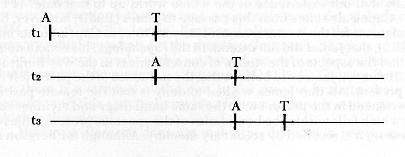
This is the problem set by Zeno of Elea in the fifth century BC. Zeno had several versions of this paradox, perhaps the most famous of which is the race of Achilles and the tortoise. Consider such a race. Both Achilles and the tortoise begin the race at some time ti. At the start of the race, however, the tortoise is allowed a slight edge over Achilles, beginning the race a bit ahead of him. At time t2 Achilles reaches the tortoise’s starting place, but the tortoise has moved on, although his lead has been diminished somewhat. At time t3 Achilles reaches the tortoise’s position at time t2, but once again the tortoise has moved on, although again the tortoise’s lead is diminished. This progression can be represented diagrammatically as follows.


It is apparent that the diagram above represents the first three members of a series which shall progress ad infinitum. The paradox of Achilles and the tortoise simply gives us a convenient and commonsensical way of generating an infinite series like the series of fractions described above. The implication Zeno drew from this paradox was that Achilles could not catch up with the tortoise. The general implication of generating such an infinite series is that any process taking place over a continuum cannot be accomplished, for this would mean successively achieving an infinite number of states or positions in that process. In other words, for the process to be completed infinity itself would have to be transcended.

Bergson believed that such an argument is fallacious, for the paradox we are drawn into is simply the consequence of identifying time with space (CM 144f., TFW 112-15). Space can be infinitely divided. We can take, for example, a line segment, and divide it as much as we wish. The limit of such division is the mathematical point, but so long as we start with a spatial quantity of some positive magnitude, this limit shall never be reached. Consequently, space is infinitely divisible. But time, for Bergson, is not divisible as space is. It is, rather, a fluid and continuous flow which cannot be sliced up endlessly. Zeno has identified Achilles’ motion with the positions he occupied in space, and has fallen into the paradox through the mathematical analysis of these positions.

To proceed as Zeno is to admit that the race can be arbitrarily broken up like the space which has been covered; it is to believe that the passage is in reality applied to the trajectory; it is making movement and immobility [i.e., space] coincide and consequently confusing one with the other. (CM 145)

Bergson, then, finds Zeno’s paradox flawed. In identifying time with space we identify it with a series of externally related and discrete points, and this denies the internal relatedness and infusion of conscious states which both Bergson and James insisted were the characteristic features of conscious life. Thus, if we only consider the course which Achilles ran, Zeno can make his case, but so long as we concentrate our attention on the race as run, the paradox cannot arise.

James came to realize the affinities between his own thought and that of Bergson’s in 1902 upon reading Bergson’s Données immédiate de la conscience (TFW) and Matière et mémoire (MM) (TCWJ2 603f.). James’s admiration of Bergson’s philosophy grew thereafter, until in 1908 James gave the Hibbert Lectures at Oxford, subsequently published as A Pluralistic Universe. Concerning these lectures James wrote to Bergson, "It amounts practically to a critique of intellectualism, and a vindication of the immediately vécu flux -- in short, to Bergsonism" (TCWJ2 622). Thus James joined Bergson in defending an ‘intuitive’ methodology and criticizing the cognitive constructions of intellectualist philosophy.

However, James did not simply adopt Bergson’s philosophy. This can be seen in his discussion of Zeno’s paradox in A Pluralistic Universe (PU 102-04), and in his last book, published posthumously, entitled Some Problems of Philosophy (SPP 80-95). For Bergson Zeno’s paradox posed no problem if we refuse to identify time with space. Our intuitive understanding of the flow of our conscious lives shows the error of the paradox -- the flow of consciousness is a continuity and not a mathematical succession of points. However, though this answer might be adequate for the critique of the spatializing of time (PU 113f.), James showed that it was not sufficient to answer completely the problem raised by Zeno.

The problem which Zeno raised with his paradox is, as we have seen, the problem of the infinite. James, in Some Problems of Philosophy, draws the distinction between two types of infinitely conditioned things: (1) "Things conceived as standing," such as space and past time; and (2) "Things conceived as growing," such as motion and change (SPP 85f.). With a standing class of infinite magnitude the existence of each of the members of the class is accomplished. The existence or previous existence of each member is, then, a given. However, with a growing infinite the existence of each term is not accomplished, but is being accomplished in serial order. As James puts it, in this case we do not have an accomplished fact, but a task (SPP 88).

According to James, the first type of infinity, that of standing things, does not prove to be troublesome logically or conceptually so long as we take it distributively and not conjunctively. That is, if we consecutively number each member of a standing class of infinite magnitude, we need only conceive of each member as awaiting a corresponding number. The process of numbering shall simply go on ad infinitum as does the series of positive integers. It is only when we consider an infinite class conjunctively, that is, when we conceive of it as a certain sum total of things, that we get into conceptual difficulties. If we consider an infinite standing class conjunctively, we are led into a contradiction, for to speak of all the members of a class is to speak of a bounded total or finitude. Consequently, in taking a class of infinite magnitude in respect to all of its members, that is, the sum total of the things constituting the class, we surreptitiously introduce the concept of finitude and predicate it of the infinite. But so long as we consider each thing in the class, and not all things in it, we are not thrown into these difficulties (SPP 86).

But when we consider the second type of infinity, that of things growing, we come upon graver difficulties. In this case we cannot take the infinite distributively if we are to consider the growing process as continuous. The continuous process is infinitely divisible, and thus if the process itself is of some positive magnitude, then each part of the process will be of a positive magnitude and will, in turn, be itself divisible. The process is, then, only accomplished if the infinite number of parts of the process are successively surmounted. However, the process accomplished is a completed fact with all of its parts surmounted. Here lies the difficulty, for if we take each part distributively and count off each part as it is accomplished, the process itself can never be completed since, by definition, an infinite series cannot be completed. We have, then, an antinomy, for if we suppose a finite process to be continuous, then that process can never be accomplished. Achilles will never catch the tortoise since to do this he would have to accomplish the impossible -- he would have to reach the end of an unending series (SPP 87f.).

The solution to this antinomy is the denial that the processes of things growing are continuous in the sense of being infinitely divisible. Thus, James postulated that the flow of experience must come in discrete durational units. But more than this -- all temporal process must be accomplished through durational units. As James explains in A Pluralistic Universe,

All our sensible experiences, as we get them immediately, do . . . change by discrete pulses of perception, each of which keeps us saying ‘more, more, more,’ or ‘less, less, less,’ as the definite increments or diminutions make themselves felt. . . . [All our sensible experiences] come to us in drops. Time itself comes in drops. (PU 104)

The continuity of experience and, by extension, of time itself must, then, be reinterpreted. It is not an infinitely divisible continuum, but rather a series of durational quanta. As Whitehead puts it, "There is a becoming of continuity, but no continuity of becoming" (PR 35/ 53).

It may be asked how this view differs from the discrete sensations of the associationists or the discrete mathematical instants of the intellectualists which James and Bergson criticized. The answer is that the durational units are internally related. Just as we find the various conscious states of our experience enter into the constitution of one another, so the units of becoming must be related in this way. Whitehead speaks of this internal relatedness as ‘prehension’. Each durational unit prehends those units which have gone before, and is prehended by subsequent units. Thus even though the units are discrete, they are not insulated from one another. The qualities of one unit pervade the constitution of those units which succeed it (cf. SMW 101-06).

The real problem behind Zeno’s paradox is overlooked by Bergson. The difficulty which he pointed out was the result of a confusion of what James called the infinite of things standing with the infinite of things growing, that is, a confusion of space and time. But James showed that the difficulties which arise in the paradox still arise even if we do not ‘spatialize’ time. Consequently, Bergson never saw the need to postulate the succession of units or drops of experience to explain the continuity of the experiential flow.

A clearer view of James’s theory might be had if we draw some of the implications of the theory. What does it mean to say that experience comes in drops? First of all, it means that there must be some unit of experience which is unchanging. If this were not so, then Zeno’s paradox would once again arise. For if we were to say that James’s drops of experience included a changing process, then once again this process would have to be completed over an infinite number of component durations. Thus the basic units of experience come into being and die away to be succeeded by others, but they do not change.

Secondly, this view means that when we try to measure the duration taken up by a process there will be a certain limit to what is in principle measurable in itself. This is a necessary consequence of this theory, since the measurement of time is only possible if there is some change of state taking place, whether this change is in the process being measured or in the instrument of measurement itself. Since there is no change in the basic units of temporal succession, we cannot measure their duration in themselves. We might be able to determine what fraction of time they took up of a longer duration which is measurable. Thus we could on hindsight see they are indeed durational. But when we try to measure the duration of a process, there will be a limit to the accuracy we can achieve. It is as if upon experiencing a year’s time we can look back on a day of that year and determine that its duration was 1/365th of the duration of the year. Yet when we try to measure the duration of the day itself, our instruments fail us. If we start our clock at the beginning of the day, it will not register a unit of time as having past until the day is over and a new day is beginning. This result is not a consequence of the inaccuracy of our instruments, but is a consequence of the nature of time itself. There is, in other words, a basic limit to physical time beyond which we cannot go. We can in imagination take smaller and smaller fractions of a certain duration, a process which will lead us finally to 1/_ of the duration, or the Newtonian instant. However, there is nothing real in the world itself which corresponds to this instant. Real time cannot be divided in this fashion.

A third implication of this theory is that the continuous change of experience is accomplished through the succession of the basic durational units or drops of experience. The continuity of our experience is, then, not the continuity of the infinitely divisible, for in this sense of continuity we must say that the flow of experience is discontinuous. Rather, it is the continuity of a series which has no gaps between its members. As James puts it, experience is continuous in the sense that "anything is continuous when its parts appear as immediate next neighbors, with absolutely nothing between" (SPP 95). In this way experience, like time itself, is a becoming of continuity.

IV

Both James and Bergson insisted that if we look inward and come to understand the nature of our inner conscious lives we find consciousness in a state of continuous flux. But James realized something which Bergson did not -- that we cannot simply insist that the flow of consciousness is continuous; we must make sense of the continuity. This led James to the theory that the stream of consciousness, and time itself, must come in discrete durational units which in themselves do not involve change.

Bergson seems to have felt the need at times to postulate a durational unit of a similar type as James’s. In Matter and Memory he speaks of a quasi-instantaneous sensori-motor present (MM 177f.), and also of the vibratory nature of matter (MM 276). However, these suggestions are tempered by Bergson’s sharp distinction between the sensori-motor present and memory (which is not quasi-instantaneous) on the one hand (MM 179f.), and his insistence that the vibrations of matter are continuous with one another on the other (MM 276). Bergson does not seem to be, in these passages, adopting the Jamesian view of time, but is still insisting on the radical continuity of time without offering an explanation of this continuity.

Bergson’s insistence on this radical continuity of time leads him to startling and seemingly contradictory positions. Consider, for example, this passage.

There is no mood . . . no matter how simple, which does not change at every instant, since there is no consciousness without memory, no continuation of a state without the addition, to the present feeling, of memory of past moments. That is what duration consists of. Inner duration is the continuous life of a memory which prolongs the past into the present. . . . Without that survival of the past in the present there would be no duration but only instantaneity. (CM 179)

Several questions arise here. First, this passage seems to contradict Bergson’s notion of the sensori-motor present. Would not this present still exist even if memory ceased? It would seem that if there is a sensori-motor present then if memory ceased we would be left in Russell’s ‘solipsism-of-the-moment’, but not in instantaneity.4 But a graver difficulty arises with this passage, for it seems that we have here a surreptitious renewal of the mathematical notion of time. The notion of continuity being used in this passage seems to be the mathematical continuity which James rejected as not being the empirical continuity of experience. In this passage Bergson seems to allow for the slicing up of the ‘continuous life of memory’ ad infinitum, leading towards the obliteration of memory, and with it consciousness, in instantaneity. This passage consequently invites the paradox of the growing infinite which led James to deny the mathematical continuity of time.

I believe that in the final analysis the value of Bergson’s work was that of an innovator. His ideas swept away the prejudices of dogmatic philosophical tradition and demanded an accounting of the inner conscious life and the universe itself, as we find it, not as philosophers have believed it ought to be or must be. James also seems to have found the primary value of Bergson’s philosophy in this. As James wrote to C. A. Strong in 1907, Bergson "has killed the beast Intellectualism dead!" (TCWJ2 604). In so doing, and in his suggestive theory of intuition, Bergson led the way to the further metaphysical developments of James, Whitehead, Dewey, and others in the first half of the twentieth century.

But it is in James’s theory of time, and not Bergson’s, that we find the adoption of the same basic solution to the problem of continuity which we find later in Whitehead’s metaphysics. In the Psychology itself we can find ideas which are the harbingers of both James’s theory of durational units of time, and Whitehead’s metaphysics. We have seen how this is true of "The Stream of Thought." But also in chapter X, "The Consciousness of Self," we find several suggestions which were later developed by James and Whitehead. For example, James, in this chapter, postulates that it is the passing thought which is the thinker, and it is the succession of these thoughts which constitutes the stream of consciousness (PP1 342). This notion seems to allude to an epochal theory of time. Also James, in this chapter, speaks of successive thoughts as appropriating or repudiating the contents of earlier thoughts (PP1 340), a notion which Whitehead later takes up in his distinction between positive and negative prehensions.

But perhaps the most interesting idea to arise in this chapter is James’s suggestion that the stream of thought is made up of bits of knowledge or, as James puts it, bits of ‘sciousness’, which include knowledge of other objects only, not themselves. Dewey also pointed this passage out with some interest (2:590f.), but I do not believe he fully understood its import. It is not James s suggestion, as Dewey believes, that there is no mental state at all which is the ‘subject’ or ‘knower’, but rather that the knower and the knowledge are one and the same, that is, identical, and that this bit of knowledge does not know itself as an object. "Each ‘section’ of the stream, says James, "would then be a bit of sciousness or knowledge of this sort, including and contemplating its ‘me’ and its ‘not-me’ as objects which work out their drama together, but not yet including or contemplating its own subjective being" (PP1 304). This brilliant speculation of James’s is a necessary consequence of the epochal theory of time. As we have seen, one implication of this theory is that the basic durational units of time do not change in their own constitutions. If we furthermore accept the notion that these units are internally related, in the sense that the earlier drops of consciousness enter into the consciousness of subsequent drops, it follows that these units or drops of consciousness cannot know themselves. If this were not the case, then these units of consciousness would change, for added to the constitution of the drop taken from the other objects of knowledge there would have to be the knowledge of itself as distinguished from the knowledge of its objects. Consequently at some point during the duration the knowledge would have to be added to its constitution -- the drop of experience would have to change -- which is impossible upon the epochal theory of time.5 As Whitehead says in Process and Reality, "No actual entity can be conscious of its own satisfaction; for such knowledge would be a component in the process, and would thereby alter the satisfaction" (PR 85/ 130). This point of the knower’s being the knowledge while not being aware of itself is central to the epochal theory of time, and the theory of prehension.

The later developments of James’s theory of time, proposed in A Pluralistic Universe and Some Problems of Philosophy, bear remarkable resemblance to Whitehead’s epochal theory of time. Whitehead also argues this theory by using Zeno, although he uses a sophistication of Zeno’s arrow paradox, and not, as James, the paradox of Achilles and the tortoise (PR 68f./ 105-07). Basically the insight of the epochal theory of time might be put in this fashion: that what becomes and what changes are not the same things. What becomes are the durational units or drops of experience, which Whitehead calls ‘actual entities’. What changes is the series of these drops or actual entities as they come into being and perish through the passage of time.6 Bergson did not make this distinction. For him becoming and change were one and the same. But James and Whitehead saw insuperable difficulties in the confusing of becoming and change, and it is their insight into these difficulties, and their solution, which gave rise to a more adequate understanding of the nature of time.7


References

CM -- Henri Bergson. The Creative Mind, trans. Mabelle L. Andison. Totowa: Littlefield, Adams & Co., 1965.

MM -- Henri Bergson. Matter and Memory, trans. Nancy Margaret Paul and W. Scott Palmer. London: George Allen & Unwin, 1911.

PP1 -- William James. The Principles of Psychology, vol. I. 1890; rpt. New York: Dover Publications, Inc., 1950.

PU -- William James. A Pluralistic Universe. Cambridge, Mass. Harvard University Press, 1977.

SPP -- William James. Some Problems of Philosophy. Cambridge, Mass.: Harvard University Press, 1979.

TCWJ2 -- Ralph Barton Perry. The Thought and Character of William James, vol. II. Boston: Little, Brown & Co., 1935.

TFW -- Henri Bergson. Time and Free Will, trans. F. L. Pogson. New York: Harper & Brothers, 1960.

1. Milic Capek. "Stream of Consciousness and ‘Durée Réele’," Philosophy and Phenomenological Research 10 (1950), 331-53.

2. John Dewey. "The Vanishing Subject in the Psychology of James," Journal of Philosophy 37 (1940), 589-99.

3. Victor Lowe. "William James and Whitehead’s Doctrine of Prehension," Journal of Philosophy 38 (1941), 113-26.


Notes

1James does indicate at times in "The Stream of Thought" his belief that the flow of conscious life indicates the features of reality as a whole. See, for example, the quotation already cited in which James indicates that relations of objects are known through our feelings of relations.

2 For a discussion of ‘intuition’ see CM, introduction (Part II).

3 See William James, "The Function of Cognition," The Writings of William James, John J. McDermott, ed. (Chicago: University of Chicago Press, 1977), pp.136-52. This article was first published in 1885, five years prior to the publication of the Psychology.

4 See also James’s discussion in PP1 643-45. James makes it clear in his discussion of primary memory that the existence of memory requires the existence of a substantive state of mind, which would suggest that if memory ceased there would still he a durational state of mind. I believe that James’s response to Richet (p. 644n) would be an appropriate response to Bergson: "Professor Richet has . . . no right to say . . .:‘Without memory no conscious sensation, without memory no consciousness’. All he is entitled to say is: ‘Without memory no consciousness known outside itself’."

5In response to this point it might be objected that awareness or knowledge of self is not necessarily something added to the drop of experience, but is, on the contrary, constitutive of it throughout its duration. However, this is tantamount to saying that any experience includes a reflexive awareness of the experience itself. This view leads to difficulty, for awareness or knowledge is always awareness or knowledge of some object. Thus, such a reflexive awareness would have to be aware of the experience as object, which cannot be the case if the awareness and the experience are one and the same. If it is rebutted that we need not speak of the experience as the object of knowledge of this reflexive awareness, then this view boils down to a recommendation for a radical shift in our understanding of what we mean when we speak of an ‘awareness of’ or ‘knowledge of’ something, a shift which is unwarranted.

6.I am indebted to Steven Nofsinger for suggesting this distinction to me as a way of distinguishing Bergson’s and Whitehead’s philosophies.

7 I would like to extend my gratitude to Drs. S. Morris Eames and Winston Wilkinson for their many helpful suggestions on earlier drafts of this paper.

From Mimesis to Kinesis: The Aristotelian Dramatic Matrix, Psychoanalysis, and Some Recent Alternati

Freud’s mind was tragically oriented . . . there’s always at the end of the vision that vacant spot where he knows he’s defeated, but he wants then to be defeated with dignity. Do you see? He can’t cure everybody. He may not even have an answer, but, by God, he’s going to try with great dignity and all the intelligence and feeling he’s got to arrive at some wisdom.

-- Arthur Miller 1

Of Whitehead’s more specific concepts, his "presentational immediacy," the "immediate perception of the contemporary external world,"2 has probably had the greatest single impact on recent poets. Such direct influence, however, by no means exhausts the relationship between his philosophy and contemporary poetics. Though largely unconnected with the evolution of recent art theories, Whitehead prophetically anticipated some of their most radical concerns. The following excerpts from his 1933 Adventures of Ideas sum up some of these with amazing accuracy and comprehensiveness. The human body, Whitehead writes,

is an instrument for the production of art in the life of the human soul. It concentrates upon those elements in human experience selected for conscious perception intensities of subjective form derived from components dismissed into shadow.... In this way the work of art is a message from the Unseen. It unlooses depths of feeling from behind the frontier where precision of consciousness fails. The starting-point for the highly developed human art is thus to be sought amid the cravings generated by the physiological functionings of the body. The origin of art lies in the craving for re-enaction. . . . There is a biological law -- which however must not be pressed too far -- that in some vague sense the embryo in the womb reproduces in its life-history features of ancestors in remote geologic epochs. Thus art has its origin in ceremonial evolutions from which issue play, religious ritual, tribal ceremonial, dance, pictures on caves, poetic literature, prose, music.3

Had I been aware of it at the time, the statement might well have influenced my previous attempt to describe the new understanding of art "as a re-enactment of nature in process, achieved by projective empathy and psychophysiological spontaneity, rather than as an imitation of reality in stasis."4 To Whitehead as against Aristotle, the subject matter of art is not the "kind of thing that might be,"5 but unmediated reality especially where it reaches into unconscious, pre-civilized experience. The creativity which gives it shape, takes its impetus not so much from rational activities allied to philosophical speculation, as from the rhythms of the body and the motions of our soul. Language, even in the strictly literary arts, is no more than a means to the end of suggesting facts ultimately inaccessible to words. Enshrined as it may become in print, the creative impulse first and foremost derives from the body. The traditional bias of Western aesthetics towards discursive reason, in other words, has been reversed.

According to Aristotle, Sophocles’ Oedipus Rex owed part of its eminence as the greatest work of art to the fact that the play could be given its full artistic impact by mere recital, that is to say by virtue of its strictly linguistic potential. Just as this position marks our traditional understanding of art at its perhaps furthest extreme, so its reversal, now widely practiced in today’s avant-garde theater, has helped the new "body" poetics to its most radical and literal realization. To Jerzy Grotowski, for instance, the primary medium for the actor ought to be his body. "[E]verything must come from and through the body. First and foremost, there must be a physical reaction to everything that affects us. Before reacting with the voice, you must first react with the body. If you think, you must think with the body."6 Grotowski’s mentor, Artaud, had earlier demanded a similar primacy of the spectacle over the spoken word. In following "the very automatism of the liberated unconscious,"7 this theater of cruelty should avoid the "cheap imitations of reality" of Aristotelian persuasion. While emphasizing the psychotherapeutic bias of his own efforts, Artaud at the same time inveighs against "a purely descriptive and narrative theatre -- storytelling psychology" as well as psychology in general. Just like the Aristotelian dramatic matrix, psychology, he seems to imply, ". . . works relentlessly to reduce the unknown to the known, to the quotidian and the ordinary, [and] is the cause of the theater’s abasement and its fearful loss of energy."

All this calls for an explanation which Artaud himself or his various followers have so far denied us. What connections, if any, exist between Aristotelian poetics and the contemporary psychological theater as well as psychoanalysis itself? And to what degree can the efforts of an Artaud or Grotowski to evolve a new theater of the body rather than the spoken word be seen as an alternative to this traditional nexus, an alternative with its roots in the same bodily character of experience emphasized so often, and so emphatically, by Whitehead?

I

For lack of examples listed by Artaud himself, two plays, Pirandello’s Six Characters in Search of an Author and Miller’s Death of a Salesman, may serve to illustrate that part of twentieth-century theater with roots in the traditional nexus based on Aristotle and psychoanalytic theory. At first sight the two plays seem to have little in common except that their authors considered them as tragedies. Pirandello felt that he had dramatized "the inherent tragic conflict between life (which is always moving and changing) and form (which fixes it, immutable)."8 Miller thought of his play as the tragedy of a man who "gave his life, or sold it, in order to justify the waste of it."9 Yet even these concepts of tragedy are conspicuous for their differences rather than their affinities. What relates the two plays and, in fact, makes them two of the most forceful manifestations of the tragic in our century, remained a secret even to their authors.

The genesis of Six Characters is well known from the playwright’s 1930 preface to the play. The Father who, possessed with the demon of experiment, sends his own wife to live with another man and almost ends up sleeping with his "Step-Daughter" by the surrogate husband, had somehow taken hold of his imagination without revealing its deeper meaning in a significant form. For real poets, in Pirandello’s Aristotelian conviction, "admit only figures, affairs, landscapes which have been soaked, so to speak, in a particular sense of life and acquire from it a universal value."10 Unable to discover it after much effort, Pirandello eventually found this deeper significance in the conflict "between life-in-movement and form" which crystallized in two scenes of an "outrageous unalterable fixity." The characters search for an author, the whole impromptu stunt of staging their melodramatic entanglements before the surprised manager, is little else than the search for these two crucial moments. The first occurs when the Father, about to sleep with a prostitute, realizes that she is his Step-Daughter; the second, a tragic result of the first, when the young Boy out of the substitute marriage shoots himself with a revolver. The Step-Daughter, like the Father, is "dying to live" her scene in the belief that it caused all her present misery. In turn, the Father calls it his "eternal moment": "She (indicating the Step-Daughter) is here to catch me, fix me, and hold me eternally in the stocks for that one fleeting and shameful moment of my life."

The eagerness with which Father and Step-Daughter want to reenact this traumatic encounter finds its repressive counterpart in the twenty-two-year-old Son, who is made to relive the second scene. His father’s claim to have fathomed "the meaning of it all" is a matter of mere scorn and revulsion to him. Such things, in his opinion, "ought to have remained hidden." But though he preaches repression, he is unable to escape the thrall of his two traumatic memories, one the suicide of the Boy, the other the death by drowning of the four-year-old Child. "There was no scene," he protests. "I went away, that’s all! I don’t care for scenes!" His final reliving of the scene is all the more authentic for being so involuntarily spontaneous.

I ran over to her; I was jumping in to drag her out when I saw something that froze my blood . . . the boy standing stock still, with eyes like a madman’s watching his little drowned sister, in the fountain! (The Step-Daughter bends over the fountain to hide the child. She sobs.) Then . . . (A revolver shot rings out behind the trees where the Boy is hidden.)

Pirandello, in fusing pretense and reality, has actual death and suicide "reenacted" on the stage here. This seems to imply that repressed traumatic events become more powerful than reality itself once they are released. The playwright himself, of course, who was barely aware of Freud at the time he wrote Six Characters, would hardly have talked about his play in these psychoanalytic terms. Instead of pointing out what from a post-Freudian perspective appears as its case history-like plot, Pirandello discusses the play in the traditional vocabulary of Aristotle, to whom the most important thing in a play was how the author had transformed the random events of life into "one action, a complete whole, with its several incidents so closely connected that the transposal or withdrawal of any one of them will disjoin and dislocate the whole."11 In Pirandello’s view, the content of Six Characters may well be chaotic, but his presentation of it was "the reverse of confused." After all, audiences around the world had recognized the clarity of the intrigue and the way in which the whole was finally "quite simple, clear, and orderly."12

We find Miller making similar claims for Death of a Salesman. The playwright’s general sense of form, he confessed in an interview, "comes from a positive need to organize life. The very impulse to write, I think, springs from an inner chaos crying for order, for meaning, and that meaning must be discovered … or the work lies dead as it is finished."13 This Aristotelian search for significant form crystallized in a specific scene which, as in Pirandello’s Six Characters, holds everything in its "outrageous unalterable fixity." There is similarity even of content. Just as Pirandello’s Father, making love to his Step-Daughter prostitute, is discovered by the Mother, so Miller’s Willy Loman and his mistress are surprised by his son Biff in a Boston hotel room.

The two tragedies differ mainly in the way in which their "internal logic" (to use Miller’s phrase) is arranged around these focal scenes. Speaking in psychoanalytic terms, Pirandello’s protagonist plays the role of his own analyst in explaining and reenacting the cause of his misery. "I’m crying aloud the reason of my sufferings,"14 he exclaims. His endless perorations on how a single encounter has crippled his life forever remind the manager of Pirandello, an author he heartily detests. The Father, in other words, assumes the role of the playwright in expounding what the author of, say, Aristotle’s model tragedy, Oedipus Rex, reveals in the gradual unfolding of his play. In a brilliant detective story-like pursuit in which the investigator reveals his own crime, Oedipus finds out about the cause of his misery, while the Father simply wants to demonstrate and, what is more, theorize about it. For man, he explains, "never reasons so much and becomes so introspective as when he suffers; since he is anxious to get at the cause of his sufferings, to learn who has produced them, and whether it is just or unjust that he should have to bear them."

Arthur Miller’s relation to his protagonist, then, resembles not so much Pirandello’s towards the Father, as Sophocles’ towards Oedipus. The play’s internal logic gradually renders both audience and hero aware of his hidden guilt. In Oedipus Rex this takes the form of an investigation into objective facts, while Death of a Salesman gives us a psychoanalytic variant of the same process. Willy Loman’s half-demented forays into his past proceed with the random unpredictability with which a neurotic patient might talk to his analyst. But the form of this involuntary confession, as manifest in the play’s structure, finally amounts to a coherent case history of the protagonist’s dilemma. Characteristically, the original version of the play was entitled The Inside of His Head.15

Death of a Salesman, as Miller points out, is the tragedy of a man who unwittingly ruins his son, recognizes his guilt, and is forgiven by his victim.16 More than halfway through the play, Willy Loman, talking to Bernard, his son’s former schoolmate, still wonders why Biff at age seventeen suddenly turned from a high school football hero into a hopeless good-for-nothing. Surely Buff’s failure in a math course is not enough to explain this transformation. To both Bernard and Willy it is a total enigma:

WILLY: Why? Why! Bernard, that question has been trailing me like a ghost for the last fifteen years. He flunked the subject, and laid down and died like a hammer hit him!17

When Bernard suggests that it happened after Biff had gone to visit his father in Boston, Willy, wavering between half-recognition and aggressiveness, reacts like Oedipus when Jocasta tells him the circumstances of Laius’ murder at the crossroads.18 To the spectator there is little surprise in all this.

For throughout the first half of the play we have been made to watch Willy with the eyes of an analyst listening to his neurotic patient. What we witness now is what Freud would have called a final outburst of "resistance due to repression."19 Very soon the protagonist’s embattled ego will yield its defenses to the forces of a repressed traumatic experience as it invades him from the unconscious. Willy Loman, in Miller’s own words, is "the kind of man you see muttering to himself on a subway . . . he can no longer restrain the power of his experience from disrupting the superficial sociality of his behaviour."20 And as we see his daydream phantasies enacted in front of our eyes, one single event stands out with particular obsessiveness. At one point his wife Linda tells him he is "the handsomest man in the world." This, in Willy’s guilt-ridden mind, evokes a scene with his former mistress calling him a "wonderful man" and thanking him for some stockings he gave her. There is a second association when Willy wakes up from this reverie, sees Linda mending her stockings and screams: "Now throw them out!" All this, we are made to understand, is somehow connected with Biff’s failure in the math course. For following the hotel room scene there is another flashback, disrupted by the mistress’ laughter and Willy’s "Shut up!" in which young Bernard warns the Lomans that their son is about to flunk math. But at this point we still ask ourselves how the two incidents interconnect.

Willy’s overflowing unconscious, however, does not withhold the answer for much longer. His conversation with the adult Bernard has stirred up the crucial link in the chain of associations. Willy is at a restaurant with his two sons and their pickups. When Buff refuses to tell him about his recent interview with his former boss, Oliver, he suddenly, to the confusion of everybody, bursts out: "No, no! You had to go and flunk math!" Now his wandering mind returns to the scene in which young Bernard reported Biff’s failure. But the scene has undergone a significant change. Only Linda and young Bernard are present, while Biff has already left for Boston. Meanwhile in the restaurant, Biff asks himself why he ever went to see Oliver. In Willy’s mind this question is promptly answered by the laughter of his former mistress, which is enough to finally break down his remaining conscious defenses. Abandoned by his two sons, he relives the traumatic scene, long repressed, which contains the solution to the riddle that has plagued him for so long. Biff, thinking that his father might intercede for him with his math teacher, found Willy in the company of a half-naked woman.

II

As much as they point back to Aristotle’s Poetics and Sophocles’ Oedipus Rex, the plot structures of both Death of a Salesman and Six Characters in Search of an Author, then, show equal affinity with twentieth-century psychoanalysis. This is all the more striking as both Pirandello and Miller were practically ignorant of Freud’s teachings when they wrote their plays.21 It also suggests that both Freudian psychoanalysis and contemporary psychological drama, each through independent channels, have common roots in the Aristotelian dramatic matrix as largely derived from Sophocles’ Oedipus Rex. It remains to be seen what connections there are between psychoanalysis proper and this over two-thousand-year-old aesthetic tradition.

Such links can be found even for more recent psychoanalytic methods which in their emphasis on physiological reenactment seem to offer radical alternatives to Freud’s rationalist methods. What, for instance, could be further removed from strictly discursive psychoanalysis than primal scream therapy? But rereading Arthur Janov one quickly realizes that screaming here is only a means to the end of uncovering the unbroken chain of neatly interconnected events or "scenes" often leading back to the "major scene" which caused the neurosis. To quote from Janov’s examples:

A patient who had no memory before the age often began to relive experiences at the age of fourteen and worked her way down the age ladder until she relived a terrible event that caused the final split at the age often Some patients are able to go directly to the major scene in which they felt the split; others take months to get there."22

A similar picture emerges from Bioenergetics. Its main exponent, Alexander Lowen, proposes to "help a person get back together with his body and to help him enjoy to the fullest degree possible the life of the body."23 To this end, Lowen designed a number of ingenious physical exercises combined with primal therapy. But these are subservient to a kind of torture chamber psychoanalysis in which the patient reveals his past in the state of exhaustion or emotional turmoil induced by screaming and physical exercise. In Lowen s own words:

One of the purposes of the analysis is to create that map in the patient’s mind. It is a map of words, made up of memories, and is therefore the full history of the person’s life. When it all comes together like the pieces in a jigsaw puzzle, it finally makes sense and the person sees who he is and how he is in the world, as well as knows the why of his character.

Lowen’s and Janov’s direct indebtedness here is to Freud, who throughout talks about his patients’ repressed experiences in terms of highly specific, dramatic, and traumatic "scenes." The analyst, like Theseus in the labyrinth of the unconscious, has to "get hold of a piece of the logical thread"24 that will lead him to a logically coherent case history. Not before all the pieces of the puzzle are assembled should he reveal the patient’s true life history to its protagonist who will then be "overborne by the force of logic."

It is only towards the end of the treatment that we have before us an intelligible, consistent, and unbroken case history. Whereas the practical aim of the treatment is to remove all possible symptoms and to replace them by conscious thoughts, we may regard it as a second and theoretical aim to repair all the damages to the patient’s memory. These two aims are coincident. When one is reached, so is the other; and the same path leads to them both.

Alternatively one might argue that Janov’s and Lowen’s indebtedness to Freud reaches far beyond the father of psychoanalysis; or, if viewed from a different angle, that Freud’s impact on his disciples and twentieth-century thought generally stems to a large extent from the fact that he translated into new, psychoanalytic terms what in its major premises forms part of an over two-thousand-year-old tradition of Western thought.

Freud was partly aware of these roots. Even before the birth of psychoanalysis proper, Aristotle’s concept of the purging of certain detrimental emotions (fear and pity) reached by witnessing someone else’s calamities provided Freud and Breuer with the label for their cathartic method. Here the psychical process which caused the neurosis "must be repeated as vividly as possible; it must be brought back to its status nascendi and then given verbal utterance." Even though the patient, to describe him in Aristotelian terms, becomes his own spectacle, the analogy holds. For most of the repressed material he is made to relive will strike him like an alien experience. Freud before long abandoned this more dramatic method for one in which the patient rids himself of his neurosis by learning to see it as a part of his intelligible case history. But even as late as 1924 he still admitted that "the cathartic method was the immediate precursor of psychoanalysis, and, in spite of every extension of experience and of every modification of theory, is still contained within it as its nucleus."

Freud’s indebtedness to the traditional dramatic matrix is equally apparent regarding the complex, which to him constitutes "the nucleus of all neuroses" as well as the beginning point of all "religion, morals, society and art."25 From its earliest mention in the letters to Fliess,26 Freud named the complex after Oedipus Rex. The discovery, he wrote in The Interpretation of Dreams (1900),

is confirmed by a legend . . . whose profound and universal power to move can only be understood if the hypothesis I have put forward in regard to the psychology of children has an equally universal validity. What I have in mind is the legend of King Oedipus and Sophocles’ drama which bears his name.27

One question to be raised in this connection is if Freud, without his model, would have ever "discovered" the complex. Another concerns the supposedly "universal validity" of the legend. Freud may question the interpretation of Oedipus King as a "tragedy of destiny" but only by reinterpreting the notion of destiny. Destiny to him is not one man’s specific fate according to the will of the gods but "the fate of all of us." Oedipus’ "destiny moves us only because it might have been ours -- because the oracle laid the same curse upon us before our birth as upon him. . . King Oedipus, who slew his father Laius and married his mother Jocasta, merely shows us the fulfillment of our own childhood wishes." Yet recent investigations into the history of the story come to the opposite conclusion. As Thalia P. Feldman points out, Oedipus, in the extant literature up to Aeschylus, was not treated as an offender who needed punishment. "It is the Aeschylean Oedipus who first blinds himself, an unprecedented individual action which signifies that the offender is loading himself with the enormous burden of shame and horror which he feels at his involvement, even though he and everyone else knows that he is not guilty."28 This throws serious doubts on Freud’s claim that the killing of the primal father, the formation of the Oedipus complex, and the birth of tragedy all happened at the dawn of history. What seems to be closer to the truth is that both tragedy and the Oedipus legend represent relatively recent phenomena in a specific culture which as such bequeathed its limitations to Freud’s discoveries of neurosis and the discontents of civilization.

Freud’s third major debt to the traditional dramatic matrix is reflected in his general preference, shared with Aristotle, for Oedipus Rex as a play whose action "consists in nothing other than the process of revealing, with cunning delays and ever-mounting excitement . . . that Oedipus himself is the murderer of Laius."29 Sophocles’ tragedy, if it is not an actual precursor of the modern detective story, can certainly be termed an early example of what Edgar Allan Poe called a "tale of ratiocination."30 Particularly ingenious here is the use of coincidence such as when Oedipus sends for the shepherd who saved his life at mount Cithaeron, who also happens to be the sole survivor of the king’s murder at the hands of his unknowing son; or when the news of Polybus’ death is brought by a messenger who happens to be the shepherd who took young Oedipus from his Theban colleague and brought him to Polybus, king of Corinth. For a moment Oedipus believes that he has escaped the prophecy that he will murder his father until the messenger tells him that he was not related to Polybus. This reversal is confirmed by the arriving Theban shepherd who is forced to testify to Oedipus’ identity with the killer of Laius. What Freud calls "the process of revealing, with cunning delays and ever-mounting excitement," is what Aristotle, with his customary precision, describes as an example of peripety and anagnorisis combined, a fusion made even more powerful by the fact that both arise from a "probable or necessary sequence of events."31 Thus, the two devices add the final touch of perfection to a plot whose several incidents are so closely connected that the transposal or withdrawal of any one of them will disjoin and dislocate the whole."

No wonder that Freud, in calling the action of Oedipus Rex a mere process of revealing, with cunning delays and ever-mounting excitement," was reminded of similar revelations he was involved in almost daily. The process, he writes, "can be likened to the work of a psycho-analysis,"32 which itself leads to the equivalent of Aristotle’s plot, an "intelligible, consistent and unbroken case history." One might add that the analogy has a causal dimension in that the Aristotelian dramatic matrix played midwife at the very birth of psychoanalysis.

Both tragedy and psychoanalysis deal with and in a way try to resolve human suffering. Ironically, Aristotle here was far more optimistic than Freud, who from the beginning purported to do no more than to transform "your hysterical misery into common unhappiness." For in the Aristotelian hierarchy of entelechies, all of which are striving towards self-perception, poetry, as against historiography, imitates things not as they are but as they ought to be. Its statements therefore are of the nature of universals rather than particulars. While "Nature always strives after ‘the better,’" 33art anticipates that process of teleological self-improvement and seeks to fill tip "the deficiencies of Nature" here and now.34 But how then can tragedy, imitating the worst aspects of life ("EW]hat is done by violence is contrary to Nature),35 be the greatest form of art as Aristotle asserts? The answer is contained in the catharsis concept, and, since the better kinds of catharsis are aroused by "the very structure and incidents of the play,"36 the answer is found in the coherence of the plot. To Aristotle, pity and fear are irrational emotions, and their purgation, achieved by presenting the irrational in an ordered context, can only have the aim of making man more rational.37 "Now, in men," Aristotle writes in Politics, "rational principle and mind are the end towards which nature strives, so that the birth and moral discipline of the citizens ought to be ordered with a view to them. . . . And as the body is prior in order of generation to the soul, so the irrational is prior to the rational."38

The catharsis concept, then, seems to cover the whole spectrum from Freud’s "cathartic method" of acting out repressed experiences, to psychoanalysis proper purporting to cure the patient by making him understand these experiences as being part of his intelligible, consistent, and unbroken case history. The forces at work on the Aristotelian spectator of tragedy are of a similar nature. Without some display of violence or suffering, of course, no fear and pity can be aroused. But to Aristotle, this is not to be misunderstood in the sense of a theater of cruelty. Those, he writes, "who make use of the Spectacle to put before us that which is merely monstrous . . . are wholly out of touch with Tragedy."39 Similarly, the best way of handling the deed of horror is found in a play like Cresphontes where Merope, "on the point of slaying her son, recognizes him in time."40 More important than the actual presentation of violence and suffering is the device of peripety in causing surprise while at the same time letting us recognize what surprised us as an ordered sequence of cause and effect. For the arousal of pity and fear, like the emotions felt in reliving a repressed traumatic scene, will be purged by such hindsight. Aristotelian catharsis and Freudian therapy also share an almost exclusive reliance on discursive language. Just as Freud restricts analysis to the patient’s verbal articulation of his erratic life story towards the logically consistent discourse of his case history, so Aristotle, as already pointed out, prefers to have the cathartic impact of tragedy depend on the spoken word to the exclusion of a spectacle.

The Plot in fact should be so framed that, even without seeing the things take place, he who simply hears the account of them shall be filled with horror and pity at the incidents; which is just the effect that the mere recital of the story in Oedipus would have on one.41

III

Whoever remembers the Happenings of the sixties and seventies will know that Artaud by no means offered the most radical reaction against this position. While Michael Kirby hailed The Theatre of Cruelty as "almost a text for Happenings,"42 Artaud himself was far from advocating a total abolition of language in the theater. But he was equally removed from Freud’s or Aristotle’s belief that language can resolve the contingency of experience in its discursive order. On the contrary, language has been ossified by such assumptions, and, before it can be used in the theater, has to be cleansed of its abstract encrustations. For hidden underneath is its old dynamic potential which, as Artaud concluded before Charles Olson,43 can be reclaimed from the respiratory sources of language:

let words be joined again to the physical motions that gave them birth, and let the discursive, logical aspect of speech disappear beneath its affective, physical side, i.e., let words be heard in their sonority rather than be exclusively taken for what they mean grammatically.44

Artaud had his own ideas about how the theater of cruelty would benefit the spectators. This is achieved neither by letting them see the randomness of events in their deeper causal coherence nor by making them understand life as a logically consistent case history. No amount of explaining or understanding will do away with the basic cruelty of life – "that life is always someone’s death." Man, rather than deluding himself that suffering might be eliminated, should simply learn to confront it. The new theater, then, "far from copying life, puts itself whenever possible in communication with pure forces." It should immerse the spectator in the irrational rather than strive to purge it out of him. The actor is to provide him with a model in this pursuit. To Artaud, "every emotion has organic bases," so that the soul, for instance, is no more than a "skein of vibrations." Yin and Yang, Chinese acupuncture, and the Cabala are invoked in discussing possible new acting techniques that will provide an alternative to the Aristotelian mimetic theater and its twentieth-century variant, story-telling psychology." As an "athlete of the heart," the actor should explore the different modes of respiration in his acting. Thus joining "the passions by means of their forces, instead of regarding them as pure abstractions," will confer a "mastery upon the actor which makes him equal to a true healer."

Artaud’s alternative to the psychological theater was to a large extent inspired by non-Western sources. A Balinese dance group which he saw at the 1931 Colonial Exhibition in Paris brought his rather diffuse ideas about "The Theater and the Plague" or "The Alchemical Theater" to a concrete focus. It also led him to define his goals in analogy to "the Oriental theater of metaphysical tendency" as opposed to "the Occidental theater of psychological tendency." These Balinese productions, he wrote, "take shape at the very heart of matter, life, reality. There is in them something of the ceremonial quality of a religious rite, in the sense that they extirpate from the mind of the on-looker all idea of pretense, of cheap imitation of reality." Some what later, Hindu cosmology helped him redefine his concept of cruelty as the central law of the universe. Unlike the Judeo-Christian God, Brahma suffers his own creation "with a suffering that yields joyous harmonics perhaps, but which at the ultimate extremity of the curve can only be expressed by a terrible crushing and grinding."

The passage serves to remind us that Artaud was not the first either to oppose the Aristotelian dramatic matrix or to derive his alternatives from non-Western sources. It also brings to mind the one-sided distortions which have characterized this now nearly two-hundred-year-old tradition right from the days of Schopenhauer’s pessimistic transcription of Eastern thought. For Eastern philosophy, if considered in its own right, is neither pessimistic nor optimistic, but rather what we might call fatalistic. In depicting the supreme divinity as a monster of destruction, the Bhagavad Gita, for instance, clearly admits to the natural cruelty of life. At the same time it exhorts us to act even if such action may involve someone else’s suffering or death. Neither teleological laws inherent in life nor rational orders that man might impose upon it will eliminate this dilemma. All man can do in trying to face it, is develop the appropriate kind of self-detachment through meditation. Analogously, Sanskrit drama has little concern with implicit teleological schemes, coherent plots showing things as they ought to be, or the purging of fear and pity with the aim of producing more rational citizens. Bharata’s Natyasastra, the Sanskrit equivalent of Aristotle’s Poetics, defines drama, not as the "imitation of . . . one action, a complete whole"45 but as the "representation of conditions and situations"46 aiming to induce a state of appreciative serenity analogous to the life-affirming self-detachment reached through meditation.

Arthur Schopenhauer, the first philosopher-aesthetician to make such ideas his own, misinterpreted the Eastern acceptance of suffering as a denunciation of life and the attempt to come to terms with it as resignation. Lacking all sense of the psychophysiological core of Eastern mysticism, he consistently advocated a repression ("Unterdrückung") and negation of all life impulses. Hence tragedy to him is simply a powerful artistic medium to the same end. In portraying the "horrific side of life" ("die schreckliche Seite des Lebens")47 and showing how all the misery of life results from the blind workings of the Will which is everything, tragedy merely induces a state of quietism in the spectator:

The power of transport peculiar to tragedy may be seen to arise from our sudden recognition that life fails to provide any true satisfactions and hence does not deserve our loyalty. Tragedy guides us to the final goal, which is resignation.

Schopenhauer’s words from The World as Will and Idea are quoted in Nietzsche’s 1886 "Critical Glance Backward" in The Birth of Tragedy (1872),48 which inverts the Schopenhauerian position by way of anticipating the more recent theater of cruelty. Reacting against all previous teleological and rationalist make-believe, Nietzsche, like his teacher, sees tragedy as dealing with the "natural cruelty of things" ("naturliche Grausamkeit der Dinge");49 and he makes light of critics who "never tire of telling us about the hero’s struggle with destiny, about the triumph of the moral order, and about the purging of the emotions."50 Facing "the Heraclitean double motion" of Apollonian creativity and Dionysiac destructiveness, the tragedian focuses on "the eternal wound of being" and shows how, again and again in life, the Apollonian illusion or "veil of Maya" is torn apart until nothing remains but "shreds floating before the vision of mystical Oneness." But as "an augury of eventual reintegration," the Dionysiac spirit "which playfully shatters and rebuilds the teeming world of individuals" induces the very opposite of Schopenhauerian resignation in the spectator:

Tragedy cries, "We believe that life is eternal!". . . It makes us realize that everything that is generated must be prepared to face its painful dissolution. . . . Pity and terror notwithstanding, we realize our great good fortune in having life -- not as individuals, but as part of the life force with whose procreative lust we have become one.

In advocating this untragic celebration of life despite the "horror of individual existence," Nietzsche anticipates Artaud to the very point of sounding imposingly messianic while failing to investigate the practical possibilities of the new theater. There is little even in Le théâtre et son double that enables us to imagine how, as the potential audience of such spectacles, we will be made to join in such amor fati rejoicing. All it amounts to, as Jerzy Grotowski concludes, is "a very fertile aesthetic proposition. It is not a technique." Artaud, like Nietzsche before him, evolved a theoretical alternative to the Aristotelian dramatic matrix and its psychoanalytic derivations. But neither explored the ways in which their theory could be turned into practice, a task more recently tackled by Brook, Grotowski, and others.

The primary aim of Grotowski’s poor theater, for instance, is "a kind of social psycho-therapy"51 in which the spectator comes to share the actor’s psychophysiological self-penetration towards an "inner harmony and peace of mind." This is achieved neither by an Aristotelian portrayal of characters for the sake of their actions nor a psychoanalytic dissecting of emotions for the sake of establishing tragic case histories. Acting to Grotowski is the very Opposite of imitating an action or emotion. "An actor should not use his organism to illustrate a ‘movement of the soul,’ he should accomplish this movement with his organism." Instead of enacting the words codified in a literary text he ought to use his body in order to find a language of signs. Words to Grotowski "are always pretexts" and more often than not disguise the impulse that tries to reveal itself in them. To make words the guidelines for acting is as ill-advised, therefore, as to suggest boredom, for example, by letting the actor act in a "bored" manner. For a bored man, as he desperately and unsuccessfully tries to find something that will end his boredom, is far more active than usual. Before all else, the theater’s medium is the body of the actor. "Before reacting with the voice, you must first react with the body. If you think, you must first think with your body."

In this regard, Grotowski’s poor theater differs not only from its Aristotelian and Freudian counterparts but also from such neo-Freudian advocates of a process psychotherapy as Janov or Lowen. Prima facie, Towards a Poor Theater, with its handbook like lists of physical exercises and its psychoanalytic vocabulary, sometimes sounds conspicuously like Lowen’s Bioenergetics. Living, Grotowski writes,

is not being contracted, nor is it being relaxed: it is a process. But if the actor is always too contracted, the cause blocking the natural respiratory process -- almost always of a psychical or psychological nature -- must be discovered. We must determine which is his natural type of respiration. I observe the actor, while suggesting exercises that compel him into total psycho-physical mobilization.

But to Grotowski, the process of "total psycho-physical mobilization," including primal scream techniques, no longer serves as a means towards the end of establishing consistent case histories within the overall framework of a psychoanalytically discursive logic. Its truer counterparts perhaps are Poetics like the Sanskrit Natyasastra or the Japanese Kwadensho. Such treatises at least show that the training of actors in a manner resembling a process psychotherapy devoid of rationalist systematization is more than a recent fad of the West. It has been common practice in India and Japan for many centuries.


Notes

I Richard A. Evans, Psychology and Arthur Miller (New York: F. P. Dutton, 1969), p. 79.

2A. N. Whitehead, Symbolism, Its Meaning and Effect (New York: Capricorn Books, 1959), p. 21. Concerning the influence of the concept on contemporary poets see F. Faas, Towards a New American Poetics: Essays & Interviews (Charles Olson, Robert Duncan, Gary Snyder, Robert Creeley. Robert Bly, Allen Ginsberg) (Santa Barbara: Black Sparrow Press 1979), pp. 47, 65, and passim. See also Charles Altieri, "From Symbolist Thought to Immanence: The Ground of Postmodern American Poetics," Boundary 2 1 (1972-73), 605-41, pp. 623ff.

3(New York: Macmillan, 1967), pp. 270-71.

4New American Poetics, p. 32.

5Aristotle, Poetics 1451 b 5. This and all following quotations from Aristotle’s Poetics are from Ingram Bywater’s translation, Aristotle. Rhetoric and Poetics. Introduction by F. Solmsen (New York: Random House, 1954).

6Towards a Poor Theater (New York: Simon and Schuster, 1968), p. 204.

7 For this and the following quotations from Artaud see The Theater and its Double (New York: Grove Press, 1958), pp. 54, 60, 76, 77.

8Naked Masks. Five Plays, ed. Eric Bentley (New York: E. P. Dutton, 1952), p.367.

9Death of a Salesman. Test and Criticism. ed. C. Weales (New York: Viking Press, 1967), p. 150.

10 For this and the following quotations from Pirandello see Naked Masks, pp. 364-65, 371, 367, 223, 258, 260, 239, 274, 276.

11 Poetics, 1451 a 32-34.

12 Naked Masks. p. 374.

13 For this and the following quotations from A. Miller see Death, ed. C. Weales, pp. 185, 171, 149.

14 For this and the following quotation from Pirandello see Naked Masks, p. 267.

15 See Death, ed. G. Weales, p. 155.

16 See ibid., p. 167.

17 Ibid., p. 93.

18 Compare Death, ed. G. Weales, p. 94, with Oedipus Rex, line 711ff.

19 An Outline of Psycho-Analysis translated by James Strachey (New York: Norton, 1969), p. 36.

20 For this and the following quotations from A. Miller see Death, ed. C. Weales, pp. 158, 37, 38, 39, 40, 109.

21A. Miller maintains that he "was little better than ignorant of Freud’s teachings when [he] wrote Death of a Salesman," Death, ed. C, Weales, p.161.

22 The Primal Scream (New York: Dell, 1974), p. 97.

23 For this and the following quotation from A. Lowen see Bioenergetics (Harmondsworth: Penguin Books, 1975), pp. 43, 327.

24 For this and the following quotations from Freud see Pelican Freud Library, 15 vols., ed. A. Richards (Harmondsworth: Penguin Books, 1973ff.), III, 380, 387; VIII, 47; III, 57, 44.

25Totem and Taboo, pp. 156-57.

26 See The Origins of Psycho-Analysis. Letters to Wilhelm Fliess, Drafts and Notes: 1887-1902, ed. Marie Bonaparte, etc. (New York: Basic Books, 1954), p.223.

27 For this and the following quotation from Freud see Pelican Freud Library, ed. A. Richards, IV, 362-63, 364. For a detailed analysis of Freud’s Oedipus interpretation in Die Traumdeutung see Cynthia Chase, "Oedipal Textuality: Reading Freud’s Reading of Oedipus," Diacritics 9 (1979), 54-68. The author, however, seems to me to derive erroneous conclusions from misinterpreting Oedipus’ self-blinding as an act of repression (see p. 57).

28 "Taboo in the Oedipus Theme," Oedipus Tyrannus, translated and edited by L. Berkowitz and T. F. Brunner (New York: Norton, 1970), pp. 59-69, 63.

29 Pelican Freud Library, ed. A. Richards, IV, 363.

30 The New Columbia Encyclopedia, ed. W. H. Harris and J. S. Levey (New York: Columbia University Press, 1975), p. 752.

31 Poetics, 1451 a 33-34.

32 For this and the following quotations from Freud see Pelican Freud Library, ed. A. Richards, IV, 363; III, 387; III, 393.

33On Generation and Corruption, 3.36 b 27, The Basic Works of Aristotle (New York: Random House, 1941), p. 527.

34Politics, 1337 a 41, Basic Works, p. 1305.

35 Generation of Animals, 788 b 28-29, The Works of Aristotle. Translated into English under the Editorship of J. A. Smith and W. D. Ross (Oxford: At the Clarendon Press, 1970), V.

36 Poetics, 1453 b 9-10.

37 Cf. Leon Golden, "The Clarification Theory of Katharsis," Hermes 104 (1976), pp.437-52, especially p.445, which of all catharsis interpretations lam aware of comes closest to the one presented here.

38 Politics, 1334 b 14-21, Basic Works, p. 1300.

39 Poetics, 1453 b 9-10.

40 Ibid., 1454 a 6-7. Concerning the contradiction between this statement and 1453 a 13-15, see J. Moles, "Notes on Aristotle, Poetics 13 and 14," Classical Quarterly N.S. XXIX, 1 (1979), pp. 77-94, 82ff.

41 Poetics, 1453 b 3-7.

42 Happenings. An Illustrated Anthology, written and edited by M. Kirby (New York: E. P. Dutton, 1966), p. 34.

43 See E. Faas, New American Poetics, p. 45ff.

44 For this and the following quotations from Artaud see Theater, pp.119,102,82,140, 135, 133, 135, 72, 60,103.

45 Aristotle, Poetics, 1451 a 32-33.

46 See P. Lal, Great Sanskrit Plays in Modern Translation (New York: New Directions, n.d.), p. XVII. See also E. Faas, "Faust and Sacontalá," Comparative Literature 31, 4 (Fall 1979), pp. 367-91, 373.

47 For this and the following quotations from Schopenhauer see Werke. Zürcher Ausgabe, ed. Arthur Hübscher, 10 vols. (Zürich: Diogenes Verlag, 1977), II, 472; 1, 318-19.

48 The Birth of Tragedy and The Genealogy of Morals, translated by Francis Golffing (Garden City, N.Y.; Doubleday, 1956), p.12.

49Werke. Kritische Gesamtausgabe, ed. G. Colli and M. Montinari (Berlin: de Gruyter, 1972), pt. 3, vol. 1, 115.

50 For this and the following quotations from Nietzsche see Birth, pp. 133, 120, 108, 23, 67,143, 102.

51For this and the following quotations from Grotowski see Poor Theatre, pp.206, 46, 45, 123, 235, 236, 204, 208.

Whitehead’s Other Aesthetic

In Alfred North Whitehead’s philosophy there are two ways of describing beauty, or aesthetic experience. Whitehead scholars, with damaging effects, have overemphasized one and underemphasized the other. They have so emphasized the rationalistic way, which concentrates on the intellectual organization of the past, that the meaning of aesthetic experience has been exaggerated. They have so underemphasized the empirical way, which concentrates on the physical response to the past, that the power of aesthetic experience has been neglected. The underemphasis on the empirical way is particularly important because it has not only discouraged the aesthetic appreciation of the power of art and of the world of ordinary experience, it has also discouraged the moral action which such appreciation might engender.

To state my point with greater intensity: the genius of the beautiful is its capacity to move us emotionally; when the Whitehead scholar accounts for the beautiful only rationalistically, much of this genius is missed. To say that aesthetic value can be comprehended rationally leaves out about as much as to say that Auschwitz can be comprehended as the misuse of freedom -- in neither instance is the account incorrect; in both instances, when the account is the only account, the picture is distorted, and so are the actions which it might engender.

In this essay, I will emphasize Whitehead’s empiricist aesthetic. My critical discussion will focus on the rationalistic claim that Alfred North Whitehead’s aesthetic can be properly understood in terms of his notion of the proposition. My empiricist rejoinder will be informed epistemologically by Whitehead’s radical empiricism, and aesthetically by the claim that the beautiful speaks in ways not entirely susceptible to rational analysis.

Donald W. Sherburne is the justly recognized foremost proponent of a rationalistic Whiteheadian aesthetic. His A Whiteheadian Aesthetic has subtly influenced numerous process philosophers and theologians.1 Sherburne’s rationalistic approach is embodied in his specific suggestion that for Whitehead an art work is a proposition or a part of a proposition and that aesthetic experience is a feeling of such a proposition; this approach is derived primarily from Whitehead’s Process and Reality. A proposition proposes that certain select matters of fact, called "logical subjects," be interpreted, or theorized about, in terms of a particular "predicate." An art work embodies such a proposition (or, in the case of music, a predicative pattern only2), and the proposition (or its part) is the real meaning of the art, distinguishable from the physical artifact itself. The recreation of this proposal in the conscious, definite, and intellectual awareness of the beholder is called a "propositional feeling," and it is this feeling which is aesthetic experience. This theory is rationalistic in that it identifies aesthetic experience with a clear, distinct, and ordered estimation of the external artistic reality.

Sherburne’s rationalistic aesthetic conforms to a general approach long-standing in process thought. Both Whitehead and Charles Hartshorne have repeatedly argued that art and aesthetic experience arise within a structure of contrast within identity, or unity in variety.3 This structure enables the mind, or the rationalizing self, to grip the beautiful, to hold it within a category, sometimes called a proposition. This aesthetic rationality is, in turn, a remnant of the classical, Platonizing, and Cartesian effort of mentality to fasten onto the physical, to refuse to let the physical go until the physical has yielded some cognizable promise.4

On the other hand, from the empirical side, Whitehead and his colleagues in radical empiricism, William James, Henri Bergson, and John Dewey, have insisted that cognition is only an abstraction from the more fundamental physical experience, and that to treat the cognizable as the more real is -- with a truly Cartesian forgetfulness -- to put the wagon before the horse. So, while those interpretations which stress contrast within identity and propositional meanings are by no means wrong, they are derivative and secondary, and should be treated accordingly.

It is only with regard to emphasis, then, that I respond to Sherburne and his Whiteheadian colleagues. Sherburne does include the empirical in his aesthetic analysis. He rejects the idealism of Benedetto Croce, and insists on the importance of the physical art object;5 he rejects the "overintellectualism" of Vernon Lee, and insists on the importance of emotion;6 Sherburne acknowledges that some art propositions cannot be rendered linguistically; and he acknowledges that art propositions are first felt physically and that the function of aesthetic experience is to bring clarity to the "vague and inarticulate feelings from a dim, prenumbral region."7 Nevertheless, when Sherburne highlights Whitehead’s specific accomplishment, he chooses to take "very seriously" Whitehead’s aim to rescue the type of thought found in Bergson, James, and Dewey "from the charge of anti-intellectualism." "An indispensable step," Sherburne says, in effecting this ‘rescue is the rationalization of ‘the inner flux,’ the giving to it of an intelligible structure." He maintains that Whitehead accomplishes this rationalization through a genetic analysis of conscious intellection. Sherburne, in turn, claims that his own interpretation of Whitehead’s aesthetic is "based on, not opposed to, that analysis of conscious intellection."8 Sherburne’s aim is not to honor the authenticity of the empirically immediate, "vague and inarticulate feelings from a dim, prenumbral region." It is to rationalize, clarify, and specify those feelings; it is, in short, to tame them; in the area of aesthetics, it is to reduce them to a proposition, felt with a propositional feeling.

For Sherburne, then, the art object, as a proposition, is about meaning, or theory; it is something that may or may not be said about events that may or may not belong together. From two sides it abstracts from brute actuality; it is an imaginative predication about an imaginary selection of circumstances. The proposition lures the subject to simply recreate the proposition in subjective experience. While the true art object is real as an hypothesis is real, the physical artifact itself, whether a thing (like a painting) or a performance, is only the medium between the hypothesis and the experience of the hypothesis.

Now Sherburne is certainly not wrong, whether in his interpretation of Whitehead or of art. Any aesthetic which eliminated entirely the propositional nature of art, reduced art to something physical and aesthetic experience to a physical encounter, would be silly. A piece of literature would be ink scrawls on paper, and a great literary critic would be someone with an ocular affinity for black on white. Even if such preposterousness could be overcome, there would remain all of the questions of why perspective would not totally determine interpretation, as would happen if interactions were sheerly physical, and of how good art and good criticism would be distinguished from bad.9 Clearly, art and its impact cannot be understood without some allowance for its status as an imaginative reality, a status deeply dependent on art’s physicalness, but not reducible to physicalness.

Nevertheless, Sherburne, his colleagues, and even the particular Whitehead of Process and Reality, in their devotion to rationalizing the meaning of the world, including the world of art objects, fail to appreciate the aesthetic power of the experienced world. This is a criticism very difficult to sustain, for it refers to something beyond rationalization and, thus, beyond what can be expressed in a rationalistic argument. I could appeal to memory, and question whether the love of art is finally a love of propositions, whether it is that much an affair of cognition. While such an appeal would be definitive in that, in a typically Whiteheadian fashion, it would appeal "to the self-evidence of experience," it would be an appeal more suitable to an entire life than to the short exposition which will follow hereafter. Consequently, in my effort to sketch Whitehead’s empirical aesthetic I must appeal -- even as Whitehead-the-author does -- to definition, to illustration, and to argument from the history of philosophy.

I. Definition

I have suggested that there are two sides to Whitehead’s aesthetic, the rational and the empirical. Or, to state it more dramatically, there are two aesthetics, each mutually dependent on the other. While the rationalizing aesthetic emphasizes the intellectual organization of the world through propositions and propositional feelings, the empirical aesthetic emphasizes the immediate, physical, emotional, and nonconscious response to the world. An empirical aesthetic attempts to honor, rather than tame, those "vague and inarticulate feelings from a dim, penumbral region."

The importance of Whitehead’s empirical aesthetic cannot be understood apart from some discussion of Whitehead’s notion of perception, and perception is best considered through a brief review of Whitehead’s notion of "symbolic reference" which, in turn, involves the notions of "causal efficacy" and "presentational immediacy." When the multiplicity of the past world physically and causally impinges on the body of the present subject, the world is felt only dimly, if at all consciously; the world is felt, Whitehead says, in its causal efficacy. The clear, fully conscious, and definite awareness of this world is a highly selective, abstract, and organized reduction of causal efficacy, giving a sense of an organized world there, in front of us, a sense Whitehead names presentational immediacy. The thousand physical influences of a green, warm, stale, almost-silent, lamp-lit, desk-furnished, late-at-night room are unconsciously eliminated in favor of a line read on the page on the desk before my eyes. We properly interpret that internal and mental impression of the line to refer to parts of the external and physical world of the room through a process Whitehead names symbolic reference. And quite commonsensically and pragmatically we regard the distinct, mental impression of the line as derivative from the physical impact of the world on our eyeballs. We do not -- despite what David Hume and Immanual Kant have said -- finally regard our clear and distinct mental impressions as primary and nonderivative, and the world’s causality as secondary and derived from the mind.10

While, Whitehead says, the clear, distinct, and conscious impressions of the mind are "handy" and provide "the manageable elements in our perceptions of the world," they are not what is most real or most important.11 It is the things in the world which matter most:

But for all their vagueness, for all their lack of definition, these controlling presences, these sources of power, these things with an inner life, with their own richness of content, these beings, with the destiny of the world hidden in their natures; are what we want to know about.12

And we will know them better not by our clear and distinct impressions, but by our dim physical awareness, derivable from their initial impact on our bodies through causal efficacy.

To sense the world through causal efficacy is in essence, Whitehead says, to sense the aesthetic value of the world. It is to sense power at its deepest, and "the essence of power is the drive towards aesthetic worth for its own sake."13 When Whitehead speaks of power this way, he recognizes that the telos of the universe is toward beauty, in that it aims toward the heightening of felt contrast. Consequently, the "sense of external reality -- that is to say, the sense of being one actuality in a world of actualities -- is the gift of aesthetic significance."14

This account of awareness is empirical because it is based on the immediate experience of the causal efficacy of the physical world; it is radically empirical because it claims to sense, in addition to the data for the five senses, the objective embodiments of values, and it senses these values "intuitively" -- that is, physically by, for example, a sense of aversion or a sense of attraction. Because, for Whitehead, those experienced values are essentially aesthetic values, this radical empiricism is aesthetic in orientation, and it can lead, in turn, to a developed, empirical aesthetic.15

An empirical aesthetic, when confronted with a rationalistic aesthetic, would claim that there are aesthetic objects other than propositions, for simply "the sense of being one actuality in a world of actualities" is an experience of something nonpropositional but aesthetic. Such experiences themselves are evidence for the further claim that there are more subjective aesthetic reponses than those which can be called propositional feelings. Finally, an empirical aesthetic would claim, over against a rationalistic aesthetic, to be primary rather than secondary, necessary rather than accidental.16 It would seek to bring to some dim awareness that intimate concourse of the body with the aesthetic worth of the world, and, somehow, in the process to preserve the immediacy of that concourse, as it is, prior to the abstraction of selected elements, the wholesale elimination of "irrelevancies," and the development of propositional feelings, all of which occur in a rational aesthetic judgment. An empirical aesthetic would seek to honor directly those "vast issues vaguely haunting the fullness of existence," to attend directly to that physical reaction to the world which says with incorrigible indefiniteness, " ‘This is important,’ ‘That is different,’ ‘This is lovely.’ " 17

II. Illustration

It is just this empirical sense of the aesthetic which William Carlos Williams had, particularly in his most conscious moments of rebellion from the cognitive and academic orientation of art. In his autobiography, in the midst of an explanation of how his work as a medical doctor facilitated his work as a poet, Williams said,

I was permitted by my medical badge to follow the poor, defeated body into gulfs and grottos. And the astonishing thing is that at such times and in such places -- foul as they may be with the stinking ischiorectal abscesses of our comings and goings -- just there, the thing, in all its greatest beauty, may for a moment be freed to fly for a moment guiltily about the room. In illness, in the permission las a physician have had to be present at deaths and births, at the tormented battles between daughter and diabolic mother, shattered by a gone brain -- just there -- for a split second -- from one side or the other, it has fluttered before me for a moment, a phrase which I quickly write down on anything at hand, any piece of paper I can grab.18

This same radically empirical spirit is manifest in what may be Williams’ most famous short poem, "The Red Wheelbarrow

So much depends

upon

a red wheel

barrow

glazed with rain

water

beside the white

chickens.19

The "So much depends" is not the predicate of a proposition, but is an expression of the physical appreciation of a physical phenomenon -- powerful, rich, and, finally, inarticulate. The problem confronted by such a poem is not that of understanding, of explanation or of establishing the rational relation among the logical subjects -- wheelbarrow, rainwater, and white chickens. Rather, the problem is that of sheer knowledge, of how to accede linguistically to the aesthetic value in the sheer relationality and facticity before one’s eyes.20 To regard such a poem as a proposition is to make it a banality; and for the Western, scientifically-minded, academic intellectual that is no trick at all.

III. History

To include the rationalistic aesthetic in an elaboration of Whitehead’s thought is, as we have said, by no means wrong. But to single it out, even to the point of neglecting the empirical, is to fail to give Whitehead the proper intellectual lineage. It could be to make the father the child of the son; it could be to make Whitehead the child of his rationalist successors, like Charles Hartshorne, rather than -- properly, I believe -- to make Whitehead the child of Bergson and James and Dewey, all his philosophical antecedents and all radical empiricists21 in revolt against one form of rationalism or another.

Of course, these radical empiricists have their rationalistic side, as Whitehead does. John Dewey, even in his aesthetic, can be interpreted as a "propositionalist." In Art as Experience, it is valid to say that in one respect art is a proposition, suggesting a structure in terms of which an individual entity, already out of harmony with its environment, can achieve a new and harmonious relation with it.22

To say that alone, however, would be to distort Dewey, for it would leave the impression that art is the artist’s rational construct, imposed on a world which lacks its own significance. Dewey, in fact, proceeds immediately to say,

The live animal does not have to project emotions into the objects experienced. Nature is kind and hateful, bland and morose, irritating and comforting, long before she is mathematically qualified or even a congeries of "secondary" qualities like colors and their shapes.23

Accordingly and as a radical empiricist, Dewey places his emphasis on the discernment of objective value in the objective world. Dewey calls this value "quality," but by the term he means neither mathematical nor secondary qualities; he uses the term to refer, first, to the wholeness or deeper reality, in some aspect of the world, often as that wholeness is presented in a work of art.24 If this were called the objective locus of quality, the subjective locus would be the emotional intuition of the objective quality; this subjective quality gives the experience itself the unity which makes it that particular experience.25 It is this empirical discernment of quality which provides the substance of the derivative and propositional resolution of the conflict between the individual and its environment. So for Dewey the major aesthetic task is empirical; it is to discern properly the aesthetic quality of the external object.26

Similarly, although Whitehead has a propositional aesthetic, for him the major aesthetic task is to discern, through a concentration on causal efficacy, the aesthetic worth of the external world. The primacy of this task, and the derivative nature of a rationalistic aesthetic, is best understood when Whitehead is seen in a line of radical empiricists, a position which is most evident in his Symbolism: Its Meaning and Effect and Modes of Thought. There Whitehead compares his own epistemology primarily to Hume’s and Kant’s epistemologies, but also to that trust in mental experience which has passed from Descartes, to Locke, to Berkeley. He notes that these thinkers regarded the clear and distinct mental images of presentational immediacy as primitive, and causal efficacy as derivative. Whitehead calls this "a complete inversion of the evidence," and contends that it leads to the "fallacy of simple location" and the "fallacy of misplaced concreteness."27 His response is, of course, to argue for the primitiveness of causal efficacy, and to contend that the primary aim of knowledge is to elucidate with as little abstraction as possible the immediacy of causal efficacy. This is a separate enterprise, quite different from the elucidation effected by presentational immediacy itself. In this empiricism, Whitehead should be regarded as a successor to Bergson, James, and Dewey, and not primarily as one who would correct their "anti-intellectualism."

While the commonality among James, Bergson, Dewey, and Whitehead will not be established in this short essay,28 it can be at least illustrated by reference to a curious linguistic move made by the three of those who wrote in English. In Adventures of Ideas Whitehead said:

Logicians are not called in to advise artists. The key to the explanation is the understanding of the prehension of individuality. This is the feeling of each objective factor as an individual "It" with its own significance.29

Why the inarticulateness, especially from Whitehead at his articulate best in what may be his most readable book? The answer may be that by using "It" in the way he does, he is attempting to point to a primal, physical, and immediate experience of objective value, an experience inaccessible to normal, conscious, and circumspect language. Virtually the same linguistic awkwardness appears in the writings of his American compatriots, James and Dewey. In Essays in Radical Empiricism James wrote:

The instant field of the present is at all times what I call the "pure" experience. It is only virtually or potentially either object or subject as yet. For the time being, it is plain, unqualified actuality, or existence, a simple that.30

In Art as Experience, in his efforts to define that imperceptible "quality" in our experience of the immediate world, Dewey stumbles from language about having "an experience," to illustrations such as "‘that was an experience,’" and "that meal."31 Bergson, however, chose simply to refer to sympathy and intuition, preferring, I suspect, style to awkward American accuracies.32

The burden of this set of remarks is to contend that an empirical aesthetic, which looks through art or through aesthetic experience in order to recover the primitiveness of causal efficacy, is most obvious in Whitehead’s thought when it is considered in a primarily American historical context. From that vantage point it is apparent that a propositional and rational aesthetic, while certainly not guilty of an inversion of the evidence or of the fallacies of simple location and misplaced concreteness, rests on what is derivative and secondary.

This distinction is not, I hope, merely pedantic. It seeks to be a reminder that for Whitehead all propositional estimates of aesthetic worth, while they do lend important handles, are merely provisional, merely the intellect’s feeble effort to account for what is unaccountable. It should emphasize the empirical appreciation of the perishable value of the particular, not only for its aesthetic worth, but for the responsive moral action which it might engender.

Notes

1This influence is most pronounced in Biblical interpretation in the work of William A. Beardslee; see, for example, A House for Hope (Philadelphia: Westminster Press, 1972), Ch. 8. Directly or indirectly, Sherburne has influenced the group of process Biblical scholars who have written very effectively in a "thematic issue" of the Journal of the American Academy of Religion, entitled "New Testament Interpretation from a Process Perspective" (Volume XLVII, No. 1, March, 1979). The issue includes articles by John B. Cobb, Jr., William Beardslee, David Lull, Russell Pregeant, Theodore J. Weeden, Sr., and Barry A. Woodbridge. Beardslee sets the tone of the issue when he speaks of "reading of a text through a theory of propositions" (p.35, see also p.65); and Woodbridge summarizes the group’s contention "that a text is a configuration of various linguistic symbols which tend to elicit ‘lures for feeling’ technically called ‘propositional feelings’ . . ." (pp.122-23). For a comment on propositional notions of Christology see John Cobb, Jr., Christ in a Pluralistic Age (Philadelphia: Westminster Press, 1975), pp. 14-15 and of sacramentology see Bernard J. Lee, SM., "The Sacrament of Creative Transformation, Process Studies, Vol. 8, No. 4, Winter, 1978, pp. 240-52.

2 See Donald W. Sherburne, "Meaning and Music," The Journal of Aesthetics and Art Criticism, XXIV, 4 (Summer, 1966). pp. 579-83.

3Alfred North Whitehead, Process and Reality: An Essay in Cosmology, Corrected Edition edited by David Ray Griffin and Donald W. Sherburne (London and New York: The Free Press, 1978), pp.280, 111; Charles Hartshorne, Man’s Vision of God and the Logic of Theism (Hamden, Connecticut: Archon Books 1964), p.212.

4This is not to identify Sherburne with the skeptical mind-body dualism established by Descartes and recently examined in its broadest ramifications by Richard Rorty in his Philosophy and the Mirror of Nature (Princeton, New Jersey: Princeton University Press, 1979). Rather it is to suggest that Sherburne’s type of analysis invests primary confidence in an intellectual construct, the propositional feeling, and proceeds to examine the world on the basis of that construct, all in a way somewhat reminiscent of Descartes and of the eighteenth-century British empiricists.

5 Donald W. Sherburne, A Whiteheadian Aesthetic. Some Implications of Whitehead’s Metaphysical Speculation (New Haven: Yale University Press, 1961), p. 171.

6 Ibid., p. 155.

7Ibid., p. 179.

8Ibid., pp. 10-11.

9 See E. D. Hirsch, Jr., The Aims of Interpretation (Chicago: The University of Chicago Press, 1976), Chapters 1-5, especially his attacks on "perspectivism"

10 Whitehead, Process and Reality, Part II, Chapter VIII; Alfred North Whitehead, Symbolism: Its Meaning and Effect (New York: Capricorn Books, 1959), Ch. II.

11 Ibid., pp. 56-57.

12 Ibid.

13 A. N. Whitehead, Modes of Thought (New York: Capricorn Books, 1958), P. 163.

14 Ibid., p. 165; see also p. 161.

15 Such an aesthetic would concentrate, for example, on what John Cobb, following Vernon Lee, calls the "hearer" of music -- that is, one who reacts to music as it is felt in the mode of causal efficacy. It would depart, obviously, from Cobb’s contention that "listeners," responding in the mode of presentational immediacy, are alone "capable of useful criticism or indeed of any serious discussion of musical composition" (John B. Cobb, Jr., "Toward Clarity in Aesthetics, Philosophy and Phenomenological Research, 18 [1957], p. 178).

16 Whitehead, Modes of Thought, pp. 158-59.

17 Ibid., p. 6.

18 The Autobiography of William Carlos Williams (New York: Random House, 1951), pp. 288-89.

19"The Collected Earlier Poems of William Carlos Williams (Norfolk, Conn.: New Directions Books, 1951), p. 277.

20 See J. Hillis Miller, "Introduction" William Carlos Williams. A Collection of Critical Essays, ed., J. Hillis Miller (Englewood Cliffs: Prentice-Hall, 1966).

21 I am using James’s label "radical empiricism" to identify that empiricism which claims that relations as well as atomic data can be perceived and that they can be perceived bodily, emotionally, and evaluatively, as well as through the five senses. Radical empiricism is to be distinguished from a Humian or positivistic empiricism which claims that atomic sense data alone are perceived and that they are perceived through the five senses alone.

22John Dewey, Art as Experience (New York: Capricorn Books, 1958), pp. 14-15.

23 Ibid., p. 16; see also pp. 65-75.

24 Ibid., pp. 191-95; see also John Dewey, Experience and Nature (New York, N.Y.: Dover Publications 1958), p. xii.

25 Dewey, Art as Experience, pp. 37ff.

26 See William Shea’s effort to establish this and to show the religious meaning manifest for Dewey through the aesthetic discernment of quality in "Qualitative Wholes: Aesthetic and Religious Experience in the Work of John Dewey" The Journal of Religion, Vol. 60, Number] (January, 1960), pp. 32-50.

27 Whitehead, Symbolism pp.52,38,39; see also Modes of Thought, Chs. 6 and 8.

28 I have attempted, however, to show Whitehead’s radical empiricism and to associate it with James’s radical empiricism in my "Radical Empiricism and Religious Art," The Journal of Religion, Vol. 61, No. 1 (April, 1981).

29A. N. Whitehead, Adventures of Ideas (New York: The Free Press, 1967), p. 262.

30 William James, Essays in Radical Empiricism, A Pluralistic Universe (New York: Longmans, Green and Company, 1947), Vol. 1, p. 23.

31 Dewey, Art as Experience, pp. 35-37.

32 H. Bergson, Creative Evolution (Westport: Greenwood Press, 1975), pp. 191-95.

Historical Process Theology: A Field in a Map of Thought

Just as Margaret Fuller, at the risk of grandiosity, once decided to "accept the universe," process theologians and philosophers have decided, with the same risk, to "accept history;" When informed of Fuller’s decision, Thomas Carlyle said, "By God! she’d better." Equally but without Carlyle’s dismissive irreverence, process theologians decided that they had better accept history.

From the time they began calling themselves process theologians and process philosophers, process thinkers have accepted history. But now, perhaps in response to a growing consciousness of the plurality and relativity of all things, it appears that some process theologians are building a distinct type of process theology around their acceptance of history. Without making too fine a point of it, I believe something might be gained from discussing what seems to be a "historical process theology," and by placing it alongside the already well developed and still valuable rationalistic process theology, empirical process theology, and speculative process theology.

This is not necessarily a happy addition to the conversation among process thinkers, for historical process thought, followed to its own conclusion, can be disturbing. To accept history is not just to replace that awkward but old acrobatics -- whereby the philosopher or theologian on one hand stands within history and on the other hand stands outside history -- with something more graceful. Admittedly, getting over such dualistic handstands is a victors but it feels victorious only for a moment. This victory of process thinkers begins to look like the victory of the quantum physicists, who accepted history and helped defeat classical physics, but then realized that this was the kind of accomplishment after which "you smile for months and then you weep for years." One reason the quantum physicists and the process thinkers wept, I am arguing, is that thoroughly to accept history is also to adopt a new and unanticipated set of problems.

I. Process Thinkers as New Historicists

The word "history" tends to refer both to the scholarly discipline of describing things by reference to how they come to be and to the actual spatial and temporal process out of which things come to be.

Process thinkers rejected the dualistic use of both types of history, even when advanced by sophisticated historical thinkers who promoted what might be called "the old historicism."’ For the old historicism, scholarship records the craters in the paths of history left by meteors from the world of eternity. Also for the old historicism, actual spatial-temporal events mirror, or sometimes fail exactly to mirror, the eternal ideas and principles of that same world beyond history. The decision to reject the old historicism separated the process thinkers from idealists like Augustine. Hegel, or Ralph Waldo Emerson, from materialists like Democritus, Marx, or E. Q Wilson, and from theological transcendentalists like Luther, Calvin, and Paul Tillich. For process thinkers history, whether as scholarship or as temporal process, did not obediently follow pure ideas, physical laws, or divine directives and principles. History was not, in a word, tame.

Adopting a form of what might be called "the new historicism," the process thinkers found history to be wild, to be a jungle unattended by any gardener, or at least any known gardener. All things move through an essentially unplott world and their route is itself essentially unplotted. Alfred North Whitehead’s "ontological principle" announced that the reasons for things are not ideas, laws, directives, or principles, but concrete things acting either out of the past or in the present (PR 24). This left history at the mercy of things that are unprincipled. Even God is driven by past things or b) God’s own concrete identity rather than by abstract principles acting from outside history.

For the process thinkers, historical changes are regular and anticipated to the extent that they are caused by past things, but abrupt and unanticipated to the extent that they depend on the spontaneous decisions of present things.

Both kinds of change have emotional consequences, and it is these that make the wildness of history disturbing. First, to the extent that causality predominates, the present is responsible for the future, for it has the power to send history off into directions it would not otherwise go. When people realize they have such enormous causal power and when they realize that that power hinges on their own, spontaneous decisions, they suffer from what might be called "the burden of historical responsibility" Second, to the extent that decisions are independent and spontaneous, they are abrupt and, to everyone except the one who is deciding. they are incomprehensible. To the extent that any person truly and independently decides, that person is totally isolated, even from what once was thought to be his or her own soul or essence. Anyone is tempted to emphasize the "abide with me" line of the hymn lines "Abide with me. Fast falls the eventide," but for the free act, in its freedom, nothing abides, nothing alleviates the solitude of the decision-making process. This causes people to suffer from what might be called "the burden of historical solitude." In short, the historical person is, on one hand, terribly responsible and, on the other hand, utterly alone. This intensified responsibility and this intensified solitude are the existential consequences of "accepting history."

Some people work with all this quite cheerfully. They still live contentedly in the first months of smiling They warm their hands at the blaze of wildness and cheerfully call themselves "deconstructionists" and "postmodernists." Others have moved to the years of weeping When invited to go out and experience a history that has no abiding meaning or meaning-maker, they, like Herman Melville’s "Bartleby the Scrivener," would "prefer not to." History feels wild, untamed by anyone who would plot the garden, so that it is the creatures who must invent the plot and who must be responsible for what it yields.

Whether with smiling or weeping, to accept history is to accept more than one’s own history (although it surely is that). It is to accept history itself. It is not just to accept one unplotted set of affairs rather than another unplotted set of affairs, but to accept the fact that affairs are simply not plotted. It is to accept that people are defined by and define others in the course of a discontinuous train of events and decisions, even though they might wish to abide with God’s plan or Plato’s heaven or E. O. Wilson’s grand generic scheme -- with anything that transcends history and then bursts into history to save them.

II. How They Became New Historicists

Many who have come to accept history in this sense trace their conversion, first, to a breakdown of natural structure that began with Charles Darwin, was magnified by quantum physics, and is still unfolding in the philosophies of the sciences; and, second, to a breakdown of cultural structure that began with Friederich Nietzsche in Europe and William James in America, was magnified by the chaos and brutality of twentieth century politics and warfare, and is still unfolding in postmodern studies.

For many process thinkers, the specific cause for the decision to accept history was a dose reading of Alfred North Whitehead, whose American writings can be seen as one elaborate metaphor for his own decision to accept history. After witnessing the collapse of the absolute structures of Newtonian physics between 1880 and 1900, Whitehead is said to have remarked, "I have been fooled once, and I’ll be damned if I’ll be fooled again!"2 Eventually, he let go of the dogma that had dominated Western thought: the belief that events are guided by a sure, rational hand and that scientists and philosophers are capable of reading the print of that hand as it appears in natural and cultural history He acknowledged that all things "perpetually perish" -- where "perish" refers not to the end of all time but to the end of every moment. Victor Lowe, Whitehead’s principal biographer, repeatedly alludes to Whitehead’s gloom and desperation and attributes them, in part, to the loss of Whitehead’s son Eric in World War I. Reading this Whitehead can bring to mind the Matthew Arnold of "Dover Beach," who saw the process. "the turn-bid ebb and flow/Of human misery" and knew:

... we are here as on a darkling plain

Swept with confused alarms of struggle and flight,

Where ignorant armies clash by night.

Whitehead and the process thinkers continue to be important and interesting primarily because, like almost no other philosophers and theologians since the ancient Hebrews, they not only accept history, but emphasize it. Contrary to Wordsworth, they do not believe they "come trailing clouds of glory."3 Rather, our private selves are invaded by the vicissitudes of public history and we do in fact "suffer the slings and arrows of outrageous fortune." Yes, we can "take arms against a sea of troubles," but not without its first taking arms against us.4

The process thinkers have been widely vindicated. The natural sciences explain events in terms of their historical pasta and, now also, in terms of their present choices. To the quantum physicists, individual choices are so impenetrable that they are called arbitrary, accidental, random. To biologists, particular mutations are unpredictable. In the humanities, postmodern philosophers and literary theorists tend to deny that decisions about meaning are guided by a trans-historical reason or by any objective truth and assert that our interpretations of the world partially re-constitute the world they interpret. Even philosophers of science find themselves catching up to the process thinkers when they acknowledge that the natural sciences and perhaps even nature’s laws are built through historical relations and decisions.

Are not the process thinkers, then, well attuned to their times and well poised to define what is good in the present moment of history and to convince the postmodern public of their definition? The first answer is that they are and that they have done so, What liberal theology in the past thirty-five years has been more publicly persuasive? But when compared to the religious and political right’s success in defining what is good and in convincing the public of its truth, process and every other academic theology and philosophy pale by comparison. It is as though Richard John Neuhaus and Michael Novack or, more frighteningly, Jerry Falwell and Pat Robinson have assumed the venerable mantles of Walter Rauschenbusch, Reinhold Niebuhr, and Paul Tillich.

III. The Need for Historical Process Thought

As a whole, process thinkers will fare better in this contest of pubic persuasion if some of their members emphasize history, especially particular histories. This follows from the recognition that what is socially good is actually "a good" for a particular people in a particular historical location, rather than "the good" for all people at all times. But to determine the good for a particular people, a process thinker must know their history. Even though studying particular people is quite appropriate to process thought, it is not something process thinkers as a group are famous for, Such study has been initiated by several process thinkers -- I think immediately of John Cobb, Douglas Sturm, and George Pixley. But in an effort to urge more of this study, I am calling for a field of concentration within the map of process thought and naming it "historical process thought." Its mission is to focus on particular histories, their characteristics, and the common good germane to those histories. It is to study what Bernard Meland called the "structure of experience,"5 but, more importantly, to move clearly beyond method and actually to define that structure as it is found in a particular society This focus can distinguish historical process thought from speculative, rationalistic, and empirical forms of process thought without detracting from those important approaches.6

The more speculative and more rationalistic process thinkers are not primarily historical process thinkers because they are not primarily interested in getting close to a particular historical circumstance, even though they do seek truths that are historically applicable and adequate and do reject truths that transcend history in the manner of the old historicism. While they amplify understandings of the structures of becoming that seem to be exemplified everywhere in history, and while they build general arguments based on those structures, they cannot be said to be primarily interested in examining any particular historical society This is not to deny that, say, Whitehead or Charles Hartshorne made pungent and perceptive commentaries on the histories in which they lived -- for they did. Whitehead’s commentaries on the development of the sciences or his observations in Lucien Price’s Dialogues of Alfred North Whitehead and Hartshorne’s discussions of the history of philosophy and of urgent moral problems are, in their various ways, fine accounts of particular historical developments. Nevertheless, they and their more speculatively and rationalistically inclined successors are not known for their efforts to isolate the common historical character of any particular society, especially as it differs from other societies, nor for their efforts to name, criticize, and reconstruct its own common good.

To complicate matters, there are fans of rationalistic and speculative forms of process thought who dwell on how process metaphysics, including God, transcend any particular history, reading Whitehead and Hartshorne as though they were old historicists, like Paul Tillich. For some of them, this version of process thought may be a hedge against the wildness of a particular history To object to this extension of process thought is not to object to the speculative or rationalistic process from which it arises, but it does make the less ambitious historical process theology all the more timely.

Process historical thinkers should be distinguished not only from speculative and rationalistic process thinkers, but also from empirical process thinkers, who with their empiricism already focus on history. The empirical methods of Bernard Meland and Bernard Loomer, for example, led them occasionally to examine local experience and to write on particular developments. However, although theirs and other more recent empiricist writings remain vital and needed, they have not offered any sustained description of any particular history, let alone its common culture and its common good, as historical process thought would.

The distinction between historical process thinkers and empirical process thinkers is delicate but clear One way to understand it is to emphasize the similarity between the empiricism of the empirical process thinkers and the empiricism of most natural scientists. It is easy for both sorts of empiricists to believe that, because one bases conclusions on experience, one automatically avoids leaving the world of experience and is entitled to criticize those who do. Edward O. Wilson, for example, lives under this illusion in his recent article, "The Biological Basis of Morality" (BBM 53-70). He first looks at the transcendentalism of theologians and philosophers and then condescendingly suggests that "perhaps we need to take empiricism more seriously." But he soon claims that empiricism yields "objective knowledge," and discovers "the biological roots of moral behavior" (BBM 54). For Wilson these roots and some of this knowledge are themselves guided by what he believes are the universal and eternal principles of Darwinian evolutionary theory Wilson never acknowledges that, by relying on that theory and by generalizing it, he subscribes to principles that transcend particular histories just as surely as do the ideas of the theological and philosophical transcendentalists. But while Wilson can be faulted for being blind to his own transcendentalism, he cannot be faulted for being blind to his empiricism. In fact, he is a typical empiricist when he examines particular situations in order to get beyond particular situations, to find those universal principles that apply to all situations. In their desire to examine the particular for what it says about what is universal, empirical process thinkers resemble natural scientists like Wilson. But unlike them all, process historical thinkers turn to particular situations primarily to examine them for their particularity, not to open them up to generalities beyond their particularity.7 So, although the process historical thinkers are empiricists. they are atypical empiricists who focus on particularities in all their exceptionality, unrepeatability, and irreversibility -- that is, on their historicity.

The difference between process historical thinkers and most other empiricists may be analogous to the difference between Neils Bohr and Albert Einstein: while both are empiricists, Bohr sees physical change as a function of unrepeatable quantum events, while Einstein sees change as a function of enduring relativity principles. Einstein’s world is regular enough to be run backwards; Bohr’s is not. Bohr looks at unrepeatable accidents, random events, and decisions in all their exceptionality, unrepeatability, and irreversibility. It is this Bohr-like focus on the exceptional that distinguishes historical process thinkers.

Further and with regard to emotion rather than theory, there is reason to wonder whether the empirical approach, even when it gives sustained attention to particular histories, has provided a definition of a common culture that is socially persuasive. Valiantly, the empirical process thinkers accepted history and its wildness, but they did little to show people how to live with the resultant responsibility and solitude. If, as William James said, all religions are about an uneasiness and its solution, then for empirical theologians to accept history and just to leave people with that acceptance, as sometimes they did, may show people what they should be uneasy about but gives them no solution (VRE 400). It is as though empirical theologians accepted Whitehead’s claim that, apart from the consolations of religion, life seems to be "a flash of occasional enjoyments lighting up a mass of pain and misery, a bagatelle of transient experience" (SMW 192). But it is also as though the empirical theologians seldom got around to describing the consolations of religion. They emphasized historical continuity enough to make people painfully responsible for the future and too little to allow anyone’s achievements any lasting value. They left people with the logic of the Lincoln of The Second Inaugural: responsible enough to feel that "every drop of blood drawn with the lash, shall be paid by another drawn with the sword." But they also left people with the forebodings of the Lincoln of the Gettysburg Address: knowing that "the world will little note nor long remember what we say here." It would be no surprise if empirical process theologians and their readers were about as depressed as Lincoln sometimes was.

Of course, the empirical thinkers’ current lack of existential appeal does not automatically make the historical process thinker’s definition of a culture any more persuasive or religiously consoling than the empiricists.’

IV. Toward a Public Philosophy and Public Theology

John Dewey, that major process philosopher most neglected in the annals of process thought, is not only a model for process historical thinkers, but he contends that his historicism can provide a measure of religious consolation. Dewey noted that any adequate understanding of one’s history must refer to more than one’s particular historical problems and include "a sense of the whole" of history, and he called that sense of the whole the specific contribution of "the religious" to a person’s functioning. He was not asking for "the whole" that transcends either history or the historical observer. Rather, Dewey’s point was that any sense of the whole is a view of all natural and social history from a particular historical location at a particular time, and is admittedly relative to particular observers in a particular history. The function of a claim about the totality was not, as it was for Wilson, to provide "objective knowledge" and to serve as a basis for what Wilson called an "enduring ethical consensus" (BBM 54). Rather, the capacity to sense the whole was to enable a society to recognize the limits of its standard estimate of the whole, and to acquire an estimate of the whole that will enable it to flourish.

Of course, Dewey proposed a universal method (sometimes calling it "the method of intelligence") and made cosmological assumptions that aggravate Richard Rorty (but that differ from Rorty’s only in being more explicit than Rorty’s own).8 But these are only ancillary to Dewey’s central task, which was to use thought to promote adjustment between organisms and their history. Knowledge for Dewey is not about acquiring a vision of the whole that corresponds to the world as it essentially is or as it is everywhere and everywhen. Rather, it is about strategies for survival here and now, leaving alone questions of survival over there or later on. He was interested in an unrepeatable historical decision for an unrepeatable historical society. And when he was speaking religiously, he was interested in a decision that sets forth "the universe" for that time and place and for persons living in that rime and place, and that is so comprehensive it offers a context for all narrower decisions. That universe is admittedly different from other universes in other societies and it will soon die even in the society for which it is intended.

In addition, "the whole" for any society, carries with it the best historical estimate of that society’s common good, for the common good is just that set of practices that contributes to the society’s implementation of its best vision of the whole and, in effect, of its success.

This perhaps odd account of Dewey can be understood through a more specific account of what the sense of the whole meant for him. One way to get at that is through a description of what Bernard Loomer meant by "stature." Loomer advanced the idea of stature in the late ‘70s, near the end of his life, partly in an effort to answer the spiritual emptiness of the idea of process per se, which, by itself was for him just another abstraction, often improperly worshipped. Stature was a person’s capacity to hold together, within his or her interior life, ideas and affections contrasting so widely that, if they were any wider, they would destroy that person’s unity as a person. Loomer was impressed by the strength of character required to take within oneself fundamental contradictions, particularly contradictions to all that one cherishes. For him, to do this was to live, and to live in the most strenuous and rewarding way. It was to acquire the grounds for creativity and to experience God, because God was whatever it is in the world that encourages one to absorb and reconcile the most destructive contrasts, to embrace the enemy, to bring the enemy within oneself. To do this was not to leave history and its wildness, but to envision and to take into oneself the whole, including its wildness. Further, stature was for Loomer an aesthetic reality and was rewarding enough to let one face the difficulty of living through a wild history. It was rich and rewarding enough to counterbalance, without denying, the pain of historical responsibility and historical solitude. Given its rootage in a sense of the whole, it provided even a measure of religious consolation.

But Loomer’s approach emphasized the existential. In his own appealing way, he reveled in the person with great stature, not the community with great stature.

Over forty years earlier John Dewey had reveled, instead, in what Loomer neglected. For Dewey, "the Great Community" was, we might say, the community with stature. It was a society able to feel its own interior life, to appreciate its enormous and apparently irreconcilable internal differences, even its spiritual differences, and to harmonize those differences without diminishing their the Ideas or symbols that could provide such harmony were visions of whole, comprehensive enough to digest a society’s differences in worldview, and to begin to move those different worldviews toward a common vision.

Today Dewey’s project still seems strange, almost incomprehensible -- just as it must have in 1934, when he wrote both A Common Faith and Art as Experience. He argued that a society is able to treasure, absorb, and reconcile its internal contradictions by harmonizing their elements. This harmonization begins when intellectual leaders – "public intellectuals," we would say today -- imaginatively project a set of ideals to which diverse groups of a society can resonate. These ideals are pragmatically tested for their capacity actually to reconcile these diverse groups. When they fail, the ideals are revised and re-tested, thus participating in the revisionary process of a self-revising society. While the imaginative projection of ideals is not necessarily an accurate vision of the common culture, it can be the first step in a process that generates the envisagement and the realization of a common culture rooted in a common sense of the whole.

It is important to remember that, for Dewey, these ideals are not simply generalizations about a society. They are also imaginative and sensate experiences of "the whole," the universe, and they work to reconcile a society because they catch up the most important diversities within a society. They address and attempt to reconcile the worldviews on which members of a society base all else. And they attempt to reconcile those worldviews by connecting them to a sense of the universe from a particular historical place. While these reconciling ideals constitute a public philosophy that works towards envisioning a common culture, they also constitute a public theology because they base that vision of a common culture on a shared sense of the whole that, for Dewey, is religious in character,

To a society sold on the primacy of individual rights law and on laissez faire economics, the effort to philosophize about a common culture, let alone to develop a public theology, can seem not only strange but vaguely offensive. Most educators, particularly university professors, stand shoulder to shoulder with conservative libertarians in denying their own dependence on a common culture. Equally, the politicians of ethnicity find no reason to reconcile the ethnic good with the common good, especially in this era that holds diversity in such high regard.

Others can be put off by Dewey’s idea of a shared public vision because it seems impossible to define. How would a community discover or create within itself that history-based estimate of ideals broad enough to bring autonomous individuals and diverse groups together into a new harmony? Assuming that a society has behind it a philosophic, naturalistic, or religious heritage of comprehensive ideals, how would these be appreciated? Assuming that this heritage is tending toward obsolescence, how could it be imaginatively revised? What quality of imagination would this require and how is it related to reverence for the past and to spiritual insight?

In The Public and its Problems. Dewey suggests that intellectual leaders are needed for all this, but that they are virtually nonexistent. In Art as Experience Dewey proposes that artists should help accomplish this for a society. But where, in an inward-looking and professionalized art world, can they be found? In A Common Faith Dewey suggests that organized religion once provided a useful sense of the whole, but that now it has abandoned that task and, instead, attempts to fob off on newly emergent societies the basically irrelevant sense of the whole generated by an earlier society in a different history If this last judgment is harsh, it was harsh because "the religious" was so important to Dewey and because he still hoped for a religiousness capable of setting forth a functional sense of the whole.

But how, specifically, a sense of the whole would be developed, Dewey does not say. What kind of religious institution could accomplish this? Can today’s artists, church leaders, or educators re-direct themselves toward this task? Can public intellectuals discern, invent, and persuasively present a vision of the people as a public, a public broad enough to include its smaller and highly diverse sub-publics in all their diversity (PP 26-27,42,188)? Can artists experience and express an underlying and harmonizing common quality underlying the dissonant qualities of the society (AE 192-193)? But, most of all, can theologians and philosophers sense and express what Dewey called "that mysterious totality of being the imagination calls the universe" (CF 85)? All these, particularly the last, would give a life-sustaining bond to any society being torn apart by the increasing divergence of its most comprehensive beliefs and commitments. With the common faith that this is possible, a people would be more able to develop a spiritual culture that both sympathetically comprehended the diverse spiritual cultures within itself and also offered a vision of what they share -- thus providing the seedbed for the generation of common purposes.

In all this, Dewey does outline a way to generate a historical response to the wildness of history. To stop at the abrupt particulars, he thought, to treat particular persons or particular groups as though they could exist apart from community, let alone mean anything, was "the mad, the insane thing to do" (AE 194). To deny the burdens of historical responsibility and of historical solitude, would be historically blind. But to be sensitive to the aesthetic satisfaction of participating in the community’s public life, even its common spiritual culture, was for Dewey an objective worth pursuing.

But for this to happen, people, some people at least, must learn literally to sense the whole from a particular community’s location, and to see that sensibility as revising a chain of sensibilities that, together, form the history of a spiritual culture. Dewey only alludes to the spiritual culture and he only hints at how it might be, as he said, emotionally intuited or creatively reconstructed. Could Bernard Meland’s notion of "the structure of experience" (that vague totality that unites a community) show the way to sense and lift up a spiritual culture? Can churches, universities, and voluntary associations become places where the identity of the common and public spiritual culture will be comprehended? These institutions might not seem like particularly promising venues for such operations, but where else in, for example, America might this be accomplished? Also, have not churches already proven their ability to recognize religious traditions and to sense within their own walls a spiritual culture, an aggregation that is a congregation? Could not such practices be built upon?

To sense the spiritual culture is a high calling, for it prepares people to sense the sacred -- or God, if you prefer -- as it is manifest in present history in the form of a great living tradition or heritage of ideals that once prompted and still prompts a sense of the universe. The sacred is, Dewey said, a resource that is not "of ourselves," but that is capable of "arousing us to desire and actions" (CF 87,42). The sacred, so understood, is living and is entirely real, as William James said, because it has real effects on the culture (VRE 406). Equally and conversely, the religious community is most real, the process theologians have indicated, when it has real effects on the sacred.

But for any of this to occur, some public intellectuals -- academic or non-academic -- must learn to work historically, to become experts in identifying a country’s or a community’s historic spiritual culture. They may need to discover and to re-tell a unifying story of the country Of course, this runs against the academic grain, which nurtures what it believes to be a healthy contempt for the nation (let alone its historic spiritual culture) and a self-protecting indifference to the local community In America, where unbalanced individuality and unbalanced diversity seem sacred, the wildness of history is blowing at cyclone force, and the ability to cope with it seems to be a dying art. The satisfactions to be derived from participating in a common spiritual culture now seem quaint.

And yet, Dewey overcame his own depression about the wildness of history in the depths of the Great Depression. And Whitehead began his own philosophical war with the wildness of history at the end of The Great War. And there is reason to believe that historical process thinkers can contribute also, not to denying the wildness of history, but to appreciating it and then marshalling it in the service of the local common good.


Notes

1. See my "The Challenge of the New Historicism," The Journal of Religion 66(1966).

2. Lucien Price, Dialogues, of Alfred North Whitehead (New York: Mentor Books, 1956), 277.

3. William Wordsworth, "Intimations of Immortality."

4. Hamlet Act III, Scene 1.

5. Bernard Meland, Faith and Culture New York: Oxford University Press, 1953), Chapter 6.

6. These two types of process theology, along with the term "empirical process theology," are discussed in my "Empirical Theology, A Revisable Tradition," Process Studies 19 (1990).

7. Of course, all process thinkers, including historical process thinkers, including historical process thinkers, inevitably assume a general cosmology, even if they choose not to focus on it and to keep it always tentative.

8. Richard Rorty, "Dewey’s Metaphysics," Consequences of Pragmatism (Minneapolis, University of Minnesota Press, 1982).


References

AE John Dewey, Art as Experience. New York: Capricorn Books, 1958.

BBM Edward O. Wilson, ‘The Biological Basis of Morality," The Atlantic Monthly (April 1998).

CF John Dewey, A Common Faith. New Haven: Yale University Press, 1934.

PP John Dewey, The Public and its Problems. Athens, Ohio: Swallow Press, 1954.

VRE William James, The Varieties of Religious Experience. Cambridge: Harvard University Press, 1985.

Empirical Theology: A Revisable Tradition

But God did not only create mountains, he also created jungles. And today we are beginning to understand that the jungles are the richest and most vibrant part of his creation. The modem explorer in South America or in Africa is not looking for mountains. She is looking into the depths of the jungles to observe and understand the creatures who live there in all their intricate variety. We ourselves came out of the jungle a few million years ago, and we are now becoming aware that we need to understand and preserve the jungle if we are to remain alive and healthy on this planet. --Freeman Dyson1

I portray a current and revisionary theological empiricism, one bent by winds of American thought in the last twenty-five years, and thus appreciably different from theological empiricism as it was thirty or sixty years ago. But I do not speak simply reactively; rather, I describe an empiricism traditional and strong enough to keep its roots and to have some effect on the prevailing winds.

Theological empiricism is a distinctively American form of religious thought. Although in recent decades empirical theology in America has flourished under the roof of process theology and in many respects is allied with process theology, empirical theology is not a subdivision of process theology. Such an approach would neglect the temporal priority of empirical theology to process theology, as well as the relative independence of empirical theology over the years. Empirical theology moves from the post-Lockean sensationalist religious aestheticism of Jonathan Edwards, to the radical empiricism of William James, John Dewey, and Alfred North Whitehead, to the "Chicago School" of theology, to varieties of empirical and pragmatic theologies at Yale and Columbia, to the empirical side of process theology, to a current revisionist empirical theology -- which is fast becoming an empiricist theology that is better seen as a historicist theology. I assume that there is nothing anywhere in religious thought quite like the combination of empiricism, pragmatism, pluralism, meliorism, relativism, and historicism that form this American chain of philosophical-theological work.

In the last years of the twentieth century there is an opportunity for a major revival of this empirical theology. This is due, I believe, to the postmodern climate of thought, particularly evident in neopragmatic philosophy and deconstructionist literary criticism, and characterized by a new pragmatism, pluralism, meliorism, relativism, and historicism -- all congenial to the empirical theology that grew out of earlier American versions of these same modes of thought. I recognize that postmodernism differs from this American tradition in not having developed notions of realism and relativism; but I believe that these should be seen as current lacunae that the distinctively American philosophers and theologians can fill just as there are lacunae in American philosophy and theology that the postmodernists can fill.

1. Terms and Priorities

For empirical theology, as for most other theology, method is an outcome of content, not the other way around. Empirical theology begins with a particular speculative view of life, which in turn leads to the adoption of an empirical method. While empirical method contributes in turn to the continual justification, correction, and revision of the speculative content, that method is not the deepest source of empirical theology. An empirical theologian interprets the world and its God to be one thing rather than another; "empirical method" refers to how that interpretation is made plausible or revised.

To run it the other way, from method to content, would introduce a methodologism false to empirical theology. Such a procedure may be modem, in that it attends first to modernity’s primary concern with intellectual justification. But it leads to a consuming interest in procedures, which stanches the religious springs of theological inquiry.

The consequence of this order of things is that it is difficult to discuss the method of empirical theologians without first introducing some picture of what it is they believe. But they have been reticent about their beliefs, and have invited the charge that they are methodologists who think technique assures truth, who love locker rooms so much they never get on the floor to take a shot.

Nevertheless, empirical theologians eventually do express their worldviews. If they agree on any one thing, it is that life is characterized by struggle. The struggle is titanic, involving the most important realities in the deepest ways. The struggle is never completed, so that the world of the empirical theologian is melioristic and ambiguous, undefined by necessity, uniformity, or any pure optimism or pessimism; nor is the struggle resolvable by a priori reason, adequate worldviews, or even empirical induction. The struggle occurs not only in the heart or mind, but in a natural and human social context, so that empirical theology is naturalistic and socio-historical -- or better, it is historicist if "historicist" refers to natural as well as human history. Among empirical theologians there has been a ready admiration for Darwin and an uneasy alliance with Whitehead, who despite his deep appreciation of the agonistic nature of things, retained faith in the harmonies and uniformities underlying, he believed, the mathematics, the logic, and the theoretical physics of his time. Christologically, empirical theologians have favored the Christ of the cross (with no clear atonement), to the Christ of the resurrection. Morally, the empirical theologian tended to have a (Reinhold) Niebuhrian appreciation of history, where a balance of powers was as much as could be hoped for. Metaphysically, the struggle pictured by the empirical theologian extends to the qualitative character of all events, leading to notions of the moral ambiguity of humans, nonhumans, and sometimes even God.

The empirical method entered only when the empirical theologian had to justify this outlook. The method was an effort to say what it is in the way of epistemology, procedure of thought, and test of truth, that justifies what Charles Darwin, George Gaylord Simpson, and Steven Jay Gould call "this view of life."

Usually it is said that the empirical theologian’s method is distinctive in making experience the highest authority. However, this characterization can be challenged when it is remembered that not only have a variety of liberal and neoliberal theologies treated experience as authoritative (ETET 8-13 and RFWT 57-59), but that virtually every academic theology sooner or later treats experience as authoritative. Even anti-experiential theologians rely on the faith that God is revealed through scripture, creed, tradition, reason, story, history, or language -- a faith which (after the empiricists have left the room) will be justified only in that it is trusted, where "trusted" usually means experienced in a way that is convincing. That is, experienced.

If experience is too broad a term to isolate the distinctiveness of the empirical method, then that distinctiveness is better found in the authority that the empirical theologian gives to the particular. "The particular" refers, first of all, to the particularity of an experience; but then it is apparent that the particular refers also to the particularity of the thing experienced, for a truly particular experience occurs m a particular relation, so that even what is experienced is experienced not as general but as particular. That is, nothing is experienced in its generality (as it is for all), but only in its singularity (as it is experienced by this person at this moment). In other words, empirical theologians have justified and criticized their agonistic view of life by focusing their inquiry on the particular, so understood. In their preference for the particular (how in this moment this is for this person), rather than the general (how in all moments this allness must be for all), lay their true distinctiveness. Excluded, then, are transcendent views of "the many" as well as of "the one"; for, typically, a concern with "the many" implies that somehow the whole aggregate of data can be organized and generalized for all, yielding some approximation of the truth through some procedure like "inductive generalization."2

It is by reference, then, to the particular in this sense that the speculative views of the empirical theologian are empirically tested, justified, and revised. This, I believe, is where the genius of William James’s radical empiricism lies. It is not simply that he relied on experience, for the idealists and the positivists, the tender-minded and the tough-minded also relied on experience -- albeit of different sorts. The distinctiveness of James’s empiricism is his insistence that one has not been empirical enough if he or she focuses on what is general in experience; rather, the full extent of experience comes only when one experiences this group, this person, this psychic phenomenon without excluding anything significant -- even if, especially if, what is experienced cannot be subsumed under some general characteristic. This means admitting the confusing, vague, inarticulable, "unknowable," bodily-felt, unabstracted, ungeneralizable, and errant details of a particular experience. Only then can one experience John Dewey’s "quality" (AE 14-15) or Alfred North Whitehead’s "causal efficacy." Only then does one have what James calls "pure experience" (in the "instant field of the present," before distinctions of subject and object have been made) (ERE 23), or what Dewey calls "an experience" (subjectively) or "that meal" (objectively) (AE 35-37, emphasis in original), or what Whitehead calls "the individual ‘It’ with its own significance" (AI 262). This perception of the particular often is called affective and often is categorized as aesthetic -- partly because it is truly anomalous, inherently valuable, and no longer subsumable under cognitive or conventional understandings of "the true" (ARE Chap. 4).

This empiricism is two-sided, referring both to beginnings and to endings, to causes and to consequences. Since the particular experience in its richest state is largely uncapturable (what can be reasoned misses the full reaches of what can be said, what can be said misses the full reaches of what can be known, what can be known misses the full reaches of what can be experienced), the more significant conclusions by which a person lives cannot be methodically and precisely induced, but must be put forth largely as speculative theories that mayor may not derive from something said and known. But this speculation does not mean that radical empiricism simply yields to anti-realism or accepts subjective idealism; it remains what Bernard Meland called "empirical realism." Theological empiricism proceeds to examine its speculations to determine whether they are at least remotely connected to an experienced and not-entirely-subjective world. But because this relation cannot be precisely examined with reference to causes, it must be examined with reference to consequences. That is, one can regard pragmatically the gross fruits of actions based on speculations in order to determine whether the speculations at their unexaminable roots do or do not come into touch with an external world. This then testifies for or against a given speculation’s causal rootage in experience. Consequently, radical empiricism fully conceived is not only an epistemological notion, but a pragmatic notion.3 (The pragmatic side of this lesson has been overlearned by most of today’s neopragmatists, who are so skeptical of epistemological beginnings that they seem to treat knowledge as sheerly speculative and fasten to pragmatic tests to determine the viability of a speculation in a world that, for all they sometimes seem to know and care, is made only of words and wild guesses about how words might be newly arranged.)

This interpretation is revisionist in making speculation more important to radical empiricism and empirical theology than it commonly was thought to be. This interpretation contends that empirical theology: (1) begins with a speculative view of life as a struggle, and (2) uses, moment to moment, a speculative tactic to generate piecemeal conclusions in the face of the paucity of reliable empirical knowledge.4

I contend that only if the central role of speculation in American religious empiricism is recognized will it survive in a postmodern environment and be capable, in turn, of correcting postmodern modes of thought with its own forms of realism without foundationalism, and relativism without subjectivism. That is, a revisionist theological empiricism can advance a significant theory of relativity that, in turn, can correct the postmodernists’ inadequate efforts to rise above mere subjectivism. Accordingly, I believe that American religious empiricism in particular, if not American pragmatism and radical empiricism in general, has an important function in the late twentieth century debates over postmodernism.

However and nevertheless, in the effort to describe their loyalty to the particular, empirical theologians sometimes begin, just as I have begun, preoccupied with generalities and with logics -- a procedure which is ironic when it is not simply comic. In an effort to avoid further irony, I will describe something particular, only subsequently to return to the general.

2. The Case of William James

In the late 1860s James grew depressed. In his letters he began as early as 1867 to complain of the "hue of stagnation" that lay over most of what he did (LWJ 99). It would be convenient to say that he was driven to this by the determinisms of rationalistic idealism or positivistic empiricism; but there is little evidence that James lived and breathed those epistemological issues (as many of James’s disciples do today) or felt their control enough to be driven by them alone to a state of depression. Equally, it would be convenient to say that his relations with his father did it.5 Or one could say that James’s problems stemmed from his spending in his mid-twenties a solitary year and a half alone in Germany largely unconnected with family, friends, or any institution (not even a university). Whatever the cause, James complained of his disposition and frequented German health spas with the elderly. To justify the expenses of visiting the baths in Treplitz he explained to his father in September 1867 that earlier "thoughts of the pistol, the dagger and the bowl began to usurp an unduly large part of my attention" (LWJ 96). In January 1868 he concluded a long meandering letter to Oliver Wendell Holmes, Jr. by saying that he had written in "the dismalest of dumps," and that Holmes was "the one emergent peak, to which I cling when all the rest of the world has sunk beneath the wave." Then in a postscript he said, "That is, after all, all I wanted to write you and it may float the rest of the letter" (LWJ 127). That same month he tried to convince Thomas Ward that his reputation for possessing "calm and clockwork feelings" was a front. "All last winter, for instance, when I was on the continual verge of suicide, it used to amuse me to hear you chaff my animal contentment. The appearance of it arose from my reaction against what seemed to me your unduly noisy and demonstrative despair. The fact is, I think, that we have both gone through a good deal of similar trouble" (LWJ 129).

The conclusion of the story is well known. It was anticipated in what James advised Ward, in the same letter, to do: find "a work which shall by its mere exercise interest him and at the same time allow him to feel that through it he takes hold of the reality of things -- whatever that may be -- in some measure" (LWJ). First, take interest; second, make sure it is an interest that at least gives the illusion of taking hold of reality; third, but only implicit, the rest will take care of itself.

James knew that for himself this was possible only if he could free himself from stagnation’s internal control. In his diary on April 30, 1870 he says, "My first act of free will shall be to believe in free will." He amplifies: "Not in maxims, not in Anschauungen, but in accumulated acts of thought lies salvation. Passer outre. Hitherto, when I have felt like taking a free initiative, like daring to act originally, without carefully waiting for contemplation of the external world to determine all for me, suicide seemed the most manly form to put my daring into; now, I will go a step further with my will, not only act with it, but believe as well; believe in my individual reality and creative power" (LWJ 148, emphasis in original).

James spent much of the remainder of his life attempting to make sense of that depression crisis and its prescribed cure. Advising others, he would refer to this period. In a letter written in 1891 James would say, apparently in reference to nervous rather than physical problems: "I was entirely broken-down before I was thirty" (LWJ 313, emphasis in original).

For the philosophically and theologically inclined, it is important to keep the nature of James’s crisis in mind. He does not refer to it as a crisis induced by philosophical or theological views; he does not call it a crisis about epistemology or pragmatism or pluralism or relativism or realism or positivism or idealism, nor about deductions from ideas or inductions from experience. The crisis may not have been about generalities at all, but about a series of particular experiences of depression and a particular cure. James, a wealthy, pampered, self-conscious, serious, and precocious young man, experienced his world as stagnant. He was immobilized, contemplated suicide, and may have lacked even the follow-through to accomplish suicide. He could not go on in life without finding a practical solution to that problem. He developed a practical solution, one that appeared not to be based on any piece of knowledge, and one that required that he believe what almost none of his contemporaries (except, possibly, his father) believed: that beliefs are founded largely on individual actions and interests rather than on evidence, reason, or worldviews. James’s world might look like those of the subjective idealist or the idealistic Romantic because it was engendered by the imagination; but it was not, for unlike theirs it came without the assurance that it rested on external foundations. James seemed to have no choice. Apparently, he had tried waiting "for the contemplation of the external world to determine all" for him and this had not worked. So he turned to a world out of imagination and behavior, to what in particular had happened to himself, and to something sufficiently unique that the only generalizations that applied were generalizations about his individual acts of freedom.

My claim is that out of this highly particular situation James’s radical empiricism, as well as most of his other theories, slowly arose. It took forty years for one of history’s most productive intellects in the most opportune moment -- in, perhaps, the kairotic moment -- in American intellectual history to reach, in the nick of time, a philosophical and theological justification for the unorthodox action he had taken in his twenties. He trimmed his justifications to "the particular," refusing to give his loyalty to universal or eternal realities; it was this discipline that gives to his thought an odd ring, even today. James’s radical empiricism, as well as his pragmatism, his pluralism, his relativism, and his realism, are functions of, merely aspects of, that loyalty. His thought, by and large, was traceable to reflection on a particular and on a particular that presented a crisis, or at least something problematic.

The point is that James’s radical empiricism was not a method from which all else was derived. Instead, empiricism for James grew out of and followed upon a speculation -- for James’s theory about interest and action was a speculation thrown up to offer a dodge, a way out of a predicament. James’s empiricism arose, then, not from contemplation of the external world, nor from some sober revision of eighteenth century British empiricism. It arose as response to a speculation that, itself, arose as a response to "the situation of emergency," to use Frank Lentricchia’s phrase (AP 106). (Admittedly, such a commentary about the accidental and speculative origin of theories and chains of theories is commonplace today in science or in the philosophy of science.6)

Accordingly, empiricism was a way to explain how and why particular interests could begin to resolve an overwhelming problem. By 1910 the answer to this question was: because interests are not always arbitrary and self-created, but sometimes are perceptions of and relations to something real. How else could James explain that interests seem to have a higher chance of proving true than would mere random choices? James advocated, consequently, not merely an empiricism, but a radical empiricism -- a thorough or root empiricism including not only the five senses but a sense of what is interesting, a "dumb sense," a "seeing and feeling of the total push and pressure of the cosmos" (PRAG 9). Further, this epistemology was not epistemology in the conventional sense, telling you how to know so that you could get the truth (that is, for others as well as yourself). Rather, it was an epistemology that was relative and involved particular relations between particular people and their plural and particular worlds. For, said James, my "what" is only my version of the "that," and it grows out of the "whiches" I pinpoint in that "that." This "what" is seldom the "what" others know; it is in part my own free (and thereby ununiversalizable) creation.

Further, James could argue, this empiricist conclusion had been checked empirically through the pragmatic test. As a theory, radical empiricism had been established as pragmatically workable and true through his own writings on psychology, philosophy, and the philosophy of religion.

Let me summarize. James’s philosophy began in a particular effort to keep his head above the tide of depression. He saw life as a struggle to survive in the midst of stagnation. Convention and his own training urged him to gravitate to the general as the source of his answer to his struggle, but this did not work. Instead, he proposed as a speculation the most particular conceivable answer: that the solution lay in his own interest and its contact with reality. When this worked practically, he was left with the question, Why? From this inquiry grew his pluralism, his relativism, his realism, his pragmatism and, especially, his radical empiricism. He concluded that not only did he have every right to treat his speculative interest as worth acting on; it appeared, also, sometimes to be derived from past reality. How else explain that it meshed pragmatically with the extension of that same reality in the future? In any case, it was in the unrecognized connection between his particular speculation and his particular empirically-discerned past that the truth appeared to be born.

That is, it would be to misunderstand James to identify him primarily through his epistemology, his pluralistic cosmology, or his test of truth. This would be to treat James as a generalizing thinker who began in percepts or concepts; whereas, he was a local speculator and a local actor who began with a practical problem for which clear percepts and concepts were merely ancillary and subsequent. Of course, he reached an epistemology, a cosmology, and a pragmatic test, and he tried to show their general truth. But this was based on the particular, not the general, and consciousness of this drove James always, in effect, to say, "If another cosmology works better for you, then you treat that as true instead."

3. Empirical Theology and the Particular

Equally, in its distinctive forms American religious thought has been primitive, practical, problem-oriented, and, most of all, particular. It begins in a jam -- like James’s depression -- and attains theories only as ex post facto ways of fortifying what began as speculative resolutions of the jam. It begins in a moment of history and seeks to get to the next moment of history. Epistemologies, cosmologies, and tests of truth are merely ways to make this solution to history’s moment seem plausible. Further, this mode of religious thought sees each moment of history as creative of new problems, new solutions, new theories, and even of new realities -- for the new solutions enter the stream of events. It is a struggling history, then, that makes history. Even speculative theories, while they are largely originative, also turn out to be largely derivative from a radically empirical appreciation of a largely opaque history.

It is too simple, consequently, to see empirical theology as simply another theology, basing thought on experiences rather than on schemes or reasons, proposing that generalization proceed by induction rather than by deduction, advancing a pluralism in place of a monism, or a naturalism in place of a transcendentalism. This would miss the genius of empirical theology, which is that thought begins in a particular, problematic situation -- so that it is that situation and its particular resolution, rather than the "general" itself, which is at issue. Again, this would make empirical theology merely a variation on foundational or metaphysical forms of theology, whereas empirical theology begins with despair about foundationalism and its concern with generalities. Empirical theology is stuck with the particular, win or lose, and it is this which distinguishes the way in which empirical theologians get on with things.7

By contrast, most theologies proceed by reflection on what is regarded to be a general character of things. Rationalistic theologies, such as Charles Hartshorne’s, are based largely on a priori reason or rational argumentation, and deem these valuable precisely because they are not particular. Speculative theologies, such as process theology’s reflections on the religious suggestiveness of A. N. Whitehead’s categoreal scheme, are based largely on loyalty to universal principles, and deem these valuable precisely because they are not particular.

James was not unaware of the desirability of working with cosmologically given generalities. Still in 1873 he sought the consolation of philosophy, saying, "my strongest moral and intellectual craving is for some stable reality to lean upon" (LWJ 171). Over thirty years later, James disparaged this same view, saying that, of course, "We want a universe where we can just give up, fall on our father’s neck, and be absorbed into the absolute life as a drop of water melts into the river or the sea" (PRAG 140). But, though this approach may be typical of philosophy or theology, it did not help James; in fact, passive flotation in the spas in Germany made James worse, not better. He improved only by acting strenuously; and he advanced a philosophy to explain his action, one in which interpreters create in part the reality they interpret.

For pluralistic pragmatism, truth grows up inside of all the finite experiences. They lean on each other, but the whole of them, if such a whole there be, leans on nothing. All "homes" are in finite experience; finite experience as such is homeless. Nothing outside of the flux secures the issue of it. It can hope salvation only from its own intrinsic promises and potencies.

To rationalists this describes a tramp and vagrant world, adrift in space, with neither elephant nor tortoise to plant the sole of its foot upon. (LWJ 124-125)

That is, there is nothing to take from us the responsibilities born of our involvement with the particular. The "holy church has resolved itself into ‘meeting houses,"’ and the meeting houses are not only plural but "in the making" (LWJ 123, 121). It is our responses to the particular meeting houses -- us, relative to those houses -- that make the local church what it is. And the churches do exist, for this is a realism even though it has no foundation; accordingly, James’s relativism is a relativism that is not a subjectivism.

Of course, James’s commitment to the particular, as well as empirical theology’s commitment to the particular, does not stay with the particular, but moves onto make claims about general ways of knowing as well as general worldviews. Accordingly, James was able to say that the alternative between pragmatism and rationalism was "no longer a question in the theory of knowledge, it concerns the structure of the universe itself" (LWJ 124, emphasis in original). But this structure of the universe is merely a way of making sense of the particular, not the other way around. The universal structure of the universe is not given, as in most other forms of theology; it is in part constructed and deconstructed by the knower’s particular interests and actions. The resultant radical empiricism and pluralism involve then, not only a realism, but a general theory of reality. But this serves merely to explain, as James wrote in 1868, how by our interest and work we "take hold of reality."

And, again, the whole theory was based on a speculation that first attained clarity in the 1870s. James had wagered that a few of his interests took him into the world beyond himself, giving meaning to what otherwise "is no better than a game of private theatricals from which one may withdraw at will." James was able to conclude that, empirically, "it feels like a real fight, -- as if there were something really wild in the universe which we, with all our idealities and faithfulnesses, are needed to redeem" (WB 55).

4. Empirical Theology and the Problem of its Partners In Conversation

When empirical theology is seen in the light of this story, the important criticism of empiricism comes not from those who argue that empiricism has no solid foundations -- although there are many who argue that way.8 Obviously, everyone wants foundations. James did, certainly. Foundations lend comfort; when they appear in theologies, then the theologies seem right and serious. When they are found, "there is something that gives a click inside of us, a bell that strikes twelve," to use James’s language. Then "we know, and we know that we do know" (WB 21). This is what makes rationalistic and speculative theologies seem naturally superior -- and certainly more appealing. But James gave these things up when they did not answer his particular problem of how to overcome depression. Consequently, for critics to go on demanding that empirical theologians give answers to these foundational questions is simply to beg the question.

Instead, the question is, "What do you do when you can’t have foundations?" James answered with his radical empiricism, pluralism, and pragmatism. He chose to answer the question by demonstrating that you can have realism even though you do not have monistic foundations.9 James affirmed a realism whereby particular interests both make contact with reality, and contribute to its redemption. Of course, James’s answer is wasted on those who stand back in James’s 1870s, demanding that James not give up monistic foundations -- even if, incidentally, they do not work for him.

For today’s empirical theologian the relevant debate might seem to be with the growing majority of current philosophers and the rising number of theologians who have lost foundations. I refer specifically to: (1) deconstructionists in philosophy (e.g., Jacques Derrida and his disciples) and in philosophical theology (e.g., Mark C. Taylor); (2) the neopragmatists in philosophy (e.g., Richard Rorty, Hilary Putnam, Nelson Goodman) and the philosophy of religion (e.g., Jeffrey Stout and Cornel West); (3) the new Yale School narrative theologians (e.g., George Lindbeck, the students of Hans Frei); (4) Wittgensteinian theologians (e.g., Paul Holmer and Donald Cupitt); and (5) post-Kantian theological historicists (principally, Gordon Kaufman). Empirical theologians can converse with these people without being asked to abandon their own biographies -- that is, that either they deny that they ever gave up foundationalism or admit that because they did their thought is not serious. These people share with the empirical theologians both the abandonment of foundationalism and the primacy of the category of the historical.

However, the empirical theologians must take up with these people the question of realism and anti-realism. The empirical theologians would stress the practical dangers of the anti-realism and subjectivism in these same thinkers.10 This is not to say that the empirical theologians would simply call these late twentieth century thinkers nihilistic, for that assumes that the loss of foundationalism simply requires the loss of realism and that the acceptance of relativism simply requires subjectivism. Instead, the empirical theologians would argue that there may be a realism implicit even in their denial of foundationalism, norms implicit even in their relativism. For example, the neopragmatic or deconstructionist ethical programs do presuppose a world beyond the merely posited, linguistic world -- foundationless though it may be.11 Further, while the deconstructionist, the neopragmatist, the Wittgensteinian, and the Yale narrativist may be relativists (or relational, perspectival, and contextual thinkers), they are not really subjectivists (acting as though nothing from beyond what we agree on can correct us). But if this is so, then why are they so intent on denying realism and (in principle, even if not in fact) be so tolerant of subjectivism? Apparently, it is that these late twentieth-century thinkers are fighting the realism of Continental thought (realisms derivative from foundationalisms) and the objectivisms of Continental thought (objectivisms derivative from absolutisms). Consequently, it can appear (perhaps even to them) that to deny foundationalism is to deny realism and that to deny absolutism is not only to deny objectivism but to accept a kind of subjectivistic relativism. This ignores the fact that this two-term option did not apply to much American philosophy and theology. American radical empiricism, both philosophical and theological, advanced a free-standing realism, one independent of monistic foundationalism, and denied the subject-objective duality, thus making relativism a commentary on interrelationality rather than the subjectivistic opposite to objectivism.

I speak of relevant debate with these groups, and yet recognize that this is not on the horizon. The obstacle is historical: the groups cited above tend to look to Continental Europe and its intellectual history, whereas the empirical theologians work out of a specifically American, naturalistic philosophy and theology. Consequently and for the time being, the empirical theologians must turn and debate -- happily and gratefully, I might add -- with their siblings in American thought the meaning of the family fortune, and how it should be spent today.

5. Empirical Theologians and Speculation

My account renders empirical theology and its method unsatisfying in several important ways: (1) metaphysically, it undercuts foundations; (2) religiously, It omits the universality and eternity of theological truths; (3) historically, in emphasizing the speculative and diminishing the evidentiary, it deviates somewhat from the precedent of empirical theology itself. I advance this historicist reinterpretation of empirical theology, nevertheless, because it makes sense in a world in which pluralism, relativism, anti-foundationalism, and historicism have grown stronger and in which most senses of the correspondence-theory-of-truth realism have grown weaker. It allows, furthermore, the empirical theologians now to appreciate neo-Kantian streams of theology -- particularly their skepticism about epistemological special pleading and their recognition of the unavoidability of speculation.

These are normal adjustments. Even the latest major theological empiricists -- Henry Nelson Wieman, Bernard Meland, and Bernard Loomer -- did not have time to absorb the full impacts of the Kuhnian revolution in the philosophy of science, the neopragmatism extending from Willard Quine to Richard Rorty, the Continental movements of hermeneutics and deconstructionism, nor the epistemological effects that accompany the general demise of white, male, and Western hegemonies. They could not appreciate the extent to which in our generation reality has come to be a function of interpretation, and interpretation is a function of community. Yet, and as I argue in my History Making History: The New Historicism in American Religious Thought, the seeds of these developments were already at work in James, Dewey, Whitehead, and the "Chicago School" of theology, as well as in Wieman, Meland, and Loomer. And these seeds carry two implications: (1) that the empiricists’ own work is not incompatible with these new developments; and, (2) that most American postmodernist theologians are not as original as they might appear. And, yet again, my point is that the work of the postmodernists offers new grounds for reinterpreting theological empiricism.

I recognize that Henry Nelson Wieman, Bernard Meland, and Bernard Loomer sometimes each wrote as though he had developed his picture of God primarily through an evidentiary or inductive empiricism, establishing the truth about God by simply describing religious experience. I contend, however, that each theologian’s notion of God can be better understood as beginning primarily in speculation. Only subsequently did each establish what Meland called "a margin of intelligibility," showing that his personal estimate made sense empirically. In effect, they demonstrated that their initial speculations were not entirely ad hoc, solipsistic, mere extensions of accidental temperaments or cultural bias, but were based, after all, on experience. And it is this that makes them empirical theologians. That is, the creative speculations turn out not always to be mere lucky guesses, but sometimes in some way to be informed through a sensibility -- call it creative insight, religious faith, "a sense of the heart" (Jonathan Edwards), or "appreciative awareness" (Bernard Meland).

Nevertheless, the originating differences between, for example, the notions of God in Wieman, Meland, and Loomer can be traced to their speculative feats. Those speculations, in turn, were shaped largely by something peculiar to each theologian’s psychological or historical context, rather than entirely by something general induced from broad evidence. The speculations, that is, were driven largely by temperament and personality and/or by historical and cultural context. Referring to temperament, James said it "loads the evidence," makes one want "a universe that suits it," and leads one to believe in a representation of that universe. He acknowledged that this is an "undignified" way to describe someone’s philosophy (PRAG 11). The same sort of humiliation results from recognizing contextual dependencies. Still, whether it be psychology or history, I am contending that such particular and arbitrary conditions lie behind speculations, and that the overt work of an empiricist begins in speculations.

Let me briefly support that contention by reference to the personal outlooks of Wieman, Meland, and Loomer, neglecting just now the equally important, if not more important, influences that historical context had on their work. Wieman wanted to be an inductive thinker when he claimed that knowledge of God could be induced from a kind of immediate experience (RESM Chap. 1). However, what truly distinguished Wieman’s work was the outlook that opens his first book:

Whatever else the word God may mean, it is a term used to designate that Something upon which human life is most dependent for its security, welfare and increasing abundance. That there is such a Something cannot be doubted. The mere fact that human life happens and continues to happen, proves that this Something, however unknown, does certainly exist. (RE 9)

Without this introduction, much of Wieman’s writing can appear to be a series of posited notions: after analyzing social need, Wieman posits a mechanism that answers that need, and a source and exemplar for that mechanism (giving them the name "God" and "Christ"). But with this introduction, this contrivance becomes a reflection of a deeper Something, and Wieman makes theological sense. Wieman was convinced that there must be an ideal reality correlated to the good experienced in the natural process. It is this same trust (that experience reflects something deeper than experience) that leads Wieman, like a Barthian, to think of God as sovereign and absolute, as the source of all good -- so that humans should look not to themselves for the answer but only to God. I think that neither Meland nor Loomer would have spoken this way, and that the difference lies in whatever it was that made ‘Wieman first an idealist, who could believe that human possibility is explained by an absolute potentiality.12

Equally, Bernard Meland wanted to be an inductive thinker when he gave studious allegiance to radical empiricism as the basis for knowledge of God (HEHS Chap. 5). But Meland’s thinking was truly distinguished not by this, but by his insistence on the fallibility of religious forms and symbols -- by his insistence that the reality experienced through empirical knowledge was simply uncapturable by the precisions so loved by the theologians, whether the precision of a Wieman who strove to define with ever-increasing exactness the character of the creative event or of a Hartshorne who strove to state with ever-greater rigor the necessary elements in a notion of God. It was a combination of personal humility and patience and an intimacy with the social anthropology of the 1930s that evoked Meland’s caution -- a caution that led him to speak of God’s grace as "a tender working" (RCF 117-118). These were specific claims, driven by Meland’s peculiar temperament and context; and Wieman and Loomer would never speak quite that way.

In his "The Size of God" Loomer says he "continues the empirical tradition" and attempts to establish inductively that the various ambiguities he describes as onto-logical conditions "derive from the basic characteristics of individuals and societies" (SG 23,45). In practice Loomer’s "induction" was anecdotal and narrative. But what truly distinguishes Loomer’s later thought is his notion of "size," or "stature." In fact, it can be argued that it was considerations of stature, not empirical considerations, which required Loomer to determine that even God is (must be) ambiguous -- i.e., an ambiguous God is of greater stature than an unambiguous deity." Equally, Loomer faults those theologians who advance unambiguous notions of God because their God has less stature, rather than, as Loomer claims, because there is less empirical warrant for an unambiguous God. That is, it appears that the notion of size, or stature, is speculative, and that it leads his empirical inquiry, not the other way around. "Size" is a notion reflective of Loomer’s robustness; it measures how much dissonance a person can take on without being destroyed. That is, it is a speculation of a particular personality or a particular context -- one quite different from that of either Meland or Wieman. It is a notion advanced by a theologian who would never characterize God idealistically or as "a tender working."

6. Conclusion

Empiricism is by American standards an old tradition, but it is also a revisable tradition. One way of acknowledging its revisability is to say that it can survive the critique laid for it by Wayne Proudfoot in his 1985 Religious Experience and, more importantly, by the postmodern culture for which Proudfoot speaks.13 If it ignores that kind of postmodern critique, I am suggesting, it will not deliver on the promise it has shown recently in the growth of The American Journal of Theology and Philosophy, in the founding of The Highlands Institute for American Religious Thought, in the resurgence of Columbia and Yale forms of neonaturalism and pragmatism in the work of Robert Corrington and William Shea,14 and in the American Academy of Religion Group on Empiricism in American Religious Thought -- as well as in the growing independent scholarship of those working out of the empirical side of process theology and the Chicago school.

Proudfoot’s book -- a bomb waiting to go off for at least two decades -- argues with devastating cogency for the impossibility of neutral, inductive generalization from experience. He focuses his critique on the purportedly pure and nonbiased accounts of religion offered by Schleiermacher and William James.

Proudfoot contends that in 1799 Schleiermacher defended Christian theology against those who would explain it away scientifically, on one side, and against those who would explain it away moralistically, on the other side. Schleiermacher described religious experience as independent, autonomous, and irreducible, unmediated by either concepts or judgments. But if this feeling was to mean anything, it had to be defined or fenced in by criteria; so in On Religion Schleiermacher defined the feeling as an intuition of the whole and in The Christian Faith Schleiermacher defined the feeling as absolute dependence. But, and this is the catch, these definitions were not as innocent as they appeared, for they had already loaded Schleiermacher’s ostensibly pure description (a pure account of a pure phenomenon) with theories -- those quite specific theories implicit in "intuition," "the whole," and the "absolute." Thus Schleiermacher’s description was impure; what was to have been known as independent became dependent on cultural concepts and judgments after all. But due to terminological ambiguities, this problem was obscured; and Schleiermacher’s ostensible insulation of religion from reductionist explanations was powerfully convincing to theologians for many generations.

Proudfoot treats William James’s Varieties of Religious Experience as though it lies in this line of influence. Accordingly, Proudfoot equates Schleiermacher’s description and definition of religious experience to the Varieties’s overriding methodological distinction between: (1) the task of simply describing, without explanation, the religious experience, and (2) the task of defining religious experience as noetic and as a feeling-state. But again, the definition side was loaded with cultural concepts; and these, in turn, had already loaded James’s ostensibly simple description -- thus rendering James’s claims to simple description unwarranted. For example, Proudfoot argues that James’s descriptive "knowledge by acquaintance," even though it claims to be acquired by an unprejudiced and radically empirical "sense," is in fact heavily theory-laden, an intellectual hypothesis.

Proudfoot’s case can appear damaging because roughly the same earmarks can be found in the American religious empiricists. Whether it be Wieman’s general appropriation of James’s "knowledge by acquaintance" in Religious Experience and Scientific Method, Meland’s "appreciative awareness," or Loomer’s more narrative forms of gathering evidence, each purports merely to describe, but then evinces that the description is driven by rather specific personal and/or contextual definitions of what counts as religious experience. First, the American religious empiricists defend religion by placing it on a purely descriptive basis, using for this a radically empirical sensibility together with inductive generalization; but soon, as I have attempted to indicate, any circumspect reader can see the extent to which this description is loaded with temperamental and, possibly, contextual bias -- and, further, by the specificity peculiar to Christianity and American turn-of-the-century neonaturalism.

However, if the empirical theologians are seen as speculative in the first place, the Proudfootian critique would be undermined. Again, that critique would claim: (I) that to avoid being explained away by other approaches, the empirical theologians posited a pure and independent description of religious experience; (2) but that to avoid being unduly vague, they used definitions that turned out to be value-laden, thus making religious experience dependent and explainable after all. But, and this is the crucial point, the American religious empiricists -- including Wieman, Meland, and Loomer -- never accepted the first point with the purity the Proudfootian analysis must presuppose. They never really staked themselves on the possibility of a truly pure and independent account of anything anyway, so that to be told that their definitions and descriptions are value-laden, subjective, contextual, and speculative is not the problem it would be for a Continental dualist who accepts still a fact-value distinction and the possibility of purely factual, value-free description. Proudfoot’s dilemma presumes that just such a pure account of religious experience is claimed by all theologians who talk about religious experience; but this simply does not apply to American radical empiricists who assumed that experience is always already an interdependent combination of facts and values, objects and subjects. That is, Proudfoot makes James virtually a latter-day Schleiermacher, and fails to note how James’s radically different historical situation stamped his work. (Needless to say, this is ironic for Proudfoot, a thinker who puts so much stock in how cultural ideas load definitions.) One more time: American religious empiricists never were as intimidated by reductionism or as driven to pure descriptions as were the Continentals because these empiricists saw how to be relativistic to cultural conditions without being merely subjectivistic. This was one legacy of their neonaturalism and its mind-body monism and organicism.

To emphasize the role of speculation in American empirical theology is one way of recognizing this condition. Never quite accepting a value-free objective world nor sharply opposing it to a value-laden subjective world in the first place, American empirical theologians have no cause to be so disturbed that subjective and contextual speculation becomes constitutive of what is religious. The issue of incoherence simply does not arise in the same way for them -- if at all.

It was James who said, "The trail of the human serpent is over everything" (PRAG 37). It was Meland who argued that individual experience is only one source for empirical testimony, the other two sources being cult and myth, both prejudicing the outlook of the individual (FFS 144-145). It was Loomer whose later narrative style implied that the outlook of the individual was more like the storyteller than the quantifying objectivist. And Wieman, while he may have increasingly emphasized the rigor needed to specify objectively what was specifiable about the creative event, could contend at the end of his life that:

All the present attempts to identify ultimate reality with theological and metaphysical systems and with cosmologies like that of Whitehead and his followers will fade away. . . . Men will come to see, as they are now beginning to see with the critical examination of language, that every conceivable structure of meaning carried by language is necessarily based on the selections of data and the forms of thought derived from the ruling interests of human life. . . . But this "subjectivity" of all human thought and knowledge cannot be demonstrated until the critical examination of language in use and meaning has demonstrated the truth of it. (WEP 120)

Further, such American empiricists might challenge Proudfoot’s own apparent anti-realism. Proudfoot seems to assume that if he eliminates a descriptive objectivism and the foundations on which it would rest, he is driven to mere language. In Proudfoot’s two-term logic, because language is not objectively descriptive and foundational, it must be merely cultural, merely semantic, and, apparently, merely non-realistic and subjectivistic (RE 223-227). To the American empiricist this is simply to ignore the third option of a realism without foundationalism, a relativism without subjectivism. In fact, with Proudfoot’s two-term option his own book begs for a more sophisticated approach -- for while it denies realism in the name of a contemporary hermeneutics of suspicion, it claims to offer a realistic account of past scholarship on religious experience. To put it another way, once a two-term logic attacks in such an uncomplicated way "the myth of the Given," it lays itself open to being faulted for "the myth of the framework." 15 I do not mean to argue that there is a "given" to be defended, nor that frameworks are not operative; but only to suggest that the reduction of everything to cultural frameworks cannot work in a two-option world, for that reality to which a framework argument can apply would then be missing. Some third account is needed.

My point is that American religious empiricists, while they may have lapsed into objectivism at times, consistently can acknowledge a third position, a speculative and radically empirical realism -- or, a religious historicism. And my point is that this holds up very well in conversation with the current forces of deconstructionism, neopragmatism, and language philosophy. The American religious empiricist so understood could accept what these postmodern philosophers and theologians have elucidated without dismissing them as nihilists; but these postmodernists, in turn, also are close enough to the American religious empiricist to hear their critique of postmodern anti-realism and subjectivism.16


References

AE -- Bernard E. Meland. Art as Experience. New York: Capricorn Books, 1958.

AP -- Frank Lentricchia. Ariel and the Police: Michael Foucau It, William James Wallace Stevens. Madison: The University of Wisconsin Press, 1988.

ARE -- William Dean. American Religious Empiricism. Albany, N.Y.: State University of New York Press, 1986.

ERE -- William James. Essays in Radical Empiricism and A Pluralistic Universe (together in one volume). New York: Longmans, Green and Company, 1947.

ETET -- Bernard E. Meland. "The Empirical Tradition in Empirical Theology." The Future of Empirical Theology. Ed. Bernard E. Meland. Chicago: The University of Chicago Press, 1968.

FFS -- Bernard E. Meland. Fallible Forms and Symbols. Philadelphia: Fortress Press, 1976.

HEHS -- Bernard E. Meland. Higher Education and the Human Spirit. Chicago: The University of Chicago Press, 1953.

LWJ -- The Letters of William James, Vols. I & II. Ed. Henry James. Boston: The Atlantic Monthly Press, 1920.

PRAG -- William James. Pragmatism. Cambridge, Mass.: Harvard University Press, 1975.

RCF -- Bernard E. Meland. The Reawakening of Christian Faith. Freeport, N.Y.: Books for Libraries Press, 1972.

RESM -- Henry Nelson Wieman. Religious Experience and Scientific Method. Carbondale and Edwardsville, Ill.: Southern Illinois University Press, 1971.

RFWT -- Bernard E. Meland. "The Root and Form of Wieman’s Thought." The Empirical Theology of Henry Nelson Wieman. Ed. Robert W Bretall. Carbondale and Edwardsville, Ill.: Southern Illinois University Press, 1963.

SG -- Bernard M. Loomer. "The Size of God." The Size of God: The Theology of Bernard M. Loomer in Contest. Ed. William Dean and Larry E. Axel. Macon, Ga.: Mercer University Press, 1987.

WB -- William James. "Is Life Worth Living?" The Will to Believe and Other Essays in Popular Philosophy. Cambridge, Mass.: Harvard University Press, 1979.

WEPP -- Creighton Peden. "A Dialogue with Henry Nelson Wieman." Wieman’s Empirical Process Philosophy. Washington, D.C.: University Press of America, 1977.

Notes

1Freeman J. Dyson, Infinite in All Directions (New York: Harper and Row, 1988), pp. 06-07.

21t is this exclusion of universal or transcendent truths and this acceptance of the particular that disturbs many less empirical process theologians -- despite their appreciation for empiricism and concreteness. These process theologians might be mollified, however, by the admission that these comments on "the particular," as well as the agonistic view of life, are themselves half-blown metaphysical ideas.

3Pragmatism goes on to ask whether the speculative belief has moved beyond the past world, to make a new world that is more satisfactory. This is further complicated when it is realized that "satisfactory" has no absolute or given meaning, but is a relative and aesthetic judgment.

4However, this does not confuse empirical theology with "speculative theology" or speculative philosophy" -- a theology or philosophy that may be built around, for example, Whitehead’s categoreal scheme, Hegel’s absolute scheme, Kant’s subjectivist scheme. The types of approaches differ on the question of what is real. For empirical theology it is the particular alone that is real, and pragmatism and radical empiricism are commentaries on the particular, whereas for conventional speculative theology (within, say, process theology) it is the general condition (such as the primordial nature of God), in addition to the particular, that is real. Consequently, for the empirical theologian, as for the medieval nominalist, the deepest commitment is to the particular; whereas, for the speculative theologian, as for the medieval realist, one of the deepest commitments is to generality. On this question the speculative theologian agrees with the rationalist theologian (within, say, process theology), for one of the deepest commitments of the rationalist theologian is to generality as it is revealed in logical thought. For an empirical theologian such as Bernard Loomer, the speculative and rationalist theologians give unwarranted allegiance to abstractions. This allegiance is rooted, Loomer believed, in a yearning for perfection -- a perfection that is unambiguous and, thereby, nonexistent. It is ‘a yearning for the bloodless existence of clean-cut, orderly abstractions. It is, in short, a yearning for death" (SG 51).

Naturally, empirical, speculative, and rationalist theologies in one way or another all rely on the particular, the general scheme, and the logical procedure. It is their realisms that distinguish them: the pluralism of the empiricists and the monisms together with the pluralisms of the speculators and the rationalists. Consequently, the empirical theologian sometimes will be impatient with the quests for a general scheme or for "right" logical procedures, for they seem to reify something unreal. Equally, speculative and rationalist theologians will be impatient with the empirical theologian’s endless groping after and honoring of the obliqueness, pluralities, contextualities, and ambiguities of the particular, for this seems to fall short of reaching a necessary aspect of what is real.

5This appears to be the tactic used by Howard M. Feinstein in Becoming William James (Ithaca. NY: Cornell University Press, 1984).

6My own most recent evidence comes from Stephen Jay Gould, who calls James Hutton’s eighteenth-century hypothesis about a continuously recycling earth "the greatest. reconstruction of geology" -- a science that is fiercely empirical and in the nineteenth century did more than any science to fight the final cause arguments of theology. Hutton had a practical puzzle: if erosion not only creates the soil that makes life-giving vegetation possible, but carries it to the oceans, why does that soil exist at all? Because, speculates Hutton, God through final causation created a cycle whereby sediments sink and consolidate in the oceans and later are uplifted by the Earth’s interior heat. Hutton had a practical puzzle arising from his own experience as a farmer," and he speculated that God through final causation created a cyclical process of regeneration. Only later did Hutton make field observations that lent empirical credibility to his speculation. (Stephen Jay Gould, "Hutton’s Purpose," Hen’s Teeth and Horse’s Toes [New York: W. W. Norton & Company, 1983], pp. 83, 90.) See also Thomas Kuhn, The Structure of Scientific Revolutions. (Chicago: The University of Chicago Press, 1974).

7Using a similar kind of argument Bernard Loomer argued that what is distinctive about process thought is not its substitution of "process" for "being," for if this were it, then "in many respects we really would not need process thought to get on with things." Loomer argued that we do need process thought to understand "the primacy of relationships." (See Bernard M. Loomer, "Process Theology: Origins, Strengths. Weaknesses," Process Studies [Winter 1987]: 245.)

8For example, Charley D. Hardwick says "The problem is that for all the boldness of his [William Dean’s] position, it is left ontologically dangling." (New Openings for Religious Empiricism," Journal of the American Academy of Religion [Fall 1988] 56: 549). Delwin Brown has called my omission of foundationalism "methodological primitivism." (An unpublished paper, "The Fall of ‘26: Being the Reflections of an Amateur Sleuth on the Mysterious Collapse of the Socio-Historical Framework of Process Theology: with some Clues for its Reconstruction," given at the international conference of the Highlands Institute for American Religious Thought, Oxford, England, August 1988, p. 21.)

9Monism for James meant "either the mere name One, the universe of discourse; or it means the sum total of all the ascertainable particular conjunctions and concatenations; or, finally, it means some one vehicle of conjunction treated as all-inclusive, like one origin, one purpose, or one knower" (PRAG 74).

10Here Gordon Kaufman may offer a special instance, for there is a naturalistic streak running through his historicism. See especially "a hidden creativity" in Theology for a Nuclear Age (Philadelphia: Westminster Press, 1985); this naturalistic realism is anticipated in The Theological Imagination (Philadelphia: Westminster Press, 1981), chapter 1, and, to a limited extent, in An Essay on Theological Method (Missoula, Mont..’ The Scholars Press, 1975, 1979), Chapter 3.

11Richard Rorty and Jeffrey Stout, for example, are preoccupied with ethics, and thereby with how theories impact with a nonlinguistic world. This undermines their occasional antirealism, and leads their pragmatism into intercourse with a world not only beyond words but a world beyond the constructions of oneself or one’s community. See especially Richard Rorty, "Solidarity or Objectivity?" Post-Analytic Philosophy, ed. John Rajchman and Cornel West (New York: Columbia University Press, 1985), pp. 03-19; and Jeffrey Stout, The Flight from Authority: Religion. Morality, and the Quest for Autonomy (Notre Dame, IN: University of Notre Dame Press, 1981) and Ethics after Babel: The Languages of Morals and Their Discontents (Boston: Beacon Press, 1988). For discussion of these issues, see my History Making History: The New Historicism in American Religious Thought (Albany, N.Y.: State University of New York Press, 1988), especially chapter 6.

12For accounts of Wieman’s idealism, see Creighton Peden, The Chicago School: Voices in Liberal Religious Thought (Bristol, Ind. Wyndham Hall Press, 1987), pp. 85-86; Meland, "The Empirical Tradition in Theology at Chicago," pp. 36-40; and Tyron Inbody, ‘How Empirical is Wieman’s Theology?" Zygote 22 (March 1987): 53.

13Wayne Proudfoot, Religious Experience (Berkeley: University of California Press, 1985). To "ground" his critiques of Schleiermacher and William James, Proudfoot introduces two histories of interpretation theory: the hermeneutic tradition (Schleiermacher, Dilthey, Gadamer, Ricoeur, Geertz. and Hans Frei) and the pragmatic tradition (Peirce and those indebted to Peirce, such as Willard Quine, Nelson Goodman, and Wilfrid Sellars). Interestingly and indicative of Proudfoot’s bias, he emphasizes that "Both are indebted to Kant" (p. 46).

14See especially, Robert S. Corrington, The Community of Interpreters: 0n the Hermeneutics of Nature and the Bible in the American Philosophical Tradition (Macon, Ga.: Mercer University Press, 1987) and William M. Shea, The Naturalists and the Supernatural: Studies in Horizon and an American Philosophy of Religion (Macon, Ga.: Mercer University Press, 1984).

15Thomas D. Parker uses this phrase in his critique of Proudfoot in Parker’s "Immediacy and Interpretation in Religious Experience," American Religious Empiricism: Working Papers, ed. William J. Hynes and William Dean (Denver, Regis College Press, 1988). pp. 05-40.

16An earlier version of this paper was delivered as the plenary address at the annual meeting of the Society for the Advancement of American Philosophy in Evanston, Illinois in March 1989.

The Violets: “A Cosmological Reading of a Cosmology”

Alfred North Whitehead has an established and central position in the history of American poetry, and the American poet who has made the most profound use of Whitehead’s thought is Charles Olson. On this occasion, when I am to mull over the interchange between them, I am reminded of John Russell’s remark as he begins his book on the meanings of modem art: . . . in art, as in the sciences, ours is one of the big centuries."2 Out of the gloom, so to speak. Olson and Whitehead are not, of course, alone, but they stand there among the most important figures. And I like to note that Olson many times expressed his view that the finest compliment one can pay to another mind and work is in the use made of them.

In his field Olson was as remarkable a man as was Whitehead in his chosen disciplines. When he died in 1970, just turned sixty and by his own reckoning ten years short of the time he needed to complete his work,3 Olson was well into the third volume of a major verse epic, The Maximus Poems, which stands alongside Pound’s Cantos and Williams’ Paterson as a major poetic world. Besides The Maximus Poems and the poems that did not find a place in that epic structure, there are the essays and letters which propose the necessary poetic and record the struggle to find it. Olson’s poetics are argumentative about the way we stand in the world and how we belong to it (stance and ethos).

For Olson, as for any poet, the poetry is primary, but this poetic places before us the argued ground both of practice and of world view. Poets have repeatedly in this century turned philosophers, so to speak, in order to argue the value of poetry and its practice within the disturbed meanings of our time. These arguments are fascinating because they have everything to do with the poets’ sense of reality in which imagery is entangled with thought. Often, they reflect Pound’s sense of ‘make it new’ or the modernist notion that this century and its art are simultaneously the end of something and the beginning of something else, a new consciousness, and so forth. It is not one argument or another for or against tradition, nor is it the complex renewal of the imaginary which our arts witness, for, I take it, the enlightened mind does not undervalue the imaginary, which is the most striking matter of these poetics; what is laid out before us finally is the fundamental struggle for the nature of the real. And this, in my view, is a spiritual struggle, both philosophical and poetic. Old spiritual forms, along with positivisms and materialisms, which ‘held’ the real together have come loose. This is a cliché of our recognitions and condition. But we need only look at the energy of the struggle in philosophy and poetry to make it alive and central to our private and public lives.

The problem of reality -- what do we mean by the real? Part of what is meant is a valuation that includes the world of earth and sky. In the greatest poetry, ancient or modern, the sense of the real is certainly not limited to that other terrifying face of humanism, necessity, an abstract word for the very real limit and terror of poverty and deprivation.4 The pleasures of art, of philosophy, and of science are joined to us insofar as We are freed from necessity. In Europe and North America, where necessity, as yet, does not widely rule, we have the curiosity that mercantilism controls form while art, philosophy, and science do not belong to the daily round.5 Yet, they are, indeed, the elements of a reality, if we try to put one together. (I have in mind Hannah Arendt’s moving sense of the possible "recovery of the public world.") I think the fundamental problem here is a ‘scientism’ of the real, from which, in my reading, the gift of Whitehead’s searching thought, as corrective, was to allow us to escape: that is, to see and work whatever real we can manage differently. It is this broad, general, rumored sense of Whitehead, summed up in his word ‘process,’ that I believe brings him so forcefully into American poetics.

What I have noticed in the poetry and poetics of the most important poets is that they are arguing, weaving, and composing a cosmology and an epistemology. Over and over again. There is no epistemological cutoff or gash in our deepest natures, nor in our engagement with life. Nor is the ambition of what is known short on its desire for cosmos. It is this structuring, large and deep in the nature of things, that still thrills us in Hesiod’s struggle for the sense of it. Such concern, because it does tie to experience, is central to the historical role of poet and poetry. Lam not denigrating the song of poetry, for the sense of self is always a part of poetry and reality, and so one sings. But repeatedly in the history of poetry, we find ourselves returning to epic structures and the bases of epic in the shape, size, and feel of the world, in cosmos. I suggest that great poetry is always after the world -- it is a spiritual chase -- and that it has never been, in the old, outworn sense, simply subjective or personal. Of course Whitehead’s subjective principle, his theory of prehensions, and his notion of ingression to the real do not leave the subjective to itself alone. It is this aspect of poetic experience, its yen for largeness and fullness, that has brought poetry throughout its history into close proximity with the modes of theogony and theology, with science in its deepest concerns, and with philosophies which propose a world. It is in this context, then, that we may hope to understand the way in which Whitehead enters so commandingly into Olson’s poetic world.

I. Whitehead And Olson

Whitehead’s sense of reality as process, which stands to correct both materialism and idealism in their command over us, did not enter upon our thought and imaginations without preparation, without forerunners. Hugh Kenner, in his discussion of the importance to Ezra Pound of Fenollosa’s "The Chinese Written Character as a Medium for Poetry," notices the depth of preparation for such a view:

The Descartes who (Boileau complained) had "cut the throat" of poetry, and the Locke who made poetry a diversion of relaxed or enfeebled minds, lived among learned men . . . [who thought] of words naming things, and words as many as there were things, and language a taxonomy of static things, with many an "is" but ideally no verb. And it was just such notions . . . that Ernest Fenollosa, encouraged by ideograms, set out to refute, on behalf of "the language of science which is the language of poetry. . . ."6

In a letter of 1916, before Fenollosa’s essay was printed in 1919, Pound articulates the same vision:: "‘All nouns come from verbs.’ To the primitive man, a thing only is what it does. That is Fenollosa, but I think the theory a very good one for poets to go by."7 It is of singular importance that among poets the effort to regain a world view is also a search for a different stance in language. Olson will make a similar move by giving attention to the Hopi language as revealed in Benjamin Whorf’s studies.8 And it fascinates me that when I turn to science I find the physicist David Bohm undertaking the same search:

The subject-verb-object structure of language, along with its world view, tends to impose itself very strongly in our speech, even in those cases in which some attention would reveal its evident inappropriateness Is it not possible for the syntax and grammatical form of language to be changed so as to give a basic role to the verb rather than the noun?9

This involves, I think, a renewed sense of literature, particularly poetry, in which the work of an active, undistanced language goes on, a parataxis.

I note the influence of Whitehead’s conceptuality in yet other contemporary cosmological writings -- in Bohm, in Ruth Nanda Anshen’s beautiful essay "Convergence," and in Bernard Lovell’s Emerging Cosmology. Lovell closes his book with this quotation from Whitehead:

There is no parting from your own shadow. To experience this faith is to know that in being ourselves we are more than ourselves: to know that our experience, dim and fragmentary as it is, yet sounds the utmost depths of reality: to know that detached details merely in order to be themselves demand that they should find themselves in a system of things: to know that this system includes the harmony of logical rationality, and the harmony of aesthetic achievement: to know that, while the harmony of logic lies upon the universe as an iron necessity, the aesthetic harmony stands before it as a living ideal moulding the general flux in its broken progress towards finer, subtler issues.10

This wonderful voice, guiding science (and, as we shall see, through Olson entering into poetry), draws attention to what is most to be attended to in art -- it draws attention to (if I may cadge some phrases from an author writing on Melville, who was Olson’s first master) "the mode of [the] engagement with life, the capacity of the deep-driving literary imagination to plunge to the bottom of human experience and to find there what is funded as ontological possibility."11 Funded by Olson and Whitehead on this occasion.

But to return to Kenner and the forerunners of the process mode of thinking:

And behind that effort. Behind it, preparing for it, a chain of philosophers, a chain which "leads back through Hegel, Lotse, Schelling and Herder to Leibnitz (as Whitehead constantly recognized), and then it seems to disappear": seems to disappear because we are looking for European predecessors, and Leibnitz was indebted to China. So runs Joseph Needham’s remarkable hypothesis, which attributes European organicism, via Leibnitz’ Jesuit friends of the China Mission, to neo-Confucian Li and the school of Chu Hsi. . . . 12

Kenner is surely right to point to this history, however much modern relativity theory, as interpreted by Whitehead, placed a premium on process.

Olson, modern as he is, is also New England; he had those roots. In an old fashioned New England education, Emerson was encountered simply because he would be found among the books on the family shelves. In terms of poetry and process, Olson’s first debts are to Pound (and through him to Fenollosa and Confucianism) and to William Carlos Williams’ early interest in science (reflected in his poetry, serving as a means to gain objectivity and emotional accuracy). Mike Weaver has finely drawn these concerns together in his discussion of science and poetry in Williams’ early work. There we find out that Williams requested a copy of C. P. Steinmetz’ book on relativity in 1926 and that he was given a copy of Whitehead’s Science and the Modern World in December, 1926. Williams wrote in that copy: "Finished reading it at sea, Sept. 26, 1927 -- A milestone surely in my career, should I have the force and imagination to go on with my work."13 Because Whitehead’s vision of reality influences stance and, thereby, form in so powerful a poet as Williams, it is fair to say that the beginning of the involvement of Whitehead in American poetry has something like a precise date -- Sept. 26, 1927.

Among Olson’s books, now collected in The Charles Olson Archives in the University of Connecticut Library at Storrs, only two of Whitehead’s titles turn up: Process and Reality an Essay in Cosmology and The Aims of Education and Other Essays.14 This tells us only so much: that certain titles remained in his library, others did not, and that his personal collection is not the record of the breadth of his reading. Charles Boer, in his fine memoir of Olson’s last months in Connecticut, recalls an evening’s conversation on Whitehead. His narration is addressed to Olson himself:

The Wesleyan University undergraduate curriculum in your day had been revamped along "general education" lines and Whitehead’s book, published in your freshman year at Wesleyan, became one of the core texts in this curriculum. Its "philosophy of organism," its "subjectivist principle," and especially its scientifically minded efforts to offer a cosmology for the twentieth century were facets of Whitehead’s thought that remained with you throughout your life.15

Olson was an undergraduate at Wesleyan 1928-1932, and he received his MA. there in 1933.16 He was later to continue graduate studies at Harvard. Boer’s descriptive terms for Whitehead’s book seem more suitable to Process and Reality than to any other title, though all the elements noted are concerns present in Science and the Modern World, which would be the likely book for an undergraduate programme. The latter was first published in 1925 and the former in 1929. The conversation, Thanksgiving Day, 1969, here remembered, may well have contained some fusion of the two books, since Process and Reality tends to drink up and then clarify the vocabulary of the earlier book. In a lecture at Black Mountain College, dated 1956, Olson describes and dates his early exposure to Whitehead:

I am the more persuaded of the importance and use of Whitehead’s thought that I did not know his work -- except in snatches and by rumor, including the disappointment of a dinner and evening with him when I was 25 and he was what, 75! -- until last year. So it comes out like those violets of Bolyai Senior on all sides when men are needed, that we possess a body of thinking of the order of Whitehead’s to catch us up where we wouldn’t poke our hearts in and to intensify our own thought just where it does poke. He is a sort of an Aquinas, the man. He did make a Summa of three centuries, and cast his system as a net of Speculative Philosophy so that it goes at least as far as Plato. And his advantage over either Plato or Aquinas is the advantage we share: that the error of matter was removed in exactly these last three centuries. I quote Whitehead: "The dominance of the scalar physical quantity, inertia, in the Newtonian physics obscured the recognition of the truth that all fundamental quantities are vector and not scalar." (Scalar, you will recall, is an undirected quantity, while vector is a directed magnitude as a force or velocity.) So one gets the restoration of Heraclitus’ flux translated as, All things are vectors. Or put it, All that matters moves! And one is out into a space of facts and forms as fresh as our own sense of our own existence.

This lecture was "preceded and followed" by study sessions on Process and Reality.17 Doubtless, it comes as a shock to find the mathematical vocabulary of’ Whitehead so quickly translated into ‘existence.’ This is characteristic of Olson’s use of Whitehead, a kind of translation throughout, beginning with his considered reading of him in 1955. Such translation is founded in Whitehead’s own method, as Paul Christensen points out:

The breadth and comprehension of Whitehead’s metaphysical thesis in Process and Reality suggested to Olson another manifestation of the new will to cohere. Whitehead proposed to explain through his philosophy of organism how all the evolving forms of the totality are tending toward some final harmonious order which, he argued, will be the material embodiment of God. . . . The movement toward harmony is not directed from any outside force acting upon the chaos; it is occurring through the success of its own accidental combinations. . . . It is not this thesis by itself that stimulates Olson; rather it is the very grandeur of the act of Whitehead as he "takes thought" on his own perceptions. His speculation is that the bewildering prehensive activities of all levels of matter do have a goal, and he speculates boldly on what that goal might be. Part of Whitehead’s argument has to do with the precise formative event in nature; to explain how it is that some entities receive formation and others deny it, he ascribes to any entity or formal group stages of "feeling." Olson finds this explanation the most compelling feature of Whitehead’s book.18

This summary statement brings us a long way into a sense of Olson’s response to the philosopher, but we should remember that, for Whitehead, the universe was incomplete and in process. And so it stood for Olson. I shall return to the stages of "feeling" in a moment.

What strikes me most in the passage from the Olson lecture is the predominant sense of freshness of view and stance -- "out into a space of facts and forms as fresh as The violets in Olson’s neighborhood are remarkable. Sherman Paul, who has written a beautiful, insightful book on Olson, has elegantly gathered together the pieces of his use of the image of a violet, or of a bunch of them: he writes, "Whitehead’s thought is a violet," and he notes Olson’s reference to violets in the dance-essay, Apollonius of Tyana – "how men spring up, when they are needed, like violets, on all sides, in the spring, when winter has been too long." Finally, he draws our attention to Olson’s first use of the image in a poem of 1950, "The Story of an Olson, and Bad Thing," in which.... Olson associates the fragrance of violets with blood and the smell of life -- with birth." In the same context, Paul marvelously reminds us of a parallel instance of such a’ freshening of view in William Carlos Williams’ poem, "St. Francis Einstein of the Daffodils, On the first visit of Professor Einstein to the United States in spring of 1921," wherein

Einstein, tall as a violet

in the lattice-arbor corner

is tall as

a blossomy peartree19

A fresh world view, then, indebted to science by way of Einstein and Whitehead, neither otherwordly nor transcendent to life, is what is at stake. And further, the imaginary, the thought given by way of image is not denigrated but made dynamic in the perceptual field. That field is large, relational, in the sense of operative, and alive.

This aspect of the translation of science into poetry leads to an enormous change in the formal mode of a poem. William Carlos Williams entitled his lecture at the University of Washington in 1948, "The Poem as a Field of Action." Therein we find this statement:

How can we accept Einstein’s theory of relativity, affecting our very conception of the heavens about us of which poets write so much, without incorporating its essential fact -- the relativity of measurements -- into our own category of activity: the poem. Do we think we stand outside the universe? Or that the Church of England does? Relativity applies to everything, like love, if it applies to anything in the world.20

Paul Christensen describes the look and feel of Olson’s Maximus Poems in just such terms:

the unfinished, in-process look of the pages, the large leaves, the workbook appearance express the nature of his poetic composition. The poems are the partially stated connections between objects in the Gloucester field; they are "soundings" or, for that matter, the "field notes" of its metaphysical and cosmological exploration. The infinite potentiality and complexity of the field make any one effort at best a fragment of understanding; and the final books are just this, the partial filling in of a vast totality.21

Olson’s direct uses of Whitehead’s thought by way of reference, borrowing, and quotation can be traced to Process and Reality and to Adventures in Ideas.22 George Butterick points out that Whitehead’s "philosophy of process underlies The Maximus Poems," that, in one important instance, he names the philosopher "my great master and the companion of my poems," and that the meeting of the two men, referred to in Olson’s lecture, occurred in Cambridge in 1938. And, out of his familiarity with the entire Archive, he notes: "The copy of Process and Reality [Olson] acquired in February, 1957 is one of the most heavily marked and annotated in his library."23

Reading through Olson’s copy is an intellectual delight. There is the complexity and profundity of Whitehead’s thought, often in fine prose, and then there is the layered record of Olson’s poring over the text to find the use of it. Inside covers, back and front, flyleaves, and title page, all are heavily written over in pencil and ink of various colors, mainly blue and red, offering a kind of personal index of passages and of ideas Whitehead sparked. The first flyleaf contains a dated record of Olson’s repeated readings, including those which preceded his purchase of this copy: "1st read sprg 55/ again sprg 56/ now spring 57/ 3rd [4th?] spring -- Whitehead 58," and above those entries, "now 1964," and to the side, "Jan. 3, 1966." On the inside cover one finds the notation "Sept. 11th 1969." Other dates turn up in the margins of the text, sometimes to date the place where he started rereading or to date a specific passage as it took on particular significance. The text itself, frequently underlined, contains remarks, exclamations, phrases copied from the text -- a kind of memory device, I take it -- reflections, schematizations, and mythological notes now and again, which extend the text into image. All in all, a record of the richest kind of reading. On the title page Olson sketches a chronology: beside Whitehead’s name, "born 1861/ (Yeats born 1865)! Charles Peirce born 1839 22 years only younger!/ (H. Adams 1830)! Wm. James 1842 -- 3 years." Where the title page identifies Whitehead as Professor of Philosophy in Harvard University, Olson writes " (date of this?)," then, having found out, "1924." And where the title page identifies Process and Reality as "The Gifford Lectures delivered in the University of Edinburgh during the session 1927-28" (Olson’s underlining), he notes: "I was 16-17, & in Europe that summer." At the bottom of the page is added "[D. H.] Lawrence 1885/ 24 years younger/ than W’h/ came to US/ when?" The date of Lawrence’s coming to the U.S. is not filled in; it was, of course, in 1922. This chronology reminds us of Olson’s violets (men springing up), and it is interesting because, in it, Olson seems to have tried to tie together the modern English writers who most interested him, Yeats and Lawrence, with Whitehead and his English background. He also places Whitehead in the American philosophical tradition. It is noteworthy that Olson singles out Peirce, a physicist and founder of pragmatism (the term was current by 1878). As for the mass of the notations, it is not possible accurately to date them according to one reading or another, unless Olson has done so himself. The notations do seem to lead in two directions, one toward an understanding of Whitehead’s argument and the other toward the use of the material. When we enter upon the use of Whitehead, I do not find the relationship between the two men systematic, but rather companionable, as Olson himself said, and creative.

This move away from a systematic relationship to Whitehead’s philosophy of organism should be noted by the reader, and is, indeed, pointed out by Olson himself in the 1956 lecture:

In the pleasure of these substantiations of Whitehead I should like myself to gather up in a basket -- or all it will take is a hand -- my own pre-propositions to a knowledge of his thought. And it might be interesting to someone else in this sense, that, like violets we are a bunch!

It comes down to fact and form. A writer, I dare say, goes by words. That is, they are facts. And forms. Simultaneously. And a writer may be such simply that he takes an attitude towards this double power of word: he believes it is enough to unlock anything. Words occur to him as substances -- as entities, in fact as actual entities. My words were space, myth, fact, object. And they were globs. Yet I believed in them enough to try to reduce them to sense. I knew they were vector and in Ishmael [Olson’s first book, Call me Ishmael, 1947, scholarly on Melville and directive to his own work] treated them as such, but they didn’t, for me, get rid of scalar inertia. Whitehead, it turns out, would say that I was stuck in the second of the three stages in the process of feeling: "The second stage is governed by the private ideal... whereby the many feelings, derivatively felt as alien (the first stage of a response, the mere reception of the actual world), are transformed into a unity of aesthetic appreciation felt as private." [Olson’s parentheses.] I cannot urge on you enough to remind you that these stubborn globs one sticks by, and is stuck with, are valid, at the same time that I urge you, one day, to recognize them as "losses" of the vector force In exactly the sense in which Whitehead goes on to characterize this second stage further: "This (the second stage described above) is the incoming of ‘appetition,’ which in its higher exemplification we term ‘vision.’ In the language of physical science, the ‘scalar’ form overwhelms the original ‘vector’ form; the origins become subordinate to the individual experience. The vector form is not lost, but is submerged in the foundation of the scalar superstructure." So they sat for me, space myth fact object.24

I want to draw attention to the passages from Whitehead which Olson introduces here. They are from the chapter on "Process" (Part II, Chapter X, Section III), better than halfway through the argument of Process and Reality. Olson’s purpose appears to be to move directly to the "process of feeling" and to emphasize it. It is striking that, knowledgeable in mathematics himself, he continues to maintain Whitehead’s mathematical vocabulary. Olson is here approaching the problem of a language that will hold onto reality as process. As it turns out, the solution will be found, not simply in the words, but in the form as well. Where one may have missed the point of Olson’s earlier definition of scalar and vector, which were strictly dictionary definitions, it may be useful, with Whitehead’s sense of "the foundation of the scalar superstructure" in mind, to emphasize that the scalar is "a quantity fully described by a number" and a vector is "a complex entity representative of a directed magnitude, as of a force or a velocity."25 Understood as Olson appears to understand them, the one is complete (say, the subjective poetry of the old humanism) while the other is coming into form by attention. The emphasis is upon prehensive activity. By maintaining Whitehead’s vocabulary of the physical sciences, Olson accomplishes two things: he places human nature in the physical, like Whitehead’s actual occasions, and he shifts the attention to the vector, "the original vector forms," "the origins." This is important to Olson because origin, beginning, and renewal are finally the true subjects of his poems, and such an emphasis transforms the finitude of modern humanism with its despair and terrorisms. He was to search for active form, rather than the referential kind which he reads as entrapment in the present cultural conditions (a dead duck, if I may so express myself).

From the passages quoted by Olson, Whitehead turns to a further consideration of the "second stage of feeling," which makes the issue even clearer: ". . . the reason why the origins are not lost in the private emotion is that there is no element in the universe capable of pure privacy" – "to be ‘something’ is ‘to have the potentiality of acquiring real unity with other entities’" [this is the third metaphysical principle] – "Thus emotion is ‘emotional feeling’; and ‘what is felt’ is the presupposed vector situation" – "scalar quantities are constructs derivative from vector quantities." Whitehead, at this point, makes one of those brilliant adjustments in his argument:

In more familiar language, this principle can be expressed by the statement that the notion of ‘passing on is more fundamental than that of’ a private individual fact. In the abstract language here adopted, for metaphysical statement, ‘passing on’ becomes ‘creativity,’ in the dictionary sense of the verb creare, ‘to bring forth, beget, produce.’ Thus, according to the third principle, no entity can be divorced from the notion of creativity. An entity is at least a particular form capable of infusing its own particularity into creativity. An actual entity, or a phase of an actual entity, is more than that; but, at least, it is that. (PR II, X, III)

Thus, without abstraction, we may read the physical and mental entity as coming into form by process, a flowing from its origins.

Because I want the reader to gain a sense of the longhand of Olson’s effort, I will continue to select a few passages from Whitehead. This chapter on "Process," in which the three stages of feeling are described, opens with a consideration of the ‘flux of things’: "That ‘all things flow’ is the first vague generalization which the unsystematized, barely analyzed intuition of man has produced." It is there, Whitehead tells us, in the Psalms, for philosophy in Heraclitus, and "in all stages of civilization" in poetry.

Without doubt, if we are to go back to that ultimate, integral experience, unwarped by the sophistications of theory, that experience whose elucidation is the final aim of philosophy, the flux of things is the one ultimate generalization around which we must weave our philosophical system. (PR II, X, I)

This "ultimate, integral experience," which is a kind of continuance of feeling, is then distinguished from the "rival and antithetical" notion:

I cannot at the moment recall one immortal phrase which expresses it with the same completeness as the alternative notion has been rendered by Heraclitus. The other notion dwells on permanences of things -- the solid earth, the mountains, the stones, the Egyptian Pyramids, the spirit of man, God. (PR II, X, I)

The ensuing discussion brings face to face "the metaphysics of substance" (which Olson repeatedly in conversation with me, 1957-1959, argued that we must change) and "the metaphysics of flux," "the static spiritual world" and a "fluent world." I cannot emphasize enough the Importance of the disclosure here. It is the phrase "static spiritual world" which points toward what is dead in the modem cultural condition.

Olson’s 1956 lecture is in great part a record of the way in which Whitehead’s thought entered into his as both corrective and companion. He uses it as an occasion to reflect back on his own work. "Space as such of course I opened Ishmael with. . . . I behaved better in Ishmael than I knew. Even, for example, to jamming in the other two terms as well as myth and space, hammering object and fact as process of composition He connects this with words out of a dream:

of rhythm is image

of image is knowing

of knowing there is

a construct,

and he draws our attention to Whitehead’s sense ofa "blind perceptivity of the other physical occasions of the actual world." He had "stumbled and was stumbling" on those four words as they would direct the lifetime of his work. The problem was the vectorial, the fluency of the world. In the same section of Whitehead, where Whitehead remarks on Bergson’s "charge that the human intellect ‘spatializes the universe,’ that is to say, that it tends to ignore the fluency and to analyze the world in terms of static categories," Olson underlines and dates it 1959 -- still at it, three years after the 1956 lecture. The problem was to make space alive in time by image. That would, of course, mean myth.

Olson consistently translates Whitehead’s philosophy of organism and its magnificent vision of process back into his own acts as poet of perception and intelligence. This means that in such use of Whitehead’s thought, Olson, the poet, steps back from the systematic, abstract nature of the metaphysical task.26

It is actually form that I am seeking to draw out of the thought -- to seize a tradition out of the live air, or something, the Bejeweled Man once said -- the thought which, I have suggested, and Whitehead has the system to demonstrate, man is now possessed of after the last three centuries once again. (I suppose because I am a mythologist and least of all a philosopher. The seasons of man also recur, even if it will be some time before we know them as deliberately as we do those of nature. . . .)

Whitehead’s rereading -- a corrective, in Olson’s mind -- of three centuries of philosophy in Descartes, Locke, Hume, Kant and, by implication, Hegel, had been necessary to prepare for the three stages of feeling in process. Mythology in this context suggests a presystematic language, imaged, natural, and fundamental to the feeling mind, Whitehead’s ". . . the ‘process’ inherent in the fact of being a mind" (PR II, VI, IV).

Olson then moves to tie down his difference from Whitehead:

That is, I am not aware that many men’s acts of form yet tap the total change of stance or posture (postulate or premise) of which Whitehead’s "philosophy of organism" is one completed exemplification. Mind you, be careful here. Remember the violets. A philosophy, even of his order, or because of his order, a philosophy, just because it is a wind-up, it does seek, as he says, to be so water-tight that, "at the end, insofar as the enterprise has been successful, there should be no problem of spacetime, or of epistemology, or of causality, left over for discussion, ‘form, in the sense in which one means it as of creations, can have no life as such a system. It is like the moon, without air. Or a mother. It has had to be like Whitehead has to find God as wisdom to be, ,"a tender care that nothing be lost." The creation of form by man could hardly let this statement of his operative growth cover him just because he is not God, and his third stage of feeling -- "the satisfaction," Whitehead calls it -- can only assert itself, even as a "completed unity of operation," in a new actual entity. In other words has to go back to the vectors of which it is a proof. Taking off from the thought one can define an act of art as a vector which, having become private and thus acquired vision, ploughs the vision back by way of primordial things. Only thus can it have consequence. It cannot, by taking up consequence, into itself.27

Olson terms the condition a "return to object" and he returns art to the "contest." "I had already," he writes, "practiced the principle of the particular when [Robert] Creeley offered me the formulation form is never more than an extension of content (sign he too was one of Whitehead’s violets!)."28

The implication is clear: that the contest – "variance, dissension contention, dissonance" -- belongs to the poetic task and is the companion of that other task, the philosophical. The contest is suggestive of the theory of prehensions. I am reminded of an earlier passage in Whitehead, where Olson underlines "an instance of experience is dipolar" (PR 1,111, IV). The word dipolar, which will have continuous relevance for Olson, is encircled and a line drawn to the bottom of the page, where Whitehead is slightly reworded for emphasis: "Wh’s cosmological silence repudiates the assumption that the basic elements o experience are to be described, nota, in one, or all, of’ the three ingredients, viz:/ consciousness thougt./ sense-perception." Olson concludes with a definition of form as tensions, primordial fluency," and "a consequent one":

And each makes up the matter: the objective immortality of actual occasions requires the primordial permanence of form, whereby the creative advance ever re-establishes itself endowed with initial creation of the history of one’s self.29

The sudden appearance of "one’s self" in this context may seem abrupt. But Olson is here calling forward certain fundamental aspects of Whitehead’s thought, keyed by the use of the philosopher’s terminology. The issue of creativity is central. As Donald Sherburne has helped me to understand, "Creativity is one of the three notions involved in what Whitehead calls the Category of the Ultimate; this category expresses the general principle presupposed by all other aspects of’ the philosophy of organism The other two principles involved are many and one."30 The return to the objective, for which Olson argues, has equally in the process to account for the one. I recall an extraordinary passage from Whitehead:

But creativity is always found under conditions, and described as conditioned. The non-temporal act of all-inclusive unfettered valuation is at once a creature of creativity and a condition for creativity. It shares this double character with all creatures. By reason of its character as a creature, always in concrescence and never in the past, it receives a reaction from the world: this reaction is its consequent nature. It is here termed ‘God,’ because the contemplation of our natures, as enjoying real feeling derived from the timeless source of all order, acquires that ‘subjective form’ of refreshment and companionship at which religions aim. (PR I, III, I)

And so it is also with poetry in which a world view is at stake. Olson’s sense of ‘creative advance’ seems to reflect a passage in "The Theory of Feelings":

. . . the process of integration, which lies at the very heart of the concrescence, is the urge imposed on the concrescent unity of that universe by the three categories of subjective unity, of objective identity, and of objective diversity. The oneness of the universe and the oneness of each element in the universe, repeat themselves to the crack of doom in the creative advance from creature to creature, each creature including in itself the whole of history and exemplifying the self-identity of things and their mutual diversity. (PR III, I, VII)

To enter this creativity -- " ‘Creativity’ is the universal of universals characterizing ultimate matter of fact"31-- was, indeed, to enter upon the process of world view itself.

I have endeavored, with many a quotation, to dramatize the two languages of these men in order to avoid the critical flattening of Whitehead into his broadest generalizations or of Olson into a simplified or incorrect relation to Whitehead. The spiritual edge in Olson reached for Whitehead. At the top of a page in the "Preface" to Process and Reality, Olson writes: aim: a complete cosmology -- (a cosmology of the 20th century, to succeed the two previous ones: Plato’s Timaeus, & the 17th century)."

In a series of lectures, which followed upon the lecture we have been considering (published as The Special View of History, Notes from Black Mountain, 1956), Olson brilliantly continues the translation of Whitehead into his own terms. Though closely related to the philosophy of organism throughout, these lectures are not on Whitehead in the introductory manner of the earlier lecture. The purpose of the lectures is to outline a "new humanism" that discovers "Actual Willful Man," obedient to the real and potentially heroic. The figuration of the heroic belongs to the depths of poetic imagination, its archaic nature, for heroes belong to "the becoming the perishing, and the objective immortalities of those things which iointly constitute stubborn fact (PR, Preface, Olson’s underlining, Whitehead’s italics). Olson describes the "attempt" of these lectures:

... to supply you with what I don’t think has had to be faced before, perhaps because the humanism of the Renaissance was sufficient until a few years ago, even if it had run down by Keats’ day. The anti-humanism which I have dubbed Hegelian has been made the most the poet’s enemy. It is only recently, we might say, In which a pro-humanistic possibility has emerged.32

Two epigraphs open the argument: Heraclitus’ "Man is estranged from that with which he is most familiar" and a passage from Keats’ famous letter on "Negative Capability" -- "when man is capable of being in uncertainties, Mysteries, doubts, without any irritable reaching after fact or reason These passages become pointers in Olson’s effort to enter upon a measured humanity within the process of things. In practice, this state becomes a reversal of our current condition, both "backward and outside" our present cultural condition. Sherman Paul has best discussed this active part of Olson’s poetics:

This was Olson’s advice to students in the Greek tutorial when they confronted Homer and the other great writers who appeared later in the fifth century BC.: "take both backwards and outside em, not get caught in that culture trap of taking them forwards, as tho all that we are depends on em." He himself went back to the Sumerians and Hittites and outside to the Mayans, thereby escaping the "Western Box" in which he felt Pound was trapped.33

(Whereas in The Special View, with its play on Einstein’s title, he argues the change, in the poetry he effectively pursues it.)

We need to understand the dynamics of the thought and stance which his method of "backwards and outside" proposes. A key to this method is his "impression that man lost something just about 500 BC. and only got it back just about 1905 AD." Olson goes "backward" to a turning point, as he saw it: Heraclitus, who died in 481 BC., and the loss of the familiar. In "A Comprehension," written in 1966, there is further clarification: ". . . the ‘attack’ by Plato on poets & poetry already has asserted itself in fragments 57, 40 & 41 of Heraclitus, dating say 505 when he was in his 40’s or at around 480 when in his 60’s It is useful to read these fragments, which Olson was studying in G. D. Kirk’s Heraclitus: The Cosmic Fragments:

57: Teacher of most men is Hesiod: they are sure he knows very many things, who continually failed to recognize day and night: for they are one... [in The Theogony, 123ff., Night is mother of Day]

40: Learning of many things does not teach sense

41: for Wisdom is one thing: to be skilled in true judgment, how all things are steered through all . . .34

Olson is proposing to date the loss of the sense of reality as process at that point.

At the other end, the date 1905 AD., positing a time when we could begin to return to a sense of reality as process, undoubtedly refers to Einstein, for that is the date of Einstein’s, in his own eyes, very revolutionary" paper on light. Olson also suggests that Whitehead’s thought is a turning point as well. He writes:

And that the stance which yields the possibility of acts which are allowably historic, in other words produce, have to be negatively capable in Keats’ sense that they have to be, they have to be tin certain.

Or what we would call today relative. It will be seen within [these lectures] how thoroughly I take it Whitehead has written the metaphysic of the reality we have acquired, and because I don’t know that yet the best minds realize how thoroughly the absolute or ideal has been tucked back where it belongs -- where it got out of, in the 5th century BC. and thereafter -- I call attention to Whitehead’s analysis of the Consequent as the relative of relatives, and that the Primordial -- the absolute -- is prospective, that events are absolute only because they have a future, not from any past.35

This bow toward Whitehead excellently summarizes a living sense of the relational. (Olson was later to draw out the implications for a measured human will. The uncertainty in the process becomes the most difficult part to learn, for it is identified with love. Lest the word love seem soft or too human, I point out that the "backwards and outward" movement of information, made dynamic in relation to present cultural conditions, becomes in the vast world of The Maximus Poems a methodology for a return to that with which we are most familiar.)

The passage just quoted appears also to be drawing upon the extraordinary last chapter of Process and Reality. "God and the World," where Whitehead writes:

Thus the consequent nature of God is composed of a multiplicity of elements with individual self-realization. It is just as much a multiplicity as it is a unity; it is just as much one immediate fact as it is an unresting advance beyond itself. Thus the actuality of God must also L)e understood as a multiplicity of actual components in process of creation. This is God in his function of the kingdom of heaven. (PR V, II, VII, Olson’s underlining)

Olson draws a line from the underlined word ‘multiplicity’ to the bottom of the page and writes: "love etc. But he did not let go unnoticed Whitehead’s account of evil in this consequent world. Among other notations, he underlined this sentence: "The nature of evil is that the characters of things are mutually obstructive" (PR V, I, IV). (As a result of his companionship with the Blakean, John Clarke, Olson’s attention in his last years was drawn to the greatest poet ofthis vision of the creation as 1)0th "prolific and devouring," William Blake.) We should remember that Olson’s work and his use of Whitehead grow out of the meaning of the Second World War and be reminded of Pound’s words out of the First World War:

There died a myriad

And of the best, among them,

For an old bitch gone in the teeth,

For a botched civilization.

History, for Olson, will not be the history of the great powers, but "history as primordial and prospective."36 History, taken out of the hands of power, becomes "the function of any one of us," embodied intellectually and emotionally. The self, invoked here as an element of the-beginning-again, is not the "one of power," but rather, "the self as center and circumference."37 Behind this notion is Olson’s definition of will: "Will is the innate voluntarism of to live. Will is the infinitive of being."38 This "WILL" includes an obedience within the process, the renewed sense of subject and object, and leads to art as the "order of man," a principle close to Whitehead’s sense of ‘selection,’ which is fundamental to the act of prehension. Olson:

If order is not the world -- and the world hasn’t been the most interesting image of order since 1904, when Einstein showed the beauty of the Cosmos and one then does pass on, looking for more -- the order is man. And one can define the present (it does need to be noticed that the present is post the modern) as the search for order as man himself is the image of same. Whitehead, then, makes sense in proposing a philosophy of organism. . . .39

This crucial sense of the possibility of a reversal is present to Olson’s work throughout (spectacularly so, in the reversals of backwards and outward) in order to renew place, one’s own earth and cosmos. The most extraordinary reversal is argued in The Special View: "History is the practice of space in time. Time is the vertical or tenser and it can be for a man, of a man, precisely defined."40 Or, as he said in conversation and elsewhere, "Time is the life of space."

When Olson translates this into poetry, the poem-structure is not simply a system of metaphors for the philosophical reversal, but a record of the dynamic as it is practiced. I turn to Don Byrd, one of Olson’s must sensitive readers, for a description of this:

The three stages of feeling which Olson derives from Whitehead . . . can be usefully recalled. The poem [Maximus; Volume III] is taking its turn into the third stage. He says: "The first is that in which the multiples of anything crowd in on the individual; the second is that most individual stage when he or she seeks to impose his or her own order on the multiples; and the third is the stage called satisfaction, in which the true order is seen to be the confrontation of two interchanging forces which can be called Cod and the World" [Special View, 50]. The first and second stages of feeling are obviously the dominant modes of experience in the first and second volumes respectively. The paradox of the third volume is that the end of the personal process is a denial of the personal. The form which begins to emerge excludes every perfection but its own. The Maximus Poems, Volume III is perhaps the first religious poem to have been written since the seventeenth century. Of course, an abundance of poetry has been cast in the dilemma of belief or has asserted a belief which the poet wished he had, but no one has so successfully established himself in his own being that he becomes an agent of "two interchanging forces which can be called God and the World." "I believe in religion," Maximus says, "not magic or science I believe in! society as religious both man and society as religious" (Maximus III, 55). The God which appears in the Maximus, however, is "fully physical" (Maximus III, 13). It is the God which Whitehead describes "as the lure for feeling, the eternal urge of desire [PR V, II, II]. He is not a final cause or creator but a principle of continuation which is no sooner manifest than it becomes the basis of a new beginning.41

Olson’s own words for this, preparing for the work of it in 1956, are:

We were able, I take it, to establish a cosmology without letting God in as creator in the old sense, in the old static sense of the universe. I believe we are equally enabled today to establish a mythology without letting God in as a primordial nature in the old static sense, but only an image of Primordial Nature in the prospective sense of the absolute which is included in the relative.42

Interpretation, with its lingering positivism and its confused urge towards materialism, too often ignores the fundamental religious temper of poetic thought. It is not the embarrassment of outworn ways, but simply the way things belong together in the largest sense of such intuitions. Olson takes careful note of Whitehead’s remarks on secularization, which are not to be understood in the contemporary sense of a wipeout, with underlining and doubled arrows in the margins:

The secularization of the concept of God’s functions in the world is at least as urgent as a requisite of thought as is the secularization of other elements in experience. The concept of God is certainly one essential element in religious feeling. But the converse is not true; the concept of religious feeling is not an essential element in the concept of God’s function in the universe. (PR II, IX, VIII, Olson’s underlining)

This active thought not only moves Olson’s cosmology near to Whitehead’s, keeping in mind the latter’s moving remarks on the tragic consequences of the "unmoved mover" in Christianity and Mohammedanism (PR V, II, I), but also reopens the mythological language of poetic cosmology, as a language of the depth of things inside us.43

I have, by way of carefully ordered quotation, insisted upon the companionable -- with the bread of 44-- in this essay because there is another reading of the meeting of these two minds. Robert von Hallberg in his study, Charles Olson: The Scholar’s Art, chooses to measure Olson against what appears to be a more systematic aspect of Whitehead. He argues that Olson’s "humanistic notion of order is not quite faithful to Whitehead." And he cites a passage from Whitehead on higher organisms and their type of order:

"It is the mark of a high-grade organism to eliminate, by negative prehension, the irrelevant accidents in its environment, and to elicit massive attention to every variety of systematic order. . . . In this way the organism in question suppresses the mere multiplicity of things, and designs its own contrasts. The canons of art are merely the expression, in specialized forms, of the requisites for depth of experience." [PR IV, IV, III] When he read this passage Olson wrote in the margin: "The egotism of creation!" But the egotism was more Olson’s than Whitehead’s.45 (I have added Olson’s underlining.)

This is an important moment of preparation in von Hallberg’s argument, because, for all the memorable readings he gives us of individual poems, this alleged Olsonian egotism will lead to a dismissal of the dynamic structure of ‘feeling’ in the whole of The Maximus Poems. Maximus IV, V, VI and Volume III become a mere egocentrism. What Olson did, indeed, write above the section heading and running into the margin is: "The egotism of creation is:" and he draws two lines across the text to the word ‘order.’ Thus, we are to read: "The egotism of creation is: order." Surely, this is recognition of the prehensive activity of order with its ‘subjective aim.’ And as one reflects on the mass of Whitehead’s argument, the notation also calls forward the Cartesian separation of mind and matter that Whitehead has struggled to heal. Then, von Hallberg continues: "When Olson suggests that Whitehead’s philosophy of organism is based on man as the image of order in the world, he is standing Whitehead on his head in order to define what Olson looked forward to as ‘another humanism.’ Order for Whitehead, is process, and the process begins with the atom, not with man." 46

This is astonishing, for surely Whitehead begins with the depths of his own perception and then moves to the deeps where the atom is found. I want first to say that Olson does not argue man as the image of order, but rather the new man who will have the measured image of order within by way of thought and art. The phrase "another humanism" is taken from Olson’s major text of the outward dynamic, outward of the "Western Box," The Mayan Letters.47 The Special View, which is also reflected upon in von Hallberg’s text, ends with a chapter called "Enantiodromia or ‘the laws’: A METHODOLOGY," the running course of standing up against or with things, and an "Outline" which includes the re-posed subject-object relations.48 This is where we find "Actual Willful Man" who acts. Dr. von Hallberg cites an important passage in Whitehead in order to argue that Olson "takes the diametrically opposite path. . .":

The philosophy of organism abolishes the dletached mind. Mental activity is one of the modes of feeling belonging to all actual entities in some degree, but only amounting to conscious intellectuality in some actual entities.49 (PR II, I, VI; I have added Olson’s underlining.)

Olson draws a line from this passage to the bottom of the page and writes, "Touché (like T S E! 1961)." A few lines further along in Process and Reality, Olson is attentive to the continuation of Whitehead’s argument:

This is the problem of the solidarity of the universe. [Olson writes in the margin, "Wow!"] The classical doctrines of universals and particulars, of subject and predicate, of individual substances not present in other individual substances, of the externality of relations, alike render this problem incapable of solution. The answer given by the organic philosophy is the doctrine of prehensions, involved in concrescent integrations, and terminating in a definite. complex unity of feeling. To be actual must mean that all actual things are alike objects. . . . (PR II, I, VI, Olson’s underlining)

From the underlined word ‘objects,’ Olson draws a line to the bottom of the page and writes: "The end of the subject-object thing -- Wow." What goes wrong in von Hallberg’s summary view of Whitehead is his underestimation of the importance of the activity of prehension for Whitehead and for Olson as demonstrated in Olson’s use and adaptation of the three stages of feeling. Further, von Hallberg ignores the radical importance of the ‘subjective principle.’

Such distortion by generalization, a result of what I would like to call singular assertion, is one good reason I have arranged my essay by way of careful quotation. This is a problem of methodology. It is important to understand that Whitehead’s "‘democracy’ of actual entities," to quote von Hallberg again, does not wipe out person but resituates such an entity.50 Thus, we return once more to the problem of "actual willful man." Where Whitehead writes, ". . . the actual entity, in virtue of being what it is, is also where it is" (PR II, I, VII, Whitehead’s italics), Olson draws a line from the underlined phrase "what it is" and writes in the margin, ‘because of who it is! (1961)." At the top of the page, he has written: ". . . taxonomy is false object because no ‘real’ in [the?] many eternal objects Tartaros." We remember that "Prehensions are not atomic; they can be divided into other prehensions and combined into other prehensions" (PR III, I, XII).

With and Tartaros we enter upon Olson’s translation of Whiteheadian cosmology into mythology, which is to say into a cosmogony. His spelling in Greek letters of the word chaos is interesting; it appears to combine the Greek form kháos with the Indo-European root gh, meaning hollow. Apart from anything else, this spelling and etymology effectively distance us from the sloppy English notion of chaos as confusion. Tartaros in the Iliad is as far below Hades as the Heavens are above the Earth. These two great archaic imaginings of the depths take us back into the depth where the orders of human imagination begin and end.

An extended example of the way Olson works such translation is found outlined across two pages in Process and Reality at the end of the chapter on "Propositions" (PR II, IX). He writes:

from the induction

(ground for a probability judgment)

the statistical -- is The Actual World

status locus throwndown scattered

(strewn)

pavement

(ground)

I

(the world) /

1.) the tePAS

II (God) __________ __________

the non-statistical (for such a judgment):

the graduated ‘intensive relevances’

appetitions (starting

with G ()

constituting the primordial nature of God

thus some ‘novelty’

(otherwise none

&
without it . . .

[opposite page] the condition is

hunger -- stretching, straining (intensive relevances)

Mouth51

Here, the translation outlines an image of the world as it moves from those sections in which Whitehead analyzes the statistical and nonstatistical ground for probability judgments. Whitehead discusses the nonstatistical ground, which depends upon the theory of prehensions: "The principle of the graduated ‘intensive relevance’ of eternal objects to the primary physical data of experience expresses a real fact. . . "He emphasizes the importance of". . . the prehension by every creature of the graduated order of appetitions constituting the primordial nature of God and (the other side of the inductive and statistical) "an intuition of probability" for the origin of novelty, which, as non-statistical judgments" "lie at a far lower level of experience than do the religious emotions." Just there we come upon the passage already quoted on "the secularization of the concept of God’s functions in the world." Olson was not superstitious. This is not a transcendentalism, nor is it an idealism. Olson was after the depth of the world to which, as I have said, we all respond, though the modern public culture refuses to think of it. It is a moving story of the real that Olson is preparing here. Whitehead argues, and Olson underlines, that "statistical theory entirely fails" to provide for the judgment of novelty (PR II, IX, VII). It is well to remember that "‘Creativity’ is the principle of novelty. An actual occasion is a novel entity diverse from any entity in the ‘many’ which it unifies" (PR I, II, II, Olson’s underlining). Without that individuation within the process, valuation would be lost, and, as Olson writes, "without it" dot, dot, dot. He moves in this outline to the imagination of permanence and change with the human actor within it. "The condition is hunger," "mouth," and I note that the hunger -- the appetition, to use Whitehead’s more abstract term -- is of both body and mind. Meaning in this sense is an aspect of desire.

The mythological, the story, begins at the ground, locus, region, where the world begins for any one of us. Olson begins with the wonderful Greek, epic word TePAS. He transliterates the word except for the Greek ‘rho.’ It has a double meaning which I take to be important here: a sign, a wonder, the Latin portentum or prodigium, as the dictionary tells us, used in Homer for the heavenly constellations as signs and in other sources in a concrete sense, a monster, descriptive of the Gorgon’s head, Typhoëus and Cerberis. Olson’s use of the word in this context is of considerable complexity which I can only briefly suggest. It appears twice over with its definition as "monster or giant" alongside Whitehead’s discussion of the suppressed premise of inductive reasoning, which provides limited knowledge (PR II, IX, VI). And then, some few pages later, in the outline form reproduced above. As we open here into the mythological, the sense of the world, of cosmos, becomes overwhelming and archaic. When Olson draws God into the process, as we come upon a renewed cosmogony. The outline reproduced above becomes a curious map of the epic structure of The Maximus Poems. It is striking that this notation, which the poems turn into a tale, enters upon a fundamental concern of ancient epic, out of Gilgamesh and Hesiod -- the ground of knowing, epistemology. The muses were once a vocabulary for this and for a cosmology that belongs to the depths of feeling.

Olson is a careful and poised modern mind, but with this interest in the archaic he follows through on an intuition that has colored the arts of our century. The archaic may be understood as a prerational language of being in love with the earth and the heavens, but in its telling in the twentieth century, it is also postrational.52 That is, a discipline of feeling outside what the rational is tied to. In "Letter to Elaine Feinstein," Olson writes: "I find the contemporary substitution of society for the cosmos captive and deathly."53 The archaic is not a primitivism, but a freshness which has been beautifully described by Guy Davenport:

We have recovered in anthropology and archeology the truth that primitive man lives in a world totally alive, a world in which one talks to bears and reindeer, like the Laplanders, or to Coyote, the sun and moon, like the plains Indians.

In the seventeenth century we discovered that a drop of water is alive, in the eighteenth century that all of nature is alive in its discrete particles, in the nineteeth century that these particles are all dancing a constant dance (the Brownian movement), and the twentieth century discovered that nothing at all is dead, that the material of existence is so many little solar systems of light mush, or as Einstein said, ". . . every clod of earth, every feather, every speck of dust is a prodigious reservoir of trapped energy."54

This energy in the depth of things may be subsumed abstractly; it can be learned, taught, imaged and so felt in poetry. It is not unrelated to religion, that means of controlling the unmeasured violence that is a part of ourselves. In Special View Olson writes:

For the loss of the city-state is now calculable, that man has had restored to him, since 1875, of a unit of place and time to make up for it. . . . He has this traction or friction innately: he either gets his time and place out of himself or via that trope of himself he calls God, and it is the virtue of history as it can now be understood that it restores God as well as locality, and in so doing rids us of two other phonies of discourse, the infinite and eternal which diluted Him in distracting man from that with which he is necessarily most familiar -- what he is.55

The moral of the story is that we must not take what we mean by the aesthetic too narrowly; it is, of course, beauty, but beauty unfinished in context with place and time. Surely, this struggle for the real in Whitehead and in Olson, this struggle to find a coherence, is a modern triumph. It is also an obedience to the real. My mind leaps to that characteristic in Sophocles’ thought when it is not read as tragedy; that word is too misjudged by us. I am thinking of Oedipus at Colonus disappearing into the earth and of Herakles’ recognition of the coherence of things in The Women of Trachis.

II. On Poetics

One of Olson’s most important statements on the nature of the poem is found written at the bottom of a page in Process and Reality (PR IV, II, IV). It is a passage from Whitehead on the definition of a ‘complete locus,’ which can only be read in terms of the physical sciences. Whitehead:

The inside of a region, its volume, has a complete boundedness denied to the extensive potentiality external to it. The bounded-ness applies both to the spatial and the temporal aspects of extension. Wherever there is ambiguity as to the contrast of bounded-ness between inside and outside, there is no proper region.56

And Olson:

The inside of a poem, its volume, has a complete boundedness denied to the extensive potentiality external to it. The boundedness applies both to the spatial and temporal aspects of extension.

Whenever there is ambiguity as to the contrast of boundedness between inside & outside, there is no proper poem.

This part of Process and Reality, which involves us in non-Euclidian geometry among other things, held considerable interest for Olson because it relates our extensive connection" to the "geometry of the world." For the unphilosophical and for the nonphysicist, one of the pleasures of Whitehead’s text is the shifting quality of his vocabulary. Though one may follow with care the vocabulary which describes "the physical and geometrical theory of nature," Whitehead returns again and again to our experience of the cosmos.

Whitehead begins the discussion of this part of his book by discussing "ways of ‘dividing’ the satisfaction of an actual entity into component feelings." And we suddenly remember the definition of satisfaction in an earlier chapter (PR II, I, III): "The actual entity terminates its becoming in one complex feeling involving a completely determinate bond with every item in the universe, the bond being either a positive or a negative prehension. This termination is the ‘satisfaction’ of the actual entity." Olson underlines "one complex feeling." Where Whitehead is discussing the genetic process, which presupposes the entire quantum, Olson underlines and in the margin refers us far back in Process and Reality to Whitehead’s citation of William James. The James passage should be recalled:

Either your experience is of no content, of no change, or it is of a perceptible amount of content or change. Your acquaintance with reality grows literally by buds or drops of perception. Intellectually and on reflection you can divide these into components, but as immediately given, they come totally or not at all. (Olson underlining, PR II, II, II)

Returning to the section under discussion, Olson stops over this: "The quantum is that standpoint in the extensive continuum which is consonant with the subjective aim in its original derivation from God. Here ‘God’ is that actuality in the world, in virtue of which there is physical ‘law’" (Olson underlining). It is important to emphasize that the subjective aim is the "inherence of the subject in the process" (PR III, I, V), which Donald Sherburne further clarifies: "Process doesn’t presuppose a subject; rather the subject emerges from the process."57 The inherence of the subject in the process is fundamental to Olson’s sense of himself in The Maximus Poems. We have Olson and the figuration (I)f Maximus In the poems. George Butterick, citing Olson’s own words in his essay, The Gate and the Center," writes: "Maximus is the ‘size man can be once more ca1)able of, once the turn of the flow of his energies that I speak of as the WILL TO COHERE is admitted, and its energies taken up.’"58

In Whitehead’s chapter on "Strains," Olson once again adapts Whitehead’s vocabulary to the concerns of poetry. Here he draws attention to his sense of poetry as contest:

The poem establishes by geometric contents the possibility of rests,’ a physical content, in order of space, or ‘quantitative’ verse. In the previous discourse it was all flow (song), bec’z there was no ‘strain locus.’ Thus the ‘flow’ was without the character of ‘flow’ (song without song). (Written in PR IV, IV, V)

III. Three Pieces From Charles Olson

A Later Note on

Letter #15

In English the poetics became meubles -- furniture --

thereafter (after 1630

& Descartes was the value

until Whitehead, who cleared out the gunk

by getting the universe in (as against man alone)

& that concept of history (not Herodotus’s,)

which was a verb, to find out for yourself:

‘istorin, which makes any one’s acts a finding out for him or her self, in other words restores the traum: that we act somewhere

at least by seizure, that the objective (example Thucidides,) or the latest finest tape-recorder, or any form of record on the spot

-- live television or what -- is a lie

as against what we know went on, the dream: the dream being self-action with Whitehead’s important corollary; that no event

is not penetrated, in intersection or collision with, an eternal event

The poetics of such a situation

are yet to be found out

January 15, 1962

This is the opening poem in Maximus V. Olson calls it a note, referring back to an earlier letter on American poetics in the first volume of Maximus. It has already been noted that Olson’s poem-structure allows for such openness in finding a new structure. I take the choice of the German word for dream to be Olson’s way of removing the poetic softness that has come to envelop that word in English and possibly of allowing us to hear the sense of "trauma" in order to remind us that poetry is not easy -- that it emerges from contest. The word also means vision in German, and it may hold within it a salute to Jung, whom Olson studied with care alongside his repeated readings of Process and Reality. There is evidence among his notations that Olson was trying to relate Jung’s interpretation of dreams to Whitehead. At the end of the chapter on "The Ideal Opposites" (PR V, I, IV), Whitehead is discussing the final Opposites of his cosmology, "joy and sorrow, good and evil, disjunction and conjunction . . . the many in the one," ending in "God and the World." Whitehead gives to the opposites "a certain ultimate directness of intuition," except for God and the World, which "introduces a note of interpretation." Olson underlines and down the page he writes: "Wow, of Jung/ says on the interpretation of dreams/ M, D, R, p.310." He adds the date June 23, 1969. The book is, of course, Memories, Dreams, Reflections, wherein we find Jung writing: "Mathematics goes to great pains to create expressions for relationships which pass empirical comprehension. In much the same way, it is all-important for a disciplined imagination to build up images of intangibles by logical principles and on the basis of empirical data, that is, on the evidence of dreams." Olson may also have in mind a passage from William Carlos Williams’ essay, "The poem as a Field of Action":

. . . let me remind you here to keep in your minds the term reality as contrasted with phantasy and to tell you that the subject matter of the poem is always phantasy -- what is wished for, realized in the "dream" of the poem -- but that the structure confronts something else.59

Olson would probably not have used the word phantasy. In this poem, the self-action is then attached to an eternal." Whitehead’s proper term would be "eternal object," God in the world. This brings me to think that Olson is reflecting on earlier works by Whitehead in which, Donald Sherburne points out, the notion of event was central.60 But then Olson has returned to his own situation in which the "intersection or collision" would be an event. He ends, movingly, reflecting on the work of his poem of which "the poetics [as practice] of such a situation/ are yet to be found out."

____________________

history as time

alchemy of

slain kings roots

planets

"through time and exact definition"

(explicitness and

analogy like to like

the Lake Van Measure

I reject nothing. I accept it all (though

there on rejected. What man’s senses of

examples -- the demonstrative categories of

employment which have all descended into the

organization -- of Time for plutocratic

purposes and the result is the Americans are

simply examples of the 7 Deadly sins) One

means rather smelling entirely different --

both a fantastic sweetened possible difference

development, inner powers and

explanations. The spiritual is all in Whitehead’s

simplest of all statements: Measurement is

most possible throughout the system. That is

what I mean. That is what I feel all inside.

That is what is love.

Charles, Saturday morning

December 13th

LXIX 61

This is a note drawn from a flyleaf of John Philip Cohane’s The Key, which Olson had been given as a gift. An unorthodox book on ancient migrations, which links ancient civilizations by way of etymology, the gift was well chosen. It meets Olson’s fascination with global migration, the history of place, but the text appears to have gone unread during those last few weeks. Instead, all over the inside cover, flyleaves, and title page are notes that approach poems. In this lovely testament and tribute the only difficulty is with "Lake Van Measure," which turns up several times in Olson’s work. George Butterick has straightened the matter out for us.62 Lake Van is in far Western Turkey and is the site of the Armenian cruciform church at Achthaman. The "Measure is an "Ideal Scale," also called "Armenian," as Butterick tells us, "in the general sense of ‘northern,’ or non-Greek, non-classical," which Olson drew from Josef Strzygowski’s Origin of Early Christian Church Art. There Olson found that Christianity in the first years included Semites and Iranians; as Butterick notes, "neither East nor West in the modern sense. . . ." This is another piece of Olson’s complex effort to escape the "Western Box." Butterick further notes that Olson took the "church of Achthaman, built 904-938 A.D. . . . [to] summarize the achievement of non-Western art," and he quotes Olson: "for an American the Northern condition at this point is more interesting than any Mediterranean. . . . In this testament, then, Lake Van Measure, which was prepared for in The Maximus Poems, becomes a code phrase for a new measure of man outside the present Western condition. Then, in what is a fine tribute, Olson attaches that measure to Whitehead’s sense of measurement. This takes us back to the chapter "Measurement" in Process and Reality (PR IV, V, V), where among many underlinings and notations, Olson circles "Measurement is now possible throughout the extensive continuum." This chapter, argued in terms of "mathematical relations disclosed in presentational immediacy," is once again translated by Olson into the spiritual human order. "There is a systematic framework," Whitehead writes, "permeating all relevant fact." The human being and poet, entering that process among enduring objects -- electrons, protons, molecules, material bodies -- at once sustain that order and arise out of it. The mathematical relations involved in presentational immediacy thus belong equally to the world perceived and to the nature of the percipient. They are, at the same time public fact and private experience" (PR IV, V, III). I am reminded here that "Experience realizes itself as an element in what is everlasting" (PR II, VII, III). At the end of the chapter on "Measurement," the argument is summarized:

That perception in the mode of presentational immediacy solely depends upon the ‘withness’ of the ‘body,’ and only exhibits the external contemporary world in respect to its systematic geometrical relationship to the ‘body.’ (Olson’s underlining)

Beneath this, Olson writes: "stá." With Olson’s propensity to turn to etymology in order to make a word in the language move again, this is easily understood. It is the Indo-European base ‘stá’ of the word stand. To stand in the process -- that is to say, in the vertical of ones acts. It is the root in Olson’s important word "stance," as a good dictionary tells us: also in such words as status, state, circumstance, constant, instant, destiny, exist.63 Lovely. So, Olson builds the measure of ourselves within the process to stand against the wreckage which the human order has become. A few pages later in Process and Reality, Whitehead brings up the "contrivance for stunting humanity" and remarks:

It belongs to the goodness of the world, that its settled order should deal tenderly with the faint discordant light of the dawn of another age. Also order, as it sinks into the background before new conditions, has its requirements. The old dominance should be transformed into the firm foundations upon which new feelings arise, drawing their intensities from delicacies of contrast between system and freshness. (PR V, I, III)

In the margin, Olson writes: "The mercy of."

This essay has endeavored to show the ‘work’ of translating a metaphysics back into poetry, there to retie us to the real. I began with violets; let me close with Olson’s poppies.

When do poppies bloom I ask myself, stopping again

to look in Mrs. Frontiero’s yard, beside her house on

this side from Birdseyes (or what was once Cunningham

& Thompson’s and is now O’Donnell-Usen’s) to see if

I have missed them, flaked out and dry-like like

Dennison’s Crepe. And what I found was dark buds

like cigars, and standing up and my question is

when, then, will those blossoms more lotuses to the

West than lotuses wave like paper and petal by petal

seem more powerful than any thing except the Universe

itself, they are so animate-inanimate and dry-beauty not

any shove, or sit there poppies blow as crepe

paper. And in Mrs. Frontiero’s yard annually I

expect them as the King of the Earth must have

Penelope, awaiting her return, love lies

so delicately on the pillow as this one flower,

petal and petal, carries nothing

into or out of the World so threatening

were those cigar-stub cups just now, & I know

how quickly, and paper-like, absorbent

and krinkled paper, the poppy itself will, when here,

go again and the stalks stay like onion plants oh

come, poppy, when will you bloom?

The Fort

June 15th [Wednesday]

XLVI

(From The Maximus Poems: VolumeIII)64


Notes

1So George Butterick, Curator of the Olson Archives, University of Connecticut, remarked when we were considering one of Charles Olson’s mythological notations in the margins of Whitehead’s Process and Reality: i.e., "iotunns for iotunns" in the margin of the chapter on "Propositions" (PB II, IX, VII). Iotunn is the Norse word for giant. Permission to quote unpublished material from the Olson Archives has been granted me by the University of Connecticut, which holds the copyrights.

2 John Russell, The Meanings of Modern Art (The Museum of Modern Art, N.Y. Harper & Row, 1981), p. 9. He is writing about painting and sculpture. I have expanded his meaning to include literature and poetry.

3 Recorded in Charles Boer, Charles Olson in Connecticut (Swallow, 1975), p.137.

4 Here I am reflecting on some of Hannah Arendt’s arguments in On Revolution, Rev. ed. (Viking, 1965).

5 Take note of Jean Clay, Modern Art, 1890 -- 1918 (Vendome, 1978), p. 23, on "art’s radical effacement."

6 Hugh Kenner, The Pound Era (California, 1971), pp. 224-225.

7 Letter to Iris Barry, London, June, 1916. In Ezra Pound, Letters, 1907 -- 1941, ed. by D. D. Paige (Harcourt, 1950), p.82.

8 Charles Olson, The Special View of History, ed. by Ann Charters (Oyez, 1970), p. 24. Olson asks that we read Benjamin Lee Whorf, "An American Indian Model of the Universe," International Journal of American Linguistics, vol. 16, no.2, April, 1950.

9 David Bohm, Wholeness and the Implicate Order (Routledge & Kegan Paul, 1980), p. 29.

10 Cited in Bernard Lovell, Emerging Cosmology (Columbia, 1981), p. 197. Ruth Nanda Anshen’s essay is the statement of purpose for the series "Convergence," of which Lovell’s book is one volume. The Whitehead quotation is from Science and the Modern World (London, 1926), pp. 23-24.

11 Rowland A. Sherrill, The Prophetic Melville (Georgia, 1979), p.238.

12 Kenner, p. 231,

13 Cited in Mike Weaver, William Carlos Williams; The American Background (Cambridge, 1971), p.47 and p. 48, n. 2. Cf. Robert von Hallberg, Charles Olson; The Scholar’s Art (Harvard, 1978), p.235, a. 47.

14 George Butterick, "Olson’s Reading; A Preliminary Report, The Journal of the Charles Olson Archives, no.6, Fall, 1976, p. 88. Olson purchased the copy of Process and Reality now in the Olson Archives early in 1957 (Cambridge University Press, 1929). If one is trying to follow Olson in his interest in Whitehead, it is important to have that edition. The New York Macmillan edition of the same year is differently paged.

15 Boer, p. 108.

16 George F. Butterick, A Guide to The Maximus Poems of Charles Olson (California, 1975). Such details are taken from the "Chronology."

17Ann Charters, Olson/Melville; a Study in Affinity (Oyez, 1968), p.84. The text of the lecture quoted here is included in her ‘‘Postscript," pp. 84-90, copyright by The Charles Olson Estate,

18 Paul Christensen, Charles Olson; Call Him Ishmael (Texas., 1979), pp. 63-64.

19 Sherman Paul, Olson’s Push; Origin, Black Mountain, and Recent American Poetry (Louisiana State, 1978), pp. 99-100. The Williams poem may be found in his The Collected Earlier Poems (New Directions, 1951), pp. 379-380.

20 William Carlos Williams, Selected Essays (Random House, 1954), p. 283.

21 Christensen, p139.

22 Butterick has searched these out and noted them in The Journal of the Olson Archives, no.6, Fall, 1976, entry under Whitehead.

23 Butterick, Guide. pp. 358-359.

24 Chapters. pp. 85-86.

25 These definitions and Olson’s earlier definitions are taken from the same source: The Webster’s Collegiate Dictionary, 5th ed., Abridgement of Webster’s New International Dictionary, 2nd ed. (Merriam, 1945).

26 I am not unaware of William A. Christian’s sense of "presystematic," "systematic," and "postsystematic" types of discourse in Whitehead. This layering of argument is one of the pleasures of reading Whitehead, but they remain aspects of an explanatory discourse, whereas Olson wishes to remain closer to the flux itself. See Christian, "Whitehead’s Explanation of the Past" in George L. Kline, ed., Alfred North Whitehead; Essays on his Philosophy (Prentice-Hall, 1963), pp. 93-101.

27 Charters, pp. 87 -- 88.

28 Ibid., p. 89.

29 Ibid., p. 90.

30 Donald W. Sherburne, A Key To Whitehead’s Process and Reality (Chicago, 1981), p. 218.

31 Ibid., cited by Sherburne.

32 Olson, Special View, p. 35.

33 Paul, p. 28.

34 Charles Olson, "A Comprehension (a/ measure, that," in The Pacific Nation, no. 1,1967, p. 43, citing G. S. Kirk, Heraclitus, The Cosmic Fragments (Cambridge, 1962), pp. 155-161 and 385-391.

35 Olson, Special View, p. 16.

36 Ibid.

37 Ibid., P. 45.

38 Ibid., p. 44.

39 Ibid., p. 47.

40 Ibid., p. 27

41 Don Byrd, Charles Olson’s Maximus (Illinois, 1980), p. 169.

42 Olson, Special View, p. 55.

43 Ibid., p. 53, the definition of mythology.

44 My colleague, Rob Dunham, a Coleridge and Keats man, drew my attention to the etymology of the word companion -- with bread.

45 Robert von Hallberg, Charles Olson; The Scholar’s Art (Harvard, 1978), p.115.

46 Ibid.

47 Charles Olson, Selected Writings, ed. by Robert Creeley (New Directions, 1966), p. 93.

48 Olson, Special View, pp.57-6l.

49 Von Hallberg, p. 115.

50 Ibid., p. 125.

51 I must thank George Butterick for helping to decipher this notation.

52 This point is implied in Sherman Paul, op. cit., and also in Don Byrd’s important reading of the poem-structure of Maximus, op. cit.; see especially Charles Altieri "From Symbolist Thought to Immanance: The Ground of Postmodern American Poetics" in Boundary 2, Spring, 1973, pp.605-641.

53 Charles Olson, Human Universe and other Essays, ed. by Donald Allen (Grove, 1967), p. 97.

54 Guy Davenport, The Geography of the Imagination (North Point, 1981), pp. 26-27.

55 Olson, Special View, pp. 26-27.

56 The 1929 Macmillan edition of Process and Reality includes this explanatory note by Whitehead at the end of the book (p. 546) under the heading "CORRIGENDA" (for p.459); it appears at the bottom of p.301 in the 1978 Corrected Edition (The Free Press), edited by Griffin and Sherburne.

57 Sherburne, Key, p. 244.

58 Butterick, Guide, pp. xxviii-xxix.

59 Williams, Essays, p. 281.

60 Sherburne, Key, p. 222.

61Note made by Olson in John Philip Cohane, The Key (Crown, 1969). The passage is also quoted in Boer, p. 134, where I first saw it.

62 Butterick, Guide, entries under Lake Van and Armenian. Butterick’s scholarship is an invaluable aid to readers of Olson.

63 The Oxford Dictionary of English Etymology, ed. by C.T. Onions (Oxford, 1966), entry under ‘stand.’

64 Copyright for "A Later Note on Letter #15" is held by The Charles Olson Estate. Copyrights for the "note" and for "When do poppies bloom" by the University of Connecticut.

For Richer

When I was a teenager growing up on Long Island, one of my favorite excursions was a trip to see the great Gilded Age mansions of the North Shore. Those mansions weren’t just pieces of architectural history. They were monuments to a bygone social era, one in which the rich could afford the armies of servants needed

to maintain a house the size of a European palace. By the time I saw them, of course, that era was long past. Almost none of the Long Island mansions were still private residences. Those that hadn’t been turned into museums were occupied by nursing homes or private schools.

For the America I grew up in - the America of the 1950’s and 1960’s - was a middle-class society, both in reality and in feel. The vast income and wealth inequalities of the Gilded Age had disappeared. Yes, of course, there was the poverty of the underclass - but the conventional wisdom of the time viewed that as a social rather than an economic problem. Yes, of course, some wealthy businessmen and heirs to large fortunes lived far better than the average American. But they weren’t rich the way the robber barons who built the mansions had been rich, and there weren’t that many of them. The days when plutocrats were a force to be reckoned with in American society economically or politically, seemed long past.

Daily experience confirmed the sense of a fairly equal society. The economic disparities you were conscious of were quite muted. Highly educated professionals - middle managers, college teachers, even lawyers - often claimed that they earned less than unionized blue-collar workers. Those considered very well off lived in split-levels, had a housecleaner come in once a week and took summer vacations in Europe. But they sent their kids to public schools and drove themselves to work, just like everyone else

But that was long ago. The middle-class America of my youth was another country/

We are now living in a new Gilded Age, as extravagant as the original. Mansions have made a comeback. Back in 1999 this magazine profile Despont, the "eminence of excess," an architect who specializes in designing houses for the superrich. His creations typically range from 20,000 square feet to 60,000 square feet; houses at the upper end of his range are not much smaller than the White House. Needless to say, the armies of servants are back, too. So are the yachts. Still, even J.P Morgan didn’t have a Gulfstream.

As the story about Despont suggests, it’s not fair to say that the fact of widening inequality in America has gone unreported. Yet glimpses of the lifestyles of the rich and tasteless don’t necessarily add up in people’s minds to a clear picture of the tectonic shifts that have taken place in the distribution of income and wealth in this country. My sense is that few are aware of just how much the gap between the very rich and the rest has widened over a relatively short period of time. In fact, even bringing up the subject exposes you to charges of "class warfare," the "politics of envy" and so on. And very few people indeed are willing to talk about the profound effects - economic, social and political - of that widening gap.

Yet you can’t understand what’s happening in America today without understanding the extent, causes and consequences of the vast increase in inequality that has taken place over the last three decades, and in particular the astonishing concentration of income and wealth in just a few hands. To make sense of the current wave of corporate scandal, you need to understand how the man in the gray flannel suit has been replaced by the imperial C.E.O. The concentration of income at the top is a key reason that the United States, for all its economic achievements, has more poverty and lower life expectancy than any other major advanced nation. Above all, the growing concentration of wealth has reshaped our political system: it is at the root both of a general shift to the right and of an extreme polarization of our politics.

But before we get to all that, let’s take a look at who gets what.

II. The New Gilded Age

The Securities and Exchange Commission hath no fury like a woman scorned. The messy divorce proceedings of Jack Welch, the legendary former C.E.O. of General Electric, have had one unintended benefit: they have given us a peek at the perks of the corporate elite, which are normally hidden from public view. For it turns out that when Welch retired, he

was granted for life the use of a Manhattan apartment (including food, wine and laundry), access to corporate jets and a variety of other in-kind benefits, worth at least $2 million a year. The perks were revealing: they illustrated the extent to which corporate leaders now expect to be treated like ancien régime royalty. In monetary terms, however, the perks must have meant little to Welch. In 2000, his last full year running G.E., Welch was paid $123 million, mainly in stock and stock options.

Is it news that C.E.O.’s of large American corporations make a lot of money? Actually, it is. They were always well paid compared with the average worker, but there is simply no comparison between what executives got a generation ago and what they are paid today.

Over the past 30 years most people have seen only modest salary increases: the average annual salary in America, expressed in 1998 dollars (that is, adjusted for inflation), rose from $32,522 in 1970 to $35,864 in 1999. That’s about a 10 percent increase over 29 years - progress, but not much. Over the same period, however, according to Fortune magazine, the average real annual compensation of the top 100 C.E.O.’s went from $1.3 million - 39 times the pay of an average worker - to $37.5 million, more than 1,000 times the pay of ordinary workers.

The explosion in C.E.O. pay over the past 30 years is an amazing story in its own right, and an important one. But it is only the most spectacular indicator of a broader story, the reconcentration of income and wealth in the U.S. The rich have always been different from you and me, but they are far more different now than they were not long ago - indeed, they are as different now as they were when F. Scott Fitzgerald made his famous remark.

That's a controversial statement, though it shouldn't be. For at least the past 15 years it has been hard to deny the evidence for growing inequality in the United States. Census data clearly show a rising share of income going to the top 20 percent of families, and within that top 20 percent to the top 5 percent, with a declining share going to families in the middle. Nonetheless, denial of that evidence is a sizable, well-financed industry Conservative think tanks have produced scores of studies that try to discredit the data, the methodology and, not least, the motives of those who report the obvious. Studies that appear to refute claims of increasing inequality receive prominent endorsements on editorial pages and are eagerly cited by right-leaning government officials. Four years ago Alan Greenspan (why did anyone ever think that he was nonpartisan?) gave a keynote speech at the Federal Reserve’s annual Jackson Hole conference that amounted to an attempt to deny that there has been any real increase in inequality in America.

The concerted effort to deny that inequality is increasing is itself a symptom of the growing influence of our emerging plutocracy (more on this later). So is the fierce defense of the backup position, that inequality doesn’t matter - or maybe even that, to use Martha Stewart’s signature phrase, it’s a good thing. Meanwhile, politically motivated smoke screens aside, the reality of increasing inequality is not in doubt. In fact, the census data understate the case, because for technical reasons those data tend to undercount very high incomes - for example, it’s unlikely that they reflect the explosion in C.E.O. compensation. And other evidence makes it clear not only that inequality is increasing but that the action gets bigger the closer you get to the top. That is, it’s not simply that the top 20 percent of families have had bigger percentage gains than families near the middle: the top 5 percent have done better than the next 15, the top 1 percent better than the next 4, and so on up to Bill Gates.

Studies that try to do a better job of tracking high incomes have found startling results. For example, a recent study by the nonpartisan Congressional Budget Office used income tax data and other sources to improve on the census estimates. The C.B.O. study found that between 1979 and 1997, the after-tax incomes of the top 1 percent of families rose 157 percent,

compared with only a 10 percent gain for families near the middle of the income distribution. Even more startling results come from a new study by Thomas Piketty, at the French research institute Cepremap, and Emmanuel Saez, who is now at the University of California at Berkeley. Using income tax data, Piketty and Saez have produced estimates of the incomes of the well-to-do, the rich and the very rich back to 1913.

The first point you learn from these new estimates is that the middle-class America of my youth is best thought of not as the normal state of our society, but as an interregnum between Gilded Ages. America before 1930 was a society in which a small number of very rich people controlled a large share of the nation’s wealth. We became a middle-class society only after the concentration of income at the top dropped sharply during the New Deal, and especially during World War II. The economic historians Claudia Goldin and Robert Margo have dubbed the narrowing of income gaps during those years the Great Compression. Incomes then stayed fairly equally distributed until the 1970’s: the rapid rise in incomes during the first postwar generation was very evenly spread across the population.

Since the 1970’s, however, income gaps have been rapidly widening. Piketty and Saez confirm what I suspected: by most measures we are, in fact, back to the days of "The Great Gatsby." After 30 years in which the income shares of the top 10 percent of taxpayers, the top 1 percent and so on were far below their levels in the 1920’s, all are very nearly back where they were.

And the big winners are the very, very rich. One ploy often used to play down growing inequality is to rely oh rather coarse statistical breakdowns - dividing the population into five "quintiles," each containing 20 percent of families, or at most 10 "deciles." Indeed, Green-span’s speech at Jackson Hole relied mainly on decile data. From there it’s a short step to denying that we’re really talking about the rich at all. For example, a conservative commentator might concede, grudgingly, that there has been some increase in the share of national income going to the top 10 percent of taxpayers, but then point out that anyone with an income over $81,000 is in that top 10 percent. So we’re just talking about shifts within the middle class, right?

Wrong: the top 10 percent contains a lot of people whom we would still consider middle class, but they weren’t the big winners. Most of the gains in the share of the top 10 percent of taxpayers over the past 30 years were actually gains to the top 1 percent, rather than the next 9 percent. In 1998 the top 1 percent started at $230,000. In turn, 60 percent of the gains of that top 1 percent went to the top 0.1 percent, those with incomes of more than $790,000. And almost half of those gains went to a mere 13,000 taxpayers, the top 0.01 percent, who had an income of at least $3.6 million and an average income of $17 million.

A stickler for detail might point out that the Piketty-Saez estimates end in 1998 and that the C.B.O. numbers end a year earlier. Have the trends shown in the data reversed? Almost surely not. In fact, all indications are that the explosion of incomes at the top continued through 2000. Since then the plunge in stock prices must have put some crimp in high incomes - but census data show inequality continuing to increase in 2001, mainly because of the severe effects of the recession on the working poor and near poor. When the recession ends, we can be sure that we will find ourselves a society in which income inequality is even higher than it was in the late 90’s.

So claims that we’ve entered a second Gilded Age aren’t exaggerated. In America’s middle-class era, the mansion-building, yacht-owning classes had pretty much disappeared. According to Piketty and Saez, in 1970 the top 0.01 percent of taxpayers had 0.7 percent of total income - that is, they earned "only" 70 times as much as the average, not enough to buy or maintain a mega-residence. But in 1998 the top 0.01 percent received more than 3 percent of all income. That meant that the 13,000 richest families in America had almost as much income as the 20 million poorest households; those 13,000 families had incomes 300 times that of average families.

And let me repeat: this transformation has happened very quickly, and it is still going on. You might think that 1987, the year Tom Wolfe published his novel "The Bonfire of the Vanities" and Oliver Stone released his movie "Wall Street," marked the high tide of America’s new money culture. But in 1987 the top 0.01 percent earned only about 40 percent of what they do today, and top executives less than a fifth as much. The America of "Wall Street" and "The Bonfire of the Vanities" was positively egalitarian compared with the country we live in today.


III. Undoing the New Deal


In the middle of the 1980’s, as economists became aware that something important was happening to the distribution of income in America, they formulated three main hypotheses about its causes.

The "globalization" hypothesis tied America’s changing income distribution to the growth of world trade, and especially the growing imports of manufactured goods from the third world. Its basic message was that blue-collar workers - the sort of people who in my youth often made as much money as college-educated middle managers - were losing ground in the face of competition from low-wage workers in Asia. A result was stagnation or decline in the wages of ordinary people, with a growing share of national income going to the highly educated.

A second hypothesis, "skill-biased technological change," situated the cause of growing inequality not in foreign trade but in domestic innovation. The torrid pace of progress in information technology, so the story went, had increased the demand for the highly skilled and educated. And so the income distribution increasingly favored brains rather than brawn.

Finally, the "superstar" hypothesis - named by the Chicago economist Sherwin Rosen - offered a variant on the technological story It argued that modern technologies of communication often turn competition into a tournament in which the winner is richly rewarded, while the runners-up get far less. The classic example - which gives the theory its name - is the entertainment business. As Rosen pointed out, in bygone days there were hundreds of comedians making a modest living at live shows in the borscht belt and other places. Now they are mostly gone; what is left is a handful of superstar TV comedians.

The debates among these hypotheses - particularly the debate between those who attributed growing inequality to globalization and those who attributed it to technology - were many and bitter. I was a participant in those debates myself. But I won’t dwell on them, because in the last few years there has been a growing sense among economists that none of these hypotheses work.

I don’t mean to say that there was nothing to these stories. Yet as more evidence has accumulated, each of the hypotheses has seemed increasingly inadequate. Globalization can explain part of the relative decline in blue-collar wages, but it can’t explain the 2,500 percent rise in C.E.O. incomes. Technology may explain why the salary premium associated with a college education has risen, but it’s hard to match up with the huge increase in inequality among the college-educated, with little progress for many but gigantic gains at the top. The superstar theory works for Jay Leno, but not for the thousands of people who have become awesomely rich without going on TV

The Great Compression - the substantial reduction in inequality during the New Deal and the Second World War - also seems hard to understand in terms of the usual theories. During World War II Franklin Roosevelt used government control over wages to compress wage gaps. But if the middle-class society that emerged from the war was an artificial creation, why did it persist for another 30 years?

Some -- by no means all -- economists trying to understand growing inequality have begun to take seriously a hypothesis that would have been considered irredeemably fuzzy-minded not long ago. This view stresses the role of social norms in setting limits to inequality. According to this view, the New Deal had a more profound impact on American society than even its most ardent admirers have suggested: it imposed norms of relative equality in pay that persisted for more than 30 years, creating the broadly middle-class society we came to take for granted. But those norms began to unravel in the 1970’s and have done so at an accelerating pace.

Exhibit A for this view is the story of executive compensation. In the 1960’s, America’s great corporations behaved more like socialist republics than like cutthroat capitalist enterprises, and top executives behaved more like public-spirited bureaucrats than like captains of industry. I’m not exaggerating. Consider the description of executive behavior offered by John Kenneth Gaibraith in his 1967 book, "The New Industrial State": "Management does not go out ruthlessly to reward itself - a sound management is expected to exercise restraint." Managerial self-dealing was a thing of the past: "With the power of decision goes opportunity for making money. . . . Were everyone to seek to do so ... the corporation would be a chaos of competitive avarice. But these are not the sort of thing that a good company man does; a remarkably effective code bans such behavior. Group decision-making insures, moreover, that almost everyone’s actions and even thoughts are known to others. This acts to enforce the code and, more than incidentally, a high standard of personal honesty as well."

Thirty-five years on, a cover article in Fortune is titled "You Bought. They Sold." "All over corporate America," reads the blurb, "top execs were cashing in stocks even as their companies were tanking. Who was left holding the bag? You." As I said, we’ve become a different country.

Let’s leave actual malfeasance on one side for a moment, and ask how the relatively modest salaries of top executives 30 years ago became the gigantic pay packages of today. There are two main stories, both of which emphasize changing norms rather than pure economics. The more optimistic story draws an analogy between the explosion of C.E.O. pay and the explosion of baseball salaries with the introduction of free agency. According to this story, highly paid C.E.O.’s really are worth it, because having the right man in that job makes a huge difference. The more pessimistic view - which I find more plausible - is that competition for talent is a minor factor. Yes, a great executive can make a big difference - but those huge pay packages have been going as often as not to executives whose performance is mediocre at best. The key reason executives are paid so much now is that they appoint the members of the corporate board that determines their compensation and control many of the perks that board members count on. So it’s not the invisible hand of the market that leads to those monumental executive incomes; it’s the invisible handshake in the boardroom.

But then why weren’t executives paid lavishly 30 years ago? Again, it’s a matter of corporate culture. For a generation after World War II, fear of outrage kept executive salaries in check. Now the outrage is gone. That is, the explosion of executive pay represents a social change rather than the purely economic forces of supply and demand. We should think of it not as a market trend like the rising value of waterfront property, but as something more like the sexual revolution of the 1960's -- a relaxation of old strictures, a new permissiveness, but in this case the permissiveness is financial rather than sexual. Sure enough, John Kenneth Galbraith described the honest executive of 1967 as being one who "eschews the lovely, available and even naked woman by whom he is intimately surrounded." By the end of the 1990’s, the executive motto might as well have been "If it feels good, do it."

How did this change in corporate culture happen? Economists and management theorists are only beginning to explore that question, but it’s easy to suggest a few factors. One was the changing structure of financial markets. In his new book, "Searching for a Corporate Savior," Rakesh Khurana of Harvard Business School suggests that during the 1980’s and 1990’s, "managerial capitalism" - the world of the man in the gray flannel suit - was replaced by "investor capitalism." Institutional investors weren’t willing to let a C.E.O. choose his own successor from inside the corporation; they wanted heroic leaders, often outsiders, and were willing to pay immense sums to get them. The subtitle of Khurana’s book, by the way, is "The Irrational Quest for Charismatic C.E.O.’s."

But fashionable management theorists didn’t think it was irrational. Since the 1980’s there has been ever more emphasis on the importance of "leadership" - meaning personal, charismatic leadership. When Lee Iacocca of Chrysler became a business celebrity in the early 1980’s, he was practically alone: Khurana reports that in 1980 only one issue of Business Week featured a C.E.O. on its cover. By 1999 the number was up to 19. And once it was considered normal, even necessary, for a C.E.O. to be famous, it also became easier to make him rich.

Economists also did their bit to legitimize previously unthinkable levels of executive pay. During the 1980’s and 1990’s a torrent of academic papers - popularized in business magazines and incorporated into consultants’ recommendations - argued that Gordon Gekko was right: greed is good; greed works. In order to get the best performance out of executives, these papers argued, it was necessary to align their interests with those of stockholders. And the way to do that was with large grants of stock or stock options.

It’s hard to escape the suspicion that these new intellectual justifications for soaring executive pay were as much effect as cause. I’m not suggesting that management theorists and economists were personally corrupt. It would have been a subtle, unconscious process: the ideas that were taken up by business schools, that led to nice speaking and consulting fees, tended to be the ones that ratified an existing trend, and thereby gave it legitimacy.

What economists like Piketty and Saez are now suggesting is that the story of executive compensation is representative of a broader story, Much more than economists and free-market advocates like to imagine, wages - particularly at the top - are determined by social norms. What happened during the 1930’s and 1940’s was that new norms of equality were established, largely through the political process. What happened in the 1980’s and 1990’s was that those norms unraveled, replaced by an ethos of "anything goes." And a result was an explosion of income at the top of the scale.

IV. The Price of Inequality


It was one of those revealing moments. Responding to an e-mail message from a Canadian viewer, Robert Novak of"Crossfire" delivered a little speech: "Marg, like most Canadians, you're ill informed and wrong. The U.S. has the longerst standard of living -- longest life expectancy of any country in the world, including Canada. That's the truth." .

But it was Novak who had his facts wrong. Canadians can expect to live about two years longer than Americans. In fact, life expectancy in the U.S. is well below that in Canada, Japan and every major nation in Western Europe. On average, we can expect lives a bit shorter than those of Greeks, a bit longer than those of Portuguese. Male life expectancy is lower in the U.S. than it is in Costa Rica.

Still, you can understand why Novak assumed that we were No. 1. After all, we really are the richest major nation, with real G.D.P per capita about 20 percent higher than Canada’s. And it has been an article of faith in this country that a rising tide lifts all boats. Doesn’t our high and rising national wealth translate into a high standard of living - including good medical care - for all Americans?

Well, no. Although America has higher per capita income than other advanced countries, it turns out that that’s mainly because our rich are much richer. And here’s a radical thought: if the rich get more, that leaves less for everyone else.

That statement - which is simply a matter of arithmetic - is guaranteed to bring accusations of "class warfare." If the accuser gets more specific, he’ll probably offer two reasons that it’s foolish to make a fuss over the high incomes of a few people at the top of the income distribution. First, he’ll tell you that what the elite get may look like a lot of money, but it’s still a small share of the total - that is, when all is said and done the rich aren’t getting that big a piece of the pie. Second, he’ll tell you that trying to do anything to reduce incomes at the top will hurt, not help, people further down the distribution, because attempts to redistribute income damage incentives.

These arguments for lack of concern are plausible. And they were entirely correct, once upon a time - namely, back when we had a middle-class society. But there’s a lot less truth to them now.

First, the share of the rich in total income is no longer trivial. These days 1 percent of families receive about 16 percent of total pretax income, and have about 14 percent of after-tax income. That share has roughly doubled over the past 30 years, and is now about as large as the share of the bottom 40 percent of the population. That’s a big shift of income to the top; as a matter of pure arithmetic, it must mean that the incomes of less well off families grew considerably more slowly than average income. And they did. Adjusting for inflation, average family income - total income divided by the number of families - grew 28 percent from 1979 to 1997. But median family income - the income of a family in the middle of the distribution, a better indicator of how typical American families are doing - grew only 10 percent. And the incomes of the bottom fifth of families actually fell slightly.

Let me belabor this point for a bit. We pride ourselves, with considerable justification, on our record of economic growth. But over the last few decades it’s remarkable how little of that growth has trickled down to ordinary families. Median family income has risen only about 0.5 percent per year - and as far as we can tell from somewhat unreliable data, just about all of that increase was due to wives working longer hours, with little or no gain in real wages. Furthermore, numbers about income don’t reflect the growing riskiness of life for ordinary workers. In the days when General Motors was known in-house as Generous Motors, many workers felt that they had considerable job security - the company wouldn’t fire them except in extremis. Many had contracts that guaranteed health insurance, even if they were laid off; they had pension benefits that did not depend on the stock market. Now mass firings from long-established companies are commonplace; losing your job means losing your insurance; and as millions of people have been learning, a 401(k) plan is no guarantee of a comfortable retirement.

Still, many people will say that while the U.S. economic system may generate a lot of inequality, it also generates much higher incomes than any alternative, so that everyone is better off. That was the moral Business Week tried to convey in its recent special issue with "25 Ideas for a Changing World." One of those ideas was "the rich get richer, and that’s O.K." High incomes at the top, the conventional wisdom declares, are the result of a free-market system that provides huge incentives for performance. And the system delivers that performance, which means that wealth at the top doesn’t come at the expense of the rest of us.

A skeptic might point out that the explosion in executive compensation seems at best loosely related to actual performance. Jack Welch was one of the 10 highest-paid executives in the United States in 2000, and you could argue that he earned it. But did Dennis Kozlowski of Tyco, or Gerald Levin of Time Warner, who were also in the top 10? A skeptic might also point out that even during the economic boom of the late 1990’s, U.S. productivity growth was no better than it was during the great postwar expansion, which corresponds to the era when America was truly middle class and C.E.O. ‘s were modestly paid technocrats.

But can we produce any direct evidence about the effects of inequality? We can’t rerun our own history and ask what would have happened if the social norms of middle-class America had continued to limit incomes at the top, and if government policy had leaned against rising inequality instead of reinforcing it, which is what actually happened. But we can compare ourselves with other advanced countries. And the results are somewhat surprising.

Many Americans assume that because we are the richest country in the world, with real G.D.P per capita higher than that of other major advanced countries, Americans must be better off across the board - that it’s not just our rich who are richer than their counterparts abroad, but that the typical American family is much better off than the typical family elsewhere, and that even our poor are well off by foreign standards.

But it's not true. Let me use the example of Sweden, that great conservative bete noire.

A few months ago the conservative cyberpundit Glenn Reynolds made a splash when he pointed out that Sweden G>D>P> erp capita is roughly comparable with that of with that of Mississippi - see, those foolish believers in the welfare state have impoverished themselves! Presumably he assumed that this means that the typical Swede is as poor as the typical resident of Mississippi, and therefore much worse off than the typical American.

But life expectancy in Sweden is about three years higher than that of the U.S. Infant mortality is half the U.S. level, and less than a third the rate in Mississippi. Functional illiteracy is much less common than in the U.S.

How is this possible? One answer is that G.D.P per capita is in some ways a misleading measure. Swedes take longer vacations than Americans, so they work fewer hours per year. That’s a choice, not a failure of economic performance. Real G.D.P per hour worked is 16 percent lower than in the United States, which makes Swedish productivity about the same as Canada’s.

But the main point is that though Sweden may have lower average income than the United States, that’s mainly because our rich are so much richer. The median Swedish family has a standard of living rough iv comparable with that of the median U.S. family: wages are if anything higher in Sweden, and a higher tax burden is offset by public provision of health care and generally better public services. And as you move further down the income distribution, Swedish living standards are way ahead of those in the U.S. Swedish families with children that are at the 10th percentile - poorer than 90 percent of the population - have incomes 60 percent higher than their U.S. counterparts. And very few people in Sweden experience the deep poverty that is all too common in the United States. One measure: in 1994 only 6 percent of Swedes lived on less than $1 1 per day, compared with 14 percent in the U.S.

The moral of this comparison is that even if you think that America’s high levels of inequality are the price of our high level of national income, it’s not at all clear that this price is worth paying. The reason conservatives engage in bouts of Sweden-bashing is that they want to convince us that there is no tradeoff between economic efficiency and equity - that if you try to take from the rich and give to the poor, you actually make everyone worse off. But the comparison between the U.S. and other advanced couintries doesn't support this conclusion at all. Yes, we are the richest major nation. But because so much of our national income is concentrated in relatively few hands, large numbers of Americans are worse off economically than their counterparts in other advanced countries.

And we might even offer a challenge from the other side: inequality in the United States has arguably reached levels where it is counterproductive. That is, you can make a case that our society would be richer if its richest members didn't get quite so much.

I could make this argument on historical grounds. The most impressive economic growth in U.S. history coincided with the middle-class interregnum, the post-World War II generation, when incomes were most evenly distributed. But let’s focus on a specific case, the. extraordinary pay packages of today’s top executives. Are these good for the economy?

Until recently it was almost unchallenged conventional wisdom that, whatever else you might say, the new imperial C.E.O.’s had delivered results that dwarfed the expense of their compensation. But now that the stock bubble has burst, it has become increasingly clear that there was a price to those big pay packages, after all. In fact, the price paid by shareholders and society at large may have been many times larger than the amount actually paid to the executives.

It’s easy to get boggled by the details of corporate scandal - insider loans, stock options, special-purpose entities, mark-to-market, round-tripping. but there’s a simple reason that the details are so complicated. All of these schemes were designed to benefit corporate insiders - to inflate the pay of the C.E.O. and his inner circle. That is, they were all about the "chaos of competitive avarice" that, according to John Kenneth Gaibraith, had been ruled out in the corporation of the 1960’s. But while all restraint has vanished within the American corporation, the outside world - including stockholders - is still prudish, and open looting by executives is still not acceptable. So the looting has to be camouflaged, taking place through complicated schemes that can be rationalized to outsiders as clever corporate strategies.

Economists who study crime tell us that crime is inefficient - that is, the costs of crime to the economy are much larger than the amount stolen. Crime, and the fear of crime, divert resources away from productive uses: criminals spend their time stealing rather than producing, and poten. tial victims spend time and money trying to pro. tect their property. Also, the things people do to avoid becoming victims - like avoiding dangerous districts - have a cost even if they succeed in averting an actual crime.

The same holds true of corporate malfeasance, whether or not it actually involves breaking the law. Executives who devote their time to creating innovative ways to divert shareholder money into their own pockets probably aren’t running the real business very well (think Enron, WorldCom, Tyco, Global Crossing, Adelphia ... ). Investments chosen because they create the illusion of profitability while insiders cash in their stock options are a waste of scarce resources. And if the supply of funds from lenders and shareholders dries up because of a lack of trust, the economy as a whole suffers. Just ask Indonesia.

The argument for a system in which some people get very rich has always been that the lure of wealth provides powerful incentives. But the question is, incentives to do what? As we learn more about what has actually been going on in corporate America, it’s becoming less and less clear whether those incentives have actually made executives work on behalf of the rest of us.


V. Inequality and Politics

In September the Senate debated a proposed measure that would impose a one-time capital gains tax on Americans who renounce their citizenship in order to avoid paying U.S. taxes. Senator Phil Gramm was not pleased, declaring that the proposal was "right out of Nazi Germany." Pretty strong language, but no stronger than the metaphor Daniel Mitchell of the Heritage Foundation used, in an op-ed article in The Washington Times, to ‘describe a bill designed to prevent corporations from rechartering abroad for tax purposes: Mitchell described this legislation as the "Dred Scott tax bill," referring to the infamous 1857 Supreme Court ruling that required free states to return escaped slaves.

Twenty years ago, would a prominent senator have likened those who want wealthy people to pay taxes to Nazis? Would a member of a think tank with close ties to the administration have drawn a parallel between corporate taxation and slavery? I don’t think so. The remarks by Gramm and Mitchell, while stronger than usual, were indicators of two huge changes in American politics. One is the growing polarization of our politics - our politicians are less and less inclined to offer even the appearance of moderation. The other is the growing tendency of policy and policy makers to cater to the interests of the wealthy. And I mean the wealthy, not the merely well-off: only someone with a net worth of at least several million dollars is likely to find it worthwhile to become a tax exile,

You don’t need a political scientist to tell you that modern American politics is bitterly polarized. But wasn’t it always thus? No, it wasn’t. From World War II until the 1970's -- the same era during which income inequality has historically low -- political partisanship was much more muted than it is today. That's not just a subjective assessment. My Princeton political science colleagues Nolan McCarty and Howard Rosenthal, together with Keith Poole at the University of Houston, have done a statistical analysis showing that the voting behavior of a congressman is much better predicted by his party affiliation today than it was 25 years ago. In fact, the division between the parties is sharper now than it has been since the 1920’s.

What are the parties divided about? The answer is simple: economics. McCarty, Rosenthal and Poole write that "voting in Congress is highly ideological - one-dimensional left/right, liberal versus conservative." It may sound simplistic to describe Democrats as the party that wants to tax the rich and help the poor, and Republicans as the party that wants to keep taxes and social spending as low as possible. And during the era of middle-class America that would indeed have been simplistic: politics wasn’t defined by economic issues. But that was a different country; as McCarty, Rosenthal and Poole put it, "If income and wealth are distributed in a fairly equitable way, little is to be gained for politicians to organize politics around nonexistent conflicts." Now the conflicts are real, and our politics is organized around them. In other words, the growing inequality of our incomes probably lies behind the growing divisiveness of our politics.

But the politics of rich and poor hasn’t played out the way you might think. Since the incomes of America’s wealthy have soared while ordinary families have seen at best small gains, you might have expected politicians to seek votes by proposing to soak the rich. In have moved to the right, not because the Democrats have moved to the left. And actual economic policy has moved steadily in favor of the wealthy. The major tax cuts of the past 25 years, the Reagan cuts in the 1980’s and the recent Bush cuts, were both heavily tilted toward the very well off. (Despite obfuscations, it remains true that more than half the Bush tax cut will eventually go to the top I percent of families.) The major tax increase over that period, the increase in payroll taxes in the 1980’s, fell most heavily on working-class families.

The most remarkable example of how politics has shifted in favor of the wealthy - an example that helps us understand why economic policy has reinforced, not countered, the movement toward greater inequality - is the drive to repeal the estate tax. The estate tax is, overwhelmingly, a tax on the wealthy. In 1999, only the top 2 percent of estates paid any tax at all, and half the estate tax was paid by only 3,300 estates, 0.16 percent of the total, with a minimum value of $5 million and an average value of $17 million. A quarter of the tax was paid by just 467 estates worth more than $20 million. Tales of family farms and businesses broken up to pay the estate tax are basically rural legends; hardly any real examples have been found, despite diligent searching.

You might have thought’ that a tax that falls on so few people yet yields a significant amount of revenue would be politically popular; you certainly wouldn't expect widespread opposition. Moreover, there has long been an argument that the estate tax promotes democratic values, precisely because it limits the ability of the wealthy to dorm dynasties. So why has there been a power political drive to repeal the estate tax, and why was such a repeal a centerpiece of the Bush tax cut?

There is an economic argument for repealing the estate tax, but it’s hard to believe that many people take it seriously. More significant for members of Congress, surely, is the question of who would benefit from repeal: while those who will actually benefit from estate tax repeal are few in number, they have a lot of money and control even more (corporate C.E.O.’s can now count on leaving taxable estates behind). That is, they are the sort of people who command the attention of politicians in search of campaign funds.

But it’s not just about campaign contributions: much of the general public has been convinced that the estate tax is a bad thing. If you try talking about the tax to a group of moderately prosperous retirees, you get some interesting reactions. They refer to it as the "death tax"; many of them believe that their estates will face punitive taxation, even though most of them will pay little or nothing; they are convinced that small businesses and family farms bear the brunt of the tax.

These misconceptions don’t arise by accident. They have, instead, been deliberately promoted. For example, a Heritage Foundation document titled "Time to Repeal Federal Death Taxes: The Nightmare of the American Dream" emphasizes stories that rarely, if ever, happen in real life: "Small-business owners, particularly minority owners, suffer anxious moments wondering whether the businesses they hope to hand down to their children will be destroyed by the death tax bill, ... Women whose children are grown struggle to find ways to re-enter the work force without upsetting the family’s estate tax avoidance plan." And who finances the Heritage Foundation? Why, foundations created by wealthy families, of course.

The point is that it is no accident that strongly conservative views, views that militate against taxes on the rich, have spread even as the rich get richer compared with the rest of us: in addition to directly buying influence, money can be used to shape public perceptions. The liberal group People for the American Way’s report on how conservative foundations have deployed vast sums to support think tanks, friendly media and other institutions that promote right-wing causes is titled "Buying a Movement."

Not to put too fine a point on it: as the rich get richer, they can buy a lot of things besides goods and services. Money buys political influence; used cleverly, it also buys intellectual influence. A result is that growing income disparities in the United States, far from leading to demands to soak the rich, have been accompanied by a growing movement to let them keep more of their earnings and to pass their wealth on to their children.

This obviously raises the possibility of a self-reinforcing process. As the gap between the rich and the rest of the population grows, economic policy increasingly caters to the interests of the elite, while public services for the population at large - above all, public education - are starved of resources. As policy increasingly favors the interests of the rich and neglects the interests of the general population, income disparities grow even wider.

VI. Plutocracy?


In 1924, the mansions of Long Island’s North Shore were still in their full glory, as was the political power of the class that owned them. When Gov. Al Smith of New York proposed building a system of parks on Long Island, the mansion owners were bitterly opposed. One baron - Horace Havemeyer, the "sultan of sugar" - warned that North Shore towns would be "overrun with rabble from the city." "Rabble?" Smith said. "That’s me you’re talking about." In the end New Yorkers got their parks, but it was close: the interests of a few hundred wealthy families nearly prevailed over those of New York City’s middle class.

America in the 1920’s wasn’t a feudal society But it was a nation in which vast privilege - often inherited privilege - stood in contrast to vast misery. It was also a nation in which the government, more often than not, served the interests of the privileged and ignored the aspirations of ordinary people.

Those days are past - or are they? Income inequality in America has now returned to the levels of the 1920’s. Inherited wealth doesn’t yet play a big part in our society but given time - and the repeal of the estate tax - we will grow ourselves a hereditary elite just as set apart from the concerns of ordinary Americans as old Horace Havemeyer. And the new elite, like the old, will have enormous political power.

Kevin Phillips concludes his book "Wealth and Democracy" with a grim warning: "Either democracy must be renewed, with politics brought back to life, or wealth is likely to cement a new and less democratic regime - plutocracy by some other name." It’s a pretty extreme line, but we live in extreme times. Even if the forms of democracy remain, they may become meaningless. It’s all too easy to see how we may become a country in which the big rewards are reserved for people with the right connections; in which ordinary people see little hope of advancement; in which political involvement seems pointless, because in the end the interests of the elite always get served.

Am I being too pessimistic? Even my liberal friends tell me not to worry, that our system has great resilience, that the center will hold. I hope they’re right, but they may be looking in the rearview mirror. Our optimism about America, our belief that in the end our nation always finds its way, comes from the past -- a past in which we were a middle-class society. But that was another country.

New-time Religion

Book Review:

Varieties of Religion today: William James Revisited

By Charles Taylor: Harvard University Press, 144 pp.


Among widely influential philosophers today I can think of only two who are self-professed practicing Christians: Charles Taylor and Alasdair Maclntyre, both Roman Catholics. Like Maclntyre, Taylor is unusually knowledgeable about the social sciences (he has taught in a political science department) and is primarily concerned with the intellectual, ethical and religious meaning of modernity. Like Maclntyre, he is an indispensable companion for Christians who would make sense of the world in which we live, and he has deeply influenced my own work.

Taylor’s usual method is to publish a major treatise and then follow with a brief book that makes his argument available to a wider audience. He followed his major opus Hegel (1975) with the much more accessible Hegel and Modern Society (1979). His magisterial Sources of the Self (1989), tracing the historical origins of the modern notion of the self, was followed by The Ethics of Authenticity (1992). But on this occasion Taylor has reversed his usual practice and published the smaller book first. The larger book, on which he is still at work, grows out of his 1999 Gifford Lectures and is concerned with the question "What does it mean to call our age secular?" Varieties of Religion Today is a brief meditation on that question, central for understanding modernity, and takes as its point of departure the work of William James, particularly The Varieties of Religious Experience (James’s own Gifford Lectures).

Why James? Because on one critical point James turned out to be remarkably prescient. Indeed, as Taylor points out, James’s argument is completely contemporary. Though James would not have used today’s jargon, he would in substance have affirmed what many Americans say today: "I’m not religious but I’m very spiritual." James divides religion into two "branches," the personal and the institutional. He chooses to focus entirely on personal religion, leaving the institutional aside, since it lives "at second hand upon tradition." Institutional religion is identified with "church," so that "when we hear the word ‘religion’ nowadays, we think inevitably of some ‘church’ or other; and to some persons the word ‘church’ suggests . . . hypocrisy and tyranny and meanness and tenacity of superstition."

It is James’s purpose to rescue the word "religion" in its personal sense (apparently the word "spirituality" was not yet available as a contrasting term), since he largely shares the negative view of church held by "some persons." In 1902, when Varieties was published, such a view was probably held only by an intellectual elite, but by the end of the century it had become much more general. A 1995-96 survey found one-third of Americans holding a rather extreme form of it. They believe that "people have God within them, so churches aren’t really necessary.

Taylor points out that this preference for personal religion obscures something that has existed not only in almost all pre-modern cultures but, to varying degrees, still survives among contemporary Americans the conviction that "the locus of the relation with God is (also) through the community, and not simply in the individual. But this is the way that the life of the Christian church has been conceived, among many Protestants as well as Catholics; and also the way Israel and the Islamic umma have been conceived."

What the Jamesian view of religion as personal further obscures is the quintessentially Catholic notion of the church as a "sacramental communion" through which God’s life penetrates ours. Protestantism had already narrowed and marginalized the sacraments; for this newer view not only have the sacraments in the liturgical sense become superfluous, but a sacramental understanding of the religious life has become unavailable.

One more problem with James’s view arises from his idea that personal religion is based exclusively on feeling and not on cognitive belief. Statements about God, creation, Christ and the like no longer have any defining place in the religious life, though individuals may hold whatever such views they choose. Here again Taylor points out the disjunction between James’s view, shared by many contemporaries, and any form of historic Christianity.

Taylor identifies several inherent problems with James’s ideas. The concept that religious experience is purely one of feeling, Taylor points out, is undermined by the problem that "the very idea of an experience that is in no way formulated is impossible." More fundamentally, Taylor argues, "all experiences require some vocabulary, and these are inevitably in large part handed to us in the first place by our society, whatever transformations we may ring on them later." The languages and vocabularies of religious experience "are never those simply of an individual." Personal religion, then, is not in any ultimate sense personal, but is the product of a certain kind of society, which, like all other kinds of society, imposes itself on individuals. My co-authors and I discovered as much in our interviews for Habits of the Heart when questions about individuality triggered some of the most stereotypical language we encountered: it seems that "we’re all unique; we’re all different" in exactly the same way.

The fact that for so many people religion today has become entirely personal and private has had an important consequence. We can call our age secular in the sense that there is no society-wide institutional basis for religion. Taylor contrasts our situation with two earlier ones and denominates all three sociologically according to the degree to which they conform to Emil Durkheim’s notion that any coherent society must be at base a religious collectivity. In the pre-modern West people lived in what one might call an "enchanted world" (in contrast to the disenchanted world Max Weber believed we now inhabit). Not only was the religious life the focus of a great deal of activity in such societies (the cathedral was central to the life of every major city, for example), but political society was closely linked to it, the king being regarded as a manifestation of God’s will on earth. This pervasively sacred world Taylor calls "paleo-Durkheimian."

Protestant societies marked "a shift from the enchanted world to a cosmos conceived in conformity with post-Newtonian science," in which the world, though no longer permeated with sacred meaning, nonetheless "declares the glory of God" in its "design, its beauty, its regularity, but also in its having evidently been shaped to conduce to the welfare of God’s creatures, particularly of ourselves." God’s presence in the world is no longer mediated by a king, but remains evident in the moral order and in a constitutional order, based in the American case on the explicit notion that all people are created equal and are endowed by their creator with certain inalienable rights. This resulted in a quasi-established Protestant church combined with a strong sense of national destiny -- in a word, civil religion. Taylor calls this understanding "neo-Durkheimian.

But today, although remnants of neo- and even paleo-Durkheimianism survive, society is basically post-Durkheimian, Taylor argues. A highly personal and individual understanding of religion, shared by many who continue to go to church, has difficulty extending solidarity beyond the single individual. Sympathy for others may be easily roused, as in the outpouring of donations for the families of the victims of September 11. But sustained commitments beyond the moment of sympathy have become rare, as became evident when many local charities found themselves strapped for donations after September 11. Their usual donors did not give to New York victims in addition to their local obligations but instead of them. Still, one wonders what Taylor would make of the recrudescence of neo-Durkheimian rhetoric in presidential statements and public flagwaving after the events of September 11. Is this a temporary aberration, or a genuine shift in by now long-term trends? I would think, and I suspect Taylor would agree, that the former is more likely the case.

The deeper question that I, a Durkheimian sociologist, would ask Taylor is whether a post-Durkheimian society is ultimately viable. Without some degree of consensus, without something like a "common faith" even in John Dewey’s diluted sense of the term, is a coherent society possible? This question is particularly salient at this historical moment when the US. is not only a superpower but the center of the world’s only empire. People in much of the world have, culturally, two nationalities, the one they were born with and American. We have become not a nation, but the nation, yet a nation whose citizens feel no lasting solidarity beyond themselves and their families. Is that a situation too incoherent to last?

Taylor is quite right to argue that there is no use hankering for paleo- or neo-Durkheimian revivals. We don’t really want to go back to either of those earlier solutions. He is also right to remind us that within the post-Durkheimian ambiance, many individuals will still choose to reaffirm paleo- and neo-Durkheimian solidarities within their own particular groups. But without some degree of ethical and religious consensus, the burden of social coherence must rest entirely on economic, political and military structures -- just the structures that our highly individualist society most abhors. Religious individualism, then, leads to a purely secular society which can be held together only by external coercion. A contradiction indeed. One hopes that Taylor’s expanded book will shed more light on this disturbing conundrum.

New Religious Consciousness: Rejecting the Past, Designing the Future

The disturbances and outbursts in America in the 1960s were hardly unique in modern history. Indeed in a century where irrationalities and horrors of all sorts--mass executions, mass imprisonments, wars of annihilation, revolutions, rebellions and depressions -- have been common, the events of that decade in America:

might even be overlooked. But it is precisely the significance of that decade that the irrationalities and horrors of modern history were borne in upon Americans so seriously that for the first time mass disaffection from the common understandings of American culture and society began to occur. Far more serious than any of the startling events of the decade was the massive erosion of the legitimacy of American institutions -- business, government, education, the churches, the family -- that set in, particularly among young people, and that continues, if public opinion polls are to be believed, in the 1970s even when overt protest has become less frequent.

The erosion of the legitimacy of established institutions among certain sectors of the populations of many European countries--particularly the working class and the intellectuals--began at least 100 years ago. In many of the newer third-world countries, the nation, state and modern institutions have not yet gained enough legitimacy to begin the process of erosion. But in America, in spite of a civil war, major social and religious movements, and minor disturbances of occasionally violent intensity, the fundamental legitimacy of the established order had never before been questioned on such a scale. This is in part because that order was itself a revolutionary order, the result of one of the modern world’s few successful revolutions. The messianic hope generated by the successful revolution and nurtured by the defeat of slavery in the Civil War, for long made it possible to overlook or minimize the extent to which the society failed to achieve its ideals. The promise of early fulfillment, which seemed so tangible in America, operated to mute our native critics and prevent mass defection, at least for a long time. But in the decade of the 60's for many, not only of the deprived but the less privileged, that promise had begun to run out.

The interpretations of reality in America that had been most successful in providing meaning and generating loyalty up until the 60's were biblical religion and utilitarian individualism. The self-understanding of the original colonists was that they were "God's new Israel," a nation under God. (From this point of view the addition of the phrase "under God" to the pledge of allegiance in the 195o's was an indication of the erosion of the tradition not because it was an innovation but because it arose from the need to make explicit what, had for generations been taken for granted.) In New England this understanding was expressed in the biblical symbol of a covenant signifying a special relationship between God and the people.

American society was to be one of exemplary obedience to God ‘s laws and subject to the grace and judgment of the Lord. The notion of Americans as an elect people with exemplary significance for the world was not abandoned but enhanced during the revolution and period of constructing the new nation. It was dramatically reaffirmed by Lincoln in the Civil War and continued to be expressed in the 20th. century in the thought of men like William Jennings Bryan and Woodrow Wilson. This biblical aspect of the national self-understanding was strongly social and collective even though it contained an element of voluntarism from its Protestant roots. Its highest conception of reality was an objective absolute God as revealed in scriptures and its conception of morality was also based on objective revelation.’’.

A second underlying interpretation of reality that has been enon~us1y influential in American history, utilitarian individualism, was never wholly compatible with the biblical tradition, complex as the relations, complex as the relations of attraction and repulsion between the two were. This tradition was rooted ultimately in the sophistic, skeptical and hedonistic strands of ancient Greek philosophy, but took its modern form initial in the theoretical writings of Thomas Hobbes. It became popular in America mainly through the somewhat softer and less consistent version of John Locke and his followers, a version deliberately designed to obscure the contrast with biblical religion. In its consistent original Hobbesian form, utilitarianism grew out of an effort to apply the methods of science to the understanding of man and was both atheistic and determinist. While the common-sense Lockian version was the most pervasive current of American thought has not been fully conscious of these implications, the relation between utilitarianism and Anglo-American social science has been close and continuous from Hobbes and Locke to the classical economists of the 18th and early 19th centuries to the social Darwinists of the late 19th century and finally to such influential present-day. sociologists as George Homans.

Whereas the central term for understanding individual motivation in the biblical tradition was "conscience," the central term in the utilitarian tradition was "interest." The biblical understanding of national life was based on the notion of community with charity for all the members, a community, a community supported by public and private virtue. The utilitarian tradition believed in a neutral state in which individuals would be allowed to pursue the maximization of their self-interest and the product would be public and private prosperity. The harshness of these contrasts was obscured, though never obliterated, by several by several considerations. The biblical tradition promised earthly rewards, as well. as heavenly, for virtuous actions. The utilitarian tradition required self-restraint and "morality" if not as ends then as means. But the most pervasive mechanism for the harmonization of the two traditions was the corruption of the biblical tradition by utilitarian individualism so that religion itself finally became for many a means for the maximization of self-interest with no effective link to virtue, charity or community. A purely private pietism emphasizing only individual rewards that grew up in the 19th century and took many forms in the 20th , from NormanVincent Peale to Rev. Ike, was the expression of that corruption.

The increasing dominance of utilitarian individualism expressed not only in the corruption of religion but also in the rising prestige of science, technology and bureaucratic organization. The scientific instrumentalism that was already prominent in Hobbes became the central tenet of the most typical late American philosophy, Pragmatism. The tradition of utilitarian individualism expressed no interest in shared values or ends since it considered the only significant end to be maximizing individual interest, and individual ends are essentially random. Utilitarianism tended therefore to concentrate solely on the rationalization of means, on technical reason. As a result the rationalization of means became an end in itself. This is illustrated in the story about an American farmer who was asked why he worked so hard. To raise more corn, was his reply. But why do you want to do that? To make more money. What for? To buy more land. Why? To raise more corn. And so on ad infinitum. While utilitarian individualism had no interest in society as an end in itself, it was certainly not unaware of the importance of society. Society like everything else was to be used instrumentally. The key term was organization, the instrumental use of social relationships. "Effective organization" was as much a hallmark of the American ethos as technological inventiveness.

The central value for utilitarian individualism was a term that could also be used to obscure the gap between the utilitarian and the biblical traditions, since it is a central biblical term as well. But for biblical religion, freedom meant above all freedom from sin, freedom to do the right, and was almost equivalent to virtue. For utilitarianism it meant the freedom to pursue one's own ends. Everything was to be subordinate to that: nature, social relations, even personal feelings. The exclusive concentration on means rendered that final end of freedom so devoid of content that it became illusory and the rationalization of means a kind of treadmill that was in fact the opposite of freedom.

That part of the biblical tradition that remained uncorrupted or only minimally corrupted found itself deeply uneasy with the dominant utilitarian ethos. Fundamentalism in America is not simply an expression of backward yokels. Even Bryan’s opposition to evolution was in part an opposition to social Darwinism that he saw as undermining all humane values in America. But that opposition remained largely inchoate, in part because it could not penetrate the façade of biblical symbols that the society never abandoned even when it betrayed them.

It was this dual set of fundamental understandings that the eruption of the 1960s fundamentally challenged. It is important to remember that the events of the '50s were preceded and prepared for by a new articulation of Christian symbolism in the later ‘50s in the life and work of Martin Luther King. King stood not only for the actualization of that central and ambiguous value of freedom for those who had never fully experienced even its most formal benefits. Even more significantly he stood for the actualization of the Christian imperative of love. For him society was not to be used manipulatively for individual ends. Even in a bitter struggle one’s actions were to express that fundamental love, that oneness of all men in the sight of God, that is deeper than any self interest. It was that conception, so close to America’s expressed biblical values and so far from its utilitarian practice that, together with militant activism, was so profoundly unsettling.

We are accustomed to thinking of the "costs" of modernization in the developing nations: the disrupted traditions, the break-up of families and villages, the impact of vast economic and social forces that can neither be understood nor adapted to in terms of inherited wisdom and ways of living. Because it is our tradition that invented modernization we have thought that we were somehow immune to the costs or that because the process was, with us, so slow and so gradual, we had successfully absorbed the strains of modernization, What the ‘60s showed us was that in America, too, the costs have been high and the strains by no means wholly absorbed. In that decade, at least among a significant proportion of the education young of a whole generation, occurred the repudiation of the tradition of utilitarian individualism (even though it often persisted unconsciously even among those doing the repudiating) and the biblical tradition too, especially as it was seen, in part realistically, as linked to utilitarianism. Let us examine the critique.

_________________________________________________________________________________

The criticisms of American society that developed in the ‘60s were diverse and not always coherent, one with another. In many different forms there was a new consciousness of the question of ends. The continuous expansion of wealth and power, which is what the rationalization of means meant in practice, did not seem so self-evidently goad. There were of course some sharp questions about the unequal distribution of wealth and power, hut beyond that was the question whether the quality life was a simple function of wealth and power, or whether the endless accumulation of wealth and power was not destroying the quality and meaning of life, ecologically and sociologically. If the rationalization of means, the concern for pure instrumentalism, was no longer self-evidently meaningful then those things that had been subordinated, dominated and exploited for the sake of rationalizing means took on a new significance. Nature, social relations and personal feelings could now be treated as ends rather than means, could be liberated from the repressive control of technical reason

Among those who shared this general analysis there was a division between those who placed emphasis on overthrowing the present system as a necessary precondition for the realization of a more human society and those who emphasized the present embodiment of a new style of life "in the pores ," so to speak, of the old society. The contrast was not absolute as the effort to create politically "liberated zones" in certain communities such as Berkeley and Ann Arbor indicates. And for a time in the late ‘60s opposition to the Vietnam war, seen as an example of technical reason gone mad, took precedence over everything else. Yet there was a contrast between those mainly oriented to political action (still, in a way, oriented to means rather than ends, though it was the means to overthrow the existing system) and those mainly concerned with the actual creation of alternative patterns of living. The difference between demonstrations. The difference between demonstrations and sit-ins on the one hand, and love-ins and rock festivals on the other, illustrates the contrast. Political activists shared some of the personal characteristics of those they fought -- they were "uptight," repressed, dominated by time and work. The cultural experimenters, represented most vividly, perhaps, by the "love, peace, groovy" flower children of the middle ‘50s believed in harmony with man and nature and the enjoyment of the present moment through drugs, music or meditation. In either case there was a sharp opposition to the dominant American ethos of utilitarian instrumentalism oriented to personal success. There was also a deep ambivalence to the biblical tradition to which I will return.

__________________________________________________________________________________

The question of why the old: order began to lose its legitimacy just when it did is not one we have felt equipped to answer. Clearly in the ‘60s there was a conjuncture of dissatisfactions that did not all have the same meaning. The protests of racial minorities, middle-class youth and women had different causes and different goals. In spite of all the unsolved problems the crisis was brought on by the success of the society as much as by its failures. That education and affluence did not bring happiness or fulfillment was perhaps as. important as the fact that society did not seem to be able to solve the problem of racism and poverty. The outbreak of a particularly vicious and meaningless little war in Asia that stymied America’s leadership both militarily and politically for years on end, acted as a catalyst but did not cause the crisis. The deepest cause, no matter what the particular factors contributed to the actual timing, was in my opinion, the inability of utilitarian individualism to provide a meaningful pattern of personal and social existence, especially when its alliance with biblical religion began to sag because biblical religion itself had been gutted in the process. I would thus interpret the crisis of the '60s above all as a crisis of meaning, a religious crisis, with major political social and cultural consequences to be sure.

Religious upheaval is not new in American history. Time and time again, after a. period of spiritual dryness, there has been an outbreak of the spirit. But the religious crisis was in more ways a contrast to the great awakenings of the 18th and 19th centuries than a continuation of them. By all the measures of conventional religiosity the early ‘50s had been a period of- religious revival, but the revival of the ‘50s proved to be as artificial as the Cold War atmosphere that may have fostered it. The ‘60s saw a continuous drop in church attendance and a declining belief in the importance of religion, as measured by national polls. It is true that conservative and fundamentalist churches continued to grow and that the major losses were in the mainline Protestant denominations and in the Catholic Church after the full consequences of’ Vatican II began to sink in. But in terms of. American culture the latter were far more important than the conservative fringe. Although clergy and laity of many denominations played an important part in the events of the ‘60s, the churches as such were not the locale of the major changes, even the religious ones.

Indeed it was easier for many in the biblical tradition to relate to the political than to the religious aspect of the developing counterculture. The demans for social justice had a close fit with the prophetic teachings of Judaism and Christianity. The struggle for racial equality and later the struggle against the Vietnam war drew many leaders from the churches and synagogues, even though the membership as a whole remained passive. But in spite of the leadership of Martin Luther King and the martyrdom of divinity students in the civil rights movement, and in spite of the leadership of the Berrigans and William Sloane Coffin in the peace movement, those movements as a whole remained indifferent if not hostile to religion. By the end of the ‘60s those churchmen who had given everything to the political struggle found themselves without influence and without a following. For most of the political activists the churches remained too closely identified with the established powers to gain much sympathy or interest. As dogmatic Marxism gained greater influence among the activists during the decade, ideological anti-religion increased as well.

But the churches were if anything even less well prepared to cope with the new spirituality of the ‘60s. The demand for immediate, powerful and deep religious experience, which was part of the turn away from future - oriented instrumentalism toward present meaning and fulfillment, could on the whole not be met by the religious bodies. The major Protestant churches in the course of generations of defensive struggles against secular rationalism had taken on some of the color of the enemy. Moralism and verbalism and the almost complete absence of ecstatic experience characterized the middle-class Protestant churches. The more intense religiosity of black and lower-class churches remained largely unavailable to the white middle-class members of the counterculture. The Catholic Church with its great sacramental tradition might be imagined to have been a more hospitable home for the new movement, but such was not the case. Older Catholicism had its own defensiveness that took the form of scholastic intellectualism and legalistic moralism. Nor did Vatican II really improve things. The Catholic Church finally decided to recognize the value of the modern world just when American young people were beginning to find it valueless. As if all this were not enough, the biblical arrogance toward nature and the Christian hostility toward the impulse life were both alien to the new spiritual mood. Thus the religion of the counter culture was by and ,large not biblical. It drew from many sources including the American Indian. But its deepest influences came from Asia.

In many ways Asian spirituality provided a more thorough contrast to the rejected utilitarian individualism than did the biblical religion. To external achievement it posed inner experience; to the exploitation of nature, harmony with nature; to impersonal organization, an intense relation to a guru. Mahayana Buddhism, particularly in the form of Zen, provided the most pervasive religious influence on the counterculture but elements from Taoism, Hinduism and Sufism were also influential. What drug experiences, interpreted in oriental religious terms, as Leary and Alpert did quite early, and meditation experiences, often taken up when drug use was found to have too many negative consequences, showed was the illusoriness of worldly striving. Careerism and status seeking, the sacrifice of present fulfillment for some every-receding future goal, no longer seemed worth while.. There was a turn away not only from utilitarian individualism but from the whole apparatus of industrial society. The new ethos preferred handicrafts and farming to business and industry and small face-to-face communities to impersonal bureaucracy and the isolated nuclear family. Simplicity and naturalness in food and clothing were the ideal even though conspicuous consumption and oneupsmanship (oh, you don’t use natural salt, I see) made their inevitable appearance.

Thus the limits were pushed far beyond what any previous great awakening had seen toward socialism in one direction, toward mysticism in the other. But perhaps the major meaning of the '60s was not anything positive at all. Neither the political movement nor the counterculture survived the decade. Important successor movements did survive, but the major meaning of the '60s was purely negative: the erosion of the legitimacy of the American way of life. On the surface what seems to have been most drastically undermined was utilitarian individualism, for the erosion of the biblical tradition seemed only to continue what had been a long-term trend. The actual situation was more complicated. Utilitarian individualism had perhaps never before been so divested of its ideological and religious façade, never before recognized in all its naked destructiveness. And yet that very exposure could become an ironic victory. If all moral restraints are illegitimate, then why should I believe in religion and morality? If those who win in American society are the big crooks, why should I not try to be a big crook rather than a little one? In this way the unmasking of utilitarian individualism led to the very condition from which Hobbes sought to save us--the war of all against all. Always before, the biblical side of the American tradition has been able to bring antinomian and anarchic tendencies under some kind of control, and perhaps that is still possible today. Certainly the fragile structures of. the counterculture were not able to do so. But out of the shattered hopes of the '60s there has emerged a cynical privatism, a narrowing of sympathy and concern to the smallest possible circle, that is truly frightening. What has happened to Richard Nixon should not obscure for us the meaning of his overwhelming victory in 1972. It was the victory of cynical privatism.

______________________________________________________________________________

In this rather gloomy period of American history, and the mood of youth culture has been predominantly gloomy -- not the hope for massive change that characterized the 60s but the anxious concern for survival, physical and moral -- the successor movements of the early ‘70s take on a special interest. We may ask whether any of them have been able to take up and preserve the’ positive seeds of’ the ‘60s so that under more favorable circumstances they may grow and bear fruit once again. Some of the successor movements clearly do not have that potential. The Weathermen and the SLA on the one hand, the Krishna Consciousness Society and the Divine Light Mission on the other, are parodies of the broader political and religious movements that they represent, too narrow and in some, cases too self-destructive to contribute to, the future solution of our problems. About others there maybe more hope.

To some extent the successor movements, especially the explicitly religious ones, have been survival units in a quite literal sense. They have provided a stable social setting and a coherent set of symbols for young people disoriented by the drug culture or disillusioned with radical politics. What Synanon claims to have done for drug users, religious groups -- from Zen Buddhists to Jesus people -- have done for ex-hippies.

The Krishna Consciousness Society grew up for example, amidst the disintegration of Haight Asbury as a hippie utopia. The rescue mission aspect of the successor movements has had quite tangible results. In many instances reconciliation with parents has been facilitated by the more stable life-style and the religious ideology of acceptance rather than confrontation. A new, more positive orientation toward occupational roles has often developed. In some cases, such as followers of Meher Baba, this has meant a return to school and the resumption of a normal middle-class career pattern. For others, for example, resident devotees of the San Francisco Zen Center or ashram residents of the 3H0 movement, jobs are seen only as means to subsistence, having no value in themselves. While the attitude toward work in tar of punctuality, thoroughness and politeness is, from the employer’ s point of view, positive, the religious devotee has no inner commitment to the job nor does he look forward to any advancement. In terms of intelligence and education the jobholder is frequently "overqualified" for the position he holds but this causes no personal distress because of the meaning the job has for him. For many of these groups the ideal solution would be economic self-sufficiency, so ‘that members would not have to leave the community at all, but few are able to attain this. As in monastic orders some full-time devotees can be supported frugally by the gifts of sympathizers but they are exceptions. Many of the groups also insist on a stable sexual life, in some instances celibate but more usually monogamous, with sexual relation being confined to marriage. Such norms are found not only among Jesus people but in the oriental groups as well.

These features of stability should not be interpreted as simple adaptation to the established society though in some cases that may occur. The human potential, movement may serve such an adaptive function, and perhaps Synanon also does to a certain extent. But for the more explicitly religious groups, stable patterns of personal living and occupation do not mean acceptance of the established order. Sympathizers of the oriental religions tend to be as critical of American society as political radicals, far more critical then the norm. While people sympathetic to the Jesus movement are less critical of American society, the Christian World, Liberation Front, a Berkeley: group, is atypical in being quite critical. All of these movements share a very negative image of established society as sunk in materiialism and heading for disaster. Many of them have intense millennial expectations, viewing the present society as in the last stage of degradation before the dawning of a new era. 3HQ people speak of the Aquarian age which is about to replace the dying Piscean age. Krishna Consciousness people speak of the present as the last stage of the materialistic Kali-Yuga and on the verge of a new age of peace and happiness. More traditionally biblical expectations of the millennium are common among Jesus people. All of these groups, well behaved as they are, have withdrawn fundamentally from contemporary American society, see it as corrupt and illegitimate, and place their hope in a radically different vision. We should remember that early Christians too were well behaved -- Paul advised them to remain in their jobs and their marriages -- yet by withholding any deep commitment to the Roman Empire they helped to bring it down and to form a society of a very different type.

An important dimension of variation among the groups we have studied is the degree of openness or closure toward the outside world. However some groups with tightly controlled boundaries, that is, specific and demanding requirements for membership, are also highly conversionist, as in the case of Krishna Consciousness and Jesus

movements. Nonetheless open boundaries are undoubtedly more conducive to rapid expansion. Transcendental Meditation, which claims not to be a religion and has few if any doctrinal or behavioral requirements, has attracted hundreds of thousands, even though many quickly abandon the practice. The Krishna Consciousness movement on the other hand has remained quite small, perhaps no more than 3,000 or 4,000 members. Recently this movement has shown distinct introversionist tendencies in sending hundreds of its ‘followers permanently to India.

____________________________________________________________________________

Some of the more interesting movements show a range of possibilities or a change over tine on the dimension of openness and closure. Zen Buddhism is one of the most pervasive influences on the entire range of counter-cultural developments. Philip Kapleau's Three Pillars of Zen was for a time a kind of bible of the counter-culture, influencing thousands who had only the most casual acquaintance with Zen meditation. Alan Watts, one of the most influential counter-cultural gurus, preached essentially a modified Zen. The influence of Zen on everything from psychotherapy to esthetics has been major in the last 10 years. Yet full time membership in a Zen monastery or center is an extremely demanding enterprise, leading in some cases to vows of chastity and poverty. The history of the San Francisco Zen Center from the late ‘50s to the present shows a continuous movement from general intellectual and cultural interest in Zen to high and demanding standards of practice. Of course Zen, perhaps more than any other movement of oriental origin, exercises an influence out of all proportion to the number of its full time devotees. Just for that reason it represents clearly the tension between general cultural influence and a tightly organized in-group that is to be found in many other movements. 3H0 has undergone a shift comparable to the Zen Center in moving away from general yoga practice to the specific beliefs and rituals of Sikhism. A slight tendency in the opposite’ direction is to be found in the Christian World Liberation Front which has sacrificed some of its "forever family" community for more active ministries especially in the cultural field with its publications and courses. Political groups probably show something of the same spectrum of openness and closedness.

On the whole’ the’ human potential ‘groups are open compared to the religious groups, having few requirements for participation tbough abstention from drugs and alcohol and avoidance of aggressive behavior may be required of participants during the actual period of’ training.’ Acceptance of certain frames of reference (I am perfect just as I am) may be a prerequisite if the training is to make sense but these views are not seen as doctrinal requirements. In general ,the human potential groups, and groups like ‘Transcendental ‘Meditation that are very similar to them, may be seen as cults rather than as sects in the traditional sociological sense of those terms. The human potential groups are not usually membership groups,. except temporarily. Their leaders may be seen as charismatic, but more as healers and teachers than as organizational leaders.

Sympathizers of the human potential movement seem to be less alienated from American society than followers of oriental religions or political radicals. They are, nonetheless, more critical than the norm and many of their beliefs contrast sharply with established American ideology. A tension exists within the movement over the issue of latent utilitarianism. If the techniques of the human potential movement are to be used for personal and business success (the training group movement out of which the human potential movement in part derives had tendencies in that direction) then it is no different from the mind cures and positive thinking of the most debased kinds of utilitarian religion in America. But for some in the movement the whole idea of success is viewed negatively and the training is seen in part as a way of gaining liberation from that. goal. The high evaluation of bodily awareness and intrapsychic experience as well as nonmanipulative interpersonal relations place much of the movement in tension with the more usual orientations of American utilitarian individualism. Here utilitarian individualism is a hydra-headed monster that tends to survive just where is most attacked.

____________________________________________________________________________

,Immediate experience rather than doctrinal belief continues to be central among all the religious movements, including the Jesus movement, and in the human potential movement as well. Knowledge in the sense of direct first-hand encounter has so much higher standing than abstract argument based on logic that one could almost speak of anti-intellectualism in n-any groups. Yet it would be a mistake to interpret this tendency as rampant irrationalism. ‘Even though science is viewed ambivalently and the dangers of scientific progress are consciously feared by many in our groups, science as such is not rejected. There is a belief that much of what is experienced could be scientifically validated. Indeed the human potential groups (and Transcendental Meditation) believe that their teachings are in accord with science broadly understood. The study of the physiology of the brain during meditation is seen not as a threat but as a support for religious practice. Since, reality inheres in the actual experience, explanatory schemes, theological or scientific, are secondary, though scientific explanations tend to be preferred to theological ones because of the general prestige of science. At a deeper level the lack of interest in critical reflective reason may be a form of anti-intellectualism but the conscious irrationalism of groups such as the "romantic German youth movement is quite missing. Similarly there is a complete absence of primordial loyalties and hatreds based on race, ethnic group or even religion.

In spite of the primacy of experience, belief is not entirely missing. In some groups, as we have already seen .in the case of 3H0, the stress on doctrine may be increasing. The early phase of the new left was heavily experiential.’ Unless you had placed your body on the line you could not understand the reality of American society. Consciousness-raising in racial and women's groups continues to emphasize the experiential aspect of oppression and the struggle against it. But new left groups became increasingly doctrinal toward the end of the ‘60s and remain today more oriented to doctrine than experience in comparison with religious and human potential groups.

A central belief shared by the oriental religions and diffused widely outside them is important because of how sharply it contrasts with established American views. This is the belief in the unity of all being. Our separate selves, according to Buddhism, Hinduism and their offshoots, are not ultimately real. Philosophical Hinduism and Mahayana Buddhism reject dualism. For them ultimately there is no difference between myself and yourself and this river and that mountain. We are, all one and the conflict between us is therefore illusory.

While such beliefs are diametrically’ opposed to utilitarian individualism, for whom the individual is the ultimate ontological reality, there are elements in the Christian tradition to which they are not entirely opposed. Christian theology also felt the unity of Being and the necessity to love beings . The New Testament spoke of the church as one body of which we are all members. But Christianity has tended to maintain the ultimate dualism of creator and creation which the oriental, religions would obliterate. Christian mystics have at times made statements (viewed as heretical) expressing the ultimate unity of God and man and, in mediated form, the unity of God and man through Christ is an orthodox belief. Still American Christianity has seldom emphasized the aspect of the Christian tradition that stressed the unity rather than the distinction of divinity and man so that the oriental teachings stand out as sharply divergent.

Much of the counter cultural criticism of American society related to the belief in non-dualism. If man and nature, men and women, white and black, rich and poor are really one then there is no basis far the exploitation of the latter by the former The ordination of women by Zen Buddhists and 3H0, even though not warranted in the earlier traditions, shows how their American followers interpret the fundamental beliefs. It is significant that from the basis of non-dualism conclusions similar to those of Marxism can be reached. But because the theoretical basis is fundamental unity rather than fundamental opposition, the criticism of existing society is non- hostile, non-confrontational and often non-political. Nonetheless the effort to construct a witness community based on unity and identity rather than opposition and oppression can itself have critical consequences in a society based on opposite principles.

Another feature of oriental religion that has been widely influential is their view of dogma and symbol. Believing, as many of them do, that the fundamental truth, the truth of non-dualism, is one, they also accept many beliefs and symbols as appropriate for different groups or different levels of spiritual insight. Dogmatism has by no means been missing in the oriental religions and has been traditionally more important than many of their American followers probably realize. But relative to Christianity and biblical religions generally the contrast holds. Belief in certain doctrinal or historical statements (Jesus is the Son of God, Christ rose from the tomb on the third day) has bben so central in Western religion tht it has been hard for Westerners to imagine religions for whom literal belief in wuch statements is unimportant. But the impact of oriental religion coincides with a long history of religion in the West in which particular beliefs have been rendered questionable but the significance of religion and myth in human action has been reaffirmed. Post-critical western religion was therefore ready for a positive response to Asian religions in a way different from any earlier period. Paul Tillich’s response to Zen Buddhism late in his life is an example of this. Thomas Merton’s final immersion in Buddhism is an even better one. Such tendencies, however, are not to be found in the Christian World Liberation Front or other Jesus movements.

But in many of the oriental groups and certainly in the human potential movement there has been a willingness to ‘find meaning in a wide variety of symbols and practices without regarding them literally or exclusively. The danger here as elsewhere is that post-critical religion can become purely utilitarian. This can happen if one fails to see that any religious symbol or practice, however relative and partial, is an effort to express or attain the truth about ultimate reality. If such symbols and practices become mere techniques for "self-realization" then once again we see utilitarian individualism reborn from its own ashes.

Studies in which I've been engaged began with the thought that the new religious consciousness that seemed to be developing among young people in the San Francisco Bay area might be some harbinger, some straw in the wind, that would tell us of. changes to cane in American culture and society. We were aware that studies of American religion based on national sample could tell us mainly about what was believed in the present and perhaps also in the past, since religious views change relatively slowly. Such samples, however, could not easily pick up what was incipient, especially what was radically new and as yet confined to only small groups. Even our Bay Area sample, weighted as it was to youth, picked up only a tiny handful of those deeply committed to new forms of religion, although it did lead us to believe that the new groups had gotten a hearing and some sympathy from a significant minority. Our studies of particular groups, based on participant-observation field studies, have told us a great deal about particular groups.

But to assess what we have discovered with respect to possible future trends remains hazardous. We must await other developments in the society as a whole. In trying to assess the possible meaning and role of our groups in the future I would like to outline three possible scenarios for American society: liberal, traditional authoritarian, and revolutionary.

__________________________________________________________________________

I

The future that most people seem to expect and that the futurologists describe with their projections is very much like the present society but more so.. This is what I call the liberal scenario. American society would continue as in the past to devote itself to the accumulation of wealth and power. The mindless rationalization of means and the lack of concern with ends would only increase as biblical religion and morality continue to erode. Utilitarian individualism, with less biblical restraint or facade than ever before, would continue as the dominant ideology. Its economic form, capitalism, its political form, bureaucracy, and its ideological form, scientism, would each increasingly dominate its respective sphere. Among the elite, scientism, the idolization of technical reason alone, would provide some coherent meaning after traditional religion and morality had gone. But technical reason would hardly be a sufficient surrogate religion for the masses. No longer accepting the society as legitimate in any ideal terms, the masses would have to be brought to acquiesce grudgingly by a combination of coercion and material reward. In such a society one could see a certain role for oriental religious groups and the human potential movement --perhaps even for a small radical political fringe. All of these could be allowed within limits to operate and provide the possibility of expressing the frustration and rage that the system generates but in a way such that the individuals concerned were cooled out and the system itself is not threatened. The utilitarian individualism that is latent in all the counter-cultural successor movements, political and religious, makes this a real possibility.

This scenario depicts the society as heading, mildly and gradually, into something, like Aldous Huxley’s Brave New World.

II

Lately, however, questions have been raised as to the viability of this direction of development. Perhaps there are inner contradictions that will lead to a drastic breakdown in the foreseeable future. Robert Heilbroner has recently predicted such a collapse,largely as a result of ecological catastrophe. But Heilbroner also envisages the possibility that tensions between the rich and the poor nations could bring disaster even sooner than ecological attrition. Even since Heilbroner wrote, the proliferation of atomic weapon capacity in India and the Middle East has strengthened this possibility. Another distinct possibility is worldwide economic collapse bringing social convulsions in train. No matter how the breakdown of the "modernization" syndrome might occur, Heilbroner envisages a relapse into traditional authoritarianism as the most likely result, providing, that is, that the worst outcome, total destruction of life on the planet, is avoided. Simpler, poorer and less free societies might be all that humans would be capable of in the wake of a global catastrophe. The social and personal coherence that the ‘modernizing societies never attained might be supplied by the rigid ‘myths and rituals of a new hierarchical authoritarian society. To put it in terms of the present discussion, the collapse of subjective reason, which is what technical reason ultimately is, would bring in its wake a revival of objective reason in a particularly closed and reified form. Technical reason, because it is concerned not with truth or reality but only with results, not with what is but only with what works, is ultimately completely subjective. That its domineering manipulative attitude to reality in the service of the subject leads ultimately to the destruction of any true subjectivity is only one of its many ironies. But a new traditional authoritarianism would set up some single orthodox version of what truth and reality are and enforce agreement. Some historically relative creed, belief and ritual would be asserted as identical with objective reality itself. In this way social and personal coherence would be achieved, but ultimately at the expense of any real objectivity.

If a relapse into traditional authoritarianism is a distinct possibility in America, and I believe it is, we might ask what are the likely candidates for the job of supplying the new orthodoxy. Perhaps the most likely system would be right-wing Protestant fundamentalism. We already have a good example of such a regime in Afrikaner dominated South Africa. Conservative Protestant fundamentalism has a large and, by some measures, growing following in America. It has the religious and moral absolutism that a traditional authoritarianism would require, and it is hard to see any close rival on the American scene today. The Catholic Church, which might at an earlier period have been a candidate for such a role, is certainly not, in its post Vatican II disarray. Some of the more authoritarian of our Asian religions might provide a sufficiently doctrinaire model but their small following in comparison with Protestant fundamentalism virtually rules them out. The future for most of the groups we have studied, all but the Jesus movements, would be bleak indeed under such a neo-traditional authoritarianism. It is doubtful if even a group as open as the Christian World Liberation Front could survive. Neo-authoritarian regimes are hard on non-conformity in every sphere. The new Chilean government, for example, not only sets standards of dress and hair style but also persecutes oriental religions.

III

There remains a third alternative, however improbably. It is this that I am calling revolutionary, not in the sense that it would be inaugurated by a bloody uprising, which I do not think likely, but because it would bring fundamental structural change, socially and culturally. It is to this rather unlikely outcome that most of the groups we have studied, at least the most flexible and open of them, would have most to contribute. Such a new order would involve, as in the case of traditional authoritarianism, an abrupt shift away from the exclusive dominance of technical reason, but it would not involve the adoption of the reified objective reason either. In accord with its concern for ends rather than means alone such a revolutionary culture would have affirm commitment to the quest for ultimate reality But it would not imagine that any one set of religious or philosophical symbols or beliefs can adequately express that reality. Priorities would shift away from endless accumulation of wealth and power to a greater concern for harmony with nature and between human beings. Perhaps a much simpler, material life, simpler, that is, compared to present middle-class American standards, would result, but it would not be accompanied by an abandonment of free inquiry or free speech. Science, which would ultimately have to be shackled in a traditional authoritarian regime, would continue to be pursued in the revolutionary culture but it would not be idolized as in the liberal model. In all these respects the values, attitudes and beliefs of the oriental religious groups, the human potential movement and even a group like the Christian World Liberation Front, as well as the more flexible of the radical political groups, would be consonant with the new regime and its needs. Indeed many of the present activities of such groups could be seen as experiments leading to the possibility of such a new alternative. Neither safety valve nor persecuted minority, the new groups would be, under such an option, the vanguard of a new age.

Such an outcome would accord most closely with the millennial expectations which we have seen are rife among the new groups. Even if an enormous amount of thought and planning were devoted to such an alternative, thought and planning that the small struggling groups we have been studying are quite incapable at the moment of supplying, the revolutionary alternative seems quite utopian. Perhaps only a major shift in the established biblical religions, a shift away from their uneasy alliance with utilitarian individualism and toward a profound reappropriation of their own religious roots and an openness to the needs of the contemporary world, would provide the mass base for a successful effort to establish the revolutionary alternative. But that shift, too, at present seems quite utopian. It may be, however, that only the implementation of a utopian vision, a holistic reason that unites subjectivity and objectivity, will make human life in the 21st century worth living