Siding with Grace (Romans 11:1-32; Matthew 15:21-28)

Q: "What comfort does the return of Christ ‘to judge the living and the dead’ give you?"

A: "That in all affliction and persecution I may await with head held high the very Judge from heaven who has already submitted himself to the judgment of God for me and has removed all the curse from me. . . . He shall take me, together with all his elect, to himself into heavenly joy and glory."

Heidelberg Catechism


Throughout the history of Christian thought, some have claimed that salvation is essentially and finally an exclusive affair. "We shall never be clearly persuaded, as we ought to be," writes John Calvin, "that our salvation flows from the wellspring of Gods free mercy until we come to know his eternal election, which illumines God’s grace by this contrast: that God does not indiscriminately adopt all into the hope of salvation but gives to some what God denies to others"

At the heart of this difficult doctrine is the proclamation that our lives and our deaths are in God’s hand; we are loved of God not by our own merit but by God’s gracious initiative toward us We need not spend our lives in good works in order to be saved but only in grateful response to being so loved. Still, there is that menacing little caveat that thrust the Canaanite woman upon Jesus’ mercy: If we are among the saved.

In the play Angels in America, Prior, a character living with AIDS, describes the arrival of his ancestor, a ship captain who made his living by bringing whale oil to the Old World and immigrants to the New World. When his ship sank off the coast of Nova Scotia in a winter tempest, the captain went down with the ship. But the crew took 70 women and kids in a big, open rowboat. When the weather was rough, the crew thought the boat was overcrowded. In an effort to get the ballast "right," they picked up survivors and tossed them into the sea. But the boat was also leaking. As the boat sank lower, more people were sacrificed, until the crew arrived in Halifax with only nine people on board.

"I think about that story a lot now," says Prior from his sickbed. "People in a boat, waiting, terrified, while implacable, unsmiling men, irresistibly strong, seize . . . maybe the person next to you, maybe you, and with no warning at all, with time only for a quick intake of air you are pitched into freezing, turbulent water and salt and darkness to drown."

How, ask the old theologians, do the blessed feel when they think of the damned? "The thought does not trouble them," they say. "On the contrary, when they look at the damned they rejoice that God’s honor is so great." I think about this doctrine a lot in a time when the church, more and more, appears to be a leaky boat in the hands of implacable, unsmiling Christians who are determined to get the ballast right.

Old theologians notwithstanding, there is another reading of the biblical witness. If this reading errs, it errs on the side of grace. On the deck of this lifeboat the ballast is miraculously maintained -- no matter the accumulated weight and woes of its passengers -- by One whose placability knows no end. Karl Barth, perhaps the most prominent spokesperson for such a reading of the biblical witness in our time, says:

Would it not be better in the time of grace in which we still live to proclaim to all people this good news.. to confess and bear witness that Christ died for all that Christ suffered also for them. Then the contrast between the elect and the damned can continue to concern us only humorously. For the elect who awaits his Judge with head held high, there can be no alternative but to proclaim this Judge to those who do not yet know him and thus to remain in solidarity with all [people]. But this means that all pictures of judgment day are wrong. They are profoundly unchristian pictures.

So it is that the final scene of a play about people many consider damned might be, in Barth’s terms, a more profoundly Christian picture of judgment day than the one in the Heidelberg Catechism. Prior, who has been living with AIDS for five years, stands at his favorite place: the Bethesda Fountain in Central Park. This is the angel of Bethesda, he says. Louis, his former Jewish lover, explains. "She was this angel, she landed in the Temple square in Jerusalem, in the days of the Second Temple, right in the middle of a working day she descended and just her foot touched the earth. And where it did, a fountain shot up from the ground. When the Romans destroyed the Temple, the fountain of Bethesda ran dry." Belize, Prior’s gay African-American friend, continues the story. "If anyone who was suffering, in the body or spirit, walked through the waters of the fountain of Bethesda, they would be healed, washed clean of pain." "When the Millennium comes," breaks in Hannah, a matronly white Mormon mother who has cared for all three men, "the fountain of Bethesda will flow again. And I told Prior I would personally take him there to bathe. We will all bathe ourselves clean."

What comfort does the return of Christ "to judge the living and the dead" give us? Simply this: that he comes to judge us all and save us all. In the meantime, the least we can do is keep afloat and together in the church and in the world for his sake.

The Shadow Side

"Fear," writes Karl Barth, "is the anticipation of a supposedly certain defeat." This is what rules the emotions of Joseph’s brothers, who fear and hate their brother’s favored status. This is what strikes the hearts of Jesus’ disciples when they see him walking toward them on the water. And this is how it is with us. There is so much we come to fear over the course of a lifetime, so much we suppose will defeat us, that we make life an exercise in securing ourselves against our insecurities.

From the beginning, what one of us did not fear the dark, supposing certain defeat awaited us as the lights went out? Annie Dillard writes about a strange light that swept across her bedroom wall, hour after hour and night after night. "When I was five," she wrote, "I would not go to bed willingly because something came into my room. This was a private matter between me and it. If I spoke of it, it would kill me. . . . I dared not blink or breathe; I tried to hush my whooping blood." Then one night she figured out that the windshield of a passing car was reflecting the corner streetlights outside. "Figuring it out," she says, was as memorable as the . . . thing itself. Figuring it out was a long and forced ascent to the very rim of being, to the membrane of skin that both separates and connects the inner life and the outer world."

There are fears that seem to have been in our bones from birth, fears that shape our lives by the shadow they cast. The fear of certain defeat in relationships keeps us from intimacy. The fear of certain defeat in family relationships keeps us from confronting a parent or comforting a child or speaking our heart. The fear of failing in a job burdens us in our work and makes us unable to break free. These fears define the person we are and deny the person we want to become. They defeat us day in and day out.

Other fears are external. They hold us hostage, silence us and dismantle our humanity. "The first time he hit me I was 19," says Anna Quindlen’s main character in Black and Blue. "I can hear his voice now, so persuasive, so low and yet somehow so strong, making me understand once again that I am all wrong. Frannie, Frannie, Fran, he says. . . . How huge was his rage. It was like a twister cloud; it rose suddenly from nothing into a moving thing that blew the roof off, black and strong."

Our world seems to be ordered by way of power and powerlessness, byway of the bullies and the beaten. So it must have been for Matthew Shepard in a Wyoming wilderness. So it surely was for James Byrd as he was dragged to his death. So it continues to be for spouses who are certain they deserve the beating they regularly receive, or children waiting to be assaulted by an adult caretaker. Fear begins to control lives when it insidiously possesses the life of the person who dominates with violence, or a community of those who exclude, abuse, exterminate and hate.

"Hatred," wrote C. S. Lewis’s Screwtape to Wormwood, "is often the compensation by which a frightened man reimburses himself for the miseries of Fear. The more he fears, the more he will hate." The darkest fear of all, the fear that has the power not only to shape a life for death-dealing, but also to distort an entire community, is the fear that lurks beneath the pretense of power and privilege, the fear which crouches behind the doorways of prejudice and preys upon the least of these. It is often a righteous fear, justified in the name of a greater Power who has, according to us, willed our dominant bold on the present order.

"Others become scapegoats," writes Miroslav Volf in Exclusion and Embrace: A Theological Exploration of Identity, Otherness and Reconciliation, "concocted from our own shadows as repositories for our sins and weaknesses [and fears] so we can relish the illusion of our sinlessness and strength." We exclude, VoIf implies, because we are fearful of "anything that blurs our boundaries, disturbs our identities and disarranges our symbolic cultural maps. Others strike us like objects that are ‘out of place,’ like ‘dirt’ that needs to be removed in order to return the sense of propriety to our world."

This is how fear shapes a human life, distorts the human community and denies another person the humanity revealed by One whose power was made perfect in weakness.

So we leave the story of Joseph’s brothers, whose jealous fear of their brother led them to ditch him in the wilderness, and turn to the disciples, whose fears of the storm pale before their terror of the One who shows up to save them. "Only here," says Karl Barth, "is it really worthwhile to be afraid. Here hearts and reins are tried. Here the question is awe and not agitation. Here no one can escape and no one can console himself. Having reached the ultimate limit of all that we fear, where God is revealed to us, we are no longer afraid of this or the next thing, but of Him alone."

Augustine suggests that we respond to our fears with prayer. We are to ask God to watch over us while we are on our life voyage. "Remember such as lie exposed to the rough storms of trouble and temptations," he prays. "Frail is our vessel, and the ocean is wide."

Our Jewish Problem (Genesis 32:22-30; Romans 9:1-5)

The relationship of the church to Israel and of Christians to Jews has the character of a sibling rivalry gone disastrously awry. The belief that Christians have "superseded" Israel as the chosen of God -- that we have replaced the Jews as the apple of God’s eye, that we are the singular recipients of God’s election -- has led, in the extreme, to the Holocaust. It has also kept the church from an honest examination of its flawed relationship with God.

To be fair, supersessionism has come by its story line honestly. "That the God of Israel tends to favor the late-born over the first-born sons is a point of venerable antiquity among Christian theologians," writes Jewish theologian Jon Levenson. Paul believed that "the grace of the choosing God still attached itself in some measure to Israel according to the flesh . . ." Yet he was able to bring about an astonishing reversal of the Jew and gentile situation. "Without such precedents as the partial dispossession of Ishmael by Isaac and of Esau by Jacob . . . Paul and the church’s partial dispossession of the Jews could hardly have been conceived," says Levenson. Christian supersessionism is indebted to the Jewish foundational story even as it claims to supersede that story.

As a well-educated Jew, Paul knew that God chooses leaders who will carry God’s promise into the future. Before the birth of Christ and in the history of Israel, God surprised human expectations and conventions in God’s choices. For Israel, this had to do with which branch of the bloodline received the nod. Often a younger sibling was chosen instead of an older one. As a Christian, Paul believed that although Jesus had come from Israel, he had to be rejected by Israel as Messiah so that God’s new covenant of grace could be for gentiles as well as Jews. After all, if the religious leaders of the day had seen the coming of Israel’s Messiah in the birth, life and teachings of Jesus, there would have been no gospel to the gentiles. The story of God’s covenant with Israel would have remained a covenant with the people who claimed Abraham as their father.

But then comes a question: In choosing to be in relationship with the likes of us, has God rejected Israel? Does our covenant with God make the first covenant null and void? Paul responds, "By no means!" He argues that the Jews’ rejection of Jesus was God’s will for the sake of the reconciliation of the world. God has hardened the heart of Israel "until the full number of gentiles come in" to the covenant. God has made Israel "enemies of God for [our] sake," he writes, "but as regards election, they are beloved for the sake of their ancestors, for the gifts and the calling of God are irrevocable." In other words, God does not go back on God’s promises. The first covenant holds forever, giving us the common hope that in the fullness of God’s time we will all be branches growing out of the one root of faith -- gentiles as the wild olive shoot grafted on through Christ, and Israel as a natural branch.

In the meantime, we are left to sort out our relationship with the firstborn sibling of this God -- the same God we know in Jesus Christ -- who keeps covenants. If Paul’s take on salvation history bears any relation to God’s purposes, and if Christians are really intent upon hastening the day of the Lord, then we had better get to work -- not on converting the Jewish people, but on reaching the gentiles out there who are religiously having coffee at Starbucks on Sunday morning. We should leave God’s relationship with Israel to God.

I have loved the church all of my life, but I am saddened and sickened when the church cannot seem to understand this part of its mission. We say we believe the gospel ought not be kept from anyone, but what we really believe is that we Christians have been given the corner on true religion and that we alone can mediate the relationship between God and humanity. I have bet my life on the truth that in Jesus Christ the fullness of God was pleased to dwell, but I can no longer quietly accept the conviction of many of my fellow Christians that God’s revelation in Christ gives us a reason to judge Israel s relationship with God as inadequate. So with Paul, I say of my community of faith: I have great sorrow and unceasing anguish in my heart.

Perhaps that is why Karl Barth’s commentary on the Book of Romans speaks to me in a way Barth most likely would not have intended as I have struggled to make sense of my presbytery’s decision to establish a new Presbyterian church for "completed Jews" in a Jewish neighborhood of Philadelphia. Of the church’s failures, Barth says:

Only one thing can cause us great sorrow and unceasing pain, and that is whether the theme of the Church does anything more than disclose the deceitfulness of men. Does it also disclose the Truth of God? . . . Must we . . . whisper stammeringly that the Church of Jacob is established in eternity? Assuredly not: our duty is to take seriously to heart the known tribulation of the Church, and to wrestle with God, the God of Jacob: "I will not let thee go, except thou bless me."

I realize, when I see our failure to give a theologically thoughtful witness, that God’s purposes are especially revealed in the events that uncover the church’s brokenness and unfaithfulness.

Facing Fear (Genesis 21:8-12; Matthew 10:26-30)

Sarah, Sarah, how much alike you and I are! A day full of agape love and unabashed joy when we’ve received the gift of a precious child. Then hours of fear and jealous rage concerning the future of the adored son.

Sarah has been through a lot. Because she is barren, she gives her slave girl, Hamar, to Abraham that an heir might be conceived, and Ishmael is born. Then God gives Sarah and Abraham a son, Isaac. As the Genesis reading begins, Sarah’s jealousies have overtaken her. She fears that her slave’s child will inherit the patrimony along with Isaac. After all, Ishmael is the oldest son. So Sarah demands that her husband banish Hagar and the child.

Abraham is greatly distressed, for he loves both sons. But he is not consumed by his fear and agony. He seeks God’s mercy for his dilemma and is able to hear God’s word to him. God assures him that Ishmael will live and become the founder of a great nation. Trusting God, Abraham gives bread and water to Hagar and Ishmael and sends them into the wilderness.

The scene shifts to mother and child to mother and child wandering in the unknown – that place where fears overtake us and God seems distant or absent. When the water runs out, Hagar places Ishmael in the shade of a bush and cries out to God for mercy. God hears her sobs and delivers a message through an angel who asks Hagar why she is afraid. The angel tells her that she should lift up Ishmael, hold fast to her son and that indeed this child will someday be the patriarch of a wonderful nation. Through God’s graciousness, Hagar’s "eyes are opened" and she sees a well of water nearby. Ishmael does become the father of a nation, and lo and behold, Abraham becomes the progenitor of both Jews and Arabs.

Fear almost won the day -- fear displayed in jealousy, fear for the life of a child, and fear for the future. For the sake of theological debate, let us challenge ourselves with this statement: The opposite of love is fear. When we are afraid, our fear may immobilize us. We become paralyzed, and can easily allow an overarching dependence to control our lives. It is at that point that fear casts out love -- both love of God and love of self.

This immobilization of love, this place where fear descends like a cloud of anguish, has happened in my life and in countless others I have known. I recall only too vividly that on the day my husband died, my second grandchild was born. Between tears of deep sorrow and tears of joy, I was at least able to "open my eyes" to this beautiful theology and mark the juxtaposition of life and of death in the everyday.

Then, two days later, I received the phone message that my grandson had stopped breathing and was being rushed to the pediatric specialists. I was torn apart by fear, not only the fear that I might lose a precious one whose life had only begun to enchant me, but fear that I would not be able to handle another loss. I "laid myself down in the shade," unable to comprehend. Like Sarah I was terrified of the future; like Hagar I was unable to believe that all would be well.

My grandson did live, but I will never forget the hours of dread. I do know that there are many varieties of fear, and that each can banish love from our souls and leave us parched for Christ’s living water. I try to be aware of the faces of fear that creep into my days, and I cherish these passages from scripture, which remind me of my humanity.

In his commentary on these verses, Walter Brueggemann asks us to consider these sons of Abraham in contrast to Jesus’ parable of the lost son. The older son is obedient and merits a fine inheritance. He is like the "elected" son of Hagar, a child "begotten by determination and planning." The younger son seems to be honored with "life as a gift." This son is the "treasured" one. In each case we are to understand that God’s love is issued freely. It is not inhibited by barrenness or old age, by monies or secrets or jealousies gone rampant. It is God alone, as we seen in the life of Jesus the Son, who can make all things new and shower us with unimaginable love and grace.

John Mogabgab, editor of Weavings, relates this contemporary fable There was a seeker who met Jesus on a lonely road. "Lord," inquired the pilgrim, "after all the people had been fed with the bread and fish, you said to your disciples: ‘Gather up the fragments left over, so that nothing may be lost’ (John 6:12). What are the fragments that must be gathered up so that nothing will be lost?" Jesus gazed at the wayfarer a long moment and then answered:

The fragments are your fears, which multiply like the loaves and fishes and fill more baskets than you can carry by yourself. These must not be lost. Instead, they must be brought to Me, so that I may bear them with you. In this way, nothing that is part of you will be left unfound.

We are told that perfect love casts out fear, yet our human love will never be free enough of fear to accomplish such an imperative. With Sarah and Hagar, we pray that we might come to a place of selfless love. We seek to understand that God cares "for every hair on our head" for every bone in our body. We place our hands in Christ’s hands, with a hope that lifts us up from fears -- and pray unceasingly for God’s angel to arrive announcing that we must not be afraid.

Close Call (Genesis 22:1-14)

As a Child, and then as a parent, this powerful story was abhorrent to me. In my youth I thought: God asked what of Abraham? Is this the God who I am supposed to worship? I was at the age when a child joyfully sings "Jesus Loves Me," and God was demanding that Abraham do away with his precious son. I tried but could not imagine my parents, whom I adored, taking me into the unknown to sacrifice me to God.

As a parent, I read the passage with even wider eyes -- imagine being asked to sacrifice your child, the beloved gift that you have waited for all of your life. How could I, or anyone, ever have such faith?

Today I am slowly coming to grips with Abraham’s overwhelming obedience to God’s request, but I know I still respond with many "yes, buts" as I continue my own faith journey. In the first sentence of the narration, we are told that God is going to test Abraham. The story is straightforward: God calls, Abraham answers and sets about to honor the demand that Isaac be sacrificed. The story is told with little emotion, but we may experience powerful emotions as we absorb the words. We may also come to understand this as an account of abundant faith. The outcome of the story will determine not only the life of a child, but also the future of a nation.

When God calls Abraham, Abraham answers God three times with "Here I am," and he answers immediately. Robin Scroggs says that Abraham’s response is grounded in radical obedience. God gives Abraham the instructions to take his dear son and to present him as a burnt offering. Abraham and Isaac set out. The father cuts wood for the offering and finds the place for the sacrifice. He tells his entourage to wait. When they’re alone together, Isaac implores, "Father!" Abraham again answers, "Here I am, my son." Isaac wonders where the lamb for the offering is. In the essence of faith, with utter trust and confidence, Abraham replies, "God will provide the offering, my son." As Abraham takes up his knife, the angel of the Lord calls his name once more. When Abraham answers, "Here I am," God understands the depth of his faith, and Isaac is spared.

Will Abraham trust and obey the Giver, or only adore the gift? This is the test question, says Walter Brueggemann. "At the beginning God is the tester; at the end, God is the provider." Brueggemann also asks, "Can the same God who promises life also command death?" After all, to assert that "God provides" requires a faith as intense as does the conviction that God tests. And we are not allowed to choose between God’s testing and providing, between the command and the promise.

What a riveting narrative -- if only we could leave it behind as "Old Testament theology." But God goes even further by giving us another Son who is sacrificed so that we might believe. Jesus’ test is crucifixion; God’s providing is Jesus’ resurrection. Here is the answer to our horrified questions about Isaac’s sacrifice -- our God does not demand such an offering from us, because it is already given by Christ’s death and new life. The lamb in the thicket is now the Pascal Lamb, and we are the recipients of eternal grace. The powerful story of Abraham and Isaac has led us into a deeper vision of the dynamics of faith.

Margaret Farley describes this belief:

Faith leads us through valleys of darkness and into the shadow of death. But all the while, it leads into life, and it knows the ways not only of sadness, hut of joy By it we are carried into God’s own life; in it we can find one another; through it we come home even to ourselves. Incredible work, radical surrender, unlimited future, inexhaustible life -- these are not illusions . . . they do bear pondering . . . as aspects of the concept of faith -- believing, believing in and believing into the God who has been revealed in Jesus Christ.

At the end of the film Places in the Heart, all of the characters present during the movie gather together in church, those living and those who have died. They are intermingled, with the killer sitting next to his victim, the white racist next to the black man he mistreated, all sitting in places where they would not have been during their lives. They partake of the Holy Supper. The bread and wine pass from one to another. Suddenly we know what faith is, even as we know we cannot explain it. In one powerful scene, we see what Christ accomplished for us on the cross. We see the Holy Spirit handing plate and cup to all of God’s children. This vision is Abraham’s legacy -- one day, enfolded in God’s unconditional and steadfast love, we will live in harmony with our Lord, and thus with one another.

I believe the Abraham-Isaac scripture comes to us not only to demonstrate how very arduous it is to have true, abiding faith in God, but also to paint for us the magnificence of the Creator’s grace in our lives. Father Abraham is Father and Mother God. Father Abraham, through Isaac’s lineage, will become the Father of Jesus the Son, God Incarnate. Faith in this God will ultimately heal us and bring us to new, abundant life.

The Fight Over Water in the Middle East

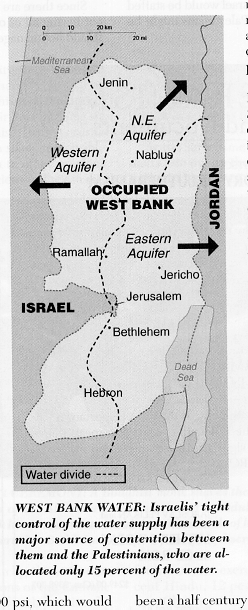
"Water will determine the future of the Occupied Territories, and by extension, the issue of conflict or peace in the region." Thomas Naff made this remark several years ago, and water remains a key, if often unacknowledged, issue behind the strife in the Middle East. When Israel’s Likud Party vowed in May never to allow the creation of a Palestinian state, former Prime Minister Benjamin Netanyahu acknowledged that a central issue is water: "A Palestinian state would control the aquifer, which gives us 30 percent of our water. Yes to a Palestinian state means no to a Jewish state, and yes to a Jewish state means no to a Palestinian State."

When Israel occupied the West Bank in 1967, it enforced stringent methods to monitor and control water supplies. Only 15 percent of the water supply was allocated to the Palestinians; the other 85 percent is used either by Jewish settlers, who constitute less than 10 percent of the population, or by Israel. As a result, about 90 percent of the land cultivated by Jewish settlers is irrigated, as opposed to only 3 percent of the land farmed by Palestinians.

For personal use -- drinking, cooking, bathing and sanitation -- Jewish settlers consume more than four times as much water as do West Bank Palestinians, who average only 88 liters per person per day. This is less than the 100 liters considered to be the minimum for an acceptable quality of life. (Most American toilets require at least two liters for a single flush.)

Since the beginning of the occupation, the Israeli authorities have not permitted Palestinians to drill any new wells for agricultural purposes or to repair existing wells that are in close proximity to the wells of Jewish settlers. Arab wells have been metered, and limits have been placed on the amount that may be pumped from them. In addition, water from two aquifers which are mainly in the West Bank but extend into Israel are used to supply Israel.

Yet even these measures have not solved Israel’s water problems. Like many other parts of the world, Israel has a critical need to increase fresh water supplies.

The planet has huge amounts of water – about 1,360,000,000 cubic kilometers. But 97 percent of the earth’s water is seawater and another 2 percent is locked in icecaps and glaciers. Most of the remaining 1 percent of the earth’s water supply is found in underground aquifers which are recharged by rainwater seeping through the soil.

Water use has been increasing even more rapidly than population. During the 20th century world population more than tripled, and the use of water for agriculture increased more than fivefold. Agriculture accounts for 65 percent of the global use of fresh water.

As a result of these large increases, which are likely to continue, pumping from most aquifers has exceeded the rate at which they replenish themselves. For example, the Ogallala Aquifer, which runs 1,300 miles from Texas to South Dakota, is being used up eight times faster than nature can refill it. Over several decades the Texas portion of the Ogallala has been depleted by an estimated 164 billion cubic meters -- more than five times the entire state’s annual water use for all purposes.

For decades Israel’s use of water has outstripped its renewable supply. Overpumping has seriously degraded the Coastal Aquifer, which is entirely in Israel, deepening Israel’s dependence on the two aquifers in the West Bank and increasing its reluctance to end the occupation.

The U.S. can do something to alleviate this problem and, in the process, better prepare itself and the rest of the world to deal with their own water shortages: it can offer to finance a series of large desalination plants to greatly increase the supply of water in Israel, the West Bank and Gaza. Recent progress in desalination technology makes such a move feasible.

The new technology of "reverse osmosis" offers a more efficient and less costly method of desalination than the old process of distillation. Reverse osmosis involves passing sea water through a thin-film membrane at a pressure of 1,000 to 1,500 per square inch. About one-third of this water emerges with a low salt content; the other two-thirds, containing 50 percent more salt than the water that was taken from the sea, is then returned to the sea.

While the cost of desalinated water has steadily decreased, it still is much more expensive than water from traditional irrigation sources. The cost of a medium-size desalination plant, producing 6 million gallons per day, is about $25 million; the Cost of the water produced is about 0.3 cent per gallon, three or four times the present cost of water for agricultural use in Israel. This makes desalinating seawater for agricultural use too costly to attract private investment.

But for only a small fraction of the $2.8 billion a year the U.S. gives Israel in military and economic aid it could provide the subsidies that would make desalination plants economical. The subsidies could be provided through a combination of grants and low-interest loans. Since about half the cost of delivering water represents capital charges, such subsidies would reduce the cost of desalinated water by 20 to 50 percent.

High-value crops such as vegetables, citrus fruits, grapes and apricots can by grown in the Middle East if 5,000 to 8,000 cubic meters of water (about 1.7 million gallons) per hectare (2.47 acres) are provided each year. Since the value of the crops per hectare would be about $10,000, the present cost of about $5,000 for desalinated water per hectare is too high. But the cost of desalinated water probably will be much less in the future.

Lower costs can be achieved through technological innovation and through economies of scale -- a product is less costly to manufacture in large quantities. Today the cost of desalinated water is about half of what it was 15 years ago; surely the cost can be decreased by half again -- or more. Improved membrane technology could allow operating at a pressure as low as 600 psi, which would substantially decrease both capital and operating costs.

By financing desalination plants, the U.S. could also greatly decrease the tensions in the area, turn barren land into rich farmland, some of which could be used for resettling those in refugee camps, and encourage economic cooperation between Israel and Palestine that would provide a powerful incentive for peace. While the first use of the desalinated water must be to address the present inequities and to improve agriculture on existing Palestinian farmland, further increases in water could be used to convert barren land into productive farms.

The Occupied Territories include large areas of rich soil which need only water to flourish. By skillful use of drip irrigation, the Israelis have demonstrated that it is possible to make a desert bloom. A $25 million desalination plant would provide enough water to make about 3,000 acres of Palestinian land bloom.

Land is at the heart of the conflict between Israelis and Palestinians. By increasing the amount of available arable land, it will be easier to agree on how to divide it. Implementing a desalination project would require cooperation between Israelis and Arabs, and the necessity for this cooperation can be one of the proposal’s major benefits.

Inspired by a 1943 book by David Mitrany, A Working Peace System, political scientists developed the concept of "functionalism," the idea that a lasting peace can be achieved if political adversaries learn to cooperate on a functional, rather than a political, project. Thanks to the vision of a French statesman, Jean Monnet, this concept was tested in 1951 when Belgium, France, Italy, Luxembourg, the Netherlands and West Germany established the European Coal and Steel Community. The ECSC united its six member nations in a single common market for the production and trade of coal, steel, iron ore and scrap metal, abolishing all trade barriers for these products.

That was the beginning of increasing economic cooperation between European nations which for centuries had fought bitter wars against each other. The community eventually became the European Community and eliminated all tariffs for trade between the member countries. In 1992 the EC, which had grown to 12 countries, created the European Union. The result of this economic cooperation has been a half century of peace and prosperity.

The desalinization project would make it necessary for Israelis and Palestinians to cooperate. Desalination plants must be adjacent to the sea. However, the West Bank does not border the Mediterranean. Gaza does, and it would be economical to locate desalination plants serving the southern part of the West Bank in Gaza. For much of the West Bank, pipes would need to run through Israel.

Here is a workable scenario: A corporation owned by both Israeli and Palestinian interests (probably the governments, at least initially) builds one or more very large desalination plants and the necessary pipelines, develops the land to be irrigated, manages the farms on that land, and perhaps develops communities where the farm workers can live. The management team includes Israelis and Palestinians. The workers on West Bank farms would be Palestinian, although there might be some Israeli technical staff. The desalination plants in Israel would he staffed primarily by Israelis, though some Palestinians might be part of the staff.

While the first jointly owned desalination plants would provide water for the West Bank, subsequent plants would provide water for Gaza and Israel. The latter would not only increase cultivated land but also replace some of the water now being drawn from the aquifers largely in the West Bank. In addition, desalination plants might be built to furnish water to areas in Jordan, Syria and Lebanon, particularly if such areas were opened up for refugee resettlement.

Since there are advantages to competition, as well as to not having all of one’s eggs in one basket, one company should not manage all of these ventures. There should be about three, each of which would control multiple desalination plants and the farming enterprises that they would spawn.

There are, of course, some risks. Water costs might still remain high. Israelis and Palestinians might refuse to cooperate. But there is so much to gain from such practical cooperation on the water problem that the risks are worth taking.

The Organ Business: Second Thoughts on Transplants

Book Review: Raising the Dead: Organ Transplants, Ethics, and Society, by Ronald Munson (Oxford University Press).

Are we morally obligated to extend every life that we have the technological or medical ability to extend? The claim that we are underlies Ronald Munson’s book. He provides a fairly comprehensive survey of the ethical issues involved in organ transplantation in a lively style, relying on current, historical or fictional cases to illustrate many of the ethical and policy issues. He also integrates relevant medical and scientific information into the discussion.

Munson’s background makes him the right person to write this book. He is a professor of philosophy of science and medicine at the University of Missouri -- St. Louis, has served as a medical ethicist on a National Institutes of Health study and a human subjects review committee and has written three novels. Yet his book is not definitive. We need to think more broadly and deeply about some of the issues he raises.

Munson makes three major claims: that we ought to increase the organ supply, that donors and recipients should be protected from exploitation, and that telling stories about individuals is morally helpful in assessing the complex issues associated with transplantation. The logic that underlies his first claim is familiar and easy to understand. Organ transplantation saves lives, even though it is a complicated practice that leaves chronic disease in its wake even in the best of circumstances. Thousands of people die every year because of the scarcity of available organs. Thus, we have a "prima facie obligation to shape policies and practices to save their lives."

So distressing to Munson are the looming deaths of those with organ failure that he favors nearly every innovation intended to increase the organ supply, including the sale of organs. The following fictional case represents Munson’s ideal scenario for organ sale. Alice Cushman’s daughter, Karen, needs a kidney transplant. Karen’s father is dead and her mother’s kidneys turn out to be too scarred to be usable. Meanwhile, Betty Burke’s son, Chris, needs a bone marrow transplant. His insurance will pay only 70 percent of the $300,000 treatment, so his mother must raise the remaining $60,000 herself. Luckily, Betty and Alice meet in the hospital waiting room and devise a plan in which Betty pretends to be a long lost cousin and donates her kidney to Karen for the $60,000 she needs for her son.

Munson considers this an ideal case. His argument is that selling one’s nonvital organs to achieve a chosen benefit is merely an extension of allowing individuals to make decisions about the course of their lives and the risks they are willing to take. We allow people to race motorcycles and climb mountains for recreation, so we ought to allow them to take similar risks for more noble purposes such as securing needed medical care for a loved one. According to Munson, there is no moral difference between giving a kidney to one’s child and selling it if the money gained is used to secure other necessary health care for that child. "Except that money changes hands, the consent, risks, and motivation in [the Cushman-Burke] transaction are the same as in the trading and in the donation." Munson also supports the sale of organs for other reasons, although he doesn’t make an extended argument for this position.

Munson grants that there may be risks associated with the sale of organs, including exploitation of the poor, decline in the quality of organs, decline of altruism in society, and the detrimental effects of commodifying the human body However, he finds these insufficient deterrents when balanced against the "gain of saving thousands of lives." He dismisses similar objections against policies of accepting donations by children, use of anencephalic newborns as donors, and use of animal and mechanical organs. After all, what "repels [opponents of these policies] may result in saving or prolonging the life of a sister, a mother child."

Although the logic that underlies Munson’s arguments is well accepted, it bears further scrutiny The fact that people die because they can’t obtain an organ does not in itself prove that we have a duty to increase the organ supply. A significant increase in organs available for transplantation would have mixed results. Its positive consequences would be that more people would receive transplants, some of whom have the potential to respond very well to a transplant. In addition, some difficult allocation decisions could be avoided. For instance, we wouldn’t have to decide whether smokers should compete equally for lung transplants with nonsmokers, since there would be enough for both groups.

But increasing the organ supply would also mean that many individuals who are now considered questionable candidates would be accepted at transplant centers, and their care would be more expensive and their outcomes less satisfactory than current cases. In addition, the cost of significantly increasing the number of transplants is potentially extremely high; scarcity is now the only factor that controls the cost of these medical procedures, which range in price from $100,000 to $400,000. These costs would further burden the strained resources of private and public insurance agencies, thereby decreasing the amount of money spent on other goods (medical and social).

We should not begin the discussion by assuming that maximizing the length of life for those with organ failure is the best way to address health concerns. In fact, if our goal is to save as many people as possible, we will likely conclude that organ transplantation is not the best method. Public health initiatives would be much more effective.

Furthermore, holding up the extension of one life or 5,000 lives as the conclusive justification for any procurement policy suggests that those extended lives trump every other good in society. We know this isn’t true. Other important social values are worth protecting, even at the expense of foreseen but unintended loss of life. We are forced to acknowledge this when people go off to fight wars. We tacitly accept it when we allow people to carry guns or when budget constraints prevent us from hanging a traffic light at a busy intersection.

Munson’s second claim is that we should protect both recipients and donors from exploitation. Munson explores the case of Baby Fae, who received a baboon heart in 1984. Munson’s treatment of this case (like his discussion of Mickey Mantle in his first two chapters) is well researched and balanced. He concludes that sometimes professional ambition and even humanitarian zeal can cause well-intentioned physicians to pressure patients or their families to accept experimental treatments. That is why it is important to have government regulations and an external review of risky proposals. Munson adds that we should prove treatments safe and effective before offering them to children, unless a particular promising treatment can be tested only on children.

It would be difficult to disagree with Munson’s conclusion. We certainly ought to protect children from a researcher’s ambition. However, there is not much difference between Baby Fae’s mother and people considering standard transplantation for vital organs (heart, lung and liver) for themselves or loved ones. Many will he so frightened by the prospect of death that they will be unable to understand the risks and benefits of a proposed transplant -- so they are hardly accepting the risks freely. When the results are poor, transplants can impoverish an entire family and lock some family members into caregiver roles. Professionals try to educate patients about the rigors and risks of transplantation, but know that much of what they say is not absorbed. Thus, the need to protect children involved in research is only one instance of the widespread and seemingly intractable problem of obtaining informed consent.

Avoiding the exploitation of living donors is also extremely difficult. Living donors are counseled about the risks of donation, but often this is done after they have decided to donate based on glowing reports in the media about the practice, and the spoken or unspoken understanding that donating an organ will make them heroes in their families. This past January Mike Hurewitz, a healthy 57 year old, donated 60 percent of his liver to his younger brother, Adam, at Mount Sinai Hospital in New York. Adam is now recovering and may enjoy several more years of life. Mike died of postoperative complications. Immediately following the report of this story, healthy siblings at other transplant centers backed out of scheduled surgeries. The very fact that news of this donor death changed their minds suggests that they hadn’t initially comprehended the risk, even if their surgeons had stressed it.

Desperate people are hard to educate and easy to exploit. Perhaps the best defense against such exploitation is balanced information and education about transplantation before individuals find themselves in desperate straits. The practice of organ procurement organizations encouraging high school students to sign their organ donor cards -- a practice mandated by law in some states -- does not qualify as balanced education.

Munson’s final claim is that we need to examine individual transplant cases because doing so keeps us connected to real people and the complex circumstances of their lives. Munson’s historical cases add this complexity to his analysis. His chapters on Mickey Mantle and Baby Fae are the best in the book. Imagining particular individuals and scenarios reminds us to remain humble and serious when we ask questions about the worth of transplantation and its social and economic costs.

However, some stories close off important conversations rather than enrich them. We are already familiar with these stories, found in television movies or feel-good segments about organ donors or recipients on the local news. Such stories amount to a kind of emotional blackmail; we can’t ask the most important question -- is transplantation, in general, worth its costs? -- because that would be like saying that Robby, Mickey or Karen ought to have died. Munson’s fictional stories tend to echo these one-dimensional accounts.

We must tell stories about both the good and bad sides of transplantation. One of my stories is about Tom, a lung transplant recipient who was one of my patients when I was a nurse in an intensive care unit. He lived nearly a year after his lung transplant, but never was well enough to leave the hospital. He had some good days, but he experienced a great deal of pain, anxiety and limited mobility. He also intermittently suffered from "ICU psychosis," imagining that his nurses were purposely throwing his intravenous tubing on the floor and stepping on it. When his father would visit the unit, he would never enter his son’s hospital room, but would stand grieving his son’s slow death from outside the glass walls.

We can also tell the story of Mike Hurewitz and his untimely death, or of Barbara Tarrant, RN., who donated a kidney to her grown son in Greenville, North Carolina, last year. She suffered a massive stroke the day after surgery and is now confined to a nursing home, paralyzed on her left side, able to speak only a few words at a time, most of them meaningless. We could also find stories about people like Molly, whose insurance company pays for transplants but says it can’t afford to include the benefit of psychiatric medications that keep suicidal thoughts at bay.

Stories are a convenient and effective vehicle to educate the public about transplantation, but no single story by itself provides a conclusion. Perhaps it makes sense that philosophers, ethicists and scientists finally turn away from personal stories and ask questions about numbers. How many transplant recipients live five years? How many have complications?

Munson’s message, finally, is fairly traditional, differing from the mainstream only in his extreme enthusiasm for organ transplantation. His imaginative approach fails to tap the rich complexities and moral dilemmas of this practice. The most crucial question Munson doesn’t ask may be, "What do we think death is, and to what lengths should we go to delay it?" Munson seems to impart godlike qualities to modern medicine and science, as the title of his book suggests. He begins by referring to a transplant recipient as a "modern Lazarus." He seems to imagine that there are no human goods more valuable than the continuation of physical life, and nothing to hope for beyond earthly existence.

Christian readers, among others, may find this worldview ultimately unsatisfying, and in the end unable to free us from considering the meaning of our mortality. After all, everyone brought back from "death," whether by Jesus or by modern medicine, will eventually die again.

A Contested Classic: Critics Ask: Whose Christ? Which Culture?

"Behind this posture of humble nonnormative objectivity, it will become clear to any careful reader that Niebuhr has so organized his presentation as to indicate a definite preference for ‘transformation.’. . . ‘Transformation’ takes into itself all the values of its predecessor types and corrects most of their shortcomings."

-- John Howard Yoder ("How H. Richard Niebuhr Reasoned: A Critique of Christ and Culture," in Authentic Transformation.)

"Niebuhr does not use the conversionist or transformationist type as a polemical tool against the others. It is arguably the case that the fifth type is treated less critically and more sympathetically than the previous four, and thus reflects Niebuhr’s judgment that it is most adequate. But it is also the case he described each of the types with empathy, showing why each could be backed by biblical and other considerations."

-- James Gustafson (preface to the 50th-anniversary edition of Christ and Culture.)

"The typologist needs to remember that he is not constructing a value scale. His enterprise is directed toward neither explanation nor evaluation, but toward understanding and appreciation. . . . [The typologist] will belong to one of the types, himself and will have a preference for it; but one purpose of typology is that of helping him understand his own type as one of many and so to achieve some measure of disinterestedness."

-- H. Richard Niebuhr (‘Types of Christian Ethics," in Authentic Transformation.)


A book that one can barely escape reading on the way to earning a seminary degree is Christ and Culture, by H. Richard Niebuhr. Published in 1951, the book quickly became a classic. Its categories -- such as "Christ against culture" and "Christ of culture" -- have ever since been familiar reference points in the field of Christian ethics and in debates about how Christians and the church should engage matters of politics, society and culture.

The book has also had its vigorous detractors, however -- especially of late. Critics argue that though Niebuhr presents with apparent neutrality a typology of five ways that Christians have related to culture, he subtly asserts his own liberal Protestant bias.

A sign of the polemical status of the hook these days is James Gustafson’s preface to the 50th-anniversary edition (published by Harper San Francisco). Gustafson, a leading Christian ethicist and former student of Niebuhr’s at Yale, uses the occasion to scathingly attack those who have found Niebuhr’s typology flawed or dangerously misleading. Drawing Gustafson’s ire are theologians Stanley Hauerwas and William Willimon, church historian George Marsden, and the late Mennonite theologian and ethicist John Howard Yoder.

Yoder laid out the fundamental critique of Niebuhr in an unpublished essay of 1958 which circulated for years as a sort of underground document. (It was finally published in 1996 in Authentic Transformation: A New Vision of Christ and Culture, edited by Glen Stassen et al.) Hauerwas, Willimon and Marsden all draw upon Yoder’s critique. Gustafson, for his part, says Yoder’s essay "is laced with more ad hominem arguments and fortified with more gratuitous footnotes than anything I ever read by scholars in the field of Christian ethics."

Gustafson and other supporters of the book claim that Niebuhr’s description of five types of Christian ethics elucidates various approaches to the "enduring problem" of how Christians relate their loyalty to Christ to their other loyalties. In this view, Christ and Culture provides a straightforward introduction to the various approaches to Christian ethics and theological sources.

Niebuhr leads readers through the vastness of Christian history and theology by sketching five types that are compared in terms of consistency of theology and practice. Drawing on various representative people or churches, Niebuhr examines each type’s approach to Christology, reason and revelation, evil and sin, law and love, church and state, and views of history. The first two types are the two extremes. Those who adopt the "Christ against culture" position reject culture as fallen, and see separation from it as necessary in order to give absolute loyalty to Christ. This type stands in sharp contrast to the culture. The "Christ of culture" type finds in Christ an affirmation of all that is good in culture. This type sees little or no difference between loyalty to Christ and the best a particular culture has to offer.

The next three types Niebuhr calls "the church of the middle." Of these, the "Christ above culture" type seeks a synthesis of culture with Christ so that grace perfects or builds upon culture. This type sees that the good in culture needs to be and can be properly ordered and completed by Christ. The "Christ and culture in paradox" type finds less continuity between culture and the Christian life. It keeps a critical distance from culture, and yet sees it as useful in the Christian life if kept within its appropriate bounds. This type sees a duality in which culture has a legitimate place in Christian life, but that place is not the Christian’s heart or church; in those places Christ must rule.

Niebuhr’s final type, "Christ transforming culture," remains critical of culture yet also enters into alliance with what it finds in culture that is capable of becoming part of ongoing work toward the kingdom of God. This type sees culture as the raw material that can be shaped by Christians according to the Christian vision of human life.

Niebuhr claimed that he did not seek to give a privileged place to one type over another, but to "define typical partial answers that recur so often in different eras and societies that they seem to be less the product of historical conditioning than of the nature of the problem itself and the meaning of its terms." His examination of the different types is meant to reveal the relative strengths and weaknesses of each. "In this way," Niebuhr wrote, "the course of the great conversation about Christ and culture maybe more intelligently followed, and some of the fruits of the discussion may be garnered." In the book’s conclusion he states "that neither extension nor refinement of study could bring us to the conclusive result that would enable us to say, ‘This is the Christian answer."’

Yoder argues, however, that "behind this posture of humble nonnormative objectivity . . . Niebuhr has so organized his presentation as to indicate a definite preference for ‘transformation."’ Niebuhr’s version of the "great conversation" omits criticism of the fifth type, and avoids giving specific criteria for and examples of the transformation this type purportedly seeks.

Gustafson counters that "Niebuhr can prefer the transformationist type" since "the comparison with others shows that it is one of many" and his comparative work "gives him a critical perspective on his preference."

Hauerwas and Willimon argue that the very way in which Niebuhr states the "problem" of Christ in relationship to culture reflects Niebuhr’s biases toward the transformationist type. Also, Niebuhr’s expressed commitment to respecting the plurality of answers to the "Christ and culture" question inevitably leads him to favor the transformationist type. As Hauerwas and Willimon state in Resident Aliens "Since Niebuhr could appreciate the ‘rightness’ of all the types of churches he described . . . his own pluralism underwrote the implicit assumption that his position (pluralism) was superior to other, more narrow ecclesiology."

Niebuhr had an explicit concern to be fair and impartial in defining terms, stating the problem and evaluating the types. But did Niebuhr set himself an impossible task? How does one give a "neutral" definition or understanding of Christ? How does one give an understanding of culture that does not reflect one’s own view of what qualifies as "culture" and what does not? Echoing Alasdair McIntyre, critics of Niebuhr’s project may rightly ask. "Whose Christ? and what culture?"

Niebuhr’s underlying liberal theological assumptions are evident as he seeks to somehow distill out from historical particularity the essential characteristics of "Christ" and of "culture." Christ, for Niebuhr, is one who "points away from all that is conditioned to the Unconditioned" and who "is the moral mediator of the Father’s will toward men." This is a Christ, say the Yoderian critics, who lacks any specffic ethical teaching or practices. Glen Stassen points out: "The farther the book goes, the less specific it gets about the ethics of the New Testament Jesus. . . . Nowhere does the chapter on transformationism indicate Christ’s ethics or practices. The result is that readers may be convinced to call themselves transformationists without committing themselves to any specific ethics." In short, Niebuhr is working with a liberal Protestant notion of Christ, a Christ who provides little more than the ideal of self-sacrificial love (expressed as an intention), along with the concept of theocentrism (expressed as a critique of all temporal values as incomplete).

Additionally, Yoder charges that the "culture" in Christ and Culture is understood in a misleadingly monolithic way. Culture, Niebuhr writes, "is that total process of human activity and that total result of such activity"; therefore "we cannot escape culture any more readily that we can escape nature. As a result of this definition, says Yoder, when Niebuhr talks of culture it must (if those who represent a type are to be consistent) be withdrawn from in totality, transformed in totality, accommodated to in totality, or be stood above or in paradoxical relation to in totality.

Critics further complain that even though Niebuhr recognizes a pluralism within culture, the types are defined by how they relate to values that are not simply "culture" but rather are culturally dominant. It turns out that to be responsibly engaged in transforming culture means being responsive to the values and concerns of the cultural elite (much like the ones who Gustafson describes as finding the book helpful). This stance provokes Hauerwas and Willimon’s charge that Niebuhr ends up justifying "what was already there -- a church that had ceased to ask the right questions as it went about congratulating itself for transforming the world, not noticing that in fact the world had tamed the church."

So is the book a fair and balanced discussion of the various types of Christian responses to culture, or is it an argument for the transformationist type that looks suspiciously like Niebuhr’s own form of liberal Protestantism? Perhaps in either case the book can still serve, as Niebuhr himself hoped it would, as a starting point for discussing the Christian life and its relation to various aspects of human life, including institutions such as the state and the economy.

One can certainly be critical of Christ and Culture without being dismissive of the book. Marsden, in a speech at Austin Theological Seminary marking 50 years since Niebuhr had given the lectures there which later became Christ and Culture, argues that a careful reading reveals that "Niebuhr’s five categories can he extremely useful analytical tools." Yoder himself wrote, "It continues to be worthwhile to read Niebuhr carefully. . . . The more a text is treated as a ‘classic,’ the more it matters that we be critically aware of its unspoken axioms, its tacit biases and lacunae, and the way it directs and diverts attention."

Yoder takes seriously Niebuhr’s own insistence on the particularity of all theological and ethical positions. In that spirit readers may continue to find the book useful, even as they take note of Niebuhr’s own type of liberal Protestantism.

Whose Land is it? Apartheid in Israel/Palestine

On the long climb to Jerusalem I notice two kinds of trucks. One kind is carrying huge battle tanks still muddy from combat in the West Bank. The other is carrying tents sent from America for Palestinians who have lost their homes in the fighting. The tanks tell rush-hour commuters, "We are at war." I see them again pictured on T-shirts that say "Peace Through Superior Force," The tents on the other trucks draw little attention. Their Palestinian recipients will eventually reject them as signs of the duplicity of American policy.

We pass a Jerusalem traffic light where Israeli and Palestinian thoroughfares intersect. The green light for the Israeli traffic is long. "You belong here," it seems to say. The green light for the Palestinian traffic is short. "We call this a racist traffic light," says an Israeli lawyer who defends East Jerusalem’s Arab residents. Through bypasses, overpasses and outright barriers, Israeli planners and engineers have removed most points of contact between the two populations, he explains. An "apartheid" tunnel probably will soon replace this light. To anyone entering East Jerusalem after an absence of several years, it is clear that Israel has been taking over traditional Arab neighborhoods.

Later, driving in an interchurch aid convoy to the town of Jenin, we pass military checkpoints where Palestinians wait in long lines. Not far away Israeli settlers speed to their jobs on highways cut through Palestinian land. The West Bank has 280 military checkpoints through which Palestinians must pass.

The settlements themselves make the loudest statement -- 190 of them now in the West Bank, East Jerusalem and Gaza, including enclaves carved out of Palestinian communities, according to the Foundation for Middle East Peace. The settlements are more numerous, more complete and much bigger than they were when I was here four years ago.

When the sun is shining these bright limestone cities set on top of hills dominate the landscape. Palestinian land has been expropriated for settlements and roads; Palestinian homes have been demolished as punishment for those who resist the Israeli occupation. These deeds are documented by courageous Palestinian and Israeli NGOs. Each fallen stone, each torn olive branch is a new memorial for the villages that have vanished by the hundreds since the establishment of the state of Israel in 1948.

Despite all these visible signs, much of the occupation is hidden, like an iceberg. Jeff Halper, an Israeli anthropologist who heads a nonprofit organization called the Israeli Committee Against House Demolitions, calls Israeli policy a "matrix of control." The system is "designed to allow Israel to control every aspect of Palestinian life in the occupied territories while lowering Israel’s military profile in order to give the impression to the outside world that what Palestinians refer to as ‘occupation’ is merely proper administration, and that Israel has a ‘duty’ to defend itself and the status quo, Halper says.

Halper’s group details a web of zones, restrictions and intrusions. Occupied land, for example, is divided into areas A, B, C, D, H-1, H-2, Yellow, Green, Blue and White, and controlled by a mixture of civil administrators, military orders and undercover agents. Underground water is controlled. Businesses have to cope with various licenses and inspections. Farmers cannot plant or sell certain crops. Palestinians cannot work, travel or enter other areas without permits from Israeli authorities.

Vigorous debate about the occupation takes place in Israel. In April the newspaper Ha’aretz carried a quote by Michael Ben-Yair, attorney general of Israel in the mid-1990s, calling the occupation the "seventh day" of Israel’s 1967 Six-Day War: "We enthusiastically chose to become a colonial society, ignoring international treaties, expropriating lands, transferring settlers from Israel to the occupied territories, engaging in theft and finding justification for all these activities.

"Passionately desiring to keep the occupied territories, we developed two judicial systems: one progressive, liberal -- in Israel; and the other cruel, injurious -- in the occupied territories. In effect, we established an apartheid regime in the occupied territories immediately following their capture. That regime exists to this day."

How much of this "seventh day" war or the "matrix of control" is evident to Americans? Could the U.S. pursue its policies if Americans could actually see what is happening in the Holy Land?

In the region itself satellite television channels are making the occupation more visible than ever. The impact of Al Jazeera TV can be compared to what CNN’S might be if a regime like Saddam Hussein’s occupied the homeland of 3 million Americans and CNN provided hours of direct coverage of the occupation. Across the Arabic-speaking world the realities of the Israeli-Palestinian conflict are becoming more and more palpable.

That reality plays out in ways that will never make headlines. In a hospital on the Mount of Olives a man lies swollen and gasping like a puffed-up fish, a victim of what Palestinians call "the situation." For him the situation means waiting seven days between the dialysis treatments he should be receiving every two days. He is Abdel Majoud Awes, one of the millions whose personal problems are compounded by the perversions of justice in the Holy Land. He is Palestinian, but many an Israeli is also burdened or broken by the conflict. Their fates are the real news of the Middle East.

Awes explains that his home in the West Bank is a ten-minute drive from the dialysis machine in Nablus that keeps him alive. But when Israel launched its campaign against militants in late March, Israeli soldiers stopped Awes from going for treatment for two painful weeks. Desperate, he finally called an ambulance to take him on the long journey to Jerusalem. But soldiers at one of the checkpoints turned the ambulance back. "By then my body was swollen all over," Awes told me. "It was harder and harder to breathe. I was looking death in the face." He weighed 250 pounds -- 30 more than normal -- because of all the fluid waste retained in his body.

Then, showing the everyday perseverance that life requires in Palestine, a friend carried Awes on his back over the hills to a rendezvous with a taxi summoned from Jerusalem. The dialysis unit at the Lutheran World Federation’s Augusta Victoria Hospital in Jerusalem was treating 20 patients a day, nearly double its normal load. Awes was just one more.

For Awes, a shopkeeper, the crisis costs time, money and health. "The three-hour taxi ride is about $50 each time, and it makes me very tired," Awes said. "My wife has to stay home to keep our small shop open and look after our young daughter." To help her and to save money Awes makes the trip to Jerusalem only once a week. He arrives each time swollen and discolored. The infrequency of his treatments are tempting fate.

The Lutheran World Federation also has five village clinics in the West Bank. As the policies of occupation have hardened, these primary health centers provide the only health care available to 1,000 patients per week. A routine visit to one of them goes like this: A doctor and nurse park their van at a gas station on a freeway used by settlers and other Israelis. Leaving a letter of explanation on the dashboard, they breach occupation regulations and cross the boulders that restrict Palestinian access to the freeway, then hike down a path to a village taxi waiting below.

In a typical half-day visit to the West Bank village of Beit Liqia recently the doctor saw 79 patients. Whether the patient is a newborn, a heart attack victim or a cancer sufferer, each consultation can last only a few minutes. The 15,000 inhabitants of the village have been living isolated inside a "military area" for eight months.

Providing mental health care presents even greater challenges. Trauma, rehabilitation and vocational counselors supported by Lutheran World Relief have joined forces with other caregivers to cope with the rise in caseloads. In Jenin a counselor tells me that more and more youth are suicide-prone. "Suicide bombers?" I ask. "No" he says emphatically, "just suicide." Even some of the brightest students see suicide as a fitting epitaph for a hopeless life. His words stay with me at the town’s "ground zero," where fierce resistance in a refugee neighborhood was smashed by rockets and armored bulldozers.

A "refugee" in Jenin is someone from 58 villages conquered by Israel in 1948. Now, 54 despairing years later, some of the grandsons and granddaughters of these refugees, still living in the poverty of the camp, have reportedly gone beyond suicide to suicide bombing. The messages these suicide bombers leave behind chill one’s blood. Explosives wired to desperate hearts, and the carnage then visited on others, are sweeping indictments of every party to the conflict, especially of those whose own tactics favor explosives and disregard the human heart.

Minutes from Jenin one finds oneself in the beautiful Galilee. It was green and blooming in springtime when I was there. Every field and flower declares this a land of promise. This too is evidence. Peace is possible, even in Jenin.

Peace will come through deeds that give life and that deal in truth. For example, if a provisional state of Palestine is declared, Israeli settlements and other forms of occupation will have to be dismantled just as quickly as Palestinian militancy. Without honest reciprocity, the bestowal of statehood will be little more than a pretext for maintaining the "matrix of control."

A balance also must be found between the forces that influence America’s government. At its last national convention the largest political-action committee for Israel welcomed 50 U.S. senators and 100 representatives. The various groups that lobby for justice for both Israel and Palestine are scarcely noticed. If a just peace for Israel and Palestine could find even one active supporter among every thousand of America’s Christians, Muslims and Jews, Bethlehem’s angel chorus would have good reason to sing again.

Meanwhile, in Bethlehem and other places, the church is standing with the weak and seeking peace. Most of the peacemakers are Palestinians. In his 28th day under curfew Mitri Raheb, pastor of Bethlehem Lutheran Church, was still gracious toward his assailants. He an others like him ask Americans for prayers and for letters to Congress.

Outsiders work for peace as well. Esker Sindby, a medical student from Denmark, rides along to village clinics because Israeli soldiers behave differently when Palestinian staff are accompanied by people from other countries. He is one of a small team of "ecumenical accompaniers." Sandra Olewine, a U.S. Methodist minister, spent April under siege in Bethlehem. She shared her neighbors’ suffering and described in vivid e-mails the F-16 strikes across the street. She is one of many foreign church workers who believe the Holy Land can nourish two peoples and three faiths.

Craig Kippels, an American hospital administrator, uses his professional skills to support the Palestinian leaders and staff at Augusta Victoria Hospital. He, his family and many like them work stressful years in institutions that serve those in need. Daniel Seidemann, an Israeli lawyer, defends land and property rights for Palestinians and NGOs in East Jerusalem. He is arguing the multimillion-dollar tax case that hangs over the LWF hospital there, a case that threatens Roman Catholic, Mennonite, Swedish and ecumenical service agencies as well. All of these people, and many more, are needed now and for the foreseeable future. Injustice is gaining ground. Only deeds of love and truth will bring peace.

Rethinking Divorce Laws Fault or No Fault?

Divorce is a disruption of the collective interests of the family by the self-interest of one or both of the spouses. Divorce is selfish. In 35 years of practicing family law, I have seldom encountered a spouse who obtained a divorce out of concern for his or her partner or for the sake of their children.

Lawyers have not contributed much to the support of marriage and the family, even though the need for shoring up such support is quite apparent. Most of the best law schools have not given a high priority to family law. The family law courses that do exist have concentrated narrowly on the substantive law and the mechanics of getting people divorced. Lawyers’ role in supporting marriage may not have even been considered relevant. Their focus remains on who gets what, be it income, property or children.

Lawyers can use their offices to support marriage. But this opportunity will be missed if the lawyer does not ask appropriate questions and listen, if he (or she) does not consider the support of marriage a part of his job description, if he takes the position that a client seeking to keep her marriage together is in the wrong place, if he believes that lawyers who encourage reconciliation appear weak, or if he tries to shunt the whole problem off to the mental health professionals.

One cannot overlook the role of money in all this. Lawyers are paid more for divorces than for reconciliations.

Prior to 1969, marriage was generally regarded in most states as a contract between two parties that could be dissolved only if one of the spouses committed an act legally recognized as incompatible with the continuation of the marriage. The incompatible action was called a "fault ground" for divorce. Divorce was granted by courts only upon proof of a "fault ground" such as adultery, extreme and repeated cruelty or desertion for an entire year. At the granting of a couple’s divorce, one person was found guilty and one innocent.

These laws were satisfying to those who for religious or other reasons believed that marriage is a union or a contract for life that cannot be dissolved except in the most exceptional circumstances. But the fault laws did not necessarily preclude divorce, at least for those who could afford the process.

There were many avenues open to obtaining a divorce. The most common method was by agreement. But reaching an agreement almost invariably involved money If the spouse who sought the divorce was guilty of adultery, for example, he (or she) could not obtain a divorce in a fault state, because he was guilty of a ground for divorce. He therefore usually had to satisfy his spouse financially before she would agree to proceed against him to obtain the divorce. If the negotiations failed, a trial could result in denial of the divorce, even under circumstances in which each spouse proved the other guilty of a ground for divorce. Then the spouses, if they did not reach an agreement, were consigned to continue their marriage after a prolonged, rancorous session in the courthouse.

Fault divorce laws did not readily produce equitable results and often favored the wealthy. Despite their inadequacies, however, such laws led to fewer divorces. A partial reason for this is that the less well-off had less access to the system. A more complete reason is that the restrictive divorce laws were part of the values of a society that disapproved of divorce and favored the preservation of marriage. Marriage therefore had a framework of support in place, not only from the legal system but also from families, churches, friends, children, schools, workplaces, media -- from almost all of society. Marriages in need of repair had institutional resources from which to seek help. It was considered right to be married and wrong to be divorced.

No-fault divorce laws were enacted beginning in 1969. Every state now has no-fault grounds for divorce, permitting a spouse who is dissatisfied with the marriage to obtain a divorce simply on that ground. The theory is that a marriage in which one or both spouses no longer wish to participate is irretrievably broken down.

Divorce proliferated under the no-fault divorce laws in numbers never seen before. Coincidentally, a body of research evolved that gave divorce a respectable sociological and theoretical foundation. The research concluded that spouses in unhappy marriages are better off obtaining divorces and pursuing their individual lives. Children are resilient and can recover from being part of a broken family, according to these findings. Psychological therapy and drugs can repair people under most circumstances, so any damage that results from divorce can be fixed. The earlier concern for children of divorce and for the spouse who wanted to keep the marriage together was seen as misplaced.

It is no surprise that a crumbling of the institutional support for marriage accompanied society’s change of attitude about divorce. For example, families, clergy, psychologists and magazine columnists who formerly supported lifetime marriage now give counsel on how to get through a divorce and live one’s life afterwards. William J. Doherty reports that over 60 percent of marriage and family therapists are "neutral" on the subject of marriage or divorce in providing therapy. It does not matter whether they help create a good marriage or a good divorce.

Recently, however, there has been a reaction against the prevailing view of divorce. It began with some disquieting research in 1985 conducted by Lenore J. Weitzman in California. She concluded that, contrary to expectations, women were not able after divorce to achieve the same standard of living they had enjoyed during their marriages. Even worse, after a divorce men’s economic circumstances dramatically improved, while women’s economic positions and those of the children living with them deteriorated. Weitzman’s The Divorce Revolution led the proponents of no-fault divorce and women’s independence to relinquish one of their fundamental beliefs: that the majority of women could sustain themselves financially after a divorce without help. Most states responded by amending the spousal and children’s support laws to provide for more and longer support for dependent women.

Recent research has also emphasized the costs of divorce to children. A child of divorce is commonly subjected to abrupt and traumatic changes: loss of father on a regular and consistent basis, his replacement by a stepfather or the mother’s live-in boyfriend, and so on. Most divorces entail the absence of a father. An absent father is likely to spend less money on his children’s education and support than does a present, involved father. The absent father leaves his children less protected and more vulnerable to abuse, and his daughters are more likely to become pregnant as teenagers. Children of divorce perform less well in school, are less likely to graduate and less likely to matriculate into college. The prevalence of delinquency in broken homes is 10 to 15 percent higher than in intact homes.

Current findings indicate that children may suffer long-term negative effects from divorce. For example, significant numbers experience moderate to severe depression and difficulty in establishing love relationships. Children of divorced parents are two to three times more likely to dissolve their own marriages than are children of intact marriages. The divorce process itself has a decidedly adverse effect on children. Almost no child wants his parents to divorce. The situation can easily be exacerbated when the children are drawn into the divorce process. It does not take much effort to imagine the damage to a child whose parents are publicly struggling over her. The child herself may have to state a preference in a choice she does not want to make. Since divorce affects close to 1 million children annually, the damage created is enormous.

Not only are children disadvantaged by divorce, but the marriage partner who was supposed to benefit also suffers, according to recent reports. Both sexes have increased health hazards as a consequence of divorce. Depression is relatively well recognized as a possible result, but less obvious are the physical hazards. They range from loss of weight to increased cigarette and alcohol consumption, lower immune function and a higher risk of dying.

This research has at least corrected the assumption that divorce is cost-free to all concerned. The cost is more than individual: when multiplied by the over 1.1 million divorces per year -- which affect almost 1 million children annually -- an enormous cost is piled on society every year.

In view of these concerns, some have advocated resurrecting the fault laws, or at least enacting more restrictive laws to replace the no-fault laws. Louisiana in 1997 adopted a provision for covenant marriage" that parties may select as an alternative to ordinary marriage. Louisiana’s ordinary marriage law permits no-fault divorce after six months’ separation; covenant marriage requires either the proof of a fault ground to obtain a divorce or the couple’s living apart for a substantial period of time. Arizona followed suit the next year by enacting a covenant marriage alternative in which proof of one of the fault grounds or living apart for a period of time is required unless both parties agree to the divorce.

The theory behind this partial resumption of fault divorce is that if it becomes more difficult to divorce, there will be fewer divorces. But there is no reason to believe that the widespread reenactment of fault or more restrictive divorce laws by itself would produce beneficial results. There is no easy answer or quick fix to the phenomenon of a deluge of divorces that began in 1969 and has persisted for more than 30 years. Divorce has become ingrained in our culture. It is not even clear that the majority of Americans are interested in such a change.

Besides, the reformers face substantial unanswered questions. For example, if society gives marriage greater protection, what is to be done in cases of a adultery? Adultery will not go away. What would be the mechanism to allow the dissolution of verifiably destructive marriages? The trapped and endangered spouse must be allowed to escape.

Nor can we expect research results on divorce to deter husbands and wives from divorce. To change the divorce equation, which now favors the spouse who wants to leave the marriage, requires a change in cultural values. Marriage and the collective interests of the family must be invested with at least as much value as the right of the dissatisfied spouse to abandon the marriage.

Such changes cannot just be legislated, they cannot be accomplished by cost-benefit research, and they cannot be accomplished by one of the professions acting alone. Because these changes deal with a variety of intangibles, it is difficult even to know where to start. A promising place to begin is found in two sentences in a report by the Rutgers National Marriage Project: "Most Americans continue to prize and value marriage as an important life goal, and the vast majority of us will marry at least once in a lifetime. . . . Most couples enter marriage with a strong desire and determination for a lifelong, loving partnership." The separation between the ideal and the reality is wide. But because the ideal of a loving. lifetime marriage exists in the imaginations of so many Americans, it is a starting point from which individuals may be persuaded to give up a portion of their self-absorption in favor of the collective interests of the family.

A practical argument for a stable marriage is that an intact family is the best milieu in which to raise children. A concomitant of increasing the value of marriage in society is enhancing the worth of children. Children are entitled to at least as much attention as is paid to commerce. As children are more prized, the family will be more honored and there will be more of an effort to keep families together.

Marriage needs reinforcement from every aspect of society in order to survive. Legislation without shared social mores will be no more successful than was the prohibition of alcohol. However, this does not mean that legislation has no part in a cultural campaign to change American marriage values. Legislation, rather than facilitating divorce, can support marriage. For example, legislation could give a voice to the spouse who does not want her marriage to fail -- as well as to a spokesperson for the children -- in deciding whether there should be a divorce. Legislation can be shaped to add balance -- not favoring the spouse who wants to terminate the marriage but ensuring more protection to the other spouse and the children.

A proposal has recently been made to have engaged couples commit to mechanisms that would impose penalties or delay on divorce -- a way of discouraging divorce by making it a costly and less impulsive procedure. Another proposal is to require the divorcing spouses and their children to share the wealth that has been accumulated during the marriage in accordance with predetermined guidelines, primarily in order to give the children more financial security. Particularly useful are the provisions for pre- and postmarital counseling in the Louisiana and Arizona covenant marriage laws. Legislation can support marriage by encouraging counseling and providing resources for it, and by allowing sufficient time between the filing of a lawsuit and the entry of a divorce judgment for a spouse who opposes the divorce to have a fair chance through counseling to preserve the marriage.

What part can lawyers play? They can obviously work to help formulate more balanced legislation. Family lawyers who believe in marriage should seek to convince other family lawyers of the value of marriage. Lawyers should encourage and participate in professional seminars that teach support of marriages as well as those that teach the mechanics of taking them apart.

Family lawyers should explore with every client the potential for reconciliation and the comparative costs and benefits of staying married or obtaining a divorce. Many clients come to their lawyers’ offices in such a pell-mell rush toward divorce that they have hardly considered other possibilities or the downside of dissolving their marriage and family. Before the divorce dynamic takes over and establishes a life of its own, a lawyer can create a needed pause just by playing devil’s advocate -- a role to which lawyers should be accustomed. Marital therapy ought to be urged by lawyers in every case where there is a possibility of counseling. Meanwhile, a lawyer must be protective of a family’s children.

The most obvious situation in which family lawyers interact with other professionals is that involving counselors or clergy. Communication among all the participants is critical. The wall of therapist or clergy confidentiality cannot be allowed to prevent vital communication concerning the marriage. Preservation of the marriage and the family is at least as important as most individual confidences, A balance can and should be struck.

A reformation of the money incentives to lawyers is also desirable. A reward for reconciling couples and a system other than the hourly rate (which encourages prolonged litigation) are not impossible and would be an improvement. But such changes are unlikely to come soon, and they are not absolutely necessary.

Lawyers are licensed by the state, as are marriages. The state has an interest in marriage. In acquiring his license to practice his trade, a family lawyer should be obliged to assist the state in preserving the marriages that the state sanctions. Lawyers need to be made aware of this obligation and taught how to discharge it. Lawyer support of marriages could produce large benefits to spouses, children and society at large, but benefits would also accrue to the lawyers themselves. The perception of family lawyers could undergo a dramatic change if they lent their good offices to the constructive preservation of marriages as well as to the activity of dissolving them.

Is the genie out of the bottle? America is inundated with divorce and its consequences. Divorce is part of the fabric of society. Ironically, however, even the pursuit of individual happiness is not always fulfilled: second and subsequent marriages have higher divorce rates than do first marriages. Yes, the genie is out of the bottle. But there are many reasons why we should try to push it back in.