Chapter 2: Why Gregory?

We now introduce the pivotal figure who will occupy our attention throughout the remainder of these pages. In doing so, we will show why Gregory is a perennially plausible model for pastoral integration. We will seek to clarify the principal assumptions that shaped his distinctive approach to the guidance of souls.

GREGORY WHO?

Who was this character? Why should we return to writings that are now almost fourteen centuries old? Why is it appropriate that we look at his life, even if briefly? He taught that the surest witness to the authenticity of a teacher is his embodied behavior. It is hardly possible to speak properly of his theology apart from his unusual life.

Gregory is surely one of the most gifted persons in Western history. He had enormous influence on both the thought and the life of the medieval church, its organization, its mission, its forms of worship, its songs, preaching, and scriptural interpretation. He almost single-handedly developed a holistic pattern of theological and pastoral integration of the sort that we are still searching for today.

More than that of any theologian from Augustine to Luther, Gregory’s pastoral work had awesome political effect — so much so that it has become axiomatic that to understand the Middle Ages, one must understand Gregory. Just as Augustine’s theological formulations were essential to medieval Christian theology, so Gregory’s pastoral formulations were essential to the formation of medieval pastoral life. It is not unusual for church historians to divide pre-Reformation church history into two essential parts — before Gregory and after Gregory. For Gregory fittingly sums up and concludes the patristic period. And the medieval period begins with his transitional work, based on a firm Augustinian footing. Gregory is considered one of the four great Latin Fathers (along with Ambrose, Jerome, and Augustine) and is usually viewed as the principle founder of the medieval papacy.1

Gregory is popularly remembered for one contribution above all else — music. He was a music teacher, a musician, a composer, founder of the most influential school of music of his day, and the prime figure in the development of finely crafted Gregorian music. What other form of music can one name that has survived intact for more than a millennium?

The historical situation into which he was born was chaotic and frightening. It looked as if the ancient world was at that time being dismantled piece by piece. New nations were emerging. Barbarian powers were challenging ancient civilities. Pastoral theology during this period became not only the bearer of the Christian tradition but also of ancient culture and philosophy. Gregory was intent upon defending the achievements of ancient culture from irrevocable destruction.2

Born in A.D. 540 of patrician parents who owned large estates in Sicily and Rome, Gregory lived through a demanding series of extraordinary cultural crises and trying personal challenges. Between the time he was six and twelve years old (546-52) Rome was captured by the Goths under Titila, later garrisoned by Belisarius, again besieged by the Goths, and once again conquered by Narses. It may have been this chaotic historical context that later elicited a rugged historical realism bordering on historical pessimism in Gregory, who sincerely expected that the world historical tragedy would soon come to an end. The constant threat of anarchy may have given him a different attitude toward temporal power than he would have had if he had been born in less troubled times. His social location as a recipient of wealth makes all the more dramatic the fundamental decision in his early thirties to give away all his possessions to the poor and take up the monastic life.3

Any reader of Gregory quickly senses the man’s dialectical astuteness. His power of analysis reminds one of Socrates, Augustine, Kierkegaard, or Reinhold Niebuhr. All of these minds were able to hold together irony, paradox, and humor in good-spirited dialectical tension. They grasped the saliently competitive sides of a perplexing issue, pursuing the truth dialogically. Their habit of balancing statements with counterstatements makes the reader aware that they had taken seriously the crucial objections to their own arguments. Such was Gregory’s mind. He displayed the kind of wisdom that habitually reflects discretely about the consequences of what one is saying.

This dialectical bent of mind led Gregory early toward the study of law and the practice of political service. His rhetorical skill and gifts of leadership soon became widely recognized. As a very young man of thirty-three years, having already served in various political offices, Gregory was offered and accepted the highest civil office in the city of Rome — that of prefect. Yet he held this office only a short time. Having quickly reached the pinnacle of political power in one of the most important cities of the world, he just as readily gave up the life of political governance voluntarily for the monastic life of poverty and prayer.

When his father died, Gregory became the inheritor of vastly wealthy Sicilian and Roman estates. Then came the critical turning point of his life. After a profound inward struggle, he decided once for all to give these far-flung properties to the poor. He completely disavowed both wealth and power. In 574, at the age of thirty-four, taking the oath of poverty and celibacy, he became a monk according to the pattern of St. Benedict. Through his energy and beneficence six monasteries were established in Sicily and one remarkable monastic experiment in Rome, St. Andrew, from which so much of the seventh century leadership of the church was destined soon to come. He gave all else to the poor. Later, when Gregory would urge the whole church to give liberally to the poor, he was commending, not an abstract idea without any radical commitment of his own, but rather a maxim that he himself had decisively embraced at the crucial moment of his life.

The monasteries followed a rigorous daily order of work and worship, of praise, confession, and study. They withdrew from worldly affairs in order to intercede for the world before God in prayer. Gregory entered wholeheartedly into this proto-Benedictine way. Later he recalled these monastic years (574-78) as the happiest of his life. During this period he improved the arts of spiritual contemplation and, as mentor to fellow contemplatives, applied himself to learn the elements of pastoral counsel.

In 578 his life turned again toward a public direction. He was abruptly called out of the monastic life, which he loved, into public life, which he resisted. There is abundant evidence from his private letters that he preferred the monastery, but against his own inclination he was persuaded in 578 to respond to an important historical crisis. The Lombards had been attacking from the north, advancing toward Rome. The only hope of help was thought to be Constantinople. The pope, Pelagius II, chose Gregory as his nuncio, a crisis diplomat. Gregory consented to become the ambassador of Rome to the court of Byzantium, an awesome responsibility that he was to hold for six difficult years (579-86).

While in Byzantium, he learned that if Rome were to survive it had to do so on its own resources; it could not look always to Byzantium or Ravenna for help or protection. That information became a crucial lesson that would have much significance later when he was to acquire much wider responsibility.

One might imagine that the cosmopolitan city of Constantinople would be an inhospitable place for the quiet and thoughtful Gregory. With the help of several monks who moved to Byzantium with him, however, he was able to maintain his monastic disciplines, holding together the balance between the contemplative and active life. He was both monk and ambassador without ceasing to be either. It was there in Constantinople that he completed his first major theological work, on the morals of Job, or Moralia, a discussion of moral maxims and insights that emerged out of his metaphorical exposition of the text of Job.4

The last noteworthy event of his stay in Constantinople was his debate with the Patriarch of Constantinople on the critical question of the resurrection. Gregory argued for the palpability of Christ’s resurrected body, against the notion of an impalpable, unbodily, immaterial resurrection — a logos asarkos. This was for Gregory a hinge point of Christian teaching that could not be diminished without dire consequences. The conflict was finally adjudicated by the emperor in favor of Gregory.

Upon his return to Rome, Gregory soon became the key soul guide at St. Andrew monastery. Under his guidance the monks had wide effect upon distant parts of the known world. Vivid glimpses of monastic life of that time are seen in Gregory’s Dialogues. Gregory’s views of spiritual formation were decisively shaped through this intensive group experience. He lectured on the prophets, the historical books, and the wisdom literature of the Old Testament, to which his metaphorical imagination was irresistibly drawn.5 But the community of prayer was the decisive context for this creativity.

Out of the abbey of St. Andrew came many missionaries to Spain, to the Lombards, to Sardinia, and — most importantly — to England. It was to this period that the story as told by the venerable Bede and the monk of Whitby belongs, of Gregory’s memorable encounter with young Anglo-Saxons in the market (perhaps slaves), of whom he remarked: "non Angli, sed angeli" (not Angles, but angels). Gregory and his fellow monks began to conceive a mission to the English. He obtained permission from the pope to go to Britain and actually set forth on his mission. But when the people of Rome learned that he had left town headed for England, and was to be gone for a long time, they protested urgently to the pope. The local crowd of pursuers caught up with the departing band of missionaries on their third day out from Rome and, it is said, virtually forced Gregory to come back to Rome. Shortly thereafter Gregory took up the duties of papal secretary to the ailing pontiff.

It was from Gregory’s closest circle of fellow monks, however, that the first missionaries to England shortly thereafter came, led by Augustine, Gregory’s close friend from St. Andrew, who became the first bishop of Canterbury and the principal "Apostle to the English." Gregory’s name is thus intimately connected with the origins of the Christian community in England. Later the early medieval king of England, Alfred the Great, presided over a translation of Gregory’s Liber regulae pastoralis into Anglo-Saxon. This pastoral treatise became one of the earliest and best-preserved examples of primitive English style.

Even before Gregory’s ascension to the papacy he had refined a remarkable combination of theological and pastoral interests: the dialectic between contemplation and action, the balance between orthodoxy and orthopraxis, scripture study practically applied, the combination of political activity with theology, and the concern for preserving the external safety of the Christian community amid an intermittently hostile political environment. Whether we approve of his political activities or not, there is no doubt that Gregory was politically concerned and imaginatively active in decisively impacting his own world. Yet at the same time he rigorously maintained the contemplative life. Although wealthy by birth, he was deeply committed to relieving and improving the lives of the poor. While ensconced in the heart of Roman Christianity, he envisioned a world-wide Christian mission and was himself willing to become a missionary to a remote and primitive people who showed vast promise. All these things were present in his ministry prior to the time that, upon accession to the papacy, he wrote his famous book of pastoral care, which will be the primary interest of the pages that follow.6

THE POPE AS PASTOR

The year 589 was a time of economic, military, and cultural disaster for Rome. Devastating floods followed by pestilence caused many deaths. The economy was moribund. Rome was constantly threatened with foreign invasion. Amid this dismal situation the aging Pope Pelagius II died in February of 590. Gregory, who had been serving as the pope’s confidant and secretary since about 586, was immediately and unanimously elected. He knew, however, that the acceptance of the office meant the end of the contemplative life that he so much desired. So he resolutely refused to accept the office. It was more than a polite refusal. He went to extraordinary lengths to disavow the election. He addressed a letter to the Emperor Maurice pleading with him not to confirm the election. By some accounts he went for a time into hiding.

Six months later his election was finally confirmed by the emperor. Gregory was horrified at the news of his confirmation, having implored the emperor to be relieved. The clergy and people of Rome, who desperately wanted Gregory as pope, seized him bodily it is said, and carried him to the basilica of St. Peter. The unwilling monk was consecrated on September 3, 590. There is no doubt from subsequent letters that for the rest of his life he regretted his elevation. He truly wanted to remain a monk, a modest director of souls, and a quiet contemplative. Instead, the last fourteen years of his life were spent in an energetic and amazingly creative papacy. At last accepting the unwelcome challenge, he transmuted the office itself in irreversible ways.

His first act in the papal office was to write his remarkable Pastoral Care. A book of pastoral instruction, it was originally intended primarily for bishops, but its counsel also applied to all those serving as pastoral guides or in tasks of spiritual direction. It quickly became a standard handbook of pastoral care for subsequent generations. It was undoubtedly one of the most widely read works of medieval literature, so highly esteemed that centuries later its many episcopal areas bishops were formally presented a copy of the book during their ordination and pastors were instructed to follow its precepts. It became the prime interpreter of the tasks of pastoral care for over a millennium following Gregory. Of no other work on pastoral care can such a claim be made. The remainder of this book will be a critical analysis of its argument.

The plague ended soon after Gregory’s succession to the papacy. Gregory was determined to find a way to peace with the attacking Lombards. Against heavy odds peace was finally concluded in stages between 592 and 593, but Gregory had to resort to making a separate peace when the civil authorities miserably failed. The price was high, requiring a costly ransom and continuing tribute in order to secure a stable peace.7

The pastoral care of the poor soon became the central preoccupation of his administration. He showed great skill in financial accountability and estate management. Those who had been managing the estates and papal patrimonies soon learned that they were not dealing with someone who could be easily deceived. They were required to be accountable. Gregory was exceedingly careful in watching over the temporal resources that were to be dedicated to the poor. He almost literally emptied the treasury of the papacy on behalf of the poor. He regarded himself as an administrator of this property for the sake of the poor, for whom one could never do enough. Due to wars, plagues, and floods, many refugees were strewn about the Roman countryside. No one who reads Gregory’s letters can dismiss this man as insensitive to the dispossessed. He basically reconceived the purpose of the papal patrimony. These valuable lands in Italy, Sicily, Gaul, and Northern Africa had great resources which Gregory channeled toward care of the poor, the ransom of captives, and support of hospitals and orphanages.

One memorable clue to Gregory’s servant image of the pastor emerged from a wrenching conflict that occurred between Gregory and John, Patriarch of Constantinople. In 595, John had assumed the auspicious title of Universal Bishop, which Gregory thought to be self-serving and regrettable.8 In order to demonstrate his own response Gregory publicly defined the role of the Roman bishop as the servant of the servants of God (servus servorum domini), a term that thereafter was used to describe the heart of papal authority and one which has been thereafter always associated with the Gregorian political imagination.

Gregory’s influence on liturgy and music matched his influence on theology and ministry. He reformed the sacramentary of Gelasius and set the mass very much in the shape in which it remained until this century. Yet Gregory is remembered for nothing more than his music. He is said to have instituted an academy for cantors and given them lessons himself. Deeply fond of music, he reformed the psalmody, wrote hymns and prayers with musical accompaniment, and supervised the composition of choral music for versicles and canticles. He saw to it that a stunning musical accompaniment would attend the Gregorian liturgical reforms.

Gregory did not think of himself as an original theologian. He might have winced at the thought that he had changed or even slightly revised any ecumenically accepted doctrine. Nonetheless he was an imaginative orthodox thinker, in the sense that he combined a commitment to orthodox church teaching (of the first four General Ecumenical Councils) with a thoughtful and creative application of ecumenical orthodoxy.

His theology stressed penance as reparation. He thought that some active behavioral response was required for the proper reception of the Eucharist. Later this view became decisively influential in medieval doctrines of penance and purgation. This behavioral realism anticipates modern notions of behavior modification. For if you are serious about behavior change, Gregory thought, you will work incrementally by small steps to modify actually revisable behavior as evidence of your earnest desire for change. One cannot truly repent and then sit around and do nothing. Where that happens, repentance has been misunderstood.

Gregory is sometimes regarded as an original contributor to the idea of purgation of sins after death. But even this view correlated significantly with his view of contrition as requiring behavioral change and reparation. He was not proposing the unPauline view that one can merit God’s forgiveness through good works. Rather through good works we show evidence of our seriousness about God’s forgiveness. The omnipotent God visits the contrite through the grace of compunction, and the pastor declares the truly penitent absolved as a representative pastoral act. But this absolution does not abruptly end the task of soul care. For the penitent does well to show behavioral evidence of an earnest determination to live out the life of forgiveness. This is a distortable idea. It does not mean that our satisfaction supplants the satisfaction of God through Christ, but rather means that we work to amend the pain that our sin has caused by concrete acts of reparative penance. The truly penitent not only has a change of mind and a confession of the mouth, but also proceeds with some visible, demonstrative acts of restorative reparation, or deeds of penance. In Gregory we therefore have the kernel of the medieval doctrine of penance, the abuses of which Luther was later to recognize and struggle against. Otherwise Gregory’s theology is strongly Augustinian, although less complex and philosophically sophisticated than Augustine’s. Gregory’s preaching became the pattern for much of the preaching and moral instruction in the early medieval period.9

Despite his wide reputation as a person of empathic kindness and understanding, Gregory’s administration was known for its strictness. He was rigorous in oversight of church property on behalf of the poor. He was exceedingly discriminating in the appointment of new bishops, examining them carefully, not hesitating to reject one or propose another.10 He was equally strict in taking away ecclesiastical privileges from clerics who abused their authority. He vigorously protected clerics from incursions or usurpations of authority by civil tribunals which had become unjustly extended.

Throughout his administration he had to deal with volatile temporal authorities, notably with the Exarch Romanus of Ravenna, with King Agiluif of the Lombards and his family, and with the Byzantine emperors. He did not want Rome to be barbarized. He thirsted for peace, even on less than favorable terms. He was willing to look for available means of cooperation with the Emperor Maurice, and even with the Emperor Phocos after Phocos murdered Maurice. Gregory has been vilified by some Protestant writers for his willingness to work with whatever civil authority was in power. But this reflected his basic view of the relation of church and state. He viewed the emperor as God’s representative for temporal authority and church leaders as guides of spiritual affairs. It was only when this preferred division of authority broke down that he was willing as pope to take emergency responsibility for temporal power. He struggled constantly for a benign cooperation between the two spheres. Each should take care of its own sphere without much interference from the other. He especially wanted ecclesiastical independence from state power and royal bungling. It was only when temporal power failed to protect innocent people that he resorted to raising an army, consulting with generals on military strategy, instructing ambassadors to the king, and negotiating a separate peace. Above all he viewed himself as called to intercede with state authorities on behalf of the poor and dispossessed when they were unjustly treated. He was not rebellious against temporal power because he thought it, according to Romans 13, instituted by God and accountable to God.11

Gregory protected Jews, championed their rights, and resisted the obnoxious practice of forcing them to accept baptism. He insisted on their civil freedoms and on respect for their right to worship in their synagogues. He also was willing to resist excessive or unjust practices on the part of Jews, especially that of owning Christian slaves.

Gregory was the first monk to become pope. He is for that reason sometimes called pater monachorum, the father of monasticism. But of course he did not father monasticism. Rather, he expressed its ideals and furthered its growth. He placed stringent claims upon monastics and granted them special privileges.

Even though he did not have the breadth of classical learning to match Clement or Onigen or Augustine, he nonetheless was knowledgeable in the categories of Roman law, political thought, and medicine. He was the most important theologian of his century, in addition to being a brilliant administrator, a committed missioner, an imaginative biblical exegete, a beloved preacher, and above all a wise physician of souls.

This is the man to whom we appeal today as still relevant to our contemporary malaise in pastoral care. He is a man of many parts, with remarkably broad interests and versatile competencies. By all accounts he was remembered as a saintly soul and an inimitable soul guide.

KEY ASSUMPTIONS OF GREGORY’S PASTORAL CARE

We are seeking to show how classical pastoral reflection offers a viable pattern for pastoral care today. From among many exponents of the classical tradition, we have chosen Gregory the Great on the grounds of his wide influence and his extraordinary pertinence to our contemporary dilemmas.

The whole range of Gregory’s work reveals the scope of his pastoral-theological integration. The writing that most clearly and prominently displays the heart of this integration, however, is his Liber regulae pastoralis (literally Book of Pastoral Guidance), often translated as Pastoral Care after the first two words of the text (Pastorolis curae) or asPastoralia or Concerning Pastoral Care (De pastorali cura). To this, the most widely read single text in the history of pastoral care, may be added his letters of pastoral instruction to various persons in ministry concerning the special situations they were confronting. Of the many letters he wrote, 854 are extant. They cover widely diverse subject areas. Gregory also wrote biblical expositions on Job, a number of homilies on the Gospels, and twenty-two homilies on Ezekiel (593). Finally, he wrote four books of Dialogue on the L!fe and Miracles of the Italian Fathers and the Immortality of the Saints (593-94), in which he recounted the remarkable life of Benedict of Nursia, founder of the Benedictine order. This work became a model for early medieval hagiography12 We will focus mainly on one book, the liber regulae pastoralis his systematic treatise on pastoral care, using his biblical exegesis and correspondence as supportive resources.

Only two English translations are available of Gregory’s Pastoral Care, both regrettably dated. Henry Davis’s 1950 translation for Vol. 11 of the Ancient Christian Writers Series (hereafter noted as PC) is better than the 1894 translation by James Barmby (hereafter noted as BPR) for the Nicene and Post-Nicene Fathers (NPNF), though it, too, remains seriously deficient. Two limitations are particularly important: Davis rather woodenly translates regula consistently as rule rather than pattern or model, and he tends to render monere as admonish rather than counsel or advise. The impression is given that Gregory is addressing only bishops about matters of episcopal admonition and governance, instead of pastors generally about the whole pastoral task. Thus the pastor becomes a "supreme ruler" or "governor" who "rules" his flock, rather than a pastoral guide who provides wise counsel for the flock.

Among the recurrent themes of Gregory’s pastoral book are these four axioms: (1) that each pastoral case requires variable response, (2) that the display of an outstanding virtue may conceal a corresponding vice to which the pastoral counselor must attend, (3) that the pastor’s care mirrors Christ’s care for us, and (4) that authority in ministry is paradoxically validated only through humble service following the example of Jesus Christ. We will briefly explore these axioms.

Gregory’s most influential assumption is that no two pastoral cases are to be handled in precisely the same way. Each requires a response gauged to the specific contours of the situation. Gregory calls the pastor to be keenly attentive to these contextual peculiarities, fine nuances, and ever-changing emotive qualities, rather than flatly applying rigid norms without listening to the situation.

Second, an apparent virtue may often conceal a hidden vice or moral deficit. There was a cautious realism in Gregory’s candid recognition that each desirable behavior or excellent action overtly displayed may betray or reveal a corresponding limitation or dysfunctional behavior. Gregory grasped clearly the inner complementarity of virtues and vices and was fascinated by their accompanying self-deceptions. Virtue was thought to be an appropriate balance of desirable behaviors. But Gregory was keenly aware that any excellent balance that is capable of being achieved is capable also of being easily upset in one direction or another, toward either an excess or a deficit, which is the essential definition of vitium, or vice. He understood how commonly vices pass themselves off as virtues, as when tightfistedness masquerades as frugality.13 He illustrated: A parishioner who is wasteful may pretend to be generous. Likewise, "Often inordinate laxity is believed to be kindness, and unbridled anger passes as the virtue of spiritual zeal. Precipitancy is frequently taken as efficient promptitude, and dilatoriness as grave deliberation."14 The analysis was rigorous and realistic.

Given these deceptions, it then becomes necessary for the discerning pastor to distinguish carefully between excellent behaviors that have intrinsic proportionality and those that are dysfunctionally excessive or deficient. At a broad level of generalization, Gregory’s pastoral care sought to nurture in the parishioner an appropriate balance of excellent behaviors without the self-deception that invites vice to parade as virtue.

A central feature of the caring process involves sorting out the layers of self-deception that prevent one from seeing these imbalances. The pastor therefore becomes an agent of realism on behalf of the parishioner to clarify prevailing self-deceptions. This occurs through deeply empathic interior participation in the other’s consciousness, deeply respecting the person. Through warmth, listening, patience, and spare advice, the pastor helps the parishioner to grasp and overcome the self-deception.

Third, our interpersonal care can at best be only a modest refraction of the radiance of God’s own caring for us in Jesus Christ. Throughout Gregory’s Pastoral Care the christological analogies are constantly interplaying with and infusing the pastoral images. Christ is the true pastor whose caring is manifested through our care. Our comfort points beyond itself to the comfort of God in Christ.

There is in good pastoral care a sensitive and subtle balance between caring for the person’s inward feeling process, and caring for the person’s outward behavioral change.15 God’s care for humanity in Christ is aimed not just at the temporary luxury of immediately "feeling better about ourselves," but at the long-term reshaping of behavioral responses, taking practical steps toward implementing constructive changes in order that a more richly grounded happiness may become possible.

Finally, all who are given responsibility to guide others ought to "consider in themselves not the authority of their rank, but the quality of their condition, and to rejoice not to be over [persons], but to do them good."16 The empathic pastor whose life is lived in Christ is able to see through historical distortions and class distinctions to grasp the fundamental unity and equality of persons. That respect for persons is reflected through the down-to-earthness of the good pastor, and it has its root in a christological analogy: God is empathetic with us in Jesus Christ, therefore we are being called to be empathic toward the lonely or alienated neighbor. Whatever authority is given the pastoral office, it is paradoxically validated only when it is accompanied by the sign of humility, signaling that it shares in Christ’s own empathy for human fallenness.17

GREGORY’S ANTICIPATIONS OF MODERN PSYCHOTHERAPY

One of the serendipities modern readers find in studying Gregory is that he seems to anticipate several psychological approaches and therapeutic developments that are currently considered to be wholly unprecedented innovations of contemporary psychotherapy. Imagined newness is often historical ignorance. Gregory anticipated modern therapies in five ways:

First, those who imagine that behavior modification techniques are a twentieth century innovation may have forgotten how prevalent some behaviorist assumptions have been in the Christian tradition generally, and particularly in the early medieval monastic and penitential traditions. Gregory’s work emerged out of the creative milieu of the formative stages of Benedictine monasticism. He placed a strong emphasis upon the regular and consistent positive reinforcement of desired behaviors. He was intently concerned with the careful identification and accurate tracking of preferred behaviors, with deliberate scheduling of realistic behavior change objectives, with accurate measurement of incremental changes, with deliberately programmed steps of behavior change, and, at selected times, with aversive conditioning.18

Second, many think of Freud as an unparalleled innovator who first learned to unpack the hidden layers of unconscious motivation through an analysis of one’s early interpersonal history, always alert to the tendency to self-deception and rationalization. Yet all these interests are recurrent dimensions of Gregory’s pastoral method. Self-deception is assumed by Gregory to be a constant tendency of the fallen will. Reality based self-knowledge is one of the central aims of a healing process.that proceeds by conversation. Some of Gregory’s images — chiseling at the wall, opening the door, or going through the door and beholding the beastly, the animal, the libidinal images inside — are much akin to the kinds of unraveling of dream images and unconscious symbolism that we find later in Freud and the psychoanalytic tradition.19

Third, those who think of Jung as consummate innovator will find much in Gregory that anticipates Jung’s affirmative view of the unconscious, of primordial fantasies, and his psychological fascination with mythic and mandalic meanings.20 Gregory understood well the coincidence of opposites, and the imaginative resolution of opposites into a higher synthesis or integration. He was intrigued by the ways in which every vice is correlated with its virtue so that personal interaction becomes a constant interplay of these opposites, complements, and corollaries. Powerful archetypical images float in and out of Gregory’s language and are constantly being treated imaginatively through his spiritualist biblical expositions.

Fourth, those who speak of the importance of body language and nonverbal communication may think of this as a distinctively modern notion,21 but again they maybe surprised to find Gregory constantly relating the caring process to nonverbal communication. Pastor and parishioner communicate not only through words but through acts, colors, symbols, clothing, and nonverbal gestures. Gregory was keenly attentive to the correspondence or lack of it between speech and life, language and act.

Finally, and perhaps most importantly, the three primary assumptions of client centered therapy were all operational already in Gregory’s pastoral method. Carl Rogers identified these three necessary and sufficient conditions for positive psychological change as accurate empathy, unconditional positive regard, and self-congruence.22 In subsequent sections we will show how each of these three points of the therapeutic triad function crucially in Gregory’s pastoral care.

THE ART OF PASTORAL GOVERNANCE

Gregory’s central subject is pastoral guidance (governance or direction) rather than the more limited notion of pastoral rule (as the available English translations would suggest). Although written chiefly for the pastoral guidance by and for bishops, Gregory’s view of pastoral care finds many applications in all the pastoral offices, including deacons and presbyters as well. He teaches his readers how to become proper physicians of souls, able to recognize different spiritual diseases and to suit the treatment to the various cases so as to guide the soul toward spiritual health, toward happiness and wholeness, toward sanctification and fulfillment.23

The guidance of souls is an art exceeding all other arts in subtlety. It requires on the part of its practitioner accurate perception of complex data, a lifetime of scripture study, and practical wisdom. Objectively to understand spiritual precepts is not enough. A person may cognitively grasp and understand a precept yet not live in accordance with it. Pastoral counselors whose lives do not embody their teaching should not expect any prudent parishioner to take their counsel seriously.24

But how does one learn this art of arts, the governance of souls? "No one presumes to teach an art until he has first, with intent meditation, learnt it."25 Some misconceive the difficulty of the counselor’s task and prematurely yearn to "teach what they have not learned."26 The problem is an old one, for Isaiah complained that "the shepherds themselves have not known understanding" (Isa. 56:11; cf. Jer. 2:8), and Jesus himself wryly observed that when the blind lead the blind, "both fall into the ditch" (Matt. 15:14).

We will show how Gregory weaves scriptural resources intrinsically into his pastoral care in such a way that biblical texts and pastoral practice are inseparable, and the one cannot be conceived without the other. Some modern readers may be vaguely disgruntled to find in Gregory only what their modern eyes perceive to be a naively unhistorical treatment of texts of scripture. If so, we are properly reminded that Gregory’s treatment of scripture was exemplary of the typological, mystical, and anagogic hermeneutic that tended to prevail in his time. Neither Gregory nor any leading exegete of his time had a primary interest in objective historical evidentiary argument.

Gregory thought that a clearly conceived theory of pastoral care was required for effective pastoral practice. The art requires both study and personal mentioning.27 The guide who proposes to take the flock through steep places, precipices, or hazardous situations must be fittingly prepared both conceptually and experientially. No one should enter this task of counsel of souls who has not practiced in life what has been learned by study.28 Those who "penetrate with their understanding what they trample on in their lives"29 are not yet ready for care of souls.

From Ezekiel, Gregory developed a powerful symbol of the potential danger that an egocentric minister may bring to the flock. It is as if the leading cattle trample the best herbage while they graze, or, when some come to drink, they churn up the water so others cannot drink. "My flock has to eat what you have trampled up and drink what you have churned up" (Ezek. 34:19). Gregory’s analogy: A pastor may at first drink clear water, benefitting from the lofty wisdom of tradition, and graze in the pastures of scripture, but while he is in the pastoral charge he may be thoughtlessly churning up the clearest water and trampling the best grass from which others will later attempt to drink and feed.

Gregory thought that the pastor could create awful mischief for the congregation. "One who has the name and rank of sanctity, while he acts perversely" can do incalculable harm to the church.30 Jesus rightly remarked it would be better that a millstone were hanging around one’s neck than that one should harm defenseless "little ones" entrusted to one’s care (Matt. 18:16).

Gregory thought the expectation of an easy income was the clearest evidence of the disqualification of the pastoral counselor.31 Also, the hidden desire to "hold sway over others" was regarded as a particularly disastrous motive for ministry.32 The overarching pastoral model is Jesus who refused coercive power when offered (John 6:15). When the "lust of preeminence" infects pastoral counsel, even good things that may have been achieved already may be undone and come to nothing in our hands. But when the pastor is willing to face adversity for truth’s sake, then even evils of long standing can be wiped away.33 Gregory illustrated the hunger for preeminence by reference to both Saul and David: Saul was a good man until he achieved power (1 Kgs. 10:22), while David loved God, but upon attaining power fell into infidelity and cruelty. The art of pastoral care is not won cheaply. When we try to snatch it as a means of manipulative power or personal control, it disappears in our hands.

THE HAZARDS OF SOUL CARE

Gregory was convinced that the guidance of souls carried special hazards for the guide. There is the danger that one may become so engaged in another’s struggle that one decreases in level-headed self-awareness. Ironically, in offering help the helpers may in time become more and more ignorant of themselves. Preoccupation with the inner life of others may "dissipate the concentration of the mind." It is as though one were "so preoccupied during a journey as to forget what [one’s] destination was."34 When we are doing too many things for others without realistically knowing ourselves, we may inadvertently harm others. This is why rigorous preparation for pastoral counsel is necessary: "We would not have [those] who stumble on plain ground set their feet on a precipice."35

On the other hand those who have been called and prepared, who are spiritually formed and theologically grounded, must not refuse to undertake the risks of spiritual counsel. This would deprive others of the gifts they rightfully should receive. The maxim: One who fixates on one’s own self-fulfillment so as to ignore others’ needs may not only deprive others of gifts prepared for them but ultimately deprive oneself of serenity. Jesus said: "A city that is set on a hill cannot be hid" (Matt. 5:15). If you love me, he said to Peter, "feed my sheep" (John 21:17). For those who shrink from the task, who love only quiet and secret places, Gregory’s judgment is rather harsh: They are "undoubtedly guilty in proportion to the greatness of the gifts whereby they might have been publicly useful."36

In achieving a balance between self-care and care of others, Gregory spins this homely analogy: With only one shoe, one cannot walk easily. If one shoe is care of oneself and the other is care for others, both are needed. He hinges this analogy upon an amusing passage in Deut. 25:5-10, on which he happily dwells. According to Mosaic law, in the case of a brother’s death it would be the surviving brother’s duty to have intercourse with the wife in order to continue the line of Israel.

If the man is unwilling to take his brother’s wife, she shall go to the elders at the town gate and say "My husband’s brother refuses to perpetuate his brother’s name in Israel; he will not do his duty by me." At this the elders of the town shall summon him and reason with him. If he still stands his ground and says, "I will not take her," his brother’s widow shall go up to him in the presence of the elders; she shall pull his sandal off his foot and spit in his face and declare:

"Thus we requite the man who will not build up his brother’s family." His family shall be known in Israel as the House of the Unsandalled Man. (Deut. 25:7-10).

Gregory’s point (he savored these analogies!): If you are for others without caring for yourself, you have only one sandal. If you only take care of yourself, you have one sandal. If you are called and prepared to care for others and refuse, the circumstance is something like the woman who comes and takes the sandal off your foot and spits in your face!37

Everyone who has seriously thought about ministry has encountered the special temptation that says, yes, I feel called to ministry but I do not want to be thrust into this gravely responsible position of guidance of souls. I would prefer, in the interest of humility, not to undertake any direction of souls. Gregory answered candidly out of his own intense struggle with his vocation:

It is hardly genuine humility to refuse responsibility when you have understood that it is God’s call for you to take a certain kind of leadership. Here the vice of obstinacy may be parading under the guise of humility. This vice gains its power from the burdensome awareness that we still do not desire to take on responsibilities for which we have in fact been thoroughly prepared because they run counter to our egocentric inclinations.38

CALL TO THE MINISTRY OF CARE

Gregory thought it hazardous to undertake the tasks of pastoral counsel without thinking deeply about one’s pastoral calling. He used Isaiah and Jeremiah as laudable, but opposite, prototypes. Isaiah is the ready one who said, "Here am I; send me" (Isa. 6:8). Jeremiah oppositely pleaded with the Lord not to send him: "I do not know how to speak; I am only a child" (Jer. 1:6). Both are valid responses. Jeremiah repeatedly had to be prompted to accept the call to prophetic ministry, the same call to which Isaiah seemed to be eagerly drawn. It is good that Jeremiah, who had refused, did not persist in his refusal and that Isaiah, who wanted to be sent, was willing to become thoroughly prepared to be sent. Thus one who is called and prepared for care of souls must not egocentrically decline to undertake the task, or in the guise of humility proudly resist it. And yet one who is hesitant about speaking has the right to give due resistance to ministry until such time as the calling becomes clear and unavoidable.39

Gregory sees in Moses a proper combination of these two points of tension, which are brought together and integrated in the notion of humble consent. For Moses gave free consent to the task of leadership, yet he was fully aware of his own inadequacies. So we are called to resist, as Jeremiah did, the task of soul care in so far as we know our lack of preparation for it. Yet insofar as the calling is ascertained and preparation rightly made, we must, like Isaiah, consent willingly to the task.40

The same dialectic is found in the instruction to Timothy that "to aspire to leadership is an honourable ambition," which is immediately coupled with a rigorous list of desired behaviors that pastoral leadership should evidence, such as sobriety, good temper, courteousness, hospitality, and aptness to teach. The pastor "impels by approval and checks by alarms"41 in a dialectic that requires multiple interpersonal competencies, both empathy and confrontation, reinforcing desirable behaviors and resisting undesirable behaviors.

Gregory was fascinated with the psychology of self-deception in the call to ministry: "For the mind often lies to itself about itself, and makes believe that it loves the good work, when actually it does not, and that it does not wish for mundane glory, when, in fact, it does."42 We may deceive ourselves into thinking that once we have acquired the position of pastoral guide we will therefore respond magnanimously; yet once it is acquired we may quickly forget the compassionate energy that once motivated us. The remedy is sustained self-examination under the care of another experienced pastoral guide.

Effective ministry requires situational discernment, a due sense of which initiative is needed at which time. This is what the tradition has called "wisdom." For example, pastors may be "quickly moved by a compassionate heart to forgive," yet must not be so diverted by forgiveness that they forgive in excess or in such a way as to invite irresponsibility.43 Only deep and accurate empathy can prepare the way for this discernment.

Gregory concluded Book One of his Pastoral Care with a remarkable exegesis of a curious passage found in Leviticus 21: The Lord spoke to Moses and said, speak to Aaron in these words: No man among your descendants for all time who has any physical defect shall come and present the food of his God. No man with a defect shall come, whether a blind man, a lame man, a man stunted or overgrown, a man deformed in foot or hand, or with misshapen brows or a film over his eye or a discharge from it, a man who has a scab or eruption or has a testicle ruptured. No descendant of Aaron the priest who has any defect in his body shall approach to present the food-offerings of the Lord."44

Gregory does not take this passage literally, but he is fascinated with its symbolic meaning for those who provide counsel. Physical blemish is not his interest, but rather moral or spiritual deformation. Amusingly, Gregory focuses on the nose, metaphorically viewed: if it is too small, the counselor may not discern the stenches of human existence, but if too large, even as big as a "tower of Lebanon overlooking Damascus" (Cant. 7:4, RSV), such a nose will confuse itself by the variety of its own intake! Then the eyes are metaphorically treated: the bleary-eyed are not ready for offering counsel because their eyelids are weak and swollen by the flow, so they are not capable of fine, carefully balanced discrimination. Then the skin: one whose internal heat or undissipated anger is such that it continually breaks out in scabs and eruptions should not be charged with the care of souls, nor should one who has chronic skin itch, metaphorically a symbol of avarice. Finally, one who has a testicle ruptured should not take on the task of spiritual direction, for symbolically that suggests an interpersonal style that easily becomes overburdened with guilt.45 Whoever has these defects should not offer the loaves of bread. For one who is himself immobilized by these debilitating obstacles is not in a good position to reshape the immobilities of others.

PASTORAL CONVERSATION

One best prepares for pastoral counsel by meditating often on scripture and the patristic writers. It is only when one "pours continually on the examples of the fathers that went before him" and walks steadily in "the footsteps of the saints"46 that the requisite wisdom and discernment will emerge. The pastoral guide is to "think without intermission of the lives of the ancients" (namely, the apostles, martyrs, and church fathers). It is only out of the life of dialogue with the ancient ecumenical tradition that the life of the pastor will be empowered and guided.

The pastoral guide points the way to others more by example than by overt instruction: "His voice penetrates the hearts of his hearers the more readily if his way of life commends what he says. What he enjoins in words, he will help to execute by example."47 The soul guide must neither covet prosperity nor fear adversity. "Let neither smooth things coax him to the surrender of his will, nor rough things press him (own to despair."48

Few learnings are more important to the pastor than to learn when to keep silent and when to speak. Two equal dangers must be avoided: either speaking what should be left unspoken or failing to speak what must be spoken.49 The pastor must at times be like a bell — an open, clear, ringing public witness. But bells are irritating if rung incessantly. Bells are best heard sparingly and at the uniquely fitting time, especially at special, celebrative times (Exod. 28:33-35). The spiriual guide must not waste speech loquaciously but must save spech for the opportune moment of its greatest effect, when, symbdically, one may be able to "ring the bells" of another’s moral awareness or self-understanding.

Gregory employed a sexual analogy for the pastor who is "addicted to much speaking."50 Excessive loquacity is a little like lechery, like one who spreads his seed promiscuously. Good speech is more like a garden that is carefully weeded or a plant well-pruned. One produces a progeny of excellent thoughts with spare, well-ordered speech. But by spreading oneself out "in immoderate wordiness, he has an issue of seed, not for the purpose of progeny," but for self-assertive egocentricity. The pastoral counselor is duly warned against "uttering even that which is right overmuch."51 Spare pastoral speech is compared to the pomegranate which has many seeds, all of which are ordered within a firmly formed outer rind — symbolic to Gregory of the unity of ecumenical faith (Exod. 28:34).52

AUTHORITY AND SERVANTHOOD IN THE PASTORAL OFFICE

Order is the premise of freedom. Those who need assistance look to those capable of giving assistance. In the real world, parents and children do not stand on an equal footing, nor do teacher and learner. Yet soul care presupposes a more fundamental equality of human condition between the carer and those cared for.53

Gregory’s essential metaphor for the pastor is, not the powerful king, but the lowly and patient shepherd. The influence of the shepherd is noncoercive and benign. Gregory recognized clearly a dilemma intrinsic to all pastoral leadership: guidance is necessary yet tends toward pride. Anyone who undertakes the office of ministry is tempted to look down upon others he is called to serve. Those who exercise influence or power perennially tend to deceive themselves into imagining that the accidents of power are based on merit. Gregory thought that this temptation accompanies virtually all forms of power or influence. We tend to assume that we are wiser merely because we temporarily have power. In exercising the influence of guidance, we easily forget our basic equality with others (Isa. 14:13).54

How is this dilemma of power to be ordered within ministry? Gregory wisely held this dialectic together: "He orders this power well who knows both how to maintain it and to combat it."55

Gregory’s models for simultaneously maintaining and resisting pastoral power are Peter, Paul, and Jesus himself.

Peter, for example, deliberately refused to accept immoderate veneration. When Cornelius "bowed to the ground in deep reverence," Peter abruptly raised him to his feet and said, "Stand up, I am a man like anyone else" (Acts 10:26). Yet later, in the case of Ananias, Peter was fully capable of exercising bold, demonstrative leadership. Peter therefore was capable of both enjoying "the communion of equality" with those in his spiritual charge and asserting "the just claims of authority."56 Only a proper grasp of this dialectical tension could have made Peter a credible pastoral guide.

Similarly Paul was a called apostle, legitimately recognized by the community as a teacher of faith, yet he approached the Corinthians with exceptional empathic affinity: "Do not think we are dictating the terms of your faith; your hold on your faith is secure enough. We are working with you for your own happiness" (2 Cor. 1:23). This dialectic fascinated Gregory because it showed so forcefully that Paul regarded the Corinthians as equal to him in faith and that his authority was not to be exercised except in abuses of faith. These three Pauline themes are closely interwoven — authority of apostolicity, equality of faith, and servant ministry. Paul had legitimate authority in maintaining the apostolic faith, especially where correction was needed. But he regarded himself as inconspicuously equal among believers.57

The pastor hopes to sustain this subtle, sensitive dialectic between authority and equality. The assertion of equality can tend toward excess if the ownership of legitimate governance is avoided. On the other hand, authority may be excessively exercised so that we lose track of our basic finitude and the equality of believers. Wisdom lies in a sense of due proportionality and accurate situational discernment. The pastor is called to exercise the legitimate authority of ministry, but to do so in a self-critical spirit so that parishioners may behold the Christ-centered connection between authority and servanthood.58 Jesus distinguished between the Gentiles who "lord it over others" and you who are called "to serve" (Matt. 20:25). There is always a danger in ministry that under the pretense of exercising discipline we turn the ministry of governance into "the purpose of domination."59 Yet on the other side there is another danger that in the interest of preserving the equality of persons we may fail to exercise needed discipline.

This equilibrium is illumined by a medical analogy: If you have a fractured leg, it needs to be compressed; by proper constraint, you hold back the fracture so as to prevent the wound from bleeding mortally for lack of firm binding. However, fractures can be made worse by immoderate constraint. To heal a wound, the bonds of constraint must be in the right proportion — not too tight, not too loose. Similarly, in ministries of care "there is much wanting to discipline and to compassion if one be without the other. . . What one needs is both compassion justly considerate and discipline affectionately severe."60

Similarly, wine and oil, according to the medical practice of Gregory’s day, were applied to wounds. Wine was used to cleanse and purify the wound as a purgative; oil was applied as a balm "to the end that through wine what is festering may be purged, and through oil what is curable may be soothed."61 Similarly, pastoral gentleness must be mingled with firmness, and discipline with compassion. Only this combination of qualities makes a fit counselor.

The same dialectic is further symbolized by the rod and staff spoken of in Psalm 23. The rod is capable of restraint, while the staff provides support. Both are needed by the shepherd. Each is required in due proportion. Love must not be overpossessive, vigor must not be exasperating, and zeal must not be immoderately fiery. Rather, the pastor aims for a proportional blend of these caring qualities in all empathic counsel.62

Gregory warns against excessively wearying ourselves as pastors through overt action and praxis to the neglect of inner discipline and spiritual formation. One cannot provide good counsel for temporal happiness unless one has discovered that happiness which lives out of eternity. Gregory was critical of mindless pastoral activism that "delights in being hustled by worldly tumults" and yet remains "ignorant of the things that are within."63 Timothy was similarly instructed: "A soldier on active service will not let himself be involved in civilian affairs; he must be wholly at his commanding officer’s disposal" (2 Tim. 2:4). The pastoral counselor will not be inordinately involved in business matters or competitive enterprise.

Having stressed the importance of spiritual discipline, Gregory then turns to the importance of caring for one’s own temporal and physical life. The pastor has a duty to his body; physical needs are not to be despised. Spiritual discipline that is careless of the body may quickly become dissipated.

It was said that the religious leaders in Israel would neither shave their heads nor allow their hair to grow too long. Rather, they were to clip their hair in a modest way so that it would cover the head but not fall over the eyes. Symbolically that suggested to Gregory that the pastor is not to be entirely cut off from the life of the flesh (as symbolized by the shaven head of the monastic), nor should hair grow so nativistically over one’s eyes that one is unable to behold the light of eternity. The pastor lives between two worlds, eternity and time, body and spirit, in but not of the world.

TOUGH LOVE

The pastor must not be an advocate merely of what pleases the parishioner but more so of what ought to please.64 The pastor, like others, is tempted to please others, to seek inordinately to be approved and loved, and to prefer flattery to the plain truth. To covet being loved is an understandable, and recurring, temptation in ministry.

The pastoral guide may be perennially tempted either toward softness or roughness in excess. If one is prone always to offer pillows and cushions for everyone (Ezek. 13:18), the dimensions of admonition and correction may be lacking, rooted in a "lust of trying to please." On the other hand the pastoral counselor may tend toward harsh censoriousness or excessive roughness, trying to coerce change in others, forgetting kindness, and resorting to tactics of fear in order to force behavioral change on demand. For a more appropriate balance of softness and roughness, Gregory turned to the biblical models of Peter, who willingly accepted Paul’s rebuke (Gal. 2:11), and of David, who listened profitably to the straightforward reproof to Nathan (2 Sam. 12:7). Both counsels were uttered in the context of covenant love.

It is not surprising that the pastor has a desire to please others in a proportional way. But when this becomes linked with an excessive hunger for affirmation, one may lose candor and misplace truth. The pastoral desire to please needs a deeper purpose, namely, to draw persons nearer the truth. Pastoral conversation does not proceed merely to wallow in affirmation, but rather to live in the service of the truth. In this sense, the pastor does well to study to please others in order that a trust relation may be deepened. This is different from seeking affirmation for its own sake. Again Gregory’s pattern was Paul, who sought earnestly to please all persons in all things (1 Cor. 10:33), yet maintained his capacity for candid negation and constructive reproof. "Paul pleases and does not please, because in wishing to please he sought not to please men, but that through him truth might please men."65

Gregory’s pastoral care had room for the seasonable toleration of a persistently undesirable behavior. This medical analogy was used: If you apply medications that are unseasonable, not suited to the time or stage of the illness, they may entirely lose their medicinal function. The remedy must fit the precise time when it can be metabolized. If it cannot be currently assimilated, then the pastor may in good conscience deliberately tolerate the error and look for a better time for truthful disclosure.66 The pastor, however, should be aware both of the potential collusive quality of such counsel and of its temporary necessity.

DEPTH COUNSELING

There are other times, however, when such temporary collusions are inappropriate, when some painfully deep unpacking may need to be done. Note how similar Gregory’s procedure is, in this case, to that of modern psychoanalysis. When a matter is deeply hidden in self-deception, it needs delicate examination. Counselors may begin by examining little things, throwaway comments, minor irritations. They will chip away at tiny deceptions, things so small they are almost unnoticeable. Only then can they find a window into the larger passions and motivations.67 First, says Gregory, the pastoral conversation makes a tiny hole that later becomes a small door, which later may become a larger door through which both conversants can walk through to see what is inside.

To develop this procedure, Gregory commented upon a powerful metaphor from Ezekiel, who spoke of first digging at a wall until there appeared a door, through which he then went in where he beheld the "abominations," the hoary characters, the fantasies of deceit. This, says Gregory, is what pastoral counselors do. They first chip away by delicate probing, putting a wedge into the situation so that the hardness of heart will in some sense be softened or dented. Only then may there appear a larger door through which one can move into the interior world of affect of the neighbor. One may then go in and see what is there. In Ezekiel’s case, he beheld there "the creeping things" and the "idols" (Ezek. 8:7-13, RSV). Gregory was suggesting a conversational procedure that resembles in some ways what we know today as psychoanalytic therapy, where one "goes in, as it were, to see the abominations," and by examining certain external symptoms, "sees into the hearts of his subject, so that all the evil thoughts therein are disclosed to him."68 Here the counselor beholds the beasts, the appetites, the idols, the creeping things. This is a procedure for incrementally unpacking layers of self-deception, moving from a dent to a door and then into the inner heart and motivational roots of consciousness.

When should gentleness be the hallmark of counsel? Especially when the fault occurs as a result of ignorance. When finitude has played a greater role in freedom’s fall, then "it is certainly necessary that the very censure of it be tempered with great moderation."69 Pastors know that all flesh, including their own, is tempted toward infirmity, misconception, and corruption.

Here Gregory makes an astonishing observation akin to the psychoanalytic notion of projection: Whenever we are overly zealous in pursuing the infirmities of others, we may be fearing in them precisely what we are reproaching in ourselves. This is why Paul instructs the admonisher to "look to yourself, each one of you; you may be tempted too" (Gal. 6:1-2). Gregory elaborates:

"It is as though he meant to say in so many words that when the sight of another’s infirmity is displeasing, reflect on what you are, that the spirit may moderate itself in its zeal of reproving, in fearing in its own case that which it reproves."70

Some deficits are to be openly confronted and firmly encountered. This is especially so when the fault has been stubbornly left unrecognized. Then it must be called candidly to the attention of the hearer if any headway at all is to be made. Ezekiel suggests that there are times when you must virtually "draw a picture of it" (cf. Ezek. 4:lff.).

Yet if this is done too harshly, such a recognition may drive a guilt-prone parishioner to despair. Immoderately sharp pastoral admonition may cut too deeply. It is said in Mosaic Law that if you go into the woods to cut wood with a friend in simplicity of heart and accidentally the axe flies from your hand, your friend may be hit and killed (Deut. 19:4-5). When an axe flies accidentally from the hands of an overzealous counselor, regardless of high motives, the wound may be too deep.

We have reviewed Gregory’s views of the authority of ministry and the rudiments of pastoral counsel. The path is now clear to examine an extended series of cases of pastoral counsel that require discernment, good judgment, and contextual wisdom. Gregory has laid the groundwork by discussing the balance of virtues required of the spiritual guide, the dialectic of gentleness and severity, the recognition of vice that may parade as virtue, the relation of contemplation and action, and the need for silence as well as speaking. All of these themes are crucial in the preparation of the pastor for contextual discernment in pastoral conversation. Now Gregory turns to seventy-two case studies in pastoral response. These cases are the central concern of the remainder of his Pastoral Care and of Part Two of our analysis.


NOTES:

1. Frederick Homes Dudden, Gregory the Great (London: Longmans, Green, and Co., 1905), 1: chaps. 1, 2.

2. James Barmby, Gregory the Great (New York: Pott, Young & Co., 1879), chap. 1.

3. Dudden, Gregory the Great, 1: 31ff.

4. Gregory the Great, Morals on the Book of Job, 3 vols., trans. J. Bliss, Library of the Fathers of the Holy Catholic Church Series (Oxford: John Henry Parker, 1850).

5. Henry Hoyle Howorth, Saint Gregory the Great (London:J. Murray, 1912).

6. Pierre Batiffol, Saint Gregory the Great, trans. John L. Stoddard (London: Burns, Oates & Washbourne, 1929), chaps. 1, 2.

7. Barmby, Gregory the Great.

8. Gregory the Great, The Book of Pastoral Rule (hereafter noted as BPR), and Epistles, Nicene and Post-Nicene Fathers (hereafter NPN F), 2d series, vol. 12 (Grand Rapids: Wm. B. Eerdmans, 1976), Epistles, chaps. 5, 18.

9. Dudden, Gregory the Great, 2 passim.

10. BPR, Epistles 1.40, 1.56, 7.38, 10.7.

11. Howorth, Saint Gregory, passim.

12. Gregory the Great, Dialogues, Fathers of the Church series, vol. 39 (New York: Catholic University Press, n.d.).

13. Gregory the Great, Pastoral Care, trans. Henry Davis, Ancient Christian Writers series, vol. 11 (Westminster, Md.: Newman, 1950), hereafter noted as PC. The reference here is to PC 3.20.

14. Ibid., 2.9.

15. Ibid., 2.7.

16. BPR 2.6.

17. Cf. Oden, Kerygma and Counseling, chap. 1.

18. Joseph Wolpe, The Practice of Behavior Therapy (New York: Pergamon Press, 1969); PC 3.3.

19. Sigmund Freud, Complete Psychological Works, Standard Ed. (London: Hogarth, 1953—), 14: 17.

20. Carl G. Jung, Collected Works (Princeton: Princeton University Press, 1959—).

21. A. Mehrabian,Nonverbal Communication (Chicago: Aldine Publishing, 1972); Alexander Lowen,Betrayal of the Body (New York: Macmillan Co., 1967).

22. Carl R. Rogers, On Becoming a Person (Boston: Houghton Mifflin, 1961).

23. PC 2.1.

24. Ibid.

25. BPR 2.1.

26. PC 1.1.

27. Ibid., 1.2.

28. Ibid.

29. BPR 1.2.

30. Ibid.

31. PC 1.1-3.

32. Ibid., 1.2-3.

33. Ibid., 1.3.

34. Ibid., 1.4.

35. Ibid., 2.5.

36. BPR 1.5.

37. PC 1.5,6.

38. Ibid., 1.6.

39. Ibid., 1.7.

40. Ibid.

41. Ibid., 1.8.

42. Ibid., 1.9.

43. Ibid., 1, 10.

44. Ibid., 1.10,11.

45. Ibid., 1.11.

46. BPR 2.2.

47. PC 2.3.

48. BPR 2.3.

49. PC 2.4.

50. BPR 2.5.

51. PC 2.5.

52. Ibid., 2.4.

53. Ibid., 2.6.

54. Cf. ibid., 2.6.

55. Ibid.

56. BPR 2.6.

57. PC 2.6.

58. Ibid.

59. Ibid.

60. BPR 2.6.

61. Ibid.

62. PC 2.6.

63. BPR 2.7.

64. PC 2.8.

65. Ibid.

66. Ibid., 2.10.

67. Ibid.

68. Ibid.

69. Ibid.

70. Ibid.
Chapter 1: Recovering Lost Identity

A major effort is needed today to rediscover and remine the classical models of Christian pastoral care and to make available once again the key texts of that classical tradition following about fifty years of neglect, the depths of which are arguably unprecedented in any previous Christian century. A whole generation of pastoral scholars will be needed to recover textually and rediscover practically the classics of pastoral care, texts which reach out for the contemporary working pastor in the counseling task. This book presents one such patristic voice, Gregory the Great, as a primary exemplar of classical pastoral care, but there are many others whose works need to find their way back to contemporary pastoral practice.

CLASSICAL PASTORAL CARE: A TEXTUAL DEFINITION

Many of the key classical sources which have carried enormous weight for centuries of Christian pastoral counseling are available now only from rare book sources. Pastors and religious counselors today are hungering for deeper rootage in a tradition that is in many cases not even available to them.

The identification of the classical style of Christian pastoral care is best achieved by pointing to a series of venerable texts that have been repeatedly and resourcefully used as key reference points for the church’s pastoral ministry, many of them steadily for over a millennium. These texts begin essentially with the New Testament Pastoral and Catholic Epistles and continue through many stages of development — patristic, medieval, and reformation — well into the nineteenth century, where pastoral theologians as varied as Horace Bushnell, Alexander Vinet, and Washington Gladden demonstrate that the tradition was diligently remembered and often quoted.

Although this is a richly varied body of literature, I will mention only a few of the most widely quoted sources that have often carried the essential burden of the tradition. Our purpose at this point is to show in a preliminary way that there is in fact a classical pastoral tradition and that this tradition is embodied in a well-defined series of texts: Cyprian’s writings on patience, jealousy, and envy; Tertullian’s works on the soul; Chrysostom on the priesthood; Ambrose on the responsibilities of the clergy; and numerous works by Augustine — on the soul, happiness, admonition, patience, and grief counseling.

At the center of the pastoral tradition is Gregory’s Pastoral Care, which for more than a millennium was considered to be the indispensable guide to pastoral counseling; followed by Bonaventure on the right ordering of the soul; various sections of Thomas Aquinas’ Summa Theologica on happiness, fear, anger, the emotions, the dispositions, love, and desire; Hugh of St. Victor on preparation for confession, anointing of the sick, and care for the dying.

The Reformation tradition of pastoral care is seen in Martin Luther’s table-talk and letters; Zwingli on the pastor; John Calvin’s letters; Martin Bucer on visitation of the sick and poor; Thomas More’s prison writings; George Herbert’s Country Parson; Gilbert Burnet’s discourse on pastoral care; Jeremy Taylor’s spiritual exercises; Richard Baxter on self-acquaintance; the astute English tradition of pastoral direction represented by Anglican Bishops Wilson, Spratt, Gibson, and Hort; many eighteenth century writers such as Philip Doddridge, Count Nicolas von Zinzendorf, Jonathan Edwards, John Wesley, and William Paley, who were all interested in pastoral care and the caring community.

They were followed by the pivotal contributions to the study of practical theology by F. D. Schleiermacher, J. M. Sailer, Claus Harms, Wilhem Loehe, H. A. Koestlin, J. B. Renninger, Theodosius Harnack, J. T. Beck, and Carl Immanuel Nitzsch in the nineteenth century German tradition. In the English tradition. H. Newman, F. D. Maurice, Charles Bridges, and Handley Moule made key contributions, while the Swiss Protestant tradition was wisely represented by Alexandre Vinet.1

The preliminary list could be much longer, but at least this will serve to show where some of the basic textual materials lie for the restudy and redefinition of pastoral counseling today, lost as it appears now to be in what Erikson would call an "identity diffusion." 2 Although there are fascinating varieties within this tradition, a careful examination will show that it is indeed a single developing tradition rather than a plethora of unrelated traditions. It is unified by its eucharistic center and its concern to embody the living Christ through interpersonal meeting.

RECENT CLINICAL PASTORAL COUNSELING: HAS PASTORAL IDENTITY BEEN MISPLACED?

What curious fate has befallen the classical tradition of pastoral care in the last five decades? It has been steadily accommodated to a series of psychotherapies. It has fallen deeply into a pervasive amnesia toward its own classical pastoral past, into a vague absent-mindedness about the great figures of this distinguished tradition, and into what can only generously be called a growing ignorance of classical pastoral care.

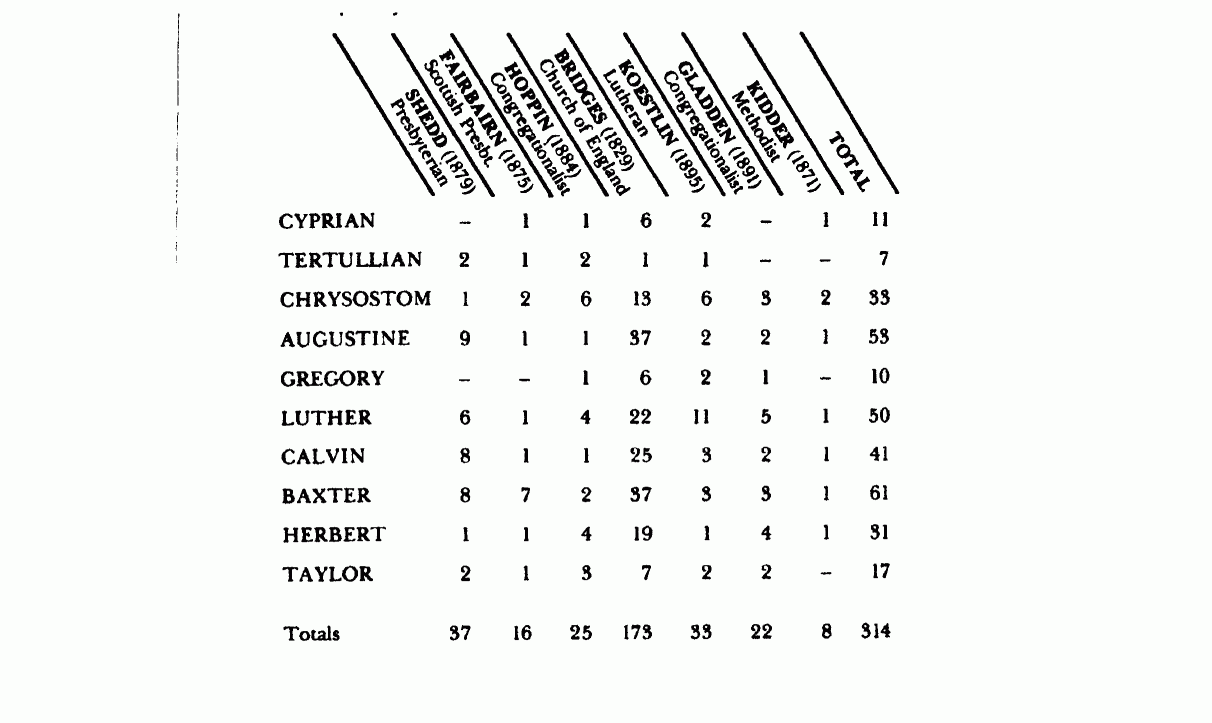
In order to test out my hypothesis that the classical pastoral tradition has been quickly and abruptly forgotten in the twentieth century, I gathered some data from the indexes of leading books on pastoral theology from the nineteenth and twentieth centuries. I selected ten key figures in classical pastoral care that seemed to me to carry the tradition most significantly: Cyprian, Tertullian, Chrysostom, Augustine, Gregory the Great, Luther, Calvin, George Herbert, Richard Baxter, and Jeremy Taylor. I then checked out the number of times they were referred to in seven standard works of pastoral theology in the nineteenth century, those by William G. I. Shedd of Union (Presbyterian),3 Patrick Fairbairn of Glasgow (Scottish Presbyterian),4 James M. Hoppin of Yale (Congregationalist),5 Charles Bridges (Church of England),6 Heinrich Koestlin of Giessen (Lutheran),7 Washington Gladden of Columbus (Congregationalist),8 and Daniel Kidder of Drew (Methodist).9 I found that every one of these authors unfailingly quoted Chrysostom, Augustine, Luther, Calvin, Herbert, and Baxter (Table 1). There were 154 references in all to our ten classical pastoral guides. Most often referred to were Augustine, Luther, Baxter, and Chrysostom, followed by Herbert, Calvin, Taylor, and Gregory. This clearly establishes the point that at the turn of the century the classical tradition was alive and well, recalled, and considered important to the practice of pastoral care.

TABLE 1

Representative Nineteenth-Century Pastoral Writers: Frequency of References to the Classical Pastoral Tradition


Curiosity aroused, I then selected seven major contemporary writers on pastoral counseling whose influence I judged to be most general and whose views seemed by consensus to be most representative. I chose the most widely used texts of four well-known Americans — Seward Hiltner, Howard Clinebell, Wayne Oates, and Carrol Wise,10 and three Europeans — from the Lutheran tradition Dietrich Stollberg, from the Reformed tradition Paul Tournier, and from the Roman Catholic tradition Father Joseph Nuttin of Louvain.11 In all these major modern pastoral works I could not find even a single quotation by or reference to Augustine, Baxter, Calvin, Cyprian, Chrysostom, Gregory the Great, or Luther (Table 2). It is as if for these contemporary pastoral counselors classical pastoral thought did not impinge relevantly on their work.

TABLE 2

Representative Twentieth-Century Pastoral Writers: Frequency of Reference to Classical Texts of Pastoral Care


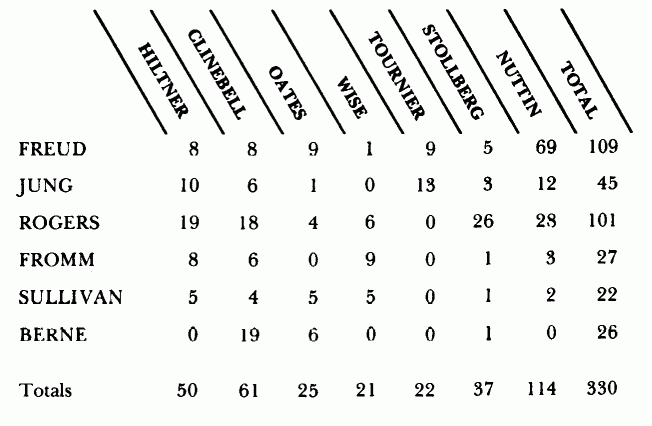
This further whetted my interest in seeing how many references these same current writers might be making to key modern psychologists and psychotherapists in their attempt to give guidance to Christian pastoral counselors. I selected six major psychotherapeutic contributors — Freud, Jung, Rogers, Sullivan, Berne, and Fromm — and found 330 references to these modern figures in the same seven widely used texts, including 109 references to Freud, 101 to Rogers, 45 to Jung, 27 to Fromm, 26 to Berne, and 22 to Sullivan (Table 3). In most cases these writers were being quoted with approval or referred to as authoritative guides for pastoral counseling.

TABLE 3

Representative Twentieth-Century Pastoral Writers: Frequency of Reference to Modern Psychotherapists


This exercise astonished me. It provided preliminary evidence for a hunch I had felt for a long time — namely, that contemporary psychotherapists are far more inwardly important and objectively authoritative for pastoral counseling today than are the writers of classical Christian pastoral care. I invite others to check this out for themselves, using different historical and contemporary writers; I think the result will be the same.

What happened after 1920? It was as if a slow pendulum gradually reversed its direction and began to swing headlong toward modern psychological accommodation. A key figure in the reversal was Anton Boisen, founder of the clinical pastoral education movement, a creative man in whom the classical tradition still lived and whose works are still eminently worth reading.12 But after Boisen, pastoral care soon acquired a consuming interest in psychoanalysis, psychopathology, clinical methods of treatment, and in the whole string of therapeutic approaches that were to follow Freud.13 It was a vital and significant task, but regrettably the theological moorings were not sufficiently deep to prevent an ever-increasing drift toward forgetfulness of the previous traditions of pastoral counseling. It is as if a giant shade had been pulled. Classic pastoral wisdom fell into a deep sleep for about four decades.

During these decades we have witnessed wave after wave of various hegemonies of emergent psychologies being accommodated, often cheaply, into pastoral care without much self-conscious identity formation from the tradition. I do not want to exaggerate so as to suggest that the classical tradition of pastoral care was entirely forgotten. That did not happen (as we can see especially in the brilliant work of Frank Lake).14 We are still living implicitly out of the quiet influences of that vital but inconspicuous tradition. It is amazing how resilient these patterns of pastoral response can be, even when they are not being deliberately studied. For language assumptions and recurrent historical paradigms may continue to be maintained at operational levels by social traditioning, despite rapidly changing ideologies and leadership elites and the appearance of novelty. But the classical tradition has not been diligently studied since the 1920s. It has lain fallow and borne only occasional wild fruit. We are now at the far end of that pendulum swing, and the momentum is again reversing toward an emerging hunger for classical wisdom.

During the past twenty-five years of my professional life the methodological key to the active energies of pastoral care has been its pervasive hunger for the accommodation of various therapies from orthodox Freudian and Jungian all the way through the broad and colorful spectrum of Harry Stack Sullivan, Carl Rogers, B. F. Skinner, Erich Fromm, Fritz Perls, Eric Berne, Albert Ellis, Will Schutz, and Joseph Wolpe, — all of whom one by one have been courted and welcomed and accommodated (often rather uncritically) into the practice, structures, language, and professional apparatus of Christian ministry. The task of the pastoral counselor thus understood in recent years has tended to become that of trying to ferret out what is currently happening or likely to happen next in the sphere of emergent psychologies and adapting it as deftly as possible to the work of ministry. In the adaptation, however, the fundament of Christian pastoral care in its classical sense has at best been neglected and at worst polemicized. So pastoral theology has become in many cases little more than a thoughtless mimic of the most current psychological trends. Often these trends, as psychologist Paul Vita has astutely shown, have been bad psychology to begin with.15 Modern pastoral counseling has had only the slenderest accountability to the classical pastoral tradition. Meanwhile it is little wonder that the working pastor continues to look in vain to the field of pastoral theology for some distinction between Christian pastoral care and popular psychological faddism. I may be exaggerating slightly, but I think not much.

This process might plausibly have continued further for some time to come were it not for the most damaging and embarrassing blow to such accommodationism—the studies of psychotherapeutic effectiveness. I refer to the slowly growing recognition of the fate-laden importance of the so-called outcome studies disclosing the actual results attained through application of the various psychotherapies. Slowly but surely we are finally learning more and more about the surprising ineffectiveness of average psychotherapy. An accumulation of controlled studies by highly respected psychologists (Allen Bergin, Hans Eysenck, Hans Strupp, Jerome Frank, Charles Truax, Robert Carkhuff, and Philip Hanson) has convincingly shown that the average psychotherapy cure rate is about the same as that which eventuates merely through the passage of time, approximately 65-70 percent.

This is not just somebody’s curious idea or untested theory, but a well-supported conclusion based on over three hundred controlled empirical studies.16 These outcome studies have caused me to question the effectiveness of the very psychotherapies upon which I had earlier been building my case as a theologian in dialogue with behavior change theories. The evidence has been accumulating for a long time, but to date it has been almost systematically ignored by the accommodationist trend that has until recently become virtually normative in recent American pastoral care. The accommodation of pastoral care to psychotherapy has bottomed out proportionally as these empirical outcome studies have been taken seriously.

These data prompt us to return to the thornier question: Has bondage to the assumptions of modern consciousness resulted in the loss of our freedom to learn from the classical pastoral tradition? I think the short answer, at least in the U.S.A., is yes. The longer answer could be stated in the form of a hypothesis for further discussion: Recent pastoral counseling has incurred a fixated dependency upon and an indebtedness to modern psychology and modern consciousness generally that has prevented it from even looking at all premodern wisdoms, including classical pastoral care. This has amounted to a net loss of freedom, a harsh constriction on the freedom to learn. We have bet all our chips on the assumption that modern consciousness will lead us into vaster freedoms while our specific freedom to be attentive to our own Christian pastoral tradition has been plundered, polemicized, and despoiled.

Evidence is growing that the time is ripe for a major restudy of classical Christian pastoral counsel. The average pastor has come to a saturation point with fads. By now most have likely done the TA trip, the T-Group trip, microlabs, and perhaps some Gestalt training, as well as dabbled with psychoanalysis and/or any number of other available therapeutic strategies — client-centered, bioenergetics, Jungian, Adlerian, rational-emotive therapy, parent effectiveness training, EST, and the list goes on and on.17 Pastors are anxiously wondering not only how most of these approaches are to be integrated into the Christian tradition (since many of them are openly contemptuous of key assumptions of Christianity) but also what their social and historical consequences will be. Early readings are not reassuring.18 Wise pastors know there has to be a better way. They are often tired of compliantly following psychiatric clues in an era in which psychiatry itself is more and more on the defensive and at times in public disrepute. Many pastors have long suspected what the public opinion analysts are now verifying, that psychiatry has the lowest trust rating among all medical specializations.

It is doubly ironic that the psychologists and psychotherapists are themselves beginning to call pastors back to their traditional pastoral identity. Major statements by therapists Karl Menninger, Frank Lake, Paul Pruyser, Hobart Mowrer, Ruth Barnhouse, and Paul Vita19 have forcefully stated this point, and there is every reason to believe that the momentum in this direction will increase. In speaking of the religious counselors he has worked with, Paul Pruyser writes, "I became aware that much of the instruction was one-sided, with the consent of both parties: the theologians sat at the feet of the psychiatric Gamaliels and seemed to like it. Pastors were eager to absorb as much psychological knowledge and skill as they could, without even thinking of instructional reciprocity. . . I have learned that ministers would be hard put to know what to teach, from their own discipline, to members of the psychological professions even if they were specifically asked and salaried to do so,"20 and he goes on to plead that ministers recover their historic identity in order better to serve persons who are doing some real "soul searching."

A high priority for some theological teachers and pastoral care professionals will be to study, translate, and make available the texts that are now largely unavailable. Many of the most important of these valued treatises simply cannot be purchased. I know of nowhere that you can buy, even through rare book channels, Bishop Burnet’s A Discourse of the Pastoral Care (1692), or Sailer’s Pastoral Theologie,21 you will find them in only a handful of the best libraries in the country. Some works like Augustine’s "The Care to be Taken for the Dead" appear in the Nicene and post-Nicene Fathers, but the ailing translation is so jumbled as to be virtually unreadable. The translations of the Anti-Nicene Fathers and the Nicene and Post-Nicene Fathers, done prior to the turn of this century, are greatly hampered by stilted Victorian phrases. So we have several strata of problems: inaccessibility, out-of- print volumes, the high cost of rare books, poor translations, and add to this the hesitation of book publishers to risk publishing historical themes that are not self-evidently of wide popular interest. These are the obstacles that have stood in the way for some time now in bringing these texts back into availability. The hunger is rising as the nonavailabiity increases.

THE PROMISE OF AN ENRICHED SYNTHESIS BETWEEN OLD AND NEW

At this point it seems fitting to speak, even if tentatively, of the challenge and promise of the road ahead for Christian pastoral care, assuming a gradually increasing accessibility of the basic texts of the tradition. I am not proposing a reactionary archaism that would rigidly repeat culturally determined prejudices of the past. Nor am I proposing a radically new model that would transcend this morass with some brilliant innovation.

The task that lies ahead is the development of a postmodern, post-Freudian, neoclassical approach to Christian pastoral care that takes seriously the resources of modernity while also penetrating its illusions and, having found the best of modern psychotherapies still problematic, has turned again to the classical tradition for its bearings, yet without disowning what it has learned from modern clinical experience.

In order to do this we must learn in some fresh new ways the courage to give intelligent resistance to the narcissistic imperialism and hedonistic reductionism that prevail both in the culture and, to a large extent, in the churches. This course I have not yet seen, but nothing is more crucial for us in the pastoral care field than to find its ground and possibility. We can no longer afford ourselves the luxury of allowing contemporary psychotherapies to define for us what pastoral care is. The situation comes very close to being a confessional moment (in statu confessionis) for those of us to whom the teaching office of the church is committed, at least in the fields of pastoral theology and pastoral care. We must define for ourselves again what pastoral care is and in what sense pastoral theology is and remains theology, and in order to do that we must be carefully instructed by the tradition out of which that understanding can emerge. Otherwise there can be nothing but continued and expanded confusion about professional identity.

The task is not merely that of giving skeptical, critical resistance to present trends, but also that of giving new energies to a wholesome reconstruction of a pastoral care that is informed by Christian theology, able to provide a credible pastoral theodicy; able to work through difficult cases of conscience; aware of the dialectic of grace and freedom, gospel and law; able to point saliently to the providence of God in the midst of our human alienations; aware of the intrinsic connections between community, healing, and proclamation (koinonia, therapeia, and kerygma); and well-grounded in the classical understanding of the triune God. The Prevailing theological method of recent pastoral care has followed the intuition of pietism in placing its stress largely on personal experience, often to the exclusion of historical experience, reason, scripture, and tradition. The new efforts in neoclassical pastoral care must work out of a sound, wholesome theological method that neglects neither scripture, tradition, reason, nor experience in the quest to understand how our response to revelation manifests itself in concrete personal and interpersonal decision.

But really, you ask, what can the classical tradition usefully contribute to modern pastoral counseling? What practical difference might it make if it were trying to preserve and develop the achievements of contemporary clinically oriented pastoral care? Although it is far too early to answer these questions with any certainty, there are some general shifts of direction that to a greater or lesser degree I would expect to occur:

• Intercessory prayer would again become an important aspect of pastoral counsel.

• The antinomianism of contemporary pastoral care (under the tutelage of hedonic pop psychologies) would be more effectively resisted by a more balanced dialectic of gospel and law.

• Marriage counseling would tend to function more within the framework of a traditional Christian doctrine of matrimony rather than essentially as a hedonic cost/benefit calculus.

• Empathy training for pastoral counseling would be more deliberately and self-consciously grounded in an incarnational understanding of God’s participation in human alienation.

• Out of our recent history of exaggerated self-expression, compulsive feeling disclosure, and narcissism, we may be in for a new round of experimentation in askesis, self-discipline, self-denial, and rigorism, which might in turn threaten to become exaggerated in a masochistic direction and thus again need the corrective of a balanced Christian anthropology.

• The diminished moral power of the previously prevailing momentum of individualistic autonomy and self-assertiveness may call for a new emphasis in group process upon corporate responsibility, mutual accountability, moral self-examination, and social commitment, an emphasis that would be undergirded by studies in Bible and tradition.

• We are ready for a new look at the traditional Protestant pattern of regular pastoral visitation, which could enter many doors now closed to most secular therapists.

• Pastoral counsel would work harder than it is now working to develop a thorough and meaningful pastoral theodicy that takes fully into account the philosophical and moral objections to classical Christian arguments on the problem of evil and the meaning of suffering, yet with new attentiveness to the deeper pastoral intent of that tradition.

• The new synthesis would interweave evangelical witness more deliberately into the process of pastoral conversation rather than disavowing witness or disassociating proclamation from therapeutic dialogue.

• Group experimentation would continue, but be rooted with more awareness of classical Christian understandings of witness, service, and community.

• Older therapeutic approaches such as fasting, dietary control, meditation, and concrete acts of restitution would have new importance.

• The now atrophied concept of call to ministry may need to be thoroughly restudied and reconceived as a hinge concept of the pastoral office and of ordination.

• Contemporary pastoral theology in dialogue with the classical tradition may learn to speak in a more definite way about the spiritual and moral qualifications for ministry, reflecting the tradition’s persistent concern for moral character, humility, zeal, and self-denial.

• The arts of spiritual direction that have been developed, nurtured, reexamined, and refined over a dozen centuries of pastoral experience may be due for serious restudy. Efforts could be made to bring these resources back into contemporary pastoral interactions that presuppose post-Freudian understandings.

• Pastoral care would become less prone to messianic faddism, because it would have built into it a critical apparatus more deeply rooted in the Christian tradition.

• A nonsexist, nonchauvinist reinterpretation of ministry, prayer, pastoral care, and spiritual direction would require a serious critical dialogue with tradition, a dialogue that must be as far-ranging as the radical feminists assert and yet able to incorporate the collective wisdom of Christian historical experience. Such critical dialogue is worth risking and far better than a simplistic accommodation to modern individualistic narcissism or reductive naturalisms.

• The term pastoral counseling would again be reclaimed as an integral part of the pastoral office, intrinsically correlated with liturgy, preaching, and the nurture of Christian community and relatively less identified with purely secularized, nonecclesial, theologically emasculated fee-basis counseling.

THE MOMENT OF TRUTH

Pastoral counseling need not be ashamed of many of its achievements in the twentieth century. But it cannot boast of its biblical grounding, historical awareness, or theological clarity. The European churches are learning rapidly from American pastoral care of our clinical training, supervisory programs, and therapeutic skills, but if we ask how well we have integrated these achievements into ordained ministry, or a clear conception of the pastoral office, the answer must be — "very superficially." At worst, pastoral counseling has learned that it can get along quite well without Christ and the apostles, scriptures, ancient ecumenical church teaching, and with minimal pastoral reference. At times it amounts to a curious disavowal of professional ministry in the name of professionalism.

I have tried as a theologian to defend fee-basis counseling. In the past I have even sought to provide for it a biblical and theological rationale. But today I find myself hard put to account for the now all-too-familiar pattern of the ordained, full-time, fee-basis pastoral counselor who has no congregation, no explicit pastoral role, and cannot tell you the inner relation between the therapeutic task and the Christian community. One has to skate pretty far out on the thin ice of secular theology in order easily to embrace the premise that this is all there is to the pastoral office — diakonia without marturia, counseling without kerygma — and that pastoral counseling may be fully expressed without any reference to Christian revelation, baptism, Lord’s Supper, ministry, ordination, prayer, scripture, and the language of the religious community out of which the counseling emerges and to which it is presumably accountable.

Protestant and Catholic pastoral counseling has been drawn into a collusive relationship with an accommodationist theology that has seduced it into a partial or substantive disavowal of historic Christianity, its sacraments, doctrine, ordination, and self-giving service. I give you a case in point: with the emergence of government supported therapies, to our amazement it has now suddenly become a pocketbook question for some fee-basis counselors as to whether they are in any definable sense Christian pastors, and on that answer hangs the fateful possibility of their being able to get on government payrolls as counselors and consultants. The specter of government sponsored pastoral counseling not only raises grave questions of church and state boundaries: it also raises puzzling questions about the extent of disavowal of religious orientation and witness implicit in tax supported counseling.

This has thus unexpectedly placed pastoral counseling at a confessional crossroad (in statu confessionis).22 Some will experience the question starkly: As a pastoral counselor, will I in good conscience accept income from the government at the cost of disavowing implicitly or explicitly all religious perspective or reference in my counseling process? If I make that disavowal, to what extent can I or the church I serve legitimately regard that as pastoral counseling? What is specifically pastoral about a pastoral counseling that has abandoned the historic pastoral office? Some "professional pastoral counselors" will answer, "Yes, I can in good conscience accept government funding," using as a precedent other ministers who have entered government social services. They will argue that they can fulfill their ministry without word and sacrament, without overt witness or worshiping community, and (why not?) without ordination. Big brother government involvement in pastoral counseling is only an overt and stark example of what is happening more subtly in fee-basis pastoral counseling generally, with third party payments on the increase.

What disturbs me most is the fact that such fateful decisions can come so easily and thoughtlessly. For I am aware of the cheap grace theology that supports them, which I myself to some extent have condoned or at least (until recently) not rejected with determination. That theology has offered pastoral counseling a flesh-less Christ, a logos asarkos,23 coupled with a diluted ideology of general ministry that makes no distinction between the ordained ministry and the ministry of the laity, and therefore easily loses track of the specific scriptural entrustment to ordained ministry to secure the apostolic witness through Christian teaching, preaching, and sacramental action.

Just as the Christian martyrs of the second and third centuries were called upon by state power to give assent to the Roman gods, and because they refused entered into a status confessionis in which confession of faith was unavoidably required at great cost, so ministry today is coming to such a point where this confession of faith is unavoidable: We will not accept your tax money, surveillance, or support if they require any hint of a disavowal of the God of Abraham, Isaac, and Jacob, and Jesus.

Some will choose one way, some another. But if it is less than a deliberate decision, we deceive ourselves in a deeper way than all the layers of neurotic self-deception that we have learned to analyze. For it is, finally, God with whom we are dealing, who judges justly, and who knows the imaginations of our hearts.


NOTES:

1. For a more complete bibliography of the classics of the pastoral tradition, please refer to the 1200 or so entries in the bibliography of my Pastoral Theology: Essentials of Ministry (San Francisco: Harper & Row, 1983), 317-54. Regrettably a large number of these books are out of print. Our purpose in setting forth this modest preliminary list is to help the reader to become aware that there is in fact a definite body of important pastoral texts once widely known but now largely neglected.

2. Erik Erikson, Identity and the Life Cycle (New York: International Universities Press, 1959), chaps. 2, 3.

3. William G. I. Shedd, Homiletics and Pastoral Theology (New York: Charles Scribner’s Sons, 1867).

4. Patrick Fairbairn, Pastoral Theology (Edinburgh: T. & I. Clark, 1872).

5. James M. Hoppin, Pastoral Theology (New York: Funk & Wagnalls, 1884).

6. Charles Bridges, The Christian Ministry (New York: Robert Carter, 1847).

7. Heinrich Koestlin, Die Lehre von der Seelsorge (Berlin: Reuther and Reichard, 1895).

8. Washington Gladden, The Christian Pastor (New York: Charles Scribner’s Sons, 1898).

9. Daniel Kidder, The Christian Pastorate (New York: Methodist Book Concern, 1871).

10. Seward Hiltner, Pastoral Counseling (Nashville: Abingdon Press, 1949); Howard Clinebell, Basic Types of Pastoral Counseling (Nashville: Abingdon Press, 1966); Wayne E. Oates, Pastoral Counseling (Philadelphia: Westminster Press, 1974); and Carroll A. Wise, Pastoral Counseling (New York: Harper & Bros., 1951).

11. Dietrich Stollberg, Therapeutische Seelsorge (Munich: Chr. Kaiser, 1969); Paul Tournier, The Doctor’s Casebook in the Light of the Bible (New York: Harper and Bros., 1960): Joseph Nuttin, Psychoanalysis and Personality (New York: New American Library, 1962).

12. Anton Boisen, Out of the Depths (New York: Harper & Bros., 1960).

13. This history has been partially chronicled in Seward Hiltner, ed., Clinical Pastoral Training (New York: Federal Council of Churches, 1945); Charles Kemp, Physicians of the Soul: A History of Pastoral Counseling (New York: Macmillan Co. 1947); Edward Thornton, Professional Education for Ministry: A History of Clinical Pastoral Education (Nashville: Abingdon Press, 1969).

14. Frank Lake, Clinical Theology (London: Darton, Longman & Todd, 1966).

15. Paul Vitz, Psychology As Religion (Grand Rapids: Wm. B. Eerdmans, 1977).

16. For a general review of these therapeutic effectiveness studies, see my articles, "A Popu1ist’s View of Psychotherapeutic Deprofessionalization," Journal of Humanistic Psychology, (Spring 1974) and "Consumer Interests in Therapeutic Outcome Studies," Journal of Humanistic Psychology 15 (Summer 1975), as well as Game Free, chap. 3.

17. See The Intensive Group Experience, chaps. 1, 5.

18. See chap. 1 of my discussion in Guilt Free (Nashville: Abingdon Press, 1980).

19. Karl Menninger, Whatever Became of Sin? (New York: Hawthorn Books, 1972); Lake, Clinical Theology; Paul Pruyser, The Minister as Diagnostician (Philadelphia: Westminster Press, 1976); O. Hobart Mowrer, The Crisis in Psychiatry and Religion (New York: Van Nostrand, 1961); Ruth Barnhouse, "Spiritual Direction and Psychotherapy," Journal of Pastoral Care 33 (September 1979): 149-63; Vitz, Psychology as Religion.

20. Pruyser, Minister as Diagnostician, 39f.

21. Gilbert Burnet, A Discourse of the Pastoral Care, 1692 (London: W. Baynes, 1818); Jacob Sailer, Vortseungen aus der Pastoraltheologie (Munich: J. J. Lentner, 1788).

22. Cf. Dietrich Bonhoeffer, Letters and Papers from Prison (New York: Macmillan Co., 1953).

23. Cf. my Contemporary Theology and Psychotherapy, 62-64.

Introduction

Before we ask "Gregory Who?" or "Why him?" it is first necessary to look candidly at the contemporary situation of pastoral care to ask why it needs ancient pastoral wisdom. Otherwise, we might give the skewed impression that we are merely reviewing Gregory as a historical exercise only, with no direct relevance to the pressing dilemmas of current pastoral care. To avoid this misunderstanding, we will take several careful steps to introduce ourselves properly to the issues that lie ahead.

We will first set forth a fundamental principle of theological dialogue with psychotherapy: The empathic acceptance that is implicitly presupposed in effective psychotherapy is made explicit in the Christian witness to revelation. This hypothesis, which we first stated over two decades ago, remains a key premise of the ensuing discussion.

It is appropriate to explain how I have journeyed from that preliminary hypothesis to the more vexing problems of this book. The argument could have been stated without any window at all into my own personal history. Yet it may be useful to show how and why I have now come full circle to a fundamentally revised set of questions and how they mesh with the present dilemmas of pastoral care. Every time I tell something of my personal story, I find to my amazement that others mention with great feeling that they too have experienced something analogous and that my story has helped them see what has happened to them.

From this autobiographical beginning point it becomes meaningful to take on the major technical issue of this chapter, asking whether pastoral counseling has a definable historic identity? Can we textually and historically define the central tradition of classical Christian pastoral care? A descriptive answer to this question will allow us better to ask about the ironic fate of that identity in our own time: How has historic pastoral care been remembered by us? Have we lost or misplaced that treasure in our modern broken vessels? Only then will our constructive question emerge with power: Can we recover that treasure? And if so, what is the promise of an enriched synthesis between classical and contemporary pastoral care? By the conclusion of the first chapter we will begin to wonder aloud whether we may have happened upon a decisive "moment of truth" for pastoral theology in our time.

THEOLOGICAL ROOTS OF PASTORAL PRACTICE

Theological foundations must be laid carefully. How is psychotherapeutic empathy analogous to the Christian good news of God’s love? Empathy is the process of placing oneself in the frame of reference of another, perceiving the world as the other perceives it, sharing his or her world imaginatively. Incarnation means that God assumes our frame of reference, entering into our human situation of finitude and estrangement, sharing our human condition even unto death.

When the troubled person finds himself or herself under the care of someone with accurate empathy, someone who seems able to enter another’s perceptual framework, he or she experiences a profoundly liberating feeling of being known, being understood. Empathy is the precondition of all therapeutic effectiveness.

Christian worship celebrates the God who has chosen to enter our human frame of reference, to participate in our troubled condition, and to affirm human existence by sharing in its contingency, suffering, and death. Just as the counselor enters the frame of reference of a troubled person and, without being neurotic, significantly participates in that person’s neurosis, so God, according to Christian witness, participates concretely in our human estrangement without himself being estranged.

When the Apostles’ Creed confesses trust in the one who was born of the Virgin Mary, suffered under Pontius Pilate, was crucified, dead, and buried, it expresses a penetrating affirmation of God’s determination to share fully in our human condition. This stands against the docetic view that Christ was never really born. The early church witnessed to the infinite scope of God’s unconditional empathetic love. Analogously, the therapeutic process may be seen as a certain sort of descent into hell. The therapist engages in the depths of the inner conflict of the neighbor, descending into that hell with the other person. This may in turn free the neighbor to experience the hell of his or her own feelings, looking toward a renewal of faith and courage.

In all effective psychotherapy there is hidden an implicit assumption that is made explicit in the Christian proclamation. The therapist accepts the troubled neighbor in the midst of neurotic guilt feelings and compulsions, not on the narrow assumption that the neighbor is just privately acceptable by the therapist as a friendly human being, but on the much more basic assumption that every person, as human being, is accepted by being itself. Effective empathy assumes a cosmic permission to get in touch with one’s own deepest experiencing. Persons who are offered this empathic gift tend to grow toward more appropriate self-acceptance and self-understanding. The counselor is not the source of such acceptance. The counselor only points to an acceptance that has its source beyond himself. The unspoken assumption is that acceptance is already there, despite all human rejection, and that the person who is neurotically guilty, anxious, and depressed does not have proper self-knowledge. The assumption that the individual is acceptable is a more profound ontological assumption than is ordinarily acknowledged by the therapist, who does not arrive at this assumption, but begins with it.

This implicit assumption is precisely what is made explicit and revealed by God’s self-disclosure in Jesus Christ. The Christian proclamation seeks to state clearly and decisively that in Christ God has made himself known to us as one who loves us so unconditionally that his love calls for radical behavior change on our part. The Source of life is for us. This Word is declared not as a speculative idea but in and through an event. The ministry of Jesus of Nazareth is the originative event that calls forth the witness of the church to this Word from on high.

Can Christian proclamation of this unmerited divine grace be made consistent with humanistic-Socratic counseling which seeks the achievement of insight? A clearer conception of the self-disclosure of the accepting reality may help us hold together both sides of a seemingly paradoxical answer: The Christian good news is that God is with us and for us, which is the implicit basis of effective therapeutic empathy. That implicit awareness becomes explicitly announced in Christian preaching.

When the empathic pastor works effectively as a counselor, faith is becoming active in love. Here proclamation and therapy support one another in an integral ministry of witness and mission. The love of God to which the pastor overtly witnesses in preaching is recapitulated in a nonverbal way in the active empathy of counseling.

But why even preach, if the same accepting reality is fully present in so-called secular relationships? What is the point of talking about Jesus as the Christ if the love that he manifests openly is hiddenly present in all of life and perhaps uniquely and dramatically in secular psychotherapy?

This same basic issue is to be found already in the New Testament. Paul declares that "there is no distinction between Jew and Greek; the same Lord is Lord of all and bestows his riches upon all who call upon him" (Rom. 10:12, RSV). Yet if God is already present, why announce his presence? Paul explains that the purpose of proclamation is to call persons to an awareness of the reality of the situation in which they already exist, the reality of God’s occurring love; not to introduce God to the world as if God were not already there, but to introduce persons to themselves as those who are always already claimed by God. Paul asks how are we to rely upon the accepting reality if we have never known ourselves to be encountered by it (Rom. 10:14)? And how are persons to "believe in him of whom they have never heard? And how are they to hear without a preacher?" In sum: "Faith comes from what is heard, and what is heard comes by the preaching of Christ" (Rom. 10:17, RSV). Here is the necessity of overt, clear, decisive proclamation, which announces the accepting reality present in therapy as a reality that has chosen to make itself bodily known once for all in history.

Suppose we pursue the other side of the issue. If proclamation of the revealed Word of God is necessary in order to identify the ground of acceptance, why should it not therefore become imperative that the therapist always be a preacher, an overt proclaimer of the self-disclosure of the accepting reality? The nub of this issue is whether divine acceptance must be mediated verbally or whether it can be adequately mediated nonverbally through an interpersonal relationship. Our argument hinges on the premise that liberating divine acceptance can be mediated concretely through concrete interpersonal relationships without overt witness to its ground and source, although it is also seeking constantly to clarify through language its inner source and ground.

THE POINT OF VIEW OF MY WORK AS AN AUTHOR

It was in an attempt to spell out the intriguing consequences of these embryonic insights and hunches of the late l950s that I set my feet on the path that has preoccupied me ever since — the attempt to reengage the then atrophied dialogue between theology and the many approaches to psychotherapy.

A summary glance over the road I have thus far taken will show more clearly where I am coming from. I want to speak autobiographically of the circuitous course of my own dialogue with psychotherapy, its challenges and limitations, and of the ways I am now coming to see the incompleteness of my own pilgrimage. I hope you will recognize that the surprising place in which I now find myself in this dialogue is an organic extension of the basic concern that first drew me into it. Otherwise, my present classicist trajectory might, on superficial glance, seem to be an unexplained reversal of the previous direction.

My clinical beginning point in the l950s, later surpassed, was client-centered therapy. I myself was a recipient of the accurate empathy and unconditional positive regard of an extraordinarily congruent person, Robert Elliott. So I speak of these relational qualities as one who experienced them as profoundly important at a particular juncture of my life, 1955-56. By the close of the fifties I was seeking as a young teacher to effect a workable integration of a therapy of personal self-disclosure with a theology of divine self-disclosure (more particularly of Carl Rogers and Karl Barth).1

In the mid-sixties I was in Germany doing clinical work at the Psychiatrische und Neurologishe Klinik of Heidelberg, enthusiastic especially about existential psychotherapy, asking whether the tradition of Martin Heidegger, Ludwig Binswanger, Karl Jaspers, Medard Boss, J. H. van den Berg, Igor Caruso, and Viktor von Weizsacker could be integrated into the secularization theologies of Dietrich Bonhoeffer and Rudolf Bultmann, to which I was then deeply committed.2

In the "freaked-out" late sixties I was eagerly investing myself in almost every available brand of intensive group process from T-groups and growth groups to microlabs and marathons with a strong emphasis on psychodrama and Gestalt awareness training. I did more clinical work in the psychiatric ward of a VA hospital, and taught Clinical Pastoral Education chaplain trainees at the Institute of Religion of the Texas Medical Center. I looked for some connection between contemporary group process and the Jewish-Christian tradition of small group confession and mutual pastoral care, especially as manifested in Jewish hasidic and Christian pietistic groups of the 18th century.3 But even at that point I began to recognize the potential self-deception of my own antinomian temptations. Like most liberal Protestants of that period, I had deep-seated tendencies to anarchic politics and messianic expectations about social experimentation, which (under the tutelage of my inimitable friend, Will Herberg) eventually revealed themselves as hollow. This work with experimental groups extended into a more chastened critical study of transactional analysis in relation to Pauline-Augustinian understandings of human bondage and freedom.4

About 1971, however, there was a major turn in my pilgrimage as I gradually became painfully aware of the so-called outcome studies reporting the dubious effectiveness of average psychotherapy, whose cure rates barely match spontaneous remission, coupled with the frightening spectre of client deterioration (i.e., patients finding their condition worsening under the care of professional psychotherapists). The sobering implications of these controlled studies for pastoral care elicited a substantial shift of direction for me toward the kind of critique of pychotherapeutic assumptions that was already being developed by Thomas Szasz, O. H. Mowrer, Hans Eysenck, and William Schofield.5

My work with experimental group psychotherapy and interpersonal analysis essentially came to an end in 1976. I had been attempting to solve some of the problems strewn in the path of transactional analysis. I thought the TA simplisms needed a basic corrective. So I developed the Collusion Spectrum as a more accurate descriptive means of sorting out human interactions, relying heavily on the empirical data of several social psychologists, mostly of a behaviorist orientation (George Homans, J. Thibaut, H. Kelley, the early Timothy Leary, Robert Carson, and Harold Rausch). I sought to correlate these data with the medieval doctrines of virtue and interpersonal justice.6

The crisis intervention therapists (Eric Lindemann, Gerald Caplan, Robert Carkhuff, David Switzer, and Edgar Jackson) then became important to me in the mid-seventies as I dealt with the more sober moral dilemmas involved in pastoral care for the dying.7

Although I had been teaching Kierkegaard seminars for many years and had lived in constant companionship with his authorship, the perennial Kierkegaardian side of my work did not bear visible fruit until I completed a work on Kierkegaard’s parables, which was fully two decades in the making.8 No twentieth century psychologist has influenced my psychology as deeply as Kierkegaard, and I still doubt that the analytical powers and psychological insights of Freud and the post-Freudians have equaled those of Kierkegaard.

This circuitous account of my pilgrimage is crucial to the rest of what I will be saying. For it forms the background of the work I am currently trying to do in the recovery of the classical pastoral traditions. By 1979 a very different theological project was undertaken — the attempt to recover classical ecumenical orthodoxy amid postmodern cultural consciousness. That effort represented a joyful decision on my part to turn again toward the classical Christian pastoral tradition, especially as expressed by the ecumenical consensus of Christianity’s first millennium of experience in caring for souls. It was coupled with a critique of modernity, which I define as the overarching ideology of the modern period characterized by the three key terms describing larger patterns familiar to modern psychotherapy — autonomous individualism, naturalistic reductionism, and narcissistic hedonism. Modern chauvinism has assumed that all recent modes of knowing the truth are vastly superior to all older ways, a view that has recently presided over the precipitous deterioration of social structures and processes in the third quarter of the twentieth century. My frank goal has been to help free persons from feeling intimidated by modernity, which while it often seems awesome is rapidly losing its moral power, and to grasp the emerging vision of a postmodern classical Christianity.9

This is a rough aerial map of the rocky ground I have covered in trying thus far to relate therapeutic counseling to the Christian message. As I now return to the early Christian pastoral tradition, however, I do not wish to negate the learning of this earlier journey of psychological discovery, nor do I want to disown my own work except for a few brief excessive passages in which I harshly inveighed against a deliberately religious orientation in counseling. But I now see more clearly than before some of the deficits that prevented the previous dialogue from deepening and maturing. So this is where I am coming from — but where am I headed?


NOTES:

1. This theme eventually became the core of the argument of my Kerygma and Counseling (Philadelphia: Westminster Press, 1966; San Francisco: Harper & Row, 1978). 1 sought at that time to show how the same hypothesis could be related to Freudian, Adlerian, and Gestalt approaches to psychotherapy. At the time I was teaching pastoral counseling and theology, and guiding a general hospital pastoral education program.

2. For the results of this period of research, see my Contemporary Theology and Psychotherapy (Philadelphia: Westminster Press, 1967), and The Structure of Awareness (Nashville: Abingdon Press, 1969).

3. See my The Intensive Group Experience (Philadelphia: Westminster Press, 1972).

4. See my Game Free. The Meaning of Intimacy (New York: Harper & Row, 1974).

5. This shift was first publicly expressed in After Therapy What? 1972 Finch Lectures, Fuller School of Psychology, with responses by N. Warren, K. Mulholland, C. Schoonhoven, C. Kraft, and W. Walker (Springfield, Ill: Charles C. Thomas, 1974).

6. See my TAG: The Transactional Awareness Game (New York: Harper & Row, 1976).

7. See my Should Treatment Be Terminated? (San Francisco: Harper & Row, 1976).

8. See Soren Kierkegaard, Parables of Kierkegaard, ed. Thomas C. Oden (Princeton: Princeton University Press, 1978).

9. See my Agenda for Theology: Recovering Christian Roots (San Francisco: Harper & Row, 1979).

Chapter 8: Growth in Grace: The Final Assurance

Christian hope, we have been saying, is grounded in the structure of life. We believe we see within that structure the loving work of God. Christian hope for human society is based on the fact of God’s creative and redemptive working which is woven through the whole fabric of life. One manifestation of that work is a coercive and persuasive thrust toward a human society of justice and equality. While we reject the romantic doctrine that this society gradually emerges in purity, we do believe that God wins His victories in spite of the persistent evil.

This sober hopefulness depends upon the belief that it is possible in some degree for men to love their neighbors as themselves. We must examine this belief. Is this true? Or have we been describing life as it ought to be but not as it is? Reinhold Niebuhr suggests the formula that the Christian life means a break with sin in principle but not in fact.1 Is that where we must come out?

I

Part of the controversy over the possibility of love derives from misunderstandings of what the problem is. Some clarification is in order.

A first confusion arises if we try to prove the possibility of man’s loving his neighbor simply by pointing to noble, sacrificial, and kindly behavior. Of course there is such behavior. But the question is, What does it mean? The facts are clear. Human beings are capable of self-sacrifice. Parents gladly give their lives for their children. Men will die for their nation, and they will risk life even for someone unknown to them. The bonds of degrading habits can be broken. Alcoholics Anonymous proves this every day. Men can be converted, and can experience a new spirit which shatters old ways and releases them to live with decency and kindness. Let us add quickly that all these facts reveal something of the goodness of God and the potential goodness of man. But none of these facts answers the question which Christian faith must answer. Can a man give his life to the one real good, to the community of all things under God? Only the will to that good is the meaning of Christian love. Even the sacrifice of life for a stranger in peril may be no more than a natural response to danger or an expression of comradely feeling. Heroism both physical and moral may spring from motives quite different from the love we see in Christ.

The natural question comes: "What difference does it make what may be the source of moral qualities provided men actually achieve them?" But it makes all the difference. It makes the radical difference as to what we can hope for from human beings. Notice, if human goodness is prompted by something less than the full demand of the universal community of good, then no matter how courageous and high-minded it may be, Somewhere this limitation will be revealed. And that place will be just in the case where love is most needed, that is, where man must transcend his emotional attachments and instinctive responses to rise to a new level of service to the universal good. The ultimate imperative of the Gospel is, "Seek ye first the kingdom of God and his righteousness." Kierkegaard echoes the Gospel in saying, "Purity of heart is to will one thing."2 Can man really submit even his high ideals and noble virtues to be transformed by the demands of the one final good, the Great Society of all? If so we can hope that something of that society can really grow on earth. If not, we shall still discover many great goods in human experience. But they will all finally be exposed as falling short of the actual needs of the common life. The good which could make life whole will not be ours.

The doctrine that pagan virtues are but splendid vices is relevant here, though this ancient saying is an unfortunate statement of a partial truth. There is no reason to deny that human virtues are genuine goods in God’s sight as well as man’s. The religious question is whether man’s virtues lead him to will to serve God first and whether they support that will. Human experience gives abundant evidence that unless virtues are finally transmuted by the spirit of love they may become deadly in the service of ruthless and ignoble desires. Even kindness can make a man fail to meet the real demands of God in a given situation where something rigorous and unyielding is called for. Jacques Barzun remarks that "most of the heartburnings in the academic world come from somebody’s yielding to the temptation to be kind at the wrong time." 3

Christian love does not mean we will a good in which the self has no part. That error we have tried to refute in Chapter Three. Negation of self is a Buddhist, not a Christian, idea. But the high demand of God is to will one’s own good only as it can serve and share in the good of all. To love ourselves for God’s sake is the highest form of love as Bernard said.4 It is the possibility of that love we are seeking.

A second confusion which attends the discussion of the possibility of love is related to the problem of perfectionism. Jesus said, "You must be perfect as your heavenly father is perfect." 5 The word (Greek) which is usually translated "perfect" occurs fairly frequently in Paul’s letters.6 The problem of the various forms of perfectionism in Christianity has been thoroughly analyzed in such works as Dr. Sangster’s Path to Perfection, a study of John Wesley, and R. Newton Flews’ The Idea of Perfection in Christian Theology.7 The meaning of this doctrine of perfection is one problem for Christian faith. But the point to be made here is that the question of whether love is in any sense possible for man is separable from that of whether in this life he can ever perfectly love God and his neighbor. I am, for example, never quite certain whether Niebuhr means by a "break with sin in fact" a complete break. If the question is whether perfect love is possible I should certainly side with Niebuhr. But we may find it possible to assert that the beginning and maturing of the life of love is a fact. Let the possibility of perfection take its proper place as an ideal which lies always beyond existence. Or let it be the momentary glimpse of perfect love which transcends our ordinary state of being, which perhaps is what it really meant to John Wesley. But let us not insist upon the achievement of perfection in the Christian life any more than we insist upon it in the works of our hands or our minds.

With two possible sources of confusion removed we can state our thesis: It is possible for human beings, in response to the power and goodness of God, to begin to will His Kingdom above all other things and to grow toward a more mature expression of that will. In our first chapter we said that the new life is made possible through an encounter with the redemptive love of God. It involves a release from the old self and the putting on of a new. The power which works this transformation is released in the frustrated life through the discovery that the love which God demands is a love which shares our human lot and offers reconciliation. Norman Pittenger has said that what Christianity has to offer is life in God, life in charity, and life in union.8 If that is no real offer then we have no Gospel.

Evidence is called for to support this claim. But what kind of evidence will be sufficient? We can multiply testimonies from Christian experience. We can describe Christian lives as we know them, but all of this leaves us unsatisfied. We need to probe more deeply into the kind of problem here presented for Christian thought for nothing less than the good news of Christianity is at stake.

There are three reasons why it is difficult to support any interpretation of the Christian life.

First, there is the problem presented by the kind of reality we are inquiring about, namely, human motives and the human will. Man is more than a bundle of reflexes and emotional patterns which can be studied objectively. Man is spirit. He is a free creative participant in the process of becoming. Spirit is our name for personality in action, encountering and creatively responding to the demands of life. It is man as spirit that expresses love in all the high senses of that word. It is the human will in its inward structure and intent that is the real man as Christianity sees him. The question about love is a question about spirit, motives, and personal intention.

Now, we ask, what kind of experience can enable us to pass judgment on the spirit? The answer is that all human experience is evidence. But does any experience give conclusive evidence that our interpretation is valid? In judging others we are always reduced to mediated evidence. We certainly cannot enter into another person’s soul, at least never sufficiently enough to judge without question what is there.

It might appear that there is one whose spirit we can judge, that is ourself. But is a man ever really known to himself? We do not know ourselves apart from interpretation of our motives. We get the principles which we use in self-interpretation from something beyond our own experience, the categories and concepts of the group. There is a sense in which we are always seeing ourselves as others see us. Dr. E. E. Aubrey has made this point clearly in his book, Man’s Search for Himself. 9 A vivid illustration of the problem here raised for all moral judgments is given in the experience of a lecturer who asserted to a group of Southern people that no one could practice discrimination against another race and be a Christian. To this one person replied: Suppose that your family, your school, all the groups to which you belonged and whose members you respected, practiced and justified discrimination so that you never had a chance to raise with yourself a question about it, were you then not a Christian? The lecturer was forced to make an application of the doctrine of invincible ignorance! Any claim on our thought or behavior which we have never had an opportunity to recognize cannot be held against us as free and moral beings.

Unless then we can find some kind of "intuitive" knowledge of motives which cannot be questioned, we would seem to be forever at the mercy of the historical relativities of the concepts by which groups live. One who is born, for example, into a Christian group which teaches the doctrine of perfection may be expected to interpret a decisive religious experience as the granting of perfect love by the Holy Spirit.

The fact that we misjudge our own motives is the primary difficulty of the "intuitionist" solution of the problem. Once we allow that intuitions can be faulty, we have to provide for some method and standard by which they are corrected. This takes us beyond a purely intuitional theory of knowledge. Rarely if ever does our judgment of our intentions become mature in the moment of action. It is in retrospect with the advantage of some detachment, and with the opportunity of bringing into our judgment the wider range of our knowledge that we begin to know ourselves. We often revise our estimate of the motives and interests which actually have dominated us. What we thought was profound religious stirring we may judge to have had a large mixture of adolescent romanticism. Our "devotion to the Kingdom of God" may have concealed an inward yearning for approval and power. There is clinical evidence here. The psychologist Rollo May tells of an idealistic college student who went to the Near East as a missionary only to break down when he discovered he really did not possess the spirit he was teaching. "The boys saw through our shell. The idea had got around that when we teachers talked about love, it was not Christian love for the natives at all, but love for our own ideal of love."10

Ours has been an age of unmasking. We have indulged in what has become almost an orgy of self-disclosure and self-abasement. The names of Freud and Marx stand for some of the profounder discoveries about the hidden springs of conduct. Much modern literature, poetry, and painting has joined the chorus. It is difficult to sift the sense from the nonsense, but surely this whole exercise in self-analysis has yielded solid truth. We need, for example, to recognize how deeply our spiritual lives are influenced by the conditions inherent in the particular economic and social structure in which we are placed. Most people have little or no conception of how their emotional patterns and profoundest religious experiences are conditioned by the values, experiences, and frustrations which their particular role in the social order involves. To face these facts, and to be willing to follow through to the end whatever may contribute to our self-knowledge is itself an act of love, for love casts out the fear of knowing the truth about ourselves.

We now seem to be saying that we can get knowledge of our real intentions. It would be nonsense to say that we misjudge our motives unless there is some way in which misjudgments are corrected.

The solution has already been hinted at. It consists in a synthesis of intuition and critical reflection. We have to take our interpretations of human behavior as hypotheses and test them against an ever wider range of experience. That testing includes a continuing attention to whatever the special sciences tell us about the conditions and the character of human motivations. But we cannot get the truth about man simply by adding up what the sciences say. We have to gather the data of experience to achieve a coherent interpretation which includes as clear an analysis as we can make of our presuppositions about the nature of things.

Such data as we have are often like this testimony out of the concentration camps. Mine. Olga Lengyel writes:

Yet I saw many internees cling to their human dignity to the very end. The Nazis could debase them physically but they could not degrade them morally. Because of them I have not entirely lost my faith in mankind. If even in the hell of Birkenau there were those who were not necessarily inhuman to their fellow men, then there is still hope. It is that hope which keeps me alive.11

The facts upon which we comfortably reflect are indeed often gathered at great cost.

The work of elaborating a world view in which all our particular ideas will have their place is essential to any judgment on the nature of man. On its technical side this is the task of philosophy and theology. These disciplines can achieve a view of things which makes sense. But we cannot claim for them as much objectivity as the sciences have.12 Psychology itself shares many of those difficulties with philosophy and theology. Professor Allport says: "Even the psychologist who honestly desires not to underestimate the complexities of personality finds himself limited by the crudity of the tools within his professional store."13 Even with the best tools, we will always be confronted by the fact that the interpretation of human motives involves ultimate theories of the nature of things which can be tested only as they progressively illuminate more and more of the human scene. Alternative world views will always be possible. It is the fate of man to be able to know himself adequately only as he comes to know God.

One further remark about the understanding of personality which has been made possible by modern science should be made. The disclosure that the particular interests of men, whether biological, psychological, or economic, do influence not only their behavior but their self-interpretation, does not disprove the claim that love as will to the universal good is possible. We do not have to show that some pure and detached spirit of love operates in man apart from his natural interests and desires. We do not have to show that love exists completely uncorrupted by those interests. We only hold that the whole man can act with freedom, and that his act can be qualified by his will to serve the good of all things.

Any judgment on human nature runs into the problem of human differences. There are varieties of Christian experience. We have to take into account the whole company of saints and wicked, the once-born and the twice-born, the strong of spirit and the weak, the kindly and the ruthless, those who have saved their souls by withdrawal from the world, and those who have assumed the moral risks of ecclesiastical office and public trust. Each adds something to our experience of the way of love, both in its possibility and its elusiveness. Professor Whitehead’s reminder that "the intolerant use of abstractions is the major vice of the intellect" is timely for the theology of the Christian life.14 The imposition on experience of particular patterns which define for everyone what it should be like for him to be a Christian has been a major vice not only of theology but of the Church’s approach to Christian nurture.

We are not looking, then, for an indisputable judgment on what may be possible in the response of the spirit to God’s demand. We are looking for a sober and responsible position which squares with as full an understanding as we can get of what the history of the Christian people reveals. The position now to be set forth is this: While it seems quite clear that perfect love is never possessed by man, the beginning of a response in love to the grace of God is possible and growth in grace as a maturing in that life is possible. In our formulation of the Christian life we have to do justice both to the grace and to the growth, for whatever progress in the life of love is possible, it is always progress within the structure of man’s relationship to the creative and redemptive working of God. Growth never takes us beyond the need of grace in any of its aspects. But there can be real progress in the Christian life.

II

To break any living thing into parts, whether it be a flower or the pilgrimage of the human spirit, is to risk destroying its vital unity. Yet we must analyze, and too simple formulas for the Christian life are to be distrusted. The five principles here set forth are attempts to do justice to five aspects of the Christian life conceived as growth in response to the grace of God. These distinctions do not represent separate moments of experience. They are aspects of a total life the mystery of which lies beyond our powers of analysis. If we take any one of them in isolation from the others we fall into error.

The emphasis upon "growth" connects the New Testament conception of growth in grace with the metaphysical doctrine that the most concrete reality we know is process. Applied to the description of the Christian life, this means that our standpoint is directly opposed to that neo-orthodox doctrine which stresses the discontinuity of Christian faith with the rest of experience in such a way that it is asserted, for example, by Dr. Daniel T. Jenkins that there is "no kind of continuity between the ‘old man’ and the ‘new man in Christ.’ "15 Our analysis presupposes that there is always continuity in human experience between any of its moments and all of its moments. The Christian life is a process in which the continuum of conditions and consequences is not escaped. Within this process God does effect a revolutionary transformation.

1. Growth in grace has a beginning. The beginning of the new life of the Christian is the birth of faith in the whole man. Faith is born out of the encounter of man with the fact of God. It is the breaking of the shell of self-centeredness and the free commitment of the self to the power and the goodness of God. Faith is more than belief though it involves belief. Faith is more than an act of will, though it involves a decision of will. Faith is response. It is the whole-souled giving of life into the keeping of God who is the absolutely trustworthy source and redeemer of life.16

Two points have given rise to endless controversy over the nature of faith. The first has to do with the relative significance of God’s power and man’s freedom in the new beginning. The second has to do with the psychological process involved, particularly the significance of emotional manifestations which may accompany conversion.

With respect to the first, there are always difficulties if we try to separate, even in thought, God’s bestowal of the new life from our reception of it. It is right to emphasize that faith itself is given to us as a gift. We cannot create it by an act of will any more than we can create God’s mercy for us, and bring it to ourselves by human effort. Yet God cannot bestow faith which we in our freedom will not receive. There is a double movement in faith -- God toward us and we toward God. God is the initiator of all saving activity. Here it appears to me the Calvinist insistence on "predestination" is so far correct. But we need not make an artificial separation between justification by faith as the receiving of the gift of forgiveness, and regeneration as the actual beginning of the new life. There is no such separation, as Calvin himself takes great pains to make clear. If there is no element of our own freedom in our giving of ourselves to God, then the Christian life depends on a mechanical action. If we deny human freedom we make the humanist protest against religion inevitable and so far valid.

On the question of the actual psychological processes involved in the birth of faith, and particularly on the question of whether faith is given once for all, we must exercise caution. On the psychological side there is so much we do not know about religious experience. What we have said about the varieties of experience applies here. Some find faith in a dramatic experience for which they can give date and place. Some find it as an imperceptible growth, its beginning known, if at all, only in retrospect. As we shall see in a later point, we have no basis for saying that faith is always possessed once for all. Men do lose their faith. Some find it again. We can know we are telling the truth when we say this, though we should always be uncertain about judgment on any particular case. There is something in the whole person which no analysis will ever reveal.

The precise difficulty in stating the marks of true faith is illustrated by the struggle of Jonathan Edwards with this problem. For Edwards it was a pressing question. In the Great Awakening, he saw all about him -- much of it produced through his own preaching -- the violent psychological disturbances connected with religion. How is one to tell what is really an authentic sign of faith and what is not? Edwards’ analysis is keen and uncompromising. He discusses many suggestions as to how the difference can be told, and rejects even the most plausible ones. For example, "It is no certain sign that the religious affections which persons have are such as have in them the nature of true religion, or that they have not, that they dispose persons to spend much time in religion, and to be zealously engaged in the external duties of worship."17 Again. "It is no sign that affections are right or that they are wrong, that they make persons that have them exceedingly confident that what they experience is divine, and that they are in a good estate."18 And Edwards avoids the error of putting faith in good works. "It is no evidence that religious affections are saving or that they are otherwise that there is an appearance of love in them."19

Edwards must be able to say what the distinguishing signs of faith are else he could not make these statements; but he acknowledges that he does not believe it is in God’s plan to give us rules whereby "we may certainly know who of our fellow professors are his." This is God’s prerogative.20 Edwards’ answer is that divine things are discerned by the spirit, hence this judgment itself is a judgment of faith. He does introduce "Christ-like ways of life," and "perseverance in the duties of the Christian." These are the best signs we have.

Edwards’ treatment is a masterly blend of psychological insight and the cautious reserve appropriate in the Christian sense of the mystery of grace. But the assurance that there is a life in faith is maintained.

2. The second principle is that the life of faith is actualized in the process of life. There begins a new way of living. That the reality of this new way was an integral part of the message of Jesus is superbly put by Karl Holl in his comment on the distinctive Christian notion that "God stands particularly close to the sinner."21 Holl points out the relation of this doctrine to Jesus’ teaching:

It is all the more astonishing that on the basis of such a conception of God, which seemed to dissolve all morality, Jesus nevertheless built up an ethic, and the most exacting ethic conceivable at that. . . . The meaning is clear: pardoning grace overcomes, because at the same time it encourages and humbles. It creates an inner affection, a feeling of gratitude which must find expression, and for which the highest is not too much to do. . . . From this follows the most splendid feature of the ethic of Jesus, namely, the naturalness, the spontaneous character of the action, which he supposes even in things most difficult and self-denying. . . . God takes the initiative: with His forgiveness He creates something quite new, out of which arises at once a real, close, and warm relationship to God, and with it at the same time a morality which ventures to take even God Himself as its model.22

The new life includes (1) a new interpretation of the meaning of life, (2) a new devotion in the service of God, and (3) a new participation in the working of God. These are all recognizable processes. All involve growth in the depth, the wisdom, and the completeness of the life of faith.

Growth in grace involves growth in the new structure of meaning through which faith interprets life. The possession of a new meaning in itself yields power to alter life. We are interpreters. We live in the world which is in large part shaped for us by the system of cultural symbols and concepts which we inherit. Our very minds and spirits are interwoven with the structure of symbols and meanings by which we interpret the world. The significance of Dr. Hocking’s remark, "What the man sees becomes the working part of the man," has been abundantly confirmed in the psychological clinic.23 The process of healing the disordered personality involves the reinterpretation of the past and the achievement of a new interpretation of the meaning of existence. The Christian revelation has always been apprehended as the Word of God, not merely a word about life, but the entry into human history of a new meaning which has become operative in shaping the course of history.

This aspect of the new meaning in the life of faith helps us to see more deeply into the question of whether faith can ever be lost once it has become real in life. This much is true: when I have once seen my life in relation to God all further experience must be so interpreted as to include that fact. Whatever the loss of faith may mean it can never be a return simply to what life was before faith possessed it. Its meaning now is "life which has lost faith." This gives a new dimension to the bitter experience. There is a sense then in which once the life in grace has begun it can never fall completely out of its apprehension of that grace, even when we rebel against God. We have stood once within the circle of God’s love. We can never move far enough to leave it entirely.

Interpretation exists within the life of devotion, for the new meaning is simply life given in service. It is the life of work in response to our vocation. Energy, intelligence, and will are enlisted in doing what needs to be done. This too is process. This working must be renewed day by day; the new life has its times of waning energy and loss of courage, its times of decision, and its times of victory in the whole-souled response to need.

The new life participates in the power of God. We do not do it all. We share in a working which is beyond our sight and our power. Our moment in time is the heir of all previous moments and of what God has accomplished in them. We are deceived by the appearance that everything is dependent upon our efforts. But the tides and powers which shape our destiny and to which we add our mite of freedom and creative decision have been running for all the ages. It follows that what we actually do is largely invisible to us. What we actually do is what our life becomes as it influences the ongoing history. We share in a destiny we can but faintly envision. We participate in a task which occupies God for eternity.

We come now to the difficult question of whether it is meaningful to speak of growth or progress in the life of love. It might appear that if we describe the Christian life as process, we should have to accept the notion of a progressive achievement. But the matter is not so simple.

3. The third principle is that there is new temptation at every stage of the Christian experience. Therefore, growth in grace is never growth away from dependence upon the continuing mercy of God.

The danger of all theories of growth in grace is that they may justify a false complacency by suggesting that achievement in the religious life puts one beyond the possibility of serious temptation and actual sin. This danger is manifest when Professor Macintosh describes the Christian experience in these terms: "Christ brings to us the salvation which consists in being indwelt and progressively delivered from the ruling power of sin. . . . As Paul might have said, the Christian life is the Christ-like life, the life of faith, hope, and unselfish love, inwardly felt and outwardly expressed."24

There are two reasons why this puts the matter inacceptably. The first is that the risks of freedom are not recognized. If we say the progress of the Christian life results in a freedom only to do the good then we make spiritual maturity a development out of responsibility into mechanism. There is no evidence that mature Christian experience makes new decisions automatic. Habits become established, indeed. But the meaning of every important decision is precisely that old habits do not suffice. We have the example of the prayer of Jesus prayed in agony in the garden of Gethsemane, There is every evidence that his last decision was the most difficult to make.

In the second place, there is abundant evidence that growth in the life of the spirit brings new temptations with it. The very achievements of the Christian life bring peculiar difficulties. These are not always overcome in proportion to the degree of spiritual advancement. That evidence has been gathered and powerfully presented by Reinhold Niebuhr. His analysis of the sin of moral and spiritual pride is a permanent addition to the Christian interpretation of life.25 Sin is man’s absolutizing of himself.26 Its source lies both in man’s insecurity and in his possession of something which makes a high estimate of his own wisdom and virtue plausible. The good man can always find reasons to conceive of his goodness more highly than it deserves. Behind our exaggerated estimates of our own virtue there usually lies a more or less hidden consciousness that our case is not so strong as we would have it.

A judgment confirming Niebuhr’s has come from one whose orientation is somewhat different. W. E. Sangster, whose study of Wesley’s doctrine of perfection we have noted, is closer to the pietist tradition, and he affirms the possibility of love more unequivocally than does Niebuhr. Yet Sangster concludes that the claim to perfection has been a mistake. It is part of the strategy of the Christian life to recognize the saints’ capacity for self-deception.

John Calvin was correct in his saying that humility is the first. second, and third truth about the Christian life, at least so contemporary theology agrees.27 The dam to any complete possession of Christian love reveals a superficial knowledge of how deep sin is and how frail we are. However much thou progress thou must set thy hope on mercy," says St. Augustine.28

Our first three principles affirm growth in the Christian life; yet we have now said this growth never gives us such firm spiritual achievement that we can say our goodness is adequate. We need to go on then to the statement of the fourth principle.

4. Real growth in the strength to love and serve God is possible. Growth in grace means that there can be progress in the expression of Christian wisdom and love. There is no contradiction between this and the third principle for we do not say that such growth puts man beyond the possibility of temptation and the subtle corruptions of the spirit. We say only that there can be growth in the discernment of what it is that corrupts and in the power to meet temptation.

The term "progress" very likely confuses the issue here for some. In our modern usage it connotes a smooth and all but inevitable movement toward a goal. But no reader of Bunyan’s Pilgrim’s Progress need fall into this illusion. Bunyan’s description of the Christian journey through life is one of the most realistic ever produced. There are giants to be fought at nearly every turn in the road, and the Pilgrim trembles to see at the very gate of heaven a byway to the pit. But there are experiences of victory, and a vision of the gates of glory at the end. Calvin’s description of the Christian life comes from another ruggedly realistic mind. He faces all the difficulties but finally leaves this door of hope open. "No man will be so unhappy but that he may every day make some progress, however small"29

Growth in grace may be best interpreted as progress toward spiritual maturity. Dr. Moffatt usually translates the New Testament word as "mature." Maturity in the life of loving service is a recognizable fact in Christian experience.

Christian maturity means progress in self-understanding which is one of the prerequisites of works of love. We correctly speak of progress toward a fuller awareness of the meaning of love and of the nature of sin. There has been, for example, a growth in grace in this respect in the modern Church’s understanding of social sin. The recognition that love must bear the burdens of the common life, that what appears as personal holiness may mask an irresponsible attitude toward social injustice, and that the task of love includes social reconstruction marks an advance in Christian maturity. It would be impossible for this gain to be made had there not appeared here and there in the Church those for whom the way of love was real.

Maturity in the life of love means increasing skill in meeting the obligations which love lays upon us. Every minister knows people of good will in his parish upon whom he relies because they know, often better than he does, what needs to be done for the person in need. The minister knows of others, not lacking in good will, who are inept in situations which demand special sensitivity and insight. Christian maturity involves the development of the skills and intelligence through which love can do its work. It is here that much of the responsibility of Christian education lies. We have to speak cautiously about increasing the skills of the spiritual life. It is God’s work more than ours. We can, however, try to provide the conditions under which love has a chance to grow, and do its work well. A. D. Lindsay has wisely observed:

The difference between ordinary people and saints is not that saints fulfill the plain duties which ordinary men neglect. The things saints do have not usually occurred to ordinary people at all. . . ." Gracious" conduct is somehow like the work of an artist. It needs imagination and spontaneity. It is not a choice between presented alternatives but the creation of something new.30

It may be objected that we are speaking here not of growth in love but in skill and insight. I reply that these cannot be absolutely separated. Love itself is necessary to growth in knowledge of other persons. Growth of insight may lead to a deeper appreciation and self-giving. Love which has capacity for social imagination, and for a skillful dealing with human problems, is strengthened in itself. Growth in grace is growth in a wise, continually renewed appreciation of the things which serve and the things which destroy, and the mastery of ways of dealing with both.

Christian maturity involves, then, progress in our capacity to love. This is the most difficult principle to affirm. Let us quickly observe that if Christian experience means anything at all it is also the most difficult to deny. Surely the New Testament affirms it: "Work out your own salvation with fear and trembling for it is God who worketh in you."31 "The Lord make you to increase and abound in love one toward another, and toward all men."32 "Seeing that ye have put off the old man with his doings and have put on the new man that is being renewed unto knowledge after the image of him that created him."33 The difference between the beginning of life in love and whatever fuller realization of love comes to be may be slight indeed. But there can be no Christian life at all unless there is some real meaning in progress in strength to express love. If that be not true then the meaning of life is realized only in moments of vision which do not affect our earthly existence except by relating us to something outside of it. The New Testament, the message of Jesus, the existence of the Church become inexplicable. Sangster rightly opposes the tendency in contemporary theology to stress the impossibility of holiness. It is as dangerous an error as that involved in too simple doctrines of sanctification. We need the balance of the Westminster Confession which rings with a new clarity and power at the dose of our inquiry into the secret of the Christian life. The Confession allows no extravagant self-appraisal. It requires a searching and reverent humility before the righteousness of Christ. But it does not shut the door to our growth in such love as God in Christ has made possible for us:

When God converts a sinner, and translates him into the state of grace, he freeth him from his natural bondage under sin, and by his grace alone enables him freely to will and to do that which is spiritually good; yet so, as that by reason of his remaining corruption, he doth not perfectly nor only will that which is good, but doth also will that which is evil. The will of man is made perfectly and immutably free to good alone in the state of Glory only.34

5. The fifth principle brings into view a new dimension of our human pilgrimage toward the light. There is the last question of the Christian’s relation to the things loved in this life, and the nature of his hope in the face of death. Growth in grace involves maturity in the kind of attachment we have to the goods of this earthly existence. The principle may be stated thus: Growth in Christian maturity is growth in love for all the goods of mortal life, and at the same time it is growth in the capacity for detachment of our ultimate faith and hope from dependence upon our particular plans and interests. Christian detachment is not a denial of the ultimate worth of created things; but it is a willingness to yield all things to the transformation of the passage of time and to surrender them to the ultimate order of God’s Kingdom. Even the fate of conscious personality we entrust in death to God’s keeping without knowing exactly how His care for us will be expressed.

Our discussion in this book has centered on the problem of hope. That hope has many dimensions in Christian experience. There is a legitimate hope for good in every human situation. We have said that hope that one’s own spirit might grow in love to God and man is not vain, for God’s grace is real. Yet in every particular human hope there is a link to a victory which transcends earthly fortune and misfortune. The wisdom of life lies in the discovery that joy belongs only to him who can submit all his own hopes to the cause of the great community of good which life on earth can never fully define or capture.

Paul’s faith that "love hopeth all things" is not sentimentality. It is the affirmation which Christian faith must make about what it means to trust in God. Only the man whose hope can stand the defeat of any particular project is free to hope "for all things," that is, for whatever good may really be possible under God. Such a faith is not flight from the responsibilities of this life. The God we serve is the giver of this life with its obligations and possibilities. There is no situation in which the Christian cannot find meaning and hope. There is no social wrong which need remain unattacked, unmitigated, unreformed. There is no private desperate struggle with anxiety and bitterness and failure which cannot yield new hope when we discover that God does not leave us forsaken. But those who know this, while they are released to spend themselves in doing what needs to be done, live with a certain divine carelessness concerning earthly fortunes. Their hope sees beyond the years and they live in this demanding present under the everlasting assurance of God’s love.

Notes:

1) Reinhold Niebuhr, The Nature and Destiny of Man, Vol. II, passim.

2) S. Kierkegaard, Purity of Heart Is to Will One Thing, trans. Douglas Steere (New York: Harper & Brothers, rev. ed., 1948).

3) Jacques Barzun, Teacher in America, p. 201.

4) Bernard of Clairvaux, Loving God, 15, 39 (Opera 1360).

5) Matthew 5:48. Moffatt translation.

6) W. E. Sangster, The Path to Perfection (Nashville: Abingdon-Cokesbury Press, 1943). Textual analysis in chap. iii.

7) R. Newton Flew, The Idea of Perfection in Christian Theology (London: Oxford University Press, 1934).

8) W. Norman Pittenger, "What the Church has to Give," The Christian Century, Vol. 62, No. 11, March 14, 1945, p. 333.

9) E. E. Aubrey, Man’s Search for Himself (Nashville: Abingdon-Cokesbury Press, 1940), esp. chap. ii.

10) Quoted in Rollo May, The Springs of Creative Living (Nashville: Abingdon-Cokesbury Press, 1940), p. 47.

11) Olga Lengyel, Five Chimneys (Chicago: Ziff-Davis Publishing Company, 1947), p. 212.

12) Cf. A. N. Whitehead, Process and Reality, chap. i.

13) Gordon W. Allport, Personality (New York: Henry Holt and Company, Inc., 1937), p. 215.

14) A. N. Whitehead, Science and the Modern World, p. 26.

15) Daniel T. Jenkins, The Nature of Catholicity (London: Faber & Faber, Ltd., 1942), p. 65.

16) Professor H. N. Wieman has clarified the meaning of faith as commitment. Cf. The Source of Human Good (Chicago: University of Chicago Press, 1946), pp. 46-53.

17) Jonathan Edwards, Works, Vol. III, p. 45.

18) Ibid., p. 48.

19) Ibid., p. 34.

20) Ibid., p. 63; cf. p. 202.

21) Quoted in William Manson, Jesus the Messiah (Philadelphia: Westminster Press, 1946), p. 62.

22) Ibid., pp. 62-63.

23) William E. Hocking, Human Nature and Its Remaking (New Haven: Yale University Press, rev. ed., 1929), p. 411.

24) Douglas C. Macintosh, Personal Religion (New York: Charles Scribner’s Sons, 1942), pp., 141-42.

25) Reinhold Niebuhr, The Nature and Destiny of Man, Vol. I, chap. vii.

26) I am indebted to Wilhelm Pauck for this definition.

27) John Calvin, Institutes of the Christian Religion, 7th American ed. (Philadelphia: Westminster Press, 1936), Vol. I, p. 291.

28) St. Augustine, commentary on Psalm CXLVII, sec. 12.

29) Calvin, op. cit., p. 750.

30) A. D. Lindsay, The Two Moralities, quoted in Dorothy Sayers, The Mind of the Maker (New York: Harcourt, Brace and Company, Inc., 1941), p. 192.

31) Philippians 2:12-13.

32) I Thessalonians 3:12.

33) Colossians 3:9.

34) The Westminster Confession, chap. IX, Secs. 4-5.

Chapter 7:<I> </I>The Good Earth and the Good Society

The hope for a "better world" of human dignity, productive peace, and social justice formed a cardinal tenet of the liberal expression of Christian faith. We are all beginning to learn that Christian hope ought never to be expressed as a prediction of the course of history. We cannot demand that the future be bent to conform to human plans. Christian hope is the spirit in which we accept the risk of the future. We move into the unknown with faith and expectancy because we have seen salvation accomplished in the midst of evil.

At this time when hope runs low among men, we should be ready to give as sane an interpretation as we can fashion of the possibilities of human life. Christianity would be a sorry failure today if it kept itself aloof from the search for constructive solutions of human problems. Secular idealism may not reach the height of religious faith, but a conscientious effort to bring a better order into the world is one of the continuing signs of the image of God in man.

I

We need to consider what kind of hope for the better world is implied in the viewpoint we have developed and show how we must hold this hope in strict balance with a Christian realism concerning the evil which is within us and about us. We need to formulate the Christian hope in a way which embraces what is valid in both realism and utopianism.

I use the word "utopianism" deliberately because it brings us straightway to the crux of our problem. The word "utopian" is usually hissed rather than spoken today. It is hurled with reproach at liberal Christianity which is charged with having allowed the Christian faith to be replaced by a secular utopianism. The American approach to politics and history is characterized as "utopian" when critics wish to say that Americans do not understand historical realities. Richard Niebuhr describes this dissolution of the Gospel in American Christianity: "A God without wrath brought men without sin into a Kingdom without judgment through the ministrations of a Christ without a cross."1

We have admitted the justice in this criticism. We want no return to a view of history which deals superficially with the fact of evil. It may serve the purpose of clarity if having made this qualification I state bluntly my thesis that the utopianism in the liberal faith had a lasting value which it derived partly from the Christian faith and partly from what was valid in the world view of the Enlightenment. We could make no greater mistake today than to allow this utopian element to be uprooted from our Christian experience and witness. Utopianism rightly understood has a place in the Christian response to life.

To use the term "utopian" merely as a scornful epithet does not serve the purpose of clear thinking. Let us ask what it means. What is utopian in a bad sense and what is not?

In the narrow sense of the word "a Utopia" is an imaginative picture of a perfect order of life, projected either backward toward a golden age or forward into an ideal future. From Plato’s Republic to the several visions of H. G. Wells, the Utopias have served as the vehicles for the expression of wisdom about life, social preachment, and sheer imaginative delight. Culturally speaking, at least, we should be much the poorer without them.

It is doubtful if any one generalization about the functions and significance of these artistic and intellectual visions can be made. Mr. Toynbee is probably oversimplfying when he says that their primary intent is to arrest the process of decay of civilization while trying to show that certain selected elements of the civilization are essential to perfection. Plato, for example, borrows some of the Spartan ideals for his perfect state in order to arrest the decay of Athens.2 This misses, I believe, the profounder significance of Plato’s Republic as an expression of philosophical wisdom. A strong case has been made by F. J. E. Woodbridge that Plato not only does not seriously regard his "perfect state" as realizable, but that he means to make us see the error of imposing perfection too rigorously on human fallibility.3 Edward Bellamy’s Looking Backward illustrates the utopia which becomes a persuasive call to radical social reforms.4 It also illustrates one of the functions of utopian thought as a medium of realistic criticism of the present. When Bellamy says that in his new society the editors of newspapers are elected by the subscribers, he hits straight at the problem of the democratic control of the sources of propaganda which has become critical for us.

The religious utopianism of the Anabaptists in the Reformation period and of the Levellers and Diggers in England grew out of the Christian expectation of the imminent end of the world and the attempt within the religious community to begin to live the life of the new order here and now. The modern utopias of liberalism and of Marxism have asserted the possibility of the order which overcomes evil emerging either through gradual development or catastrophic struggles in history. Both Marxists and liberals who expect in their different ways the coming of the good society are able to live in a kind of anticipatory participation in the perfection of the goal. Its triumph is assured. A Condorcet predicting the age of peace from his prison during the French Revolution, or the German Communist in a Nazi concentration camp, may live through the trials of the present with a serenity born of the knowledge that what ought to be will be.

The "utopian" experimental societies so familiar in American history have drawn little groups of people into adventure of proving that the new order is possible. They all failed; yet many were splendid failures and released into the mainstream of our culture forces and ideals which we would not willingly let go.5

This cursory survey reminds us that the "lure of perfection" has its own power, and appears as a recurring phenomenon among sensitive souls. Our capacity to deal with what we call the realistic problems of life would be weakened without this element which contains something profound in spite of the romantic and even absurd ways in which it may be expressed.

We are encouraged to look for the deeper element in utopianism through the labors of the sociologist Karl Mannheim, who has characterized it in a brilliant manner. If we follow Mannheim we are able to identify a general meaning of "utopianism" as one of the ways in which groups in history take hold of their historical situation.

Mannheim describes the "utopian mentality" in these words: "Every age allows to arise . . . those ideas and values in which are contained in condensed form the unrealized and the unfulfilled tendencies which represent the needs of each age. These intellectual elements then become the explosive material for bursting the limits of the existing order." 6 The utopian element appears where men believe in the creative eruption of forces which are capable of meeting the new demands of life. Now we begin to see one aspect of the historical significance of the Christian faith that God is powerful and that He will act. Mannheim himself traces the "spiritualization" of politics in modern culture to its origin in the chiliastic utopias of exploited and oppressed Christian groups which began to try to make radical changes in the political order.7 Faith that God’s power was producing the new order became a call to revolutionary human response. Religion which has not lost its utopianism is the opposite of the opiate of the people.

The sense in which the utopian element belongs in the Christian view of history now becomes clear. It does not require the assertion that perfection is possible in any life or society. It does mean that history is open to the power of God and through His power society can be transformed in the direction of the real good. It is one of the functions of theology to be a critic of utopias and utopianism. Criticism is evaluation. The Christian mind will seek at all times for the possibility of new good which may be hidden from our sight, but which we know is everywhere present.

Utopianism in the Christian hope is that spirit which knows that man is never satisfied or at peace until he discovers the meaning of life in the community of love with God and his fellows. It is the everlasting expectancy of God’s mercy sustaining and redeeming our twisted lives. It is the willingness to trust life to Him even when we cannot see the way through. It is the willingness to let the old order be shaken to pieces and to believe that a better is possible under God who is forever making "a new heaven and a new earth." This expectancy of the Christian spirit has more than one mode of expression. It may release a zestful activism in which we start out to get things done. But there is also a brooding and silent patience in the face of disaster, when we see no way to turn and nothing we can do. But the waiting can be filled with hope for him who believes that God keeps His own watch in the night.

Hope itself is born of the spirit’s grip upon ultimate things. The forms of hope are functions of the world view of a particular mind or culture. When we try to say what we hope for and why we hope, we begin and end with the vision of God as the source and meaning of life. But we also point to the life about us and try to say what we see in it that sustains our hope. When we do this we discover that Christian hope has many dimensions. We shall explore three of them,

II

1. Christian hope is sustained by, and expresses itself in, a reverent grateful love for the good earth.

In asserting the goodness of our natural environment we should avoid a false sentimentality. There is a mystery of evil in the creation. Human life is often crushed, starved, or killed by disease before its "natural" course is run. Yet amidst the travail of creation there is the fact of the tender nurture of life. The earth is but a passing order. Still if this present cosmos is but a wasting flow of energy, in faith we believe that creative love will go on doing its patient work. God is not bound to one universe or one cosmic epoch, and His work is manifest in this order which sustains our life. The prayer for "our daily bread" is the acknowledgment of our dependence, and the expression of hope that the God who has given life will continue to give it. We experience His grace in the order of the stars and seasons, the rhythm of work and rest, the repeated miracle of birth, growth, death, and new life. The Christian attitude permits no ultimate asceticism toward the things of earth and sense. When the meek shall inherit the earth their reward is like the reward of the Kingdom of heaven itself.

We acknowledge that the criticism of romantic tendencies in the theologies which have stressed the immanence of God is often justified. We are not defending the sweetish sentiments taught in much poetry and song which discreetly ignore the cruel and darker side of nature. But there is more than sentimentality in a reverent acceptance of this life with fear of its evil and love for its good. Such acceptance comes from the discovery of the patient working of God as He bears us with Him into the future. As Tagore wrote: "Every child comes into the world with the message that God does not yet despair of man."8

Even death has its place in the service of God. It is the way life makes way for more life.9 Death establishes a common fate for every living thing, and thus gives a decisive character to our dependence upon God and our unity with all His creatures. It opens the way to the participation of this finite life in the infinite life of God. The traditional doctrine that death is in the world as the result of sin may easily lead to confusion. Death as separation from God is the mark of sin. But death as a natural fact is one of the conditions under which God’s work gets done. Here is a decisive point at which we need to recognize that our existence as finite creatures offers us something more than temptations to sin. The theologies which stress original sin inordinately tend to see nothing but temptation in the natural order. But there are also persuasions to love in our creaturely experience. Even in death God draws us to Himself.

The reverent acceptance of the natural conditions of life has practical consequences. When man regards nature only as something to be exploited for immediate gain without concern for the whole good it is meant to serve, he loses even his capacity to make full use of nature. A scientific conquest of nature without the sense of reverence will always turn against us. Mind becomes calculating, practical, sure of its capacity to dominate. Yet this imperial confidence of man the exploiter has nothing to serve. It loses the zest of life. It has no power to see it whole. That is much of what is wrong with man’s spirit today. Sheer control over life for the sake of control is self-defeating. The good earth is good only as we love it in the using of it.

The Malvern conference of English churchmen said in 1941, "We must recover reverence for the earth and its resources, treating it no longer as a reservoir of potential wealth to be exploited but as a storehouse of divine bounty on which we utterly depend."10 Mr. David Lilienthal has given practical evidence of the validity of this religious attitude in his account of how the principle of the "respect for the unity of nature" emerged in the development of the Tennessee Valley Authority. The principle is that soil, forests, rivers, and our technical skill will together serve human life provided we understand and respect the interrelatedness of all life. Thoughtless exploitation of one natural resource without taking account of the whole restorative cycle of nature and the whole need of man wastes natural wealth. Mr. Lilienthal gives the striking example of Ducktown, Tennessee. To this town came a copper mining company interested apparently only in copper. To get fuel for the smelter furnaces the magnificent hard wood forests were cut down. Fumes from the smelter laid their killing blight on the remaining vegetation. Rainfall washed away the good soil now unprotected. Man made a desert of the land.11 The actual cost in natural wealth of this one failure is staggering. Today new technical skill has rendered the smelter fumes harmless. A program is under way to restore the lost forests and fields. The earth will yield her increase when man respects her laws. As the engineer describes the principle of the unity of nature an ancient word takes on new meaning, "The earth is the Lord’s and the fullness thereof." God made us members not only of one another, but of the one great society of all creatures.

It may be held that our earth really provides only meager living for most human beings. One school of economists suggests that nothing much better than poverty for the masses of men is conceivable within the economy of nature as we know it. Certainly it is true that we cannot expect, and indeed we would not want, a world which did not call forth a strenuous disciplined effort of mind and body for the maintenance of life. Yet the burden of grinding poverty destroys the possibility of the full life for the masses of men. The scientist, K. F. Mather, has made out a strong case that there is "Enough and to Spare" of natural resources. The resources are in the earth and the means to use those resources are at hand to lift mankind beyond the threat of starvation, and out of the grinding condition of insecure physical existence. Fairfield Osborn in Our Plundered Planet gives a less optimistic analysis, but makes the same argument that intelligent planning is imperative for the full use of the resources we have.12 Advances in medical science are so dramatic we need only to mention them. Life expectancy in America has doubled since 1900. That is a gain for human good beyond calculation. Scientific resources for dealing with mental illness are increasing. While our culture produces neurotic personalities, we know some of the causes and some of the ways by which men can be helped to accept life and to live it with adequacy rather than to be broken by it. All this takes human effort and ingenuity. Nature does not give her bounty without human labor. But man did not invent his own inventiveness. That itself is a gift of grace.

Christian faith accepts the challenge of the natural environment to make it serve human fulfillment. We need to make certain that neither the mood of despair of our time, nor the theological concentration of attention on man as sinner robs us of a respect for life’s essential goodness and the importance of intelligence and disciplined effort in meeting the particular problems which are set for us by the conditions of human existence. Hope for man is reborn whenever we rediscover our dependence upon the good earth. That hope will be expressed in a reverent concern that what God has provided shall be used to serve nothing less than His good which is the one real good of all things.

2- The Christian hope for man is sustained by, and expressed in, the never-ending struggle for the Good Society.

"The Good Society" is a utopian symbol. That is its power. The hope for a redeemed humanity, living in dignity, freedom, and brotherhood under God is an integral part of the Christian faith about the meaning of the human adventure. Whatever blocks the coming of the Good Society is an enemy of Christ. What helps humanity forward toward that society is proof that Christ reigns with power. This hope for the Good Society was justified in liberal theology both by its ultimate faith in God and by what it took to be experiences of real victory over evil.

We can save that hope. We must save it if Christianity is to have an ethical gospel for human affairs. The ethic of love presupposes that in some measure what ought to be can come to be. Such is the radical faith with which the Christian spirit ought to release us to tackle our social problems.

We now know that it is imperative for us to recognize that the Christian hope for the Good Society can be saved only if we achieve a new formulation of it. We know that something was wrong with the optimism of the social gospel. What is not so clear is how to bring the spiritual and moral depth of that gospel into a new philosophy of Christian action in history. But a most promising solution is emerging in the theological discussion today. The key is this: The aim of Christian social ethics is to discover and promote the establishment of those conditions which will aid the growth of communities of freedom, justice, and equality. These communities will not be "the great community," but they will support that community, and be something like it. We cannot directly create a good society. It must grow. No growth is mechanical or wholly controllable even in the lowest orders of life. At the human level the growth of community depends on the free response of men to the needs of their neighbors. What we can do is to discover in human experience those social, economic, political, and cultural conditions which may open the way for the life of free men under God.

To make clear what is new in this approach to the social gospel let us take the analogy of the family. Suppose a man and a woman marry, and set out to establish the Perfect Marriage. They determine to govern the whole of life toward the full realization of the ideal. They manage their children’s lives with the intention of seeing to it that nothing but the most perfect domestic order is established. Now we quickly sense there is something dangerous and humanly intolerable in such an effort. It has been well said, when we work at our virtues they may become deadly. We are forcing something which cannot be forced. When our try for perfection falls short as it must, we have no resources with which to meet it. if we have staked the meaning of life on achieving nothing less than the ideal.

Some forms of the Christian attack on the social problem have expressed just such a taut idealism. Men set out to create their ideal Christian order of life, that is, to control history.

Whatever the moral heroism it may elicit the limitations of this idealistic approach are now clear. The structure of the ideal society Cannot be finally prescribed, nor can we directly create a new order, The stuff of human history and human nature simply does not permit that kind of attack. We have to make our way through monstrous evil, and make endless concessions to what is actually there in the forces which shape our destiny. The crucial difference between two ways of looking at human problems is the difference between trying to manage history according to plan, and a responsible planning within a history which is more successfully dealt with when we recognize the unmanageable factors within it.

We can know in principle for all situations that some structures of human society block the real good, and some may open the way for it. Here, then, is the distinctive task of Christian social philosophy: to raise in every social order the question, "What is its consequence for the community of mutuality among men?" There is, for example, no Christian economics in the sense of a distinctive Christian science of economic behavior, nor any one Christian answer to the question. "What is a good economic order?" But there is a Christian question to put to all economic orders and programs. What does this way of life do to the freedom, equality, and growth of mutuality of the people who live in it?

The elaboration of this approach to Christian social ethics is an enormous task requiring the continuing co-operation of every Christian whether he be layman, minister, scientist, or theologian. There will always be differences of judgment in the Christian group on specific political and social issues. I am here concerned to state a method of approach to the problem rather than to discuss the complex issues which surround us everywhere. But "a moral discussion is inconclusive and even trivial, if it leaves out the question of its application," as Gregory Vlastos has said.13 In order to be as specific as possible about this approach to Christian social philosophy I shall outline in arbitrary fashion five general principles which I suggest can be supported by the evidence of human experience as being necessary guides to the conditions under which the Good Society can grow.

First, the resources of the good earth and of human intelligence must provide for every responsible member of society the minimal basis for decent health, housing, education, and recreation. We have come very near to accepting this charge on the total social body in principle, though we are a long way from achieving it in practice. The problem in America is not primarily one of wealth. There is enough. The real problems arise in finding the adequate ways to provide and distribute such security. Ways are being found. If one rides the downtown bus in one of our large cities through the slum areas in which children play in dirty alleys behind saloons, and then passes a housing project with clean, sunlit yards. and children playing in safety, he can only say, "So far, so good, not only for them but for all society." The fundamental securities, basic education, and the necessities of healthful and wholesome life can be shared among all.

Second, political institutions must be found which unite stable order with the maximum opportunity for free interchange of goods. ideas, and experiences among men. Order is the precondition of successful human living. At the international level we know that an order capable of enforcing peace is essential to survival itself. Order and freedom are not antithetical, though there will always be practical difficulties in equating them perfectly. The unity of order and freedom is essential to the growth of the real good, for this good is the growing community of personal understanding, and mutual interdependence among people. Consequently the Christian ethic always stands against artificial barriers of law or custom which segregate races or classes, and which in any way deny the right or opportunity of free and equal meeting of men in personal comradeship.

To state the political requirement in this way illustrates the difference of this approach to Christian social philosophy from the attempt to create the Good Society according to an ideal plan. So much of the actual work of state-making takes the form of ground-clearing and obstacle removing. The poll tax has to be repealed. A law forbidding discrimination against groups in public restaurants has to be enforced. A board of trustees has to be educated to the necessity for understanding anti-Semitism and its evils. The United Nations fights for its life. We try to find what needs to be done to save it. All this is a long way from "creating the Good Society." But this is what responsible Christian action must be. We must break up the inhuman conditions which set men against one another. We must plant such seeds as we can of a better way. But God gives the increase in ways we cannot prescribe.

Third, the political order must protect the voluntary associations of men, and the free propagation of their faith about ultimate matters. The religious group, the Church, is not the only significant voluntary group in the state, but it is the principal group whose supreme loyalty is given to something beyond the state. Karl Barth has proposed an amazingly simple principle of Christian politics. He says: "All that can be said from the standpoint of divine justification on the question (and the questions) of human law is summed up in this one statement: ‘the Church must have freedom to proclaim divine justification.’" 14 That the freedom of the Church to speak its message should be the one principle by which Christianity judges any social order may seem an absurd oversimplification. Probably it does say too little, but it is far from absurd.

Justification means making righteous. What Barth says is that where the Church is free to proclaim God’s righteousness above all human righteousness; where the Church can call men to worship the God who is the judge of every state; and where the Church can publicly interpret the demand of righteousness in relation to the life about it; here we have the most fundamental of all freedoms, and the one absolute condition of the better social order. Men must feel free to speak, hear, and criticize in the realm of faith. Whether such freedom can exist in a state where any church is "established" is debatable, taking human experience as a whole. We cannot say it is absolutely impossible given certain historical conditions. But Americans and many others are rightly dubious about it.15

Fourth, the resources of both the political order and the voluntary groups in society must be used to bring healing and mercy to broken lives. One of the truly bright strands in the dark fabric of human history is the slow but real progress of the humanitarian ideal. Lives can be reclaimed. The moral demand for humane treatment of the criminal and the sense of social responsibility for seeking his rehabilitation are precious achievements of civilization, however tragically inadequate present practice may be. There will always be those who need special care and aid from the state, the Church, or other institutions. Both in England and in America at the present time we appear ready to recognize that the good offices of courts and other public institutions may help to save many marriages which are threatened with collapse. Philanthropy which merely patches up the worst results of evil social conditions can hardly be called anything more than a necessary evil. But in the best society we can conceive men will still need to bear one another’s burdens.

Fifth. Our first four principles are so widely accepted by men of good will that they sound commonplace. That does not make it less necessary to state them. We are a long way from achieving them even on the most optimistic view. The principle which we now urge is of a somewhat different character. In some measure it has been accepted in enlightened democratic society; but it always meets stubborn resistance. The fifth condition of the good society is that every man shall be able to participate with power in the making of the decisions which affect his life; and every group shall be able to participate with power in the decisions which affect its interests as a group. Here is the ethical frontier in the major struggles of mankind today. How shall the worker participate with power in the decisions which affect his job, his income, his security? How shall all nations, strong and weak, participate with power in the decisions in the international political order which affect their very existence and their prospects for security?

The importance of the power problem for Christian ethics derives both from the fact that power, whether economic, political, military, or spiritual, means capacity to determine life for good or ill, and from the fact that some fundamental redistribution of power is necessary as a condition of the freedom and dignity of men in their social relations. The failure to recognize the significance of power is a grave error for which traditional Christian ethics may at some points be held responsible. It has sometimes made the false assumption that where men have the spirit of love they can be indifferent to the structure of power in their social relationship. But "liberty of contract begins where equality of bargaining power exists," as Oliver Wendell Holmes said.16 There are indeed many kinds of power, including the power of prestige, of moral conviction, of rational persuasion. That is why there can be no simple rule for calculating equality of power. But Justice Holmes points to the essential matter. If I have power over my neighbor and he has none over me, the chances are overwhelming that I will exploit him. I will probably justify my exploitation on the ground that my motives are pure. The proof of this is that in all the struggles for power in human history, those who have been powerless have been able to see the evil that is done to them; whereas those who have power both cannot and will not see the evil. To take one example: women have been systematically exploited by men in all human relations and not least in the home in all Western civilization. They have been assigned the dullest work, have been denied opportunity for self-development, have had the major decisions affecting their lives determined by men. A modern writer pleads that women might have a chance "to be something other than a nurse-maid. a scrub-woman, a delivery truck."17 In so far as the status of women has approached equality in our society this gain cannot be attributed primarily to the moral insight of men. It was made possible through the new economic power of women which came with the technological developments in modern industry. This is but one example of the fact that the distribution of economic power is essential to the establishment of human relations on a basis of the equal dignity of all members of the community.

We have already pointed out that the existence of the power factor does not make the ethic of love irrelevant. On the contrary, love as a principle of social ethics implies that distribution and organization of power which can offer the foundation for free and constructive human relations. One of the high strategies of parental love is to allow children the growing sense of power which sets them free from either the conscious or unconscious domination of the parents. It is in such a strategy rather than in the intensity of emotional attachment that parental love reaches its highest moral plane, and comes closest to the meaning of love in its religious sense.

The word "democracy" has not appeared in our statement of the conditions of the possibility of the good society. Whether these conditions are identical with democracy is in part a matter of definition. They are not identical with all the political and ideological forms which have characterized democracy. But if basic democracy means the attempt to order the common life in such a way that these conditions are met -- and I believe that basic democracy can be so defined -- then the positive relationship between the Christian ethic and political and social democracy is here affirmed. All the democratic rights and freedoms are, from this Christian perspective, derived from the one natural right which belongs to every man. his right to find fulfillment in the free service and enjoyment of God and his fellows.18

III

The Christian hope for human society is that these conditions can be more completely fulfilled, and that within these conditions men will continue to discover and respond to the high possibilities of justice and love.

We cannot absolutely prove that these conditions can be more fully realized. Ultimate assumptions about the nature of human existence and the forces which determine it are involved. Yet some objectivity in the analysis of human possibilities is possible. We have a right to take some hope from certain facts which are being brought to light. Four recent major studies of human problems support a measure of optimism in human affairs: Arnold Toynbee’s A Study of History; Quincy Wright’s Study of War; Gunnar Myrdal’s study of color caste in America, entitled An American Dilemma; and the essays edited by the cultural anthropologist, Ralph Linton, entitled The Science of Man in the World Crisis. These intensive analyses of the human scene by historian, social scientist, political scientist, and anthropologist, do not cover up the brutal, tragic record. If one wanted to defend Thomas Hobbes’ description of human life as "nasty, brutish, and short," he could use these studies as case material. But they also reveal something more hopeful. They all reject the kind of fatalistic determinism which at times has hung like a pall over our scientific sophistication. When Mr. Toynbee says, "The more I study the record the less of a fatalist I become," he is speaking as one individual, but he expresses a judgment which is more and more finding support.19 Neither the fatalistic pessimism of Spengler nor the mechanistic optimism of Herbert Spencer, nor yet the confident assurance of Professor Sorokin that we can chart the future on the basis of a scientific formula represent infallible truth.20 We may believe one or the other of them. But we may also interpret the facts as supporting the belief that there are within limitations real possibilities for the exercise of human freedom in the reconstruction of the orders of existence. Myrdal says: "With all we know today, there should be the possibility to build a nation and a world where people’s great propensities for sympathy and cooperation would not be so thwarted." Looking at America and the race problem he says: "America can demonstrate that justice, equality, and cooperation are possible between white and colored people"21 Mr. Wright makes the important point that the belief in the inevitability of a great evil, such as war, will itself contribute to man s inability to deal with that evil. He concludes that the ways in which men will deal with conflict are not determined; and human intelligence and control may make possible a world order which can prevent the terrible destruction of violent warfare.22

To believe in human freedom is to believe that conditions do not control human decisions. Conditions make certain kinds of decisions more likely and more possible. But freedom sets the limit to all assurance that any particular human problem will be solved. The ultimate condition of the Good Society is that men shall freely will the justice and the love which are necessary to it. We need to say to ourselves cold-bloodedly that if we do not rise to the demand of our time for a wider justice and a more stable world order, there is the real possibility that what will be left of humanity will be a few crazed survivors stumbling and mumbling about in the radioactive ruins left by the atomic war. But a great demand has its own power of calling forth a high response. What we can believe in and hope for is the possibility of that response.23

3. Our hope has a third dimension. Christian hope is sustained by, and expressed in, faith in the Kingdom of God. In the good earth, and in such glimpses of the Good Society as we have we discern a deeper reality upon which these depend. The Kingdom of God we have said is God’s love being manifested with power. His Kingdom is present in the goodness of the earth and in the promise of the better society. Its form in our history is that of the reign of Christ against His enemies which are the enemies of all human fulfillment. Beyond and yet within all political issues we recognize the more ultimate issue of our relation to the eternal work of God.

The Kingdom of God is disclosed among us first as judgment. We cannot identify any earthly Good Society, even one perfected in our imagination, with God’s order. On this point structural alterations must be made in the interpretation of the social gospel. The minister may say: "The Kingdom of God was for Jesus something to be achieved on this earth here and now. He urged his followers to seek to transform the whole social order until it conformed to the will of God and brought justice to all. . . . An immediate task right here in our own community that will help is to work for public power at cost."24 But he is making a claim which should not be made and raising hopes which should not be raised. Public power at cost probably is one of the ways in which the principle of distribution of economic power must be implemented in modern society. But we can support that program as Christians while refusing to claim for one political policy the righteousness of God. This, then, should be the new imperative of the Christian social gospel: "Let us create according, to our best wisdom, the conditions of the Good Society for the sake of the Kingdom of God."

The Kingdom is promise and power as well as judgment. We know our efforts are not futile. Our hope is not pinned to the success of any particular program we undertake. This belief in the continuing victory of God within the shattering of human designs is based on more than an untested faith. It is based on the continuing experience of a people who have lived by that faith, have seen it illuminated through one solitary life which is forever remembered, a people who have known a new life made possible by that memory. Here is the real Good Society in history. It is something other than political orders or ecclesiastical institutions. It is the company of imperfect folk who have seen the love of God, entrusted their lives to Him, and have begun to love one another. While we certainly do not draw the boundaries of that society at the limits of historic Christianity, and Christian theology has never done so, it is our Christian confession that such knowledge as we have of the "communion of saints" has come to us primarily through the Christian community.

Everything we have so far said about man’s hope depends upon the assertion that through the transforming power of God it is possible for men to love one another. The reader who has come so far with us will already have been asking whether that assertion is made on faith, or whether it is a truth of experience. To this question we give our attention in the last chapter.

Notes:

1) Richard Niebuhr, The Kingdom of God in America, p. 193.

2) Arnold Toynbee, A Study of History, I Vol. abridgment (New York: Oxford University Press, 1946), p. 183.

3) F. J. E. Woodbridge, The Son of Apollo, pp. 81 ff.

4) Edward Bellamy, Looking Backward (Boston: Houghton Muffin Company, 1898), pp. 167-69.

5) Cf. the account by James Dombrowski of the Christian Commonwealth Colony in Georgia in his Early Days of Christian Socialism in America (New York: Columbia University Press, 1936), chap. xii.

6) Karl Mannheim, Ideology and Utopia (New York: Harcourt, Brace and Company, 1936), p. 179.

7) Ibid., pp. 217-26.

8) Quoted in W. C. Barclay, Challenge and Power (Nashville: Abingdon-Cokesbury Press, 1936), p. 61.

9) William E. Hocking, Thoughts on Death and Life (New York: Harper & Brothers, 1937), pp. 12-26.

10) Malvern Conference Report, Malvern, 1941; the Life of the Church and the Order of Society (London: Longmans, Green and Company, 1942).

11) David E. Lilienthal, TVA -- Democracy on the March (New York: Harper & Brothers, 1944), pp. 83-84.

12) Fairfield Osborn, Our Plundered Planet (Boston: Little, Brown & Company, 1948); and William Vogt, The Road to Survival (New York: Wm. Sloane Associates, Inc., 1948).

13) R. B. Y. Scott and Gregory Vlastos, eds., Towards the Christian Revolution (New York: Harper & Brothers, 1936), p. 69.

14) Karl Barth, Church and State, p. 83.

15) Professor John Bennett pointed out at the Interseminary Conference at Oxford, Ohio, in June of 1947, the importance of historical development in making possible freedom in spite of Church establishment.

16) See Dissenting Opinions of Mr. Justice Holmes, arr. Alfred Lief (New York: The Vanguard Press, 1929), p. 9.

17) Elizabeth Hawes, "American Women Don’t Get a Break," Reader’s Scope, February, 1947, Vol. 4, No. 9.

18) Cf. William E. Hocking, Freedom of the Press (Chicago: University of Chicago Press, 1947).

19) Arnold Toynbee speaking on the University of Chicago Round Table, March 23, 1947, No. 470, Round Table Publications.

20) Herbert Spencer, First Principles, 4th ed. (New York: A. L. Burt Company, 1880); Oswald Spengler, The Decline of the West (New York: Alfred A. Knopf, 1926-28); Pitirim Sorokin, The Crisis of Our Age (New York: E. P. Dutton & Company, Inc., 1941). Sorokin is less deterministic than the others, especially in his latest book, The Reconstruction of Humanity (Boston:The Beacon Press, 1948).

21) Gunnar Myrdal, An American Dilemma, 2 vols. (New York: Harper & Brothers, 1944), pp. 1024, 1021.

22) Quincy Wright, A Study of War (Chicago: University of Chicago Press, 1942), pp. 6, 1223.

23) Wayne D. Williams, "What Instrumentality for the Administration of International Justice Will Most Effectively Promote the Establishment and Maintenance of International Law and Order?" American Bar Association Journal, September, 1944.

24) Quoted from a published sermon in Faith at Work, Vol. I, No. 2, October, 1945, published by the Religious Associates of the NCPAC.

Chapter 6: The Divine Call and Man’s Response

In the conception of the meaning of history at which we have arrived we interpret our present life as having its course within and under the reign of Christ. God has revealed His love in Christ with decisive power and clarity. He has made it possible for us to believe in the victory of His love, and to see its beginnings. Yet the victory is not consummated.

It is necessary to consider the implications of this standpoint for Christian ethics. Our problem is to interpret the moral responsibility of the Christian in relation to the faith that God’s grace is operative creatively and redemptively in life. If this can be done we shall have passed beyond the crisis of liberal Christianity; for the liberal view of the relation of Christian love to moral problems is in difficulty today precisely because the philosophy of history on which it is based does not sufficiently recognize the tragic obstacles which are set in the way of the life of love. Neo-orthodox theology is unable to give adequate ethical guidance, for, as we have seen. its philosophy of history commits an opposite error and puts the love of God outside of history. It is judgment upon us; but it does not transform the world.

I

Christian ethics must be practical as well as theoretical. The test of theory is its capacity to illuminate the concrete demands which God makes upon the use of our freedom in all the variety of human situations. But is not that problem solved for the Christian? The living God has spoken in the Ten Commandments, in His word given through the prophets, in the teaching and example of Jesus, in the Sermon on the Mount, in the two great commandments of love to God and to our neighbor. For Christian faith these are the disclosures of God’s will. Yet to say this is really to state the problem rather than to solve it for three reasons.

The first is the obvious one that moral principles have to be interpreted. "Thou shalt not steal," can serve as an example. An advertiser slightly exaggerates the merits of a product in order to induce people to buy. Is that stealing? "Thou shalt not bear false witness." We withhold facts from someone for his own good. Is that lying? And what things are Caesar’s?

The second difficulty is that the spirit of love is something more than principles and rules. This is the assertion of the freedom of the Gospel over against the bondage of the law. We serve a living God and we cannot believe that He has bound Himself to static requirements embedded in the past and its traditions. The spirit of love must work amidst the infinite variety of occasions and duties. Yet we know we cannot live without principles and rules.

Finally, there is the scandal of our moral situation. All of us, at all times, live in ways which serve evil as well as good, and which contradict the spirit of love. In proving this sweeping statement we need not single out some one example of our moral plight, such as our perplexity of conscience in the killing and destruction of war, and treat it as an isolated problem. It is not. It is an example, of especial difficulty to be sure, of the universal moral problem of man. How can we say we love and serve our neighbor when in many of our individual and social relations we exploit one another? Fritz Kreisler remarked not long ago that he never drinks a bottle of milk without realizing that he is taking it away from some child who needs it more than he does. As Lincoln Steffens wrote, "We are in on the evils we abhor" in modern society.1 When we try to do our moral duty by working against these evils, we discover that we rarely have a choice which does not involve compromise. Every conscientious politician discovers what T. V. Smith has called the deepest theoretical discrepancy in life, that between private conscience and public convenience.2 We must support injustice and profit from special privilege in order to possess power which may make it possible for us to do some relative good. The Gospel injunction, "Be ye perfect." leaves us bewildered before what Wood-bridge has called "earth’s inappropriateness to perfection."3

In dwelling thus upon our ethical perplexities we must not obscure the fact that our deepest problem is to find the strength to do the right as we see it. The doing may help the seeing. If our hearts were more nearly what they should be our minds would be less confused. But there are real moral dilemmas. Growth in ethical sensitivity often increases perplexity in the tragic choices of life. Few of us today can read with anything but unbelieving astonishment a statement by Phillips Brooks which breathes the spirit of more serene days:

The wonder of the life of Jesus is this . . . that there is not a single action that you are called upon to do of which you need be, of which you will be, in any serious doubt for ten minutes as to what Jesus Christ . . . would have you do under those circumstances and with the material upon which you are called to act.4

Dean Willard Sperry, whose theological orientation is perhaps not very far removed from that of Phillips Brooks, speaks for us when he says:

All of us -- manufacturers, industrialists, bankers, brokers, hand workers, professors, doctors, ministers -- are involved together in the moral muddle and the moral tragedy of our time.5

It does not serve clarity on this point to indulge in the melancholy of moral despair. The very persistence of private conscience in the face of public convenience supports the faith that moral values are not irrelevant. If we put to ourselves in honest self-examination this question, "When we try to think through to the end our actual moral responsibility before God, what do we see in our moral situation?" very likely the answer has a curious double aspect. On the one hand the difference between right and wrong stands out quite clearly. The distinction between an honest effort to secure justice and base connivance in injustice, the difference between loyalty and disloyalty to those we love, the difference between a decent and a vicious life -- all of this becomes sharply outlined when we are honest. At the same time the absolute demands of the Gospel loom up more and more dearly as judgment upon us. The security and comfort which we enjoy are purchased at someone else’s expense. The modern city, where more and more of us want to live, enjoys its munificence at the expense of the rural areas as Arthur E. Holt has forcibly brought home in This Nation Under God.6 Those fortunate enough to live in suburbs or other desirable residential districts enjoy their space and light partly through the exploitation of the crowded and blighted areas. As a nation we waste enough food each day to keep thousands from starvation. But the waste goes on. The scramble for the more desirable niche in a crowded world continues, and we are in it.

Such is the scandal of our moral situation. We must find something deeper than a simple moralism in our approach to the moral problem itself. We must find how it is possible to hold to some ultimate integrity even when that integrity involves a radical humility about our own moral attainment. The religious life is always something more and deeper than "the good life."

What is demanded of Christian ethics in our time is to show how we can hold together the absolute claim of the God of love upon every life amidst the ambiguities of our moral situation. We must try again, as Christians have always tried, to find our way through the paradox of losing one’s life to find it which appears finally in every ethical decision. We must put the answer not merely in generalities, but so as to guide the Christian service of God in the actual roles and decisions which are open to us. We must have an ethic for the president of General Corporation and the representatives of Local 42 as they face one another in a dispute over the closed shop. The policeman, the public executioner, the machine politician, the manufacturer of atomic bombs are not queer individuals with unique ethical problems. They are Every-man. Our debates over pacifism often obscure the fact that both the supporter of war who kills and the conscientious objector who risks allowing defenseless people to be killed both share the same fundamental moral dilemma in spite of their different ways of solving it. Christian ethics must make it clear how Christians who differ radically on specific ethical issues may yet find reconciliation and mutual support within the body of Christ.

There is, I suggest, a Christian answer to the moral problem, not in the form of a solution to every particular moral choice, but in the form of a deeper understanding of the moral life itself. This answer depends upon the theological insight that the God we serve is both Creator and Redeemer. The Christian answer lies in a conception which emerged in the Protestant Reformation, but which has yet to be appreciated in its full meaning: the conception of life as vocation.

II

We can throw the Protestant answer to the moral problem into dearer relief if we contrast it with the Roman Catholic solution.

For Roman Catholicism the final court of appeal in all moral questions is the Church, which interprets the revealed will of God. For Protestantism the final court of appeal is the conscience of the individual as he responds to the Word of God. There appears here clearly a certain initial advantage to the Catholic, for when he asks,

"How shall I know in a given case what I ought to do," he can always turn to the Church which claims to possess the infallible truth of God and which therefore claims to speak with final authority on every moral situation. The genius of Catholicism has been displayed in its achievement of uniting the moral teaching of the Bible with the rationalistic tradition of Aristotelian ethics, Stoicism, and the tradition of natural law, and in its continuing capacity to adjust and refine its moral tradition in the light of new situations. Elements of democratic ethics, such as doctrines of human rights and religious freedom, are gradually finding their way into Catholic thought.7 Since the Church is a living organism it can respond to every new cultural situation while maintaining steadfastly its own absolute authority. The problem of the compromise of the Christian with the necessities of secular life is solved in Catholicism by the establishment within the Church of religious orders in which, through renunciation of "the world," the life of love can be realized and the moral merit thus achieved, shared with all the believers in the Church. Finally, the need for forgiveness of the Christian, whether he be a worldly sinner or a saint, is always met. The sacrifice of the mass makes it possible for the Christian to appropriate the supreme merit of Christ without whose atonement for our sin none of us could deserve anything but condemnation before the judgment of God.

Protestantism ought always to be conscious of the depth and scope of this Catholic solution of the problem of the Christian life. We may be alternately amused and amazed at a judgment like the following contained in a standard Catholic work on moral theology: "Catholic moral theology is based on the dogmatic teaching of the one true Church. Protestant ethics rests on arbitrary doctrinal assumptions. . . . Catholics acknowledge an infallible authority in questions of both dogma and morals, whereas Protestants possess no objective rule for either but are buffeted to and fro by the winds of subjectivism and error."8 But we can admit that it is not easy to state a convincing alternative to the dogmatic Catholic claim. And we can further recognize that there is in Catholicism an understanding of the Christian community as a source of moral insight which our modern individualistic Protestantism needs to recognize more fully, though it can find a corrective in its own heritage.9

Protestants hold the Roman Catholic answer will not do; and for two reasons. The first is that a human institution subject to all the sins and errors of mortality is here absolutized as the infallible spokesman for God. This means that the freedom of God to speak a new word through the prophet, a word against the Church is denied. Thus Catholicism rejects one of the cardinal truths which is given in the revelation of God out of which the Bible came. God in His freedom raises up men who speak His word of judgment against all "holy" orders and institutions. When this ultimate religious reservation which prevents our identifying any human ethic with the absolute will of God is not made, the evil of absolutizing some relative tradition or standpoint begins to manifest itself. It is clear in the history of Catholicism that its moral teaching embodies and sanctifies the relative social and cultural values of those civilizations in which the Church was formed and in which it has lived. We read in a Catholic book of moral theology the following:

Holy Scripture teaches that while men and women are united by God in a most intimate union, woman is not man’s equal, but his helpmate and companion. It follows that woman in public and social life may legitimately aspire to no other role than that of a true helpmate to man.

We know quite well that we are not listening here to the voice of God.10 We are listening to the voice of the dominant class in a feudal Society.11 The Catholic ethic is a frozen ethic. It moves glacierlike through human history, carrying with it the debris of outworn values and stubbornly trying to break through everything in its path by the sheer weight of its dogmatic claim. The absurd position of the Roman Church on birth control is a striking and pitiful example.12

The other failure of the Catholic solution is that the basic moral dilemma remains unsolved. Neither the individual Catholic, whether lay or religious, nor the Church itself, escapes the ambiguities of the moral situation. The Church does evil as well as good. In spite of the heroic renunciation of the religious orders they live in the world, depend upon it, and become entangled with its economic and political injustices.13 What actually takes place in the Catholic attempt to meet the relativities of moral choices is a continuous compromise with principles to fit situations. An example is afforded by the attempt to say what is fair and unfair in war. Says the teaching of the Church:

Absolutely damnable and illicit means of warfare are: lying, perjury, the intentional dissemination of false reports, e.g. of faked victories. Among the licit means are: espionage, stratagems, ambuscades, etc.; these are allowed because they are not based on lies pure and simple, but merely furnish the enemy an occasion for drawing false conclusions 14

Certainly we must recognize the importance of the attempt to keep the moral sense alive even in war, but this method which seeks to distinguish always between a "right" and a "wrong" tends toward the subtle hypocrisy of self-justification. Some reason must always be found why our act is right and another’s wrong. The depth of the moral problem which was confessed in the Christian News Letter during the last war is not recognized: "As the war takes its course the contradictions between its necessities and the Christian purpose deepens."15

III

Protestantism came into being through a new understanding of what it means to live as a Christian in the world. The Reformers saw that the basis of moral responsibility and decision of the Christian does not lie in the elaboration of principles but in the concrete response of free men to the call of God, which is a call to action and service. That is our vocation. It was this doctrine with which the Reformers pried Christian ethics loose from the dominion of the Church. It was this by which they broke the distinction between the religious and the secular orders. It was here they discovered a foundation for ethics which transcends all legalistic systems. And it was this doctrine, in turn based on the doctrine of justification by faith, which made it possible for Luther and Calvin to say what it means to live the Christian life of service to the God of love in the midst of the tragic necessities of this world.16

Though the Reformers laid the basis for the life of moral responsibility, they did not carry through the full implications of the new conception of vocation. How and why this failure came about is the familiar story, told most fully in the studies of Weber and Tawney.17 The doctrine of vocation became the means of sanctifying the emerging values of capitalist society. Success in business was taken as a mark of divine election. Lutheran ethics, following certain tendencies in Luther’s own thought but neglecting his main intention, conceived the social orders outside the Church as necessary bulwarks against sin, but obeying principles of a different order from the demands of the Gospel of love. Today with the increasing secularization of our society, the word "vocation" has almost lost any religious connotation. It simply means to most people the way in which anyone earns his living.

It may be the word "vocation" is beyond recovery, though its roots are in the New Testament. But the meaning of the word which the Reformers saved for Christianity must be recovered. It is the key to the ethical profundity and power of the Gospel. Its essence is that what we have to do as moral agents is determined by the fact that we serve in this world the living God who is our Creator and Redeemer. With that insight we must reconceive the Christian understanding of the moral demand in every social relationship from the family to the world community. It is a tremendous task; but there has already been a substantial beginning upon it.

Two Protestant theologians have recently given us major discussions of the doctrine of vocation in relation to Protestant ethics. One is Dr. Robert L. Calhoun in God and the Common Life, and the other is Dr. Emil Brunner in The Divine Imperative.18 It is instructive to examine these side by side, not only because both contain such great merits, but because taken together they strongly suggest that neither Calhoun’s liberalism nor Brunner’s neo-orthodoxy gives a wholly satisfactory foundation to the doctrine of vocation. We may be encouraged to try again.

In Calhoun’s work, God is interpreted as the world-maker who intelligently and persuasively works to bring man toward fulfillment. Man’s call from God is to see what God is doing and to share in the labor. "To do needful work, then, to lose oneself and find oneself therein, to participate thus in a common task and a shared life: this and the summons to it, we shall mean by vocation."19 Here the focus of attention is upon vocation as work, rather than upon the total ethical obligation. Yet even with this legitimate narrowing of the emphasis Calhoun does not bring sharply into view the problem of moral action in a sinful world. He rightly argues that we do not need to surrender belief in the possibility of progress while we discard the notion of its inevitability. He makes necessary reservations about the eternal tension between perfection and the limitations of human achievement.20 But the problem of choice between evils is somewhat by-passed. For example, writing as he did in the midst of the depression (1935), Calhoun discusses the problem of revolutionary violence as a means to correction of economic injustices. He does not reject the possible necessity of violence, but he says: "One must weigh coldly the chances that the proper group will get into power."21 That is a sensible statement; but it does not help us to interpret these situations into which we are "hurled" by the irrational circumstances of life. There are eruptions of violence in which we either participate or renounce responsibility. These difficulties have been stressed by Professor Calhoun in his later writing; and one can believe that were he to restate the doctrine of vocation today it would be put in the context of a sterner view of the historical realities.22

In contrast to the liberal view the doctrine of the universal fact of sin as the context of moral decision forms the substance of Brunner’s doctrine of vocation. For him the notion of the calling is the solution of the problem of the Christian service of God in a sinful world. The calling, Brunner makes clear, is not only that situation in which we work; but it is that divine summons which comes to us where we are and in obedience to which we find the meaning of life. Brunner says:

This idea of Calling is full of eschatological tension and a daring which conquers the world; indeed we might almost call it a ‘divine audacity’ and the reason is this: God takes over all responsibility for our action in the world which in itself is sinful, if we, on our part, will only do here and now that which the present situation demands from one who loves God and his neighbor.23

I have already stated one qualification which I believe needs to be made of Brunner’s doctrine.24 The statement that the world "in itself is sinful" leaves inadequate place for the continuing bond between creation and the love of God. Some of the circumstances which Brunner regards as the consequence of sin are simply natural and necessary conditions for the growth of life in love. A further problem in Brunner’s thought is that his doctrine is bound up with a conception of Providence in which the irrational circumstances of life, that is, our finding ourselves in this time and place and situation, are too simply identified with the inscrutable purposes of God.25 He makes too little room for the notion which is so well stated by Calhoun and which surely belongs in the Christian view of life, that the world is an unfinished world. Its structures and processes are pliable in the hands of the creative God, and in some measure, in the hands of His creatures. When the doctrine of Providence is given a deterministic interpretation the notion of "calling" can too easily be used to justify the particular class structure in which we find ourselves.26

IV

These two contributions have opened the way for a rediscovery of the meaning of the Christian life as a life of moral integrity in devotion to the will of God. The Christian ethic can cope with the realistic situation of life in a history riddled with evil. It will be an ethic which interprets the moral life as the whole response of man to the demand of God, not merely a legalistic obedience to abstract principles. Yet it will be an ethic which holds in creative balance the authority of enduring moral principles with the freedom of the Christian spirit.

The clue to ethical reconstruction is this: The living God whose nature and purpose is love calls us to respond in our freedom to the tasks which are set for us by the fact that He is at work in our human history both as Creator and as Redeemer,

It is perhaps futile to speculate upon what might have happened if the doctrine of vocation had been thus understood from the beginning. The text which has been made the basis of traditional formulations is, of course, Paul’s statement: "Let each man abide in that calling wherein he was called."27 We may note the problem of Paul’s exact meaning here has never been solved. It would be going too far to say that clarification of the wording of a text could alone have altered Christian history; but we may be allowed to speculate upon what might have been made of the doctrine of calling if Paul’s statement had been interpreted in the light of his full teaching. Suppose, for example, the definition of the call had been always understood in relation to Romans 12. "I beseech you therefore brethren that you present your bodies a living sacrifice, holy, acceptable to God which is your reasonable service." Here the call of God is a summons to the new life of service. We escape the pernicious notion that we must regard as divinely given and unalterable the social status into which men happen to be born.

The true New Testament sense of the calling does not put the emphasis on the social status or rank of the Christian. It means that the Christian wherever he is has been called out by God to become a member of the new community, the Body of Christ in the world. To put this interpretation of the meaning of vocation into a formal statement:

The divine call to us men, and our response to it, means that we are responsible for doing here and now in the situation in which we stand whatever will serve the work of God who is seeking to bring all life to fulfillment in that universal community of love which is the real good of every creature.

To do here and now what needs to be done for the sake of the real good, is the substance of the Christian acknowledgment of our moral obligation. The freedom of the Christian man which Luther rewon for the Christian is that which comes from seeing that no arbitrary rule, ecclesiastical law, or abstract principle takes precedence over this concrete necessity and our conscientious response to it. "What needs to be done" is to serve the good which God is bringing about. What God is doing must be seen partly under the aspect of creation and partly under that of redemption. That is why love has its tragic work as well as its joyous work. Every ethical decision must be made not only in the light of the high possibilities for good which we envision, but also in the light of what is possible in the actual situation. One of the burdens which love assumes Is that of reckoning with the grim necessities. Once this truth is understood a new light is thrown on the moral problem.

Christian love is not primarily a matter of kindly personal affections. It is a matter of responsible action to serve the good of life. The degree to which the Christian teaching of love has been shoved aside as irrelevant because this has not been understood is well illustrated by the remark of a student of American relations with Central America in a recent volume on American foreign policy. Mr. Allen Haden says:

In this wonderland of rhetoric the Good Neighbor Policy has unfortunately become confused with the Christian principle of loving one’s neighbor. But the question is not whether we love the Cubans or the Cubans love us, The question is whether the United States will consume so much Cuban sugar, alcohol, and bagass that Cuban canefield peons will have work and Cuban politics, in consequence, will stay attuned to Washington and not feel forced to find political friends elsewhere in order to sell sugar.

The question is not whether we love Costa Riquenos, Guatemaltecos, or Nicaraguenses. The question is whether United States government policy reinforces or mitigates absentee banana land-lordism, whose agents manipulate Central American politics, banking, and general income.28

It may well be that the forces which will actually decide this question will operate in terms of interests and attitudes which have nothing to do with Christian love. But to any Christian who has responsibility in such a situation, what he is to do about it has everything to do with whether or not he loves his neighbor. Love is nothing if it is not the will to justice, and, beyond justice, the will to the opening of the way for a new community of mind and spirit. Whatever can be done about absentee-landlordism to serve those ends can be done as an expression of Christian love.

There are compromises involved in every political decision. But if a choice between evils is to have any moral meaning at all, one evil will be judged less than another because it involves less destruction of some real good. Archbishop Temple clearly recognizes the moral problem of Christian politics: "The art of government is not to devise what would be the best system for saints to work, but to secure that the lower motives actually found among men prompt that conduct which the higher motives demand. The law which associates imprisonment with theft leads a dishonest or defectively honest man to act honestly."29 But the Archbishop never allows us to forget that the Christian’s motivation involves more than a calculated prudence. It involves the obligation to find ways in which through political action the higher motives may be released and the higher community may be given opportunity to grow.

If there be a place for the assumption of the moral risks of compromise in the way of love, there is also place for renunciation which involves radical attack on everything which stands in the way of the new order which God wills. The spirit of love emerges in every Christian generation as a demand that men defy the claims of some particular state or church, and refuse to participate in some evil order. It sometimes leads Christians to the sacrifice of all privilege in order to share life with the lowliest and neediest of mankind. It sometimes involves the giving of life itself that God’s work may be done. There are the lives of Schweitzer and Damien and Kagawa in which the purity and heroism of renunciation of comfort and privilege forever humble us and reveal our shallowness. Yet I do not believe the conclusion is justified that the only Christian life is that in which family, privileged profession, and public responsibility are renounced, The work of God depends in part upon men of loyalty and devotion in the places of public power. The test is whether that power is used in responsible service to the God who is moving against the injustices in the present structures of power. In such a world each one of us has to make his Christian way.

We see, then, why Protestant ethics does not attempt to say legalistically what is right and wrong for every man. It is in the responsible spirit of love to God and our neighbor that we must decide concretely what is right or wrong. This is how we understand that moral radicalism which begins in the greatest of the Hebrew prophets and which has run through Christian ethics from the beginning. The prophets asserted the demand of the clean heart against all the specific requirements of the law.30 Jesus summed up all the law in the two commandments to love God and our neighbor.31 Paul puts it radically when he says, "All things are lawful for me; but all things edify not"32 It is in the actual service of my neighbor’s need and my own that the ultimate permission or prohibition of any action lies. St. Augustine put the Christian position most strikingly, "Love, and then do as you will"33

V

It might appear that the problems of Christian ethics can be solved at one stroke. The Gospel supersedes all law. The one thing needful is our response to the call of God. But the experience of Christianity proves we cannot stop at this point. We cannot dispense with the moral law, either in its basic formal principles or the multitude of rules and precepts which follow from them. But in Protestant ethics we understand these in a new way. They are no longer injunctions which have to be applied legalistically to every situation; they are guides to the meaning of responsibility, that is, to our vocation. What this means we must analyze in relation to "the law of love" which is the fundamental moral principle, and then in relation to those other principles and precepts which are endlessly multiplied and elaborated in human living.

The "law of love" has a peculiar character as law. Its peculiarity consists in the fact that as a law it commands the spirit of love which must be something more than obedience to law. The relevance of this to our analysis of community as the principle of the real good can be made clear. For "community" as that order which is sought by love can be stated as a formal principle. It is the order in which the members of a society are so related that the freedom, uniqueness, and power of each serves the freedom, uniqueness, and growth of all the other members. But growth of community is not merely a formal principle, it is an actual process in the world. To use an analogy, the mathematical statement of the position in the spectrum of the color blue is the abstract definition of the color; but to know the color blue as it is in nature one must see it with his eyes. So the law of love which is the requirement of community is a law which can be formally stated as a principle of action; but community must be experienced in life before we can really say we know what it is. Moral action in response to the divine call is not simply a matter of applying the law of love to a situation. It means sharing in the creation of a community of good in existence. That is a living process. The law of love or community, then, is not bondage for the spirit, but the dynamic rational principle which can guide the spirit in its service of the real good.

The law of love, however, must be supplemented. We might imagine a person so attuned to the needs of his neighbor, and so lacking in sinful self-will that he would spontaneously see what needed to be done and do it. But so long as we are not in this state of perfection we have to live by the rational elaboration of moral principles, and by specific moral and legal rules: "Thou shalt not kill." "Thou shalt not commit adultery." "No man shall be deprived of life, liberty, or property without due process of law." When we set the freedom of the Christian above all law, we do not discard such injunctions.

We regard moral principles in a new light. They are more or less adequate guides to responsible action. The one absolute demand is that we serve the growth of community. But we have to seek community through an endless variety of circumstances and in a world which often does not permit us to seek it directly. Take an example of the specific command, "Thou shalt not kill." If we make that an absolute rule we can make no sense of it. It cannot mean to kill no living thing; for all life must kill. We kill bacteria which attack us. We kill plants and animals for food. There are circumstances in which nearly every one of us would admit the necessity of killing another human being. Your failure to kill a madman running amok may permit him to kill a dozen innocent people. Consider the suicides of Jews and others in Germany who either had to take their own lives and those of their families or have them taken in far more horrible fashion. Try to solve the moral problem by absolutizing a command like this and you make it hopeless. But take "thou shalt not kill" as a statement of the obligation of all life to serve the good of all, and you understand it in a new way. Every life is sacred. It has its place in the economy of God. We take it justifiably only for the sake of the whole community of life.

We may use another illustration from philosophical ethics. Consider Kant’s principle: "Act as if the maxim of your action were by your will to become a universal law of nature."34 The attempt to make this the basis of all moral judgments lands in endless difficulties. It is purely formal. It takes no account of the differences of individual circumstances. But consider the maxim an expression of the meaning of responsibility and it comes suddenly to life. It means you are only one among many, you cannot act without reference to the whole. You cannot claim superior status or special exemptions from the universal moral obligation. The moral obligation upon you is the same for each one. This is, I believe, the actual movement of Kant’s thought, though it is obscured by his formalism, The real content of his principle is dependent upon the Christian apprehension of the mutual obligation of all rational beings to the real good of one universal society.

In addition to moral principles we have to look at human experience for moral guidance. This raises the complex problems of the "orders" -- family, state, economic -- and their relations to natural law theories of ethics. It is not to our purpose here to invade this complex field. What we are suggesting is that the ethical problem must be viewed from the standpoint of the dynamic relationship between man’s experience and God’s working. It is the static character of the doctrines of the orders and of natural law theories which is their limitation. Emil Brunner is entirely right in his criticism of contemporary theologies which have tried "to deduce the order of law and the state from the historical event Christ, the cross of Christ. How fantastic the deduction is must be plain to any unprejudiced mind,"35 There is no substitute in Christian ethics for a continual attempt to relate the good which we know in Christ to the full circumstances of life as these are disclosed in our experience with the best scientific, historical, and other data we can get. The family, for example, belongs to the order of creation. Mutual responsibilities are created for each member by the biological and psychological facts of our nature as sexual beings dependent upon one another. But the question of what form of the family will most fully release the freedom and capabilities of its members and sustain the growth of the most intimate and full community of persons cannot be answered dogmatically out of the religious tradition. All the orders of creation are in process. They are all subject to indeterminate modification. The service of God involves both the profoundest respect for the way in which the orders serve justice and mutuality in any given situation, and a continual attempt to find where they block the fuller community of life with life. The call to adjust our human ways to the demands of new good is as truly a part of the Christian vocation as is the call to maintain the abiding values in the orders which sustain and guide us. The doctrine of vocation thus transcends both the conservative and progressive attitudes. It requires both. A Church in which this approach to ethics is understood will be more fully able to reconcile within its own body those who emphasize one or the other principle, and those who disagree profoundly in their judgment on particular moral issues.

The two intolerable positions are: first, one which deals irresponsibly with the given structures of society, as if some ultimate perfection could be secured by human effort; and, second, one which merely says the world is full of evils. "you can’t change human nature," and hence accepts the status quo.

How shall the Christian find his concrete duty and service where he is? Every statement of ethical theory is incomplete until that question has been faced. Since as Protestants we hold that the call of God has to be understood and appropriated by the individual in his own conscience, we cannot prescribe some legalistic method by which moral decisions can be made. Conscience stands above church and above advice and counsel. This is a real loneliness and "forsakenness" in the experience of moral decisions in which we literally take our lives into our own hands. Nothing less than this is the meaning of Protestant freedom.

Once we are clear that nothing can destroy this freedom, we can say where our resources are. In the first place, we have something to learn from the Catholic emphasis in ethics. We are not just individuals. We are members of a community, the Church. There is a pinnacle of freedom in the individual conscience, but in large measure our conscience itself is a social product. We have the best chance of hearing the Word of God to us as individuals when our lives are deeply rooted in the religious community through which the sensitizing of conscience takes place. This community is not only the particular church group to which we belong, but the whole living body of those who in all times have sought God and been found by Him. The fact that we do not finally submit our consciences to the dictates of any tradition or institution is the best possible reason for using our freedom to appropriate the moral wisdom of all traditions and institutions. The fact of freedom makes the more necessary the sharing of life with that company of people whose faith and moral conviction are necessary to each individual’s moral sanity.

Our second resource in making moral decisions is prayer. There is no way to the deeper levels of moral insight more important than the lifting of the mind and conscience to the spirit of God. The humble act of self-examination; the opening of the closed self to the cleansing and healing work of God; the sealing of moral resolve in dependence upon the power of God; all this is what real prayer can mean in the moral life. Divine guidance does not mean the insertion by supernatural means of ideas in our minds. It is dangerous to take any particular notion which we derive in the moment of prayer and identify it with the will of God. We know too much about the ways of self-deception and wish-fulfillment to be satisfied with that. Dr. Buttrick in a classic phrase has said that the greatest service of prayer is "the courageous and creative acceptance of the terms of mortal life."36 One of those terms is the fallibility of human decisions. Prayer is the sword of the spirit even against its own evil. It is most effective when we approach it in the humility of confession that God’s mercy is our first and last need. Then guidance does come in illumination and the power of resolve.

There is one further resource for the Christian life. God is at work in history. He calls us to respond in action. It is true, therefore, that we discover our moral responsibility as we begin to act responsibly. The truth, "He that doeth the will shall know of the doctrine," can be distorted into a false pragmatism.37 Action alone does not reveal truth. But there is wisdom here. The way we come to know our calling is to begin to respond to God’s demand, where we are, however feebly and uncertainly. The final word which the Protestant sermon must ever address to him who would discover God is: begin to live where you are as if you knew what responsibility meant. Take your neighbor seriously. See him in Christ. Move out toward him in love, and the miracle will happen. You will begin to learn how God can use your life. To him who does what he can will be given light.

The Christian conception of the moral life as service in the world of the order of good which is never wholly realized in the world opens the way to moral integrity. Belief in integrity is possible if we can be freed of two illusions. One is that the world order is fixed and there is nothing original ever to be done within its broken state. The other is that we can find some way of life which involves no moral perplexities, and in which we can regard ourselves as free from sin. To identify what we are doing with what God is doing is the open sesame to fanaticism. The true spirituality of John Wesley is revealed not by his teaching that perfection is possible in the Christian life but in the fact that he never claimed perfection for himself. Integrity is possible not because we can be altogether what we ought to be, but because we can participate in the working of God whose grace includes forgiveness for what we are. Justification by faith in God’s grace is the ultimate relationship within which such moral achievement as is possible for us will always have its rightful place.

What kind of human society then can we legitimately work for and hope for?

Notes:

1) Lincoln Steffens, Autobiography (New York: Harcourt, Brace and Company, Inc., 1931), p. 611.

2) T. V. Smith, op. cit., p. 87.

3) F. J. E. Woodbridge, The Son of Apollo (Boston: Houghton Muffin Company, 1929), p. 82.

4) Phillips Brooks, "The Christ," Addresses (Boston: Chas. E. Brown, 1893), p. 135.

5) Willard L. Sperry, "Our Moral Chaos," Fortune, Vol. XXV, No. 5, May, 1942, p. 108.

6) Arthur E. Holt, This Nation Under God (New York: Harper & Brothers, 1939), pp. 46-54, 109.

7) The official position of the Roman Church on political orders is that the Church can adapt itself to various types of government, whether monarchic or republican, aristocratic or democratic. See the encyclical Dilectissima Nobis, June 3, 1933, paragraph 6. For the struggle for democratic ideas in the Church see Don Luigi Sturzo, "The Catholic Church and Christian Democracy," Social Action, May 15, 1944. Cf. Jacques Maritain, Christianisme et Democratie (New York: La Maison Francaise, 1943).

8) Anton Koch, A Handbook of Moral Theology, ed. Arthur Preuss (St. Louis: B. Herder Book Company, 1925), Vol. 1, p. 7.

9) Cf. J. S. Whale, Christian Doctrine (New York: The Macmillan Company, 1941), pp. 144-49.

10) Anton Koch, op. cit., Vol. V, p. 500.

11) Cf. Reinhold Niebuhr, The Nature and Destiny of Man, Vol. I, p. 221. "The whole imposing structure of Thomist ethics is in one of its aspects, no more than a religious sanctification of the relativities of the feudal social system as it flowered in the thirteenth century."

12) For the Catholic teaching see the encyclical of Pius XI, Casti Connubi, December, 1930. Analysis and commentary by the Rev. Edgar Schmiedeler, Christian Marriage (Huntington, Indiana: Our Sunday Visitor Press, 5938). Cf. Edward R. Moore, The Case against Birth Control (New York: Appleton. Century-Crofts, 1931). For a Protestant statement in nontheological terms see Katherine Salter, "Answer to a Catholic Mother," Protestant, Vol. 5, No. 6, March, 1944, pp. 41 ff.

13) Cf. G. G. Coulton, Five Centuries of Religion, 3 vols. (New York: The Macmillan Company, 1923-36).

14) Anton Koch, op. cit., Vol. V. p. 136.

15) The Christian News Letter, No. 75, April 2, 1941.

16) Karl Holl, "Die Geschichte des Wortes Beruf," Gesammelte Aufsätze zur Kirchengeschichte (1928). Vol. III, and his study of Luther’s views of the calling in Vol. I, esp. pp. 239-87.

17) Max Weber, The Protestant Ethic and the Spirit of Capitalism, trans. Talcott Parsons (New York: Charles Scribner’s Sons, 1930). R. H. Tawney, Religion and the Rise of Capitalism (New York: Harcourt, Brace and Company, Inc., 1926).

18) Robert L. Calhoun, God and the Common Life; Emil Brunner, The Divine Imperative, have already been noted.

19) Robert L. Calhoun, God and the Common Life, p 71.

20) Ibid., p. 71.

21) Ibid., p. 225.

22) Cf. Robert L. Calhoun, "The Dilemma of Humanitarian Modernism," in the Oxford Conference volume, The Christian Understanding of Man, esp. pp. 75 ff.

23) Emil Brunner, The Divine Imperative, p. 206.

24) Chap. IV, supra.

25) Emil Brunner, The Divine Imperative, p. 203.

26) I am indebted to Dr. James Luther Adams for pointing this out. There are emphases in Brunner’s book which go in a different direction from this on the rigidity of the orders; but the view of the world as process is never adequately realized.

27) I Corinthians 7:20; Ephesians 1:18.

28) Allen Haden, "Latin America," in Quincy Wright, A Foreign Policy for the United States (Chicago: University of Chicago Press, 1947), p. 227.

29) William Temple, Christianity and Social Order (New York: Penguin Books, 1942), p. 78.

30) Micah 6:8; Jeremiah 31:33.

31) Luke 10:27.

32) I Corinthians 6:12. Cf. Paul Ramsey, "A Theology of Social Action," Social Action, October 15, 1946, p. 29.

33) St. Augustine, In Epist. Joannis ad Parthos, Tr. vii, 8.

34) I. Kant, The Fundamental Principles of the Metaphysic of Ethics, trans. Otto Manthey-Zorn (New York: Appleton-Century-Crofts, 1938), p. 38.

35) Cf. Emil Brunner, Justice and the Social Order (New York: Harper & Brothers, 1945), pp. 271-72.

36) George A. Buttrick, op. cit., p. 118.

37) John 7:17.

Chapter 5: Time, Progress, and the Kingdom of God

The Christian faith that God works creatively and redemptively in human history does not contradict the facts of history. It is required by those facts when we see deeply enough into them. So we have asserted. We have argued that man’s bond with the ultimate structure of God’s good, and man’s dependence upon the working of God’s power is disclosed in the midst of the turmoil of our existence. We can discern the presence of the ultimate order of love even in the political orders where compromise, clash of interests, and warfare seem to prevail in disregard of the divine law. God’s Kingdom, which is the assertion of His love with power, does "press upon" the world at every moment. Yet even as we make this assertion we recognize that we live in actual estrangement from God. There is a dark reality of evil which sets the creation against God’s love, and turns the human heart upon itself. We are left therefore with the perplexity which we must examine in this chapter. Can we believe in the progress of the reign of God in history or is the ultimate conflict between His Kingdom and the kingdoms of this world unresolved to the end of time?

I

The question of progress involves the problem of the nature of time which has been hovering on the edge of our discussion and which must now be brought to the center of attention. Our life passes from birth to death. The world moves into its future, and moment by moment dies away. What is lost and what is saved in this everlasting passage? Does God’s Kingdom really grow in depth and fulfillment through the long sweep of the ages, or is that merely an outworn liberal notion which has brought liberal theology to its present extremity?

There are some who say that all attempts to speak of the course of events in relation to an indeterminate future are speculative and fruitless. Had we not better say "it doth not yet appear what we shall be" and go about our business unafraid and untroubled? Certainly humility and reserve are appropriate. No questions lead us so quickly beyond our depth as those concerning time. There is a certain practical wisdom in refusing to allow the fulfillment of today’s task to depend upon answers to obscure questions about tomorrow.

Yet to leave the matter there is not only superficial, it is paralyzing to action, for hope has practical consequences. Hope in the human spirit means its relation to the future before it, the eternity above it, and the saving of the precious values of its past. The depth and range of hope qualifies our sense of the worth of the present. I am in part what I hope for; for what I am is what I am willing to commit myself to, and that depends upon what I believe finally counts. As Professor Whitehead observes, "The greater part of morality hinges upon relevance in the future,"1 I encounter my neighbor as one who shares with me the fate of death. If death destroys for me my hope, it also destroys my valuation of my neighbor. I can treat him as a bit of earth dust, to be exploited for whatever momentary benefit I can secure from him. But if my hope for all of life involves the belief that the good of life has eternal stature then I see my neighbor in a different light. Berdyaev is profoundly right in insisting that all ethics needs eschatology.2 One factor in the sickness of the modern world is the loss of confidence in any abiding significance of the transitory goods of life. For evidence we may cite the contemporary existentialist philosophy in which nothing matters but the moment of experience. Its consequence is the hell depicted in Sartre’s No Exit. The possibility that our civilization and perhaps even the human race itself might be destroyed in atomic warfare has but given new intensity to the problem which has always haunted man the creature.3

If hopelessness breeds paralysis of will, hope releases human energies. The causes which enlist men always give some assurance that what is to be sacrificed for will bear fruitful consequences in some new order, The dynamic of fascism, communism, and democracy is in each case related to a faith in which each individual can see his life linked with a significant future. Hitler promised the thousand year Reich, the Marxists believe in the inevitability of the classless society, Democrats proclaim the century of the common man.

The Christian interpretation of man’s pilgrimage in time cannot be put into a simple parallelism with these political philosophies. Christianity does not ignore the vision of a redeemed political order but it sets all political hopes in a perspective which relates each person and each historical fact to the ultimate community of all life with God. A Christian view of time and history which preserves the truth and rejects the illusion in man’s vision of history can organize and release human energies today as it did in the days of St. Augustine, and as it did in the bright days of the nineteenth century when the prospect of a reborn society on earth seemed to light the way.

If a new vision of man’s destiny is to come it will have to be founded on something different from the liberal theory of progress, and also something different from the complete rejection of that idea in contemporary theology. In this chapter I shall state the reasons for saying that the liberal doctrine will not do, and then try to save out of the liberal perspective the valid concept which it possessed. We can then examine the views of history of those who reject entirely the concept of the progress of man toward the Kingdom of God. Finally, we shall state the key concept by which a Christian conception of history can maintain fidelity to the facts and yield a more sobered but still hopeful view of the long pilgrimage of man.

II

The notion of a cumulative achievement of good in history which brings about in the world a more complete embodiment of the divine order was an integral part of the liberal Christian theology. What is often overlooked in the reaction against this doctrine is that the liberals formulated it in more than one way. Actually the conception of a cumulative achievement in our moral and religious experience is not easy to discard. Reinhold Niebuhr, for example, carefully insists that there are cumulative achievements on the plane of history.4 Paul Tillich, in his discussion of the idea of progress. distinguishes several spheres to which the idea may be related: the first is that of technical progress, the second, that of political unification, and the third. "the gradual humanization of human relationships." In these, he agrees, progress has actually taken place. But there are two areas where the idea of progress does not apply: There is no progress with respect to the creative works of culture or with respect to the morality of mankind. The first is impossible because creativity is a matter of grace, not of growth; the second is impossible because morality is a matter of free decision, and consequently not a matter of delivery and tradition.5

These distinctions are clarifying, yet if they are held without qualification they deny the truth that the liberal theology was groping for, even though it never set it free from an untenable doctrine of the progressive elimination of evil from human life. This judgment may be sustained by examining briefly some of the formulas by which liberals sought to interpret the progress of the Kingdom of God in history.

Professor Case’s The Christian Philosophy of History shows clearly the difficulties of interpreting history as the simple triumph of good men over evil men. His pattern is the liberal one:

God is working within history where he has willed that men should learn to be the efficient instruments of the divine energy. Upon their shoulders has been placed the responsibility for learning and pursuing God’s designs for bringing his Kingdom to realization on earth.6

History resolves itself into a conflict of good men with bad men. Badness is the result of a beastly strain "inherited perhaps from a Neanderthal man."7 Case does not quite say the complete eradication of evil will ever be accomplished but still "the accumulations of the years mount ever upward toward the goal of the good man’s desire."8

The moralism which makes possible such a neat separation between good and evil men, and which implies subtly that we who make the distinction are to be counted among the good cannot be refuted by argument. But once this simple removal of our own consciences from the sphere of judgment has been shaken, once we see the conflict between good and evil in its true depth in every human heart, a deeper view of history must be found if we are to have a hope based on solid foundations. Even on Case’s terms the question of the meaning of the whole process remains unsolved. ‘What is the meaning of the life of an individual with all its suffering and frustration if it be but a stage on the way to some future consummation in an infinitely removed time? In what sense is life fulfilled now? The problem is especially acute when we recognize as Case himself does that "a closer scrutiny of the historical process shows that disasters overtake equally the righteous with the wicked."9 Christian liberalism must rewrite its philosophy of history with this fact given its full value. If we make a less simple distinction between the righteous and the wicked, and treat the problem of fulfillment in relation to the mystery of temporal flux and its relation to the abiding realities, then the Christian philosophy of history will stand upon the belief in a redemptive activity of God which wins its strange victory in spite of the continuing tragic character of the course of events.

The interpretation of cosmic progress which Whitehead offers in his Adventures of Ideas is not subject to quite the same criticism. He takes the fundamental conflict to be that between force and persuasion.

The history of ideas is a history of mistakes. But through all mistakes it is also the history of the gradual purification of conduct. When there is progress in the development of favorable order, we find conduct protected from relapse into brutalization by the increasing agency of ideas consciously entertained. In this way Plato is justified in his saying. "The creation of the world -- that is to say, the world of civilized order -- is the victory of persuasion over Force."10

The progress of mankind can be measured by this yardstick. Note Whitehead’s insistence that conduct is "protected from relapse." The fact of progress was symbolized for Whitehead in the year he wrote, 1931, by the achievement of a peaceful settlement between Gandhi and the Viceroy of India.11

Waiving for the moment the far from settled question of the extent that Gandhi’s techniques of nonviolence were adapted to the particular social and cultural situation in which he found himself, we still must ask whether we can really see the vindication of hope for the higher values in a cumulative and secure achievement of orders of persuasion over brute force. Certainly the experience of the twentieth century confirms the fear that cultures of high moral sensitivity may yet relapse into incredible cruelty. Whitehead’s doctrine does not seem to square with his own view that there is an element of conflict and exploitation in the very structure of life. "Life is robbery."12 Nor does his view square with the contemplation of the tragic element in the vision of God with which his Process and Reality closes.13

The case may be put this way. If new configurations of power are always to be expected in the ongoing march of creativity, what reason have we to believe that the persuasive elements in life will not forever have to maintain a precarious existence amidst the formidable march of more ruthless powers? We must not discount the significance or worth of the "tendernesses" of life.14 We may well account them more valuable just because they are precious amidst staggering forces. Yet the evidence seems slim indeed that the history of the cosmos exhibits a universal and progressive taming of the elemental forces. Whitehead himself has called for the cleansing of dogma by the recourse to critical analysis of the evidence. His view of history has a romantic overtone which goes beyond the facts.

A similar difficulty is presented by John Macmurray’s attempt to combine a Christian-Augustinian doctrine of God’s sovereignty with a Marxist interpretation of the structure of historical development as leading inevitably toward the fulfillment of the good society. Macmurray gives content to the doctrine that man is created in the image of God by saying this means we axe created for freedom and for equality. The community defined by these two concepts is what our human nature really craves, and what it must have if it is not to be in conflict with itself both within the individual and within society. Therefore, any social structure which separates men into classes produces overt conflict between classes. Out of these conflicts the more adequate order of freedom and equality must certainly emerge, for it represents the embodiment of the real structure of historical forces which possess ultimately irresistible power. In his Clue to History in 1939 Macmurray wrote:

It is the inevitable destiny of fascism to create what it intends to prevent -- the socialist commonwealth of the world. The fundamental law of human nature cannot be broken. "He that saveth his life shall lose it." The will to power is self-frustrating. It is the meek who will inherit the earth.15

Macmurray himself seems to allow some sort of qualification of this determinism. He says that "unless progress can be stopped altogether" his prediction stands.16 But if stopping progress is a real possibility then the view that history is simply the carrying out of the intention of God must be restated.

All the paradoxes and difficulties of determinist views of history appear in Macmurray’s treatment of freedom. The achievement of the divine intention is inevitable; yet men are called upon to "make the effort" on which depends the future of Western civilization.17 If men must be rallied to "make an effort" in our historical period, an effort which they may fail to make, why may it not be so in every historical period? Macmurray’s interpretation of the course of history has the advantage which comes from a realistic acceptance of the fact of conflict and tragedy in history. Yet like its Marxist counterpart his view is utopian in outcome, and falls into the error of all utopianism, that of endowing some particular historical movement or group with a moral significance and purity which it does not rightfully possess. So Macmurray says:

Soviet Russia is the nearest approach to the realization of the Christian intention that the world has yet seen, for the intention of a universal community based on equality and freedom, overriding differences of nationality, race, sex, and "religion," is its explicit and conscious purpose.18

One does not have to indulge in hysterical anticommunist sentiment to detect the exaggeration and illusion in this statement.

Let us summarize the three difficulties which all theories of historical progress toward the Kingdom of God inherently involve, and at the same time try to extract from the liberal doctrine the element of truth which it certainly embodies.

There is, first, that aspect of the passage of time which makes it a threat to the enduring worth of all the particular carriers of value which we know. "Time is perpetual perishing," says Whitehead following Locke. If the worth of life is to be secured, we must find some sense in which, again in Whitehead’s words, the occasions of experience "live forever more."19 No matter how we try to tell ourselves that each moment has its value regardless of its endurance, we cannot be indifferent to the fact that the running stream of time bears away all that we cherish. Unless religious faith faces the possibility that the human race on this earth is not a permanent fixture in the scheme of things, its hope must be forever based on concealment. The humanist Max Otto closes his survey of the human enterprise with words of ringing promise:

Oh, walk together children,

Don’t you get weary,

There’s a great Camp Meeting in the Promised Land.20

It is noteworthy that the humanist turns to the language of the religious tradition to express this conclusion. But on what basis does he hold out such a promise? We do not know what may be the fate of humanity in the course of cosmic history. The question of what may happen to life some billions of years from now is perhaps too remote to have any consequence in our thinking, except as it reminds us of the precarious situation of all life. Professor Gamow, the physicist, says our scientific knowledge gives us reason to expect that within some billions of years life will have been ended by the increasingly intense heat of the sun unless technical development may have made it possible to transport the race to some cooler portion of the universe.21 This speculation takes on grim present significance when we contemplate the possibility that humanity now may have in biological and atomic weapons the means to make earth uninhabitable.

Religious hope clings to something deeper than the continuing chance that something will turn up to keep life going. It also rests on something deeper than speculation about an infinitely prolonged life in the form of what is often meant by immortality of the soul. It depends upon the insight that the value of life is conserved by an enduring and healing fact, the fact of God. How this truth is to be expressed is indeed a perplexing problem.

Though the liberal doctrines of progress did not squarely face the fact that "nature intends to kill man," there was an element in the liberal view of the meaning of the temporal character of life which is valid. It is that the risk and adventure in the process of life is itself a meaning and a value. As Winfred E. Garrison has suggested, "being on the way" in some sense forms part of the goal of life.22

The passage of time is not wholly a sentence of death upon value; it is also the form of creative effort and moral achievement. Life in time is life in decision. Without decision there can be nothing of the spiritual stature which gives to our existence its real worth. If our life is merely an imitation of eternity then it is but a game, and of no consequence. Involvement in process is itself an enduring value. We cannot imagine any good without it. Certainly it is an error to suppose that process and progress are synonymous. But it is a valid insight to see process as integral to the spiritual character of our existence. It is significant that there are an increasing number of those who believe that God’s life itself must be conceived as having an element of adventure and movement into an open future, else we cannot conceive that He enters sympathetically into our human experience. 23

The second problem in the theory of progress is involved in the fact of freedom. Reinhold Niebuhr points out the dilemma of liberal thought which has insisted on the freedom of man to guide his own life, and yet which has tried to imagine that this freedom will be progressively used only for the good. But moral freedom is freedom to rebel against the moral claim, and freedom of the spirit is freedom to rebel against God. The conclusion is inescapable that so long as man is free the risks of freedom must be admitted with all the possibilities of its misuse.

Even the most individualistic liberalism we may still say clung to an important insight in its conception of the meaning of freedom. The use of freedom is the participation of one life in the lives of others. Freedom means the opportunity to decide how one’s life shall enter into the continuum of conditions and consequences. We have no freedom to decide whether we shall "give our lives away" in the continuing social process. We are always giving them away either constructively or destructively. The meaning of life is participation in an ongoing flow of activities in which the good of all participants is either served or blocked.

In the philosophic tradition it is the idealists rather than the naturalists who have made the fullest place for this insight into the essentially social character of human existence, though contemporary naturalism as in Mead, Dewey, and Wieman has achieved a similar perspective. There is now emerging a reconciliation of the emphasis on individual freedom and the fact of the involvement of every creature in social structures. My life is not my own. It is the result of the creative activity of God in a stream of conditions and events far beyond the range of my knowledge. My conscious life is but a faint light shining out of a background of powers, processes, events, and memories. In every moment of life, I give my being back into the stream. I am actually in large measure what others can take me to be. My own self is completed only as others axe affected by my being. I am passive to the social process in every moment and yet an active creator of it. Within this taking and giving the marvelous fact of free, responsible reflection and decision appears. Now this self which decides freely is not apart from the social process, but rather embedded in it. Yet in some degree it can in its own integrity freely choose what it shall accept and reject from the whole, and thus it chooses in part the way in which it shall enter into the experience of others. What I decide becomes a datum for others and the consequences of my decision a part of their objective world.

In some such fashion we can do justice to the elements of determination and freedom in our experience. Only individuals have minds, but each mind is what it is in large part because of what it has received from the group. Hence the group is something more than a collection of individuals’ minds; the group is a process in which individual minds are woven together in a dynamic pattern which tends to impose itself on each one.

The liberal gain in the interpretation of freedom can still be held. Freedom means the possibility to allow ourselves to be determined by that which is deepest in the process of life; and to relate our own lives to the ongoing whole in decisions made out of faith, hope, and love. Freedom is the opportunity to qualify the structure of life for ourselves and for others. It is the possibility of maintaining integrity by serving first the good of God and all other things second. To affirm this possibility is not to claim that in human experience it is ever perfectly actualized. But it is to recognize that our human decisions are made possible by our appropriation of the meanings, memories, hopes, and possibilities which become available to us in the history in which we live.

The judgment that there can be no progress in the moral realm is not defensible. Unless there be some cumulative and progressive development of the community of freedom, equality, and love among men it is impossible to give any adequate account of our common experience of sharing in the spirit and insight which comes to us from others. It is this sharing which makes our own moral decision possible. We are members one of another, even in moral experience. Every parent s concern for the kind of environment in which his child grows up is testimony to this fact, even though we know that we can never guarantee the quality of life which with emerge in any free person.

The final problem for the progressive view is that of the actual fact of the persistence of evil in all the structures of human history. There are varieties of Christian experience with the evil in the self. For some the break with sin appears to be possible; for others, there is the continuing experience, "that which I would I do not, and that which I would not that I do." But in either case we cannot say that any life is beyond the power of temptation and sin. We know of no social order which does not show exploitation and injustice, none in which tragic choices do not have to be made. There is a rent in existence, and its name is evil. All that it means we cannot know. The Christian theologian, John Bennett. has powerfully stated this truth in his Christian Realism.24

While the belief in the cumulative processes of life permits us no superficial optimism, it does require the acknowledgment that the final meaning of evil cannot be known until all things are done. There is, we do know, a redemptive work of God through which past evil, while it remains evil, can enter into the creation of present good by qualifying our moral sensitivity, and deepening our valuation of life. There can be moral maturing through tragic experience both for individuals and for whole peoples. Out of the suffering of the Hebrew people has come the moral power of the prophets and the spiritual reality of reconciliation between man and God.

Liberal theology made its contribution to theology through its affirmation of process as the most fundamental category of being. The Christian interpretation of the meaning of history becomes transformed when this conception is allowed to replace the metaphysics of static being. It should be possible to restate the Christian hope for God’s work with man in history from this new perspective without falling into the errors of those who allowed process to become too simply identified with progress.25 But before we come to our constructive statement, it is necessary to examine the alternative treatment of this problem in neo-orthodox thought today.

III

An alternative to the interpretation of history as process is offered today in those Christian theologies which have been influenced by existential philosophy which has its primary source in Kierkegaard. It is argued that process metaphysics takes the measured or clock time of physics and identifies it with the time which is relevant to human decisions and to freedom. This identification is said to be untenable. The time form of freedom is another structure, related in some way to clock time, but never to be identified with the sequential order of natural processes. Nicolas Berdyaev who affirms the existential point of view summarizes the position: "There are three times: cosmic time, historical time; and existential time." Cosmic time is symbolized by the circle, it is calendar or clock time. Historical time is that of memory and prospect It is always broken. The moments pass away and are not fulfilled. Its symbol is the line. Berdyaev says:

Existential time must not be thought of in complete isolation from cosmic and historical time, it is a break-through of one time into the other. . . . Existential time may be best symbolized not by the circle or by the line but by the point. . . . This is inward time . . . not objectivized. It is the time of the world of subjectivity, not objectivity. . . . Every state of ecstasy leads out from the computation of objectivized mathematical time and leads into existential qualitative infinity.26

These distinctions appear in various forms in Kierkegaard, Cullman, Minear, Niebuhr, and Tillich, and in each case they are used for the interpretation of the Biblical world view. And in each case the history of salvation is interpreted as belonging to a superhistory which is something superimposed upon the cosmic process.

Let us try to formulate as accurately as possible what is being affirmed in this existential theory. When man confronts the question of the meaning of his life he finds that the question can only be answered if he sees that he is related to a transcendent reality, a God whose being is of a different order from that of all creatures and processes in our experience, who is the "unconditioned" ground of all being, to use Tillich’s phrase. Since the meaning of life lies in man’s relation to God so conceived, the dimension of our being with which religion is concerned involves something other than any experienced process immanent in existence. The meaning of life cannot be measured in relation to a structure of value discoverable in our existence. When we speak therefore of Creation, of God’s purposes, of the times in which God reveals Himself, and when we speak of the end of all things, the coming of the Kingdom, we use temporal terms but we are not speaking of events to which a date can be assigned. To be sure in the case of the revelation in Jesus Christ, to take the most important example, the time of salvation is intimately connected with an actual historical period and date. But we are speaking of a realm of meaning which is not bound by the categories of historical experience. We can apprehend the meaning of what we say only in the moment and in the act of decision or, as Berdyaev says, in ecstasy. The ultimate reality upon which our hope depends is therefore the eternal truth and power of God, breaking into the flow of historical events, qualifying it, transforming it, yet always to be understood as giving meaning to life through its relation to that which is beyond the time form of the world process.

So far at least I understand Kierkegaard and his followers. This standpoint represents the sharpest possible challenge to the liberal theology with its affirmation that the natural processes are the locus of God’s redemptive work; and that the meaning of life is organically involved in the emergence of orders of value in history.

This problem is so fundamental to the whole question of the nature of Christian hope and the existential analysis is so widely influential that I propose to examine Kierkegaard’s formulation more closely and to offer a criticism of it.

Sören Kierkegaard is the most important source and the magnificent genius of existential philosophy. If a reconstruction in theology which is neither liberal nor neo-orthodox is to emerge it will have to define itself against Kierkegaard even as Kierkegaard defined himself against Hegel. And it will, I believe, learn much from Kierkegaard as he learned much from the great idealist.

Hegel’s philosophy is a thoroughgoing and grandiloquent attempt to conceive the whole of world history as a process exhibiting a rational structure. It is the spirit coming to self-consciousness, God realizing Himself in human society. That Hegel badly overstated and overworked his thesis is universally recognized. He did have a profound sense of the tragic and the ironic in human affairs. He was not a naïve optimist; but he did not avoid the idolatry of identifying the absolute will of God with the Prussian state in which he happened to live and work.27

Kierkegaard’s work is a sustained and passionate protest against the Hegelian system, and against what Hegel made out of human history, and out of Christianity. Where Hegel saw continuity and rational pattern, Kierkegaard saw discontinuity and paradox. Hegel and his followers felt intellectually secure in the logical structure which underlay the System. Kierkegaard attacked this complacency with savage irony and invective. When Hegelianized theology became the means of fortifying the complacencies of the established Christian Church, Kierkegaard literally poured out his life in a struggle to expose what to him was a betrayal of the Christ who suffered and died that men might repent.

For Kierkegaard the human soul is poised on the knife edge of lostness. He tried to break through Hegelian objectivity to the inwardness and suffering of personal existence. No Christian before him, and perhaps none since, has so profoundly expressed the desperation of the soul’s search for a rock of faith which will hold firm in the midst of the complete insecurity of human existence. These things Kierkegaard felt, and he said them with a penetration of the human heart and a consummate artistry rarely equaled in either philosophical or theological writing. I do not see how one can read him and remain the same person. We turn eagerly to learn the secret of that leap of faith which gains assurance of God and through which a man becomes a disciple of the Christ who is contemporary with every age.28

Just here the perplexities begin. Kierkegaard describes this movement toward God, or this being met by God, in terms which remove it from any recognizable human experience. He insists that his philosophy makes a place for real becoming where Hegel’s "becoming" is all shadow play.29 Becoming is defined by Kierkegaard as "a change in actuality brought about by freedom."30 But this becoming takes place in the moment of existential time. It is no process in the time sequence of human events. "If a decision in time is postulated then . . . the learner is in error, which is precisely what makes a beginning in the moment necessary."31 The knife of existential analysis cuts cleanly between the past and present in describing the new birth. "In the Moment man also becomes conscious of the new birth, for his antecedent state was one of non-being."32

What is this movement which takes place outside of time; which is a leap from non-Being to Being without even so much as the Hegelian dialectical logic to connect the two stages? The closest Kierkegaard comes to giving a philosophical answer is his notion of repetition. The Socratic "recollection" will not do. for that is recall of something temporally past. There must be a movement toward eternity which is movement toward realization but not in a temporal sense. This he calls repetition. This concept never received very clear definition from Kierkegaard but we are perhaps not far wrong if we say that repetition is man’s free enactment of his relationship to eternity. For example, Kierkegaard is "repeating" Abraham’s sacrifice of Isaac in his renunciation of his fiancée. In any case this conception cannot be made intelligible. Kierkegaard himself says that this category is the "interest upon which metaphysics founders."33 The whole continuum of conditions and consequences in time is set aside. For the religious movement it does not exist.

Four unhappy consequences flow from Kierkegaard’s doctrine of time. They have not been escaped in the neo-orthodox movement which he had greatly influenced, though some of his exaggerations have been sharply qualified. We should consider in our time of theological ferment what price must be paid for the existential doctrine that ultimate meaning belongs only to the Moment, that is, to a time which is other than the time of the world-historical process. It is, I suggest, too high a price, both in the loss of rational coherence, and in loss of the relevance of religious faith to human problems.

The first consequence is Kierkegaard’s extreme individualism. He declared his category was "the solitary individual" and desired these words inscribed on his tomb.34 It is, to be sure, something of a relief in the midst of today’s sentimentalities about "fellowship" to hear Kierkegaard affirm that fellowship is a lower category than the individual.35 But he overshot his mark. He practically ignored the significance of life in the social process, and in the religious community. This was not accidental. Our common-sense view of time regards it as the form of social process. It is the order which links past with future in the continuum of influences and consequences. But Kierkegaard’s "Moment" is apart from all this. In the crisis of decision a man may think of himself as freed from all external relations. So Kierkegaard apparently thinks. But this is an illusion. It is a distortion of the facts to say that "the disciple who is born anew owes nothing to any man but everything to his Divine Teacher."36 We are not solitary individuals, even in the moment of decision. What happens in the moment of choice owes much to our inheritance from the communities in which our lives are lived. Kierkegaard’s own individualism is partly explicable in relation to his experience of discovering that he was not "like the others."37

The issue here joined with existential philosophy involves much more than philosophical technicalities. It is a matter of life and death to our civilization that we recover what it means to possess freedom in community. Real freedom belongs not to the isolated individual, but to the person who can maintain his individuality and integrity even as he accepts his interdependence with other life. If theology is to illuminate the life of the human spirit it must interpret both the fact of man’s capacity to judge society from a point of view which transcends all achieved cultural values, and also the fact of that social solidarity which in the religious community makes the prophetic critic possible. Isaiah and Jeremiah spoke for their people Israel even as they spoke against them.

The second consequence is that the time-form of religious decision is divorced from the time-form of political and social effort. Kierkegaard confesses he knows and cares nothing about politics. Amusingly he says his acquaintances charge him with being politically "a nincompoop who bows seven times before everything that has a royal commission." It is not altogether a satisfactory answer that he is serving the kingdom which "would not at any price be a kingdom of this world."38 The question of responsible decision in the political order remains. To say that "there exists only one sickness, sin,"39 and to pour scorn on all political movements produces a simplification of human problems, and in some instances prophetic judgment; but it also leaves the manipulation of social and political institutions which do make and break lives of people to whatever shrewd and ruthless schemers may get social power.

A third consequence follows inevitably. Kierkegaard denies all meaning to moral progress in history. The sharpness of his analysis enables us to recognize the real problem but it also discloses the inadequacy of his answer. He holds that all ages and times stand under the same judgment of God. "Every generation has to begin all over again with Christ."40 He contrasts the idea of the Church Militant in which the Christian stands in opposition to his culture, with the idea of the Church Triumphant (on earth), in which the Christian is honored and rewarded for being a Christian. The first he believes is Christianity, the second hypocrisy.41 Therefore, "if the contemporary generation of believers found no time to triumph, neither will any later generation, for the task is always the same and faith is always militant."42

Now in one sense the task always is the same. It is to transform men who try to live life apart from God into men who begin to trust God. No human progress can change the fundamental necessity of that movement in every age and time. But it does not follow that all societies and cultures offer equally adequate contexts for making the transformation possible for more and more persons. The Church grows in a time of persecution. But we do not therefore work for the creation of a society so inhuman and unjust that any who seek justice and love will be cast into prison, tortured and killed. Let us substitute our own paradox for Kierkegaard’s. The task of serving the Kingdom of God will always be the same. But that task includes the everlasting effort to bring decency and justice into human society. While that aspect of the task is never finished, it is not without its real successes, or its hope for greater ones.

A final consequence of Kierkegaard’s view is that it becomes inconceivable how God can share in the actual processes of human experience. "The eternal ... has absolutely no history."43 Therefore, we can make nothing of the conception of God as patient and suffering worker. The meaning of our existence as unfinished creatures in a life which has its times of planting and its times of reaping becomes an insoluble riddle. I do not say Kierkegaard accepts this conclusion in all respects. But it is inherent in his view of time.

Many of the extreme consequences of Kierkegaard’s position are avoided by those contemporary theologians who have gone through existentialism to the reconstruction of Biblical theology, and who have sought to discover, usually with Kierkegaard’s help, the "unique time-consciousness" of the Bible.44

This assertion that there is a distinctive time-consciousness in the Biblical world view is made by Professor Paul Minear. His studies in Biblical theology show that there is in the Bible the basis for a corrective of the exaggerated individualism of Kierkegaard. The Bible grows out of historical experience and its world view involves a profound sense of the meaning of the life of peoples, their hopes and expectancies, their time of crisis, and their ultimate destiny. But Professor Minear’s interpretation of the Biblical outlook falls short just at the point where he insists on reading the Bible through the eyes of Kierkegaard.

Minear points out that the Bible speaks of time in two senses, which are usually designated by two different words, chronos and kairos. 45 Chronos refers to calendar time, kairos to historical and eschatological time. The "kairos" is the "crucial stage in destiny." It is the time of decision which involves man’s ultimate destiny.

It is characteristic of the tendency of neo-orthodox thought, even when it returns to the Biblical conception of time, to make the distinction between kairos and chronos too sharp. The distinction is made in such a way that chronos, the day-by-day time which is the form of our human existence, is either treated as irrelevant to the issues of man’s salvation, or else it is regarded as the sphere of death and frustration from which we must be saved. Minear seems to be imposing a metaphysical distinction on the Bible when he says that the coming of Christ means that "the tyranny of chronos has been broken once and for all. It stands under the all-encompassing negation of God’s judgment. Its boundary has been set by the manifestation of a ‘wholly-other order of reality.’" 46 But why. we ask, must chronos be negated? Is it wholly evil in God’s sight or man’s experience that there should be times and seasons? Does the Bible really separate a calendar time which is the sphere of tragic frustration from a time which is wholly different? It appears rather that the Bible views the history of the Hebrew people, the life of Jesus, and the life of the Church as sharing in one continuous working of God in which every aspect of human life and its natural environment has its necessary and fruitful role to play. There are difficulties indeed with the Biblical eschatology; but some of them arise precisely from the fact that the Biblical world view did not contemplate a distinction between two orders of time. The world, it is said, was created in six days. The end of the world is an event expected before those now living pass away. When the Apostle Paul says, "It is far on in the night the day is almost here," and when John says, "It doth not yet appear what we shall be,"47 they transcend the distinction between chronos and kairos. Both are within the sphere of God’s redemptive purpose. It is difficult to see how, if God’s relationship to the world is "wholly other" than the relation of creative spirit to its actual working in time (chronos), we can avoid discounting the Christian significance of creative effort, patient workmanship, and that careful assessment of conditions and consequences which make up so large a part of the wisdom of life.

Such an outcome which is both un-Biblical and irrational can be avoided by a restatement of the meaning of time. The concrete reality of life is the community of created beings in their individuality and their togetherness. This community moves in a continuous stream from the past into the future. God is the supreme and uncreated member of this community. We are therefore members of Him and of one another. The time structure of this interweaving of processes is duration, This is time as the order characterizing the flow of process.

Chronos, then and kairos are abstractions. They are structures which our minds can distinguish in the concrete reality for the purpose of speaking intelligibly about it. Kairos abstracts the elements of meaning, valuation, purpose, and expectation. Both terms designate something less than the full meaning of duration which escapes adequate interpretation. Yet on this view we can say that God enters into the experience of man. Both chronos and kairos have meaning for God. Professor Hartshorne’s statement of the relation of God to time saves what is intellectually and religiously meaningful in the Biblical conception.

God is the cosmic "adventure" (Whitehead) integrating all real adventures as they occur, without ever failing in readiness to realize new states out of the divine potency, which is indeed "beyond number" and definite form, yet is of value only because number and form come out of it.48

It follows that one dimension of the meaning of the Christian life is our share in world-building. It means we accept the process of becoming with all the tasks of politics, education, and reconstruction, as the area where some of God’s work gets done. We may thus preserve a unity in life. Such unity is lost if we say that the time in which we prepare today for tomorrow is of another and lesser order from the time in which we encounter God.

IV

When we attempt to do justice to all aspects of the problem of the nature of progress in human history we discover we must try to hold two truths together. The first is that our life is a process. Every moment of experience enters into and qualifies the continuous stream of life in and through which God works. The second truth is that there is a cleft which runs through the whole of our existence. Possibilities remain unrealized. There is real evil, and real loss. We live on the boundary line between the actual and the potential good. We cannot see the whole, or the end. Life resembles a poem the last line of which has not been written. Yet the meaning of the whole depends upon it. We know what it is to participate in God’s cumulative victory over the chaos of existence. Yet the victory is not yet won. We know that God works creatively and redemptively to overcome all that estranges us from Him. Yet we continually cry out, How long, O Lord, how long?

It is absurd to think that a simple formula can interpret the mystery of man’s pilgrimage. But the discussion so far suggests the possibility that a new Christian perspective on history may be emerging which will hold together the truth in the liberal doctrine of progress and the truth in the neo-orthodox affirmation of the judgment of God upon all existing things. We have now reached the point in our argument where the proposed synthesis can be formulated. Every interpretation of the meaning of history has its guiding image. We need a key concept with which to draw together the many strands of truth about one history. There is such a concept in the New Testament. Both liberalism and neo-orthodoxy have done it less than justice. It is the concept of our present history as proceeding under the reign of Christ. But the Christ who reigns in our history is embattled with his enemies. The Biblical source of this image is Paul’s word in the eschatological passage of I Corinthians 15. "He must reign till he hath put all his enemies under his feet. The last enemy that shall be destroyed is death."49 He has already despoiled the principalities and powers in the victory of the cross yet he remains the embattled Christ, contending with all things which stand in the way of God’s fulfillment of His redemptive work.50 Professor John Knox summarizes the Biblical view of our human situation after Christ has entered our history in the life and death of Jesus:

Sin is doomed and its power is weakened, but it has not been actually destroyed: salvation has already been bestowed in Christ, but the fulfillment of that salvation awaits Christ’s return in glorious power to bring to completion his victory over sin and death and to inaugurate fully and finally the Kingdom of God.51

Biblical concepts should not be strait jackets for the mind, but wings for it. They guard in metaphorical terms the fundamental insights which have come through God’s revelation to the prophets, and through the impact of Jesus upon the world. We can use the conception of the embattled reign of Christ as a guide to a reformulation of the Christian view of history. In the end this symbolic expression can have just so much meaning for us as we can give it through specifying that in our experience which bears it out. It is a Christian symbol which can form the key to a more realistic theology than that which conceived of "building the Kingdom of God in history." It is a symbol which can be the basis for understanding between the American social gospel and the Continental insistence that God’s Kingdom cannot be identified with human schemes. It can be the basis for a realistic expression of the Christian hope. We know that we live as sinners in social structures and spiritual climates which corrupt our souls, and which plunge us toward horrible catastrophe. But we know also that these powers have not the last word. They can be broken. They have been exposed through the revelation culminating in Jesus Christ. We could not even recognize them for what they are if we were not living in the beginning of a new order where love dwells.

Let us be specific about what it means to say we live in that history which is determined by the reign of Christ in conflict with his enemies.

We mean, first, that through what God has accomplished in the events which came to their climax in the life of Jesus our human existence has been given a new structure. Creative and redemptive power has been released in it which was not wholly released before. We see a meaning in life which was not so fully discerned before. There is a new community in history. Members of that community begin to live on the basis of what has taken hold of them through the life of Jesus.

The reign of Christ, then, is that period in human history which is interpreted by Christians through what God has done in the life of Jesus to disclose the ultimate meaning of our existence. That meaning is life in the community of love. It is the logos of our being. The logos is God Himself known to us under the form of the Christ-figure.52 There is an endless variety of ways in which men respond to this disclosure of God. They may ignore it. reject it, despise the view of life to which it gave rise. Or they may begin to live life in response to the truth and power there given. What is given to us through God’s revelation includes the ethic of outgoing and forgiving love. It includes the knowledge of our radical dependence upon God’s grace which goes out to those who are not worthy of it. It includes the depth and mystery of the suffering of God known to us through the suffering of Jesus upon the cross. And it includes the new life of the Christian as the enactment of the way of love in a community of those who live in this faith. It is possible to speak of such a life only because we acknowledge that it depends wholly upon our participation in the working of God which is infinitely deeper than anything we can define or control. Only as Christ reigns can we serve one another in love.

While we affirm the release of the power of God as the meaning of the reign of Christ it must be understood that that power is no arbitrary and ruthless force. Certainly it is true that God does exercise coercive power We cannot escape that fact when we look at the way in which the structures of life coerce us, smash our plans, seize us in the grip of their inevitabilities. God is not identical with those structures but His wrath is in them as they are related to the ultimate structure of value which is His own being. But God also works persuasively; and His supreme resource is not coercive force, but the compelling power of His revelation in the Suffering Servant of all. The Christ who reigns asserts God’s power as truly in the washing of the feet of the disciples as in the condemnation of the Pharisees. He transforms the world as he dies upon the cross, even as he transforms it in expelling the money-changers from the temple. We should not absolutize any one event in the life of Jesus as disclosing the way in which God’s love must work. The ethical implications of this position we shall shortly examine But here it is necessary to point out that when we speak of the reigning Christ we do not mean the monarchical concept of an arbitrary exercise of power. Christ reigns supremely because he reigns from his cross.53

This conception of the reign of Christ includes the universality of his meaning for human existence. Here is the bridge between the social gospel and the neo-orthodox theology. There are not two kingdoms, one an inner kingdom of Christ related only to believers, and another a kingdom of this world which God has left to other powers, and upon which His love makes no immediate demands. That conception was destroyed long ago by the social gospel with its affirmation of the Christian concern with the structure of human society. It is also being vigorously criticized by the continental theologians today. Karl Barth himself perhaps even fell into an exaggerated identification of a political cause with the cause of Christ in some of his writings during the war.54 In any case the Christian affirmation is that the reign of Christ involves a demand for justice and freedom throughout the whole of life. Nothing less than the whole is the field of God’s redemptive work.

In the second place, to live in the reign of Christ means to share in an actual and continual victory of good over evil. It is one thing to recognize that evil is never eradicated from the self or from society. But it does not follow that good never triumphs over evil. The fact is quite the contrary. There would be no world at all, if there were not a continual realization of good. Every achievement of good is in so far a victory over evil, either over the evil of chaos and meaninglessness, or the evil of actual obstructions to the growth of the real good. Christians ought always to take heart. It is not true that there are no historical gains making for a humanity which more nearly exemplifies the image of its creator. There is always something to be done in the service of God under the reign of Christ. While we have admitted we cannot from our human point of view guarantee the permanence of any created good we know; we do know that wherever conditions of slavery, ignorance, and established privilege have been broken there is a gain which man can surrender only at the cost of denying that which is deepest in himself.

Perhaps men will deny their own will for life in community. The reign of Christ is always an embattled reign. Our third assertion is that we know nothing of the working of God in the world except in relation to real opposition. Christ’s reign is embattled in the human spirit, in the social structures, and in the Church which is his own body in the world. Protestant hope for the Church is not based upon any notion of its freedom from the corruptions of sin. It is based on the fact that in the Church among all human communities men can most directly appeal to the reigning Christ’s judgment upon the community itself The Church is not the Kingdom of God. It is the people who live by faith in the Christ who reigns against an opposition which exists even in those who have begun to serve him.

Christ is embattled with untruth. Our perspective applies in the realm of knowledge. "Now we see through a glass darkly."55 We speak of the very essence of God’s being. We know He is love. Yet we know that all human constructions in which we try to grasp this essence are inadequate.

The struggle with evil goes on "until Christ has put death under his feet," So far as we know human history will always be the scene of contending powers. But the conception of the reign of Christ contains a hope which looks beyond all the particular victories which God continues to win. This is our fourth assertion. Our hope is that the good which comes to be is not lost, but participates in the continuing life of God and thus shares in His ultimate victory. A consummation of history in which evil is finally purged and destroyed is beyond our power even to imagine. Hope does not depend upon it, though it may include it. But we do know that it means to share in a victory of God over the world in the sense that through faith in Him and His ultimate mercy we are reconciled to the conflict in which we stand. We believe that not only our present victories but even our failures can be transmuted into good. We believe that good is everlasting in God.

The question of the ultimate outcome of history involves the meaning of the Kingdom of God. We distinguish between the reign of Christ and the Kingdom of God. God’s Kingdom is always present in history for it is His assertion of His love with power. It has come among us in Jesus Christ, whose reign is God’s reign. But the Kingdom of God is also a symbol for the fulfillment of love in all things. That fulfillment is beyond the reign of Christ. It is an eschatological concept. It symbolizes an ultimate victory which we can know only as promise and share only in hope. Thus the concept of the reign of Christ enables us to make a clear distinction between what our human works achieve in history and the community of God’s love in its perfect fulfillment, His Kingdom is always judgment upon our works, even while it is manifest in His power in our midst.

To live as a believer in the reign of Christ means to live within the battle not apart from it. It is no sham battle. But to believe that Christ reigns within the battle is to find peace. We know that God has His own strategy for bringing good out of evil. As believers we begin to live in a new history where love is accomplishing its perfect work, though this new history is never separate from the old. Again Paul’s words express both the continuing struggle and the everlasting victory:

We are pressed on every side, yet not straitened; perplexed, yet not unto despair; pursued, yet not forsaken; smitten down, yet not destroyed; always bearing about in the body the dying of Jesus, that the life also of Jesus may be manifested in our body.56

With this interpretation of the Christian philosophy of human history we have reached the affirmation upon which our entire argument rests. Christian hope which gathers up all particular human hopes and yet is deeper than they is founded upon the fact of the present creative and redemptive working of God in human life. It remains to show what this implies for individual ethics, for social ethics, and for the progress toward spiritual maturity of the Christian. Our closing chapters are devoted to these three problems.

Notes:

1) A. N. Whitehead, Process and Reality.

2) N. Berdyaev, op. cit., pp. 317 ff.

3) Cf. Joseph Haroutunian, Wisdom and Folly in Religion (New York: Charles Scribner’s Sons, 1940), pp. 35-36.

4) Reinhold Niebuhr, The Nature and Destiny of Man, Vol. II, passim.

5) Paul Tillich, in the Oxford Conference volume, The Kingdom of God and History, ed. J. H. Oldham (Chicago: Willett, Clark & Company, 1938), pp. 113-14.

6) S. J. Case, op cit., p. vi.

7) Ibid., pp. 213-15.

8) Ibid., p. 218.

9) Ibid., p. 211.

10) A. N. Whitehead, Adventures of Ideas (New York: The Macmillan Company, 1933), pp. 30-31.

11) Ibid., p. 205.

12) A. N. Whitehead, Process and Reality, p. 160.

13) Ibid., "We are therefore left with the final opposites joy and sorrow, good and evil . . ." (p. 518). "Thus the universe is to be conceived as attaining the active self-expression of its own variety of opposites" (p. 531).

14) For a development of this theme of Whitehead’s see B. E. Meland, Seeds of Redemption (New York: The Macmillan Company, 1947).

15) John Macmurray, The Clue to History (New York: Harper & Brothers, 1939), p. 237.

16) Ibid., p. 220.

17) Ibid., p. xi.

18) Ibid., p. 206.

19) A. N. Whitehead, Process and Reality, pp. 126, 533.

20) Max Otto, The Human Enterprise (New York: Appleton-Century-Crofts, 1940), p. 369; cf. his Natural Laws and Human Hopes (New York: Henry Holt and Company, 1926).

21) George Gamow, The Birth and Death of the Sun (New York: Penguin Books, 1945), pp. 104-5, 154.

22) Winfred E. Garrison, "Reflections on the Goal of History," The Christian Century, Vol. 55, Nov. 2, 1938, p. 959.

23) This truth has been most clearly expressed in Charles Hartshorne, Man’s Vision of God.

24) John Bennett, op cit., Appendix.

25) This confusion seems to me patent in W. H. Sheldon, America’s Progressive Philosophy (New Haven: Yale University Press, 1942).

26) N. Berdyaev, Slavery and Freedom (New York: Charles Scribner’s Sons, 1944), pp. 257, 260-61.

27) For incisive criticism see Reinhold Niebuhr, The Nature and Destiny of Man, Vol. I, pp. 116-18.

28) S. Kierkegaard, Philosophical Fragments (Princeton: Princeton University Press, 1942), pp. 44 if.

29) S. Kierkegaard, Repetition (Princeton: Princeton University Press, 1941). Quotation from Kierkegaard’s papers of notes intended to explain the meaning of "repetition," p. 29.

30) S. Kierkegaard, Philosophical Fragments, p. 64.

31) Ibid., p. 41.

32) Ibid., p. 15.

33) S. Kierkegaard, Repetition, p. 34.

34) S. Kierkegaard, Training in Christianity (New York: Oxford University Press,

1941), p. 57.

35) Ibid., p. 216.

36) S. Kierkegaard, Philosophical Fragments, p. 14.

37) S. Kierkegaard, The Point of View, trans. W. Lowrie (New York: Oxford University Press, 1939), p. 81.

38) S. Kierkegaard, The Attack upon "Christendom" (Princeton: Princeton University Press, 1944)’ p. 44.

39) S. Kierkegaard, Training in Christianity, p. 6~.

40) Ibid., p. 109.

41) Ibid., pp. 205 if.

42) S. Kierkegaard, Philosophical Fragments, p. 91.

43) Ibid., p. 62.

44) Paul S. Minear, "Time and the Kingdom," The Journal of Religion, Vol. XXIV, No. 2., April, 1944, p. 85. Cf. his Eyes of Faith (Philadelphia: Westminster Press, 1946), Oscar Cullmann, Christus und die Zeit (Zurich: 1946), and Karl Barth, Credo. For analysis of contemporary literature on the eschatological problem see Amos Wilder, "The Eschatology of the Gospels in Recent Discussion," Journal of Religion, Vol. XXVIII, No. 3, July, 1948.

45) Ibid., p. 81.

46) Ibid., p. 83.

47) I John 3:2; Romans 13:12.

48) Charles Hartshorne, Man’s Vision of God, pp. 227-28.

49) I Corinthians 15:25-26.

50) Colossians 2:15.

51) John Knox, Christ the Lord (New York: Harper & Brothers, 1945), p. 123. Cf. W. A. Visser ‘t Hooft, The Kingship of Christ (New York: Harper & Brothers, 1948).

52) John 1:1.

53) Visser ‘t Hooft, The Kingship of Christ, p. 17.

54) See a comment on Barth’s interpretation of the war in a letter by E. G. Homrighausen in The Christian Century, Vol. 56, No. 21, May 24, 1939, p. 678.

55) I Corinthians 13:12.

56) II Corinthians 4:8-12.

Chapter 4: The Kingdom of God and the Kingdoms of This World

One petition in the Lord’s Prayer gathers up our human need and our Christian hope: "Thy kingdom come, thy will be done on earth as it is in heaven." This prayer is the Christian’s lever to move the world.

Liberal Christianity had faith that the world can be moved. The Kingdom it believed is coming in history. World-bettering is Kingdom-building. He who shares in that work knows that his life is linked with the purpose of God. Every victory of righteousness moves the whole creation toward its consummation in the everlasting community of love.

Today the conviction is growing among Christians of many different theological persuasions that we can no longer hold to this interpretation of the coming of the Kingdom on earth. The abyss between the Kingdom of God and the kingdoms of this world has opened up before our eyes. We are perplexed to know what to make of our tragic world history, and to know how as Christians we are to live in it.

We must examine the roots of this perplexity, and show why its solution lies in an interpretation of the creative and redemptive work of God which is other than that of either liberalism or neo-orthodoxy. Our attention is now directed to a problem where perplexity is perhaps greatest, the relation of the Christian ideal of the good to the realities of the political order. All the social problems have in our time taken on a "political" dimension. Witness how economics now has become again "political economy." The problem of Christian ethics in politics is especially urgent. If we can find the signs of the Kingdom of God in politics, we can doubtless find them anywhere!

I

The very phrase "power politics" seems to exclude every moral consideration, let alone a Christian ideal of life. The struggle for world law and order has enlisted the mind and devotion of men of good will. They have had few more forceful spokesmen than Mr. E. B. White whose editorials in the New Yorker, published under the title of "The Wild Flag," put the case for world government with unsurpassed clarity and with a seasoning of humor which makes them far more effective than dry solemnity. Examine these sentences from the public letter which Mr. White addressed to the American delegates at the opening of the United Nations:

When you sit down, sit down as an American if it makes you feel comfortable, but when you rise to speak, get up like a man anywhere. . . .

Bear in mind always that foreign policy is domestic policy with its hat on. The purpose of the meeting. is to replace policy with law, and to make common cause.

Think not to represent us by safeguarding our interests. Represent us by perceiving that our interests are other people’s and theirs ours.

Be concerned with principles, not with results. We do not ask for results, merely for a soil-building program. You are not at a chess game, even though it has the appearance of one, you are at a carnival of hope.

Build the great republic.1

Beneath the urbane surface of these words we cannot fail to hear the authentic accents of moral faith and human good sense. Yet, irresistible as they are, they plunge us into every problem of the political order. The delegates are appealed to as individuals, yet we know they must act under compulsions and orders which are determined by all kinds of political stakes and decisions at home. They are urged to recognize the harmony of interests of all nations, yet as the political scientist E. H. Carr has pointed out, it is the collapse of belief in the harmony of interests which constitutes the crisis in economic and political theory today.2 Mr. White pleads that we replace the search for isolated security of one nation with devotion to the common cause of all. But can a nation do that? Is it not the case that nations are in their very nature fated to throw themselves at one another in a grim game of power to which the principles of ethics are no more relevant than to the death battle of prehistoric mastodons? Finally, Mr. White puts his faith in an order of law as the substitute for rule by conflict of powers. But have we not had to learn that law reflects and in large part depends upon the power structure of society? The dictum that "the Sermon on the Mount is not for statesmen," has become a predominant influence upon Christian political theory in our time.3 One contemporary Christian philosopher rejects all naïve ethical idealism in politics with the assertion: "The Christian kingdom is not of this world, it belongs to the realm of the spirit. In this world, it is always Caesar who is bound to be victorious, while Christ will for ever be crucified,"4

No one can doubt that the crisis for the liberal Christian interpretation of politics is very great. Liberalism put hope largely in the possibility of creating the good state in which force would be either unnecessary, or would function only as police power under law. But the actual forces in society are always partially at least anarchic and ruthless. The theological ethics of neo-orthodoxy must be understood as an attempt to achieve responsible Christian action in the political sphere, but to do this in the face of the contradiction between that order and the demands of love.

We must bear in mind what the real question we must answer is. It is not the question whether our social and political life is now what it ought to be; nor even whether it is better than other social orders have been. The problem is not perfection in politics. We may very well believe, though it is debatable, that injustice and violence are worse in our century than in any previous time. But the question is: Are there certain unchangeable facts in the human situation which compel us to recognize that the contradiction between the Kingdom of God and the kingdoms of this world is ineradicably present in life itself? Neo-orthodoxy says there are such facts; liberalism denies it. I shall try to show that there is an answer which differs from both of these.

II

The whole neo-orthodox case against the liberal doctrine that the orders of this world can be transformed into the Kingdom of love rests ultimately on two propositions about the actual situation of man in nature and in society, which we need carefully to examine. These propositions are held to be universally applicable to all men’s life, but they have special relevance to the political order. One of these is that human history is the arena of competitive power, and that therefore it contradicts in its essence the order of love. The other is that all human relations are caught in impersonal orders which contradict the spirit of Christian love which is wholly personal. We shall examine the problem of power and conflict in Reinhold Niebuhr’s thought, for he stresses it most; and the problem of personality and the impersonal in the work of Emil Brunner who makes it his basic concept.

There are moralists who hold that all actual historical power is evil. In the last century Jacob Burckhardt said, "Power is in itself evil."5 Today Professor Hans Morgenthau says that the "ubiquity of the desire for power . . . constitutes the ubiquity of evil in human action."6 Hence, he concludes "to the degree to which the essence and aim of politics is power over man, politics is evil." But politics "is a struggle for power over men." The conclusion is unavoidable, "political ethics is indeed the ethics of doing evil."7 Professor Carr leans toward the same position when he speaks of "that uneasy compromise between power and morality which is the foundation of all political life," thus implying that power is the factor which compromises morality.8

It is instructive that Niebuhr never quite allows himself to fall into this flat equation of power with evil. There are good reasons in the Christian faith why he does not; for God is both goodness and power. He has created this world of creatures with their particular powers, and has created them good.9 Niebuhr therefore says explicity: "Power is not evil of itself."10 But while he thus appears to lay the foundation for a view of ethics which gives a positive place to power, the judgment to which we are forced to come, I think, is that in effect Niebuhr’s position finally amounts to saying that all historical vitalities and power are actually in contradiction to the demand of love.

How it is possible for him to come to this conclusion is seen if we analyze Niebuhr’s doctrine of sin. He believes that in the human situation we are inevitably involved in the sins of pride and self-assertion. How in this case man can be said to be free is one of the paradoxes which Niebuhr holds defies rational understanding.11 But if we accept the paradox, while we may say there is an ideal possibility that we could assert our human will to power in history without sinning and thus bring in the Kingdom of love, this is no actual possibility. Actually our will to power is asserted as a sinful egoism. Now in a world of competing egos conflict is inevitable. And Niebuhr holds that conflict is always evil. He remarks that "Nietzschean morality perversely transposes all values and raises the disease of social life, conflict, to the eminence of the criterion of all values."12 Conflict within the self or between selves is always evil. Thus for Niebuhr all self-assertion of individual or group in history contradicts the demands of the Gospel, and involves us in the sinful warfare of interests. Since there is no escape from self-assertion in human life, there is no escape from conflict, nor from coercion which is covert conflict. And both are evil.

We are here at the most crucial point of all Christian ethics, and of the Christian world view itself. What has happened in Niebuhr’s theology, and in the whole movement of neo-orthodoxy is this: It has taken two truths which it has asserted against liberalism and has drawn a false conclusion from them. One truth is that a philosophy such as Nietzsche’s which glorifies conflict and coercion can and has been used to justify terrible and destructive evil. The other truth is that in all human conflict there is probably an element of sinful misuse of freedom and of self-assertion at the expense of the real good. But the erroneous conclusion is drawn that all conflict and coercion, all historical assertion of power, is actually in itself evil.

This conclusion does not follow. It can be shown to be false. Consequently we can see what it is in neo-orthodoxy which separates the Kingdom of God too completely from the kingdoms of this world; and we can see what it is that is lacking in its appreciation of the goodness of life.

Power is essential to life. To be anything is to possess some power of one’s own and to assert it. But, more important, the conflict of powers, of interests, of life with life can and does function constructively in the growth and good of life. The glorification of conflict within the self, or between life and life may, to be sure, become the justification of appalling evil or it may sink into a sentimental romanticism which has nothing to do with the goal of Christian aspiration. But what we have to see is that there is a perfectly natural and useful friction of life with life, of interest with interest, of will with will. Seriously, now, who would want to live in a world where there was no clash, no friction, no contest of ideas or of spirit?

Consider the matter of coercion, in relation to the growth of personality. Coercion in the home certainly means that there is some conflict between the immediate desire and will of a child and his parents, and the exercises of coercion by a parent perhaps always produces some conflict in the child. Yet the growth of personality is impossible without this element. Dr. Hocking puts the logic clearly: "In the course of nature, human beings arrive at self-government by way of a long regime of parental coercion. The presence of coercion, therefore, cannot be incompatible with the growth of spontaneous lawfulness."13 This is not to deny what Niebuhr and others have shown of the subtle ways in which sin may be expressed in the tyrannies of parents over children. A counselor tells of the girl who reported, "Father always lets us have his way." But the evil is in the tyranny, not in the coercion, In some human relations at least coercion is not only necessary, which Niebuhr of course admits, but also it is an essential element in the growth of the real good of mutuality among free and responsible persons.14

But what of overt conflict? Is that not always evil? Let us take one example of the way in which conflict may serve the good of life which has been sadly neglected. Professor Frank Knight is right in saying that philosophers and theologians have paid far too little attention to play.15 Some play involves competitive games. The game has its competitors each striving to win, its testing in a fair field, and the deeper testing in the bearing of victory and defeat. A great part of the zest and worth of play depends on the element of conflict which it holds. Where there is no will to win on both sides there is no real game.

It may be objected that this reference to play proves the point of the evil in real conflict; for it might be argued that the essence of play is that the conflict is not quite real. The normal demands of life are relaxed. We can afford the luxury of the contest in which no one really gets hurt, and in which the value of enjoyment is secured to all participants in spite of the outcome. But let us consider the possibility that the acceptance of conflict, in the spirit of play -- that is, with the will to see it through -- has a far broader and deeper role in life. The very zest of life itself depends partly on the fact that as individuals and as groups we have to find our way to one another and to make terms with one another through the friction of wills and interests. We need the willingness to accept the friction as a necessary part of the way toward mature living together.

The principle that conflict is essential to the wholesome growth of mutuality in human relations can be directly applied to our under. standing of one aspect of politics which theologians have too often neglected. Mr. T. V. Smith, professor and politician, has caught the spirit of American politics with a human understanding which reveals how it is possible to discover the creative element in political conflict. Professor Smith believes that democracy has discovered one of the foundations of human good in what he calls the "legislative way of life." That way of life, he says frankly, is "built upon conflict"; but the state of mind essential to it is one which holds competition among ideas, ideals, and persons to be itself a standard and fruitful form of co-operation.16 A veteran of Chicago politics once tried to explain the fascination the career held for him: "I kept at it because it was recreation to me. I always like a good fight; the chance, the suspense, interest me. I never gambled nor played cards so it was fun to me."17 Now one may find something less than the pure spirit of love here but there is also disclosed a valuable element in human nature which a Christian ethic ought to respect and enlist, not relegate to a place wholly outside the Kingdom.

T. V. Smith links the ideal of sportsmanship to the spirit of a wholesome political activity.18 He suggests that this sportsmanship involves a certain humility. Where I do not admit that my opponent may have any truth in him at all I no longer really compete with him. I find ways to deny him the right to compete. Democracy as an ideal might be said to be the attempt to accord to every person the possibility of finding his rightful share in the social good through an order in which his interests and claims will have a fair hearing, and through a political process in which whatever power he can legitimately muster will be able to make itself felt. It is a long way from such an ideal of political activity to the actualities in which it is carried on; but it is essential to our human attempt to live together to see that the "game of politics" is not merely a necessary evil but that it has at its best a link with legitimate good.

This point may be reinforced by one further consideration. Conflict has its dangers, its risks, its destructive forms, and its way of corrupting the human spirit. But it is equally true that harmony, at the biological, psychological, and social levels, also has its risks and its evils. We are seeking the real good of human life under the conditions imposed by our world. It seems clear that tension, friction, the moving of mind against mind and will against will, are our protection against stagnation. The exaltation of integration as the psychological ideal appears to overlook this simple truth. The best integrated persons are rarely the most sensitive, useful, or creative even in dealing with their own problems. I quote Dr. Hocking again in his keen observation on the function of anger: "The reflective awareness of anger contains the perception that conflict, instead of being the purely disintegrating force we commonly regard it, has a constructive function; that it is a process which associate life normally goes through on its way to more durable foundations."19 Consider in this connection the observation of a psychiatrist that the only completely happy people are the hopeless cases who have surrendered every tension and are in complete self-satisfaction. The implications of this view of conflict for the problem of the economic order we shall examine later; but we may remark here that even contemporary socialist economic theory has made a place for types of competition among producing units within the co-operative society.20

Though we argue that it is far too simple to say that the conflict of wills among men contradicts their real goad, let us be clear that it is far too simple to say that conflict is necessarily good. I am pleading for no Social Darwinism nor for a Nietzschean view of human society. Neither am I arguing that all conflict ultimately serves the good through God’s Providence. Hegel’s idealism is a mistaken simplification of the problem of evil when he says, "This process or course of finitude, of pain, strife, victory, is a moment or stage in the nature of Spirit."21 There is real evil which destroys spirit, and much of it takes the form of destructive conflict. The conclusion of our analysis is that Christian ethics ought to make most careful discrimination as to types of conflict and of harmony, and set forth the conditions under which both conflict and harmony may serve and those under which they may block the growth of mutuality. War, for example, is one type of conflict, and it seems clear that modern war involves such wholesale destruction that the most one can say is that its outcome may prevent worse evil, not that it serves any positive good. But all conflict is not warfare, nor does it involve violent destruction of the opponent. A recent commentator on labor problems says. "Collective bargaining is civil war." It may be that, but it may also be the place where for the first time the worker and his employer meet with such balance of power that each is forced to listen to the position of the other.22 Some employers have been won over to the collective bargaining method through the discovery that they could learn more about efficient production through this process.23

If the preceding argument be sound we have found the creative goodness of God at a place where theologians have forgotten to look for it. When Niebuhr describes life as "a welter of perils and passions"24 one may accept his description as essentially true. But there is a work of God in the midst of this dark reality which brings forth matured, self-reliant, free persons whose freedom has been nurtured by their participation in that friction of will against will which makes up so much of life. Passion, contention, peril, and adventure belong to the goodness of life as much as to its evil. They are "the terms of mortal life";25 and a just Christian appreciation of them will recognize even in the darker patterns of life the weaving of the creative hand of God.

Now it is clear why we can say that God’s good is revealed in history, not only at the edge of it. Niebuhr’s argument that the revelation in Christ takes place only at the edge of history is based on the doctrine that all conflict of power is evil. History is the field of competing powers. Therefore Christ "refuses to participate in the claims and counter-claims of historical existence."26 That as we have already observed surely is in flat contradiction to the record. Jesus denounced the Pharisees, a social and religious elite, for laying heavy burdens on the poor. He broke with the institution of the sabbath which was deeply entwined with the social, economic, and religious life of the Jewish people. He healed the sick. He gathered a group of disciples and sent them out to teach. His teaching so threatened the political and ecclesiastical powers that they destroyed him. The consequence, whether intended or unintended, of his life was the formation of the Church whose existence is a part of the very fabric of all Western social and political history since its beginning. If all this is not exercising power in history it is hard to see what to make of it.

It is true that the ultimate problem of the relation of the ethic of love to the relativities of the political orders cannot be simply solved. But what we have established so far is that the exercise of power in history, the expression of the interests, vitalities, and wills which belong to us as human beings, and even the participation in the inevitable conflict of these interests and vitalities, are not in contradiction to the real human good which is the earthly content of our life in the love of God. The Kingdom of God has a purchase upon the kingdoms of this world which liberalism conceived too simply but which its critics have only faintly recognized.

III

As we turn now to the problem of the Kingdom and the political order as put by Emil Brunner in his great work, The Divine Imperative, we note that the same argument we have examined in Niebuhr appears also in Brunner. He describes the demand of love as a pure ideal standing against all coercion and conflict. Hence the state, which wields the sword, imprisons and executes the criminal, must obey a different law from that of love.

By force of compulsion the individual State gains respect from other states, and by force of compulsion it maintains its unity over against the opposing will of individuals and of groups. It is by this that the action of the State is a contradiction of the law of love; it is this which makes it a moral problem. In itself compulsion is contrary to love; it is sinful.27

We must live and act as Christians in this order of the state as also we must live in the economic order, and in the family, but "we should be fully aware that the Christian, in the service of love, is summoned to place himself within an order which is inherently loveless."28

If we ask where this inherent break between the necessary conditions of social life and the command to love our neighbor occurs we find a new argument in Brunner. He holds that the Christian ethic of love is a purely personal ethic and can therefore be realized only in a person-to-person relationship which is never wholly possible in this world. He says the ethos of institutions and systems is always different from the ethos of agape. Justice is the rule in institutions and "justice belongs," says Brunner, "to the world of systems, not to the world of persons. . . . Within the system as such there can be nothing higher, for love knows nought of systems."29

Brunner’s thought here shows the influence of a book which has rightly exercised on contemporary thought, an influence all out of proportion to its length, Martin Buber’s I and Thou30 Buber, the Jewish philosopher and mystic, has given a fresh interpretation to the religious problem. He sees our human world divided into two primary dimensions, the personal dimension of I and Thou, and the impersonal dimension of I and It. Impersonal relations are governed by calculations of use. I recognize whatever I find myself related to merely as an impersonal thing. "It" may be my employee, my student, or anything which is the object of my rational calculation. I try to bring the other into the service of my ego. In the personal relationships all this disappears and two subjects are face to face, not to use each other nor to seek domination, but in the freedom and community of love.

Buber’s profound expression of the yearning for the full reality of personal existence possesses great power because it hits straight at the primary need of our society. The spiritual struggle of Western man can be interpreted as his search for a way of life which will make possible free personal selfhood in the midst of all the forces, dogmatic, ecclesiastical, economic, social, and technical, which depersonalize him. When, on the wall of a labor union headquarters, we read, "Love thy neighbor, but organize him," we see the necessity; yet we instinctively sense the threat that every organization, labor unions no more than any other, makes to the free personal relationship. Every judge faces this when he is confronted with the conflict between the impartial demands of the law and the actual personal needs of those before the law. All of us fret and kick against the steel bands of institutionalism; the teacher against the grading system, the social worker against the artificiality created by the very fact of his being a professional representative of the state commissioned to deal with human needs, the worker something of whose very life is "bought" against the employer, and the sensitive employer who buys that portion of that life against the system, the public official against the role which political necessity assigns to him. A Jewish proverb says, "When a man is appointed an official on earth, he becomes a man of evil above"31 Martin Luther writing on secular authority cautiously observed, "It is not impossible for a prince to be a Christian though it is a rare thing and surrounded with difficulties."32

Institutionalism is only one aspect of the problem. There is the whole influence of scientific calculation on the human mind and spirit. There is the vastness of the economic and political powers which toss individuals about as chips. There is the flood of standardized amusement, reading, radio, all of which produces a kind of dumb mass-mindedness. The very glorification of the strong individual, and the hysterical emotion centered upon "personalities in the news," reflects the feeble hold which we have on our own selfhood.33 How desperately we search for that personal reality which will vicariously, if not directly, help us to feel we possess our own hearts and will. Martin Buber and Emil Brunner, Max Weber and Nicolas Berdyaev have penetrated to this real inner crisis in the modern spirit.

But consider now Brunner’ s view of the consequence of this analysis for Christian ethics. We know wehave to live in institutions. orders, and under laws. How are we to be guided in these areas where agape is shattered by impersonality?

Brunner’s answer is that where we cannot express love directly we must be guided by the ethics of rational ideas, of calculations, of adjustment of means to ends. Justice and equality are rational ideals. They "do not know love"34 "Love strides over all man-made barriers, brushes aside the ‘claims of equity.’ and presses forward to meet the other,"35 "Legalism is the evil."36 "The legalistic type of person finds it impossible to come into real human, personal contact with his fellowman."37 He sums up. "These orders do not obey the logic of faith or of love, but the logic of the human and the rational positing of an end."38 "There certainly is an insoluble dualism between the law of the orders and the commandment of love"39

Now there is a warning signal in such statements which ought to put us on our guard. We are encountering the same error which we discovered in Niebuhr. Something which belongs to the necessary good of human life, in this case the rational guidance of life by critical evaluation of means and ends, is asserted to be in contradiction to the demand of love. What has become of the Christian doctrine that man is created in the image of God? ‘Where is the recognition that the necessities of our human life serve love and do not always destroy it?

Brunner’s answer is that this legalistic element enters into life not through the creation itself but through sin. The universal necessity for rational ethical calculation within the orders is a consequence of original sin. In effect, then, just as he and Niebuhr conclude that conflict contradicts love, Brunner concludes that all law contradicts love. This I believe we must reject as a serious distortion of the Christian view of life and of Christian ethics. It is a half-truth, not a whole-truth.

Certainly the Christian ethic is a personal ethic. Its aim is a society of free and responsible individuals, with the life of each made more full and more free through sharing in the life of all. But we must not overlook the fact that in human life the growth of wholesome personal relations depends in part on the existence of certain impersonal elements. The impersonal factors in laws and institutions and rational ethical principles are not merely concessions to sin. They enter into and support the growth of the personal factors. We miss the wonder of human personality if we look for it solely in the factors of consciousness and mentality and moral freedom. The most wonderful thing is that these factors appear within and are coordinated through the vast world of structures and processes which are not personal. It is the creative work of God which achieves in personality a unique organization of impersonal structures which becomes a new center of power and direction reacting upon the impersonal order. A. N. Whitehead’s metaphysical insight here undergirds the alternative to the personalism of Brunner and Buber. For Whitehead, "though life in its essence is the gain of intensity through freedom, yet it can also submit to canalization and so gain the massiveness of order"40

For illustration of the importance of this order to personality consider the significance of privacy in personal relationships. It is a strange thing, this business of the locked door, the fence, the prayer in secret, the retreats which we make from one another. We are rightly uneasy about it all for there probably always creeps into our isolation a sinful element. Yet there is something more to be said. The retreat of privacy, of physical and psychical freedom from the other, is imperative for the healthy growth of personality even in the most intimate human relationships. Those who know the effects on human personality of the tragic overcrowding which goes with poverty and poor housing continually remind us that this means children grow up "without privacy." They are exposed to all the experiences of adult life before they are ready to interpret them; and the consequences on personality may be damaging beyond repair.

Every person needs the protection of his own growing feeling and insight against the ruthless and inopportune invasion of another. Jacques Barzun rightly objects to the prevalence of the custom of demanding of applicants for admission to schools that they state in full their good intentions and purposes in making the move. "No human being," he says, "should be asked to display worthy motives on request."41 We cannot achieve the deeper levels of personal friendship except by respecting that barrier of privacy without which the slow and delicate growth of understanding will be killed. I venture that this may be the reason why in general men achieve in their friendships a greater success than do women. Men maintain personal loyalty without insisting on intruding into that which the other does not care to reveal. Women in our culture are less secure in their friendship, and they cannot stand the possibility that the other "may have secrets." This necessary distance in personal relations does not prove that we are sinners under the curse of an angry God. It proves that we are human beings under the limitations of finite existence. It is a dangerous sentimentality to exalt a pure and unmediated meeting of subjects in the I-Thou relationship as the only true good.

To the function of privacy must be added the function of impersonal principle in the philosophy of personal relations. We have already pointed out that the world largely consists of subpersonal processes and abstract structures as we encounter it. But the discovery of this impersonal character of the setting of our life does not destroy personality. It offers the enduring order in which personality can exist. The discovery of common structures and principles which stand impartially beyond the particular wishes and passions of individuals offers that stable common ground in which we can begin to achieve social existence. The most important application of this truth to our present problem is the conclusion that the search for rational ethical order is not a contradiction of Christian love. The discovery of ethical principle is the first step in the achievement of the full dignity and meaning of personal existence. That God is both love and law is the doctrine of the whole Judeo-Christian tradition. The discovery of the rational order which makes intelligible our being and our moral life is one of the first steps in our discovery that we live and move and have our being in God. Our lives are embraced by a universal intelligible order which makes possible a human social existence in which something beyond arbitrary whim and power is operative.

It is therefore too simple a judgment that the law of the state, enforced by power, always contradicts the ethic of love. Law provides one of the conditions of personal freedom when it imposes an element of impersonal principle upon all the members of the society. It offers the stable order and the articulation of principle by which men can live together in moral relationships.

There is to be sure something in the spirit of love which overflows all abstract principle. But our point is that the spirit needs the undergirding structure of law for its own development. Emil Brunner seems to admit this when he says that God has given us the "orders" of the family, state, etc, for the sake of our education in community. But if they perform this function how are they so alien to that love which is the heart of the Christian ethic? When, for example, we try to define the rights of men in the political order, we are to be sure setting up legal fences between persons. We are not creating love. We are saying what personal freedoms shall not be violated on pain of punishment. But at the same time we are designating certain ways of life, and giving them collective sanction which are entitled to the loyalty of all members of the society regardless of private wishes or convenience. The state which establishes freedom of speech in its constitution and enforces it has added a necessary element to the spiritual as well as to the political basis of the common life.

Let us readily admit that no problem of modern life is more profound than that of saving personality from destruction amidst the titanic powers released in a technological civilization. But the solution of that problem in so far as we can conceive it has a quite different emphasis from that implied by Brunner’s analysis. The key is not to view the institutionalization of life, the extension of legal controls, and the multiplication of collective political structures as something in itself alien to the Christian ideal of love; rather, it is to discover the kind of political conditions under which the growth of love can be furthered.

One application of this conception of the place of personality in the social order is of so great importance for the present crisis in Christian thought that we should take special account of it. This is the problem of the Christian attitude toward the positive law of the state. Both liberal political philosophy and liberal Christianity have put a large measure of trust in the achievement of the good society through establishment of a legal constitutional order which embodies the essential ideals of justice and equality. We are now in a period of serious questioning of how far that faith was justified. Certainly there are grave limitations. Law in itself does not "make people good." The actual law of any state must be recognized as depending upon the complex of powers and interests which establish it and upon which its enforcement depends. Every particular law will represent in part the temporary achievement of a balance or compromise between conflicting interests. It will be something less than perfect justice. Law can never enact mutuality. But what is not to be forgotten is that while law "reflects" the community, law also becomes a creative element in the mind and will of the community. Law is a social psychological fact as well as a political fact. It is a means by which a people may educate and discipline its own spirit for better or for worse.

An American experiment in the function of law in racial relations is now being carried out. Not only are laws which segregate races being attacked, but positive laws which make it a crime to spread racial prejudice are being passed. Through fair employment practices acts some states are seeking to outlaw discrimination in employment based on racial or creedal background. The successful experience of the State of New York with such a law in which hundreds of cases have been adjusted satisfactorily even without recourse to the courts encourages us to believe that the difficulties are not nearly so great as some feared or wanted us to believe.42 It is true that one can easily put too much faith in sheer legislation which may be rendered futile if it is not supported in the community consciousness. But the significance of such a law is not only that it puts the coercive power of the state against the unjust discriminator, but that it puts the moral power of the state against it also, T. V. Smith’s statement that laws "represent the maximum of private conscience which can at any time become social fact." applies to be sure only where law is created not by some arbitrary decree but by a process which can reflect the public mind,43 But where this process exists, the man who finds the law lying across his path is confronted not only with a political power but with a moral judgment. In the FEP laws there is implied the judgment not only that discrimination is inexpedient but that it is wrong. Individuals may or may not agree with this judgment; but its very existence in the form of law is a social fact putting the weight of the collective conscience behind a positive conception of the rights of men.

The liberal faith that law can positively serve the good is not naïve. What is really naïve is to fail to see that law operates dynamically in the consciousness of the community. This has been abundantly proved in the history of the law of race relations in America.

Carey McWilliams points out the use which was made of the laws discriminating against property holding by Japanese in California. These began with one school board which adopted ordinances segregating Oriental students. Agitation for anti-Oriental laws was continued by labor leaders who were welding a political labor movement. McWilliams concludes:

Anti-Oriental prejudice became a part of the mores in large part as a result of incessant propaganda and agitation for the enactment of various legislative proposals. . . . It would also seem that legislative pattern of discrimination once achieved, tended to function as a means by which these same attitudes were kept alive.44

McWilliams quotes from Justice Harlan’s dissent in a famous civil rights case in the Supreme Court, Plessy vs. Ferguson, which puts the point with classic simplicity:

What can more certainly arouse race hate, what more certainly create and perpetuate a feeling of distrust between these races than state enactments which, in fact, proceed upon the grounds that colored citizens are so inferior and degraded that they cannot be allowed to sit in public coaches occupied by white citizens?45

We can see now why we cannot accept Brunner’s statement that the state "cannot itself be creative."46 The state is always creative for good or evil, It not only reflects but it helps to produce the mind and spirit of the community. Liberal Christianity was right in finding a place for the direct expression of Christian love in politics. for politics is statecraft. The administrator, legislator, statesman, or ward chairman who works at his task in pursuit of the creation of an order of life in which the full dignity and freedom of men can be realized is expressing Christian love as truly as it can be expressed anywhere. We can admit that to say "love thy neighbor, but organize him" poses difficulties; but we do not need to surrender the conviction that the responsible organization of power for the ends of human justice and freedom is a true expression of Christian love.

In the State of Colorado in 1944 a special session of the legislature was called to consider a bill to outlaw the holding of property by all persons of Japanese origin. It appeared to have a chance of being passed. In the first hours of the debate a legislator named Hill, so recently discharged from the army he was still in uniform, spoke against the bill. He had been warned that he was committing political suicide but he said: "I am just as willing to die a political death as I am to die in battle to preserve American freedom."47 After that, the reporter says, the campaign "sputtered and went out like a wet fuse." The word which makes the difference between good and evil in a political controversy can be spoken. The spirit which seeks the real good lives a precarious life in the world of snarling predatory interests; but it lives.

The service of God in our time is in part a responsible participation in the political order, and in part the creation of an international political order. That is not merely idealism; it is Christian realism. The conditions of human life with all the conflict, the grasping for power, the institutionalism are not in hopeless contradiction to the order which can open the way to the greatest human good. A Christian theology which recognizes this will sustain the effort to create the foundations of that order.

IV

What vision of God’s creative and redemptive work in history emerges from this analysis? Do we mean to identify such human works as the creation of justice through the state with the activity of God? I suggest we do not need to make such an identification and we should not. Human activity we can understand as having the possibility of providing conditions under which the work of grace may be more fully released. We can go further and say that under human limitations we can mediate the grace of God through the spirit and activities of resistance to evil, of mercy and reconciliation in the human community. But we must acknowledge that God’s work itself is always something more than our works; and in its full depth and power and wholeness stands in judgment over our human working.

On this vital doctrine that the grace of God is operative in our human history we stand with the liberal theology. The error of neo-orthodoxy in its various forms can now be summarily stated. As we have seen in both Niebuhr and Brunner. there is a failure to recognize the creative work of God because there is a false doctrine of original sin which leads to a false appraisal of the natural conditions of human life. Both Niebuhr and Brunner affirm the need and the reality of redemption. Here too the interpretation of original sin works its unfortunate consequences; for now redemption is no longer an actual transformation of life; it is primarily sheer forgiveness of sin and the promise of an ultimate reconciliation beyond history. That this is somewhat qualified by both Niebuhr and Brunner, I recognize; but that is the tendency of their position.

Specifically then we have every right to regard the political order as having the potentiality of serving both the creative and the redemptive work of God. The state may provide some of the conditions of mutuality in the common life. The state knows something of mercy; for no civilized penal code is without its gesture toward the possible restoration of the wrongdoer to society. A wise public official after observing politics in an American city for a number of years said that he would prefer having the city run by elected officials with all the dangers which that involves to administration by political experts; for the politicians often have a human kindness and mercy which the experts lack. It was the chief of state at the end of the Civil War who said. "With malice toward none; with charity for all." Should those words have been reserved for the pulpit? Were they out of place in politics?

Two misunderstandings should be avoided. First, in declaring that the grace of reconciliation moves through the political order, however tenuous its hold there, we must avoid the error of identifying the political order with the whole of the human community. MacIver rightly points out that this identification is an idealistic error which leads to totalitarian deification of the state. The community is more than the state.48 The creative and redemptive work of God we may readily admit depends perhaps more basically upon the voluntary associations, the communities of artists, the scientists, and the schools than upon the political order. Thoreau remarks that "all the abuses which are the objects of reform are unconsciously amended in the intercourse of friends."49 A labor union which brings new dignity to the lives of its members and which creates good will among racial groups, a corporation which pioneers in the field of securing a more just system of labor relationships, a school system which brings brotherhood not only into its classroom but into the lives of the students and their families, a group of scientists who give time and effort to seeking the establishment of a rational and effective control over atomic energy, all this can be the human service of the creative and redemptive work of God.

Secondly, the Church has a special relationship to the grace of God. It is founded on the love and mercy of God who has through Jesus Christ created this community as the human bearer of His spirit in history. The Church as a universal community of freedom and fellowship makes possible the reconciliation of man with God and his fellows in a way which no other historical community can accomplish. The Church is not the only channel of God’s grace, though understood in its full meaning it is the most important one.

If we now can go this far in discovering within the actual orders of our life the saving work of God we may seem to be returning to the liberal interpretation of the coming of the Kingdom of God on earth. If in spite of all evil the grace of God is present with power in history, why can we not believe that the long trend of history is toward the achievement of that perfected life which is the earthly counterpart of the Kingdom of God for whose coming we pray? There is a strong temptation to accept "a long run optimism" in which we conceive of sin and evil as being progressively eliminated.

But this temptation must be resisted. If we reject the Christian pessimism of neo-orthodoxy, we must also reject this formula of liberal optimism. The reasons why this is so, and the interpretation of history to which we are led, will be examined.

Notes:

1) E. B. White, The Wild Flag (Boston: Houghton Muffin Company, 1946), pp. 144-48.

2) E. H. Carr, The Twenty Years’ Crisis (London: Macmillan & Company, 1942), chap. iv.

3) Attributed to Bismarck.

4) Erich Frank, Philosophical Understanding and Religious Truth (New York: Oxford University Press, 1945), p. 128.

5) Jacob Burckhardt, Force and Freedom, ed. J. H. Nichols (New York: Pantheon Books, Inc., 1943), p. 115.

6) Hans J. Morgenthau, "The Evil of Politics and the Ethics of Evil," Ethics, Vol. LVI, No. 1, October, 1945, p. 14.

7) Ibid., p. 17.

8) E. H. Carr, op. cit., p. 279.

9) Genesis 1.

10) Reinhold Niebuhr, The Nature and Destiny of Man, Vol. II, p. 22.

11) Ibid., Vol. I, pp. 262-63.

12) Reinhold Niebuhr, Christianity and Power Politics (New York: Charles Scribner’s Sons, 1940), p. 92. Cf. Nature and Destiny of Man II, p. 82.

13) William E. Hocking, Man and the State (New Haven: Yale University Press, 1926), p. 101.

14) See Francis J. McConnell, Christianity and Coercion (Nashville: Abingdon-Cokesbury Press, 1933), pp. 72, 107-8.

15) Frank Knight, Freedom and Reform (New York: Harper & Brothers, 1947), pp. 390 ff.

16) T. V. Smith, The Legislative Way of Life (Chicago: University of Chicago Press, 1940), pp. 15-16.

17) Quoted in Horace Cayton and St. Clair Drake, Black Metropolis (New York: Harcourt, Brace and Company, 1945), p. 362.

18) T. V. Smith, The Democratic Tradition in America (New York: Farrar & Rinehart, Inc., 1941), p. 48.

19) William E. Hocking, Man and the State, p. 10.

20) Cf. H. W. Laidler, Social-Economic Movements (New York: Thomas Y. Crowell Company, 1945), pp. 640-48.

21) G. W. F. Hegel, Philosophy of Religion (London: Kegan Paul, 1895). Vol. II, p. 83.

22) See Sumner H. Schlicter, The Challenge of Industrial Organization (Ithaca: Cornell University Press, 1947) for a judicious analysis.

23) C. S. Golden and H. Ruttenberg, The Dynamics of Industrial Democracy (New York: Harper & Brothers, 1942).

24) Reinhold Niebuhr, The Nature and Destiny of Man, Vol. I., p. 278.

25) Dr. George Buttrick’s phrase; Prayer (Nashville: Abingdon-Cokesbury Press, 1942), p. 118.

26) Reinhold Niebuhr, The Nature and Destiny of Man, Vol. II., p. 72.

27) Emil Brunner, The Divine Imperative, p. 445.

28) Ibid., p. 224.

29) Emil Brunner, Justice and the Social Order (New York: Harper & Brothers, 1945), p. 128. Cf. his Revelation and Reason (Philadelphia: Westminster Press, 1946), chap. xxi.

30) Martin Buber, I and Thou, trans. R. G. Smith (Edinburgh: T. & T. Clark, 1937).

31) The Talmudic Anthology, ed. Lewis I. Newman (New York: Behrman House, Inc., 1945), p. 179.

32) Martin Luther, Secular Authority, To What Extent It Should Be Obeyed? (Philadelphia: A. J. Holman, 1930), Vol. VI, p 265.

33) Cf. Karl Jaspers, Man in the Modern Age, trans. Eden and Cedar Paul (New York: Henry Holt and Company, Inc., 1933).

34) Emil Brunner, The Divine Imperative, p. 326.

35) Ibid., p. 327.

36) Ibid., p. 85.

37) Ibid., p. 73.

38) Ibid., p. 223.

39) Ibid., p. 222.

40) A. N. Whitehead, Process and Reality, p. 164.

41) Jacques Barzun, Teacher in America (Boston: Little, Brown & Company,1945), p. 191.

42) Annual Report of the New York State Commission Against Discrimination, New York State Executive Department, 1946.

43) T. V. Smith, op. cit., p. 71.

44) Carey McWilliams in Now, a semi-monthly journal, February and March, 1946.

45) Ibid.

46) Emil Brunner, The Divine Imperative, p. 457

47) Reported in The Christian Century, Vol. 61, March 1, 1944, p. 260.

48) R. M. MacIver, The Web of Government (New York: The Macmillan Company, 1947), p. 194.

49) Quoted in W. E. Hocking, Man and the State, pp. 264-65.

Chapter 3: Man’s Real Good

What makes the Christian Gospel good news is its proclamation of the reality of God’s redeeming grace. A new life can come into being within the present wrong and failure, the bitter injustice and despair. There is a divine strategy for achievement of new good in the midst of stubborn evil. Such is the conviction which we have set forth in the last chapter.

It is one thing to state a conviction, and quite another to show that it will stand when brought up against the facts of human experience. It is, literally, an infinite task to show that a theological perspective can solve the knotty problems of nature and law, ethics and politics, life and death, and bring them all within an interpretation which possesses an intelligible unity. Yet however difficult this task, and however far from realization it must be in our time and perhaps in every time, to try to fulfill this demand is the obligation which Christian thought must accept for itself. Christian truth is not a separate truth within the whole meaning of life. Christian teaching cannot be put into an intellectual hot house and there kept safe from the chilling blasts which blow in our human journey. If belief in the creative and the redemptive God makes sense at all, it must enable us to see more deeply and dearly into the whole of our experience, and to find what in the end of the day all honest thought must find there.

In this and the following two chapters we must deal with three of the fundamental problems which are involved in any assertion of the Christian faith in redemption. The first of these is the question of how we can adequately define that love which Christianity holds to be the clue to the nature of God and therefore define the content of that real good in relation to which all particular goods are finally judged. The second question concerns the relation of love as the ultimate ideal to the actual structures of nature and human social institutions. In particular we shall examine the problem of the Christian ideal of love when it is confronted by the realities of the political orders. Thirdly, we must show the implications of the doctrine that love is the real good for the Christian interpretation of the progress of the Kingdom of God in history. We shall state, at the close of Chapter Five, the clue to the Christian view of history to which our analysis leads. We shall then be ready to consider the positive implications of this theological perspective in which the creative and the redemptive work of God are affirmed together, for Christian ethics, for Christian politics, and for the life of the spirit when the Christian commitment becomes a way of meeting both life and death.

At the start of our analysis of the Christian "idea of the good," we may notice that this problem is directly related to one which will already have occurred to the reader. How is God one? How do we know that the various processes of creativity and redemption are all manifestations of one single reality? If we cannot show the unity of God, then we have no saving truth; for the problem of life is to find that unity and wholeness in the nature of things to which we can give ourselves with single-minded devotion. I believe it can be shown that the only convincing answer to the problem of unity in our world view lies in the discovery of one intelligible structure which is the pattern of the real good of all things. This real good is not our creation. It is that growing good which we find partly realized, partly stretching beyond existence as an unrealized ideal. We discover its claim upon us whenever we think the problem of the value of life through to the end. The thesis I defend in this chapter can be put in three brief sentences: God’s unity is His goodness. God’s goodness is His love. God’s love is that creative and redemptive power which works unceasingly in all times and places to bring to fulfillment a universal community of free and loving beings.

Let us begin with an exploratory definition of the "good."

I

To define the good is one of the perennial problems of human life. Plain men and philosophers have sought for a valid concept of the good, have been perplexed by the search, and have arrived at many different conclusions. It would be simple if we could say from the Christian standpoint that there is a fixed definition of the good, but we have to recognize that here Christianity has always revealed an inner tension. That tension arises from the fact that Christianity has always conceived this created world as essentially good, and yet it has always looked beyond this world to a consummation of life in a new order as man’s true end. Professor Amos Wilder justly observes that this tension has never been resolved. "The Christian has not made clear for himself the paradox of world denial and abundance of life. He has lodged in an otherworldliness that has seemed, whether to a Nietzsche or a Lawrence, a blasphemy against the natural creation, or in a compromise with life that has lost any creative appeal, and so deserved the apostasy of those thirsty for reality."1

If we look at the principal symbols with which Christianity has expressed the meaning of human fulfillment, we see how this perplexity about man’s true good pervades Christian experience. The primary symbol is the Kingdom of God. But in the New Testament the Kingdom appears as a reality experienced in the present, "The kingdom of heaven is among you and at the same time as other than this present order, "My kingdom is not of this world."2 Again,

Christianity says it is the abundant life which Christ offers. While it is never said that the abundant life means a denial of the goads of this world, yet it really consists in the laying up of the soul’s treasure in heaven; hence, the central paradox. "Whosoever would save his life shall lose it, and whosoever shall lose his life for my sake and the gospel’s shall save it."3 The term "eternal life" seems to point rather more unambiguously to the fulfillment of the good in life beyond death, yet in the fourth gospel, for which this is the central symbol, eternal life means a relationship to God in which man participates in this world. Here and now he may pass from death unto life.4

The New Testament term "love," agape. is that on which the whole Christian faith finally rests, for "God is love."5 Love is the content of the Kingdom, and it is the power of God’s love which brings the world into the Kingdom. Eternal life means life in the eternal love of God. Now this love by which and for which man is created, this love which constitutes the final good for which the creative and redemptive power of God is poured out, is revealed in Christ. For the answer to the question, "What is good?" the Christian looks at God’s revelation in Jesus Christ. Christ is the restoration of the true image of man, because he is the incarnation of the love which is the meaning of our existence.

The problem of defining the ultimate good in Christian theology thus becomes that of interpreting as explicitly as possible the meaning of the agape disclosed in Christ. Thus the issues which are being debated anew in the theological turmoil today center in the meaning of Christian love as it points on the one side to the possibilities of human existence, and as it points on the other side to a fulfillment of this life in an ultimate good which transcends the possibilities of this world.

The problem we are attacking can be formulated in the following way: Can it be shown that the interests of man, the creature, and the earthly efforts of man to increase values in this life, bear a positive relation to the work of God’s love looking toward His Kingdom? It might seem that the answer is simple. We have said that God’s love is not a denial of this world. If He seeks the good for His creatures, surely every human achievement is a contribution to God’s goal. But the matter is not so simple. Beginning with the experience of Paul, the Christian view of this world which came to theological expression in the Reformers and which has now been revived with great power in the contemporary Protestant theology, has always shown a certain distrust of identifying human efforts toward the good with the divine work of redemption on the ground that the good as man knows it and seeks it is really of a different order from the good revealed in Christ. No human love, it is held, even the most idealistic, can be said to embody agape, the love of God, for human love is always limited and ambiguous in its object, and is corrupted by human selfishness in its essential spirit. "Man’s altruism and idealism are not only unreliable but also in the nature of the human case bound to the chariot of self-interest."6 If this be the truth of man’s situation, then we must make a sharp distinction between God’s work of redemption and all the manifold workings of human culture. The achievement of the artist, the philosopher. the artisan, the politician are not disparaged in themselves, but we must not confuse them with the divine working which is of another order. But if our thesis that the work of redemption includes a work of creation in which human creative effort shares is valid, then this radical separation between the divine love and man’s works of love must be shown to be a distortion of the fact. I wish to show that when Christian faith points to the Kingdom of God’s love as the ultimate good, it is pointing to a reality which cannot be absolutely separated from the imperfect goods for which men strive.

It is the possibility of holding to this unitary structure of the good wherever we find it in all the realms of human interest and value that makes it possible to integrate our conception of God with an ultimate standard of judgment for all particular values. To achieve this interpretation is, I suggest, the only true and saving answer to the quest of the Christian mind for unity in thought and life. The order of value which is defined by love is the unifying fact, partly realized, partly stretching beyond realization as a possibility, to which we can give our allegiance completely. It is the nature of God Himself.

The neo-orthodox school in theology today stands against this position. It insists that the love of God is of a radically different order from all human love and human values, and however these two orders are to be related they cannot be brought into a single structure. If we are to maintain our position it must be against this contrary view. Let us examine then two of the most powerful statements of it, those of Bishop Anders Nygren and of Reinhold Niebuhr, for I believe them to be in error and that error underlies much of the distortion in the Christian interpretation of man’s predicament into which we are being led. If the views of these theologians are correct, then the good accomplished in redemption lies in a different dimension from the goad realized by human effort, and we cannot sustain the thesis that the work of redemption involves as an integral aspect a process in this world, and the actualization of love in this life.

II

Bishop Nygren, in his great work, Agape and Eros, aims to set forth what he calls the fundamental motif of Christianity which distinguishes it from the nomos motif of Judaism and the eros motif of Hellenism.7 The motif, in the view of Professor Nygren’s school of historical study, means the answer which a religion gives to the most fundamental questions which can be asked concerning the way of salvation. In Judaism man becomes acceptable to God through conformity to God’s law, for God loves the righteous man. In Hellenistic religion, taking its inspiration from Plato, it is love as eros which leads man to God. Eros here is not carnal love, but rather the ascent of the soul out of the realm of the flesh toward God, who is true and absolute being. God draws man as the object of desire draws the one who desires. Man finds salvation and immortality by rising on the wings of eros into the being of God. The Christian motif is that of salvation through love, but this is the love which is named agape in the New Testament. It must be distinguished absolutely, according to Professor Nygren, from eros. Agape is the love of God coming down to sinful man. It is spontaneous, unmotivated, poured out for man without regard to merit. Man has no worth which gives him a claim upon the love of God, either before it is given or afterward.8 Man is brought into fellowship with God, but this is not the fellowship as in the eros way of holy men with a God to whom their holiness makes them acceptable, but it is fellowship of a forgiving God with forgiven sinners. Agape is completely self-giving love. God has given himself in Christ and thus makes possible salvation which man cannot in any way attain for himself.

Professor Nygren believes the motif of agape cannot be mixed with that of eros any more than can fire and water. The attempt to make a synthesis of them can only result in the damaging or the titter elimination of the truth of agape. Actually the two have been brought together in the history of Christian thought which Professor Nygren traces so superbly in his study, but all attempts at synthesis, including that of St. Augustine with his doctrine of love as caritas, and that of the medieval theologians and mystics who saw the problem and tried to make a place for unselfish love within the Christian doctrine, really obscured and corrupted the fundamental Christian truth which was recovered by Luther in the Protestant Reformation.

Our question concerning Professor Nygren’s work does not involve any rejection of the idea that in agape Christianity has a conception of God’s love which does transcend other religious motifs. Today when so much of man’s life lies in the shambles of physical and moral destruction, the word of a divine mercy which goes out creatively to man in love becomes the veritable rock of salvation. The question is whether the meaning of agape is adequately represented in Nygren’s formulation. I suggest that he has overstated certain tendencies in the agape motif in such a way that its positive relation to human striving and ideals is obscured.

One way of dealing with a theological doctrine is to ask what the consequences are to which it leads. If these cannot be accepted, then there is at least a strong suspicion that something is wrong with it. Professor Nygren’s interpretation of agape leads to some very curious consequences. The first is that since agape is given to an object not worthy of it, the Christian cannot really say that he has agape toward God. The whole conception of man’s love to God becomes a puzzle in Nygren’s view.9 Because of certain New Testament expressions, notably the first commandment emphasized by Jesus, he must allow it, but only in a "secondary" sense, the meaning of which remains unclear. If salvation means fellowship with God, it is hard to see what this could be except mutual love in some sense between man and God.

But more than this, man cannot even want to be found by God or saved, in Professor Nygren’s view, because desire for fellowship with God would be an egocentric desire and therefore man would really be cut off from God by the very fact of his desiring to find Him. It is difficult to see what Nygren would do with the beatitude, "Blessed are those which do hunger and thirst after righteousness. for they shall be filled," because according to him all hungering and thirsting is egocentric. Again in emphasizing that God’s love is poured out on the just and the unjust, Nygren apparently sets aside that aspect of the New Testament message which emphasizes God’s justice. He asks, "Why should God’s love necessarily direct itself to that which is better?"10 But if God’s love makes no distinction as to that which is better, then it is impossible to see what the moral life is at all. Nygren’s doctrine leads to a radical antinomianism. For example. with regard to the ethical ideal of altruism, he says:

. . . the so-called love of one’s neighbor. the "universal benevolence" or altruism, which, it is said, is to be retained, is in fact so far different from Christian love that it is its most fatal perversion; for even if such "humane" ideals present on the surface certain similarities with Christian love, they are built up on a wholly different foundation, and have really no connection with it at all.11

In cutting off agape from all human norms, Nygren overlooks the fact that from its beginning as disclosed in the New Testament, Christian faith has always kept a tension between God’s love and justice. There is a final separation of the good from the evil, however complex and mysterious the relation between mercy and justice may be. Nygren, like Kierkegaard, apparently allows no place for growth in grace. He says explicitly there is no ascent of the Christian toward God.12

The final consequence of this doctrine of agape is that it becomes unintelligible. Agape. Nygren holds, is irrational,13 Of course an irrational doctrine cannot be refuted, but then it cannot be brought into any significant relation to human experience. All of these consequences lead to the conclusion that this doctrine of agape is an unacceptable interpretation of the New Testament message. It sets forth the evangelical truth, but in such an extreme form as to constitute a reductio ad absurdum of this truth.

If we can show where Nygren’s analysis has gone astray, we shall be on the way toward finding a more adequate interpretation of agape. His fundamental error lies in two closely related assumptions: one having to do with theological method and the other with the conception of the structure of love. As to method Nygren assumes that the basic motif of any faith must be exclusive of the motifs of other faiths. This assumption that what is significant in Christianity must be the exclusive possession of Christianity runs all through the contemporary revival of reformation theology, and it has worked much mischief. That the Christian Gospel can be unique and yet remain positively related to what is known of God in other gospels seems to be everywhere denied by contemporary theologians. But why? This self-consciousness of Christianity about its distinctive truth is understandable when the Church finds itself opposed by a demonic religion such as Nazism. But a just appreciation of God’s general revelation of Himself should preserve the truth that Christianity has meaning for man precisely because it represents a fulfillment of the knowledge of God which is made possible through all the things which He has made, Nygren claims, of course, simply to be setting forth scientifically the fundamental Christian motif without arguing its truth or value against any other motif. But actually to set forth a doctrine of salvation with the assertion that this alone is Christianity and everything else a corruption of Christianity. makes a work polemical throughout. He does admit that quite possibly it was only through the conjoining of agape with elements of nomos and eros that agape could have made its way into the experience of man. But this admission in itself would certainly tend to suggest that there is a more organic bond between agape, nomos, and eros than he strictly allows.

The error Nygren makes with respect to the structure of love is related to this arbitrary exclusiveness of his method, for he assumes that love must be either purely egocentric or completely spontaneous and unmotivated, when actually all love does combine the desire of the self with the good of the other. The argument that if man desires God, his desire cannot be unselfish since it is really his own desire that he wants satisfied, is simply the old sophisticated argument against altruism. If I enjoy my neighbor’s good fortune I am really selfish in this since it is I who enjoy his good fortune. The real question is, therefore, whether if I derive satisfaction from my neighbor’s good, the source of my satisfaction is wholly in myself. This would be true only in one case, that is, if I and my neighbor are absolutely isolated beings. But love is possible precisely because man is a social creature. I can feel my neighbor’s feelings, identify myself with his good. Nygren overlooks the fact that the relationship between man and his neighbor and between man and God is fundamentally a social relationship in which the good of one actually does become the good of the other. Nygren regards the medieval doctrine of love as friendship (amor amicitiae) as a curious and invalid attempt to allow for the unselfish element in love. But if man is a social creature there is nothing curious or invalid about the doctrine that I can unselfishly enjoy my neighbor’s good.14 The logic of this problem and the solution I am urging has been set forth with a clarity equal to Nygren’s in Charles Hartshorne’s Man’s Vision of God.

A similar analysis must be made of Nygren’s view of God’s action as opposed to man’s action. That the initiative remains in some way with God in all responsible human action has been maintained fairly consistently in Christian theology. But Nygren does not seem to consider that God’s power can be primary and yet man can have a measure of creative freedom in himself. Interpreting Luther, Nygren says, The Christian is not an independent center of power alongside of God. . . . He has nothing of his own to give. He is merely the tube, the channel, through which God’s love flows."15 This conclusion which utterly negates human responsibility is not necessary. It is the very mark of love to allow power to the objects of love. The tendency in modern philosophical theology to interpret God’s power and man’s derived power as dynamically related in the ongoing of life is fundamentally sound, however it may have been oversimplified in the liberal period.

Just how this relationship is to be expressed is a part of the problem we are attacking. But it should be pointed out that we are not bound to the errors which have been made in some of the traditional formulations. Professor Nygren gives the impression; in a few places he says quite explicitly, that all attempts to mingle eros with agape lead directly to the self-deification, the metaphysical dualism between body and spirit, the self-righteousness of Platonism and mysticism, and we might add, of much modern liberal theology. But the real problem is so to formulate the relationship of God and man as to keep clear the distinction between them and yet not fall into a disparagement of man.

We must say, then, that there is nothing in the idea of agape which excludes the element of human desire for the good. But just here we have to admit the problem of the Christian life appears, for is it not so that our human love is actually egocentric, that under the guise of love to God or neighbor we insinuate our inordinate self-love into our most spiritual efforts? Man’s problem is not that agape stands entirely outside his desire, but practically it is that when sinful man desires he corrupts the spirit of love. That this is an aspect of the truth about man with which Christian theology must forever struggle, is becoming clear again in our time. To unmask the secret disguises of selfishness through the light of the love of God which seeketh not its own, is the heart of the evangelical message which Nygren’s work is enabling us to recover. How can this message be recovered in a way that does not disregard the positive worth of human effort in the sight of God? That this can be done is my thesis.

III

It is particularly instructive to turn from Nygren’s work to that of Reinhold Niebuhr, for the latter is a theologian who sees the truth for which Nygren is contending and yet who insists that there is a way of bringing agape into a positive relation to the human struggle for the ideals of justice and brotherhood. Niebuhr is also instructive in this connection because it is out of his own practical acquaintance with political and social struggles that he rediscovers the transcendent element in Christian love. Nothing can be wider of the mark than to interpret Niebuhr as intending a complete pessimism. His aim is so to bring the Christian perspective into the concrete political and social experience of modern life that the possibility of achieving justice and brotherhood in human affairs will be increased because men are in some measure freed from the sentimental and romantic notions which can only lead to bitter disillusionment. Christian love must be seen in its positive significance for human efforts in history, and at the same time its transcendent position of judgment upon all human effort must be preserved. How is this to be done?

Niebuhr’s solution consists in making a distinction between sacrificial and mutual love. Sacrificial love is agape. It is the self-giving love of God. It is man’s final norm, his true good. Sacrificial love is forgiving. It is poured out to the other without calculating the merit of the other or reward to the self. Only such love as this, given to man by God, can redeem the inevitable failures of man’s own spirit. Mutual love is good will which is reciprocated. It is the will to the good of the other, but a good in which the self participates.16 Mutual love is not, therefore, the love which we know in God. The limit of mutual love is the inclusion of the good of the self in the good intended. Now Niebuhr holds that mutual love is possible for man. No limits to which it may be realized in wider and wider areas of brotherhood can be set.

Is sacrificial love possible for man? Here the answer seems to be: in an absolute sense it is not possible for man. The well-known phrase "impossible possibility" stands here in Niebuhr’s thought for the warning that the pure love of God transcends human possibility.17 At the same time an element of uncalculating sacrificial giving of the self to the good of the other is possible for man. Indeed Niebuhr believes that unless there is a degree of sacrificial love in human mutuality, mutuality will break down. "The self cannot achieve relations of mutual and reciprocal affection with others if its actions are dominated by the fear that they may not be reciprocated."18 When the pure love of God appears in history in Christ, the limits of history for realizing agape are seen, for Christ must refuse "to participate in the claims and counterclaims of historical existence."19 He can symbolize disinterested love only by refusing to become involved in historical rivalries. His life ends on the cross which stands at the edge of history showing man what his spirit ought to be, at the same time that it discloses what man as man cannot be. Niebuhr thus seems to have brought together the perfect love of God which transcends all selfishness with the human yearning for mutuality and the struggle of man for justice. By asserting the paradoxical relationship of sacrificial and mutual love he holds them together without identifying them. The Christian Gospel becomes a support of the human struggle for the good, a prophetic criticism of the spirit of that struggle, and a final assertion that man receives from God the forgiveness which enables him both to know and to accept his limitations.

Is this really a solution? Can Christian love be divided into two kinds of love held together only in the tenuous bonds of paradox? The great danger of this solution is that it leaves agape and therefore the very foundation of the Christian life fragmented and unintelligible. I do not wish to criticize the direction of Niebuhr’s solution, for that is precisely in line with the attempt to bring the doctrine of redemption into organic relation with the realization of human good in history. But Niebuhr’s formulation of the doctrine of love is not beyond criticism. The alternative to it can be plainly seen if we ask the simple question, "What is the good which the spirit of agape seeks -- what does Christian love intend?" The answer to this must be in any Christian view that agape both in God and in man intends the Kingdom of God, that is, the bringing of all things to creative dynamic harmony under the sovereign rule of God. Professor Niebuhr really accepts this: "The highest unity is a harmony of love in which the self relates itself in its freedom to other selves in their freedom under the will of God."20 But if this be true where is the "ultimate contradiction" between the self-assertion of the human life and the divine agape?21

The Kingdom of God, let us say, is not the negation of any self, but rather the fulfillment of it. Therefore, agape intends a good which does include the ultimate good of the self. In intention universal mutual love and sacrificial love are one, for what is intended is the mutual good of all, and where this is really intended the self is ready to sacrifice anything for that good except the good itself. A formulation such as this is the only defense against a doctrine of love which involves the annihilation of the self. The difficulty which it involves in the Christian life must be faced in a moment. But here I want to point out that Niebuhr has not succeeded in bringing together his doctrine that sacrificial love is complete self-giving on the one hand, and his admission that the ultimate good involves the good of the self on the other.

This becomes quite clear in the case of a most interesting illustration which Niebuhr gives of the problem of the moral life. On the basis of his definition of agape he is forced to the conclusion:

. . . It is not even right to insist that every action of the Christian must conform to agape, rather than to the norms of relative justice and mutual love by which life is maintained and conflicting interests are arbitrated in history. For as soon as the life and interest of others than the agent are involved in an action or policy, the sacrifice of those interests ceases to be "self-sacrifice." It may actually become an unjust betrayal of their interests.22

This example reveals what is mistaken in Niebuhr’s doctrine. He assumes that when I defend the interests of others my act can conform to agape in a sense which is impossible if I defend myself. But if the real good includes justice, then what difference in principle between defending justice for myself and justice for others? There is none. I say "in principle" because what Niebuhr is really pointing out is that when my own interests are involved the tendency to a corrupt assertion of those interests is very great, perhaps unavoidable in human life. It is not by any means clear, however, that even this must be admitted without qualification.

Suppose a man belongs to an exploited group of workers. If he organizes a union with the intent of creating the power which can secure justice is he deficient in love because he recognizes himself as a worker and intends that the justice which is won shall benefit all workers including himself? On Niebuhr’s view it would always be impossible for the Christian to identify himself with the cause for which he links his life with others, a curious conclusion. In this connection Niebuhr’s statement that Christ did not participate in the claims and counterclaims of historical existence should be challenged. What of the defiance of the institution of the Sabbath? What of the attack on the Pharisees? What of the blessing pronounced upon the poor? These were assertions in history of what love intends which had enormous practical consequences for historical institutions and powers. Even the saying. "Render unto Caesar the things that are Caesar’s and unto God the things that are God’s," which has indeed meant all things to all men, does assert that there are claims which God makes in history. Since that statement was uttered the political order has always found itself confronted by religious orders which point to these claims and their consequences.

We said that in principle the good which agape seeks must include the good of the self, for the Kingdom of God does not exclude any good, even my own. But the phrase "in principle" is important because the question arises whether it is possible for this very human flesh to include its own good in intention without corrupting it. It is because Niebuhr sees the difficulty here and is able to point out with such profound insight all the ways in which we deceive ourselves about our unselfishness that his work is of such inestimable value. But the problem of sacrificial love is a practical problem of the Christian life. What Niebuhr has done is to take the useful, practical distinction between intending my own good and intending the good of another without regard for self, and then to raise this distinction to the level of a metaphysical dualism between sacrificial and mutual love. St. Augustine is on sounder ground when he asserts that what we find in God is just our own true good for which we were created.23

IV

These analyses point the way to a formulation of the idea of the Kingdom of God which can be held without self-contradiction, and which does offer a basis upon which the infinite variety and complexity of moral and spiritual judgments can be made. In stating in summary fashion the Christian conception of the Kingdom of God we are not pretending that we can see perfectly what this means, nor are we saying that we can arrive at a formal principle which can act as a rule by which all Christian value judgments can be simply made. Love is a spirit which overflows in a sense all static rules and formal principles. What we can partially grasp in our Christian experience is love’s essential pattern, not its blueprint.24

The clue to our answer as to the nature of the good has already been suggested. The love which is revealed in Christ is a love which seeks the fulfillment of all things in such a relationship to one another that what flows from the life of each enriches the life of all, and each participant in the whole life finds his own good realized through the giving of self to the life of the whole. What may seem abstract in formal statement is practical and clear in our common experience. The fuller good resides where this life and that life, this natural fact and that spiritual aspiration go together in such a way that each person becomes more a whole person in serving the total order of life actual and possible of which he is a part. Let us emphasize that this is an organic as over against a mechanical conception of the good. The rule of the greatest good for the greatest number, for example, has a certain practical validity, but it implies that the greater good can be arrived at by addition whereas our principle points to the fact that the real good involves qualitative transformation of the order of life into a more subtle and complete mutual participation.

A universal community, then, in which each member is more free, more mature, more powerful through what he gives to and receives from every other member, is the best order we can think. It is the real good. It is the meaning of the Kingdom of God for human experience. The will to this community and the spirit in which we intend it and receive it is love.

We are speaking formally of the structure of the Kingdom of God. What this means concretely in all the uniqueness, variety, and infinite creativity of life, we can only faintly imagine and through experience patiently discover. It holds all the vast mystery of God within it and it stretches beyond our sight into the far reaches of time and eternity. But in the Christian experience of God’s love in Christ, we have learned the secret of the Kingdom. We know what it means in human terms. It presses upon our human existence and we enter into it as God transforms our wills. How far the realization of the will to the Kingdom of God is possible for us is the question to which we must turn in the next chapter. We are recognizing here that in human experience we are not without a glimpse of the meaning of the Kingdom, and that in Christian experience we have seen its truth.

It remains to underline certain consequences of this Christian definition of the good. First as to the relation between mutual and sacrificial love. The good which the love of God intends is an order of mutuality. In His Kingdom all selves, all real values have their place. While each gives itself to the whole, each has its own claim upon the whole, For the good is just the good of each in the good of all. It is therefore not a denial of Christian love to intend my own good in the service of the Kingdom. That is the foundation of human struggles for freedom, justice. adequate material goods, more universal brotherhood. The Christian can intend nothing less than these, for they have their place in the Kingdom of God. The movement of redemption means nothing without them. The skillful mind and fingers of the surgeon who relieves human suffering, the plodding work of the politician who wades through the mud of political compromise to hold a city or a world together, the honest workmanship of the manual laborer or the creative artist -- all of these are more indispensable to the Kingdom than the purest religious intention which will not stain itself with worldly action. According to St. Matthew’s gospel Jesus accepts in the final judgment those who have fed the hungry and clothed the naked. This is no defense of the secular spirit. It is the assertion of the religious meaning of the secular life. As Dean Willard Sperry has said, "Christianity, thus interpreted, becomes not an added entity outside the major tasks of daily life, . . . but the sum of all particulars of unselfish and sacrificial service in the day’s work, and an experience of actual community of sustaining spirit."25

The love which intends the mutuality of the Kingdom must become by that very intention sacrificial love, for the good is more than my good and the real good involves the giving of myself to the whole. Only a transformation of the human spirit into the willing. ness to give the self to the whole can suffice for the Kingdom. Here the pity and mystery of human sin shows itself. For I want to possess my good in myself alone. What is demanded of me is that nothing particular that I want for my own, even life, may be set against the claim of the Kingdom. The Christian sacrifice stands not on the basis of the simple altruistic formula of giving my life for others, but on the basis of so committing my life to the whole good of the Kingdom that nothing of my own shall stand in the way of this loyalty.

We can now see the sense in which the Christian view of the good involves the transvaluation of human values without negating them. Every judgment as to what is good must be made on the basis of what this particular concrete experience or action does for the movement of life toward the Kingdom. In the case of pleasure, for example, it is impossible to say whether pleasure is good or bad in itself. The question is what does this concrete particular pleasure do to the person who enjoys it, and to those whom his life touches. Kahlil Gibran says, "The lust for comfort murders the soul and then walks grinning in the funeral."26 The higher virtues such as courage, temperance, however noble in themselves, still stand under the judgment of how in a particular life they serve or block the growth of the one universal good. The most refined religiousness can become God’s most stubborn opposition as the conflict between Jesus and the Pharisees makes clear. Furthermore, it is true that suffering, pain, and conflict cannot be judged evil in themselves from the Christian point of view. They may serve to increase the sensitivity of the human spirit and to work its transformation into the spirit of love. Nowhere in life is the power of faith more apparent than in its capacity to make man face any experience, no matter what, with the hope that out of it some real good can come. This does not mean that no moral distinctions are to be made in life and that no experience should be avoided. There is evil -- positive, destructive, violent. But any situation, no matter how riddled with evil, is subject to the creative transformation through which the human spirit is turned toward its true good.

We say man can be turned toward his true good, but is not that good always beyond? The transcendence of the Kingdom of God over the possibilities of this world consists partly in the obvious fact that the full realization of the whole order of mutuality is far from complete. But there is a deeper problem. In life as it is given to us to live, there seem to be permanent conditions which stand against the order of mutuality so that this world yearns for a good which in its very nature it cannot embody. Nature sets life against life. Human values split into a thousand varieties of incompatible ideals. We find ourselves divided by our very efforts to realize the wholeness of life. Berdyaev says that the creative life cannot aim at redemption. "Creative genius is not concerned with salvation or perdition. . . . If Pushkin went in for asceticism and sought the salvation of his soul, he would probably have ceased to be a great poet."27 Professor Calhoun warns all sentimental humanitarians not to forget the "cruel puzzle" that truth-seeking and generosity can get man into trouble.28 The human mind frequently seems to break down at the attempt to make valid practical judgments among the goods and evils of experience.

What we have tried to achieve so far is a statement of the meaning of the Kingdom. There is a goal of redemption which however vast and beyond our power to comprehend, still has an intelligible meaning in relation to our human values.

The attempt to define the good leads therefore to the question whether in any sense the order of complete mutuality is possible in this world. Is it possible for our very human flesh even to intend it? Can the love of God become the substance and the spirit of our life? To this question we now turn in an analysis of human society as it stands in relation to the Kingdom of God.

By arriving at this positive conclusion concerning the relation of self-realization in human life to the Kingdom of God we have not solved the problem of how far self-realization in the Kingdom of God is possible within human existence as we know it. Let us be clear about that. But by avoiding some of the errors in statements of this relationship which do violence to the nature of love we may prepare the way for a more reasoned judgment as to the possibility of this world’s redemption. Love is to the Christian a term which points to an infinite holiness which always stands in judgment upon man, but the judgment is against man’s sin, not against his existence as a man.

Notes:

1) Amos N. Wilder, The Spiritual Aspects of the New Poetry (New York: Harper & Brothers, 1940), p. 164.

2) Luke 17:21; John 18:36.

3) Mark 8:35.

4) John 5:24.

5) I John 4:8.

6) Richard Niebuhr’s characterization of the Christian view of man in The Kingdom of God in America, p. 102.

7) Anders Nygren, Agape and Eros (London: S.P.C.K., English trans., Pt. I, 1932, Pt. II, 1938).

8) Ibid., Part I, p. 174.

9) Ibid., p. 95.

10) Ibid., p. 51.

11) Ibid., p. 68.

12) Ibid., Pt. II, p. 406.

13) Ibid., Pt. II, p. 128.

14) Ibid., Pt. II, pp. 426 ff.

15) Ibid., Pt. II, pp. 516-17.

16) Reinhold Niebuhr, The Nature and Destiny of Man, Vol. II, p. 68-9.

17) Ibid., Vol. II, p. 76.

18) Ibid., Vol. II, p. 69.

19) Ibid., Vol. II, p. 72.

20) Ibid., Vol. II, p. 95.

21) Ibid., Vol. II, p. 90.

22) Ibid., Vol. II, p. 88. Niebuhr has recently written that the term "self-love" should be dropped from the discussion because "it is too inexact." He continues, "The Christian criticism of self-love is primarily directed against the self’s preoccupation with itself by which preoccupation it narrows and impoverishes its life." Christianity and Society, Spring, 1948, p. 27.

But this statement would seem to come all the way to a definition of love as the will to complete mutuality.

23) St. Augustine, On the Freedom of the Will, chap. xvii, paragraphs 45, 46.

24) My indebtedness here is to H. N. Wieman and Charles Hartshorne, and to Dr. Harold Bosley’s analysis in The Quest for Religious Certainty (New York:Harper & Brothers, 1939).

25) Willard L. Sperry, The Disciplines of Liberty (New Haven: Yale University Press, 1921), p. 175.

26) Kahlil Gibran, The Prophet (New York: Alfred A. Knopf, 1934), p. 39.

27) N. Berdyaev, The Destiny of Man (New York: Charles Scribner’s Sons, 1937), pp. 167-68.

28) Robert L. Calhoun, "The Dilemma of Humanitarian Modernism," in the Oxford Conference volume, The Christian Understanding of Man, ed. J. H. Oldham (New York: Harper & Brothers, 1938), p. 81.

Chapter 2: God: The Creator and Redeemer

Two Christian versions of the course of human history were sketched in broad strokes in the first chapter. Both these interpretations fail, we argued, to do justice to the Christian experience of redemption. There is a work of God which makes possible a new life in which the disorder, sin, and tragedy of our existence are borne in faith, and begin to be overcome. Therefore we must consider a third version of the way of God with man. It involves the assertion of the real possibility of a new life which is born out of the encounter of the sinner with God’s mercy. It involves another conception of the meaning of the tragic course of human history. Here a new ground for hope, the only ground, as I believe, for ultimate hope, is found.

Our problem is to give an account of man’s life when seen from the viewpoint of the Christian experience of redemption. But every theological assertion raises the question of the basis on which it is made. This is the problem of evidence, of the tests of truth. We must make clear the conception of Christian truth which underlies our argument. It should be said that my main concern in this book is not with theological method but with one issue in Christian theology, namely, how we are to interpret the Gospel hope of redemption. Such a problem can be discussed fruitfully within the Christian Church, using the Christian words, and referring to the common body of Christian experience, even among those who may differ on the problem of the tests of Christian truth. It has been truly said, for example, that no one can read Reinhold Niebuhr’s Gifford Lectures without coming to know himself better because of Niebuhr’s profound insight into human nature. This holds whether or not one agrees with Niebuhr’s theological method at all points. Yet it is true that the problem of truth is involved in all fundamental discussion. I shall be as explicit as possible about the presuppositions concerning how we know what we know, and the general philosophical ideas in relation to which this interpretation of the Christian faith is developed.

I

This reference just made to philosophical presuppositions identifies our thought with one type of Christian theology and cuts across the dominant tendency in the neo-orthodox movement, where philosophy is wholly rejected by theology as in Barth, or is given a merely peripheral role as in Brunner, and, to a lesser extent, in Richard Niebuhr and Reinhold Niebuhr. It may contribute to clarity if I make here the flat statement that I believe all Christian theology without exception involves general ideas about the world, and about man. These ideas are drawn from our human experience, and when given a critical analysis and elaborated, they are philosophical concepts. Such terms as "world," "eternal," "good," and indeed, "guilt, "sin," "God," are not the exclusive possession of the Christian vocabulary. The ideas for which they stand bring Christian theology into organic relation with all human experience. It can be shown that beginning with the Bible itself, down through the theology of Luther to that of Barth general philosophical ideas have entered into the substance and structure of the Christian mind. Luther cannot be understood without Occam, Brunner cannot be understood without Kierkegaard, Barth cannot be understood without Kant? This is not to say that philosophy drawn from general human experience controls theology. Christian experience is unique. It has its own integrity and its distinctive source of insight in a particular historical experience. Concepts like guilt and conversion do not mean the same thing in Christian speech as they do in Hindu mysticism or in a clinic for psychoanalysis. Christian thought need never be subservient to or identified with some particular philosophical doctrine or system. But Christian thought can never be expressed without making use of the general concepts which it is the business of philosophy to clarify and criticize. Theologians ought to be as self-conscious as possible concerning the philosophical presuppositions which they use as they interpret the Christian faith. If this is not done these presuppositions are not eliminated. They remain hidden and uncriticized.1

Two general notions are presupposed in all that follows in our interpretation of redemption. The first involves the conception of God which emerges when God is interpreted in a metaphysics of process as over against a metaphysics of static being; the other involves the principle that all knowledge, without exception, is derived from a critical interpretation of what is given in human experience.

"That which thou canst comprehend is not God," says St. Augustine, and one can only say, Amen.2 No system of metaphysics can exhaust the meaning of God for us or answer all our questions about the mode of His being. But the Creator God of Christian theology is involved in basic structures which underlie everything that is, so that we ought to be able to find traces of His presence in this moving scheme of things. God is present to us as that reality which makes it possible for the world to exist, and for it to be a world in which living, conscious, responsible beings can find meaning, freedom, and worth in life.

Under the impact of modern science our world view has been shifting in the past three hundred years. A new metaphysical orientation has emerged. It finds varied expression in the philosophies of Whitehead, Bergson, Wieman, Hartshorne and others, in which the concept of process is held to be the most general and fundamental idea which we can apply to anything we know. To be anything is to be an active functioning reality entering into dynamic relations with other things. Now a philosophical theology which takes process as its basic category has one supreme advantage over the metaphysical systems in which Christian thought has traditionally been expressed. This philosophy makes it possible for the Living God, the God who acts, the caring, saving God of the Bible to be made intelligible. The liberal theology has never yet been given sufficient credit for having taken the new science -- the new world view of the nineteenth century, the conception of growth and evolving life -- and trying to reconceive the nature of God so as to make His relation to such a world intelligible. To think of God as acting in dynamic relation to His creatures not merely as one actor among many, but as the universal creative power which sustains all things, and without which they could neither be nor act, is true to what our best knowledge of the world tells us. It is true to the insight of the Bible, which the philosophical tradition has tended to obscure behind the impassive mask of absolute, static being.

On this point there is considerable agreement in contemporary Protestant theology, even among those who claim to reject all philosophic approach to the knowledge of God. To put the same point in theological terms, the immutability and the impassivity of God are notions which hide from us the creative loving God. The doctrine that only the human nature of Jesus and not the divine nature suffered on the cross is a Catholic dogma against which the inward spirit of Protestant thought rebels. Emil Brunner is one of those who hold that the Christian doctrine of creation is not to be interpreted as a general philosophic concept; but he surely is stating the same point we have made when he says:

The created world is not simply the world, but the world-from-God, the world in which God is present and operating. . . . There is no divine creation which is not as such also a divine manifestation and a divine presence at work.3

When we say that something of the nature of God is disclosed to us in the basic order of things which embraces our human life, the problem of the transcendence and immanence of God in relation to the world is immediately involved. The conception of God as immanent in the world order was one of the ideas by which nineteenth-century theology sought to get God back into the world from which a strictly Darwinian interpretation of the natural processes would seem to have excluded Him. But what it can mean to say that God is immanent in the world without an intolerable spatializing of the concept was never made clear.

It is difficult to think of either immanence or transcendence without falling into such crude and irrelevant conceptions as "being spatially contained in," "being outside of." Professor Karl Heim’s God Transcendent might be thought to offer some help as he brilliantly shows how the concept of transcendence and its related concept, that of a boundary, can be applied to relations between persons. The boundary between I and Thou is something more than a line between the spaces we occupy. But in the last pages of his work Heim declares that God’s transcendence of the world is entirely different from all meanings of transcendence drawn from human experience. How has it helped Heim as theologian then to have gone through the whole philosophical discussion of transcendence since theology can make nothing of it? This question about Heim’s position has been incisively raised by Miss Dorothy M. Emmet in her excellent The Nature of Metaphysical Thinking.4

In contrast to Heim I am asserting that concepts drawn from our human experience do illuminate God’s way of being in relation to us. Evidence is found in the analysis of transcendence and immanence which Professor Charles Hartshorne has made. He shows how the metaphysics of process can resolve some of the ancient problems. He says:

I deny that any traditional definition of transcendence -- or, for that matter, of immanence -- is unambiguous. According to current metaphysics every individual is immanent in and transcends all others, and the transcendence and immanence of God is the supreme case of this double relation.5

To exist as a real thing is surely to possess some measure of independence, some "self-hood" which prevents absolute domination by other things. This is true of every atom of existence. This particular atom is unique, and not even God makes it something that it is not. But every individual in so far as things enter into mutually determinative relations, enters into the determination of the constitution of everything else. 6

To transcend something is to be independent of it, to be immanent in something is to have one’s own being enter directly into the constitution of that thing. As Professor Hartshorne has brilliantly shown, the consequences of this analysis for our thought of God’s relationship to the world are far-reaching. The God who is the supreme determinant of the nature of all things, entering into their very constitution sustains the relation of immanence to every creature. But it is equally true to say that God transcends every creature, in a way which is incomparably greater than their ‘independence of him." For God does not depend upon any particular creatures for His own being. He is the ground of the metaphysical order which makes all particular creatures possible.7

This formulation of the doctrine of transcendence and immanence, shows, I think, why the statement that "God is in us" is not appropriate in theology. It would seem to identify God with some human tendency, or aspect of our being, for example -- with the will to the good in man, as Professor Garnett has it.8 This is not only an erroneous notion, but is dangerous to religion, as will be shown in the argument that follows. God is indeed in us, in the sense that His goodness and power enter into the determination of our life and action. Our goodness is a response to His, and exists only in dependence upon it. But God’s goodness is never to be identified with our will and our ideals as they are. Immanence means "entering into the determination of," not "identification with." What may seem like an abstract problem in metaphysics here becomes a most practical issue in the Christian life. The subtle temptation to worship ourselves, to identify our ideals and plans with God’s good is just what the contemporary Barthian protest so rightly challenges in the liberal theology. But a more careful analysis of the conception of God’s immanence shows that we can make a radical distinction between God and ourselves without falling into the error of making a complete separation between Him and His creatures.

All metaphysical formulations are difficult, and lead to further discussion. But the fundamental pattern of our thought about God is, I trust, becoming clear. The God who saves us is neither the wholly transcendent absolute, the unmoved mover, nor is He merely the inward working power among other powers of the simple theology of immanence. He is what He is, in His own integrity, the everlasting source of all being and good, present in every moment of the world’s life, determining it as fully as it can be determined in the light of the fact that out of His love He has set His creatures free, and will not destroy their freedom.

This conception of God leads us directly to the second of our basic presuppositions, that which concerns our knowledge of God. The God who is present to us can be known through our direct experience of Him. This is a radical assertion. It establishes the resemblance of our standpoint to some types of Christian thought, and cuts us off sharply from others. We certainly cannot make any such claim without analyzing it carefully and without recognizing the real difficulties involved.

In simplest statement, the position of the experiential theology is that we know God in the same fundamental manner that we know anything else: by interpreting our immediate experience to discover what realities are impinging upon us. We know a chair, for example, by having a direct experience of the chair as it enters into our field of vision and of touch. We do not experience merely the idea of the chair as the idealists have it, nor the essence of some third entity between us and the chair as the critical realists have it. We experience this particular chair as it exists in the swirling field of force which impinges upon us and causes us to see, feel, perhaps alter our path. This is realism, naïve if you like, but it is the most plausible and down-to-earth assumption we can make. Further, no refinement of philosophical criticism has shown that it is an erroneous assumption. Our position departs from naïve realism in this, however, that we see the chair in perspective. Our sense organs are selectors as well as perceptors. Or better -- perception is selection. Out of the mass of stimuli which comes to us, only those register in our awareness which can effectively enter into the constitution of such an organism as ours. There is much of the chair that escapes our senses, our knowledge. We know that. And we know that we can make mistakes, perhaps, think we see a chair when none is there. But this statement makes no sense, unless there is some way of finding out within the limits of human fallibility that there are times when we do not make a mistake.

Now this realistic theory gives us an analogy for our knowledge God. We know God when through a critical reflection upon our experience we discover impinging upon us that pervasive creative ground of our being which binds us to one another and to all things sharers in real good. I am agreeing with John Baillie in his sensitive treatment of this problem of knowledge of God:

I believe the view to be capable of defence that no one of the four subjects of our knowledge -- ourselves, our fellows, the corporeal world, and God -- is ever presented to us except in conjunction with all three of the others.9

If this be true, the problem of knowing God is that of discernment. We must so clarify our interpretation of what is presented to us in experience that we can begin to trace, however inadequately, the outlines of that which stands "beyond, behind, and within, the passing flux of immediate things."10

While we contend that our knowledge of God is derived from experience just as is our knowledge of all other realities, there are two highly important respects in which our knowledge of God differs from all other knowledge. These differences need to be sharply set forth. In the first place, God is infinitely greater, more complex, more hidden, more beyond the grasp of our minds than any or all of His creatures. We do but touch the hem of His garment. If in our experience of the meanest flower that blows we are overawed with the mystery and the inexhaustible glory of this intricate bit of creation, how much more must we confess our inadequate understanding of God. It is true there is one point of human history where the obscure God becomes more luminous than anywhere else, in the face of Jesus Christ, and we shall speak of the significance of that knowledge in a moment. But here, too, we must say that the meaning of Jesus Christ is not for us simply and completely comprehensible. He is indeed the inexhaustible revelation of God. The tradition in Protestant theology of the "hiddenness" of God in Christ is truer to our Christian experience than is the objectively recognizable sign-performing God-Man of Roman Catholic theology.

The second special characteristic of our knowledge of God is that in Him we are seeking to know that reality which pervades all particular realities, and not something which is like the chair, limited to one locus in space and time. In one sense this would seem to make God easier to know than anything else. "Nearer is he than breathing, and closer than hands or feet." But even our commonest human experience tells us that the things which most pervade our experience -- the love of those about us, the deepest hopes which lure us, the all-embracing order of nature -- these just because they are ever present can remain mysteriously hidden, even forgotten. So also with God’s presence. Perhaps the best analogy is that with our experience of time and space. Surely if anything is omnipresent to our experience it is these two orders, yet to see them clearly for what they are has been very nearly the despair of all human philosophy. The whole history of philosophy can be written from the standpoint of the effort of man to clarify and integrate his conceptions of time and space as they enter into the constitution of the world. It is not an accident that in this story of philosophy, the problem of God has been closely related to the problem of space and time. In both cases we are seeking to grasp something which underlies the structure of the world. St. Augustine’s superb chapter (XI) in his Confessions is the classic example. As with the guidance of this supreme Christian philosopher we try to find our way into the mystery of time and its companion, memory, we feel at last that we are lying in the lap of God and looking up into the face of His eternity. We see a little. We know that God is there. We know what it means to be a creature, sharing in a creation which flows from a source which never ceases its active working. Yet we are perfectly ready to say with St. Augustine. "That which thou comprehendest, is not God," if comprehension means any complete and adequate grasp.

Our claim that we know God directly in experience can be made without presuming that this knowledge is easily had, or ever more than dimly possessed. We cannot prove God’s existence as we would that of the chair, saying lo here, lo there. How easy it is for man to overlook God! On this point I believe that John Baillie takes a mistaken position in the book already quoted. I have agreed with him that God is present to all experience; but it is not necessary to agree with him that "all men believe in God" if not with the top of their minds, certainly with the bottom of their hearts. It may be so, but it is surely an impossible thing to prove. What seems more likely is that disbelief in God is possible for man. God does not shout His presence at us.

One consequence of basic importance for Christian thought can be drawn from this analysis. Since God is the hidden, incomprehensible, infinitely difficult end of our human quest, whether or not we come to know Him depends ultimately upon whether God Himself so acts upon us that He produces the kind of sensitivity through which we can respond to Him.

The important implication for our interpretation of the Christian experience of God can now be summarily stated. We know God as present to us in all experience. But all our human knowing comes through particular experiences. We always experience in particular ways, here and now. In short our knowledge of anything is historical. It is derived from concrete happenings through which the real order of things is disclosed to us. Every happening can yield knowledge; but knowledge depends in part on the subjective element in our encounter with the world. Where there is no sensitivity there is no experience. We ourselves have to be equipped and transformed so that we can respond to what is given to us in our total experience. Our knowledge of God is the case par excellence of this necessity for sensitive discrimination and responsiveness. There are conditions of mind and spirit for recognizing the presence of God, as there are analogous conditions for recognizing the structure, the beauty, and the spirit of a symphony. But the question of what conditions we can specify for sensitivity to God’s reality is an exceedingly delicate one. One may rightly ask whether we can specify any conditions whatever. Some indeed appeal to us in these days who say it is only the despair of all human knowing and experience, which may open our minds to God.

There is a way of stating the case here. The search of the mystics for a discipline, a regimen by which the soul may mount to the vision of God, is a valid search. The pure in heart shall see God, and purity of heart is something which we can seek, and provide conditions for realizing. But where the mystical effort fails is in supposing that this human preparation in itself can bring us to see God, or even that as human effort it can bring us closer to God. That is a very great error. The danger is we forget our radical dependence upon God in all our knowing. All knowledge of God that is recognition -- and not merely cognition -- of His reality, is a gift which is given by the working of God Himself in our life.

One further statement about the discovery of God is necessary. That which gives us as Christians the possibility of recognizing God is the fact that we share in a living stream of historical experience in which God has disclosed Himself. This stream of experience begins with the Hebrew people. Its supreme events were the experiences of that people as interpreted by the prophets. The prophets were not infallible on matters of fact, or in political judgment, or even in religious insight. But they traced through the tragic life of their people the divine working of judgment, of healing, and of mercy, and they recognized the Lordship of the righteous God over all life. In Jesus of Nazareth the expectation of the Messiah received an unexpected and revolutionary fulfillment. A new people was born who had seen God in a human life, and who henceforth could understand the meaning of life only by seeing it in the light which came from the impact of Jesus upon men. To speak of revelation in the prophets and in Christ is not to speak then of some supernatural doctrine added to our human knowledge from an extrahistorical source. It is to speak of those happenings in human history which have so opened our eyes, and so transformed our minds that the disclosure of God to man has taken place.

What we shall try to say now about God and His gracious working for our good cannot be proved as a theorem. It is an interpretation of life based upon the experience of the Christian community. To share in the life of this community, to do its work, to hear its story, to read its Book, is the way to such knowledge of God as Christians have. We are not claiming exclusive knowledge of God for Christians. Nowhere has He left Himself without witness. 11 We are not claiming that what we have seen and testify to in our Christian experience is all the truth. What we do argue is that the human search for knowledge of the ultimate metaphysical truths, that is, for the reality on which all things depend for their being, and the Christian attempt to clarify what we have found disclosed to us in Christ, are two complementary sides of the same story, the story of God’s self-disclosure to the mind of man. There is one God, and the truth about Him must finally be the same for the philosopher who is a lover of wisdom as it is for the Christian believer who finds the Divine Logos in Christ.12

II

Say then that our theological task is to set forth how it is that God’s dealing with man can be described from the standpoint of Christian experience. When we say there is a creative and a redemptive work of God going on in human history what is the content of our words? What specifically are the activities of creation and redemption, and what are the demands they lay upon us?

God’s creation is His making the world, and His leading it toward fuller, finer life. Of the warp of space and the woof of time this existence of ours is woven, and held together in a dynamic whole. This does not commit us to the doctrine that this world-whole is an organic unity as we know it. It seems not to be, but rather appears as a fluid order with all sorts of variety, looseness, types of structure, ragged edges, clashing swirling power.13 But to be anything at all is to share in the total society of being. Whatever the truth in pluralism, there is this truth in monism: no world without a fundamental order which makes it a world.

This creation contains a thrust toward more complex, richer orders. To be a living thing is to become, to reach out restlessly, unceasingly, and in some measure creatively toward new life and new order. God is that reality in and through all things which makes possible the response of life to the lure of fulfillment beyond the present. 14

God the Creator we know as the power which binds the surging variety of life into richer and wider societies of mutual enjoyment and support. To be anything is to enter into social relations. Perhaps this is even true of electrons; it certainly is true of all living things, and supremely of men. But the good life is woven into these social relations. A purely individual and absolutely isolated enjoyment of appreciation is nothing at all. Emil Brunner defined hell in a recent lecture as being "the state of absolute loneliness." It is in the shared enjoyments and appreciations of social experience that real value emerges. God makes life good by creating communities in which life is so related to life that all the enjoyments, powers, and appreciations of each individual enhance the good of all the other members of the community. This is to see God’s presence in that

dark

Inscrutable workmanship that reconciles

Discordant elements, makes them cling together

In one society.15

While we affirm the creative work of God, in world-making, world-binding, and world-leading toward new communities of good, we have not identified God’s activity with the whole process of life. The poet’s "Some call it evolution, and others call it God" was a sincere expression of religious feeling; but it ignored the fact of evil. What we have said is that through the vast mystery of the whole world-process we are able to see the pervasive presence of the divine activity which makes this world the habitation of God’s creatures and, in some measure, of His good. More than this we cannot say about the total process of nature.

We are not the creator, but we can participate in and serve the work of creation. What we create will never be identical with what God is creating; but human intelligence and artistic skill and patient workmanship can serve and release His creativity. A discounting of the importance of disciplined human effort in meeting the problems of life will enfeeble any faith or religion, and it is not Christian. Reverence for the courageous intelligent response of human beings to the problems and demands of life, the patient discipline of the scientist, the integrity and creative expression of the artist, is a valid theme of Christian theology. If we discount it we fail to recognize what God has done in creating free beings whose resources He must enlist in the fight against evil.

III

What can faith say, then, in the face of real evil? This, that there is a divine strategy of redemption. There are four primary ways in which the redemptive activity of God becomes real to us. The first is in the destruction which He visits upon intolerable evil. It may appear strange to subsume the wrath of God, for that is what this means, under redemption; but the truth which we have to learn all over again is that without wrath there is no redemption. Wrath is not vengeance, not in the human resentful sense of that term. Wrath means that life has within it certain ineluctable structural principles which can be defied only at the risk of losing the good of life itself. When these are defied there is set in motion, whether in an individual life or in the social order, a chain of consequences which may take the form of vast destruction and misery; or which may work silently in the individual soul in the loss of the meaning of life, the fading of the glory, -- but it happens. Here is Lillian Smith’s description of what we have done to ourselves in America by trying to fence off one race from another:

We white people got into deep trouble long ago when we attempted to enslave other human beings. A trouble we have never faced fully and never tried with all our strength to solve. Instead, we have tried to push it away from us, and in trying, we have used a mechanism so destructive that it . . . has become a menace to the health of our culture and our individual souls. Segregation is a way of life that is actually a form of cultural schizophrenia. - - - It is a little chilling to note the paranoid symptoms of those among us who defend segregation; their violence, their sensitiveness to criticism, their over-esteem of themselves, their desire to withdraw from everything hard to face.16

The wrath of God works silently and swiftly, and because we are as insensitive as we are it is usually only when we have brought catastrophe on ourselves that we recognize it at all.

The second affirmation is that God’s redemption means the transmutation of evil and loss into new good, and higher fulfillment. There is a traditional doctrine that all evil, all pain, all suffering finally is used by God for His greater glory and our highest good. I doubt that we can say this on the basis of what we know.17 There does seem to be a real loss in life, else it is hard to see what the moral struggle and the costly sacrifices of love could mean. But this we do know, that there are ways in which real evil, a shattering illness, a tragic death, or a vicious social injustice can so enter into the deeper sensitivity of men that a higher and stronger moral and spiritual power is released.

Defeat may serve as well as victory

To shake the soul and let the glory out.18

We know this is strangely true even of moral defeat. The lesson of our dependence upon God; the fatuousness of our thinking of ourselves more highly than we ought to think comes hard. But there is an illumination and we can know that there is a patient, redemptive reality in and through all of life which transmutes real evil, real loss, real threats to the growth of human good into the deeper, more sensitive and more enduring goods of love and humility?19

Something more is necessary if we are to live with any real hope. Man, the free creature of God, who misuses his freedom, must know God’s forgiveness. That every man needs forgiveness, and that forgiveness is offered to every man, is the truth of the Gospel which is the hardest for us to accept. To believe this requires the acknowledgment in humility of God’s judgment. Yet it is absolutely necessary, for none of us is beyond this need.

The forgiveness of God is not a favor granted occasionally when we happen to need it; it is a continuing quality of His love which can hold our life together even in moral defeat. An analogy from human experience will help to clarify this. Forgiveness in human relations is something more than a series of particular acts of forgiveness. Jane Addams, who saw very deeply into human nature, expressed it when she said that in all wholesome human relations there is a forgiveness in advance. Human love, when it discovers its essence, discovers the spirit of reconciliation. There is the human counterpart of the mercy in the love of God, belief in which constitutes the heart of evangelical Christian faith. We come to know the forgiveness of God primarily through those personal relationships in which love is experienced as a mercy in which we axe moved by a power greater than ourselves. The Ritschlian theology won a truth for Protestant theology who won a truth for Protestant theology which ought never to be obscured when it made clear that the Christian community exists as that company of people who have experienced the forgiveness of God through what has come to them in Jesus.20 Jesus is the person through whom the mercy of God has been mediated to us men in our history. That is the fact. Josiah Royce with a quite different philosophical orientation from Ritschl expressed the same truth when he described the Church as the community which is sustained by its memory of the atoning deed of Jesus.21 What is supremely important here is that knowledge of God’s forgiveness does not depend upon a private and subjective illumination of the individual believer alone. It arises in the shared experience of the community of those who through Jesus of Nazareth and what has followed upon his life have discovered that God stands by man even when man is in the wrong. To stand by the wrongdoer and to suffer redemptively the consequences of his wrong is the meaning of forgiveness.

The liberal interpretation of the Gospel rarely did justice to the place of the divine forgiveness in human life. The liberal thesis that "the meaning of God in human experience" is the struggle of our better selves for moral mastery,22 should be qualified. God saves us from moral defeat by making it possible for us to know that the love which claims us is a love which forgives and remakes us in spite of our defeats in the moral struggle.

There is a final aspect of the work of redemption. It concerns the fate of the precious values of life and personality in the "perpetual perishing" of time and death. Whether we can believe that nothing valuable is ever wholly lost in the moving stream of time, we need not say. Quite possibly our human experience does not yield an answer. But Christian faith and human experience reveal that there is a treasuring of the passing goods of life, as each passing event gives itself to and becomes a part of the ongoing movement of life, and as every movement of time finds its particular niche in eternity. The limits of this redemption of good from the wreck of time through the possible participation of each moment in the eternal totality of all moments escapes our sight. But we do know that the past is embodied in the future. We do know, though to be sure this statement needs interpretation and defense in an analysis of the nature of time, that God’s "abidingness" in eternity is the necessary counterpart of His activity in time. The fact that something must persist through all time if time itself is to have any meaning is accepted by many thinkers who do not necessarily accept the presuppositions of Christian theology. Lewis Mumford, for example, affirms man’s participation in eternity:

Man’s earthly life, in short, involves the existence of another transcendental world: a world of durable meanings and values that in time detach themselves from the flux of history and loose their narrow ties to time and place.23

Mumford’s term "detachment" would in the view here adopted have to be qualified. God never allows the world to become completely detached from Himself; nor would a realm of a value completely severed from time and space have meaning for us. But there is detachment from the circumstances of particular times and places in the sense that particular values exemplify qualities and patterns which are of universal significance. The values of the symphonies of Mozart and the moral insight of Lincoln had to become embodied in actual material structures, that is, in the score of the symphony and in the acts of the man Lincoln, before they were real values. Once this beauty and this moral courage have become flesh and blood in our spatiotemporal world, the whole realm of value is thereby enhanced forever, for what is particular in these individual cases represents the concretion for all time of what before was only "possibility." We do not go beyond the bounds of what Christian experience has asserted if we say that God’s own being is qualified by whatever of good or ill has taken place among His creatures. God’s love does not change. But the "career" of His love in His dealing with the world involves a continual sifting of the evil from the good, a creative thrust toward a more complete exemplification of His good in existence, and, it is possible to believe, a treasuring for all time of the good which does come to be.

We keep our vision of God most nearly steady if we do not say that either His creative or His redemptive working is prior to the other in the disclosure He makes of Himself to us. Certainly the fullest knowledge of the Creator comes only through the encounter with the Redeemer. But truth about God’s goodness and power is revealed everywhere in the natural setting of human life, and this knowledge is not wholly perverted by sin. We stand by the validity of Paul’s declaration in Romans 1:19-20 that God’s majesty and power are visible in the creation, and in Romans 2:14-15 that the law of God has been written on the heart of those who have no knowledge of His revelation to the prophets of Israel.

IV

Our description so far of these aspects of God’s work in the world is all prologue to the claim now to be stated which goes beyond what either liberalism or neo-orthodoxy have clearly affirmed, God does transform rebellious and self-sufficient men into persons who can begin to love their fellows. The power which works this transformation is released in the depth of personal life just at the point at which man finds his own self-righteousness shattered. and discovers that the mercy of God comes to him in his need. "If any man be in Christ he is a new creature, 24 says Paul. Here is the Gospel announced as it must be in the indicative mood and present tense. The consummation of the new life is to be sure always in some way beyond the actual. We are "saved by hope."25 But the ground of hope is the reality of release from that despair which robs even suffering of its meaning, the discovery of a new gratitude for life, the fact of a new humility, and the power of the will to begin to respond to the demands of life in the spirit of love. The personal discovery of the transforming mercy of God is the supreme source of power for the life of moral responsibility and creativity.

To state a belief does not prove it. The question of what evidence supports this Christian faith is full of subtle difficulties. No one description of the Christian life can do justice to all its complexities, to its continuing involvement in sin while it has yet begun to become whole. But here I am simply trying to say what it is that the Gospel is about. If the doctrine of the new life of the Christian is the hardest of all to believe, as in our disillusioned time it must be, still there can be no good news of Christ apart from the possibility that in some measure the life of love can actually be lived on this dark and bloody battlefield of human history.

Whatever the difficulties in making belief in the new life convincing, we can try to remove some misunderstandings of it. It should be underscored that the new life which flows from the experience of the redeeming mercy of God is a life of free creative effort in which all human powers are released from the shackles of a false piety and a crabbed moralism. A comment upon Dr. Eugene W. Lyman’s wise and balanced philosophy of religion may sharpen the point I am urging on the relation of redemption and creativity in life. Dr. Lyman says:

When one is seeking a point of view for a unified interpretation of religion the creative functioning of religion offers more promise than its redemptive functioning. For when creative religion confronts definite evils it inevitably becomes redemptive, whereas the transition from the redemptive functioning to the creative is not so inevitable26

Now surely neither transition is inevitable. Religion which stresses man’s creative power may become self-righteous and futile in the presence of tragic situations. Too much of the social gospel message failed precisely here. Certainly the experience of redemption may be drawn into the quicksand of moral and spiritual complacency. But the uniquely creative element in Christian experience is just the overflow of new life and power which come from the depths of that experience in which our human despair is met by the suffering love of God in all its majesty, humility, and holiness. Some of the evidence here lies in what the themes of the Incarnation, the Cross, and the Resurrection of the Christ who took upon himself the form of a servant have done to release cultural energies in Western civilization. We need only to recall the way in which the Christian drama of redemption has given life and passion to the creative arts, to painting, to music, to social ritual, and to the most difficult of all arts, those of doing good and securing justice.27 The secret of Christianity’s contribution to the cultural works of man is that in the Christian faith, with a clarity found in no other, we see that all of life, its evil as well as its good, has a meaning which supports an ultimate hope, if we but accept the truth which God has offered in Christ and begin to respond to it.

V

There is a word in the Christian vocabulary which expresses and covers the whole activity of God in human existence -- the word "grace." "By the grace of God," we say, thus paying sometimes a half-conscious tribute in secular speech to our ultimate dependence upon Him. The word "grace" has been almost mined for many thoughtful Christians because it has been mistakenly interpreted as if it means the sheer mercy of God descending upon man apart from any moral demand or human effort. But a doctrine of grace which destroys the freedom and moral responsibility of man is not the grace known in mature Christian experience. The New Testament emphasis is upon grace as forgiveness, but never as a substitute for repentance in its ethical dimensions. Now while grace means forgiveness, it is also the Christian term for the whole of God’s love in action. As Dr. Moffatt says: "Charis had been long upon the lips of men, and always . . . it had been one of the shining words that serve the world. Beauty, kindness, gratitude; charm, favour, thankfulness. These were the main facets of the fresh word."28 Another theologian summarizes the Christian use of the term: "Grace is the supreme causal agency by which Christian life everywhere is evoked, sustained, and augmented."29 The Edinburgh ecumenical conference provided this statement which could form the basis for the meeting of all Christian minds:

The meaning of divine grace is truly known only to those who know that God is love, and that all that he does is done in love in fulfillment of his righteous purposes. His grace is manifested in our creation, preservation, and all the blessings of this life, but above all in our redemption through the life, death, and resurrection of Jesus Christ.30

All Christian doctrine of the revelation of God in Jesus Christ is an attempt to say how the unity and the power of God’s saving activity are experienced in the impact of that one life upon mankind. Christ is the climax of creation, the incarnation of the Logos without which nothing is made, the restoration of the image of God, the divine love made real in a human spirit. But this is also a world in which Christ is crucified. Redemption must come on the other side of the rent in the creation, exposed by man’s rejection of love. God invades human history at the cost of suffering. Redemption is won as men find themselves judged, forgiven, and brought to repentance through the fact of God’s victory on the cross.

The grace of God is no simple solution to the plight of man. The Christian faith does not offer solutions in the utilitarian sense of that term. It offers new life, and power, and faith. The rediscovery of the meaning of grace has come to our time through the way of agony and despair. It remains for evangelical Christianity to state again with power the faith that grace is present, available, victorious over evil. We must show how we rightly understand our human history when we see the sign of the cross in all of it and over all of it. Then the Gospel will do for our time what it has done before to

rally the lost and trembling forces of the will,

gather them up, and let them loose upon the earth.31

Notes:

1) I have tried to support this statement in "Brunner and Barth on Philosophy," The Journal of Religion, Vol. XXVII, No. 4, October, 1947.

2) This saying is cited and discussed in the paper just noted.

3) Emil Brunner, Man in Revolt, p. 91.

4) Dorothy M. Emmet, The Nature of Metaphysical Thinking (London: Macmillan & Co., 1946), pp. 208-11.

5) Charles Hartshorne, Beyond Humanism (New York: Harper & Brothers, 1937), p. 6.

6) Cf. A. N. Whitehead, Process and Reality (New York: The Macmillan Company, 1936). "The functioning of one actual entity in the self-recreation of another actual entity is the ‘objectification’ of the former for the latter actual entity," p. 38.

7) Charles Hartshorne, Man’s Vision of God (New York: Harper & Brothers, 1941). While I do not share Professor Hartshorne’s idealistic theory of knowledge my indebtedness to his analysis of the idea of God is great.

8) A. C. Garnett, op. cit. Cf. his God in Us (New York: Harper & Brothers,1945).

9) John Baillie, Our Knowledge of God (New York: Charles Scribner’s Sons, 1939), p. 178.

10) A. N. Whitehead, Science and the Modern World (New York: The Macmillan Company, 1931), p. 275.

11) Acts 14:17.

12) I have dealt somewhat more fully with the methodological problem in "Theology and Truth," The Journal of Religion, Vol. XXII, No. 4, October, 1942, and "Truth in the Theological Perspective," The Journal of Religion, Vol. XXVIII, No. 4, October, 1948.

13) Cf. William E. Hocking’s comment on Whitehead’s organismic metaphysics, Science and the Idea of God (Chapel Hill: University of North Carolina Press, 1944), pp. 108-9. Cf. Robert L. Calhoun, op. cit., p. 159.

14) Agreeing with both Hocking and Whitehead as to the significance of ideal possibilities in determining process, cf. William E. Hocking, Science and the Idea of God, p. 110.

15) Wordsworth, The Prelude, Bk. I, lines 341-44.

16) Lillian Smith, from a letter published in War and Post-War, issued by Louis Adamic, Vol. III, Nos. 9-10, September-October, 1944, p. 1.

17) Cf. John Bennett’s analysis of the problem in Christian Realism, Appendix.

18) Edwin Markham, "Victory in Defeat," from The Shoes of Happiness and Other Poems (New York: Random House, 1945), p. 347. Reprinted by permission of Mr. Virgil Markham.

19) See Nels F. S. Ferré, Evil and the Christian Faith (New York: Harper & Brothers, 1947).

20) A. Ritschl, The Christian Doctrine of Justification and Reconciliation 3rd ed. (New York: Charles Scribner’s Sons, 1900), chap. viii. For criticism of the Ritschlian interpretation of forgiveness see Paul Lehmann, Forgiveness (New York: Harper & Brothers, 1940).

21) Josiah Royce, The Problem of Christianity (New York: The Macmillan Company, 1914). See especially Lecture VI, Vol. I.

22) F. Ernest Johnson, op. cit., p. 85.

23) Lewis Mumford, The Condition of Man (New York: Harcourt, Brace and Company, 1944), p. 148.

24) II Corinthians 5:17 Cf. Galatians 6:15.

25) Romans 8:24.

26) Eugene W. Lyman, op. cit., p. 12.

27) Francis H. Stead, The Story of Social Christianity (New York: George H. Doran, 1924), 2 Vols.

28) James Moffatt, Grace in the New Testament (New York: Harper & Brothers, 1932), p. 21.

29) H. R. Mackintosh’s summary of Paul’s doctrine. "Grace" in James Hastings, Encyclopedia of Religion and Ethics (New York: Charles Scribner’s Sons, 1910).

30) Edinburgh Conference on Faith and Order, chap. ii, p. i.

31) W. H. Auden, "In Time of War," The Collected Poetry of W. H. Auden (New York: Random House, 1945), p. 347. Reprinted by permission of Random House.